Category Archives: Science & Technology

Meet city’s budding Physicist …who is also an excellent singer

PreetiBF26sept2013

Mysore :

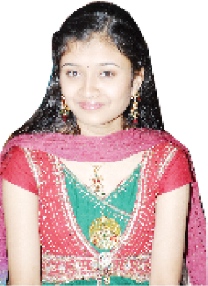
She is 17 years old. But she already knows what she wants to do. Meet Preethi Prakash Prabhu, daughter of doctor couple Dr. Prakash Prabhu and Dr. Roopa Prabhu, who wants to be a physicist. Preethi, who has been obsessed with Physics and Albert Einstein, feels ‘Physics has answers for everything in life.’ A II PU student at city’s Vidya Vardhaka PU College, she wants to take up research at the Indian Institute of Science (IISc.), Bangalore.

In order to realise this, Preethi has already cleared Kishore Vaigyanik Protsahan Yojana (KVPY), a national programme of Fellowships in basic sciences, initiated and funded by the Department of Science and Technology, Government of India, for students studying in XI standard to 1st year degree, who are highly motivated to study and pursue research in Science subjects. KVPY is one among the four tests mandatory for those willing to study at IISc.

But when asked as to what really drove Preethi towards the subject, she came up with an interesting narrative: “It all started while I was reading Dan Brown’s famous novel The Lost Symbol, where the female character Katherine Solomon is fascinated with Albert Einstein.

“Even as I read the book, I began wondering as to what is so special about Einstein that makes Katherine like him so much. I began reading about Einstein and his scientific theories on the internet and it really fascinated me. I then decided to be a Physicist.”

Ever since, Preethi has kept a constant watch on the IISc. website to learn about their undergraduate programmes. “I have qualified in KVPY and now have to see if I can get a seat at IISc., after my PU. The competition is tough as they have only 120 seats,” she adds.

While Einstein is her most favourite scientist, Preethi says almost every scientist irrespective of the subject of his/her research fascinates her, because the thought of introducing something entirely new and unknown to the world flashes only across the minds of scientists and is a captivating thought in itself. “And if I have come up with these positive ideas today, it’s all because of my parents,” says Preethi.

Along with pursuing her dream of being a Physicist, Preethi also has a keen interest in fine arts. She is a good singer and was a participant of Ede Tumbi Haaduvenu conducted by the ETV Kannada. She has also performed on Madhura Maduravee Manjula Gaana aired on DD Chandana. Preethi has won the Vishwa Kala Ratna award at the State-level music contest at Akhila Karnataka Makkala Sahitya mattu Saamskruthika Sammelana-2007 at Bangalore. A regular participant in the annual Doctor’s Musical Nite Geeth Gaatha Chal, she has also presented dance recitals during Dasara.

When asked if she will peruse fine arts or Physics, she readily says: “I want to be a physicist, dance and music are hobbies that help me relax.”—AN

Programmes to drive youngsters towards Natural and Basic Sciences

There are several exams that youngsters can take up to class X, if they are interested in studying and pursuing research in the Basic Science subjects.

• The Ministry of Science and Technology, Department of Science and Technology conduct a scholarship programme called Innovation in Science Pursuit for Inspired Research (INSPIRE) under which 10,000 scholarships of Rs. 80,000 are provided every year.

• The scholarship is offered for only bachelor and master degree Natural and Basic Science courses.

• Students having secured top 10,000 ranks in the Joint Entrance Examination of JEE-Advance, JEE-Main (top 10,000 ranks) plus those clearing NEET (top 10,000 ranks), and those who opt to study Natural and Basic Sciences in any academic institute or University leading to graduate and post-graduate degree are eligible for this scholarship.

• Students admitted to Indian Institute of Science Education and Research (IISER), National Institute of Science Education and Research (NISER), Department of Atomic Energy Centre for Basic Sciences (DAE-CBS) at the University of Mumbai or happen to be Kishore Vaigyanik ProtsahanYojana (KVPY), National Talent Search Examination (NTSE), Jagadish Bose National Science Talent Search (JBNSTS) scholars and Science Olympiad Medallists, opting to undertake courses in the Natural & Basic Sciences leading to B.Sc. and M.Sc. degrees will be eligible for Scholarship For Higher Education (SHE) – a component of INSPIRE.

source: http://www.starofmysore.com / Star of Mysore / Home> Feature Articles / September 20th, 2013

City trio wins ‘Most Innovative’ Award

Photo 01: Young Innovators: Kirthi Sudhir (left), Aditya Vikram and Nidhi Ashok. Photo 02 :The trio with their award winning model ‘Cloud Charger Extractor.’
Photo 01: Young Innovators: Kirthi Sudhir (left), Aditya Vikram and Nidhi Ashok.
Photo 02 :The trio with their award winning model ‘Cloud Charger Extractor.’

Students of this generation have great understanding of science and also possess capabilities to come out with good experiments, which in most cases mesmerise their teachers and parents.

After Shreesha, a student of Vijaya Vittala PU College, who has invented a self-sustained wheelchair, here is a group of students from Vidhyaashram PU College, who have come out with a new model which known as ‘Cloud Charger Extractor.’

The team comprising Aditya S. Vikram, Nidhi Ashok and Kirthi Sudhir, all II PU students, recently participated at the Amateur Scientist-2013, a national-level science competition organised by PESIT, Bangalore, where they won ‘The Most Innovative Award.’

As Aditya explains, the main aim of their project was to show how electrodes from clouds could be extracted to produce electricity. “The clouds have negatively charged electrons which we attract to our apparatus that is charged positively. The electrons are made to pass through the apparatus to produce electricity”, he said.

When asked about the project for the competition, Nidhi said that before they could decide on the project they held discussions on various subjects.

“The idea was to come out with a project which could address the needs of the shortage of energy. Currently we are facing shortage of electricity. Through our experiment we wanted to show people that electricity could be produced using the clouds”, added Nidhi.

Winning an award at the national level has not stopped the trio. They are determined to continue with the experiment to take the same to a higher level.

Kirthi, another team member, said, “We want to conduct further researches on our project and make it successful. There is much more to be added to our project since it is still in the basic level. We will now concentrate on enhancing the project since we are looking forward to apply for a patent.”

The trio is determined to make the project successful so that the product they are working on becomes self-sustained. With encouragement extended to such talented students, more such innovations are sure to spring up.

Aditya Vikram is the son of Dr. S.B.Vikram of Vikram Hospitals and Rathi Vikram. Nidhi Ashok is the daughter of Ashok, Superintendent of Central Excise and Padma Ashok while Kirthi Sudhir is the daughter of Dr. Sudhir, Surgeon and Professor, JSS Hospital and Naidele Sudhir.

source: http://www.starofmysore.com / Star of Mysore / Home> Feature Articles / by S. N . Venkatnag Sobers /  September 20th, 2013

Forensic odontology department plays key role in solving crime cases

Hubli :

The department of forensic odontology, SDM Dental College, Dharwad, which played a vital role in proving guilty all the accused in the Nirbhaya rape and murder case, works closely with the police department to solve criminal cases.

Established in January 2006 in SDM Dental College, Sattur, near Dharwad, its main service is carrying out dental analysis to find clues in solving crime cases. It’s the first of its kind in the state and country, where dental modules are put to forensic analysis.

In recognition of its service, the state government recognized this department as a referral centre for forensic dental cases in Karnataka in 2010. Spread over a 500 sqft area, the lab is equipped with light tables, forensic magnifying glasses, digital calipers and computers to conduct forensic analysis.

Dr Ashit B Acharya, head of the department, said, “It’s team work and the collective effort of all departments — mainly oral digital radiology, paediatric dentistry, oral pathology and oral surgery. We take help from these departments to conduct forensic analysis and give the final results. Every year, we will get 20-22 cases from the police department to conduct dental forensic analysis seeking our help in determining the age of adults, children, postmortem age estimation, sex determination of skulls and bite mark analysis.”

Apart from the police department, the lab also gets cases from the Kerala Government Dental College and Kasturba Medical College, Manipal. Police from Hubli, Gulbarga, Kushalngar, Bangalore, Mysore, Belgaum and other places refer cases to our department, he said.

He said the Nirbhaya case is not the first one from Delhi, with Delhi Police contacting them on a regular basis.

“Our department also played a significant role in solving the mystery shrouding the age and sex of hundreds of skulls found in Annigeri, near Hubli. We conducted a thorough forensic analysis of skulls and teeth for one month and established that the skulls belonged to children aged 6-8 years, and men and women aged between 30 and 50 years. The state archaeology department finally came to the conclusion that the skulls belonged to those who died in a famine and it helped them conclude that it was a heterogeneous population,” Dr Acharya said.

The lab uses two methods: x-rays for children and anatomic and microscopic methods for forensic analysis of adults. A microscopic method is used for the dead, that requires them to slice the teeth. For living people, they use anatomic or x-ray based method. X-rays are also used for the dead. Depending on the cases, analysis is done in a day or week or even a month. “We took about a month’s time to complete analysis of the Annigeri skulls,” he said.

THE DOCTOR IN CHARGE

Dr Ashit B Acharya is among the few experts in the dental forensic field. He is from Puttur, near Sullia, in Dakshina Kannada district. He did his high school and college education in Mysore, and BDS from SDM Dental College in 1999-2000.

After graduating, he specialized in forensic dentistry in Australia, then started his own lab in Nepal, working there from 2002 to 2005, before coming to Dharwad. He joined SDM College as head of the forensic department in 2006.

source: http://www.articles.timesofindia.indiatimes.com / The Times of India / Home> City> Hubli> Forensic Analysis / by Basavaraj F. Kattimani, TNN / September 14th, 2013

City’s Shreesha invents self-sustained wheelchair

WheelChairBF23sept2013

 Mysore :

Wins II place at Natl-level Amateur Scientist contest

by S.N.Venkatnag Sobers

At a time when most students aspire to become software engineers or doctors, here is a student who wants to get into Research and Development (R&D) in the field of basic science.

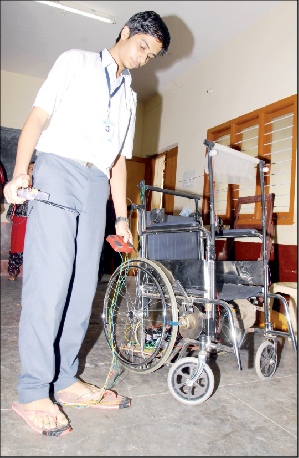
Shreesha, a Ist year PU student of Vijaya Vittala Pre-University College has set an example for the other students through his new invention, a ‘Self Sustainable Wheelchair’, which is a boon for the differently-abled and elderly citizens.

Most of the self-sustained wheelchairs available in the market are limited to only basic movements; but Shreesha’s wheelchair is different. He has added more features into the wheelchair. No wonder he won the second place at ‘The Amateur Scientist – 2013,’ a National level science competition organised by PESIT, Bangalore recently.

The wheelchair is powered by battery and runs on motors. People using it need not depend on others’ physical assistance and can easily move around by themselves.

Features

1. Rain Sensitive convertible roof-top: The top cover of the wheelchair covers automatically in case of a rainfall.

2. Darkness-sensing front headlights: In case of a power cut during night hours, the headlights of the wheelchair switches on automatically to help the user move around with ease.

3. Temperature-sensitive fans: There are two fans fixed on either sides of the wheelchair that turn on automatically when the temperature increases.

4. Self-deploying fire extinguisher: In case of fire, the fire sensor installed in the wheelchair sends a signal to the controller and automatically starts sprinkling water on the wheelchair to extinguish fire.

5. Solar Charger: Solar panels are fixed at the backside of the wheelchair to assist in charging the battery.

6. The system is completely portable and can be fixed into any other ordinary wheelchair to make it completely self-sustained.

Shreesha has invented a sensor-equipped footwear to be worn by the caretaker who when unable to push the wheelchair in case they are carrying bags in their arms, the wheel chair will move according to the feet movement of the caretaker. Which means, the wheelchair will move as the caretaker moves.

Speaking to Star of Mysore, Shreesha said that the wheelchair was invented keeping in mind the need for the differently-abled and the elderly citizens. “I want to help the needy using technology to make their lives comfortable. The inventions which I make should be economically viable so that it reaches every person who is in need of it,” added Shreesha.

When asked about his inspiration, Shreesha said that more than inspiration, it was the encouragement of his parents. His father S.R. Ramaswamy, a retired science teacher, always motivated Shreesha in all his endeavours, while his mother S.Srimathi gave him moral support.

When asked about his future plans, Shreesha said that he wanted to study basic science for now and later specialise in Mechatronics which would help him become more inventive. ‘Mechatronics’ is a design process that includes combination of mechanical engineering, electrical engineering, control engineering and computer engineering.

Elaborating on the wheelchair, he said that for now he was using a 12V battery for its operation and added that it could be further enhanced to make it more efficient. Shreesha also said he would add a blood pressure monitor and make the wheelchair completely computer programmed for better efficiency.

Other Inventions

This is not all. Shreesha has also invented ‘Rain Sensitive Clothing Line’. What does it do? As Shreesha himself explains, “when you put your clothes to dry on this clothes line, it rings an alarm when it senses rain and automatically pulls the clothes towards one corner of the line which is covered.”

For now, Shreesha is very proud of his new invention and says “the wheelchair is affordable compared to those currently available in the market. I have spent around Rs. 8000 (excluding the wheelchair’s cost) to make it self-sustained.”

Speaking on Shreesha’s achievement, R. Vasudev Bhat, Secretary, Vijaya Vittala Education Trust, said he was proud of Shreesha and added the management would continue to help such students in their endeavours. Vijaya Vittala Pre-University College Principal H. Satyaprasad mentioned that Shreesha was an example of a student using his knowledge, understanding, application and skills in a scientific way to come out with such innovative products.

source: http://www.starofmysore.com / Star of Mysore / Home> Feature Articles / by S.N. Venkatnag Sobers / September 17th, 2013

Brahma of India

Bharat Ratna Sir M. Visveswaraya’s birthday today (September 16th)

 Bharat Rathna Sir Mokshagundam Visvesvaraya 1860-1962
Bharat Rathna Sir Mokshagundam Visvesvaraya 1860-1962

Brahma, Vishnu and Maheshwara form the Hindu trinity with each assigned a specific job. Creation, preservation and destruction. Brahma will create. He is the creator of this world, architect of this universe and Vishnu is the preserver of that creation while Maheshwara, Shiva, is the destroyer of what is created so that Brahma will get new contract to create the universe again…

We see this happening since 1947 rather religiously and constitutionally. Nehru was the first Brahma after independence. Indeed he did create an India that would make it industrialised and march towards modernisation. Two major steel factories Bokaro and Rourkela; Bhakra-Nangal dam which he called the ‘modern temple,’ Scientific and Technological Research Centre so on and so forth. However, after the first few years of his 17-year-long rule as Prime Minister down-slide began, administration turned effete, corruption raised its ugly head and finally, culminated in the humiliating defeat in the 1962 China war. Soon after, he died.

Next one to rule us for almost as long a period, 16 years, as Nehru did was his daughter Indira Gandhi. She was more a Maheshwara and less of a Brahma. Bank nationalisation, abolition of the privy purse, yes. However, she was the prime cause for weakening our till then sound and strong constitutional institutions that were in place, in order to perpetuate her rule. She made the Supreme Court and even the Parliament captive in 1975 when she declared the internal emergency and passed draconian laws. Virtual dictatorship.

Time passed. Six years of NDA rule was colourless, spineless. Remember exchanging a terrorist to release passengers of a hijacked plane… in a foreign country… our Foreign Minister personally going…? However, NDA had good excuse for its pusillanimous performance: NDA is not BJP; hence following coalition dharma was a great hindrance and hugely restrictive to function freely.

People answered appropriately when time came. UPA under the leadership of Congress came to rule with Dr. Manmohan Singh as Prime Minister. Now it is about to complete 10 years. But where are we? Are we seeing Dr. Manmohan Singh as the creator of a new, resurgent India? He has wasted his time gathering votes for the 2014 Parliamentary election doling out rice, sugar and edibles and such other concessions to poor voters who are in majority instead of building a new dynamic India creating new industries, infrastructure and schemes that would generate employment, and as a natural, general rule increase per capita income.

The 2014 election-oriented laws and schemes like doling out rice at Re. 1 a kg, cash subsidy etc., by the UPA are counter-development-economic incentives. This will make the beneficiaries lazy, absent themselves from work, spouse to separate and as in Charles Dickens novel to ask ‘Some more Sir.’

Such are the leaders we got after independence. No wonder we still belong to the third world, to the category of developing country, as the developed countries call us.

Contrast these so-called leaders and nation builders with some others; but the most well-known and famous among them is Sir M. Vivesvaraya whose 152nd birthday is today rightly observed as Engineers’ Day. Though it may be a bit of exaggeration to say he was the builder of India when British were ruling us, his contribution was substantial in many areas of development, wherever he served — Bombay, Hyderabad and Karnataka. As for Karnataka, he was really the Brahma, the creator. Son of Karnataka (then Mysore Kingdom), no son of this soil has done so much for its development as he has done in just six years when he was the Dewan from 1912 to 1918. That he was fortunate, so also the people of Mysore, in having Krishna Raja Wadiyar IV as the ruler, a Raja Rishi and philosopher-king. He gave full support to Sir Vivesvaraya’s many visionary projects. Of the many, I must mention at least a few major one’s — KRS Dam, Hindustan Aeronautics Ltd., Bhadravati Iron and Steel Mill, Government Soap Factory, Sandal Wood Oi

l and Soap Factory, State Bank of Mysore, Mysore University, Hydro-Electric Project at Shivanasamudra, Mysore Sugar Factory, Hindu Modern Hotel and Metropole Hotel in our city, Century Club, Bangalore, Engineering College and more. The list seems endless. One man and what a service to the country. A real Brahma.

But sadly we have now only Maheshwaras coming in the way of Vishnu who is prevented from even maintaining what Brahma Sir M. Vivesvarayahad created for us. Look at the maintenance of KRS dam and garden; Bhadravati Steel Mill, HAL and a host of other institutions and industries. Mysore Sandal Wood Oil Factory is closed or almost closed but a huge sandal oil factory is flourishing in Kerala border. Raw material is from Karnataka! Sir M. Vivesvaraya must be turning in his grave!

Such a great man, it is said, had a very disturbing, unhappy family life. The cliche often used while honouring great achievers is that ‘behind every great man there is a woman’, inspiring him. Fate cheated him with his first wife Savithramma, who died early after marriage. Second wife died at delivery. At the persistent request of his mother he married again but this too led to his despair. Thus the aphorism that behind every successful man there is a woman was belied in Vivesvaraya’s case, so also in many other cases.

Some examples. Abraham Lincon. He had a quarrelsome, nagging wife. Field Marshal K.M. Cariappa, father of Independent India’s Defence Forces, rose to that height even as his wife separated when he was a Brigadier. And he never married again. And to go to ancient times, Socrates, the world’s greatest philosopher. He had a nagging, quarrelling and cantankerous wife so much so once while he was having his dialogue with the youngsters of Athens in the garden Arcadia, his wife, enraged, came with a bucket full of water and poured it over his head. Socrates did not lose his cool but simply humoured himself muttering: “I thought it was only thunder, it also rained.”

I think it is Masti Venkatesh Iyengar, the great Kannada novelist and littérateur, who also served at the Palace, while giving a pen sketch of the great builder statesman, had mentioned some of Vivesvaraya’s idiosyncrasies. Sir MV was very meticulous in his sartorial outfit and in his speech highly measured. Carried himself with great dignity at all times even while eating food. For example, while eating banana he would gently peal it to a small length, break it with his fingers and plunk that portion to his mouth. He would not bite it like most do.

How I wish we had builders like Sir M. Vivesvaraya and rulers like Sri Krishnaraja Wadiyar IV. Now let us pray to Shiva and request him to keep quite for just next five years. Who knows Narendra Modi may play the role of Sri Krishnaraja Wadiyar IV. But where would Modi find his Visvesvaraya? Let us pray.

source: http://www.starofmysore.com / Star of Mysore / Home> Abracadabra……. Abracadabra   kbg@starofmysore.com / September 16th, 2013

India is the place to be, say home-bound doctors

Bangalore :

After technology sector, it’s the health sector in Bangalore that is witnessing a reverse brain drain. Across fields-nephrology, general medicine, pathology, orthopaedics and oncology among others, doctors are returning to India in general and Bangalore in particular.

On an average big medical hospital chains in the city each get 8 to 10 applications every month from Indian doctors in the US, the UK, Canada, Australia and Singapore. “I interview one doctor a week. And in the last six months I have got 12 applications for jobs from doctors abroad. They are all in their 30s,” says Dr H Sudarshan Ballal, medical director, Manipal Hospitals.

The scene is no different at Sparsh Hospital on Narayana Health City campus where chief orthopaedic and hospital head Dr Sharan Patil scrutinizes at least 10 applications every month from doctors in the UK, Australia and the US.

“There is no bigger canvas to paint yourself than in medicine. Two decades ago when doctors left India, the opportunities were few. Today opportunities outweigh frustrations. After the training, they want to return,” says Dr Patil, who himself spent five years in the UK before returning to the city to become a doctor-entrepreneur.

Ten of the 40 orthopaedicians at Sparsh are those who have returned from abroad. “I began to feel I was making no difference in my job and decided to leave Australia. I find it more satisfying here. But it is good to study and train abroad for some time,” says Dr A Thomas, spine surgeon, who practised for five years at St George Hospital, University of South Wales.

Hospital honchos are seeing the trend only in the past five years. In many hospital chains of Bangalore, the entrepreneurs are doctors themselves who left practice in the dream country where they were and came back home.

For Dr Ajai Kumar who worked at the Anderson Cancer Hospital in the US, India is evolved and it’s an experience doctors don’t want to miss out on. “The country I left in the 1970s is astounding now. It has all the infrastructure and there is no dearth of training. So what is the excuse now?” says the oncologist, who started the HCG chain of hospitals in India after spending nearly two decades in the US.

The alarming growth of cancer is also one factor drawing doctors to Bangalore. Dr Ajai gets about 15 applications from doctors in the 30-40 age group every year. From paediatric oncologist to hepato biliary surgeon at HCG, the specialists who have returned to Bangalore are from across the spectrum.

Ask Dr Pallavi Rao, pathologist, who got back to Bangalore from the UK with her radiologist husband Dr Srikanth Narayanaswamy, why she took the call. “We were there from 2005 to 2012. We chose to come back home as it stopped exciting us there,” she says.

Ditto with Dr Rekha Bhatt who joined the Manipal hospital after winding up her practice in the US. “Go there to study but get back here. India is the place to put your studies to use,” says the pathologist.

For many, it is the learning experience that matters. There is no TB, dengue or malaria in western countries. “For doctors, especially youngsters, treating diseases that are prevalent means more exposure. India is a great lab for doctors because of the sheer size and the number of surgeries we do,” says cardiologist Dr Devi Shetty.

“Coming back was no compromise for me. I began to feel that Bangalore was in no way inferior to other countries, especially in my area of specialization,” says endocrinologist Dr Karthik Prabhakar who left for the UK in 1998 only to get back to the city.

For many the dream of foreign shores is over. As a child, one of India’s top nephrologists Dr Ballal dreamt of going to the US and working there. He worked towards his dream and at 21, got his green card to do his MD in nephrology and critical care. “I was not keen on coming back. In 1991, I reluctantly returned. I told myself I will give two years to decide if I want to go back. The first few months were miserable. Twenty years on, I have no regrets. I will never leave India.”

source: http://www.articles.timesofindia.indiatimes.com/ The Times of India / Home> India> HCG / by Seethalakshmi, TNN / September 03rd, 2013

Mangalore to be developed as ICT centres

Mangalore :

The Department of IT has ambitious plans for tier II cities in the state. The ICT (Information and Communication Technologies) group has plans to develop Mangalore and six others cities to develop as emerging ICT centres in the state. Also, under the Start-up warehouse programme over 1,000 start ups will be set up in the state.

The other ICT cities are: Mysore, Hubli-Dharwad, Gulbarga, Belgaum, Tumkur and Shimoga. These seven cities will receive special attention from the state to help them develop as next ICT centres, said IT and BT minister SR Patil.

He was speaking after inaugurating conference on ‘Mangalore, the emerging ITE destination’ a satellite event of State’s flagship ICT (Information and Communication Technologies) event Bangalore ITE.biz here on Friday.

Patil indicated that to start with the state will set up incubation centres in these seven emerging cities. He also said that sufficient funds would be provided to development of skills and setting up new talent development centres in these cities. Regarding the start up warehouse programme in association with Nasscom, Patil said there are about 10,000 such start ups planned in the country and about 1,000 would be in the state.

Also, under the Electronic System Design & Manufacturing (ESDM) policy, the state will set up Greenfield and Brownfield clusters. This is as per the recommendations of ICT group, which is on the lines of National Policy on Electronics.

Infosys completes 18 years of its operation in Mangalore

Kris Gopalakrishnan , Chairman, Vision Group on IT and Co-founder and Executive VC of Infosys, recalled his company’s association with Mangalore and said that this was the 18th year of Infosys setting up its shop in the coast.

Mangalore was the first centre outside Bangalore Infosys established. The DNA of this region has the culture of entrepreneurship and business,” he said.

Despite dark clouds over IT industry globally, Indian scenario was robust with a growth of 12% to 14%, which was four times more than global average, he said. He emphasised the need to establish a electronics manufacturing facilities in India which will help the country bridge it’s Current Account Deficit. Regarding trends, he said mobiles and its applications were trending and will contribute to growth if tapped.

He emphasised the need to tap into tier II cities as it had multiple advantages over Bangalore in terms of life style, operations cost and attrition rates.

source: http://www.articles.timesofindia.indiatimes.com / The Times of India / Home> Citu> Mangalore> Belgaum / by Stanley Pinto, TNN / August 3st, 2013

Edinburgh science fest draws Bangalore students in droves

Bangalore:

Hundreds of school and college students on Friday flocked to the Edinburgh International Science Festival at the sprawling Bhartiya city in Bangalore for participating in a host of events, workshops and cultural events.

Edinburgh International Science Festival

Being held for the first time in the country, the 10-day fest is demonstrating a slew of scientific projects and programmes to infuse spirit of enquiry and build scientific temper in the younger generation.

“It is heartening to know that the organizers have chosen Bangalore to host their first science fest in India, testifying the city’s global reputation as a centre of research and development (R&D) and innovations in science and technology,” Karnataka Agriculture Minister Krishna Byregowda said flagging off the event on a cloudy day.

The Minister, who also studied in the US before returning to state and plunging into politics, exhorted the youth to experience the wonders of science in an interactive mode at the fest.

Noting that such festivals kindle children’s interest in science and nurture love for exploring the domain, Indian Institute of Management (IIM-Bangalore) professor Rajiv Gowda said that the country has a rich legacy of science and mathematics since zero was invented and used for the first time by renowned astronomer Aryabhatta during the fifth century AD.

Festival chief executive Simon Gage said that the event would recreate the excitement of Edinburgh’s world famous science fest in India, which is making advances in science and technology.

“The British Council and the Scottish government played an important role in bringing this fest to India,” Gage said.

About 50,000 visitors, including school children and their parents are expected to visit the fest, which will last till September 8.

Among the events being held at the fest include, the Emergency Room (ER) Surgery, where students will gain first-hand experience in the working of an operating theatre and what it’s like to be a doctor. Similarly, at Splatastic, students will explore properties of different polymers and make colourful gooey snakes, observe a liquid-to-solid chemical reaction, produce designer slime and test it on Splatometer.

In Adventure Robots, participants build and control Lego Mindstorm Robots by learning to use basic computer programming software.

“In Math Masters, students learn tips and tricks for super fast mental math calculations and solve puzzles to develop lateral thinking,” Gage noted.

As an educational charity that encourages people of all ages and backgrounds to discover the wonders of the world around them, the Edinburgh fest demonstrates benefits of science throughout the year in partnership with overseas science festivals and an education programme that tours worldwide.

British Deputy High Commissioner Ian Felton, Discover Networks Asia-Pacific vice-president Rajiv Bakshi and Bhartiya group chairman Snehdeep Aggarwal were also present on the occasion.

Discovery Kids, Horlicks Promind, Art Konnect and mycitykids.com are the partners in the fest.

(Agencies)

Source:  http://www.post.jagran.com/ Post Jagra / Home> Indian States News / by  Agencies / August 31st, 2013

Bangalore IT.Biz in October

Union minister for communications and information technology Kapil Sibal will inaugurate the two-day Bangalore IT.Biz on October 22, according to SR Patil, minister for IT & BT.

He said the central government has given its nod for the establishment of the Information Technology Investment Region (ITIR) project between Devanahalli and Doddaballapur on 10500 acres of land.

“The state government has issued an order to acquire 2072 acres of land. They would take a decision on the quantum of developed land to be given to farmers,’’ said Patil.

Stating that the central government would be spending around Rs7,000 crore to provide the necessary facilities, he said the proposed ITIR project is expected to provide direct employment for 12 lakh people and indirect employment for 28 lakh people.

Wi-Fi facility
Minister for IT and BT SR Patil said that all arrangements have been made to provide Wi-Fi facility on MG Road and Brigade Road free of cost, for a few hours a day. He said the Wi-Fi facility would be extended to other cities such as Mysore, Hubli-Dharwad and a few places in Mangalore on a pilot basis shortly.

IIIT in Dharwad
The Indian Institute of Information Technology would be established on 50 acres of land in Karnataka University campus in Dharwad with an investment of Rs128 crore, according to Patil.

source: http://www.dnaindia.com / DNA / Home> Bangalore> Report / by DNA Correspondent / Place:Bangalore, Agency:DNA / Sunday – September 01st, 2013

Improvised GPS collars to track pachyderms

As a first step to address the issue of man-animal conflict, the Karnataka Forest Department has decided to put elephant tracking Global Positioning System (GPS) on four wild jumbos. In fact, an improvised version of the GPS collar developed by the Department of Electronics Study, Indian Institute of Science (IISc) here, would be used.

With this, Karnataka would become the first Indian state to use GPS collars on jumbos, Principal Chief Conservator of Forests (Wildlife) G S Prabhu told Express.

The four elephants are from the Bandipur National Park. They have been posing problems in Kodagu and Hassan districts, attacking people and damaging crops. More pachyderms would be collared if the present mission turns a success.

The GPS idea has been employed in Sri Lanka, where 10 elephants were collared. This helped the forest authorities to track their movements and alert villagers much before they entered human habitation, said Prabhu. The GPS is based on a network of satellites using which the location of an object on the ground could be obtained, within a few meters accuracy. So these collars obtain an extremely accurate location for the elephant every four hours, night and day. They then transmit that information (six locations per day) once a day to another satellite that relays it back to the ground. This way, they would give extremely precise data on elephant movements every four hours.

Prabhu said the improvised version of the GPS collars developed by Department of Electronics Study are water-proof, cost effective and have a  better battery life. The collars used by the South African forest authorities were not water-proof, but very expensive. Even the battery life was less. The cost of IISc-developed collar is `1.5 lakh and it weighs less than two kg. The collars would be fixed around the neck of elephants after tranquilising them. Once done, the movements of elephants could be monitored on computers, laptops and even on mobile phones.

source: http://www.newindianexpress.com / The New Indian Express / Home> States> Karnataka / by Shyam Sundar Vattam – Bangalore / August 30th, 2013