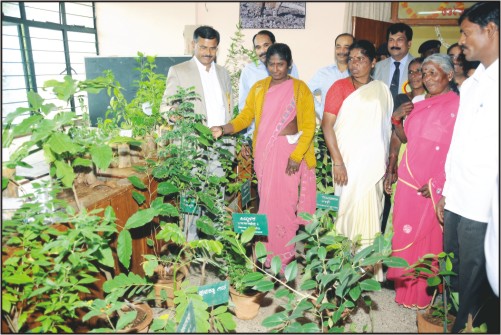
“The government proposes to establish ‘Hasiru Grama’ in every forest division in the State to promote cultivation of exclusive medicinal plants,” said B. Shivanagowda, Additional Principal Chief Conservator of Forests (APCCF).
He was speaking after inaugurating a workshop on medicinal plants organised by the Village Forest Committee (VFC) at Aranya Bhavan in Ashokapuram here today.
Over 100 growers of medicinal plants, native doctors and VFC members are participating in the programme which features lectures on sustainable storage, value addition, transportation and marketing of medicinal herbs which are on the verge of extinction.
Shivanagowda said that the three VFCs were monitoring the cultivation of medicinal plants grown in 16 villages abutting the forests. He assured that the department would provide all needed support for developing the sector with value addition in every stage.
He proposed to hold a medicinal herbs buyers’ meet to explore direct sale of the herbs to manufacturing units. He said that Shathavari, Makaliberu and Gowri hoovu plants had tremendous potential in the medicine sector.
Speaking on the occasion, APCCF Dr. G.N. Srikantaiah said that the buy back system would be immensely beneficial to the growers.
Chief Conservator of Forests (Bamboo mission) A.C. Keshavamurthy opined that Health Tourism would give a fillip to the growers as herbal medicines have become very popular now.
Chief Conservator of Forests K.B. Markandaiah welcomed. FRLHT senior Programmer Jagannath Rao spoke. DCF D.S. Gaonkar was present.
source: http://www.starofmysore.com / Star of Mysore / Home> General News / August 08th, 2013
Prof. K.S. Rangappa seen chatting with a group of researchers in Moscow.
by K.M. Chengappa
Cancer is no more considered a deadly disease. It is curable if traced in its early stages, says Prof. K.S. Rangappa, Vice-Chancellor, University of Mysore.
In a tete-a-tete with Star of Mysore, Prof. Rangappa, who had been to Russia as a visiting professor, said that he, along with Prof. Alexey of the N.D. Zelenski Institute of Organic Chemistry, Russian Academy of Sciences, Moscow, are jointly conducting a research in cancer biology in which they have created new molecules that can fight the disease.
Prof. Rangappa, who had been in Moscow from July 7 to 15, said that the research is being conducted in joint collaboration of the Indian National Science Academy and Russian Academy of Sciences.
Discussions with experts in the field were held for three days following which lectures were held in which several research scholars participated, said Prof. Rangappa, adding that he had also given a lecture at the Moscow State University following an invitation.
Prof. Rangappa said that they have applied for funding for the research project from India and Russia governments collaterally.
Prof. Alexey will soon be visiting Mysore as part of the project, he said.
source: http://www.starofmysore.com / Star of Mysore / Home> Feature Articles / August 05th, 2013
IT major Wipro has proposed to set up telecom equipment and product security test and certification centre, making it operational by October 1.
It has proposed to the Department of Telecom that it will set up the centre in phase manner, segregating the products to be tested in two clusters.
(IT major Wipro has proposed…)
The IT company has classified telecom products in three categories — High, medium and low asset value, based on the security implication that they can have on network.
“Wipro has recommended phased approach for security testing and certification of Information and Communications Technology products. In phase 1, starting October 1, 2013, Wipro has recommended testing 12 of 25 asset classes that have critical value,” a DoT official said.
The company has identified mobile devices, sim cards, network management systems, back-end infrastructure like MPLS, Internet telephony system and billing system among those products that have high risk on the network.
“Wipro would like to be cluster leader for cluster 1, which includes testing and certification of product that can high security risk on network. Wipro is confident that we will be able to get the lab operational for phase 1 by October 1, 2013,” the official said.
Wipro did not make available any comments on the issue.
source: http://www.articles.timesofindia.indiatimes.com / The Times of India / Home> Tech> Enterprise IT / by PTI / July 31st, 2013
Karnataka has become the first state in the country to establish rehabilitation centres for the disabled in all districts, said State Commissioner for Persons with Disabilities, K V Rajanna, here on Thursday.
Speaking to reporters here, Rajanna said: “Just three years ago, there was only one centre for the rehabilitation of the disabled in the state and now there are 30. Fourteen technically qualified staffers are employed at these centres and seven specialists are engaged whenever necessary. Now there are sufficient human, technical and monetary resources to address the problems of the differently-abled.”
Rajanna said 3 per cent of jobs for people with disabilities are being reserved in different government departments, gram panchayats, taluk panchayats and zilla panchayats after persistent efforts. However, timely follow-up is required to ensure that it is implemented, he said.
source: http://www.newindianexpress.com / The New Indian Express / Home> States> Karnataka / by Express News Service – Bangalore / August 02nd, 2013
* Visually challenged students can now study the subject they like * Facility to be introduced at Maharaja’s College soon Prisma Print Magnifier. Topaz Desktop Video Magnifier
by S. Kenneth Shishir
Visual impairment changes the way students obtain information about the world in which they grow and function, and limits opportunities to learn through observation of visual elements in the college curriculum and the people around them. This means that in addition to their regular classroom studies, students who are blind or visually impaired need to learn specialised skills from teachers and others who are specially trained to teach these skills, such as certified teachers of visually impaired children and orientation & mobility specialists. The specialised skills visually impaired students must learn include: Technology and computer proficiency — using computer & telecommunication equipment and software adapted for visually impaired people; Literacy — reading and writing with Braille, large print, optical devices or training in effective use of available vision.
Although many programmes provide the specialised instruction needed by students who are visually impaired, there is much room for improvement. Too many visually impaired students discontinue their studies without having mastered the skills or knowledge essential for further education, gainful employment and independent living at home and in their communities.
Students with visual impairment have unique educational needs which are most effectively met using a team approach by professionals, parents and students.
In order to meet their unique needs, students must have specialised services, books and materials in appropriate media (including Braille), as well as specialised equipment and technology to assure equal access to the core and specialised curricula, and to enable them to most effectively compete with their peers in college and ultimately in society.
Dr. I.R.N.Goudar, Visiting Professor and Library Advisor, University Library, University of Mysore, speaking to Star of Mysore, said that providing equal access to all individuals with disabilities is the aim of the University and access involves much more than providing ramps.
He said that Learning Resource Centre for Visually Challenged, a wing of Mysore University Library, has been a boon to the students for learning and gathering information by making these students more independent and reducing their dependence on others.
Assistive Technology includes new age devices and software that provide support to the disabled to overcome their disability and perform their tasks in a normal environment efficiently to compete on a level playing field with their non-disabled peers.
Dr. Goudar said the technology incorporated in the computers at the library enables the visually challenged students to access information pertaining to the subjects of their choice through voice mode and the same could be printed in Braille script.
He said that the Centre was established by the University and experienced faculty who were given training in handling these technologies have been deputed at the Centre to guide the visually challenged students.
In all, 12 computers have been installed at the Centre with special software and gadgets so that students can go through the subjects through voice mode which reads out the text to them or can get the subject printed using software which converts the texts into Braille.
Dr. Goudar said that it is proposed to extend this facility to Maharaja’s College too.
Dr. K.T. Udaya Kiran, a guest faculty at University Fine Arts College, also a well-known vocalist & violinist of the city, explaining about the technologies at the library said that this facility by the University of Mysore is a first of its kind in the entire State and Mysore University has provided an excellent opportunity to the visually challenged to pursue their studies with the subject of their choice as the subjects were limited to them earlier due to non-availability of technology and Braille notes of the subject.
Dr. Udaya Kiran also trains the students in using the gadgets and technologies at the Centre.
Speaking about the facilities, Dr. Udaya Kiran said that technologies such as Assistive Technology with speech output such as SARA, JAWS, Magic Keyboard, ZoomEx Instant Reader, Topaz Desktop Video Magnifier, Prisma Print Magnifier, Braille Box V4 Heavy Duty High Speed Volume Production Affordable Braille Press and other devices are made available to the visually challenged at the Centre.
Elaborating further, Dr. Udaya Kiran said that Text Reading Systems for the Visually Impaired like SARA (Scanning and Reading Appliances) CE, are instant text reading machines which enable a visually challenged person to hear any book. All that a person has to do is to place the book under SARA CE and it reads any letter, book, newspaper or magazine in an Indian accent.
It can be connected to a monitor or TV for viewing by partial or total visually challenged person, the text being read out in Large Print Format and it does not require any computer knowledge.
ZoomEx Instant Reader: It is a text reading system. All one has to do is place the book under Zoom-Ex and press one keystroke. Within seconds, you are reading the magnified text or listening to it as it reads the text.
JAWS (Job Access With Speech) Talking Software: This software when installed to a PC, will read out the texts to the person. It even helps a visually challenged person to access internet with selection of voice such as Indian, UK and US accents. The software converts a normal PC into a Talking PC to enable the blind to operate computers independently including Internet Access.
Topaz Desktop Video Magnifier: This magnifier helps people with low vision accomplish their daily activities leading to independent productive lives and helps them read the texts by magnifying it according to the font size the person requires.
Prisma Print Magnifier: A full colour transportable magnifier that provides a magnification of upto 52 times on a 21 inch screen. Simple to use with fine focus controls and adjustment of magnification with just raising or lowering the camera. It can also be connected to a PC using a TV tuner or VGA converter.
With these technologies introduced at the Centre, visually challenged students can now master the subjects of their choice without depending on others, which is a boon to them. It is now left to the students to fully utilise the facilities provided by the University for their excellence.
source: http://www.starofmysore.com / Star of Mysore / Home> Feature Articles / by S. Kenneth Shishir / August 01st, 2013
The company today rolled out the first batch of Activa scooters from its Narasapura plant, which has an installed capacity of 1.2 million units per annum
Honda Motorcycle & Scooter India Pvt. Ltd. (HMSI) today rolled out first batch of its largest selling automatic scooter, Activa, from its third plant at Narsapura, near Bangalore. With this ramp up, Honda has started production in the second line at the third plant.
Earlier in June the Narasapura plant started production of Honda’s 110cc mass motorcycle Dream Yuga at the first line. In Phase 1, the third plant has 1.2 million units per annum production capacity, the company said in a statement.
Aiming at a market leadership, an additional increase of 6,00,000 units will be added in the plant, which will take its annual capacity of third plant to 1.8 million units by end of this fiscal.
With this, Honda will increase its cumulative annual production capacity by 64% in just one fiscal from 2.8 million units in FY ’13 to 4.6 million units in FY ’14.
Keita Muramatsu, President & CEO, Honda Motorcycle & Scooter India Pvt. Ltd. said, “With Activa’s proven legacy of reliability and advanced features we have succeeded in selling 8 million units of Activa till date. It’s a happy moment for us as our new plant in Karnataka has begun rolling out our most popular selling scooter Activa from the 2nd line.”
source: http://www.business-standard.com / Business Standard / Home> Companies> News / by Mahesh R. Kulkarni / Bangalore – July 25th, 2013
Divya Prakash G, a Ph.D scholar at the Indian Institute of Science, comes across as a regular Bangalorean, until you speak to him about his area of interest. What reflects from his talk is not the average Bangalorean, but a brilliant personality who has enriched himself with top end research.
Divya works in the area of biological effects and applications of shock waves & nanomedicine. He has already worked with senior scientists and was involved in some exciting research that made it to newspapers everywhere. His team has developed a pen-shaped device that will help doctors administer drugs, especially vaccines, in a painless and more efficient manner.
According to Divya, he chose IISc because it is one of the top most institutes in the country which has the most advanced facilities to carry out cutting edge research which is on par with international standards.
About applying for his Ph.D, he says, “I like research and want to continue in it and get a world wide exposure. There are several steps involved before original research reaches the common man and it is mandatory for safety purposes,” he says.
But yes, he has concerns for others who are not as lucky as him. “There is need for more awareness about research and research institutes, especially in rural areas of the country. When better minds come to research, we can reach goals in all fields, from medicine to nuclear power. Many more brilliant minds might show interest in research if they are provided with sufficient scholarship as right now, the scholarship amount for Ph.D scholars is quite low,” he says.
And for this scholar, Bangalore has given him a warm reception. “The main attraction is its weather. I And I had no difficulties in communicating since people speak Hindi, Tamil, Telugu as well as English,” says Divya.
source: http://www.newindianexpress.com / The New Indian Express / Home> Cities> Bangalore / by Papiya Bhattacharya / ENS – Bangalore / July 23rd, 2013
Dr. K. Javeed Nayeem being felicitated by SRIAN Envisions’ founders Dr. Anil Sangli (extreme left) and Sripad Sangli.
Mysore :
High cost of medical education, exorbitant investments on state-of-the-art medical equipment and peer pressure have resulted in the medical profession turning into business style, observed senior Physician Dr. K. Javeed Nayeem.
Doctor-patient relationships were sacrosanct until a few decades ago but it is no longer so now-a-days nor is it easy to restore that kind of connect between the two, he bemoaned.
Speaking as the chief guest in the educative and musical evening at Jaganmohan Palace auditorium here yesterday on the theme ‘Changing Scenario in The Doctor-Patient Relationships’, Dr. Javeed Nayeem presented an insight into the decline in the relationships between the healers and their patients. Expecting immortality from the medical treatment on the part of the patients as well as their family members was at the root of disenchantment resulting in straining the relationships, he added.
Doctors not empathising with their patients, provisions under medical insurance and rulings by Consumer Disputes Redressal Courts without members having medical background also contributed to poor doctor-patient relationships, he explained, while pleading for restoring the same. The event was organised by SRIAN (Scientific Research Innovations in Advanced Neurosciences) Envisions’ founders Dr. Anil Sangli and Sripad Sangli in their series of similar educative programmes. P. Rajendra Prasad, Superintendent of Police, Chamarajanagar, as the guest of honour and Vidushi Dr. Sukanya Prabhakar as a special invitee took part in the event and made presentations of their points on the theme.
The organisers explained the aims and objectives of the programme focussed on health and wellness of our society based on scientific research, medical advances, music and financial planning by organisations, administrations and individuals in all walks of life.
Dr. Anil Sangli pointed out that communication played a pivotal role in mutually rewarding doctor-patient relationships. Positive interaction marked by trust, hope and compassion between the two sides leads to positive outcomes, he said.
Sripad explained the birth of new area of scientific pursuit namely Neuro-economics or Neuro-Finance, while providing an insight into the benefits of financial planning in life’s situations of uncertainty.
Rajendra Prasad spoke on the ‘Law and Order situations in doctor-patient relationships’, tracing the episodes to different perceptions of doctors and patients. Dr. Sukanya Prabhakar presented a lec-dem on ‘Music as a catalyst in improving societal relationships.’
Vidu. Veena S. Pandit rendered invocation. Vidu. G. Rajalakshmi Sridhar and S. Subramanya compered. Songs sung by renowned playback singer late Mohammed Rafi were rendered by Sripad Sangli and H.P. Vijayeendra Rao, Junior category winner of Edethumbi Haaduvenu programme of 2006.
source: http://www.starofmysore.com / Star of Mysore / Home> General News / July 29th, 2013
The company announced its results before market hours today, 12 July 2013.
Meanwhile, the S&P BSE Sensex was up 206.07 points, or 1.05%, to 19,882.13.
On BSE, 5,902 shares were traded in the counter as against an average daily volume of 1.43 lakh shares in the past one quarter.
The stock hit a high of Rs 2,779.40 and a low of Rs 2,779.40 so far during the day. The stock had hit a 52-week high of Rs 3,010 on 7 March 2013. The stock had hit a 52-week low of Rs 2,101.65 on 26 July 2012.
The stock had underperformed the market over the past one month till 11 July 2013, rising 2.13% compared with the Sensex’s 2.78% rise. The scrip had also underperformed the market in past one quarter, sliding 13.40% as against Sensex’s 6.12% rise.
The large-cap IT company has an equity capital of Rs 287.12 crore. Face value per share is Rs 5.
Infosys has retained its guidance of 6% to 10% growth in revenue in dollar terms for the year ending 31 March 2014 (FY 2014). The company has raised the guidance in rupee terms due to a steep depreciation of the rupee against the dollar. The company has forecast 13% to 17% growth in revenue in rupee terms for FY 2014, higher than its earlier guidance of 6% to 10% growth, which the company had given at the time of announcement of Q4 March 2013 results.
Infosys’ consolidated net profit declined 0.8% to Rs 2374 crore on 7.8% growth in revenue to Rs 11267 crore in Q1 June 2013 over Q4 March 2013. The results are as per International Financial Reporting Standards (IFRS).
Infosys Chief Financial Officer (CFO) Rajiv Bansal said that the company has announced compensation increases for FY 2014 effective July which will affect the company’s profit margins in the future quarters. Infosys CEO and Managing Director S. D. Shibulal said that the management is cautiously optimistic about rest of the year. Despite facing an uncertain macro environment, changing regulatory regime and a volatile currency environment, the company has done well in Q1 June 2013, he said.
Infosys and its subsidiaries added 66 clients in Q1 June 2013. There was a gross addition of 10,138 employees and net addition of 575 employees by Infosys and its subsidiaries in Q1.
Infosys liquid assets including cash and cash equivalents, available-for-sale financial assets, and government bonds were at Rs 24078 crore as on 30 June 2013, higher than Rs 23958 crore as on 31 March 2013.
Infosys is a global leader in business consulting and technology solutions.
Powered by Capital Market – Live News
source: http://www.business-standard.com / Business Standard / Home> News-CM> Hot Pursuit / Capital Market – July 12th, 2013
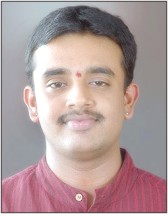
City boy B. Bharat Raj, a 5th semester student of NIE Institute of Technology, Koorgalli, is one of the three engineering students from Mysore, who have been selected by internet giant Google for the Google Student Ambassador (GSA)-2013 programme. Bharat is pursuing his engineering in Electrical and Electronics.
The students were selected on the basis of technical and communication skills. The selection process consisted of filling an online application followed by a telephonic interview for shortlisted students.
A total of 270 students have been selected from 98 cities across India. This programme provides an opportunity for students to learn about different products of Google directly.
The students will undergo a training programme at Goa from Aug. 1 and 4, where they will receive training from top executives of the company.
Other Google Student Ambassadors from city are Tejaswini, a 4th sem. student of Computer Science, Vidya Vikas Institute of Engineering and Technology (refer SOM dated July 19) and Harsha Prakash of SJCE.
source: http://www.starofmysore.com / Star of Mysore / Home> General News / July 24th, 2013
 New Delhi