Category Archives: Science & Technology

Mysuru-Educated Innovator Creates Respiration Rate Monitor For COVID-19 Patients

(from left) Sanchi Poovaya, Ranjana Nair and Aardra Kannan Ambili)

Mysore/Mysuru:

Unique among many medical solutions offered to combat COVID-19 is the new breathing monitor for Coronavirus patients developed by a Bengaluru-based start-up RayIoT and it is a matter of pride that a Kodagu-born and Mysuru-educated innovator is behind the device.

She is Ammanichanda Sanchi Poovaya, a young but experienced engineer, innovator and entrepreneur. She co-founded healthcare start-up RayIoT Solutions Inc. and is the Chief Operating Officer of the start-up that has already made a mark in innovative healthcare products.

Her start-up creates innovative healthcare and baby-tech products using Artificial Intelligence (AI) and Internet-of-Things (IoT) technologies. Very recently, Sanchi Poovaya and her other two co-founders Aardra Kannan Ambili (Chief Technology Officer) and Ranjana Nair (Co-founder and CEO) built a remote respiration monitoring system for COVID-19 patients that allows doctors to remotely monitor less critical patients while seriously ill ones get more attention.

Connected workflow sends alerts to the doctor in case of any abnormal variations in the patient’s vitals. With the high effectiveness of using respiration rate as a predictive vital, early detection especially among at-risk caregivers is a possibility.
CodavaCovidInnovator02KF27apr2020

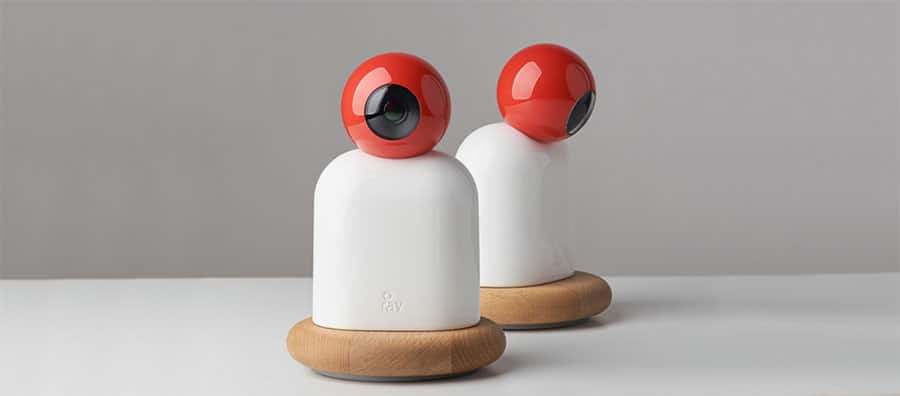
“It is a non-contact, Wi-Fi enabled, affordable respiration rate monitor for Coronavirus patients that can run as mini ICU units. In its current form, RayIoT will work as a mini ICU monitoring unit. The algorithms of Artificial Intelligence will allow doctors and other health professionals to track the respiration rate of multiple patients through an app from anywhere in the world,” Sanchi Poovaya said.

In a pandemic like COVID-19 where doctors are falling ill with excessive patient inflow, and the management of quarantined patients have become difficult, the device wirelessly tracks patient’s respiration rate, heart rate, blood pressure and temperature.

Since all the devices can be connected to one central database, using RayIoT, healthcare professionals can monitor more than one lakh patients at a time continuously. By just tracking respiration rate, they will be able to intelligently categorise quarantined patients into mild, severe, and critical cases, she said.

“The idea of a remote respiration monitoring system came to us when a celebrity, who was converting his 14-room sprawling bungalow into a quarantine facility, reached out to us. His problem was remote access to doctors, nurses and medical equipment to fully equip his quarantine facility.”

The team had to come up with a low-cost solution that could monitor the vitals of hundreds of patients at any given point of time and connect to doctors through video when the patients are moving into a severe or critical stage. “The solution also helped Government Task Forces who are monitoring huge swathes of population by providing them a single source of truth with our quarantine database,” Sanchi reveals.

RayIoT has been created by same team that is behind Raybaby (the world’s first non-contact sleep and breathing monitor for babies. This product has won many awards and was mentioned in CNN as one of the must have home gadgets.

Ammanichanda Sanchi Poovaya completed her schooling at Good Shepherd, Ammathi in Kodagu, and JSS Public School, Mysuru. She completed her Mechanical Engineering at the National Institute of Engineering (NIE), Mysuru and MS in Mechanical Engineering from Cornell University, New York.

Sanchi Poovaya is the daughter of Ammanichanda Sunil Poovaya (ex-Merchant Navy) and Shiela Poovaya (Pattada, Betoli). They live in Hosur, Bengaluru.

source: http://www.starofmysore.com / Star of Mysore / Home> Covid News / April 26th, 2020

The Man Behind Walk-In Kiosks And Disinfectant Tunnels

The designated COVID-19 Hospital (District Hospital, Mysore) on KRS Road has set up low-cost walk-in kiosks at its premises for safe collection of swabs of symptomatic people by the medical staff without direct exposure and contact with patients.

Ramesh Kikkeri
Ramesh Kikkeri

The man behind these walk-in kiosks, known as Swab Testing Cubicles is Ramesh Kikkeri, a resident of Bogadi in city. A post-Graduate in healthcare management and environment management, Ramesh Kikkeri is serving as the Disaster Management Advisor since many years.

Following COVID-19 pandemic, he has voluntarily joined hands with the District Administration and is also serving in the COVID Care Committee.

A team led by Ramesh has installed three Swab Testing Cubicles at the COVID-19 Hospital and has also readied two more STCs which are waiting to be transported to the Mandya District Hospital. Also, Ramesh and team have also installed disinfectant tunnels, which are being used at various places in city.

Shaped like an old telephone booth that is closed from four sides, one side of the Swab Testing Cubicle is made of glass with two openings where detachable and disposable rubber gloves are fixed. The gloves are fixed for the medical staff to insert hands and collect swab samples from symptomatic patients. Also, the medical staff can collect swabs from inside the Swab Testing Cubicles without wearing Personal Protective Equipment (PPE).

While one Swab Testing Cubicles at the COVID Hospital is made using steel frames, the other two is made with aluminium. The cost of each Swab Testing Cubicle is Rs. 20,000 and as they are light in weight, it could be carried from one place to another.

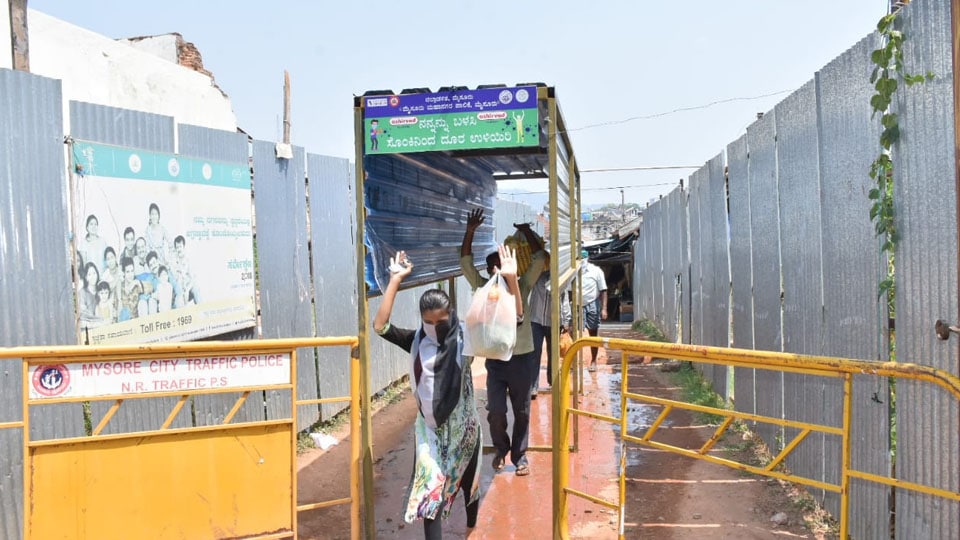
DisinfectantTunnelBF24apr2020

Disinfectant Tunnels

To destroy the virus, Sodium Hypochlorite solution is sprayed in the disinfectant tunnels, which have been installed at various places in city and Ramesh has played a major role in readying these disinfectant tunnels and installing them.

While two disinfectant tunnels are installed in K.R. Hospital premises, temporary vegetable markets on M.G. Road and at Alanahalli has one tunnel each, one tunnel each in Central Prisons, Devaraja Market, RMC Market, APMC Yard in Nanjangud and Star of Mysore Office, three tunnels each in Mysuru APMC Yard and L&T company. Ramesh has also given suggestions in the making of Sanitiser Bus by the KSRTC.

Also, the team led by Ramesh has installed the tunnels (one each) at the RMC Market on Sayyaji Rao Road, Central Prison, near Devaraja Market on Dhanvantri Road and at the Nanjangud APMC Yard.  While the cost of most of these disinfectant tunnels has been taken care of by the district administration, some have been sponsored by a few organisations and corporate companies.

No harm in sodium hypochlorite disinfection

“There are rumours doing rounds that spraying sodium hypochlorite solution is harmful. This is false. A few mischief-mongers are spreading such fake messages. As per the recommendation of World Health Organisation (WHO), one kilogram of Sodium Hypochlorite is mixed with 100 litres of water to make a solution, which is being sprayed in the disinfectant tunnels,” Ramesh said.

“Public need not panic while using the disinfectant tunnels. There may be itching sensation for a few persons which is not dangerous. At present, no other chemical apart from sodium hypochlorite has been considered as anti-viral. Until a suitable chemical is made available, Sodium Hypochlorite has to be used,” he added.

Ramesh said that they have so far installed 15 disinfectant tunnels and added that there are demands from private companies to install the tunnels in their premises. He said that each tunnel would cost within Rs. 40,000.

Ramesh Kikkeri can be contacted on Mob:  96205-43516.

source: http://www.starofmysore.com / Star of Mysore / Home> Feature Articles / April 19th, 2020


From doctors’ heart to know the hearts

A foundation donates ECG machines to Jan Aushadi Kendras in semi-urban, rural areas to help the poor get free tests

An MLA suddenly collapsed while holding a meeting at Kadaba, a small town in Dakshina Kannada, during the lockdown last month. Immediately an ECG test was done at the Pradhan Mantri Jan Aushadi Kendra in the town. As the report suggested medical emergency he was rushed to a Mangaluru hospital within no time.

Ramesh, who manages the centre, had uploaded the report to a WhatsApp group called ‘Kayakalpa’ created by the Cardiology at Doorstep (CAD) Foundation, floated by a group of doctors. Padmanabha Kamath, the chief admin of the group and also Professor and Head of the Department of Cardiology, Kasturba Medical College Hospital, Mangaluru, who read the report suggested immediate medical evacuation of the MLA.

The CAD Foundation had donated the ECG machine to the centre about a year ago. The centre has been doing the ECG test free of cost to many people since then. “It has been immensely helping for people in small places to know their health condition,” Mr. Ramesh told The Hindu.

The foundation has donated the machines to 10 Jan Aushadi Kendras in the coastal and Malnad belt where free ECG tests are being done since at leastsix months. The pharmacists managing those centres have been networked in the ‘Kayakalpa’ group which has two cardiologists. If those who underwent the test agreed, the reports are uploaded and the cardiologists read them and gave their opinion. Those who need further consultation or treatment are free to approach any doctor of their choice anywhere.

Dr. Kamath, who is also the founder of the CAD Foundation, told The Hindu that the other nine machines have been given to the centres in Mundgod, Sirsi, Bhatkal, Sringeri, Siddapura in Udupi district, Kundapura, Belman, Udupi and Mangaluru.

The doctor said that the objective of donating the machines to the centres in semi-urban and rural areas is to strengthen the foundation’s crusade against coronary artery disease, for early diagnosis and prevention, especially among economically weaker sections. With no specialists available in many such places ‘Kayakalpa’ became a platform for interaction among pharmacists, patients and doctors.

Like Vincent D’Souza who managed a centre at Naguri in Mangaluru, some even offered free blood pressure and sugar level tests at such centres. An ECG test outside cost at least ₹250, Mr. D’Souza said.

source: http://www.thehindu.com / The Hindu / Home> News> States> Karnataka / by Raviprasad Kamila / Mangaluru – April 22nd, 2020

COVID-19: Bengaluru start-up creates respirator providing over 99 per cent protection to health workers

Deepak and Vic Parmar of  ‘Oxyour’ have developed the prototype of a Powered Air Purifying Respirator.

The respirator consists of a visor that has a tube at the back which connects it to a belt.

Bengaluru :

Doctors, nurses and other paramedical staff who are at high risk of contracting the COVID-19 when treating critically ill patients can don an almost foolproof safety kit at work by using a super-smart respirator, urges an IT professional, who has developed the product in his home along with a neighbour.

The sophisticated equipment provides 99.97 per cent filtration, way above any of the surgical masks presently in vogue, making it impossible for the virus to enter.

Deepak and Vic Parmar of  ‘Oxyour’ have developed the prototype of a Powered Air Purifying Respirator (PAPR) within a month’s time after reading reports about the virus causing deaths of health professionals in Italy and Spain.

Parmar, who is passionate about electronics, owns a 3D printer, which helped them bring their design to shape easily.

Deepak told the New Indian Expres, “Respirators are popular in the US and the government has banned its export. It is relatively unknown here. With the guidance of our contacts aborad which include pulmonlogists, doctors and even industrial designers, we have been working through the nights to bring it to shape “.

While a respirator in the US costs upto 2000 dollar, it has been developed by the duo for less than Rs 50,000 , he said.

“We want someone to take it up and develop it on a mass scale so that it can reach the health service workers at the earliest. Those with expertise in mass production would do it at a much-reduced cost,” the start-up founder said.

Giving technical details, he said the respirator consists of a visor that has a tube at the back which connects it to a belt.

“Attached to the belt is a bacterial and viral H13 filter. Continuous fresh air is pumped by a mini machine through the tube to the hood and this pushes away potentially germ-filled air away from the nose and mouth of the wearer,” Deepak explains.

The equipment can be disinfected using UV light and used upto three times, he added.

source: http://www.newindianexpress.com / The New Indian Express / Home> Cities> Bengaluru / by S Lalitha / Express News Service / April 22nd, 2020

Mangaluru: Sahyadri startup ‘DreamWorks Makerspace’ deliver face-shields to COVID-19 warriors

DreamWorksBF22apr2020

Mangaluru :

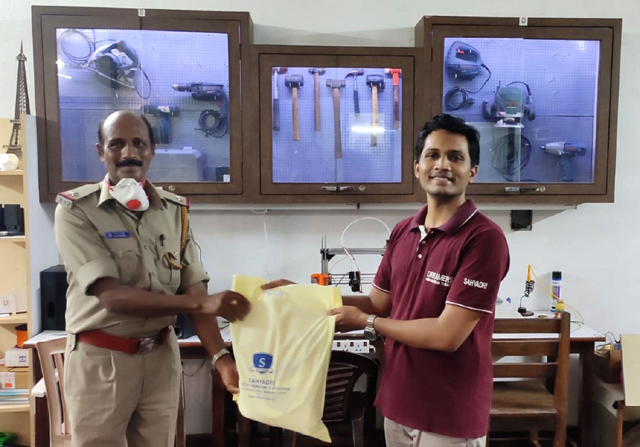
DreamWorks Makerspace at Sahyadri College of Engineering & Management, Mangaluru has been manufacturing and delivering face-shields to help the frontline healthcare professionals fight against COVID-19.

They have delivered over 500 face-shields to Shivamogga Police on April 16. They have successfully delivered 2000+ face-shields since April 2 and are continuously working to cater to the requirements.

Face shields are an urgent requirement in the nation’s fight against COVID-19 in order to help scale manufacturing to meet needs. Face shields are a key piece of equipment for front-line healthcare workers operating in close contact with COVID-19 patients. These face shields can protect a healthcare professional and COVID warriors from exposure to droplets containing the virus expelled by patients when they cough or sneeze.

source: http://www.daijiworld.com / DaijiWorld.com / Home> Campus Beat / by Media Release / April 19th, 2020

Mysuru-Origin US Doctor Gets A Brilliant 100-Car Salute

DrUmaBF22apr2020

Mysore/Mysuru:

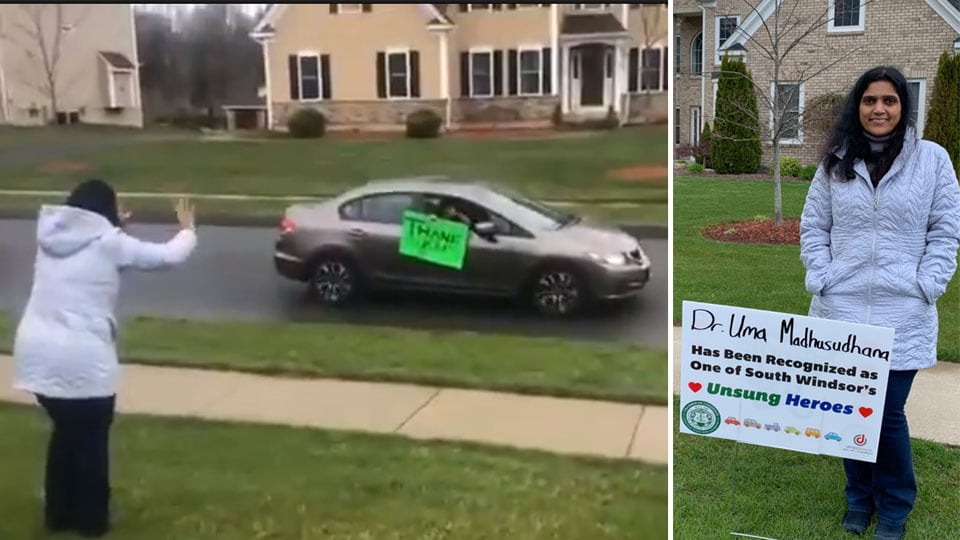
It was a proud moment for Mysuru as a city-based doctor living in the United States received a unique ‘Drive of Honour’, a heart-warming gesture to appreciate her efforts in fighting the global Coronavirus pandemic.

The ‘Drive of Honour’ was performed in front of the house of Dr. Uma Madhusudan, a Mysuru-based doctor who is treating COVID-19 patients in South Windsor Hospital in the USA.

The local neighbourhood in the USA honoured her and the video of the ‘Drive of Honour’ has gone viral. In the video, several Police vehicles, fire brigade trucks and private vehicles can be seen going past through her house with sirens and honks blowing. A convoy of at least 100 vehicles drove past Dr. Madhusudan’s house stopping by for a few seconds and thanking her.

As the global coronavirus crisis deepens, doctors across the world are being hailed as heroes and saviours, putting their own lives at risk to protect that of others. Dr. Uma Madhusudan is a 1990 batch graduate from JSS Medical College, a constituent college of JSS Academy of Higher Education and Research, Mysuru. Dr. Uma works at South Windsor Hospital.

The ‘Drive of Honour’ video has been shared by Karnataka Medical education Minister Dr. Sudhakar on Twitter. The video shows Dr. Uma standing at her lawn while a string of vehicles pass her by with the drivers waving at her, honking and cheering.

“Happy to share a video of Uma Madhusudhan, Mysuru origin Doctor in US being honoured in front of her house by grateful patients,” Sudhakar wrote. “It’s a beautiful sight of cars, police vehicles, and fire trucks lining up in gratitude, waving and honking to say Thank you Dr. Uma!”

The tweet has since been going viral and even the teachers and friends from JSS Medical College have sent their greetings and appreciation.

source: http://www.starofmysore.com / Star of Mysore / Home> Covid 19 News / April 21st, 2020

‘Sahaya Setuve’ Web app launched

The BBMP on Tuesday launched the ‘Sahaya Setuve’ Web application, a one-stop platform that will allow citizens to register as volunteers in the fight against COVID-19 and also connect with NGOs.

It can be downloaded as an app on phones or accessed on desktops. NGOs can register through the web-based portal and add their respective inventory donation form including items, number of units, and area.

Those organisations willing to donate goods to the BBMP will be given delivery route passes and the items can be deposited at a designated collection centre. The civic body also aims to use the platform to list its requirements.

Volunteers also can register for various activities that will be employed by the BBMP based on demand and need. Even doctors can register for consultations. Their location and other basic information will be displayed on the app. A BBMP official said, “The platform also acts as an efficient inventory management solution to upload and update requirements, assign and track activities.”

Speaking after the launch, Revenue Minister R. Ashok said that the initiative was timely and would help avoid duplication of work. “Though various NGOs and individuals are tirelessly working to feed and reach out to the needy, many times they end up reaching the same set of people. This can be avoided now,” he said.

All the data will be fed into a portal which also provides a dashboard view to the War Room officials.

The app can be accessed on 

https://play.google .com/store/apps/ details?id=in.bbmpgov. covid.er or http://bengaluru cares.bbmpgov.in

source: http://www.thehindu.com / The Hindu / Home> News> Cities> Bengaluru / by Staff Reporter / Bengaluru – April 15th, 2020

COVID-19: BEL develops wrist, chest bands for AIIMS to monitor people under quarantine

The first batch of ten each were despatched on Saturday by post to the Rishikesh-based institute. It was a pure labour of love for the team at BEL headed by scientist Matukumalli Rajasekhar.

Wrist and chest bands to monitor those with COVID-19 (Photo | Special Arrangement)

Bengaluru :

The Bengaluru-based PSU Bharat Electronics Limited has been roped in by the All India Institute of Medical Sciences (AIIMS) in Uttarakhand to develop wrist and chest bands to monitor those with COVID-19 or suspected of having it.

The first batch of ten each were despatched on Saturday by post to the Rishikesh-based institute. It was a pure labour of love for the team at BEL headed by scientist Matukumalli Rajasekhar of its Central Research Lab who churned out the products within a week’s time.

Rajashekhar told TNIE, “The concept was proposed by AIIMS to BEL. The software, sensors and cloud system to store them were all developed by us here. We have also developed a mobile app. A total of 40 of us were split into three teams.”

Both the bands have to be worn together by a patient, one around the wrist and the other around the hip like a belt. “It is GPS enabled and connected to a common server. The wrist band will send the temperature and other details to the server. All patient movements will be tracked through it. The chest belt will show the respiratory status of the patient. Alerts are sent to the Chief Medical Officer in each district. The CMO will alert the health workers in the area who can track the patient.”

In case any of the bands is thrown away by a patient, alerts will be sent indicating that they are not being used, he added. “Such bands are not in use anywhere in the country and it is the first such initiative,” the scientist said, adding, “AIIMS wanted to test the first batch to ensure all readings are fine. We will be doing it in bulk as soon as we get the green signal from them.”

AIIMS is likely to ask BEL to produce 25,000 pairs of bands, he added. Asked about the business part of it, the scientist said, “We are not looking at it as a profit venture. The cost incurred in readying the apparatus for each patient works out to around Rs 10,000 and the institute is likely to pay that to us. We are not charging them as it is our contribution during this crisis-ridden time.”

source: http://www.newindianexpress.com / The New Indian Express / Home> States> Karnataka / by S. Lalitha / Express News Service / April 18th, 2020

COVID-19: HAL produces, hands over protective boxes

Hindustan Aeronautics Limited (HAL) has produced and handed over more than 300 aerosol boxes to various State governments including Karnataka, Uttar Pradesh, Maharashtra and Kerala to be used in hospitals.

HAL said in a release that the transparent box acts as an insulator between the doctor and the patient and significantly reduces the possibility of COVID-19 transmission to doctors and medical staff treating patients.

“The results are encouraging and we can cater to more hospitals and States in this hour of need,” said R. Madhavan, CMD, HAL. The boxes are produced at various divisions of HAL across the country.

HAL management has already announced a contribution of ₹26.25 crore to the PM-CARES Fund, said the release.

source: http://www.thehindu.com / The Hindu / Home> News> States> Karnataka / by Special Correspondent / Bengaluru – April 16th, 2020

This doctor from Karnataka working in US has successfully treated five coronavirus patient

Dr Arun Ranganath says the best supportive care on a ventilator with the pulmonologist, anaesthetist and intensive intervention is the key for early recovery.

Dr Arun Ranganath
Dr Arun Ranganath

Tumakuru :

“No one has died from COVID-19 under my care. One patient had cancer and he died of cancer,” asserted Dr Arun Ranganath, who has been treating the intubated patients in the ICU of Maine General Medical Centre, Augusta, USA.

The physician who hails from here has treated five patients aged between 63-80 successfully and they have been discharged with one more person still getting treatment under his supervision

The expert doctor, who has had stints at hospitals in the UK, at Safdarjang in New Delhi, has been in Maine Centre for eleven years. For four years, he has been the director of the ICU and is triple board-certified in internal medicine, pulmonary and critical care.

Speaking with The New Indian Express, the shy doctor shared his experience as he has been working for over 14 hours daily at the 200-bed hospital. The young doctor says the best supportive care on a ventilator – with the pulmonologist, anaesthetist and intensive intervening at the right time – will make a difference as the rate of patient recovery will be high.

“We have also treated with some steroids, hydroxychloroquine, and azithromycin but I am not sure if it made a huge difference. I am not sure about their efficacy but at least they don’t hurt as some of the studies done in France show a mortality benefit,” he explained.

Interestingly, the doctor’s wife Nagaveni Thimmappa also works as a data analyst with the hospital as his colleague and the couple have risked their lives, leaving their little daughters aged twelve and seven years under the care of a nanny.

Hailing from Sira town, which witnessed a death due to COVID-19 and a positive case, Arun did his MBBS at Mysuru Medical College. Sadly, he lost both his parents Ranganath and Shivakumari in his childhood.

“My aunt, father’s sister, Dr Jayalakshmi, working at the government hospital at Challakere in Chitradurga district motivated me to become a doctor. My paternal uncle Panduranga educated me,” he informed.

He suggested that the shared responsibility is the need of the hour as the entire community including the doctors, the staff at the hospital and the public, in general, are at the risk of contracting the virus.

“There are definitely risks involved in the process. I can’t imagine any other better person than the physician to take that risk. On the same note, they have to protect themselves with appropriate masks and hand hygiene. They have to take care of themselves first to take care of others but that doesn’t mean that they should shy away from the responsibilities,” he advised.

He also suggested that in a country like India, the general duty doctors at the hospital should also be trained in handling critical care including the ICU as soon as possible.

“India can just not relax as the cases detected are less but should keep in mind that there might be ten times more asymptomatic carriers and the latter should be subjected to diagnosis and kept in quarantine. Early detection is the key,” he warned.

source: http://www.newindianexpress.com / The New Indian Express / Home> Good News  / by Devaraj B. Hirehalli / Express News Service / April 15th, 2020