Category Archives: Science & Technology

The solar man on a mission

solarBF30mar2013

By S.N. Venkatnag Sobers

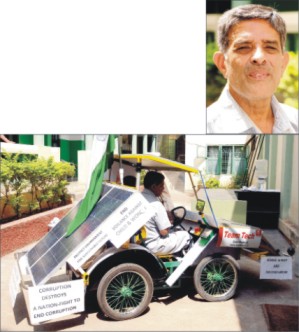
He is no engineer or a scientist or a scholar with great knowledge, but a humble person who is on a mission to create awareness about the need to make environment free from pollution. Meet Syed Sajjad Ahamed, a Bangalorean, who has been travelling across the country with his handmade Solar Car in an effort to create awareness about environmental hazards.

Syed Sajjad Ahamed, born to a poor family in Kolar, is a Class 12 drop-out. During his schooling he even struggled to pass 8th std. His father worked as manager in a transport company in Kolar, where he spent his childhood and later shifted to Bangalore. Sajjad Ahamed after being unsuccessful in his studies, did not stop but was determined enough to come out with innovations by altering some of the vehicles that were already in the market.

At first, Sajjad Ahamed came out with electrically powered Luna in 2002. The speciality of the vehicle was that it used to operate by charging the batteries without using petrol. In case of batteries going dry, the vehicle would operate through petrol. Speaking to Star of Mysore, Sajjad Ahamed said that though he was a college drop-out, he was very much interested in experimenting with things available in the market and that is how he developed and came out with innovations of his own.

Sajjad Ahamed did not stop with Luna. He later came out with an electrically operated autorickshaw which was a success but unfortunately could not be taken forward as none of the manufacturers or companies came forward to take up further research on the product.

Sajjad said, “None of the companies have come forward to even look at the innovations that I have come out with. They fear that supporting the product I invented would hurt their products which are already in the market.”

However, many organisations have helped Sajjad in his endeavour to come out with solar powered vehicles. Institutions such as Karnataka Renewable Energy Development Limited, Raman Research Institute, Exide, have all been encouraging Sajjad by providing him with necessary materials to conduct his research. He has also been assisting engineering students about the manufacturing of solar powered automobiles for their projects. “I wanted to become a professor, but I couldn’t complete my studies. I am satisfied that at least I have been able to assist engineering students in their projects”, added Sajjad.

Sajjad has till now not patented any of his innovations. When asked about the reason, he said “If I patent there will be a problem for interested people who want to take up similar work in the future. I have left the options open for the people. Anybody can come and take it forward and I will assist them in coming out similar with products.”

Currently, Sajjad has been travelling on Solar Car Mark II, which was innovated by him. He has travelled about 1,000 kms in the car which can travel at a speed of about 15 kms/ hr and can cover 150 kms/per day. The car is enabled with 500 Watt Solar panels compared to 250 watt solar panel in his first Solar Car which he came out previously. Sajjad has travelled to Andhra Pradesh, Tamil Nadu, Maharashtra, Gujarat, Delhi, Haryana and other States in his car. During his journey Sajjad stops by colleges and schools to educate them about the environmental hazards and enlighten them about the need to protect the environment from pollution in order to make the world an ideal place for living.

He not only creates awareness on pollution but also is a volunteer of anti-corruption. He has the posters of Swami Vivekananda, Anna Hazare and other great personalities through which he tries to inspire young minds to take lead in crusade against corruption. He distributes pamphlets to people during his journey regarding need to control pollution and corruption. “I want to ignite young minds to come forward and take up the mantle of leading the country forward. Youngsters should be educated and awarded about their duties”, said Sajjad.

source: http://www.StarofMysore.com / Home> Feature Articles / March 24th, 2013
Down the memory lane: PRIDE OF INDIA

‘A glimpse into India’s Scientific Heritage’

By K. Vijaya Kumar, Former Jt. Director of Information & Publicity

vijayakumarBF28mar2013This is actually the title of a rare book which my scientist-friend, Retd. Deputy Director of CFTRI, M.C. Shamanthaka Sastry, walking into my flat the other day with this book in hand, highly recommended me to go through it and return.

He briefly mentioned as to how he got this book as a gift (priced Rs. 2,000, pages 200) during his visit to Varanasi on his way back from Nepal in 2007, from a Sanskrit scholar Chamu Krishna Sastry of Samskrita Bharati (who conceived the idea of the book), whom he accidentally met on the banks of Ganga. I am, indeed, thankful to my friend Sastry for his gesture in loaning this valuable book. Later on, about its contents.

Well, I went down with my memory lane over 60 years ago as a high school student in dilemma whether to choose Science or Arts for my future course. My parents thought I was not that intelligent to study Science and myself losing courage, opted for Arts. But I have no regrets as I have developed a scientific temper over the years. Regret is that I did not study Sanskrit but satisfaction is Hindi was second language in my degree class.

Scientific temper

India became the first country in 1976 to include in its Constitution — Article 51A — making it a duty of every citizen to develop scientific temper with humanism. Pandit Jawaharlal Nehru in his book ‘Discovery of India’, as way back in 1946, wrote on scientific temper “as a way of life, a process of thinking, a method of acting and associating with our fellow men.”

In this context, I have to appreciate the initiative of my friend Arjuna Deva of Prajavani and former Chairman of Media Academy, in bringing out a Kannada monthly (Jaana) since 16 years, which devotes to create scientific temper among readers.

Sanskrit & scientific heritage

The ancient Sanskrit language which is considered as divine language is the ‘Soul of India’ and the entire Indian culture is hidden in Sanskrit. Here, I have to recollect how 43 years ago in 1970, late Pandit K.N. Varadaraja Iyengar took a bold and adventurous step and succeeded in launching a Sanskrit newspaper ‘Sudharma’ making Mysore proud to have the only Sanskrit daily in the world. In later years, his son K.V. Sampath Kumar has developed it as e-paper (sudharma.epapertoday.com) having readership across the country and abroad online. One has to remember Founder-Editor late K.N. Varadaraja Iyengar for his contribution in popularising Sanskrit.

About the book

I have a reason to bring this book in my column so that readers will appreciate how India can take pride in its scientific heritage from the time of Vedas and its contribution to the world in the development of science. Chamu Krishna Sastry, All India General Secretary of Samskrita Bharati (Publisher – First published in 2006), who conceived the idea of bringing to light the science available in Sanskrit texts and he vested with ‘Team Nagpur,’ consisting of several scholars of Nagpur in various discipline to select the works and quotes covering the spectrum of science.

Why ‘Pride of India’?

As a preface to the text, Chamu K. Sastry raises, nay, quotes two examples under this title:

The 20th century has seen unprecedented development in knowledge and technology. Car to spacecraft — all have been invented and commercialised in the lifetime of a person. At the end of this epochal growth, humanity is at crossroads:

“The Green Revolution — high yielding varieties of seeds, chemical fertilisers and pesticides — was the blessing which saved India from ruinous famines and equally ruinous Food Import Bills in 1960s. Today the brains in agriculture and chemical technology are searching desperately for ways and means of restoring the soil fertility which has completely eroded by the Green Revolution.”

“Allopathy has taken great strides in the last three decades. Unknowingly, in this avalanche of development, basic tenets of Allopathy have been lost. ‘The doctor ties the bandage but it is He who heals the fracture’ is the axiom that drove the course of treatment that doctors chose some years ago. This axiom is based on the premise that the body has the potential to heal itself. Today, the adverse side effects of allopathic treatment are so acute and widespread that there is a longing for alternate medicines in every part of the world.”

Having raised the above two examples, Chamu K. Sastry writes — “We need an alternate mindset to find innovative solutions. The world is looking to the East inclusive of India for such a solution.”

Certainly, India has solution from its rich vedic scriptures when one goes back to our scientific heritage.

The book for all Indians

Suffice it to conclude with this review on the book by Dr. M.R. Srinivasan, former Chairman, Atomic Energy Commission (which gives in a nutshell the contents of the book): “This elegantly brought out publication presents in a concise way advances made by the Indian civilisation, in the past, in a variety of fields including mathematics, physics, astronomy, civil engineering, mechanical engineering, metallurgy, chemistry and medicines. I recommend the book ‘Pride of India’ to all our citizens so that they can appreciate the rich heritage of science and technology that existed in the past in India.”

e-mail: kumarkv59@gmail.com

source: http://www.StarofMysore.com / Home> Feature Articles / March 22nd, 2013

Bangalore, first Indian city to get free Wi-Fi hotspots

Bangalore :

Free wireless internet  services are expected to commence in the commercial heart of India’s technology capital starting next month. Mahatma Gandhi  Road and Brigade Road, two of the best-known shopping destinations, will have free  Wi-Fi  access  as part of a plan to make Bangalore the first city to have such a service available at public spots.

The idea is the brainchild of a government-appointed panel headed by Mohandas Pai, a former director at Infosys . The pilot service will be available for at least six months, after which the Information and Communication Technology (ICT) panel will evaluate the network and announce possible expansion plans.

“A smartphone revolution is happening in India, but connectivity is still an issue here. We wanted to provide seamless internet access to people,” said Pai, who is also the chairman of the Manipal Global Education.

The decision to offer free wireless broadband access was taken last year and the recommendations of the ICT group were sent to Karnataka’s chief minister in January. Bangalore-based internet service provider D-VoiS has been assigned to implement the pilot free of charge. “Once the pilot finishes, we will talk to other private ISPs and figure out a revenue-sharing model,” Pai said.

Access to broadband internet free of charge at public spots will benefit hundreds of thousands of people who browse the web through mobile phones, laptops and tablets. The Internet and Mobile Association of India expects the country to have about 165 million mobile internet users by 2015.

source: http://www.timesofindia.indiatimes.com  / Home> Tech> Personal Tech> Computing / by Indu  Nandakumar, ET Bureau / March 19th, 2013

TAFE to train women farmers

Pune, MARCH 18:

Close on the heels of the success of its lab-to-land initiative to train the farming community, tractor major TAFE has decided to extend the programme to women peasants.

A pilot project to train women farmers in farm management — soil conservation, pest management, yield improvement, tractor driving and implement usage — will soon be launched, TAFE said.

The company said this during a farmers’ day event called ‘Raithara Dhinachanarane’ organised by the company at Doddaballapur near Bangalore. Over 350 farmers, including women farmers, participated in the day-long programme.

Farm scientists and experts from University of Agricultural Sciences, Bangalore, Indian Institute of Horticulture, Bangalore, and TAFE, deliberated upon improving the output of fruits like mango, grapes, sapota, banana, guava and papaya, and vegetables like cauliflower, cabbage, brinjal and tomato.

source:  http://www.The HinduBusinessLine.com / Home> Industry> Agri-Biz /by Alka Kshirsagar / Pune, March 18th, 2013

‘Grow mushrooms and enjoy protein-rich food

Mushroom seed packets to be produced for the first time in city

Mysore, Mar. 11

MushroomBF16mar2013Mushroom seed packets are being prepared in Mysore for the first time in the State, said Dr. M.S. Raju, Senior Assistant Director of the Horticulture Department, State Zone.

He was delivering the presidential address at the day-long training programme on mushroom cultivation held under the aegis of Laboratory Development Scheme of the Horticulture Department at Kukkarahalli lake here recently.

“A total of 15,000 packets weighing 250 grams and costing Rs. 10 each will be distributed among unemployed youth, women and farmers,” he said and added that the protein-rich mushrooms have great demand within the country and in foreign markets, fetching good revenue for the farmers.

“A week-long training in mushroom cultivation will be provided in Mysore city itself,” he said and added that along with the Watermelon Mela and Mango Mela, Mushroom Mela too will be held in the next month.

“Nutrition can be increased by consuming mushroom as a regular diet. Apart from being protein-rich, it helps in curing anemia, reduces body fat and controls diabetes,” said Dr. Raju.

Prof. Janardhan of the Department of Botany, Mysore University, speaking on the occasion, said that mushroom can be easily cultivated as a commercial crop using moist paddy straw. Mushrooms are the fruit-bearing parts of fungus whose extracts are used for manufacturing anti-biotic drugs, tonics, etc.

“In the future days of climate change and scarcity of agricultural land, growing food crops using less land and less manure with less effort is a challenge,” he said and urged farmers to take up mushroom cultivation.

Information Dept. Asst. Director G. Chandrakantha launched the training programme.

Asst. Horticulture Officer Narayan welcomed, Assistant Horticulture Officer (Technical) Pooja and others were present.

More than 100 participants of the training programme were given a demonstration of mushroom cultivation.

source: http://www.StarofMysore.com / Home> General News / March 11th, 2013

Green signal for spiritual university evokes sharp criticism

HarshaBF13mar2013

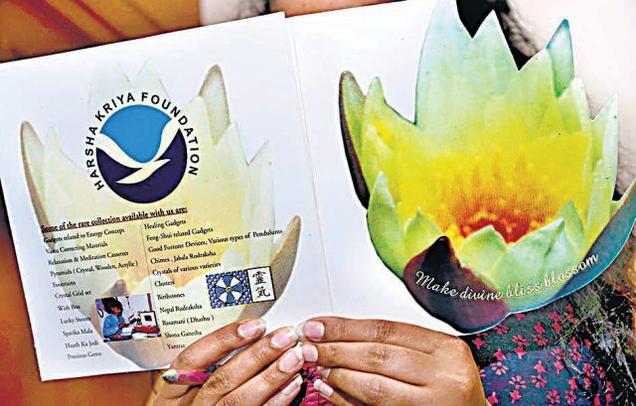
Harsha Kriya Foundation brochure. /  Photo: K. Murali Kumar / The Hindu

It is a blatant attempt to saffronise higher education’

From a tiny room on the first floor of a small building in a quiet area of Basaveshwaranagar, the Harsha Kriya Foundation runs its affairs. The Foundation has recently got the green signal for setting up the Amrutha Sinchana Spiritual University, the first of its kind in Karnataka.

Speaking to The Hindu in an office filled with such arcane objects as gems, shells, floating stones, and photographs of spiritual healers at work, Harish M., trustee of the Foundation and the university, said: “The university will offer degrees and diplomas in courses such as human energy field, feng shuirudraksha, numerology, gems and crystals. Academic courses are likely to start from 2014-15. We want to offer specialised courses to promote Indian traditions.”

Mr. Harish’s printed bio-data states he is a “healer, counsellor and trainer,” who has “counselled and healed more than 1.5 lakh cases, ranging from cardiovascular and endocrinal disorder to medically rejected cases.”

The Amrutha Sinchana Spiritual University Bill was one of the 17 passed recently by the Assembly to set up private universities in the State.

The Governor has signed eight of these bills into law. This clears the decks for the universities to start functioning as soon as they set up their infrastructure.

The Amrutha Sinchana Spiritual University Act, 2012, states that the university will impart “value-added education, life and life-skills, [and] minimise [the] suffering of fellow human beings to promote and popularise drugless energy.”

Alongside, it has the mandate of “advancement of the spiritual in the form of adyathma or spiritualshakti given by ancient yogis established in the healing process through systematic instruction, teaching, training, healing process.[sic]”

Its 40-acre campus will be located at Ghati Subramanya in Doddaballapur on the outskirts of Bangalore.

The university has drawn criticism from educationists, student bodies, scientists and political parties alike. “The basic criteria for forming a university have not been met,” said Ananth Naik, State president of the Students’ Federation of India. In a memorandum to the Governor, the SFI called the Act a “blatant attempt to saffronise higher education.”

Academic and writer G.K. Govinda Rao said academics should oppose this “most unscientific varsity.” “We can’t sleep over this, we must oppose it. The State appears to have forgotten its responsibilities.”

Sabyasachi Chatterjee, professor at the Indian Institute of Astrophysics, pointed to the constitutional provisions such an Act violated. “Article 51A (h) of the Constitution has highlighted the need to develop scientific temper, humanism and the spirit of inquiry and reform. Instead, here the State is promoting irrationality.”

Prabhu Nott, a professor of the Indian Institute of Science, said that while he was not opposed to research in spirituality, he was “uncomfortable” as “this government holds a record of promoting Hindu religion over other religions.”

Minister defends Act

But Minister for Higher Education C.T. Ravi defended the Act. “Research can be conducted to revive ancient Indian traditional methods,” he said.

Asked whether this fulfilled the stated objective for opening private universities, namely, the increase of Gross Enrolment Ratio in higher education, he said that while universities were focussing on job-oriented courses, there was a huge need for in-depth research into traditional methods too.

source:  http://www.TheHindu.com / Home> News> National> Karnataka / by Tanu Kulkarni / Bangalore, March 11th, 2013

Indo-Canadian workshop on training health professionals in suicide prevention held

CanadianBF07mar2013

Caption: Dr.G.M. Vamadeva is seen addressing the gathering yesterday.

Mysore, Mar. 1 :

The Department of Psychiatry, JSS Medical College, in association with Schullich University of Medicine & Dentistry, Canada conducted a one-day workshop on Training Health Professionals in Suicide Prevention at Sri Rajendra Auditorium in JSS Hospital premises here yesterday.

The workshop was attended by nearly 200 health professionals including Psychiatrists, Physicians, Family Physicians, General Practitioners, Auyrveda Practitioners, Psychologist, Social Workers & Nursing staff from JSS Medical College, JSS Nursing School and College, Mysore Medical College, Mandya Institute of Medical Sciences and Mysore University. It was inaugurated by dignitaries — JSS Medical College Principal Dr.H. Basavannagowdappa, Senior Journalist Niranjan Nikam, Mysore District Surgeon Dr.G.M.Vamadeva, JSS Hospital Medical Superintendent Dr. M. Guruswamy, JSS Mahavidyapeeta Medical Education Director R.Mahesh, Head of the Department of Psychiatry Prof.T.S.S.Rao and Dr. Amresh Srivastava, Dr.Paul Links and Dr.Rahel Eynan from Canada.

The dignitaries emphasised the need for such workshop as suicide is one of the leading causes of preventable death. They also noted the importance of personal narratives in fighting the stigma associated with seeking help, initiatives from the government to tackle the issue, the greater role of public & media in creating awareness and relevance of sharing the experiences for effective strategies in prevention of suicide.

The first session was on the role of family physicians and other health professionals in suicide prevention by Prof. T.S.S. Rao, who said that south India was noted across the world as suicide prone region and it was crucial that family physicians should be aware of the risk factors and protective factors.

The second session was by Dr.Paul Links on Clinical Manifestations and Causes of Suicide Behaviour. He emphasised the need to recognise suicidal behaviour at early stages and relevance of psychiatric disorders which increases the risk of suicide. The third session was by Consultant Psychiatrist at JSS, Dr.M. Kishor on Psychosocial Factors, in which he appealed for individualising risk assessment based on psychosocial factors. He also highlighted the need for health professionals’ awareness about culture and socio-economic conditions.

The session was followed by role play, coordinated by Dr.Sam Manickam on effective ways of communication by health professionals during interaction with patients. Interactive session with audience coordinated by Dr. Amaresh, Dr. Paul Links and Dr.Rahel Eynan.

source: http://www.StarofMysore.com / Home> General News / March 01st, 2013

TCS Tech Bytes in Karnataka

Bangalore , MAR 1:

Tata Consultancy Services (TCS) and the Karnataka Board for IT Education Standards (KBITES), an autonomous agency for the promotion of IT education, will roll out the fourth edition of the Engineering IT Quiz – TCS Tech Bytes.

The quiz is open to engineering students (BE/BTech) of all streams in Karnataka. N. Ganapathy Subramaniam, President – TCS Financial Solutions said, “TCS TechBytes encourages participants to develop an understanding of technology in a changing landscape.

The programme aims at fostering lateral thinking and teamwork among students, underlining that learning is a continuous process for one to excel in a competitive environment.”

source: http://www.TheHinduBusinessLine.com / Home> News> Education / by The Hindu Bureau / Bangalore, March 01st, 2013

Indo-Canadian symposium on Nano-Science & Technology concludes

CanadianBF01mar2013

Caption: Seen in the picture are (from left) S.L.Ramachandra, Hon. Secretary, NIE M.Sreepada Rao, Vice-President, Prof. Peter Mascher, Faculty of Engineering, McMaster University, H.N. Ramathirtha, NIE Director, Prof. Rajasekara Murthy, Emeritus Scientist, National Water Research Institute, Canada, S.K. Lakshminarayana, Hon. Treasurer, NIE and Dr. G.L.Shekar, Principal, NIE.

Mysore, Feb.23 :

The first Indo-Canadian Symposium on Nano-Science and Technology, organised by the National Institute of Engineering (NIE), Mysore, in association with McMaster University, Canada, concluded on Feb. 21.

Prof. Peter Mascher, Professor and William Sinclair Chair in Optoelectronics, Associate Dean (Research and External Relations), Faculty of Engineering, McMaster University, delivered the valedictory address.

Prof. Rajasekara Murthy, Emeritus Scientist, National Water Research Institute, Canada, was the guest of honour.

H.N. Ramathirtha, Past-President and Director, NIE, presided over the function.

source: http://www.StarofMysore.com / Home> General News / February 23rd, 2013

Fellowship for CFRI scientist

Mysore, Feb.20 :

Dr. K.S.M.S. Raghavarao, Chief Scientist, CSIR-Central Food Technological Research Institute (CFTRI), has been elected a Fellow of the prestigious Indian National Academy of Engineering by its Council, effective from 1st January 2013.

The Indian National Academy of Engineering is the premier association of academic engineers and recognises outstanding personal contribution by engineers through Fellowships.

Dr. Raghavarao has received the honour for his research contribution in the area of Chemical engineering.

A scientist-engineer for the past 25 years, Dr. Raghavarao has published more than 155 research publications in national and international journals.

He has 25 International patents and 50 Indian patents, 20 processes to his credit and has guided 18 students for Ph.D. degree.

He was Fellow of Institution of Engineers (2010) and recipient of National Academy of Sciences, India (NASI)-Reliance Industries Award (2008), National Award, Ministry of Agriculture (2006) and Institution of Engineers Platinum Jubilee Award (2010), according to A.S.K.V.S. Sharma, Head, Information & Publicity, CSIR-CFTRI, Mysore.

source: http://www.StarofMysore.com / Home> General News / February 20th, 2013