Category Archives: Science & Technology

Flower and fruit show in Shimoga evokes good response

Exotic flowers cultivated by farmers of Malnad are on display

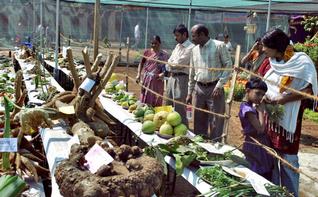
Hybrid vegetables and fruits of unusual size were the major attractions at the flower and fruit show in Shimoga on Sunday.— Photo: VAIDYA / The Hindu

The three-day flower and fruit show being held under the aegis of Department of Horticulture at Mahatma Gandhi Park has evoked good response. The exhibition will conclude on Monday.

The cultivation of decorative flowers such as gerbera, gladiolus, gypsophila, oriental lily has become popular in Malnad in recent times. The climate in Malnad region is conducive for floriculture. The exotic varieties of flower cultivated by farmers of Malnad region were displayed at the event. The replica of stag, peacock, human heart, elephant made from the flowers, crocodile designed from bitter gourd, the images of Swami Vivekananda, and Ganesh carved out of water melon fruit were appreciated by visitors. The bonsais cultivated by Chandrakala S.V. and Shobha Ravikumar were on display at the event.

With the objective to create awareness among people on breeding ornamental fish, the Department of Fisheries had setup a stall. The charts on benefits of adopting system of rice intensification (SRI) method of cultivation of paddy that is best-suited for regions where the availability of water is less were on display at the stall of the Department of Agriculture. The diverse varieties of banana, areca cultivated in Malnad region, the minor forest produce such as chinnikaiamatekaijaikai , andsoapnut were put on display.

Krishna, an artiste from Nandi Hills, has showcased the artefacts he had designed from the roots of trees and plants. Sanjith V., a student of Mahaveer Vidyalaya, said the flower replica of peacock was impressive. Khalander Baig, an employee of a business process outsourcing firm, told The Hindu that the exhibition was both an entertaining and an enlightening experience. The model on rainwater harvesting made from flowers, the implements related to drip irrigation, and the charts on SRI method of paddy cultivation displayed at the stall of Department of Agriculture will help the visitors understand the significance of conserving water, he said.

source: http://www.TheHindu.com / Home> National> Karnataka / by Staff Correspondent / Shimoga, January 28th, 2013

Heart patients can pay through EMIs

Bangalore :

Heart ailments kill about three million Indians every year. Many die because they can’t afford treatment at the right time. Now, there’s a ray of hope for poor heart patients: EMI payment for the treatment in instalments.

Heart care has gone the EMI way in Bangalore and Mysore. In south India, about 20 hospitals are facilitating cardiac treatments through Equated Monthly Installments.

Sagar Hospital, Trinity Hospital and Panacea Hospital in Bangalore have come up with Healthy Heart for All (HHFA) – a programme in association with India Medtronic. manufacturers of stents. Fortis and Vikram Hospital in Mysore too are facilitating this programme which was floated a month ago.

Under HHFA, hospitals provide financial assistance to implant devices such as stents, pacemakers, implantable cardioverter-defibrillator (ICD) and cardiac resynchronization therapy (CRT) in heart patients. Furthermore, cardiac emergencies are almost always life threatening and patients often have a tough time raising the huge sums of money at short notice. To address this issue, HHFA offers loans.

Said Dr K S Kishore, interventional cardiologist, Sagar Hospital: “Heart patients are often rushed to hospital at the 11th hour. It’s difficult for the patient or the relative to arrange for cash immediately. In such situations, the EMI facility comes in handy. Under this programme, a patient can swipe the card and pay the cost of treatment in 6 installments without interest.”

The EMI can also be extended up to seven years on interest rate of 8.25%. The three hospitals in Bangalore are offering treatments like angioplasty and valve replacement.

Instalments for other treatments

Eye surgeries, robotic surgeries for cancer and dental procedures too can be paid in easy installments at a few hospitals in the city. Manipal Hospital offers this payment option for a range of treatments by tying up with two private banks. The EMI facility is available for procedures like bypass, angioplasty, open heart surgeries, robotic surgeries, a few eye surgeries and dental treatments.

Said Dr C G Muthana, vice-president, operations, Manipal Hospitals: “Several treatments are available on EMI payment at our hospital. A patient opting for this has to swipe the credit card of the bank we have partnered with and can pay the cost in three, six or nine installments without interest. The project has just started so there isn’t much awareness about it.”

source: http://www.articles.timesofindia.indiatimes.com / Home> City> Bangalore / by Hetal Vyas, TNN / January 30th, 2013

From Dublin to Bangalore – Science Gallery model goes global

Having made science ‘cool’ at home, Dublin’s Science Gallery has global plans that are taking it as far afield as Bangalore, writes Ann O’Dea.

The highly acclaimed Science Gallery on Dublin’s Pearse Street has been bringing cutting-edge developments in science, technology and the arts to the general public since 2008, through interactive and award-winning exhibits, but the team behind the gallery now plans to replicate that successful model in a further eight countries.

From Dublin to Bangalore – Science Gallery model goes global . Michael John Gorman, founding director of Science Gallery

A donation of €1m from Google in December 2011 was used to set up the Global Science Gallery Network, which plans to open similar galleries in key cities worldwide. India was chosen alongside the UK, Singapore, the United States, Australia and Russia for the first wave of science hubs to be launched.

And it is not difficult to see why the idea is meeting with some success. Here in Dublin, the gallery has become part of the arty tech and science ecosystem, thanks to its quite unique model, says founding director Michael John Gorman.

“When we opened in February 2008, one of the reasons was we felt there was a real need to inspire and engage more 15- to 25-year-old young adults around science, technology and engineering, and to get more people considering courses and careers in these areas,” he says. “Since then, I think there is a mind shift that has happened where now people actively seek out science-related events and entertainment.”

The Brian Cox phenomenon

He does concede this may be partly attributable to the Brian Cox phenomenon – the ultracool British particle physicist and TV celebrity – not to mention figures like Ireland’s own Dara O’Briain, comedian and broadcaster whose background is in mathematics and theoretical physics. Indeed, O’Briain sits on the gallery’s Leonardo Group, 50 ‘creative’ individuals, scientists, technologists, designers and artists who feed ideas into the exhibitions.

“It was a deliberate decision when we were starting out,” says Gorman. “Many science attractions around the world are focused on very young children and families, and on school groups. We made a decision that we would have a more adult engagement with science technology and the arts. There’s this widespread idea that science is for kids and art is for adults. I don’t know why that exists as a perception but it needs to be challenged.

“When we were setting up the gallery at the boundary of the university (Trinity College Dublin) it seemed like there was an opportunity for the gallery to be a porous membrane for the university and its researchers, and for all the exciting stuff going on behind the closed doors of labs, to bring that out to the public, and draw the public into interactions with the university. We were determined that we wouldn’t vandalise the science, we wouldn’t dumb it down. There was nothing out there like that.”

In 2012, 300,000 visitors went through the Science Gallery’s doors. “To put that into perspective, when we’re starting up the gallery back in 2007-2008, our target was 50,000 visitors a year,” says Gorman.

Not only that, but 2012 saw its exhibitions tour to Singapore, Manila, New York and London.

“At the beginning of June, we had three exhibitions opening in three continents in three weeks,” says Gorman. “We also ran Ireland’s largest ever TEdx event in September in the Bord Gáis Energy Theatre, which sold out and had 2,000 people listening to people talking about the future of science and technology. In a strange way science has become cool.”

It was because that concept was quite unique that the gallery felt it could replicate the model as a ‘plug in’ to universities in other key urban centres around the world.

Science Gallery and India

Today, excitement is building in India, where in November the Karnataka State Government signed a memorandum of understanding with Science Gallery, and is launching the feasibility analysis this month. A strong steering committee is already in place, with stakeholders like the Indian Institute of Science, the National Centre for Biological Sciences, and the Srishti School of Art, Design and Technology already involved in the process.

And the Bangalore Science Gallery has other heavyweight backing, with none less than India’s leading businesswoman, self-made entrepreneur Kiran Mazumdar-Shaw a strong supporter of the initiative.

Often cited as India’s richest woman, Mazumdar-Shaw’s $800m business Biocon is one of India’s leading drug companies, with a workforce of some 6,000. She was included in Forbes’ The World’s 100 Most Powerful Women in 2012 and Time magazine’s The World’s Most Influential People in 2010. When I mentioned the Bangalore project on Twitter, to my surprise, she shot off a rapid and enthusiastic response.

Mazumdar-Shaw herself has strong Irish connections. She worked as a trainee manager in a biochemicals company in Cork back in the 1970s, before starting Biocon in the garage of a rented home in Bangalore in 1978, with seed capital of an equivalent $200 in today’s money. In 2001, Ireland’s Minister for Health at the time, Mary Harney, appointed Mazumdar-Shaw to the board of Science Foundation Ireland. Today she is Irish consul general in Bangalore.

She, too, tells me Bangalore was the obvious choice, as a “leading hub of information technology, biotechnology and nanotechnology, not only in India, but in Asia.

“The Science Gallery project is a welcome and timely addition to Bangalore’s growing stature as India’s science and technology capital,” she says. “It provides an ideal platform for interactive and multidisciplinary learning and knowledge creation.”

“Conceptually, the Science Gallery is the perfect format for advancing scientific education that has a mindset of explorative research,” she continues. “As the Irish consul general in Bangalore, I am delighted to see this meaningful and path breaking bond between the two countries being catalysed by Trinity College.”

Science Gallery is funded by a combination of Trinity College Dublin support, Government support, corporate partnerships, foundations, philanthropy and earned income.

“These supporters allow us to keep entrance to Science Gallery free of charge, which was a key principle from the outset,” says Gorman.

The earned or operational revenue has grown to about a quarter of its funding, says Gorman, thanks to the growing success of the café, the retail space, corporate hire and of course the successful touring exhibitions. During the financial year 2010/2011, Science Gallery increased its annual turnover by 20pc from 2010 to €2.2m.

Back in Bangalore, Gorman says the feasibility analysis should be completed in April, and shortly thereafter the gallery should move to the development stage, but the UK is likely to pip them to the post. Closer to home, Science Gallery is in advanced discussions with King’s College, London, regarding the setting up of a Science Gallery on its Guy’s Hospital campus there, scheduled to open in 2015, close to the Tate modern and the Shard building – a suitably edgy location for a very cool concept.

A version of this interview first appeared in The Sunday Times on 27 January

source: http://www.SiliconRepublic.com / Home> Innovation / by Ann O’Dea / January 30th, 2013
We need to learn from craftsmen: Scientist Sharada Srinivasan

Bangalore :

Scientist Sharada Srinivasan , who won the Dr Kalpana Chawla  Award for Young Scientists recently, has explored linkages between art, metals and materials, heritage, archaeology, aesthetics, science and technology and the performing arts. Apart from being a professor of heritage at the National Institute of Advanced Studies, Bangalore and collaborating research with people all over the world, she’s also an adept Bharatanatyam dancer. She speaks about her life and work:

Tell us about your work…

A major aspect of my work includes archaeo-metallurgical characterization and technical fingerprinting of South Indian bronzes of the Vijaynagar and Chola periods, uncovering of evidence for the smelting of copper, lid and tin bronzes of Karnataka and Andhra Pradesh. I’ve also worked on preservation of ancient mirror-making in Aranmula (Kerala). Certain parts of north Karnataka also produced high carbon steel during 700 BC, which I’m looking into as well as gold mining heritage sites in North Karnataka. We found evidence of bronze melting from a very long time ago around Hassan.

What are the major challenges?

Metallurgical items are often not taken very seriously by many at archeological sites though they give many insights about the era in which they were crafted. Modern mining also destroys much of our old heritage mining sites. Also, we need more support and grants for our work.

What do you think of heritage in Bangalore?

I’m concerned about the heritage culture of Bangalore. We need to build a museum culture.Youngsters spend a lot of time at multiplexes and malls which they could well spend at museums and heritage sites learning about culture and history. Museums here are disconnected when it comes to providing information to youngsters. The central government needs to inspire museum employees to do better as most artifacts on display have only brief descriptions. There needs to be creativity in this and apt explanations which youngsters can relate to.

What’s the solution?

Academic courses need more of practicals in subjects like history, and students need to learn from craftsmen  and artisans. Also, the scientific community needs to come up with relevant services that help the community.

What do you think about cannons found near the City Market?

They look like cannons from the 18th century but more scientific testing needs to be done to prove they belonged to Tipu Sultan

source: http://www.timesofindia.indiatimes.com / Home> City> Bangalore / by Rhik Kunda, TNN / January 26th, 2013

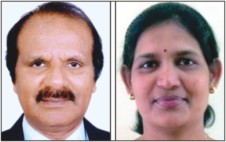
Dr. Raja Ramanna & Kalpana Chwawla awards for Mysoreans

Caption: 1) Prof. Bhyrappa 2) Dr. Shubha

Mysore, Jan. 18

The Karnataka State Council for Science and Research, Indian Institute of Science, Bangalore, has announced the names of the recipients of various prestigious science awards for 2011:

Among the awardees are two Professors of Mysore University — Prof. K.Byrappa and Dr. Shubha Gopal.

Prof. K. Byrappa, international authority in the field of Hydrothermal Technology, senior Professor of M.Tech in Material Science, University of Mysore and Founder Director of the Internal Quality Assurance Cell of Mysore Varsity, will be awarded Dr. Raja Ramanna Award for Science and Technology.

One of his books “Springer Handbook of Crystal Growth” published by Springer-Verlag, Germany, is the second biggest book ever published by Springer-Verlag which runs to about 1,857 pages. He has published over 200 research papers including 30 invited reviews and book chapters on various aspects of ‘Novel Routes of Solution Processing’ and some of his publications are highly cited.

He had earlier served as the Director of UGC Academic Staff College of Mysore Varsity, besides serving as the Chairman of the Department of Earth Science.

At present, he is the co-ordinator of the Rs. 55 crore project in Mysore University, on Material Science and Nano-technology, under the schemes University with Potential for Excellence and Centre with Potential for Excellence in a particular area.

Dr. Shubha Gopal, Chairperson, Dept. of Microbiology, University of Mysore, has been bestowed with the prestigious Dr. Kalpana Chawla Young Woman Scientist Award for 2011-12 by the Karnataka State Council for Science and Technology for her outstanding contribution in scientific research.

Dr. Shubha’s research focuses on the molecular pathogenesis of Listeria monocytogenes, especially the role of thiol-redox and carbohydrate metabolism, its biofilm formation and gene regulation. Besides, she has also worked on bioprospecting of medicinal plants and reported a novel flavanoid from Leucas aspera (Thumbe plant) which has a potential industrial application.

She has published several research articles in peer-reviewed journals, and presented various research papers in national and international conferences.

Other awardees are: Sir M. Visvesvaraya Senior Scientist Awardees: Prof. Raghavendra Gadagkar of IISc., Prof. K.Muniyappa of IISc. and Dr. K. Siddappa, Hon. Director of JSS Foundation for Science & Society and former VC of Bangalore University.

Dr. Raja Ramanna State Scientist Awardees: Dr. G.K. Narayana Reddy, former VC of Karnatak University, Dharwad; Dr. S.M. Shivaprasad of Intl. Centre for Materials Science, Jawaharlal Nehru Centre for Advanced Scientific Research, Bangalore.

Sir C.V. Raman Young Scientist Awardees: Dr. Mohammad Hussain K. Rabinal of Karnatak University; Dr. Michael Rajamathi of St. Joseph’s College, Bangalore; Dr. J. Seetharamappa of Karnatak University; Dr. Y.C. Janardhan Reddy of NIMHANS, Bangalore; Dr. Riaz Mahmood of Kuvempu University, Shimoga.

Prof. Satish Dhawan Young Engineers Awardees: Dr. Subhash C. Yaragal of National Institute of Technology Karnataka, Surathkal; Dr. K. Balakrishna of Manipal Institute of Technology.

Dr. Kalpana Chawla Young Women Scientist Awardees: Dr. Sharada Srinivasan of National Institute of Advanced Studies, IISc.

The award ceremony will take place on Jan.24 at Satish Dhawan Auditorium, Indian Institute of Science, Bangalore.

Minister for Science & Technology Anand Vasant Asnotikar will preside over the function and present the awards. Prof. G. Padmanaban, Emeritus Professor and former Director, IISc., will be the chief guest. Prof. P. Balaram, Director, IISc., will be the guest of honour.

source: http://www.StarofMysore.com / Home> General News / January 18th, 2013

They are adaptable, good at switching roles

He loves playing golf. She hates it; believes it’s a total waste of time. She loves books and music — often borrows heavy metal and hard rock stuff from her sons. He loves Tamil movies; she can’t stand them. He loves to talk at home; she prefers to do things. He loves to cook. She would rather spruce up the interiors of their home.

There’s one thing that they have in common though – the industry they work for. And this husband and wife head big companies, which make them a rare couple. Akila Krishnakumar is the India head of SunGard, a $5-billion US company that provides software to the education, financial services  and public sector organizations. Krishnakumar Natarajan, or KK as he’s fondly known, is the CEO and MD of IT services firm Mindtree .

Managing extremely demanding global jobs – involving constant inter-continental travel — raising two kids, and supporting their extended families has not been easy for the couple. Ask them about the recipe for peace, happiness and success in life and work, Akila says: “We are sensitive to each other. We treat every day as a fresh day. We do not carry old baggage.”

Akila joined  Wipro  in 1982 as a marketing executive after passing out from BITS Pilani. KK was in Wipro then, heading a marketing function. Theirs was not a love marriage. It came as a surprise to them that their parents were seeking an alliance without realizing that their children were working in the same department at Wipro.

KK quit Wipro in 1999 to co-found Mindtree. He was asked to work out   of  North America , and he had to leave Akila and their sons behind in Bangalore. A decade before that, in 1989, Akila too had taken a similar career decision, when she was posted in London and had to leave her little son in the hands of her in-laws. “I was in a dilemma. But KK’s family was fully supportive,” Akila says.

On one occasion, she had to fly from Delhi to Pune to leave her son with her mother there before she could take a flight for Bhopal  for a customer meet.

Akila quit Wipro to float an entrepreneurial venture in 1993. The firm, Exeter Systems, offered IT solutions for universities. In 1999, Exeter was acquired by Sallie Mae Solutions, which in turn was acquired by SCT Corporation. In 2004, SunGard acquired SCT. “So in a way I have been with the same company since 1993. I have seen it in various phases of growth and change.”

KK says it has been extremely challenging for the family. “But we have been adaptable, creative and been consciously finding ways to resolve every hurdle. We are also good at switching roles,” he says.

KK has been a large pillar of support, says Akila fondly. “He totally lived up to anything he was put into…be it looking after the kids, keeping the home clean or cooking for the family.”

KK and Akila are now busy creating an exclusive family hub. They are relocating both their parents and siblings from Chennai and Pune close to their weekend home on the outskirts of Bangalore. “We love our independence. At the same time we also want to be closer to our families when we grow older,” says Akila.

Travel is a common passion for the family. But aligning their calendars to vacation together is tough. “The last long vacation the four of us had was in 2007 in New Zealand. So instead of waiting and planning, we do quick, short and doable trips like the one we did recently to Chikmagalur,” says KK.

source: http://www.articles.timesofindia.indiatimes.com / Home> City> Bangalore / by Mini Joseph Tejaswi, TNN / January 14th, 2013

Bangalorean helped physicist calculate a second

Bangalore :

American physicist David J Wineland, who along with French scientist Serge Haroche won the 2012 Nobel Prize for his works in quantum physics, has a Bangalore connection. This link, incidentally, contributed significantly to the works that eventually got the physicist the honour.

Dr Bhanu Pratap Das, the top boss of the city’s Indian Institute of Astrophysics, has known Dr Wineland since 1984 when both were involved in academic works in the National Institute of Standards and Technology (NIST) at Colorado, US.

The scientists share a common interest: developing extremely precise clocks. They kept in touch after Das moved back to India.

According to Das, Cesium ions were used to measure time accurately until scientists like Wineland started using aluminum ions which got better results. “The time taken by a Cesium ion to give out a frequency of 9192631770 Hz was considered the most accurate calculation for a second,” he said, “until the scientists started experimenting with aluminum ions.”

In 2010, Wineland asked Das to reduce the error in calculating time. “He was not very sure whether the black body radiation figures which are instrumental in calculating a second were correct or not,” Das said. Blackbody radiation refers to an object or system which absorbs all radiation incidents upon it and re-radiates energy.

Das, his former students, HS Nataraj and BK Sahoo, and their two foreign research collaborators, Lucas Visscher and Mihaly Kallay, concluded their theoretical experiments in less than a year. “Our Blackbody Radiation Shift calculation had reduced the systematic error by about 28%,” said Das.

Das’s work was published in a journal in March 2011. The next year, Wineland’s work based on conclusions of Das, fetched the American physicist the Nobel for ‘ground-breaking experimental methods which enable measuring and manipulation of individual quantum systems’.

What was the Nobel for

Wineland’s finding has enabled scientists take the “first steps towards building a new type of super fast computer based on quantum physics. Perhaps the quantum computer will change our everyday lives in this century in the same radical way as the classical computer did in the last century. The research has also led to the construction of extremely precise clocks that could become the future basis for a new standard of time, with more than hundred-fold greater precision than present-day caesium clocks”, the Royal Swedish Academy of Sciences said.

source: http://www.articles.timesofindia.indiatimes.com / Home> City> Bangalore> Physicist / TNN / January 02nd, 2013

Colle Farmers Market Says UAS Organic Technology is “A Step Forward”

On January 1, Colle Farmers Market, an online farmers market community, continues to bring awareness of the organic movement as it spreads at a global rate. Colle recognizes the developing technologies of University of Agricultural Sciences (UAS) an India based organization that is developing organic production technologies for major crops.

According to The Times of India, “To encourage farmers to switch over to organic farming, Institute of Organic Farming of the University of Agricultural Sciences, Dharwad (UAS) has developed organic production technologies for major crops.” The UAS organic technology program focuses on “studying productivity, profitability, suitability, quality and input use efficiency in different crops and cropping system under organic production in comparison with conventional and integrated systems under rain-fed conditions,” reports The Times of India.

The article states that the prof. HB Babalad, Institute of Organic Farming, commented on the UAS making a “significant contribution by standardizing organic farming practices in important crops of north Karnataka region.”

The Times of India further reports that “The organic agriculture captures and store more water than soils under conventional cultivation Production in organic agriculture systems is thus less prone to extreme weather conditions, such as drought, flooding, and water logging.”

Colle Farmers Market believes that the UAS organic technology program is a step forward for a global [organic farmers market. Organic technology is improving and the more institutions that invest in this technology, the more populated our farm lands will become with organic products. Organic farming has become more than a passing phase adds Colle Farmers Market representatives. The farming communities deserve the best in organic technology and this can happen one step at a time.

source: http://www.FoodWorldNews.com  / Home / January 02nd, 2013

Minor millets have strengthened these women economically

Pushpavathi might not have a professional degree, but this has not stopped her from becoming a successful entrepreneur. Ms. Pushpavathi, who has studied only till SSLC, now offers coaching to highly educated people on entrepreneurship.

What is interesting is that products made from nutritious minor millets such as ragi have given a new economic and social status to Ms. Pushpavathi, who hails from Jigani, near Anekal. Ms. Pushpavathi underwent training in the Bakery Training Unit and Value Addition Centre of the University of Agricultural Sciences, Bangalore, on production and marketing of these products, apart from attending a course on marketing in the Canara Bank Training Institute.

Direct marketing

“I make ragi products such as malt, hurihittu, composite flour, energy food, papad and plain ragi flour with the help of six people in my house in Jigani,” says Ms. Pushpavathi. She does direct marketing of these products as it helps her make more profit. She also supplies a small quantity of these products to the nearby shops. “I make a turnover of about Rs. 2 lakh a month, resulting in a profit of about Rs. 40,000. I want to scale up this home production into a big factory by employing an additional 10 persons in the near future,” she says.

Wide range of products

She is not the only woman entrepreneur who is depending on minor millets for a living. Vijayalakshmi of Anandnagar, near Hebbal, underwent two training programmes offered by the UAS-B’s bakery centre, before turning into an entrepreneur. A science graduate, Ms. Vijayalakshmi has been preparing and marketing products made from ragi and navane (foxtail millet), including ragi malt, millet barfi, ready-to-cook food products and food for diabetics under the brand name Millet House. She manages her 18-month-old production house with the help of two persons.

Her products have started finding place in stores in her neighbourhood. She sells about 500 kg of various products a month and makes a turnover of about Rs. 30,000–Rs. 40,000. She has chalked out an ambitious plan to touch a turnover of Rs. 5 lakh a month.

Another person in this league is Jyothi Mahipal, who has already shot to fame with her millet brand Vaathsalya. “I learnt about these products from the UAS-B’s bakery centre, basically to cook new and healthy food for my family. But after coming to know about their importance in terms of nutrients, I decided to take a plunge into this as an entrepreneur,” she says. She prepares a wide range of products from all minor millets.

The hallmark of the products being made by these three women entrepreneurs is quality of nutrients and neat packaging. The food products are being made scientifically like any other branded company, by setting up all the required machinery right from the processing level.

Usha Ravindra, associate professor of the UAS-B’s Department of Food Science and Nutrition who is one of the faculty members helping women to become entrepreneurs by providing them professional training, notes that nearly 25 women have made it big in the millet sector after undergoing the university’s training.

‘Covers all aspects’

“Our training covers all aspects, right from procurement of raw materials to processing, quality testing, economies of production, book-keeping, packing and advertisements besides helping them to get market linkages,” she said.

According to her, awareness about the nutritional aspects of minor millets was slowly growing among health-conscious urban people, resulting in an increase in demand for these products.

source: http://www.TheHindu.com / Home> News> States / by B. S. Satish Kumar / Bangalore, December 31st, 2012

Rockets of Tipu Sultan to get pride of place

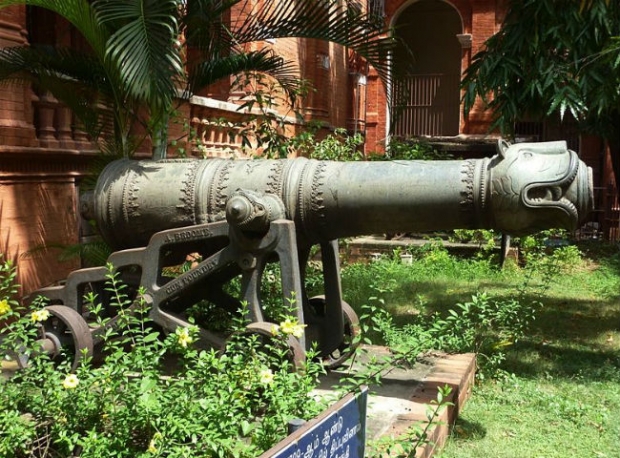
Cannon used by Tippu Sultan’s forces at the battle of Seringapatam 1799 – Wikimedia commons

Srirangapatna:

Saluting the vision of the father of  modern missile technology, Tipu Sultan, the Defence Research and Development Organisation (DRDO) plans to set up India’s first  archaeological rocket centre at his rocket court in Srirangapatna from where he fired the world’s first war rocket during the Anglo-Mysore battle.

DRDO Chief Controller (R&D), Dr W. Selvamurthy, who visited the rocket court on Friday  with other top defence scientists, was shocked  to see its condition. A portion of the front wall has collapsed and illegal constructions have cropped up on all sides.

Dr Selvamurthy said, “It’s really sad and appalling. The matter is of a great concern. The place which gave birth to the basics of rocket technology can’t be treated this way.  I will immediately write to the state Chief Secretary, the Archa­eo­logical Survey of India and the  state Dep­a­rtment of Arch­a­eology and Mus­e­u­ms  to restore and convert the mon­ument into an archaeological centre of great importance.”

He said that in the 16th century, the country’s core competence in rocket and missile technology was superior to rest of the world. The DRDO proposes to use the space to showcase India’s technological advancements. The wea­p­onry of  Mysore under Hyder Ali and Tipu Sultan was formidable and quite ahead of its time, he noted.

“We could have a life-size prototype of BrahMos, and models of a wide-range of missiles that India has developed like Prithvi, Agni and ballistic missiles, besides an original piece of Tipu’s rocket at the archaeological rocket centre we are proposing,” he added.

Meanwhile, the ASI and the state archaeological department continue to pass the buck on  the conditon of the rocket court. While  ASI representative, Satish Kumar says the department is responsible for the upkeep of the moument,  Mr. Gopal, director of the state department, contends it is the ASI’s job to restore it.

source: http://www.DeccanChronicle.com  / Home> News> Current Affairs / by S. v. Krishna Chaitanya / December 29th, 2012