Category Archives: Science & Technology

Tipu’s rocket court in Sr’patna to be converted into museum

Models of missiles and related information will be on display

Chief controller of Defence Research Development Organisation (DRDO) W Selvamurthy said that appropriate measures will be taken to convert the rocket court (Garrison Ball Alley) of Tipu Sultan reign in Srirangapatna, Mandya district into a museum.

Speaking to press persons during his visit to unit, which is said to be world’s first rocket court, he observed that the unit has become dilapidated, while the surrounding area has been encroached. Houses have been built illegally on the way to the monument.

Elaborating on the project, he said that DRDO will acquire the houses and convert the space into road and will be used for other necessary purposes.

He mentioned that the important monument had been subjected to negligence as there has been a confusion between State archaeology department and
Archaeological Survey of India (ASI) about who has to take care of the court.

Noting that a letter of correspondence will be done with both the departments and even chief secretary of Karnataka government, he said, appropriate measures will be taken immediately to conserve the place.

Selvamurthy said, models of all missiles developed in the country will be on display including the original one of Tipu reign.

Information regarding development of missile will also be made available for public.

Many do not know that India was the country which introduced missile to the world. The museum will stress on such facts and which will stress on further researches.
Prior to this, Selvamurthy visited Daria Doulat.

Director of Defence Food Research Laboratory Harsha Vardhan Batra, additional director Radha Krishna, Satish Kumar and others were present.

source: http://www.DeccanHerald.com / Home> District / Srirangapatna (Mandya Dist.), DHNS / December 28th, 2012

Aeromodelling takes wings here

Hubli :

Students of BVB College of Engineering & Technology (BVB-CET) are learning the techniques of manufacturing an aircraft, helicopters and other safety measures to be incorporated in an aircraft.

The robotics and automation department of BVB College’s initiative has formed the Aeromodelling Club to provide a platform for engineering students to learn how to make aircraft models.

Students will not only get first hand information on how to make an aircraft, but will also be given a chance to create their own aircraft or helicopter by utilizing the available resources in the club and make it fly in their leisure time.

Taking advantage of the club, some students have already created 15-20 different aircraft models. Over 50 students have enrolled with the club and spend their weekends poring over aircraft models and plans.

Speaking to TOI, Chandrakant Narayan Shet, coordinator of Aeromodelling Club, said: “we set up the club with the intention of providing real time experience of making aircraft models to college students, club. Balsa wood, circuits, controller, transmitters, receiver and servo motors and other things are used to design the model aircraft.”

There is no fee to be a member of the club. “We are also planning to train students in making quarter copter which can be used to take aerial photographs or video graph,”Shet added. “Right now the training is for our students. We are ready to guide other college students,” he added.

Mahantesh Bali, 3rd semester student of robotics and automation department, BVB College said: “We get real experience while making of aero models. Recently, I designed a boomerang copter model with the help of the resources available in the club.”

source: http://www.timesofindia.indiatimes.com / Home> City> Hubli / by Srinivas Reddy, TNN / December 27th, 2012

UAS Raichur develops e-SAP tablet to check pest attacks

Bidar :

Scientists at the University of Agriculture Sciences (UAS), Raichur, have developed a unique IT-enabled handheld device that will provide information to farmers  in real time on pest-related problems.

The device, Electronic Solutions Against Agricultaral Pests  (e-SAP), has a web-based application system which facilitates flow of information from the farmer to the farm scientist and back. “The idea behind creating e-SAP  was to help the extension worker, who is not an expert, to collect specimens right from the farmer’s field and send it to the scientists and experts in real time,” Prabhuraj A Associate Professor of Entomology at the College of Agriculture, UAS Raichur told PTI.

e-SAP will make the work of the extension service worker easy, enhance their efficiency and at the same time provide the farmers with solutions right in his field in real time, Prabhuraj, who has this technology, he added. “This technology targets one of the critical requirements of a crop cycle, pest management. e-Sap has features that can bring the farmer, extension worker, scientist and policy maker on the same plane, thereby, helping to find solutions that are more practical and in lesser time,” he said

e-SAP is currently being run on a pilot basis in Raichur district in Karnataka covering 4,000 farmers and about 10,000 hectares in 5 taluks since last year. “The technology is not very costly. We developed about 15 such tablets and the software for Rs 59 lakh. The costs of a single tablet is Rs 25,000, which can come down if it is produced on a mass scale,” Prabhuraj said.

e-SAP is unique in the sense that it has a voice-based application system, which guides the farmer and the extension worker in the local language about how to collect the data and the specimens, he added. That apart, it also allows the extension worker and the farmer to do a survey of the pest attack or related problems right in the field, which is then automatically synthesised in the form of graphs and tables along with the decision support intelligence.

Another highlight of e-SAP is the image-based model, that captures high quality images of pests and their symptoms and then guides the user in identifying the pest. This coupled with audio assistance makes it very easy to handle.

“There is an intuitively built pest specific survey to quantify the damage caused, which is based on images and also utilises the images captured by the extension worker from the affected field. This survey helps the expert is ascertaining the extent of damage and suggest remedies,” Prabhuraj said.

e-SAP devices provide continuous feed to the handheld devices with latest  farm technologies , modifications and recommendations, he added.

source: http://www.economictimes.indiatimes.com / Home> News> Technical> Hardware / PTI / December 25th, 2012

Karnataka tops in online shopping

Bangalore, Dec 20 (TruthDive) :

Karnataka topped the list of users who shopped online.

Google India search results reveal that Karnataka web users spent more time on the web for utilitarian services and the visual web in the country when compared to Delhi, Maharashtra, Tamil Nadu, Andhra Pradesh and West Bengal according to searches conducted in India featured in Google India annual Zeitgeist.

The highest searches show a growing interest by the residents of Karnataka in ‘Flipkart’, ‘online shopping’ and ‘online recharge’ with HQ in Bangalore. Flipkart services are featured in the top three fastest rising keywords in Karnataka.

Tripura, Meghalaya, Jammu & Kashmir, Assam, Pondicherry and Orissa users used the keywords online shopping more despite them having few offline retail stores. Bangalore was pushed back by Bhubhaneswar and Vizag to search for online shopping. It searched ‘online shopping India’, ‘online mobile shopping’, and ‘shoe online shopping’.

Smartphones and tablets are what Bangalore spends searching for most of the highest amount of time online. Dell laptop, iBerry tablets, Nikon and Canon’s digital camera and Samsung TV sold the most.

On eBay it was Sony with 20% of market share across the televisions.

eBay takes 43 minutes to sell a TV but a tablet sells every 11 minutes and a mobile handset sells every two minutes.

Models and budgets provide customers of eBay India’s range of gadgets easy access to the best deals.

Sales have gone up by 27% in this quarter in non-metros where it fills in distribution gaps in their city. E-commerce is said to replace direct selling in coming months. Meanwhile, the Government has put the e-commerce firms under scanner to known about their investors.

E-commerce firms in India are suspected to be acting as retail agents for brands abroad and doing business much before FDI in multi-brand retail was approved. ED has already sent notices to these firms.

source: http://www.truthdive.com / Home> Business> Exclusive> Headlines> News / by Ayyappa Prasad / December 20th, 2012

Life of a Hubli boy with Pi

The 3-D English movie — Life of Pi, which has had movie going audiences in its thrall, specially awed by the real life actions its animated tiger and animation segments, the world over — has a Hubli connection that should do the City proud.

And if you are one who stays put till the last credit rolls past before you leave the auditorium, you would have noticed the Indian name you may have instantly connected with Tanseer Ahmed Bangewale, the local lad, who has not only carved a niche for himself on the global movie marquee, but also put the Hubli city in spotlight as well, doing its citizens proud.

Marooned on the boat with a tiger, the film’s protagonist Pi keeps the feline at bay with a long stick and a loud shout. The animated scene was achieved after six-months’ effort. Besides the entry of the strange animals towards the end of the movie was also astutely visualised and conceived by the animator Tanseer.

Basking in the glory of his achievement, and new found attention his work has brought him, Tanseer, a resident of Koppadakere, Dharwad, residing in Mumbai, was in City on Sunday and shared his experience.

Working with the Academy award-winning director Ang Lee of ‘Life of Pi’ , says Tanseer, was a satisfying experience, explaining that a degree in fine arts opened a wide opportunity, although it required a lot of effort. “One need not just become a drawing teacher. Technical expertise is an added advantage,” he says.

Tanseer, 28, completed his BFA (Bachelor of Fine Arts) from a local college at Gadag with a first class. He followed it up with a course in animation in Mumbai from Hindi movie director Ketan Mehta’s Maya Academy of Advanced Cinematics (MAAC) studio. He was employed by the Rhythm and Hues Animation Studio at Malad, Mumbai, during campus recruitment.

At the studio, Tanseer, who animated for the Hollywood movie ‘Hulk-2’, also worked with the makers of ‘The Mummy Returns’, ‘The Mummy: Tomb of the Dragon Emperor’, ‘Incredible Hulk’ and ‘Night at the Museum: Battle of the Smithsonian’, besides animating for the chipmunk in the movie ‘Alvin and the Chipmunks: The Squeakquel and ‘Alvin and the Chipmunks: Chipwrecked’.

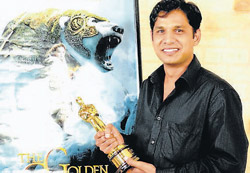
Impressed by his animation skills, especially for the movie ‘Yogi Bear’, visual effects experts at Rhythm and Hues headquarters in the US took him on board for their works which saw Tanseer join a 20-member team for the movie by Company ‘Golden Compass’, released in 2007. The movie went on to win an Academy Award for Best Visual Effects in 2008.

Happy that the family’s effort in enabling Tanseer achieve his ambition had borne fruit, a beaming father M J Banglewale, a senior professor at Vijaya Mahantesh Arts Institute, said: Tanseer is my younger son. I sent him to Mumbai so that he could learn something special, since we had to pay a fee of Rs 1.20 lakh for his course in 2005. Funds were difficult, but we did not refuse.

Sure enough, Tanseer has been true to the faith reposed in him.

source: http://www.deccanherald.com / Deccan Herald / Home> Entertainment / Hubli, DHNS / December 16th, 2012

From vinyl neglect to virtual safety

Vikram Sampath with his prized collection

Vikram Sampath’s book My name is Gauhar Jaan recounts the dramatic life-story of celebrated courtesan Gauhar Jaan, who was also India’s first singer to record on the gramophone. It was during the research for this book that Vikram’s penchant and passion for gramophone recordings was stirred.

“Gauhar had cut close to 600 records in her lifetime and I ended up collecting over 150 records of hers alone from the grey markets in Kolkata, Delhi and Mumbai,” he says. “In the process, I also stumbled upon priceless recordings of several of her contemporaries in the north and south of India, all tucked away in unknown quarters of the country.”

In 2010, after the book was published, Vikram went to Berlin on a visiting fellowship and came upon a treasure of recordings by Indian artistes at sound archives across Europe. “The constant refrain everywhere was, ‘Why doesn’t India have a national sound archive?’” says Vikram, the BITS Pilani alumni, who is a banker.

In the course of a conversation with Congress president Sonia Gandhi, who invited him for a tete a tete, after reading the book, Vikram brought to her attention a need for an archive. “It was a revelation to see her speak so knowledgeably and passionately about classical music,” says Vikram. “I brought up the archive idea with her and she was excited about it and immediately made connections with several government agencies.”

With a recommendation from such a high level, one would have thought the project was a done deal. But Vikram sighs, and says, “The proposal just kept moving across departments and academies, which gave empty promises.”

But the archive project survived. Help came from T V Mohandas Pai, who was then with Infosys and is now chairman of the Manipal Global Education. “He readily and generously funded the project with seed capital that helped to import state-of-the-art equipment that meets international standards,” he says.

The Manipal University also came forward to host the archive at their premises in Bangalore. A grant from the India Foundation for the Arts (IFA) has also helped Vikram to put together important research material around this era. “The Archive of Indian Music (AIM), which I have set up, has several trustees from across the country,” he says.

A not-for-profit trust, AIM will seek to digitise, preserve and disseminate an important slice of the musical and cultural history of our land. “The range of recordings to be covered would not be restricted to Hindustani and Carnatic classical music alone, but also theatre, early cinema, folk music recordings in all languages as also voices and speeches of great personalities like Mahatma Gandhi, Rabindranath Tagore, Jawaharlal Nehru and others,” he says.

AIM now has 10,000 records—both 78 RPM shellacs and vinyls—already collected from several places; a few donations, and others purchased from the kabadiwalas! “The trustees would help us source these records from their region and send them to Bangalore where my technician Chethan Kumar digitises these records and catalogues them on a daily basis,” says Vikram. “But the archive is going to be a virtual one.”

The website, www.archiveofindianmusic.org, is in its final stage of development in association with Vikram’s partners, Gaurav Vaz, and his company ‘The Random Lines’. It is expected to go live by end October 2012 with about 1,000 clips in the first round. “All these clips will be uploaded there and made available to people on free registration, for listening through streaming audio alone and not for download,” he informs.

Vikram says it is a shame that in a nation where music is so ubiquitous there is no central repository for all kinds of music of our country. “What better way than the arts to achieve a sense of national integration in these troubled times?” he says. “But it’s an endemic problem because as a country we have very little regard for our history and for documentation. Just see the kind of preservation done for even houses of musicians like Beethoven or Mozart, while a Thyagaraja’s house in Tiruvayyaru is broken down to have a garish renovation! ”

Of course there are government bodies, academies and archives. “But they need to make a reality check about whether their holdings are reaching out to anyone, especially in today’s day of technology and the internet with everything being so accessible,” he says.

source: http://www.newindianexpress.com / The New Indian Express / Home> Magazine / by Sandhya Iyer / December 02nd, 2012
Workshop for ASHA workers, mentors on bleeding disorders tomorrow

Manipal :

Kasturba Hospital, Manipal and Manipal Haemophilia Society is organizing a one-day training program for ASHA workers and ASHA mentors for identifying persons with bleeding disorders in four districts of Karnataka at community health centre (CHC) , Kota in Udupi district on Thursday. Dr Ramachandra Bairy, district health and family welfare officer, Udupi will inaugurate the programme at the Kota CHC.

Kasturba Hospital, Manipal Haemophilia Society and Manipal University have initiated a project ‘IDEEA’ (Identification, diagnosis, education and empowerment for action) which is funded by Nova Nordisk Hemophilia Foundation, Switzerland. The project IDEEA aims at identification and diagnosis of all cases of bleeding disorders in the four districts of the state namely – Udupi, Dakshina Kannada, Chikmagalur and Shimoga.

Lecture cum discussion will be organised to train ASHA workers on bleeding disorders. After the training, ASHA workers are expected to do house to house survey and identify persons with bleeding disorders at the earliest stage. All suspected persons with such disorders will be referred to the Hospital for further evaluation and treatment at a subsidized cost. Around 3,000 ASHA workers from neighbouring districts will be trained as a part of this project.

The authorities plan to cover a population of 56 lakh spread  over four districts. Manipal Haemophilia Society is a registered chapter of Haemophilia Foundation of India, New Delhi and affiliated to World federation of Haemophilia, Canada. It functions from Kasturba Hospital here. Manipal Hemophilia Society is involved in identification, diagnosing and providing comprehensive care to persons with haemophilia and von Willebrand disease.

source: http://www.timesofindia.indiatimes.com / Home> City> Mangalore / by Jaideep Shenoy, TNN / December 12th, 2012

Doctors deliver hope to rural pregnant women

Hubli:

Rural pregnant women  face several disadvantages compared to their urban counterparts. They are more likely to receive delayed or inadequate parental care, factors that contribute to higher infant mortality. In Dharwad, a group of gynecologists hope to better their lot by voluntarily offering their services.

Karnataka State Obstetrics and Gynecological Association , which also includes doctors of Hubli’s Karnataka Institute of Medical Sciences (KIMS) hospital, has initiated a unique pilot programme. The three-month programme ensures obstetrical care in rural areas, and enables healthy and full-term pregnancies for rural women in Dharwad district.

Apart from high infant mortality, many districts in north Karnataka have also registered high number of malnourished children. The region has also witnessed high incidence of deaths of women who have given birth to malnourished babies in Gulbarga, Bidar, Koppal, Raichur and other parts of North-Karnataka and Hyderabad-Karnatak region. In Dharwad district, around 25 such postnatal maternal deaths have been recorded since January.

To educate mothers on how to take care of their yet-to-be-born child and themselves during pregnancy, teams of gynecologists have decided to tour all primary health centres (PHC) of the district. Each team will take turns for the visits on the first and third Thursday of every month, without depending on any aid or benefit from the government.

“Around 150 gynecologists from Hubli and Dharwad are members of the association, and we have chosen 25 specialist doctors from twin cities to visit 33 PHCs of Dharwad district. From January 3 we will initiate this programme in the entire state. Despite several attempts of the government, the number of maternal deaths has not come down. So we decided to do something,” said Dr M G Hiremath, state president of the Karnataka State Obstetrics and Gynecological Association.

FIRST TIME IN STATE

Dr N M Angadi, district health officer, Dharwad, said that there is only one specialist gynecologist for district hospitals. One doctor can’t manage the line of deliveries that come up and can’t visit every PHC of the district. Dharwad district association of obstetrics and gynecologists has come forward to help the pregnant women in the district’s villages. This is the first time in the state that any association of doctors has come forward to join the hands of government hospitals, he added.

source:  http://www.timesofindia.indiatimes.com / Home> City> Hubli / by J Abbas Mulla, TNN / December 11th, 2012

Scripting success story through dairy farming

Many educated feel that agriculture is meant only for illiterate people. However, here are two brothers who have scripted success story in dairy farming through sheer hard work and dedication.

Deserting the life in Bangalore city, the two brothers  stepped into an unknown field and has achieved success.

Venkata Narasimha and his brother Keshavamurthy in Hanumanahalli have become model for other farmers in the State.

Venkatanarasimha was working as a mechanical engineer in a private firm in Bangalore. However, now he is completely at ease feeding cattle in a cowshed.

Their father late Sooryanarayana Rao used to visit the family deity at Yagati 40 years ago. After the death of Rao, the family shifted to Bangalore. Over the years, they purchased 10 acre land in Yagati.

The family sold their house and land in Mysore and Bangalore and settled down in Hanumanahalli.

At a time when Kadur was reeling under drought situation and farmers were engaged in selling their cattle, Venkata Narasimha purchased H F breed cattle from Doddaballapura and ventured into dairy farming.

“I purchased five cows by paying Rs 40,000 each. On the guidance of Veterinary doctor Dr Kotresh, I purchased 20 more cows.”

“To ensure that there was no shortage of fodder, we started growing fodder in our estate. We were purchasing fodder when we fell short of it,” they said.

Using cow dung and organic wastes available from the estate, we have started preparing compost and has been selling 25 tonne compost once in six months and two tonne vermi compost once in three months.  At present, there are 45 cows in their cow shed. They supply 440 litres milk to Yagati Milk Procuring Centre and has been fetching Rs 1.5 lakh profit per year.

The family members with the help of two labourers clean the cow shed. “If we respond to our needs, then we will not face shortage of labourers.”
The brothers attributes their success to the support they received from their family, particularly wife and children.

source: http://www.DeccanHerald.com / Home> District> DH News Service / Kadur, December 10th, 2012

Proud bunch of budding scientists earns global laurels

Bengaluru:

They could all be budding scientists. A student from Hoskote in Bengaluru rural district   and  five other  high school students of Karnataka have done the state proud by being selected to represent India  at the Intel International Science and Engineering Fair (Intel ISEF) to be held in May 2013 in Arizona, USA, along with a few other students from around the country.

An SSLC student of the Citizens High School in Hoskote, M. Yeshwanth, was selected based on his discovery that you can  kill pythogenic bacterial growth using  Bauhinia leaves. The Bauhinia,  known as camel foot (and locally as Basavana Paada) has high anti-bacterial quality.

“I am very happy to be going to the fair in USA as  I have never stepped outside Bengaluru . I cannot express how wonderful it feels to be representing my country in a science fair. Besides my parents I’d like to thank my teachers and project guide, G. Eshwaraiah from Vijaywada,” said an elated Yeshwanth.

The national selection fair in New Delhi saw 111 research based projects,  of which 40 were from Karnataka. All projects were supported by extensive research done by students from Classes V to XII.
Yeshwanth said said he spent four months working on his project.

“The testing was done in our school lab. The pathogenic bacteria such as bacillius suvtilis cause diseases like endo cardatis and meningitis,”  he explained, adding that he  intended to study the subject in greater depth now that his project had been selected for presentation at an international event.

Nayana K R and Aishwarya C A from Amrtita Vidyalayam in Davangere have won a berth in the international fest for a mathematical science  project in which they presented Vaina’s Square Lemma: Extension of Pythagoras Theorem on division of square into [N2 + 1] equal square.

Himanbindu T V and Bhargavi N Sarod of the Amrita School have won a place on the basis of their chemistry project.

Mahesh K of the St Philomena High School in Puttur too will participate in the fair.

source: http://www.DeccanChronicle.com / Home> News> Current Affairs / by Amit S. Upadhye, DC / December 06th, 2012