Category Archives: Science & Technology

Boosting research and development is key to driving the future of the Indian economy

India continues to enjoy the No. 1 position as the leading information technology, business outsourcing and consulting destination of the past two decades. In fact, the other emerging powerhouses of the BRIC nations are all hot destinations for future investments.

But we cannot rest on our laurels. It is imperative that we strive to become the finest research hub the world has ever seen. We can achieve this distinction by investing in our schools – the places where future generations will develop the skills and resources that will drive our country’s economic growth.

The Royal Society’s seminal 2011 report, ‘Knowledge,  Networks and Nations: Global Scientific Collaboration in the 21st Century’, states that even in the difficult economic times we now face, national governments need to maintain investment in their science base “in order to secure economic prosperity, tap into new sources of innovation and growth, and sustain vital connections across the global research landscape.”

Currently, a mere 0.25% of India’s  GDP is spent on research & development. The government proposes to step this up to 2% of GDP, with half of that amount coming from private industry and half from the public sector. While admirable in its intentions, the goal falls short. Israel, for example, spends 6% of its GDP on scientific research. Switzerland and Sweden both spend 4% of their GDPs on research, and even China is approaching 2%.

India is in danger of falling behind other nations in the race to build an advanced, 21th century economy. True, the country has increased its expenditures on education as a percentage of GDP to 4% during the 2011-12 school year from 3.3% in 2004-05. But compared to the other BRIC countries, we need to do more. Brazil, for instance, spends some 5.7% of its GDP on education. Smaller developing nations like Ethiopia spend 4.7%, and even Botswana spends 7.8% of its GDP on education, according to the World Bank.

Make no mistake: India needs a sustainable pipeline of scientific research. To build this pipeline, it is imperative to have strong investments in education. A population grounded in the sciences will strengthen our industries and government. Our nation will have home-grown minds working on the myriad problems facing society and improving the lives of everyone. The responsibility for this task lies not just with government but with private industry, schools, families and individuals.

I encourage young scientists and students to consider careers in research – whether in corporate laboratories or academic institutions. In the private sector, my colleagues and i set up the Infosys Science Foundation (ISF), a not-for-profit trust, to promote scientific research in India. The ISF has set up a series of public lectures by the winners of the Infosys Prize that we hope will kindle a spark of interest in young minds. We hope also to make role models of the Infosys Prize winners – the Sachin Tendulkars of science, if you will – that youngsters will want to follow.

The high point of our year is when we award the Infosys Prize to honour the outstanding achievements of researchers and scientists in the fields of engineering and computer science, humanities, life sciences, mathematics, physical sciences and social sciences. The Infosys Prize highlights the impact research has had on areas important to India’s growth.

One of our recent winners, Professor Kalyanmoy Deb, was honoured for his work in engineering and computer science. His research has led to advances in the areas of non-linear cons-traints, decision uncertainty, programming and numerical methods, computational efficiency of large-scale problems and optimisation algorithms. His work has profound implications on a range of practical ideas – from how the financial markets operate to how we can find sources of fuel in the future. The winner of the Infosys Prize in life sciences, Dr Imran Siddiqui, worked on clonal seed formation in plants that has significant implications for agriculture, especially in the developing world. The work of our winners is meaningful, impactful and inspiring.

As you can see, my colleagues and i are doing what we can to help bring about this transformation in the corporate sector. But there are many steps that India’s universities can take that will focus our students on scientific research. First and foremost is to give top-notch researchers scholarships, grants and interest-free loans to make their work financially worthwhile.

Universities can also bridge the gap of communication and interaction between researchers here and abroad. Let’s make it known that scientific research is a global pursuit benefiting the global community. Plus, schools can ensure that the research conducted by their students is measured by and meets global standards. Finally, i call on the media to devote attention and airtime to profiling India’s top researchers and scientists, and their work. Can you imagine giving the same attention to our country’s great scientists as we do to our  sports and movie stars?

Scientific gains and a booming economy  go hand in hand. We’re at a crossroads in this country. How we move forward at this very moment in our history will determine the success of this nation and whether we lead the world well into the next century.

The writer is chairman emeritus, Infosys and trustee, Infosys Science Foundation.

source: http://www.timesofindia.indiatimes.com / Home> Opinion> Edit Page / TOP ARTICLE / by N R Narayana Murthy / October 24th, 2012
TIE LUMIS excellence award for Skanray

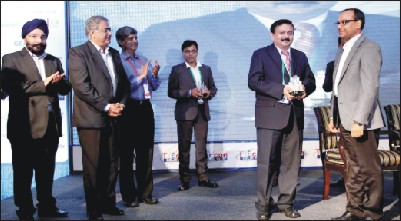
Caption: Vishwaprasad Alva, Managing Director, Skanray Technologies, Mysore, receiving the TiE Lumis Excellence Award-2012 at the TiEcon 2012 awards ceremony in New Delhi on Sept. 28 as other dignitaries look on. The award is instituted by TiE Delhi- NCR & Lumis Partners in 2008. Skanray Technologies is a city-based Primary Healthcare Devices company. TiEcon 2012 is India’s largest entrepreneurial conference.

Mysore, Oct. 16

The Mysore- based Primary Healthcare Devices Company, Skanray Technologies, won the TiE Lumis Excellence Award-2012 at the TiEcon 2012 awards ceremony in New Delhi on Sept. 28.

This award was instituted by TiE Delhi- NCR & Lumis Partners in 2008. Skanray bagged the award after rigorous scrutiny from 100 entries and the selection was based on the business strategy, competitiveness, business scalability & potential and financial stability of the business.

The Jury for this award included Rohtash Mal-Equitigro, Subinder Khurana and Sandeep Sinha-Managing Partner at Lumis Partners, Pradeep Gupta- Chairman Cybermedia.

Vishwaprasad Alva, Managing Director, Skanray Technologies received the award on behalf of the Skanray family.

Geetika Dayal, Executive Director – TiE Delhi NCR said, “The idea of these awards instituted 5 years ago was to discover path-breaking ideas that are transforming into great businesses and are potentially sustainable. It is heartening to see how the winners each year are showing unprecedented promise.”

TiEcon Delhi 2012 under its theme ‘Thriving in Chaos’ showcased not only the success and grit of entrepreneurs who have overcome all odds but also engaged with policy makers and investors to create a blueprint for India’s entrepreneurial ambitions. TiEcon 2012, India’s largest entrepreneurial conference, included more than 1,000 intellectuals from across the world like intrapreneurs, entrepreneurs, startups to engage in rich dialogue with other dynamic entrepreneurs, venture capitalists, industry executives, and thought leaders over two full days of networking, inspiring talks and idea sharing.

source: http://www.StarofMysore.com / General News / October 16th, 2012

RajaRajeswari Medical College and Hospital hosts IMSA DR. R. R THUKRAL SOUTHERN CHAPTER

Bangalore, August 7, 2012:

RajaRajeswari Medical College and Hospital recently hosted the inauguration of the R.R Thukral Southern chapter of the International Medical Sciences Academy in the city. The two day conference happened on 3rd and 4th August 2012 received a footfall of innumerable eminent doctors and medical advisors across the country.

The platform has been created to discuss and resolve varied health related issues, which is witnessing a vertical rise amongst people where in a paradigm shift in the health care solutions also needed to be addressed.

Several renowned medical institutions like National Institute of Mental Health and Neurosciences (NIMHANS), Manipal hospital, Narayana Hrudayalaya and many more participated at the conference to share their experiences in the medical field. Among the most eminent speakers were, Dr. Somashekar, specialist in Oncosurgery of MANIPAL HOSPITAL, Dr. Prathima Murthy, Professor of Psychiatry at NIMHANS, Dr. MuraliManohar specialist in Cardio-Thoracic and Vascular Surgery of Narayana Hrudayalaya delivered outstanding lectures based on their experiences in their respective specializations. They also shared their practical experiences in the profession and interacted with the audiences addressing their queries.

On the occasion, Vijay Anand, Executive Director, RajaRajeswari Medical College and Hospital said, “This conference has given our institution a whole new dimension to explore wider diversities in medical sciences. It has given our medical students a national exposure which will help them in progressing further as medical practitioners.”

The chief guest of the conference, Dr. M. Ramanathan, Vice-chancellor of Annamalai University said, “The aspiring medical students who have been a part of this platform are privileged that they have been given such an exposure at such a young stage of their professional lives. I am also delighted to see the immense growth of the institution and I believe this is the right step in the right direction to produce some of the most efficient doctors in the county.”

The conference, an initiative taken in the state by RRMCH, has been an enriching and enlightening experience for the audience and the institution was appreciated and applauded for the same.

source: http://www.rrmch.org / RajaRajeswari Medical College & Hospital / October 12th, 2012

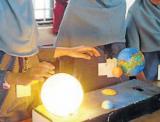
Budding young scientists showcase their skills

It is said that the best way one learns is through experiments. “Engi Connect,” is an inter-institutional science exhibition and competition aimed at promoting innovative scientific ideas among students at school-level by providing them an opportunity to create and display working science models, was held at National Institute of Technology Karnataka (NITK), Surathkal.

Creativity was at its best at the expo. Over 300 students from 50 schools of DK and Udupi districts presented various scientific concepts through simple working models and experiments.

The expo was divided into three categories such as working models, non working models and charts.

Speaking to Deccan Herald, Manju Suresh, a student of Sharada Vidyalaya School, explained the working of an elevator model made out of thread and bobbins. “My model aims at saving energy,” she said.

Shawn, a class seven student of Milagres school, is growing a plant without soil.
“One can grow plants with water and right amount of fertiliser,” he said.

Students from Delhi Public School (DPS), created an electrostatic smoke precipitator. “This model is a solution to air pollution caused by industries. This smoke precipitator attracts smoke particles and filters it and lets out clean air,” say the students.
Glenitta of DPS created ‘Smart security robot,’ which attracted a lot of attention. This robot had an adjustable camera, FM transmitter, wind speed detector and also an adjustable arm which works through a remote.

“I created this model by referring the internet. This robot can diffuse bombs and can be helpful for the army,” Glenitta says.

Students of Canara School have made a heat detector which detects heat, alerts the nearest fire station and releases water automatically.

Students from St Ann’s Girls High School created an ‘Pneumatic Air Gun,’ using water bottles and pipes.

Students of Ramakrishna School explained the methods of producing energy using windmills, hydro electric project, solar power plant, biogas and nuclear plant.

“This is the first edition of Engi Connect. We aim to provide a competitive atmosphere for the students and hence develop creative scientific thinking in them. We have also organised workshops on Android app development, web development and remote control aircraft for students.

This event is a platform for budding young scientists to showcase and develop their technical skills,” said Engi     Connect Joint Convener Uma Bera.

source: http://www.DeccanHerald.com / Home> District / Mangalore, DHNS / October 13th, 2012

Austrian Co’s community service in N’GUD

Caption: AT&S Austria’s Chairman of Supervisory Board Honnes Androsch (extreme right) is seen with Mysore Unit’s Executive Secretary Roopa Rao and Managing Director Ric Rawlley.

Mysore, Oct. 7

An Austria-based company called AT&S India, having an electronic micro-chip industry in Nanjangud, has been providing community services in the areas of health and education for villages in the surroundings for the past several years.

AT&S Mysore Unit Managing Director Ric Rawlley, addressing a press meet in city yesterday, said that AT&S India has been providing regular medical services to the residents of Korehundi village located just behind the plant, in association with JSS Medical Institution.

“Physicians visit this village – which has a population of approximately 800 people — every week to attend to the patients and provide free consultation and medicines. AT&S India has constructed a medical examination centre and also a room for small children who attend the Anganwadi (special educational / health system for poor children),” said Rawlley.

AT&S has set up a new high capacity pump installed at Srikanteswara Water Works in Nanjangud, providing 100 liters of drinking water to Sujathapuram School everyday.

“The industry has been providing scholarships for employees’ children each year, along with free medical facility to nearby village people. Regular free medical checkup and distribution of medicine to Handuvinahalli villagers is being done,” he said.

Other community service works done by the industry are: Sponsoring three eye camps per year in association with Rotary Club of Nanjangud, distribution of uniforms, school bags and drinking water to Korehundi primary school and Anganawadi children, monetary rewards for toppers, computer literacy, sponsoring vocational training to villagers, etc.

AT&S unit is situated close to river Kabini. The company has a captive power generating station to meet operational requirements. The total land area is 42 acres, which is sufficient to take care of all future expansions. The present built up area is 39,300 sq mtrs.

AT&S Austria’s Chairman of Supervisory Board Honne

source: http://www.StarofMysore.com / Home> General News / October 07th, 2012

Best Industrialist Award for B.S. Narayan

Caption: Mysore Industries Association President P. Vishwanath seen presenting Best Industrialist Award to Excel-Par Electronics Company’s Managing Director B.S. Narayan in city on Wednesday as Rotary Mid-Town President R.S. Vishwanath, Secretary L.M. Manoj Kumar and Rotary Mid-Town Professional Services Director Dr. K.A. Prahallad look on.

Mysore, Oct. 12:

The city’s Excel-Par Electronics Company’s Managing Director B.S. Narayan was presented the Best Industrialist Award by former Mayor & Mysore Industries Association President P. Vishwanath at a function organised by Rotary Mysore Mid-Town at Rotary Hall on JLB Road in the city on Wednesday.

Speaking on the occasion, Vishwanath said the entrepreneurs are the real creators of wealth. But it is tragic to note that neither the government nor associations/organisations are willing to help bail out industrialists when they are forced to shut shops for inevitable reasons. At the same time, a successful industrialist will be targeted by one and all, with the authorities working on taxing him. The present mindset of taxing a successful industrialist should go, he said.

Lamenting that nearly 70 per cent of the industries are facing closure due to problems such as power cuts, labour problem, non-availability of raw materials and the like, Vishwanath lauded Excel-Par Electronics company for its excellent management and service.

Referring to Mysore Master-plan-2031, Vishwanath observed that if the government gives its nod for the plan in its present shape, then there can be no doubt that Mysore would soon become a concrete jungle sans any green belt.

The Comprehensive Development Plan (CDP) lacks any green idea. Besides, the earlier notified green belt too has been cleverly amended in the map and shown as agricultural land.

As per the law, the green belt zone in urban areas cannot be changed for any reason. But the CDP has no mention of the green belt and in some cases, provision has been made for constructing buildings in space meant for parks.

He added that a meeting of former Mayors has resolved to submit objections to the CDP in its present form.

Vishwanath also called upon all the informed citizens and industrialists to submit their objections and suggestions to the government in this regard.

Narayan replying to the felicitation, expressed gratitude to the citizens of Mysore and the Rotary for recognising his contribution to the industrial sector.

source: http://www.StarofMysore.com / General News / October 12th, 2012

RBI to banks: Learn from Apple, Devi Shetty

Mumbai:

The Reserve Bank of India has asked banks to emulate two completely disparate organizations – Apple and Narayana Hrudayalaya – to increase their relevance to consumers.

While Apple is considered to be the ultimate aspirational brand, Narayana Hrudayalaya is a specialty hospital – a brainchild of cardiologist Dr Devi Shetty – with the altruistic motive of making complicated surgeries affordable.

Delivering the keynote address at the 6th Economic Times Banking Technology Conclave, RBI executive director G Padmanabhan said that Indian banks have grown their business 10-fold and their net profit and business per employee several-fold without hiring additional staff thanks to technology.

Urging the banks to improve customer experience in electronic transactions, Padmanabhan said they should think about difficulties customers face in navigating the maze of security protocols and ensure that these do not discourage adoption of ebanking. “Banks need to examine how they can make electronic transactions safe and secure while providing customers equal or more ease, comfort and convenience compared to branch banking.”

Padmanabhan cited the example of Apple and Steve Jobs. “Let us not get into his (Jobs’s) style of functioning; (but) the gadgets that he has given to us are world class. Their user-friendly nature makes them the most preferred in their class. Be it the iPod, iPhone or the iPad, they continue to dominate the sales in their respective markets. Can banking in India become the ultimate customer experience?”

He said banks should also crunch costs by emulating Narayana Hrudayalaya, which he described as “Walmart personifying the service spirit of Mother Teresa”. “By thinking differently about everything from the unusually high number of patients it treats to the millions it provides insurance, and by thinking a lot like the world’s largest retailer, the hospital group is able to continually wring out costs,” he said.

Drawing similarities between the two organizations, he said the hospital negotiates for better prices and buys directly from manufacturers, cutting out distributors. Cardiac care, an equipment-intensive specialty, made it easier for the hospital group to expand into other areas that require the same infrastructure. “Can banks look to reduce costs the way Narayana Hrudayalaya has done?” he asked.

source: http://www.m.timesofindia.com / Home / October 10th, 2012

City Doctor-Couple awarded in the US for contribution to Ayurveda

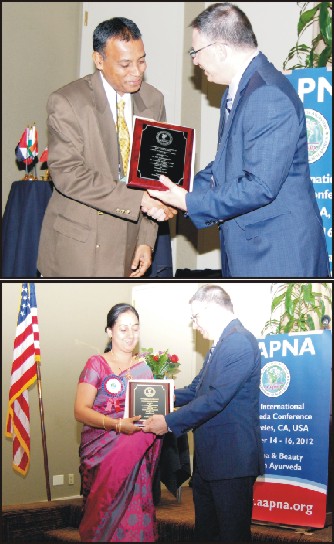
Captions: 1) Dr. N.V. Krishnamurthy (left) receiving the award. 2) Dr. Poornima Krishnamurthy receiving the award.

Mysore, Oct.6:

City’s doctor couple Dr. N.V. Krishnamurthy and Dr. Poornima Krishnamurthy, Directors and Chief Consultants of Prajna Kuteera Ayurveda Centre and Abhijna International Academy of Ayurveda and Yoga, Mysore, were presented the Aryabhata award for excellence in ayurveda research and Dharma award for outstanding contribution to promotion of ayurveda globally, respectively.

The awards were presented to the couple at a glittering ceremony at Los Angeles, USA recently by AAPNA (Association of Ayurveda Professionals of North America). The ceremony was a part of the 4th Intl. Ayurveda Conference on Skin, Spa and Beauty at Los Angeles, California.

Dr. Poornima was also conferred upon the ‘Vachaspathi Award 2012’ for her presentation on The Beauty Concepts in Ayurveda, a paper prepared based on extensive research and documentation over the years. Her paper presentation was adjudged the best amongst all presentations from ayurveda practitioners who had attended from all over the world.

The couple, both gold medallists from the University of Mysore, are prominent scholars in ayurveda and yoga. They have been treating generic and degenerative diseases of patients from all over the world. Dr. Krishnamurthy is also the Head of the Department of PG Studies in Panchakarma at JSS Ayurveda Medical College.

Their medical institutions Prajna Kuteera and Abhijna Academy in Ramakrishnanagar and Keragalli have been rendering yeomen service to needy patients. The institutions are a part of Swami Vivekananda Research Institute of Medical Sciences and Rural Development Centre, Mysore

source: http://www.StarofMysore.com / General News / October 06th, 2012

India’s Karnataka begins electronic auction sales of manganese ore

Singapore (Platts)

Indian state-owned trading company MSTC Ltd has begun electronic auction sales of minehead stocks of manganese ore available with Karnataka miner Sandur Manganese & Iron Ores (Smiore).

The auctions are on the lines of the iron ore e-auction sales the trader has been holding in the southern Indian state since September 2011.

An estimated 25,000-30,000 mt/month of manganese ore is expected to be auctioned over the next two to three months, Platts learnt from the Indian Supreme Court-appointed monitoring committee, which is overseeing the auction.

The first e-auction for manganese ore was held on September 21 in which some 27,560 mt were sold, a Bangalore-based monitoring committee official told Platts. The second auction is yet to be scheduled but is planned for the third week of October. Smiore has about 80,000 mt of manganese ore stock available to be auctioned over the next three to four months, the official added.

In the September 21 auction, the booking price of most cargoes was at a premium of about 25% on average over the respective floor price for lot sizes of 500 mt. Larger-sized cargoes were mostly sold at floor price levels, bid documents show.

The floor price for ore cargoes containing 36-68% Mn had been set at Rupee 6,500/mt ($125/mt). A 500 mt lot of this ore grade was sold at Rupee 7,950/mt and another at Rupee 7,800/mt.

A 4,012 mt cargo of the same ore grade was auctioned at Rupee 6,500/mt to SAIL Refractory Unit, a part of state-owned Steel Authority of India Ltd (Sail). All prices are on ex-stockyard basis. Royalty charges of 4.2%, VAT of 4%, and forest development tax of 12% are additional.

Smiore had been forced to suspend manganese mining operations in addition to iron ore production when Karnataka’s mining ban took effect in August 2011.

Prior to the ban, the company had had environmental clearances to mine up to 600,000 mt/year of manganese ore though production itself had averaged only 300,000 mt/year.

With the Indian Supreme Court and allied investigative authorities reassessing ore production limits in the wake of the illegal mining scandal in the state, Smiore would be permitted to mine only up to 180,000 mt/year of manganese ore when it is allowed to resume mining operations, a Bangalore-based company official told Platts.

It could take another two months for Smiore to resume manganese ore production, the official added.

Smiore operates a 4,000 mt/month silico-manganese smelter at Vyasanakere in Karnataka’s Bellary district, some 60-70 km east of Sandur. The works hosts two furnaces of about 2,000 mt/month capacity each but only one furnace is presently operational, producing about 1,500-2,000 mt/month of silicon manganese, the official said. The furnace is fed with manganese ore from stocks presently available with Smiore.

Although MSTC has been conducting e-auction sales for Karnataka-origin iron ore since September 2011, it was only in May this year that the Supreme Court permitted the sale of silico-manganese ore from Smiore’s stocks, Platts noted from the company’s announcement to the Bombay stock exchange earlier this year.

Only domestic end-users are permitted to bid in the auction sales while traders and exporters are barred from participation.

source: http://www.platts.com / Singapore (Platts) / Home> News & Analysis /  October 03rd, 2012

–Anitha Krishnan, anitha_krishnan@platts.com –Martin O’Rourke, martin_orourke@platts.com

Vyomesh Joshi joins Wipro board

Wipro on Monday announced the appointment of Vyomesh Joshi, an information technology industry veteran to its board of directors with immediate effect.

Joshi will serve as an independent member on the board and has spend having spent over three decades in the industry. He was until recently the executive vice-president of Hewlett-Packard’s Imaging and Printing Group.

Welcoming him to the board, Wipro Chairman Azim Premji said, “He brings in a unique combination of wisdom and technical capabilities. I am sure that Wipro will benefit from his insights and experience.”

Joshi received Masters’ Degree in Electrical Engineering from Ohio State University, US and had joined Hewlett Packard in 1980 as a research and development engineer and retired in March 2012 after a 32-year career with HP

source: http://www.DeccanHerald.com / Home> Business / New Delhi, DHNS / October 01st, 2012