Category Archives: Science & Technology

Karnataka NGO wins global green energy award

Mangalore, MAY 31:

The Karnataka-based NGO, Shri Kshetra Dharmasthala Rural Development Project (SKDRDP), has won Ashden Gold Award for 2012.

The Ashden awards were founded in 2001 to encourage greater use of local sustainable energy to address climate change and alleviate poverty. Ashden’s patron is the Prince of Wales.

A press release by the London-based Ashden said that the Dharmasthala-based SKDRDP was awarded the overall Ashden Gold Award of £40,000 in prize money at a meeting with the Prince of Wales in London on May 30.

Quoting the judges of the Ashden award, the release said that the project is a fantastic example of how ethically managed microfinance can deliver sustainable energy to the poor, demonstrating that providing consumer loans for energy makes sound social, environmental and economic sense.

The project provides affordable loans to families in the area, helping them buy renewable energy systems that improve their quality of life. Key to the success of this programme, which has provided nearly 20,000 energy loans, is self-help groups that help people make informed choices on what energy products they buy, it said.

Presenting the award, Dr Kandeh Yumkella, Director-General of UNIDO and Chair of UN-Energy, urged governments around the world to increase their support for clean energy pioneers. “The Ashden 2012 winners are exposing the myth that poor countries cannot stimulate growth without degrading the environment. They are demonstrating that sustainable energy stimulates green growth and new jobs, lifts people out of poverty, improves health and opens up new educational opportunities,” he said.

Dr L.H. Manjunath, Executive Director of SKDRDP, said that receiving an Ashden Gold Award was a great step in recognising that poor people need financial services to acquire sustainable energy assets. For too long, micro-credit only meant improving livelihoods. This award will redefine the scope of micro-credit, he said.

SKDRDP, which is headquartered at Dharmasthala in Dakshina Kannada district of Karnataka, has presence in 16 districts in the State. Other winners of this year’s award are: IBEKA, a community-owned micro-hydro programme in Indonesia; GIZ/INTEGRATION, a micro-hydro programme in Afghanistan; iDE/Hydrologic, an energy-saving water filter in Cambodia; and Barefoot Power, an affordable solar power provider in East Africa. SKDRDP has been selected for the overall Gold Award winner, it said.

vinayakaj@thehindu.co.in

source: http://www.TheHinduBusinessLine.com / Home> Industry & Economy> Economy / by The Hindu’s Bureau / May 31st, 2012

Minister for Education launches Ireland India Institute at DCU

The Minister for Education and Skills, Ruairí Quinn TD, has launched the Ireland India Institute, a new national centre at Dublin City University to drive enterprise, research and academic collaboration between Ireland and India.

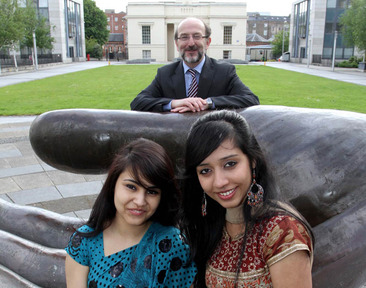
Professor Brian MacCraith, President of DCU with DCU students, Rachita Singh and Abina Philip at launch of DCU’s Ireland India Institute

Through a series of targeted initiatives, the Institute aims to practically support strategic partnerships in business, education and research between the two countries. The initiatives will include:

  • An Ireland-India Research Fund, which will help fund research into the grand challenges affecting both states in areas such as sustainable technologies, health and multiculturalism
  • The provision of Ireland India Institute Scholarships to support Indian scholars and researchers in their studies in Ireland
  • An Ireland India Institute Seminar Series which will bring some of the most significant thinkers and business leaders on contemporary India to Ireland
  • In addition, the Institute will provide a suite of academic and extra-mural programmes in areas relevant to contemporary India.

In a key development, Ms Kiran Mazumdar-Shaw, Indian entrepreneur and founder, chairman and managing director of Biocon, one of the world’s largest biotechnology companies, has agreed to become patron of the Institute.

Commenting on the launch of the Institute, Mazumdar-Shaw stated: “I am delighted to be patron of this important Ireland-India initiative.

Contemporary Ireland and India face the same global challenges, issues such as healthcare, ageing and sustainability. The Institute will help focus our joint efforts in achieving common solutions to these challenges. It will become a focal point for the study of contemporary India and a meeting place for all friends of India.  I welcome DCU’s continued strategic focus on my country which is based on academic and research excellence.”

Minister for Education and Skills, Ruairí Quinn, who formally launched the Institute, commented: “Dublin City University’s strategic focus on contemporary India has resulted, already, in a series of research collaborations with the sub-continent’s most prestigious Institutions, particularly in the areas of science and technology. The establishment of the Ireland India Institute will see DCU build on that record to host a national centre for the study of contemporary India. As Minister I have sought to drive the international agenda in our higher education institutions. I am delighted with this response to that drive.”

Professor Brian MacCraith, President of Dublin City University, stressed the importance of engagement with India as part of his overall vision for DCU: “On becoming President of DCU I made engagement with contemporary India a strategic priority for the University. Our faculty and researchers have, since that time, made great strides in developing active research projects with our Indian partners in Institutions such as IIT Madras, IISC Bangalore, JNU and IIT Delhi and others. That unprecedented degree of collaboration will be developed and fostered in the coming years through the Ireland India Institute which will become the hub for all those in Irish enterprise and academia who seek to develop our common goal of deeper Ireland India collaboration.”

The Ireland India Institute is hosted at Dublin City University and at www.irelandindiainstitute.ie.

source: http://www.businessandleadership.com / Home> Exporting / by Bernice Barrington / June 18th, 2012

Docs on call for seva

DFS is a platform for volunteers from the medical and non-medical professions to help the needy

December 26 2004, tsunami struck the southern coast. Dr Dayaprasad G. Kulkarni was an intern at a hospital in Kolar. He raised about Rs 2 lakhs and went with a couple of his doctor friends to Nagapattinam to help with the relief work. After which he “knew I had to do something more.”Armed with a MBBS degree from the Devaraj Urs Medical College, Kolar, he did a stint with Doctors Without Borders in Chattisgarh treating villagers who were affected by the Naxal presence there.  “I realized that there were international doctors working these areas, but our own Indian doctors were absent,” says Dayaprasad. “In fact, there are so many international organizations like Red Cross and iVolunteers but specifically for the medical fraternity, there isn’t anything on a national scale.”

After a master’s degree in clinical research from UK, Dayaprasad  returned to India and  started an organization for the children and people from the marginalized society – Madhyama Prasaran and Scientific Research Foundation. Dayaprasad met  with Venkatesh Murthy, founder of the Youth For Seva, and was soon associated with Doctors For Seva (DFS).  He speaks of DFS: “Doctors For Seva was created in 2010 to change the mindset of how healthcare is perceived. Years back, doctors were respected for the services rendered. Today, it is about which hospitals they are associated with. Plus, in healthcare significant amount of money is spent in tertiary care (terminal days) rather than primary and preventive healthcare. The main ideology behind DFS is to create a  platform wherein doctors, nurses and anyone in the medical or the non-medical fraternity can volunteer to help provide better healthcare. This also includes homeopathy and Ayurvedic practitioners as well.”
DFS identifies areas needing healthcare, arranges for resources and creates a database of volunteers. It also interacts with the government for facilities and infrastructure. “The idea is to involve the neighborhoods as far as possible,” says Dayaprasad. He is excited about their flagship project Doctor At School that started off in Bangalore last year. He explains: “Doctor at School involves identifying a government school in the neighbourhood and finding volunteers – doctors, hospitals and pharmacies to serve here.” The project has one general pracitioner or pediatrician assigned to a school.  He/she along with other volunteers conduct general health checkups for the children at the school during the first three months. Volunteers will hold year round general health awareness programmes every weekend at the school. The following three months will see follow-ups with elective procedures (like deformity correction) taken up. Malnourished children are given supplements. Another three months,, children come up with skits and plays that are related to health care topics. The last three months being school holidays are used for maintaining records and other administration work. “As far as possible, we try to keep things absolutely free for the patients. Neighbourhood hospitals are requested to lend their facilities for free. The best part is that after a year, we now can scale it up anywhere in India. Those interested can use our handbooks detailing the processes involved,” says Dayaprasad. Today the project covers 100 schools.
Dayaprasad has consciously taken the path of community service. “I live with my parents so food and boarding is taken care of. An honorarium comes from my work at Jagruthi Trust, a home for HIV children, and Youth for Seva. I really don’t need much to live,” he says. A theater enthusiast, he has done several plays on the healthcare theme and short films on child abuse and homosexuality. His aim for DFS is simple: Get people involved for something as basic and important as primary healthcare.
If you want to know more about Doctors for Seva contact 9632306256 or send an email to info@doctorsforseva.org. They are also on Facebook.

source: http://www.bangaloremirror.com / Home> Sunday Read>  City> Special / Bangalore Mirror / by Jayanthi Madhukar / Sunday, May 27th, 2012


Digital eyes that ‘speak’ for the blind

Four engineering students juxtapose character recognition and text-to-speech technologies to help visually impaired students

Braille is the script used by the visually impaired. The pitfalls of the script are that not many books are printed in that form. There is just one fortnightly magazine in the country, but it does not reach the interiors.

The problem is that it is not cost effective to print novels or general knowledge books in Braille. In order to overcome this problem, four students of M S Ramaiah Institute of Technology — Abrar Ahmed, Anil L P, Harish Kumar B and Sadikul Amin — have come up with a device which can recognise printed text and reproduce the same in voice format, in a chosen language.
The students took up this project — named Eyes That Speak — following visits to schools for visually impaired persons in and around Bangalore. They were disappointed by the facilities provided. They came up with a device that juxtaposes the concepts of OCR (Optical Character Recognition) and text-to-speech. OCR is a field of research in artificial intelligence and computer vision. It allows computers to recognise alphabets without human intervention. It is crucial to the computerisation of printed text, which can be electronically searched, stored compactly, displayed online and used in processes such as translation, text-to-speech and text mining.
The goal of text-to-speech is automatic conversion of text to spoken form. This field of speech research has witnessed significant advances over the past decade with many systems able to generate output that closely resemble a natural voice.
Harish explained the working of their device. “A small web cam is used to capture an image of the printed text. The image is processed to make sure
that the text is clear before it is passed on to the OCR algorithm, which enhances the red-blue-green image and sends it to a specially designed application for processing. The application uses two steps. It analyses the text lines, breaks each word and recognises the language before giving the output through an audio device,” he said.
Sadikul said, “The aim is to increase the accuracy of the OCR. We can satisfactorily say that our model can recognise even slightly tilted text.”
Anil said, “Our case study concluded that there were limited facilities for reading for the visually challenged. Eyes That Speak is aimed at providing easy solutions to the reading problems faced by visually impaired students, but it has more potential.”
“OCR is widely used in many other fields, including education, finance, and government agencies. Our model can also be used to process cheques in banks without human involvement. In order to save space and eliminate sifting through boxes of paper files, documents can be scanned and uploaded on computers,” added Abrar Ahmed.
source: http://www.bangaloremirror.com / Home> News> City> Story / Bangalore Mirror / by Purushotam Rao and  Jinil M / Sunday, May 27th, 2012

Wipro bags 10 year deal from Manipal Health Enterprises

New Delhi:

Wipro Infotech, the India and Middle East IT business unit of Wipro, said it has bagged a 10-year contract from Manipal Health Enterprises.

As part of the deal, Wipro will implement its Hospital Information System (HIS) solution and data migration services across Manipal Group Hospitals, Wipro said in a statement.

Financial details of the contract were not divulged. The proposed HIS application is patient-centric and will provide immediate access to clinical, administrative and billing data for use by hospital staff, which is required for efficient functioning of a hospital, it added.

It will also ensure high levels of automation, better availability of information, reduction in patient’s waiting time and better utilisation of revenues.

Manipal Health Enterprises’ network of hospitals manages around 4,900 beds through 15 hospitals, spread over 5 states in the country. It has a clinical and healthcare pool of over 1,500 doctors and 5,500 nurses, paramedics and support staff.

MHE’s hospital network annually services around 2 million patients in India and overseas.

“Healthcare is a focus vertical for Wipro worldwide, and we have over 120 satisfied customers successfully leveraging our HIS across India, Middle East and Asia Pacific. We are confident of delivering an efficient and cost effective solution to Manipal Hospital,” Wipro Senior VP, Business Head (India and Middle East) and Global Business Head (Infrastructure and Services) Anand Sankaran said.

source: http://www.articles.timesofindia.indiatimes.com / Home> Tech> Enterprise IT / PTI / June 01st, 2012

Infosys Awarded Pegasystems Partner Excellence Award

Innovative insurance customer process management platform allowed major health insurer to improve customer service productivity by more than 80 percent

BANGALORE, India, May 30, 2012

Infosys, a global leader in consulting, outsourcing and technology, has been awarded the Pegasystems “Excellence in Solution Development” award for a best-in-class insurance customer service delivery platform that dramatically improved call center productivity at a Fortune 500 life insurer by more than 80 percent.

The Infosys insurance practice jointly developed the solution with Pegasystems, a leader in business process management and software for customer centricity. By consolidating multiple data screens into a single dashboard, the customer service delivery platform allows call center professionals at the Fortune 500 life insurer to reduce wait times from 24 minutes to four minutes. Infosys achieved the results in less than 11 weeks after launch by leveraging Pegasystems’ Customer Process Manager for Insurance solution.

“Infosys is an innovator in smart uses of technology in the insurance industry, and is, along with our other alliance partners, a critical part of Pega’s global team,” said John Barone, vice president of global strategic alliances at Pegasystems. “We congratulate Infosys for its highly strategic approach in configuring Pega technologies that result in transformative solutions.”

The Infosys insurance practice has deep domain expertise in life and annuities, disability, long term care, property and casualty, investments, and other areas, as well as specialties in financial services as a whole. Infosys helps clients transform into the “next generation insurance carrier” through its innovative products, platforms and services that streamline policy administration, improve distribution, and facilitate data-driven underwriting.

“This award is a direct reflection of our strong insurance and technology credentials, as well as our ability to effectively implement Pegasystems solutions,” said Yezdi Mehta, vice president and head of the Americas insurance practice at Infosys. “It is a testament to our ability to help build tomorrow’s enterprise in the insurance industry, achieved with improving customer experience and transforming core business functions.”

source: http://www.marketwatch.com / PRNewswire via COMTEX/ May 30th, 2012

Bangalore: Doctors upgrade state-run maternity home’s condition

Bangalore:

A team of gynaecologists in Bangalore have taken it upon themselves to upgrade a corporation-run maternity home. Dr Latha Venkataraman and her team of 15 specialists are improving the rate of institutional deliveries in their area.

“I believe this hospital was functioning very well. I think it was started in 1962 and most of the people from this area used to come here. Unfortunately, as years went by the facilities and also the availabilities of the doctor fell or became a rarity. Thereby, the patient’s attendance to the hospital also fell,” says Venkataraman.

Two months back, Dr Venkataraman and her team of 15 specialists from the nearby private Rangadurai Hospital decided it was time for change. They roped in two gynaecologists for 8 hours daily, procured funds to get better equipment. Now, the maternity home boasts of at least 6 to 7 deliveries every week and has logged 3 surgeries.

India has the highest number of obstetricians and strangely also ranks among the highest in maternal mortality. Deaths of mothers soon after childbirth are mostly preventable. It’s in that scenario that this kind of an initiative speaks volumes.

Dr Prabha Ramakrishna, Gynaecologist, says, “See childbirth is not a disease, it is something which happens naturally to most women and it is sad that people lose lives during childbirth and that is where we need to be alert. I want to put a stop to it completely, because it is not feasible.”

Venkatraman says, “It is time we gave quality care to all women irrespective of socio-economic status. Specialists and superspecialist care should be available in their vicinity. These are simple things and simple medications can save lives. Simple things done in a simple way without missing and messing can save lives.”

And Dr Venkatraman’s efforts are showing. Over the last few weeks, the maternity home has seen a steady rise in the number of patients. In six months, the doctors plan to have enough support for 24/7 operations and the Bangalore Mahanagara Palike is looking out for more private-public-partnerships to revive its 93 hospitals.

Shankarlinge Gowda, Commissioner, BBMP, says, “Shortage of qualified doctors is an issue because we do primary care and most of the doctors are just MBBS and we send these doctors after recruitment, to these PG courses. But if the non-governmental organizations can bring in expertise in maternity care, in pediatric care and other specialties, we would welcome them.”

In a country where healthcare is out of reach to the poor, doctors like Latha Venkatraman are truly a messenger of God!

source: http://www.ibnlive.in.com / Home> India / by Deepa Balakrishnan , CNN-IBN / May 30th, 2012

Modern Family Doctor to set up health centres in Pune, Chennai

Bangalore, MAY 30:

Bangalore-based healthcare company Modern Family Doctor (MFD) will be setting up primary healthcare centres in Pune and Chennai soon. It currently operates 11 clinics across Bangalore and is in the process of setting up 10 more across the city.

The one-year-old company runs a chain of clinics focusing on providing primary healthcare to patients across all age groups under the brand name ‘The Family Doctor.’

The centre attends to basic healthcare needs of consulting, diagnostics, treatment and medication services, and has a pharmacy attached to the clinic.

According to Mr Naresh Malhotra, director of the company, primary healthcare accounts for 60 per cent of the overall healthcare delivery market. Its annual growth is projected at 15 per cent.

The company expects to set up over 300 clinics across the country by 2014. It costs about Rs 25 lakh to set up one centre, Mr Malhotra said.

The company, funded by Silicon Valley Bank, employs about 70 doctors who work full time at the centres, and is planning to hire another 200 doctors over the next few months.

As part of the expansion plans, the company is in discussion with various corporate organisations and apartment complexes to set up clinics on their premises (full-time or part-time), and is also planning to organise healthcare camps in schools.

MFD has partnered with Lal Pathlabs for laboratory investigation support, with Narayana Hridayalaya for ECG services and Star Health Insurance to provide insurance packages to its patients.

sushma.un@thehindu.co.in

source: http://www.TheHinduBusinessLine.com / Home> Industry & Economy> Marketing / by The Hindu Business Bureau / Bangalore, May 30th, 2012


When healthcare seeks help

Even as hospitals increasingly adopt cloud computing, there are still a lot of hurdles in the way.

Dr Devi Shetty, Chairman and MD, Narayana Hruduyalaya(NH) wants to change the dynamics of healthcare in India. He is changing the dynamics of hospitals by setting up beds at the lowest cost, in as little time as possible. To facilitate this, NH recently tied up with HCL Infosystems to leverage cloud computing technologies for various applications. Dr Shetty reckons this partnership will help them to set up 10,000 affordable beds and keep healthcare costs low.

Similarly, last year, HCG set up Centre of Excellence for cancer care with the help of Siemens. As a part of this collaboration, Siemens will work with HCG to develop software, undertake R&D and conduct training programmes. These will provide better alternatives to clinicians and more effective treatment to patients.

Last year, Mumbai-based SevenHills Hospital opted for a high performance network from CommScope. The 20 million sq. ft. hospital has more than 15,000 network outlets. The hospital has many vital systems connected to its networks and needed a constant, real-time view of what is happening robust cabling system. In May, Max Healthcare deployed Dell’s services and created an information technology ecosystem with the adoption of Healthcare Information and Management Systems Society (HIMSS). According to Max Healthcare, it has achieved ‘Stage 6′ on the Electronic Medical Record (EMR) adoption model, which indicates that a large portion of patient records are electronic with minimal usage of paper charts. “Max Healthcare’s physicians receive evidence-based alerts as they enter electronic orders for their patients and a closed-loop medication administration system to maximise safety processes,” said Dr Ajay Bakshi, CEO & MD, Max Healthcare.

This is a change from earlier days when hospitals preferred to develop their own IT systems and manage it. However, due to lack of skill sets and costs associated with engineers, healthcare providers have resorted to outsourcing. “We feel that technology is best managed by specialists and at the same time reduce our capex which is consistently going up,” said Dr Shetty.

As hospitals start adopting IT, the market for technology in India is growing. ‘A recent trend in healthcare is the use of mobile devices to review medical images,” said a senior official from Siemens Healthcare.

Specialist hospitals face a huge problem in terms of training their physicians and all this adds considerably to a hospital’s costs, which in turn is passed on to the patients. “The earlier trend used to be of clinicians travelling overseas for training and research and development. Now they will be trained in India at HCG. The collaboration with Siemens is a step in this direction,” said Dr B.S. Ajaikumar, Chairman, HCG.

According to management consulting firm Zinnov, cloud computing in the Indian healthcare sector will be an estimated $600 million by 2020. Current healthcare spending stands at $54 billion and is expected to reach $164 billion by 2019-20. Also, the estimated annual IT spending within existing hospitals in India is approximately $191 million currently and is expected to reach a $1.5 billion by 2020. Hospital chains like Apollo, Fortis and others have adopted IT and are looking at newer ways to provide healthcare services.

Other factors that are driving the adoption of IT systems are the emergence of medical tourism, accreditation and the increasing use of health insurance. Electronic Healthcare Record Communication (EHRs) and Picture archiving and communication system (PACs) are likely to be the biggest opportunities in the market. Patient administration systems will also see high interest. The Confederation of Indian Industry (CII) estimated that the medical technology market in India is at $2.75 billion in and pegged it at $5 billion by the end of 2012.

TECHNOLOGY STILL AILING

Despite the adoption of technology there is still considerable room for more that can impact all the stakeholders in the ecosystem, according to Mr Harsh Chitale, CEO, HCL Infosystems. Hospitals can provide better care and manage costs better internally and patients can look for lower healthcare costs (in case of regular checkups).

“In India a majority of the healthcare providers do not talk to each other. So, there is no way a large blood bank puts out information on shortages in real time or exchange patient related information,” said Nitin Khanapurkar, Executive Director, Advisory Services, KPMG India. Agrees Mr Laxman K. Baliga, COO, Anthelio Business Technologies. Indian healthcare market is underpenetrated for IT systems and services. “It is also a highly price-sensitive market. Vendors will need to have India-specific strategies and pricing. The spending will be largely driven by large corporate hospitals and government,” he said.

This problem is accentuated when you look at the numbers. About 90 per cent of secondary and tertiary healthcare facilities in India are in cities and towns, far away from the rural areas where 68 per cent of the population lives. Hence, remote areas continue to suffer from the absence of quality healthcare facilities. What’s more, due to the poor conditions of rural health centres it becomes impossible to retain doctors in villages.

Telemedicine was touted as an answer to some of the ills. It refers to the use of telecommunications for the diagnosis and treatment of diseases using technologies like video conferencing from distant places. However, telemedicine has not taken off as expected. In the majority of cases, the requisite infrastructure has yet to be laid down and, even in places where it is already available, the costs are high. Bandwidth constraints lead to the non-transmission of images or very low quality ones being beamed. In most cases, doctors would settle for viewable images, but some require high definition ones, according to the head of a leading hospital chain who did not wish to be named.

There are power shortages in rural areas and this in turn makes patients to go to the closest town for undergoing a diagnosis. Hospitals on their part say that technology costs are high and they are grappling with manpower shortages.

India has one doctor for every 1,700 patients while the ideal doctor-patient ratio is about 600 patients for every doctor. Even in China and Brazil, a doctor attends between 900-950 patients while in the US the doctor-patient ratio is 1:390. This throws up a gap of 1.4 million doctors and 2.8 million nurses, according to World Health Organisation (WHO) norms. The gap in demand-supply scenario becomes starker in rural areas when you consider the fact that 60% of healthcare resources including doctors, skilled nurses and paramedics reside in the urban centres as per the India Health Ministry Report 2010.

The per capita spend on medical technology in India is about $2 as against $5 for China and $231 for Germany. Also, CII rues poor legal backing for medical technology segment. “It has no separate legal status and is regulated by Drug Controller General of India,” according to a CII official. As per the Planning Commission, India is short of 6 lakh doctors, 10 lakh nurses and 2 lakh dental surgeons.

Then there is the issue of privacy of patient records that risk being stolen or lost. Despite most companies following international information security norms for healthcare like HIPPA, HL7 and DICOM, technologies like cloud throw up these challenges and make it more complicated than in the earlier days when IT infrastructure was within the premises of a hospital.

Some hospitals like NH who plan to work on newer models that have the potential to change the economics of healthcare services as conventionally known are hoping that technology could aid them in their journey. As Victor Hugo once said, “Nothing is powerful as an idea whose time has come”. Indian care givers should take note of that.

(With inputs from K.V. Kurmanath)

venkatesh.ganesh@thehindu.co.in

source: http://www.TheHinduBusinessLine.com / Home> Features> EWorld / by Venkatesh Ganesh
Where fear ends, learning begins

As frustrated students turn their backs on the many marvels of science, it wouldn’t be too far from the truth to say that theory can really bog down even the most enthusiastic spirit. So, children digress from the idea of innovation, preferring to pick an engineering degree or a media course over a life of research and discovery.

When Dr Sujata Virdhe discovered the many joys of experiential living, there was no stopping her on her journey to her dream. She quit a job at the Indian Space Research Organisation where she worked as a scientist in the fields of satellite power systems, solar energy and indigenisation of electronic components for two decades, and decided to follow her dream.

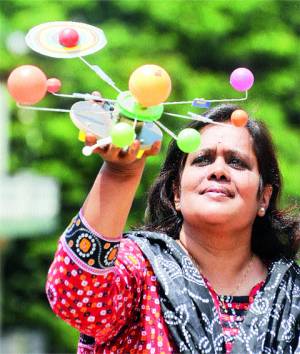
Dr Sujata Virdhe —R. Samuel

To open the eyes of every child to the magnificent universe of which we are all a part, where miracles happen every day should we choose to see them.

Catering to children between the ages of 10 and 15, the Sunday Science School (SSS) has already received a wonderful response from Maharashtra, where it was first started. The first branch in Bengaluru was set up in Domlur, with the second being inaugurated in Vijayanagar on Sunday. Dr Virde is looking at centres in Mysore, Dharwad, Hubli, Mangalore and Udupi.

“Eminent educationists feel that there is a need for hands-on learni of science, which is made unduly complicated by definitions and descriptions. This takes away the real beauty of the subject and students not only lose interest but become terrified by science,” says Dr Virdhe.

Hence, the science-by-doing module, which is aimed at kindling a love for science and research in every child. “Trained science communicators can communicate science using our readily available practical material to prepare our children for logical, rational and scientific thinking,” Dr Virdhe says.

It all started when Dr Virdhe met students whose parents were very worked up about their children being unable to grasp even the simplest scientific concepts. “I took them to the kitchen and taught them, which was when I discovered experiential learning and how important it is,” says Dr Virdhe.

Driven by a deep interest in the subject, Dr Virdhe began to collect information from textbooks for 7th grade to 12th grade children, designing her own syllabus to make learning science as hands-on and fun as possible. “The SSS wouldn’t have happened without my brother, Suyash Dake, who quit a lucrative IT job in Pune to help me realise my dream,” she says.

As a hobby, Dr Virdhe began designing tools and toys that would teach children science in the most fun way possible. “I happened to give some students a practical workshop on photovoltaic cells, which is how I knew that my passion was designing toys to teach children.”

While there are many, many products out there that can help children learn, most don’t reach them at all, for parents are simply too busy to bother. “We want to fill this gap in parenting because many parents don’t really have the time to spend with their kids,” she says.

At SSS, children are provided with all the materials they need and asked to conduct experiments with them. While the kids are given the help they need, they are, for the most part, allowed to
figure things out on their own. “We have two hours a week and when I see how engrossed the children become, it makes me want to take this to schools, too.”

Parents these days, feels Dr Virdhe, simply don’t have the time to run around for their children. Even if they are willing to do what it takes, finding materials is so hard to do and involves so much
running around that the task is given up on even before it is begun.

The first level makes sure that the children are given a strong foundation, while Level 2 has more
in-depth experiments in electronics, electromagnetism, apex microscopes and the like. “It’s like high school science and a lot more,” explains Dr Virdhe.

Dr Virdhe says the response in Maharashtra was overwhelming and has motivated them to push the dream even further. As children are allowed to explore their boundaries at their own pace, the ultimate aim of education is slowly achieved, for kids are not left with truckloads of information through which they must navigate. Instead, they are left with a tool far greater than that — imagination.

source: http://www.DeccanChronicle.com / Home> Channels> Cities> Bengaluru / by Darshana Ramdev / DC, Bengaluru / May 28th, 2012