Category Archives: Travel

Embrace the old world charm

AirlinesHotelBF14mar2015

Situated on Lavelle Road, ‘Airlines Hotel’ has remained a legendary landmark for 47 years now. Started in 1968 by SN Rao, it holds the record of being the first drive-in restaurant in the City.

‘Airlines’, as it is fondly known as, is a sought-after ‘adda’ for quick breakfasts, and has witnessed the discussions of many businessmen and college students.

“My father, SN Rao, started a drive-in restaurant called ‘Hotel Sujatha’ in Mysore in 1965. This was the first drive-in restaurant in Karnataka. After its success, he wanted to get the concept to Bengaluru and he saw this place, which was already named ‘Airlines’, and was owned by Mr Thomas. He took Mr Thomas to ‘Hotel Sujatha’ and introduced him to the concept of a drive-in restaurant and it all began there,” says Diwakar Rao, the owner of ‘Airlines Hotel’.

The tradition of hanging out in ‘Airlines Hotel’ has been passed down from generations and it has remained the most adored ‘adda’ of people of all age groups. There was a time when one could get a glimpse of all the ‘fancy’ cars in the City parked inside the premises of this restaurant which is noted for the taste of its unmatched ‘sambar’, the crispy and crunchy ‘dosa’, the soft and fluffy ‘idlis’, which are served with the traditional ‘sambar’ and ‘chutney’, tastes that one pines for.

Since its inception, and there has been no change in taste of their iconic ‘sambar’. “We have a constant check on quality and our dishes are cooked in a traditional Mangalurean style. We also have a cook who has been working here for the past 35 years now. He trains the new cooks and that is how we have maintained the same taste,” adds Diwakar.

The restaurant is definitely noted for its South Indian dishes. But it does not fail to delight those who love North Indian cuisine. Having an age-old menu with blue words printed on a white sheet, this drive-in offers ‘chola bhatura’ and ‘paneer rolls’, dishes that dominate their North Indian menu.

They also offer Chinese manchurians and for evening snacks, one can hog on a delectable variety of ‘chaats’. And each of these dishes have an assigned timings and the hotel doesn’t fail to maintain its aesthetics. The beverages, especially coffee, served in a long glass tumbler, has never disappointed its customers.

A legend in itself, this restaurant is noted to be visited by other legends like MF Hussain, Dr Rajkumar, BM Oberoi, Kumar Bangarappa and many more.

The regulars here include actors Shiva Rajkumar and Puneeth Rajkumar. The place has now become a hub for many clubs, including the owners of ‘Harley-Davidson’, ‘Vespa’, ‘Fiat110’ and many more. “There are 30 to 40 members of these clubs who come here on Sundays. They address their meetings over breakfast and then carry forward their plans,” he says.

From being a premium hotel with banquet hall, this place has managed to stay as the popular drive-in restaurant.

It has undergone ups and downs due to the licence issue and there has also been a time where it shut down for four months. Social media sites were then flooded with messages in support of the restaurant.

“Those four months were a nightmare. But the support from all the Bengalureans has helped us overcome the issue and I am thankful to everyone who supported us,” wraps up Diwakar Rao.

source: http://www.deccanherald.com / Deccan Herald / Home> Supplements> MetroLife / by Prajna GR / March 07th, 2015
Biriyani that Royalty relishes

Created at Sri Kanteerava Narasimharaja Wadiyar Sports Club, Mysuru

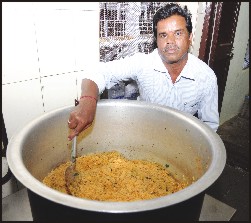
Narayan is seen preparing the famous mutton Biryani at Mysore Sports Club

by S.N. Venkatnag Sobers

In his recent interview to The Sunday Times, Yaduveer Krishnadatta Chamaraja Wadiyar, who has been adopted to the Mysore Royal Family of Wadiyars, when asked about his favourite food said, ‘‘I cannot say I have a favourite. But, if cornered, I would probably have to go with the famous Biryani from the Mysore Sports Club.”

In fact, he is not alone. Thousands of Mysoreans have been relishing the famous mouth-watering mutton biryani at the Mysore Sports Club over the past few decades.

The man behind the famous mutton biryani is Narayan, who has been working at the Mysore Sports Club for the past 32 years. Wanting to discover the man who created a Biryani that satiated the royal palate, Star of Mysore went to Sports Club to talk to this master chef. He is Narayan.

Speaking to Star of Mysore, Narayan said that members of the Royal Family including late Srikanta Datta Narasimharaja Wadiyar, Chaduranga Kantharaj Urs, Gayathri Devi, Yaduveer Krishnadatta Chamaraja Wadiyar and others were fond of the biryani cooked by him.

Mysore Sports Club introduced Mutton Biryani to its guests in 1989 and since then, it has been relished by many. Earlier to this, cooks from outside were invited to prepare biryani during events organised at the club.

Narayan said that he learnt the art cooking biryani through his guru Abdul Sattar, who lived in Mandi Mohalla.

“When I joined the Sports Club as a kitchen assistant, the then Secretaries B.A. Nanaiah and Dr. N.M. Srinivas encouraged me to learn the art of cooking biryani and since then, I have been cooking the delicacy,” he said.

Speaking about his cooking style, Narayan said that he starts preparing for biryani at around 12 noon by marinating mutton and adding necessary masala. Once the mutton is cooked, the half cooked basmati rice is added to mutton and is kept for blending for about one-and-a-half hours. Later, the hot biryani is served to the guests at the Club from 7.15 pm.

Everyday around 15-20 kg mutton biryani is prepared at Mysore Sports Club and not bit of it remains in the end. In fact, the biryani is so famous that even the non-members of Mysore Sports Club do not miss out a chance tickling their taste buds whenever they get an opportunity to visit the club. In fact most of the non-members demand the club members not to book them rooms at the Club but for a parcel of mutton biryani.

Given an opportunity, one must visit the Mysore Sports Club to savour this gastronomic delight.

source:http://www.starofmysore.com / Star of Mysore / Home> Feature Articles / Thursday – March 05th, 2015

Sommer House: Tales from the jazz age

SommerHouseBF09mar2015

Bengaluru: 

Back in the 1950s, when Bangalore was like something out of a F. Scott Fitzgerald bok, Whitefield was a small township on the outskirts of the city. On arriving at the railway station, one took a horse-drawn carriage home through the small, winding streets. It wasn’t long, however, before development put paid to much of that old world charm.

The Sommer House, a colonial bungalow that has been restored to its former beauty by long-time resident Sulaiman Jamal, aims to recreate some of that old world charm. Thrown open to the public on Monday evening, as a community center that gives senior citizens and retired army officials that long lost society whirl, Jamal, whose association with the area began when he set up his factory there said: “We have lived in Whitefield for ten years now, but when I first visited, it was a pretty wild place,  Every six months, another bungalow would be torn down.”

The two-bedroom gabled roof Sommer House, bought two years ago by Jamal, replete with antique furniture, is home to a piano that belonged, back in the day, to the Defence Services Cinema. The cottage, sits surrounded by a garden, with restored vintage cars dotting the property.

Jamal would like the House to host programmes like piano nights, dancing, catered dinners and plays. Most importantly, it will also have a free catered dinner every month for senior citizens.
Beth Chapman, Pre­sident, Overseas Women’s Club, has helped put Sulaiman’s ideas in motion.

“I’m always looking for old bungalows and the stories that surround them,” she said.
“The house is opposite Forum Value Mall and people expected a superstructure here,” Sulaiman explained. “They wonder what the catch is, but there is none. We want the people of Whitefield to feel a sense of belonging with what is now a community center.”

source: http://www.deccanchronicle.com / Deccan Chronicle / Home> News> Current Affairs / DC / Darshana Ramdev / June 18th, 2013

Castlerock railway station has turned darling for movie makers

Doodhsagar falls.
Doodhsagar falls.

Belagavi :

Castlerock railway station located amid dense forest of Western Ghats and just 15kms away from famous Doodhsagar waterfalls has become the darling of movie makers since the actor Shah Rukh Khan starrer bollywood blockbuster Chennai Express and Kannada movie ‘Maina’ released an year ago.

Scenes of the historical railway station and surrounding attractive sites in both movies have made this area popular and caused for increase in the number of travellers, especially adventure lovers. Castlerock is a hamlet with just around 2,000 population located in North-Kannada district. It’s located just 75 kms away from Belagavi and within 2kms from Goa border.

Before independence, this rail line was the link between British held India and Portuguese held Goa. Said to be that, British government had laid railway tracks up to Londa in Karnataka border. However, on the request of Portuguese, the meter gauge link was extended up to Vasco-da-Gama in Goa around at the ending years of 19th Century. This link was using for transportation of goods.

There was a check-post at the Castlerock railway station where one couldn’t cross the border without passport. Said to be that, restriction of passport had relaxed for some years in between but it was again imposed with the Goa Liberation Movement intensified. Despite Castlerock railway station was under British ruled area, it built and managed by the Portuguese government. The roofing of the station has turbulence structure. Roofing structures of Kulem, Sanverdum, Madgaon, Vasco-da-Gama and Mormugao railway stations in Goa are also same which built by the Portuguese. This meter gauge was developed into broad gauge in 1990s.

There are over 800-railway employees serve at Castlerock railway station in different departments like- operating, engineering, signal, inspecting of works (IOW) and electrical. This station is meant for transportation of goods. Manganese and iron ore from Hospeth is transported to Mormugao port. At present around 40 goods trains pass through this station while hardly two or three passenger trains. The number of goods trains have been reduced after imposing ban on lifting iron ore in Ballary district. Speaking to the TOI, station superintendent D Revanasiddappa said there is demand for more passenger trains especially during rainy season, when travelers make rush to see Doodhsagar waterfalls.

In this small hamlet, there is a railway institute, railway English medium convent school, railway health unit etc., for railway employees. According to senior railway manager R K Sinha, rainy season is continued for five months- May to September in this area. These days are very boring, as children can’t play out of home besides fungus captures buildings and even cloths due to constant moisture. Leeches are the big problem during raining which the load shedding is common, he said.

Apart from Doodhsagar waterfalls, there are also popular waterfalls in Kuveshi and Aveda, just 6-7kms distance from Castlerock. Train passes through Desur, Khanapur, Gunji, Londa and Tinaye Ghat railway stations to reach Belagavi to Castlerock.

source: http://www.timesofindia.indiatimes.com / The Times of India / Home> City> Bengaluru / by Ravindra Uppar, TNN / February 25th, 2015

Mysore Rail Museum expansion under way

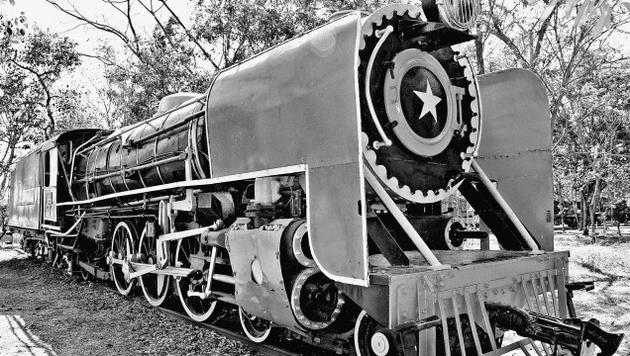
The rail museum in Mysuru is yet to become popular among tourists despite a collection of steam locomotives, rail wagons, and coaches.—Photos: M.A. Sriram

A sound-and-light show showcasing history of Railways is being planned

The rhythm of the steam locomotive conjuring up images of belching smoke and shifting tracks will come alive at the Mysore Rail Museum, which is poised for expansion.

The authorities are planning a sound-and-light programme complete with the history of the railways as part of the renovation plan.

“We have Rs. 1 crore with us while the cost of expansion is around Rs. 4.62 crore. We are awaiting the release of additional funds to take up the project, which has already been approved by the Railways,” said Rajkumar Lal, Divisional Railway Manager, Mysuru.

Rajkumar Lal,Divisional Railway Manager, Mysuru

But, expansion work has already begun in the earnest. A wooden metre gauge vintage wagon from Banapur (Hospet) of Hubballi Division has been shifted to the Mysore Rail Museum. The central workshop staff here have rebuilt and provided an under gear for the wagon,” Mr. Lal said.

In addition, two wagons of a rail bus, which was operating on the Shivamogga –Talaguppa route, have been added and so has a diesel locomotive.

A senior engineer involved with the project said they have already acquired heritage furniture from different divisions and they are being repaired for display at the museum. A steam-operated crane will be procured from Bhusaval in Maharashtra and narrow gauge coaches from Nagpur, he said.

RailBF24feb2015

Our vision is to make it a star attraction for tourists visiting Mysuru. The Additional Secretary, Tourism, Government of Karnataka, has evinced keen interest in the development of the museum and has promised aid, the official said.

In what maybe the first of its kind in the country, a touchscreen device providing comprehensive details of the Railways, the divisions, locomotives, trains, rolling stock etc. will be kept at the museum, he added.

source: http://www.thehindu.com / The Hindu / Home> News> National> Karnataka / by R. Krishna Kumar / Mysuru – February 01st, 2015


Gallery blended in heritage structure

National Gallery of Modern Art celebrates its 6th anniversary on February 18

Manikyavelu Mansion on Palace Road, Bengaluru, houses the National Gallery of Modern Art. File Photo: V. Sreenivasa Murthy

Until June 2001 when the foundation stone for NGMA was laid, the Manikyavelu Mansion on Palace Road was a verdant 3.5-acre campus with a stunning but crumbling colonial-style mansion.

“It is to the credit of Ministers, activists and officials, including Ananth Kumar, Maneka Gandhi, K.N. Srivastava and Chiranjeev Singh, that the building was restored for housing the National Gallery of Modern Art (NGMA), which is celebrating its 6th anniversary on February 18,” says architect Naresh Narasimhan who redesigned Manikyavelu Mansion. “Today, the NGMA stands as the premier cultural institution of Bengaluru and the gallery demonstrates how a heritage structure can be adaptively reused for public spaces that throb with international art and culture exhibitions.”

Mr. Narasimhan, who has also had a hand in the restoration of Metropole in Mysuru and the Maharaja’s Hotel in Brindavan Gardens, is of the view that city planners should see an ‘opportunity’ to conserve and restore heritage spaces rather than treat them as a ‘burden’.

Manikyavelu Mansion on Palace Road, Bengaluru, houses the National Gallery of Modern Art. File Photo: Bhagya Prakash K.

“It was an interesting experience to take up the over 90-year-old Manikyavelu Mansion, once the property of the Mysuru royal family,” he says. It later came to be owned by Raja Manikyavelu Mudaliar, a mine owner. It was taken over by the State government in the late sixties and handed over to the Ministry of Culture for constructing an art museum. NGMA was formally inaugurated in 2009.

The historic heritage mansion, transformed from a residence into a museum gallery at a cost of Rs. 8 crore, has been further supplemented by a Gallery Block. A 1,260-square metre extension has been added to the 1,500-square metre of the mansion, making it the best example of a surviving bungalow.

“The new design blends with spaces required for a modern museum, and coexists with the ambience of a traditional mansion,” says Mr. Narasimhan, adding that the first floor has the capacity to hold sculptures weighing up to five tonnes.

The NGMA includes a smartened up auditorium, open-air theatre, reference library, offices and art storage area, a cafeteria, and a museum shop-cum-facilitations block.

Minimalist design

Architect Sathya Prakash Varanashi of INTACH says the new NGMA building fits perfectly with the endearing old mansion in a balanced way. “With the central open space swaying with trees amidst the stone seating and water bodies, the minimalist design brings in a subdued non-dominant character required for public spaces. The external façade is skilfully retained to bring in a sense of déjà vu, which is all about adaptive re-use in conservation architecture,” he says.

Activities for art lovers

NGMA is conducting activities for art lovers on its premises on February 18 from 10.30 a.m. to 5p.m. Contact ngma.bengaluru@gmail.com

Other restored beauties

RBANM's Educational Charities building in Ulsoor. Photo: Sampath Kumar G.P.
RBANM’s Educational Charities building in Ulsoor. Photo: Sampath Kumar G.P.

RBANM’s school building in Ulsoor

Fab India building in Koramangala that retains original character of architect Charles Correa’s house

Basava Ambara near Krishna Rao Park in Basavanagudi. Photo: Bhagya Prakash K.

Basava Ambara in Basavanagudi that maintains the splendour of the original bungalow

source: http://www.thehindu.com / The Hindu / Home> News> Cities> Bengaluru / by Ranjani Govind / Bengaluru – February 15th, 2015

A Parichay with Avenue Rd’s heritage

Bengaluru:

Avenue Road may be known as the city’s wholesale trading and business hub but it’s more than that. Not all would know that the thoroughfare is probably as old as Bengaluru. Come Sunday, a group of 25 enthusiasts will take a stroll down the iconic road to discover its history.

Organized by the Bengaluru chapter of Intach, the Parichay walk aims to familiarize citizens with historical monuments and heritage sites along the road, that have survived the depredations of time. Rice Memorial Church, Rangaswamy temple, Maramma temple and the old post office are some of the structures that dot the road, which has been the city’s lifeline since its birth over 500 years ago.

The monuments are lost in the hustle and bustle of the area. “Parichay will highlight the importance of the heritage sites, when were they built and by whom, and how they should be preserved for posterity as well as for tourists,” C Aravind, chapter coordinator, told TOI.

The organizers have conducted 60-65 such walks in areas like Gavipuram, Fraser Town and Shivajinagar. “We want to make locals proud of their area and take an active interest in protecting it,” said Aravind.

Endorsing Aravind’s view, SK Aruni, deputy director, Indian Council for Historical Research (ICHR), said Avenue Road is perhaps as old as the city itself. “The aim of the walk is to explain how the city originated and trace its history through Avenue Road. Though citizens today may pass by a number of monuments, they are hardly aware of their importance,” he said.

What: Avenue Road Parichay. When: Sunday. Where: From State Bank of Mysore, K G Road, to Tipu Palace in Chamarajpet covering the Fort. The walk will begin early morning and may take around 3 hours to cover the distance of nearly 2 km.

One road, many names

SK Aruni, who will lead the guided tour giving the participants a peek into the monuments’ history, said Avenue Road is a modern name for the thoroughfare. “I think it was called Chandra Beedi or Surya Beedi or even Dodda Beedi, because of its vastness. It must have been renamed Avenue Road later as it was lined with massive trees on either side,” said Aruni. The road was also called Raja Beedi as it served as a main entrance to the city and important personalities came to Bengaluru via the road, he added.

source: http://www.timesofindia.indiatimes.com / The Times of India / Home> City> Bengaluru / by GS Kumar / February 12th, 2015

A Museum That is a Repository of the Past

Bengaluru :

Is it enough to preserve the past or do we also need to maintain its particularities with informed respect?

museum01bf24feb2015

Architect and restoration expert H C Thimmaiah, who is part of The Indian National Trust for Art and Cultural Heritage (INTACH) in Bengaluru says, “It is heartening that we are at least talking about Bengaluru’s heritage but we must be careful with how we maintain it. The Government Museum is a beautiful building. The brick red colour of such classical buildings must not be tampered with. The museum has very specific features right from the details on its pillars to its windows that have been maintained well but all old structures require an understanding of historical and architectural context. And sensitivity towards just how they must be painted, how the flooring, ceilings, the facade must be treated.”

Restore with sensitivity

As the debate about the need to retain and maintain heritage structures in Bengaluru warms up, we are told by a source that The Bowring Institute was considering a facelift sometime back. Thankfully, the plan to replace the original flooring with marble was met with some resistance within the circle of influential members who asked for Attangudi tiles or something more contextual considering it is hard today to reproduce the classic mosaic from the past.

museum02bf24feb2015

Thimmaiah, who built a house in Kodagu with upcycled elements taken from destroyed old homes, is passionate about authenticity and recalls, “A few years ago when Bangalore Club was being repainted, a paint manufacturer scratched the walls to take a sample of the signature greyish blue paint and recreated it for a fresh coat. He later told me that the paint colour would be called Bangalore Club Blue from now on.”

Prominent buildings like the Bangalore Club and the Government Museum may be better off but the architect wishes that INTACH was more active in the city for the sake of other structures. After the death of convener H R Pratibha, INTACH has been keeping a low profile. He says, “Today, bodies like INTACH and The Archeological Survey of India (ASI) must come together to guard even the lesser known aspects of our heritage and not just the showpieces. In Bengaluru, you won’t find even a single space like Mumbai’s Dadabhai Naoroji Road.”

Are private spaces not our heritage?

Architect and urban planner Dyan Belliappa is happy that the city is looking with fresh appreciation at buildings like the Government Museum and says, “The interest in Bengaluru’s public buildings post the Balabrooie Guest House debate is welcome but the city also has a built heritage of private structures some of which were a lot older than the Guest House and have been demolished with nobody even coming to know about them. While we will probably continue to revere a Vidhan Soudha, there are private structures in the Ulsoor area, around Majestic which are going with not one voice raised in protest.”

To the right of the new Airport Road, he shares, there was a fantastic old structure built with stone masonry. He says, “That kind of stone masonry will be hard to find or duplicate and yet it was destroyed. In Begur, there is a temple linked to a lake. The temple may outlast change but will the lake be treated as part of our heritage too? Even the Malleswaram Market is a heritage sprawl but will BBMP treat it as such? One building or two or just a few are not our heritage. Our lakes were our heritage too but they were just treated as water bodies and so many are gone, as are our trees.”

He adds, “Mumbai has a structured approach towards the preservation of   spaces. Some private buildings cannot be touched. Others can be modified but with sensitivity. The fact that an independent body like the Bangalore Urban Art Commission was dissolved in 2001 says a lot. Today the BMMP reflects what we value in our city but our heritage was our way of life. How does one codify that or our memories? How does one resist the haste to acquire and sell land and knock off structures because they get in the way of ‘urban development’? Our priorities are misplaced and we need to rethink the meaning of heritage.”

Contextualise the past

Organic architect professor A R Jaisim has the last word, “The Bengaluru Museum is a beautiful building. Attara Kacheri has been beautifully preserved too. Our city’s present must make space for its past because if the past is erased, we  will have no memories. Heritage must be contexualised and included in the present because without it, we have no stories to pass on to the next generation.”

Trivia

The Government Museum on Kasturba Road is a reminder of Bengaluru’s colonial heritage. In 1851, after the Madras Government Museum was established, Bengaluru got its own museum in 1865 and is today, the second oldest in South India. E G Balfour, a medical officer of the Madras Army, came to Bengaluru in the 1860s and with his support, the Chief Commissioner of Mysore State, L B Bowring established the Government Museum or the Mysore Government Museum on August 18, 1865. The museum was originally housed at the Cantonment’s jail building but then a site in Cubbon Park was selected. Col R S Sankey, the Chief Engineer of Mysore planned and built the museum in 1878.

Fun facts: The museum was once known as ‘Thamashe Bungalow’. On Mondays, women in purdah visited the museum and men were not allowed.

Collections: The museum has two exhibition floors which are divided into 18 galleries covering sculpture, natural history, geology, art, music and numismatics. It has a collection of archaeological, geological artefacts and artefacts belonging to the Neolithic period.

Timings: 10 am to 5 pm (except on Wednesday when it is closed)

source: http://www.newindianexpress.com / The New Indian Express / Home> Cities> Bengaluru / by Reema Moudgil / November 03rd, 2014

Research vessel flagged off from Malpe

Geo technical research vessel Fugro Scout setting sail amid cheers at Malpe fisheries harbour in Udupi on Monday.

The state-of-the-art Geo Technical Research Vessel (GTRV) ‘Fugro Scout’ manufactured by Tebma Shipyards Ltd. set sail to Singapore via New Mangalore Port from Malpe fisheries harbour here on Monday.

The company constructed the GTRV in 18 months and delivered it to The Netherlands-based company Fugro here. The Fugro Scout has been registered in Panama and will function under its flag. It was constructed at a cost of Rs. 240 crore.

The vessel is a mini-drill ship capable of drawing soil samples up to 3 km below the sea bed for exploration of oil, natural gas and other resources. When the vessel was flagged off by Pramod Madhwaraj, MLA, there was a loud applause, lot of cheering and waving of hands.

P. Aboobacker, Vice President – Operations, Tebma Shipyards, said the entire ship was constructed at its shipyard here. Since beginning operations in Malpe port in 2008, the company had built 18 vessels.

These 18 vessels included 10 tugs for the Indian Navy, while the remaining vessels were built for commercial purposes. “This is the second GTRV we have built for Fugro. The first one – ‘Fugro Voyager’, was awarded the ‘Best Research Vessel of 2014’ by the magazine ‘Work Boat World’,” he said.

Efficient ship

The Fugro Scout is powered by diesel electrical propulsion systems driven by active front-end drives for best fuel efficient operation. The vessel has an automated pipe and tool-handling equipment to promote safe drilling floor operations for sea bed sampling and testing.

Graeme Alexander, Project Director of GTRVs, Fugro, said the Fugro Scout would start its work in Vietnam in May. Then it was expected to sail to Iceland.

Mr. Madhwaraj said Tebma Shipyards had donated Rs. 1.10 crore for the construction of slipway for the third stage of Malpe fisheries harbour. “We want the company to do more for the fishermen here under their corporate social responsibility schemes,” he said.

source: http://www.thehindu.com / The Hindu / Home> News> National> Karnataka / by Ganesh Prabhu / Udupi – February 24th, 2015

Karanji Lake to Host Its Second Butterfly Park Soon

Mysuru :
Karanji Lake Nature Park, one of the most scenic places in Mysuru city, will soon open its second butterfly park.

One such park is already situated in a small island within the lake but hasn’t been able to attract many butterflies.

Sri Chamarajendra Zoological Gardens executive director B P Ravi told Express, “Butterflies require specific eco-climatic conditions. The island concept is wrong. The habitat is not suitable and attracts very few butterflies as it is surrounded by water. The temperature and humidity needs to be mild. This is why a new butterfly garden is being set up near the entrance gate.”

Mysuru Zoo authorities own and maintain Karanji Lake.

Nearly 150 varieties of nectar and host plants will be planted in the garden to attract various kinds of butterflies.

Display boards with information on the kinds of butterflies along with their specialities and importance will be put up.

The lake authorities also plan to encourage college students to plant saplings and will teach them about the importance of conservation. Nearly 60 per cent of the work has been completed and the garden will be ready by March. Apart from this, visitors to the lake will get to visit an orchidarium (an area where orchids are cultivated), a cactus terrarium, and a paludarium (an area that incorporates both terrestrial and aquatic elements).

source: http://www.newindianexpress.com / The New Indian Express / Home> States> Karnataka / by Express News Service / February 16th, 2015