Category Archives: Travel

Rediscover this muse

When was the last time you went to a museum? If you can’t recall, this NGO’s project will help refresh your memory and revitalise the idea in your head
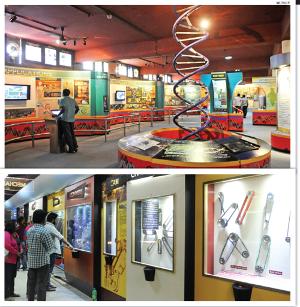
The Visvesvaraya Industrial and Technological Museum attracts 10 lakh visitors per year. (Top right) The National Gallery of Modern Art where they’re are organising new exhibitions, workshops, family quizzes, gallery walks and auditorium programmes to attract visitors

Swords, guns, king’s outfits, utensils, palanquins, artefacts, lamps, artworks… and life itself. Museums are much more than storerooms of strange and fascinating objects from a bygone era, preserved and labelled in glass cases with ‘Do Not Touch’ signs on them. They’re repositories of a way of life, showcasing a history and continuum that has brought us where we are today — whether sociologically or culturally. So why is that most of us rush to visit museums in other countries, but haven’t gone to one in our immediate vicinity since our school days, or without our children and grandchildren? Bengaluru NGO ReReeti, which hopes to transform Indian museums into spaces of learning, delight and meaningful engagement for Indian and overseas visitors, is attempting to answer that very question with a project called ‘Object of my Affection’.

In an effort to contemporarise the museum experience and re-introduce its value to a young audience, ‘Object of my Affection’ invites people to contemplate the value of objects in their home and imagine them in a museum 60 years from now. After all, “citizens get a sense of their ethnological ancestry, their nation’s cultural, scientific, historical, and technological progress through the materials on display at museums,” says Tejshvi Jain, Founding-Director of ReReeti. If you admire an object for its design, functionality or aesthetic appeal, and think it is precious today and may not be in use say 60 years from now, take a picture and upload it to Twitter or email them. Tell them when was the last time you visited a museum and why this object is museum-worthy or valuable to you. Through the exercise, which commences today and will go on for a month, ReReeti hopes to spark a thought process about the purpose of museums and help people look at them anew — as spaces that tell a narrative of a way of life.

More than objects
SK Aruni, City Director of Indian Council of Historical Research Bangalore, believes the time is ripe for such an initiative. Ruing that the revival of museums is not taken seriously, he says, “Each object has its own history, its own growth. But a museum needs to go beyond just labelling and displaying these items,” he believes. That could be done via cultural entertainment, “to show how life was lived at the time” and interactive displays or stories of the way art developed from ancient to modern times, “in art galleries”, he believes.

Great ideas, but not always successfully implemented. DK Chowda, General Secretary, Chitrakala Parishat says, “We have some of the best collections in the world including works by Bengal artistes and folk artistes, leather puppets and Mysore traditional paintings, among others.” He admits there is a need to attract newer audiences by making this a more lively space — by way of storytelling sessions around paintings, audio and visual aids, and a focus on promoting art and culture. “But we need funding and space,” is his refrain. Simple changes — like making the third floor “easier to reach”, and employing guides who can take people through the rich tapestries of the Mysore paintings (“Where did this style start? How did it emerge? What are the myths?”) are his suggestions, and hopes for the art school and museum.

Jain agrees. “Museums are perceived as dull, boring spaces,” she says. But that can be changed, if they work to fulfil people’s needs. She cites the examples of sleepovers in some US museums.
And in the UK, museums such as Tate and Victor and Albert Museum are, every so often kept open till late in the evening, and the look is changed, complete with disco lights and bars. “That attracts youngsters. Architecture students create theme-based activities — like games related to the architecture of the museum.” In Scotland, she recalls a Christmas-themed day at a museum when adults stood in a huge line, excited to make small badges with selfies on it. “In that process, they end up visiting the museum,” she says.

Have activities
It’s a philosophy KG Kumar, Director, Visvesvaraya Industrial and Technological Museum, has been trying to further ever since his return to the institution two years ago. Proudly citing a figure of 10 lakh visitors per year “highest in the science council of museums”, he talks about the various initiatives he has undertaken to make the museum a more interactive space. These include storytelling around exhibits like the spinosaurus, attended by 700 children over two days, multimedia projections, the use of miniature props that add to the storytelling sessions, and the Wright Brothers Flight Simulator that replicated the first flight in 1903, complete with controls.

“Next, I’ll have an exhibition on natural disasters and how to prevent them, a science show using dry ice, an interactive exhibit around the meaning of DNA…” The list is long.

Outreach programmes, he stresses, are necessary to attract audiences. From activity corners to demonstrate small processes in the biotechnology lab to an innovation festival where the public is invited to demonstrate their ingenious daily innovations, Kumar is making an effort to generate interest in museums. “You’ll see a king’s or a Nizam’s outfit on display, with a boring label next to it. Why not create a story around it? When did he wear it and why?” he asks. At the National Gallery of Modern Art, where he is the “borrowed” Director, he is making similar attempts with new exhibitions, summer workshops, family quizzes, gallery walks and auditorium programmes. “There are original paintings, which immediately relate to history, and contain stories of the times they were created — say Partition. We need to tell those stories in a more engaging fashion.”

We can almost see Jain nod. “Museums are holders of tradition and history. Once you make them personal enough, make a connection and make it contemporary, people will see that.” With Object of my Affection, she hopes people start with themselves. “What would you want to preserve for your next generation,” she asks. How can you be proud of your city, your time and your history? “People take selfies every now and then. So we’re connecting it to what is around them with this project,” she says. All of which will finally culminate in an exhibition of things that are important to Bengaluru. There you have it — your very own museum of memories. Not so boring anymore, right?

Object of my Affection: Choose any object from your home: spoon, hair brush, cushion cover, cooking utensil, graphic novel, lamp, whatever strikes your fancy you would want to preserve for the next generation. Click a photo, upload the photo and type ‘Object of my Affection: xyz, tag @ReReeti, use the hashtags #ReReeti #museumworthy and post your tweet. Or email: ReReeti13@gmail.com. All photo submissions will be added to their Flickr account.

source: http://www.bangaloremirror.com / Bangalore Mirror / Home> Columns> Sunday-Read / by Sowmya Rajaram, Bangalore Mirror Bureau / February 08th, 2015
12-year wait ends, all eyes on 42-ft-tall Karkala Bahubali

Mangaluru :

The 10-day Mahamastakabhisheka ceremony for the 42-foot-tall monolithic stone image of Lord Bahubali atop a rocky hill will begin in Karkala on Wednesday.

Dakshina Kannada and Udupi districts could be called the land of Bahubali as they host three towering monolithic statues at Karkala, Venur and Dharmasthala. Among them, the Karkala Gomateshwara is the tallest at 42 feet. Karkala — an evolved version of the original ‘Kari Kallu’ — derives its name from the black stones that cover the vast landscape.

Mahamastakabhisheka was performed at Karkala in 1951, 1957, 1962, 1990 and 2002. The gap of 12 years was not maintained for various reasons and the anointing in 1990 was held after a gap of 28 years due to problems caused by the implementation of the Land Reforms Act.

The imposing monument was installed by King Veera Pandya Bairarasa at the behest of guru Lalithakeerthi, a pontiff of Karkala Jain math, in 1432 AD.

The Karkala monolith of Bahubali is the third largest of the four Bahubali statues in Karnataka, the first one being the 57-foot-tall monolith at Shravanabelagola. Dharmasthala and Venur statues measure 39 feet and 35 feet, respectively.

source: http://www.timesofindia.indiatimes.com / The Times of India / Home> City> Mangaluru / by Stanley Pinto, TNN /  January 21st, 2015

For the first time, a priest from coastal region is canonized

Mangaluru :

Most Rev Bernard Moras, Archbishop of Bengaluru diocese, said let the shrine of Blessed Joseph Vaz satiate the spiritual hunger of those who approach in need of strength.

The Archbishop on Friday unveiled the statue of St Joseph Vaz to mark the end of the three-day celebration of the canonization of the saint at the Miracle Hill shrine. The Archbishop also launched a free meal programme for devotees by pouring rice into a pot. The shrine will provide free meals once a week to devotees on Friday.

The celebrations were a bit dampened after chief minister Siddaramaiah and his cabinet colleagues missed the event due to state mourning announced in the wake of the death of former governor Rameshwar Thakur on Thursday.

This is the first time a priest from the coastal region has been elevated to sainthood.

The statue of Blessed Joseph Vaz was brought to the shrine in a procession from Panir to Mudipu in a decorated vehicle on January 9, in the run-up to the event. Pope Francis on January 14 raised Blessed Joseph Vaz, who performed miracles on the hill of Mudipu, to the altar of sainthood in Sri Lanka.

Earlier during the mass, Mangaluru Bishop Aloysius Paul D’Souza, Msgr Denis Moras Prabhu, PRO Fr William Menezes, and others took part. In his homily, Moras said Blessed Vaz brought more people near God with his work and dedication. Bishop Aloysius Paul D’Souza said apart from his missionary work, his service to society in helping the needy was exemplary.

Who’s the saint:

Joseph Vaz was born on April 21, 1651, in Benaulim, Goa. He was the third son of Christopher Vaz and Miranda. He became a priest in 1676 and served in different parishes of Goa till 1681. Later, he was sent to Canara. Fr Joseph Vaz travelled from Goa barefoot. He served in Honnavar, Basrur, Kundapur, Gangolli, Mulki, Mangaluru and Panir. He was miraculously saved from an attempt on his life in 1684 while serving as the parish priest of Panir Church.

source: http://www.timesofindia.indiatimes.com / The Times of India / Home> City> Mangaluru / TNN / January 17th, 2015

Artificial waterfall to bring magic to Jog round the year

Bengaluru :

The world famous Jog, the second highest plunge waterfall in the country, will soon enthrall visitors round the year.

All the four cascades of the 252 metre-high falls — the majestic Raja, the graceful Rani, the swift Rocket and boisterous Roarer — will be in full splendor through the year as the Jog Management Authority (JMA) plans to re-circulate its water during non-rainy seasons.

Two companies have come forward to take up the project following a global tender and work is expected to start before this rainy season. Once installed, it will be world’s tallest feature of its kind, JMA officials claim.

“The full view of Jog is available to tourists only for four months (July to October) during rainy season. With Jog lacking other features required for a popular tourist destination, the number of foreign and local tourists is considerably less in the year. This is why we approached experts for a solution,” a senior JMA official told TOI.

HR Viswanath, consultant for JMA and the brain behind the project, said the magic of artificial waterfall will be realized through re-circulation method. “Using a reversible pump, the water will be pumped up through a 1,200 mm diameter pipe from the storage pond constructed at the bottom of the falls. A 3-mtr high anicut (dam) constructed upstream the Sitakatte Bridge will receive the pumped water. Then 200 cusecs of water will be let out the four sluice gates of the anicut in off seasons,” he explained.

Asked about the electricity requirement and cost of pumping water upstream, Vishwanath said the water cascading down will generate electricity with the help of a mini power station installed at the bottom of the falls. The pump will get power from the station, and the system won’t need extra power supply unless it is emergency.

Viswanath, who is former principal of BMS College of Engineering, said the technology is of double advantage as the project will be able to generate excess electricity during rainy season from the same pump by letting the waste water down. There will be no pumping up of water from the bottom during rainy season.

“The electricity produced will be surplus after meeting the required quantity for pumping purposes which can be used by the Sharavathi power grid. The project manager can also make profits by selling the excess power,” he added.

Another JMA official said two companies — National Buildings Construction Corporation, New Delhi; and an Abu Dhabi-based company owned by BR Shetty, an NRI businessman and Padma awardee — have come forward to take up the project under the build-operate-transfer model. “Once the detailed project report is ready, we will finalize the company for project implementation. The estimated cost of the project is Rs 350 crore and we are expecting the ground work to begin before July this year,” he added.

How it works

A sump to hold 23,000 cubic ft water will be built at the bottom of 252 mtr (820 ft) fall.

Using a reversible pump, water will be lifted via 1200 mm diameter pipe to a 3 metre tall anicut (dam) constructed upstream. A power pump of 20 kilowatt per hour is necessary for the purpose.

200 cusecs water let out from the four sluice gates of the anicut to create the normal beautiful jog falls.

The water cascading down will also generate electricity with the help of a mini power station installed at the bottom of the falls. The power is sufficient to pump back the water and mechanism will keep the system round the clock. Water lost in evaporation is negligible say experts.

During rainy season, power generated is an advantage as there will be no need to pump the water upstream.

source: http://www.timesofindia.indiatimes.com / The Times of India / Home> City> Bengaluru / by Rohith B R, TNN / January 26th, 2015

Heritage Walk marks the inaugral of ‘December to Remember’ Fest

HeritageBF30dec2014

Mysuru :

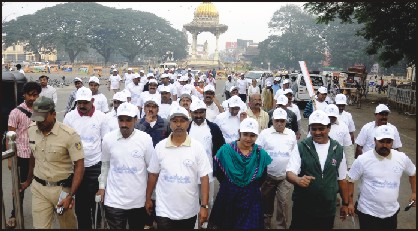
As a part of the ‘December to Remember’ Tourism Fest, an initiative of the District Administration and Department of Tourism, an Heritage Walk was organised early this morning.

Around 100 people participated in the Heritage Walk which was flagged off by DC C. Shikha. Speaking on the occasion, DC Shikha said that the Heritage Walk was organised to encourage more and more people to participate.

The walk, which started at Town Hall premises, passed through Clock Tower, Kote Anjaneya Swamy Temple, K.R. Circle, Devaraja Market, K.R. Hospital, Mysore Medical College and Research Institute (MMC&RI), City Central Library, CAVA. Later, the participants and the officials were taken to Hotel Paras for breakfast. DC Shikha was present till the end of the Heritage Walk.

Prof. (retd.) Rangaraju and journalist Echanur Kumar explained the history of heritage buildings to the participants of Heritage Walk.

DDPI H.R. Basappa, DDPU K.M. Puttu, Nehru Yuva Kendra Convener M.N. Nataraj, Department of Urban Development Project Director Lingannaiah, University of Mysore Dean Rudraiah and others were present.

Dec. 26 events: 6 am to 9 am: Heritage Walk (cycling for students) starting from Balarama Gate (Mysuru Palace); 10 am to 12 noon: Boating at Karanji Lake; 11 am to 12 noon: Carol Singing at St. Philomena’s Church.

source: http://www.starofmysore.com / Star of Mysore / Home> General News  /  Thursday , December 25th, 2014

Wildlife Calendar ‘ BANADA BADUKU ‘ released

BanadaCalendarBF25dec2014

Mysuru :

“Skill in a job alone can bring best results,” opined Sarod Maestro Pandit Rajiv Taranath.

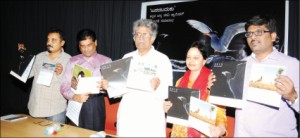
He was speaking after releasing the wildlife calendar ‘Banada Baduku’ brought out by photographer Lokesh Mosale at a function organised at Rani Bahadur auditorium in Manasagangotri here on Wednesday.

Taranath pointed out that skill was fading in many jobs and a few people like politicians, only deliver lectures and show no performance. He commended the creativity and skill of Lokesh Mosale.

Mysore University VC Prof. K.S. Rangappa said that Lokesh Mosale had captured the beauty of wildlife and compiled the calendar in a beautiful way.

Environmentalist Rajani Patil, entrepreneur S.P. Madhu, Lokesh Mosale and others were present.

source: http://www.starofmysore.com / Star of Mysore / Home> General  News  /  Friday , December 19th, 2014

Experts to plan revitalisation of two heritage markets

Project mooted after BBMP meets with city’s conservation architects

MarketsBF25dec2014

There is some hope on the horizon for the 18 heritage markets of the city that are on the hit list of BBMP which is proposing to bring them down and go in for reconstruction. Following an online campaign by INTACH, conservation architects and like-minded Bengalureans -Bengaluru Heritage Markets Campaign, a meeting was held in the BBMP on Tuesday to come out with a Plan B.

Markets standing committee chairman B R Nanjundappa and former Mayor B S Satyanarayana met Indian National Trust for Art and Cultural Heritage (INTACH) rep resentatives to discuss the issue. “Some of the markets are of no revenue value to us like Johnson Market where traders do not pay rents. But still, we are open to looking at a revitalisation plan and have asked the INTACH members to prepare a project for two markets. We will see the plan and de ide whether or not to take it forward,” Satyanarayana told Bangalore Mirror. As a pilot, rejuvenation plans for two markets will be readied by the conservation architects and if it is through, the rest of the structures will be n handled. INTACH’s campaign on Facebook is gaining traction (see box). The campaign is see c ing strong support with con servation architects putting up some history nuggets about the markets.

For instance about Murphy Town Market, a post reads: “So you love the stone facade of the Bible Society building on MG Road? This is its poor cousin.Poor only because it was neglected. This is also one of the 18 demolition candidates announced by the BBMP on Nov 26. What this needs is rejuvenation, not demolition! Make the BBMP retain heritage and culture aspects during such projects, especially in historic quarters of the city like this one! Murphy Town Market has its old world charm as reflected by the century old reading room in the market area. If BBMP has its way, all this would soon give way to a mall! Do we need a city stripped of all its community spaces and bazaars, old buildings razed and second generation shop keepers displaced? With no existing law to protect heritage buildings, it’s up to us to lend our collective voices to save them.” Publicising the Chikkamavalli Market in VV Puram, campaigners have posted: “Spanning a good block in the historic quarter of Chikkamavalli, just next door to Lalbagh and food street, adjacent to a Kempegowda Uyyale Udyanavana (Park).”

INTACH is also holding photo walks and the first one was held at Johnson Market last week.

The FB Campaign
INTACH’s campaign on Face book has so far got 750 sup porters. Bengalureans who are interested in heritage and traditional value of these buildings have fished out old photographs of the markets and have posted them. A Bengaluru Heritage Markets photo contest has also been announced with the tagline “Show your appreciation so that they never succumb to a sledgehammer.”

source: http://www.bangaloremirror.com / BangaloreMirror.com / Home> Bangalore> Civic / by Kushala S , Bangalore Mirror Bureau / December 24th, 2014

‘There is no place better than Karnataka for Tourism,’ says Dr. B.R. Shetty

DrShettyBF21dec2014

by S. Kenneth Shishir

SOM met Dr. Shetty on Friday, who was on a brief visit to the residence of former Secretary (Forests) to the State Government A.C. Lakshmana, on KRS Road in city who is the friend of Dr. Shetty’s brother Sachidananda Shetty, a resident of Mangaluru and had a short talk about his visit and projects he has taken up here. Excerpts…

SOM: Sir, is Karnataka a place for tourism?

Dr. Shetty: Of course, there is no better place than Karnataka for tourism.

SOM: Have you taken up any projects here?

Dr. Shetty: Yes, I have given a proposal to the Government of Karnataka for a project to supply water to Jog falls near Sagara in Shivamogga, especially during summer when the volume of water is reduced and the falls does not attract tourists. I have plans to supply water under his project on all 365 days to attract more tourists there. Speaker Kagodu Thimmappa has taken interest in the project and if the government approves the proposal, I will go ahead with it.

SOM: Have you planned to open a hospital in India?

Dr. Shetty: Yes, I have acquired a 220-bed hospital in Trivandrum in Kerala State and will be doubling its capacity. In central Raipur I have acquired a majority stake in an orthopaedics hospital as I want to expand it across India to serve Indians. My plan is to offer affordable health care in smaller cities and create a 12,000-bed hospital infrastructure in five years.

SOM: How is the medical sector doing in India?

Dr. Shetty: The medical sector in India is doing very well. The country can be developed as a medical tourism place also. We have the best doctors here.

SOM: How are Indian workers doing and being treated in UAE?

Dr. Shetty: Indian workers in UAE are doing good, well paid and well respected.

SOM: You have taken up many missions to help the downtrodden and the poor. What is your mission in life?

Dr. Shetty: My mission in life is to serve the community, by way of my professional ventures and personal pursuits.

Going from clinic to clinic selling drugs to doctors, loading cartons, hoisting barrels on his shoulder and climbing staircases was the first idea of Dr. Bavaguthu Raghuram Shetty popularly known as Dr. B R Shetty, Chief Executive Officer of NMC Healthcare, UAE Xchange and Neopharma, while working in the UAE in the early days.

Born in Kaup, Udupi in 1942, Dr. Shetty served as the Vice-Chairman of the Municipal Council in Udupi, where he worked towards the cause of providing proper sanitary facilities, building concrete roads, schools, underground drainage and septic tanks for people to lead a better and healthier life.

In 1973, he set foot in the desert land of the United Arab Emirates (UAE) to pursue his ambitions armed only with a clinical degree in Pharmacy and was able to start, build and succeed at multiple businesses over the years and today, his business empire is spread across the globe.

In UAE, Dr. Shetty who noticed the deficiency for basic clinics in the region, established New Medical Centre (NMC), a small pharmacy cum diagnostic clinic and became successful. Today, Dr. Shetty is the proud visionary behind 15 healthcare facilities which cater to more than one million patients annually. He has also come to the aid of regions hit by natural calamities and other adversities.

Dr. Shetty who is also interested in the tourism sector has taken up many projects to develop certain places as tourist destination with extraordinary infrastructure.

Some of the awards Dr. Shetty has won in recognition of his service are: the Padma Shri by the Government of India, Pravasi Bharatiya Samman Award, Order of Abu Dhabi, by the Government of Abu Dhabi and Forbes Middle East Top Indian Leaders in the UAE award to name a few.

source: http://www.starofmysore.com / Star of Mysore / Home> General  News  /  Sunday , December 21st, 2014

Karanji Park gets Orchidarium

Wildlife photo expo inaugurated; Great Indian Rhinos released for public viewing at Zoo

Mysuru :

Adding to the existing attractions at Karanji Lake Nature Park, an Orchidarium with 98 Orchid plants of various varieties was inaugurated by Rehana Banu, Chairperson, Zoo Authority of Karnataka (ZAK), at the Park premises on Lalitha Mahal Road in city this morning.

RehanaBanuMPOs10dec20134

Orchidarium is an indoor enclosure for keeping and cultivating plants and observing them under natural conditions, especially for the cultivation of various types of Orchids.

Orchidarium is an area that provides the desired environmental conditions for different varieties of Orchids grown abundantly for cultivation and conservation of Orchids both endangered and otherwise.

It is provided with optimum lighting conditions for the plants while protecting them from direct and harsh sunlight. The structure is covered with mesh with a roof to protect the plants from direct sunlight.

Prior to the inauguration of the Orchidarium, the Wildlife Photography exhibition was inaugurated at the Zoo Library by MLA M.K. Somashekar.

The expo, which is being held in two categories like Zoo Animals and Wildlife Photography has a total of 220 pictures clicked by both amateur and professional photographers.

In the Zoo Animals category, pictures of Hippo and its baby, playful bear cubs, tiger and its cubs playing and other pictures of Zoo animals are on display.

In the Wildlife Photography category, prize winning photos of World Wildlife Day contest clicked by photographers S.R. Madhusudhan, G.S. Ravishankar, M.K. Sapthagirish and others has been put on display.

A pair of Great Indian Rhinos, three-year-old Virat and one-year-old Bablee, brought to Mysuru Zoo from Patna’s Sanjay Gandhi Biological Park about two months ago, were released for public viewing by Mayor R. Lingappa and MLA M.K. Somashekar at an enclosure made for them at the Zoo premises.

Zoo Executive Director B.P. Ravi, Manager Shivanna, Zoo Veterinarian Dr. Suresh, RFO Girish and others were present.

source: http://www.starofmysore.com / Star of Mysore / Home> General News  /  Thursday , December 04th, 2014

Gommatagiri comes alive

Mahamasthakabhisheka performed

GommatagiriBF06dec2014

Mysuru :

With thousands of Jain pilgrims chanting “Gomateshwara Maharaj Ki jai” and “Bhagavan Bahubali Ki Jai” to the accompaniment of chanting of vedic hymns by priests, the pilgrim town of Gommatagiri located off Mysuru-Hunsur Road today came alive during the 65th Mahamasthakabhisheka to the statue of Lord Gommateshwara.

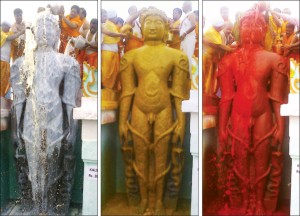
During the Mahamasthakabhisheka, the grey granite statue of Gommateshwara went from white to red to golden yellow within minutes as it was anointed with turmeric, kumkum, sandal paste, milk, curds, vermilion honey and other fragrant fluids.

The rituals were held under the supervision of Sri Devendra Keerthi Bhattaraka Pattacharya of Hombuja Jain Mutt.

The granite statue, considered to be from the earlier Vijayanagar period located atop a 50 metre tall hillock, closely resembles its famous counterpart Shravanabelagola.

Though it is not clear who installed that statue, scholars opine that the influence of Jainism in the region was unmistakable and was perhaps one of the reasons for its installation at Gommatagiri.

S. Jithendra Kumar, President, Karnataka Jain Association, was the chief guest on the occasion.

At the function in which retired Registrar of Karnataka Lokayukta – M.J. Indra Kumar, Assistant Registrar of Lokayukta – A.C. Vidyadhar, Gommatagiri Kshetra Seva Samithi President Dr. Prabha Mandal, Hon. President G.A. Suresh Kumar, Secretary Dr. M.V. Shanthakumar were among those present

source: http://www.starofmysore.com / Star of Mysore / Home> General News  /  Sunday , November 30th, 2014