Category Archives: Travel

Nostalgic Blogger Documents the Bangalore of Four Decades Ago

A Turquoise Cloud is the name of Aliyeh Rizvi's
A Turquoise Cloud is the name of Aliyeh Rizvi’s

Bangalore :

Aliyeh Rizvi used to run a niche design store called Native Place many years ago. It encapsulated her love for handcrafted traditions, nostalgia and fading remnants of culture. She took to passionate blogging subsequently to revisit everything that Bangalore stands for. Native Place no longer exists as a physical space but it is now a “collaborative mind space that works to build awareness of Bangalore’s local history and culture through curated experiences, travel writing and city based collaterals. It explores ways in which information can be used to create meaning and build a deeper connect.”

In a chat with City Express, she talks about the many projects she has undertaken to keep the memory of a genteel city alive that is now being overtaken by change at every level.

Poignant memories

The best memories I have are of Bangalore’s trees and gardens, and a life lived among them. Avenues were awash with different colours all through the year, jacaranda petals fell on our shoulders as we passed. Large family picnics were organised in Cubbon Park and Lalbagh when the weather was good. I miss the beautiful bungalows that had lovely large gardens: fruits, flowers and scented plants. I miss the Queen of the Night that bloomed after sunset, scenting an entire lane with its fragrance. We made passion fruit juice and gooseberry jam from our own fruit trees and compound walls had moss! Which means it was traditionally a cold, damp climate where early morning baths were always accompanied by shivering!

A Turquoise Cloud

I blog and write offline about the Bangalore I grew up in, to save it from vanishing. The city is my home and I am rooted in it. My blog, A Turquoise Cloud, is an archive of information and stories about local culture, city people and our symbolic spaces. The city I grew up with was being knocked down rapidly and it was becoming increasingly difficult to connect with it physically. Houses I had played in were now hi-rise buildings. The local grocery store I stopped at for sweets after school had disappeared. Trees were cut down, roads had changed. Streetscapes in the city were altered forever. I felt a terrible sense of displacement in my own hometown. I could not recognise or identify with it anymore.

That’s why we old Bangaloreans spend so much time in sentimental nostalgia and B&W photographs. It’s our only way of coping with loss.

So where does one go to find this other Bangalore? I chose to recreate it online, where it can stay virtually untouched. ATC is a space where I create a context for the  present through memories, images and stories of the city. I choose to focus on the present, by giving it a meaning through the past.

historical connect

One of my most memorable projects was as Curator, Centre for Public History, Srishti School of Art Design and Technology where I  co-facilitated a successful Public History Project titled ‘The Tiger Comes to Town’ to commemorate the 150th anniversary of the Archaeological Survey of India. The focus was the Bangalore Fort in Bangalore’s busy Kalasipalayam area and its role in local history during the 18th Sultanate, the time of Tipu Sultan, and the Third Anglo-Mysore War of 1791.

It aimed to reconnect the public with their local heritage sites through deeper engagement, build awareness and instil pride in the same. It combined elements from oral history, design, academic enquiry and performance so students could look at multiple ways to engage with the site during the course of the project. The outcome was a true city project in more ways than one.

breakfast specials

One of my most popular posts was the Bangalore Breakfast Special, since the  and the eating out-breakfast tradition is so unique to our city. I wrote that Bangaloreans love their breakfast and discuss it intensely.

Replies flooded in with suggestions to try other favourite joints, NRIs posted with intense nostalgia for iconic restaurants mentioned, more discussions about food happened, vows to visit, and even arguments over the best idlis-and dosas! Like I said, we are obsessed with our tiffin! It is always wonderful when people write in with comments and stories of their own, volunteer to share information and photographs.

We also have a page on Facebook for daily interactions and information. The blog allows you to access information by usage (eat, breathe, know) and geography (north, south, east). All posts are research intensive and constructed to provide comprehensive information, painstakingly collected, in one place.

It often takes days to track down information, locate people or join the dots, but it has to be done. In this space, I can now see the Bangalore I know and love.

Back to Native Place

Native Place is the seed of an idea which will hopefully grow into a larger organisation where people interested in the city can work together on creating new formats for city history and culture based projects- through documentation, interactions, performance and information based collateral.

Perhaps knowing a little more will build a relationship, create protectiveness and then generate the ownership we require so badly right now. Our website will be up soon and city based activities will hopefully start with the onset of the festive season.

source: http://www.newindianexpress.com / The New Indian Express  / Home> Cities> Bangalore / by Express News Service / August 19th, 2014
He dreamt of Bellur as a global yoga village

Bellur (Kolar district):

Bellur Krishnamachar Sundaraja Iyengar may never have become a famed global yoga guru, had he been attentive in his English class. Iyengar, who failed his English exam in class 10, didn’t go on to college; he took up yoga.

On Wednesday, the tiny village of Bellur in Kolar district of Karnataka, with a population of around 1,000, paid homage to the man who was born here 96 years ago. As news of BKS Iyengar’s death spread in the morning, the village folk assembled in front of the grama panchayat building in tribute.

The Brahmin boy from this dusty village had to move to Bangalore at the age of six for a formal education, as the nearest school was 20km away. This had always rankled Iyengar, who would tell his scores of disciples that all children should have a proper education.

VS Nagesh, principal of Ramamani Sundaraja Iyengar Composite Junior College, told TOI that had BKS passed his SSC examination, he would have gone on to college and maybe opted for a government job. “In that case, yoga would not have reached the rest of the world,” said Nagesh.

BKS had always dreamt of developing Bellur as a global yoga centre, and was working out the modalities, helped by his elder daughter and lone son, who have also taken up yoga.

A frequent visitor to Bellur, he was here last April for the 150th ceremony of his late father and took part in the Anna Santharpane. He spent a couple of weeks at the village, said Govindarajalu, administrator of the trust running his institutions. Former Prime Minister HD Deve Gowda met Iyengar here in May and learnt a few yoga lessons from the master.

His youngest daughter, BJS Savitha Raghu, who lives in Bangalore, said it was her father’s dream to provide a good education and healthcare facilities to children. This led to a primary school in Bellur, started in 1967 in memory of his parents. A high school was started in 2005 for his wife Ramamani, and today, the Bellur Krishnamachar Seshamma Smaraka Nidhi Trust runs the Ramamani Sundaraja Iyengar College.

The Trust has also set up a charitable hospital, taken up renovation of temples and other developmental activities.

BKS leaves behind six children and thousands of disciples across the globe. Family insiders say the deaths of two of his sons-in-law in the span of a year may have affected his health.

source: http://www.timesofindia.indiatimes.com / The Times of India / Home> City> Bangalore / TNN / August 21st, 2014

Adivasis captivate audience with traditional dances

AdivasisBF17aug2014

Mysore :

As part of ‘Anantha Yatre’ to commemorate the International Day of World Indigenous People, Indira Gandhi Rashtriya Manav Sangrahalaya (IGRMS) has organised a four-day cultural programme presented by Adivasis from various parts of the country which commenced at the Platinum Jubilee Hall at JK Grounds here yesterday.

Tribal artistes from 11 States had converged to exhibit their talents in a true cultural exchange programme.

The programme began with ‘Pooja Kunita’ presented by Krishnegowda and troupe from Pandavapura with excellent synchronisation to the beating of percussion instruments.

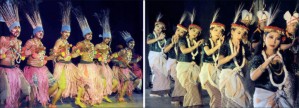
Naga tribe from Nagaland presented ‘War Dance’ with the warriors celebrating the victory which was eye-catching.

Tribals from Telangana presented a traditional ‘Gousadi’ dance in special costumes.

Young adivasis from Manipur and Arunachal Pradesh presented ‘Thogal Jagoy’ and ‘Siyomi’ dances respectively which captivated the audience.

It was a unique programme where the audience had the opportunity to enjoy a cultural extravaganza from across the country.

The cultural programmes by the tribal and folk artistes of Andhra Pradesh, Karnataka, Kerala and North Eastern States will be held everyday from 6 pm onwards at MMCAA auditorium in J.K. Grounds till Aug. 13.

Also, the workshop- cum-Demonstration on Tribal/Folk paintings of India that commenced on Aug. 9 at IGRMS, Southern Regional Centre (SRC), Wellington House on Irwin Road in city, will be held everyday between 10 am and 5.30 pm till Aug. 13.

source: http://www.starofmysore.com / Star of Mysore / Home> General News / August 11th, 2014

In memory of freedom martyrs no one remembers

Bangalore :

It’s one thing to recall sacrifices of freedom fighters on the Independence Day, but another thing to remember martyrs on other days and maintain their memorials.

Standing testimony to such neglect is a martyrs’ memorial in the heart of the city. Worse, not much is known about the four martyrs named on the plaque.

The 10-foot-tall stone plaque has been relegated to the backyard of the Shani temple at Mysore Bank Circle – the area which witnessed several flashpoints between freedom fighters and police at the height of the Quit India Movement in August 1942.

Scores of people are suspected to have died in confrontations in the area where the Mysore Bank Circle stands now. The martyrs included Shamanna Bete Rangappa, G V Thirumalaiah, Prahlad Shetty and Gundappa, all said to be students of Central College.

Their memory remained buried till 1972, the silver jubilee of Independence, when the central government decided to build a memorial at the Mysore Bank Circle where the quartet breathed their last. A plaque with their names inscribed on it was installed.

As years went by, the memorial was neglected. Road and other infrastructure development in the area shrunk the space for the memorial. Slowly, it got lost in the backyard of the temple.

On the recent Martyrs’ Day, August 9, members of Rashtra Gaurava Samrakshana Parishat, a social service NGO which stumbled upon the memorial recently, cleared the weed and other waste materials from there.

On Friday, a few local youngsters washed the memorial, decorated the place with tricolour and celebrated the Independence Day there.

“It is said these four youths were students of nearby Central college and fell to police bullets within meters of where the memorial is now located,” said T N Ramakrishna, president of the Parishat.

“There is no effort whatsoever, either from the Central government or BBMP, to protect what they call is a national monument. We want the authorities to restore the memorial to its original status. The authorities should make the memorial visible from all sides and also make suitable lighting arrangements,” he added.

Another Parishat member alleged that the space around the memorial has shrunk by about 15 feet due to encroachment. “It was in good shape till 2006-07 with a compound wall around. Later, due to encroachment and weeds, the plaque virtually invisible,” he added.

The Parishat said it would wait till October 2 (Gandhi Jayanti) to see if any effort is made to restore the memorial. “If nothing comes out, we will approach the mayor and the Kannada and culture department. If nothing positive happens, we will have to approach the court,” said Ramakrishna.

Forgotten heroes

Not much is known about the four martyrs: who they were and when exactly they fell to British bullets.

SK Aruni, deputy director, Indian Council of Historical Research, said there were many points of conflagration in the Mysore Bank Circle area during the freedom struggle. Police action against freedom fighters was severe on August 16, 17 and 18 of 1942, he added.

On August 16, a youth named Thimmanna Dasa was killed. The next day, the situation worsened. A huge crowd of 2,000 people set on fire a post office at Aralipete, near Kengeri Gate. Nine people were killed in police firing, but only six were identified: Thippaiah, Appaiah, AR Srinivasan, Narasimhachar, Subash Singh Ram Singh and Ponnaswamy.

On August 18, two of the youths mentioned in the plaque – Shamanna Bete Rangappa and G V Thirumalaiah – were killed in police action, Aruni said.

“British rulers always gave lower numbers than the actual toll to downplay the scale of the struggle,” he pointed out.

Freedom fighter HS Doreswamy said the memorial, which is inside the compound of a temple, should be made an independent structure. “Of the four people mentioned in the plaque, Gundappa was gunned down by an IG called Hamilton during a demonstration. Prahlad Shetty had been incarcerated and died in Central Jail,” he added.

source: http://www.timesofindia.indiatimes.com / The Times of India / Home> City> Bangalore / TNN / August 16th, 2014

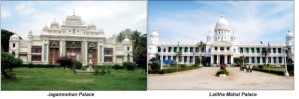
The tale of two Palaces

Pages from History

2PalacesBF16aug2014

by Prof. A.V. Narasimha Murthy

Mysore is famous for Palaces. In fact it is famous all over the world as a city of palaces because it was ruled by the Maharajas for the past five hundred years, until it was merged with the Indian Republic. The institution of the Maharajas has practically become extinct and those that survived could not maintain themselves in royal splendour for lack of resources. Even during the days of the British rule in India, the Maharajas of Mysore were recognised as such and British gave them special respect. Even Mahatma Gandhiji had openly praised the Maharaja Krishnaraja Wadiyar IV and called him ‘Rajarshi’ (saintly King). All these were responsible for the construction of palaces in Mysore. In fact, the tourists flock our city and their main agenda is to visit Mysore Palace. Two years ago there was a news item according to which the number of visitors to Mysore Palace outnumbered the visitors to the Taj Mahal. In this connection we should congratulate the Mysore Palace Board authorities in general and

its Deputy Director T.S. Subrahmanya who have been keeping the palace in an immaculate manner and providing good amenities to the tourists. These comments apply to smaller palaces like Jaganmohan Palace and Lalitha Mahal Palace.

Jaganmohan Palace as its name itself signifies is an elegant and majestic building in Mysore. It was originally built during the rule of Krishnaraja Wadiyar III, sometime in 1860. When there was an accidental fire at Mysore Palace, this was used as a Palace by the Maharaja, and all important functions took place here. It also served as a Durbar hall till the completion of the Palace in 1910. Installation of His Highness the Maharaja took place here and it was graced by Lord Curzon, the Governor General and Viceroy of India.

Later in 1900, a spacious and ornamental Pavilion was added to the then existing Jaganmohan Palace. It was specially designed for the invitees to witness the marriages and birthdays. Basically, it has a long hall and an elevated platform. The long hall has two balconies on both sides so that the royal ladies could watch the functions. Thus, most important family functions of the Maharaja took place here. Mysore Representative Assembly also met here. Mysore University Convocations also took place here for some years. I remember my uncle going to the Jaganmohan Palace for taking his degree at the convocation, almost 70 years ago. Maharaja who was the Chancellor of the University used to go to the Jaganmohan Palace in a ceremonial procession and people used to watch the procession, standing on both sides of the road.

In course of time, when the Mysore Palace became the place of residence of royalty, Jaganmohan Palace lost its royal touch. It was converted into an art gallery. The three-storeyed structure behind the main hall is a fine repository of paintings, sculptures, musical instruments and other artefacts connected with the Mysore Royal family. The real attraction is the painting section. These excellent and rare paintings include those of Raja Ravivarma, Ramavarma and also some European artists. The painting of great artist Roerich is also available here. Particularly, interesting paintings are those giving the genealogy of the Mysore Maharajas. Thus, Jaganmohan Palace is a must for all visitors to Mysore.

The greatest attraction of the Jaganmohan Palace is its frontal façade, which is majestic befitting a royal structure. Its stucco ornamentation is excellent specimen of stucco art of the period, which has practically become extinct. The broad doors in keeping with the tall façade adds majesty to the frontal portion. The stucco domes and the minarets at the four corners are highly pleasing. The central part has a vimana-like tower with minarets culminating in a broad Kalasha. The chaitya-like niches at the minarets are very elegant. In keeping with the beauty of a huge building, a vast enclosure with a garden and shady trees add gorgeousness to the Palace. In recent years this has become a great tourist attraction. Now-a-days, most of the important functions, music, drama and even religious discourses take place here. I vividly remember that Mysore Kendra of the Bharatiya Vidya Bhavan had arranged discourses on Ramayana and Mahabharata by Mathoor Krishnamurthy at this Palace for months together. T

hus, the excellent ambience of this palace makes it suitable for conducting important cultural events here. The Maharajas are gone but their creations remain forever.

Lalitha Mahal Palace is one of the most beautiful and magnificent heritage buildings not only in Mysore but in entire Karnataka. Mysore being a princely State under the British, many distinguished foreign dignitaries used to visit Mysore and stay in Mysore Palace itself. Though it was a palace, it was not suitable for the stay of foreign visitors because of the entirely ancient Indian atmosphere and conveniences such as toilet, bathrooms, etc. This defect was realised by the Maharaja Krishnaraja Wadiyar IV and he thought of building a Palace exclusively for foreign guests where they would be more comfortable and at home. Naturally, he thought of an European classical building model rather than a Hindu Palace of traditional type.

Immediately, the Maharaja commissioned a famous foreign architect by name E.W. Fritchley. He selected a spacious site near the foot of the Chamundi hill and the building was completed in 1931, under the close supervision of Maharaja himself, at a cost of Rs. 13 lakh.

This building is a majestic two-storeyed magnificent structure built in European style with elements of Roman, Greek, Gothic, Renaissance, Italian, Hindu and Sarcenic styles. Both floors have twin ionic columns, eight on either side of the main entrance which give the advantage of height. The upper portion is specially noteworthy. It has two-tier, four domes on all the four corners and one at the middle. However, the most beautiful is the central one which has three tiers and is above the entrance of the building. Actually, it is at a great height and dominates the entire area including the elevation. The smaller minaret-like domes at the peripheries add special elegance to the top of the building. The portico in the centre of the building which is surrounded by pillars gives a unique experience to a visitor when he is received there.

Though planned by a foreigner, the craftsmen were all local people who were experts in stone, stucco, marble and wood work. This is evident from the richly laid decorative motifs on walls and ceilings. The imported tiles and fixtures specially brought from England add a foreign touch. As a tourist exclaimed, the fixtures themselves could cost a fortune.

As soon as one enters into the interior of the building, Italian marble balustraded staircase welcomes the visitor. It branches off to right and left to reach the first floor. Thus, from top to bottom and from one end to another, it is an epitome of royalty. Even foreign guests are amazed at this dream-like beauty. Before closing this, I should share with my readers, the joy I had when I had the good fortune of staying here. It was some years ago when a seminar took place in Mysore and I was one of the speakers on epigraphy in that seminar. All the participants were accommodated at Lalitha Mahal and I was also given a suite. I stayed in the hotel for three days. More than the items of food, one would be enchanted by the silver plates, cups and saucers, spoons and the royal furniture and above all the royal ambience. That is the charm of Lalitha Mahal. Whenever, I delivered a lecture to foreign tourists, I used to mention that it was the creation of Maharaja Krishnaraja Wadiyar IV and the tourists would admire him for his forethought.

source: http://www.starofmysore.com / Star of Mysore / Home> Feature Articles / August 10th, 2014

Bangalore’s rail connectivity turns 150 years

A front view of Bangalore City Railway Station some time before it was completed in April 1968.

It has been 150 years since Bangalore appeared on the railway map of India. It was on August 1, 1864 that Jolarpet was connected to Bangalore Cantonment.

According to information provided by South Western Railway, the first train journey in south India took place on May 28, 1856 from Royapuram to Wallajah Road. Eight years later, Madras Railway Company opened the Jolarpettai-Bangalore Cantonment branch line. The Madras-Bangalore Mail was launched the same year.

In 1862, the line reached Renigunta and then to Raichur in 1871.

The Yeshwanthpur-Doddaballapur Meter Gauge line was opened in 1892.

In 1944, the rail network was nationalised. On April 14, 1951, the three major networks administered by the erstwhile Madras and Southern Maratha Railway, the Southern Indian Railway and Mysore State Railway were joined to form Southern Railway.

Due to historical reasons, the headquarters of the erstwhile Mysore State Railway was located in Mysore though Bangalore was the hub of operations. To improve administration and enhance monitoring, Bangalore Division was inaugurated on July 27, 1981.

No rail museum

The city does not have a museum to showcase its rail journey. Till a few weeks ago, memorabilia was being exhibited on Platform One of Bangalore City Railway Station. At present, visitors can go to Platform Five where two galleries exhibit cartoons and paintings related to trains.

The galleries had no visitors on Friday. Staff in both galleries said that visitors show up only when trains are delayed.

source: http://www.thehindu.com / The Hindu / Home> News> Cities> Bangalore / by Renuka Phadnis / August 02nd, 2014

Postal trainees explore the heritage of city on cycles

Dr. C.G. Betsurmath, Commissioner, Department of Archaeology, Museums and Heritage, is seen leading a team of postal trainees in front of Kote Anjaneya Swamy Temple during the Heritage Cycle Rally which began from Town Hall premises here yesterday morning.

Mysore:

The trainees of the Postal Training Centre (PTC), Mysore, explored the heritage of the city on cycles yesterday.

The cycle rally, organised by the Department of Archaeology, Museums and Heritage, was flagged off by Veena Kumari, Director of PTC from the Town Hall premises at 7 am. It was led by Dr. C.G. Betsurmath, Commissioner, Department of Archaeology, Museums and Heritage.

The participants covered Clock Tower, Chamaraja Circle, K.R. Circle, Lansdowne Building. Banumaiah’s College, Mysore City Corporation, Jaganmohan Palace, Parakala Mutt, Commercial Tax Office, Lokayukta Office, Oriental Research Institute, Crawford Hall, Maharaja’s College, Yuvaraja’s College, Maharani’s College, Metropole Hotel, Railway Station, Divisional Railway Office, K.R. Hospital, Govt. Ayurveda College, Central Library, Devaraja Market and the Dufferin Clock Tower on cycles.

Speaking on the occasion, Dr. Betsurmath said that yesterday’s rally was the second with the first being the rally conducted for the staff of Indian Overseas Bank.

He said that there were demands for such rallies from other institutions and offices and added that trainees of Administrative Training Institute (ATI) would participate in the next rally on Sunday.

Resource persons in the rally included retired professor of the Department of Ancient History, University of Mysore, Dr. N.S. Rangaraju, Deputy Director and Heritage In-charge Gavi Siddaiah, journalist Echanur Kumar and Curator in the Archaeology Department L.L. Gowda.

source: http://www.starofmysore.com / Star of Mysore / Home> General  News  / July 21st, 2014

Jawa, Yezdi bikes vroom on city roads

International Jawa Day today

Jawa and Yezdi bike owners taking out a rally this morning from front of the house of late F.K. Irani in Nazarbad to celebrate the International Jawa Day.

Mysore :

About 300 bikers this morning took out a rally with their precious good old Jawa and Yezdi bikes vrooming on the main roads of city to mark the 12th International Jawa Day.

The roads came alive with the sounds of Yezdi and Jawa as their owners took out their pride and joy to mark the day.

These iconic machines, called the ‘King of Roads’, were manufactured by the erstwhile Ideal Jawa (India) Ltd.

The rally, which was organised by Jawa Friends Club, Mysore, began in front of the house of late F.K. Irani, Managing Director of the then Ideal Jawa factory in city and passed through Nazarbad main road, Hardinge Circle, Doddakere Maidan road, Chamaraja Double road, Narayana Shastry Road, Devaraj Urs Road, JLB Road, Ramaswamy Circle, Saraswathipuram Fire Brigade road, Apollo Hospital Road, Vijaya Bank Circle, Vishwamanawa Double Road, Kukkarahalli Lake road, Open Air Theatre road, Hunsur Road, Vontikoppal Road, KRS Road, Jawa factory Road and will culminate at Prestige Function Hall near Columbia Asia Hospital later in the day.

Sameer, one of the organisers, speaking to SOM said that this year’s Jawa Day has been organised by about 40 friends who own Jawa and Yezdi bikes.

He said that every year, for one day, people across the city and from neighbouring Chamarajanagar, Madikeri, Mandya, Bangalore assemble at a specified place and will be riding Czech-made or Czech-inspired motorcycles Jawa or Yezdi to celebrate the Day.

‘We celebrate this day to show people that our motorcycles are still in use, and to just have some fun,’ he added.

Kishore and Hemali couple, who have come all the way from Bangalore to participate in the rally, said that over the years, these bikes have attained an iconic status as they are no longer available. If available, they are sold for over a lakh.

He also said that though the day is celebrated in Bangalore too, I wanted to celebrate the day in Mysore as it is the birth place of Jawa and Yezdi bikes.

Kishore said that he owns a 1995 model Yezdi Roadking and added that his bike is serviced in Mysore.

Madhusudhan and Keerthana from Mysore, who are participating with their 1996 model Yezdi Roadking said that it is for the third time they are participating and added that it was awesome to ride with numerous bikes manufactured by Jawa.

The motorcycles were manufactured at Ideal Jawa (India) Ltd., the first automotive company founded in collaboration with Jawa Motorcycle Company, Czechoslovakia in Mysore.

Production of these motorcycles stopped after Ideal Jawa shut its operations in 1995.

source: http://www.starofmysore.com / Star of Mysore / Home> General News  / July 13th, 2014

City magician’s blindfold ride for 30 kms

SudarshanBF14jul2014

Mysore :

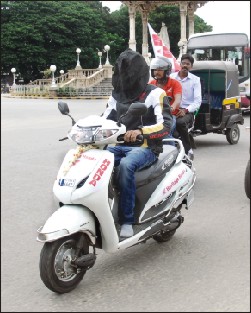
Seated blindfolded on a Honda Activa scooter, M.K. Sudarshan Jadugar, aged 21, resident of Lashkar Mohalla, today rode blindfolded from Siddalingapura to Srirangapatna and returned to Columbia Asia Hospital junction later today, after riding blindfolded for nearly 30 kms. Earlier, he did a trial run near the Palace.

Originally, Sudarshan was supposed to ride blindfolded from Mysore to Srirangapatna. However, he was denied permission by DCP M.M. Mahadevaiah who told Sudarshan to undertake the drive from Siddalingapura.

Before proceeding to Siddalingapura blindfolded, Sudarshan this morning offered pooja at Kote Anjaneya Swamy temple to symbolically begin his blindfolded ride in the presence of Ilai Alwar Swamiji and his friends and sponsors including Heritage Honda in city.

It is said that Sudarshan, who is aiming at entering into the Limca Book of Records, had ridden a bicycle blindfolded across the city in 2008 after being inspired by a show by magicians Ramesh and Uday while he was in a hospital.

Sudarshan, accompanied by an ambulance, an auto making announcement and a few friends on their bikes, claims that he would not violate any traffic rules during his blindfold ride including following traffic signals.

M.K. Sudarshan Jadugar is the son of M.K. Keshavamurthy and Vijayalakshmi, residents of Lashkar Mohalla in city.

source: http://www.starofmysore.com / Star of Mysore / Home> General News  / July 09th, 2014

Nirmala Bharat special drive launched

Rural Development Minister H K Patil said, a target had been set to free Karnataka of open defecation by 2018.

He launched a special drive under Nirmala Bharat by inaugurating a toilet at Keelara, near Mandya, on Monday. He said, the government hoped to construct 10 lakh toilets this year and this target could be achieved if one lakh of them were constructed in Mandya district.

“Under Gaurava scheme, the government plans to construct one lakh units, which would comprise of bathrooms as well as toilets. To make toilets user-friendly for senior citizens and physically handicapped persons, western commodes will be fitted in toilets, wherever necessary,” he said.

Drawing a comparison between south and north Karnataka, Patil said, the southern districts were lagging behind in implementation of various government programmes and schemes.

Directing the officials to lay stress on implementing the programmes, he said, even people demanded only roads and bhavans here. “They do not care to seek grants for playgrounds, drying yards, toilets, etc.”MP C S Puttaraju said, some shameful incidents had occurred in the district due to the lack of toilets, so people should take the issue seriously and make use of the scheme judiciously.

source: http://www.deccanherald.com / Deccan Herald / Home> District / DHNS – Mandya, July 08th, 2014