Category Archives: Travel

Shrine to immortalize Pope John Paul II’s visit to Bajpe

Mangalore :

The ‘Rome of the East’, which celebrated the beatification of Pope John Paul II three years back on the silver jubilee year of the first ever Papal visit to this coastal city, has another celebration in the offing.

A shrine is being built at the place where Pope addressed a humongous gathering of more than four lakh people on February 6, 1986. Also doubling the joy will be canonization of John Paul II by Pope Francis on April 27 this year.

Canonization is the act by which the Catholic Church declares a deceased person to be a saint, upon which the person is included in the canon, or list, of recognized saints.

Elaborating on the importance of the initiative, Fr William Menezes, public relations officer of the diocese of Mangalore, said: “It is a momentous occasion for us. Not only was John Paul II the first Pope to visit Mangalore, but will also be a Saint declared in our time.”

The shrine is being built at a cost of Rs 1.5 crore. Though work has begun, the shrine will not be complete when John Paul II is elevated to sainthood in April. It will be ready by August-September and the Vatican Ambassador to India – Apostolic Nuncio Salvatore Pennacchio will inaugurate it, Fr William said. A life-size bronze statue of John Paul II, sent by the Apostolic Nuncio, will be unveiled on that day.

Recently, a delegation led by Mangalore Bishop Aloysius Paul D’ Souza met chief minister Siddaramaiah requesting him funds for the shrine.

source: http://www.timesofindia.indiatimes.com / Times of India / Home> City> Mangalore / by Stanley Pinto, TNN / February 28th, 2014

An unfinished episode

Embark on an adventure with Pheroze Kharegat as he takes us to a place steeped in history and conspiracy. Bara Kaman in Bijapur mesmerises and captivates anyone who looks upon it…
BaraKhambaMPos04mar2014

With an overwhelming number of Mughal monuments in India, we tend to forget that, down South, in Bijapur,Karnataka has a great treasure house of Islamic architecture. Peep into the annals of history and you will be intrigued to know how this obscure  little town in northern Karnataka attracted countless dynasties in its brief thousand years of existence.

Dynasty rules

The mighty Chalukyas led the pack, followed by the Khiljis, the Bahamanis and the Adil Shahis. Bijapur’s ancestry rattles off the veritable who’s who of medieval India. They came here to rule and left their imprints in stone – the Gol Gumbaz unparalleled anywhere in the world, the sombre mausoleums and the lavish mahals.

Of all these, the most mystifying in the unfinished edifice is known as the Bara Kaman, or twelve arches. Arches that are silently crumbling, yet graceful. The unfinished tomb of Ali Adil Shah lies a short distance to the north of the citadel and the Gagan Mahal. The great high basement upon which the building stands is 215 feet square.

The most peculiar characteristic of the building are its arches. They are purely Gothic in outline, being struck from two centres with the curves continued up to the crown. On a raised platform, in the inner enclosure is the tomb of Ali Adil Shah. Standing at a dead end of a lane, located a few km from the present day Bijapur town, the Bara Kaman — as this mausoleum was called, stands in ruins.

There are no domes or pillars; just towering stone walls that curve into arches, built to represent death and immortality, as they tried to reach out to each other. The original plan was to build an edifice of 12 arches arranged both horizontally and vertically around the tomb of the king and his queens. However, barely a couple of arches completed the picture, while the rest of them seemed to have been left undone.
This is the incomplete mausoleum of Ali Adil Shah, Sultan of Bijapur, who ruled from 1656 to 1686. This building is also called as Ali Roza. This is located near to the Bijapur main market.

Family politics

Built in 1672 A D, it was the burial place of Ali Adil Shah II and his queens and members of royalty. But the planning of such a grand monument spelt death for the prince.

Ali Adil Shah was murdered by his father Ibrahim Adil Shah to prevent him from completing Bara kaman. Ibrahim Adil Shah feared that Bara kaman would lessen the popularity of Gol Gumbaz that he had gotten constructed. Bara Kaman has the tombs of Ali Adil Shah, his wife Chand Bibi, his mistress and his daughters.

The architect Malik Sandal, initially raised solid walls in the form of concentric arches and once the entire wall was erected, the inner arches were toppled off and only the outermost arch was left intact. Also iron rings were used to hold the stones in place. They weren’t cemented together.

If the mausoleum had been completed, it would have definitely rivalled the Gol Gumbaz in Bijapur.

As a visitor enters the place, he is bound to be impressed by the huge symmetrical arches. The pillars are built of stone and stand tall. The architectural skill of those who designed and constructed this monument is noteworthy.

It is a fine example of Islamic architecture which is synonymous with grace, beauty and opulence. There is no roof over the structure, a clear indication that work had to be stopped due to unknown reasons.

Massive pillars, with large stones nicely held together, support the arches, which soar to the sky. The arches are interlinked giving a picture of continuity.

The tombs are simple with no decoration and a hemispherical smooth top. Two of the arches are located on a tiered high platform, at a distance from each other, and have an austere look.

A wall at the back of the monument has a small arched opening as a lookout. The entire monument is bereft of any embellishment.

The garden in front is well maintained and the Archaeological Survey of India is looking after the upkeep of the monument, though no entry fee is charged.

It was rather late in the evening, and the sun’s rays filtered through the towering  arches, radiating a soft glow. The cenotaph just stood there throwing no clues as to why it was incomplete.

The only motive available in history is   pride that came between the father and the son. They both tried to surpass each other in terms of massive mausoleums.

source: http://www.deccanherald.com / Deccan Herald / Home> Supplements> Spectrum / Maharaja Features / March 04th, 2014

Country’s First Electric Bus Launched in Bangalore

BMTC launched an electric bus at Shantinagar Bus Station on Thursday; Right: A view of the interiors | Sudhakara Jain

The Bangalore Metropolitan Transport Corporation (BMTC) introduced the country’s first electric zero-emission bus in the city on Thursday.

Although the bus has been in Bangalore for over a month now, it was officially launched by Transport Minister Ramalinga Reddy after getting the required permissions from the Transport Department.

The bus will run on a trial basis for the next three months. During this time, it will operate along various routes, beginning with one from Majestic to Kadugodi that is likely to cost `80.

Plans are also afoot to run the bus along the airport routes. The charging point for the bus is at the Volvo depot at Majestic.

“We will study whether the bus is economical and if it can function efficiently in the city. When the battery is fully charged (six hours), the bus can run for about 250 km, which is ideal for BMTC. However, this needs to be tested. We also need to see how it fares on various roads in the city and which routes are best suited to operate the bus,” said BMTC managing director Anjum Parvez.

Transport Minister Ramalinga Reddy said that though the bus is expensive, it is likely to be a good deal as a long-term investment.

“The bus costs about `2.7 crore and this is expensive. But this is one bus in the entire country. Once the demand for the bus goes up and more people express interest in purchasing it, the rates are likely to come down. Moreover, the research and development wings of various bus manufacturers are working on this and it is some only time before the initial cost of the bus is reduced,” he said.

When asked if the state government would be willing to share the cost or offer subsidies, Reddy said, “We will consider various options if the bus is found to be suitable for the city. At present, it is on a three-month trial and following this, a decision will be taken on whether or not to purchase the bus,” he said. He added that what was important was that pollution levels would be brought down by using electric buses, hybrid or CNG-operated buses. The bus, manufactured by Build Your Dreams (BYD), was brought to India by Utopia Pvt Ltd. At least 5,000 such buses are operational in countries such as the United States, Netherlands, Switzerland and some European countries.

GOING GREEN

Zero emission

No oil required

Costs Rs 2.7 crore (Volvo Rs 88 lakh)

Fare from Majestic to Kadugodi – Rs 80

Runs for 250 km with 6 hours of charging

source: http://www.newindianexpress.com / The New Indian Express / Home> Cities> Bangalore / by Express News Service – Bangalore / February 28th, 2014

Heritage marks this mosque

It reminds one of the oldest mosque in Kerala in Calicut, maybe even in India – a quiet nondescript house sitting serenely in one of the most crowded areas in Mangalore called Bunder. We had been searching for it and so understated was it that we were directed to two other mosques before we actually found it.

The Zeenath Baksh Mosque is thousand years old / DH

Maybe we should have asked for Jumma Masjid for that is its other name. We went through bustling alleys and streets, most of whom had their own mosques, new ones with domes of different shades of glistening green domes and minarets.

Finally we reached Bunder. The street was lined with shops selling a plethora of goods ranging from groceries to bicycle parts. By sheer happenstance we asked a particular shop owner where this mosque was and he pointed next door to say” It’s here only”. Here? We were surprised as it seemed like just another house.

It is housed a little inside from the road. We were conspicuous by our presence, my friend and I, for there were hardly any women going in or out. A young man in a kurta pajama and white cap came forward and my friend asked if we could take a picture. He agreed instantly and asked if we would like to come inside. But he said, you will have to cover your heads. We agreed and he took us around , very patiently explaining to us its history.

He said that it was a thousand years old; Islam in Kanara dates back to the twelfth century, as it had become the regional center for thriving international trade with Africa and Arabia. There are purportedly letters from Cairo assumed to be from an Abraham Ben Yiju, a North African Jew who settled here for twenty years.

This was unlike the other fellow traders who came and went intermittently, but ultimately went back to their land of origin. These missives are part of the Genizah documents (so called because they were found in the Genizah which is the back room of a synagogue) prove the existence of trade between Africa and Arabia and India. Author Amitav Ghosh researched these scholarly documents for his story in his brilliant novel “In an Antique Land”.

In a similar fashion, Muslim Arab traders had a cordial relationship with the rulers of the western coastal belt of India. This is attested to also by the writing of Ibn Batuta, the intrepid North African traveller who passed through India in 1342 who estimates that the Muslims in this region amounted to 4000.

The Masjid Zaynath Baksh in Bunder is said to have been established in Mangalore in 644 A.D and was inaugurated in February 644 A.D.

In the seventeenth century, Tipu Sultan renovated the mosque adding beautifully carved rosewood pillars and also a carved ceiling. The mosque was renamed after his daughter Zeenat Baksh. The prayer hall is on a plinth with an open colonnade running around the building under heavy overhanging eaves. The renovation coexists in harmony with the older, more ancient structure.

Men were praying with quiet intensity, some standing with stretched hands and some were sitting and praying. I traced the curlicues  in the carved ornamentation of the pillars, standing solid and reassuring.

There is a pellucid ablution pool at the back and around the building is a cemetery.The façade of the mosque has green pillars supporting it.

Overall it gives the appearance of a dignified house of worship, providing a sacred sanctuary for both the dead and the living.

Maya Jayapal

source: http://www.deccanherald.com / Deccan Herald / Home> Supplements> Spectrum / by Maya Jayapal / February 25th, 2014

Now, work out at Ulsoor lake

Ulsoor residents and police personnel using the open air gym at Ulsoor Lake in Bangalore on Wednesday. — Photo: Sampath Kumar G.P./ The Hindu

Inauguration of gym marked by controversy over poster

The park adjoining Ulsoor Lake, popular among walkers and laughter clubs, is now an open air gymnasium. On Wednesday, the gymnasium, which sports the latest equipment, was inaugurated.

The project was jointly undertaken by the Bruhath Bangalore Mahanagara Palike (BBMP), the Halasuru Lake Residents Welfare Association and realty group RMZ Corp. This is the fifth such outdoor gym in the city.

Imported from Turkey, the equipment in the gym cost over Rs. 20 lakh. It was inaugurated by Rajeev Gowda, Professor of Economics and Social Sciences, Indian Institute of Management, Bangalore.

Mr. Gowda said, “These projects show contribution and commitment to fitness and exercise which is much needed in today’s society.”

Enthused Ulsoor residents feel the project would bring people together and would be of help to senior citizens. “Senior citizens would prefer to exercise out in the open rather than in a gym. Also, we want people from all walks of life to come together and utilise this facility,” said Deepak Khatri, a resident of Ulsoor.

Meanwhile, the inauguration saw some tense moments when some political activists, who identified themselves as supporters of area MLA R. Roshan Baig tore down some posters put up by organisers. They claimed that the fact that Mr. Baig’s picture was not on the poster, which featured Transport Minister Ramalinga Reddy, had angered him and his supporters. Another allegation was that the posters featured the logo of RMZ prominently, while the BBMP logo was either too small or absent.

source: http://www.thehindu.com / The Hindu / Home> News> Cities / by Staff Reporter / Bangalore – February 06th, 2014

DoubleTree Suites by Hilton Bangalore appoints Raghu Sapra as General Manager

Raghu Sapra has been appointed General Manager for DoubleTree Suites by Hilton Bangalore. Sapra is responsible for the successful launch of the first DoubleTree Suites by Hilton hotel in India.

RaghuSapraBF19feb2014

Sapra has over 17 years of experience in the lodging industry.  He has held several positions with Marriott International, Hyatt Hotels and Resorts and The Imperial, New Delhi, in India, before joining Hilton Worldwide in 2011.

Prior to his current assignment, as the Director of Operations, Sapra was part of the core pre-opening team for Hilton Bangalore Residences.  Sapra started his career in the hospitality industry with The Radisson, New Delhi, as a Front Office Supervisor.  Other highlights of his career include overseeing a significant refurbishment at the 524-room Hyatt Regency, New Delhi, and the successful transition of the Renaissance Mumbai Convention Centre Hotel and Marriott Executive Apartments into a 754-room complex.

source: http://www.hospitalitybizindia.com / HospitalityBizIndia.com / Home> Newstrack / by HBI staff reporter, Mumbai / Friday – January 31st, 2014

Attur-Karkala: Bishop of Mangalore solemnizes the Annual Feast of St. Lawrence Shrine

Karkala:

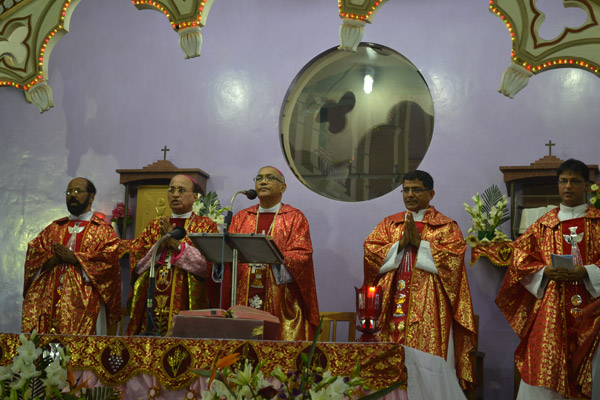
Bishop of Mangalore, Most Rev. Dr. Aloysius P. D’Souza as the chief celebrant solemnized the annual feast of St. Lawrence on Wednesday, 29 January 2014 at 10.30 am. He was joined by Most Rev. Dr. Gerald Isaac Lobo, Bishop of Udupi Diocese, Rev. Dr. Baptist Menezes, Vicar General of Udupi, Rev. Fr. Denis D’Sa, PRO of the Udupi Diocese, Rev. Fr. George D’Souza, Rector of St. Lawrence Shrine and a number of other priests from Udupi and Mangalore Dioceses. Unprecedented crowd participated in the feast mass.

BishopBF08feb2014

In his homily on the theme of the annual feast “Christian Families-Cradle of Faith”, Bishop Aloysius D’Souza  specially mentioned the three basic principles of a good Christian family that were put forward by the present Pope, Francis  addressing families from 95 countries of the world when they had gone to Vatican on a pilgrimage. These three basic principles are: Prayer, Faith in family and Happiness in the family.

Elaborating these three basic principles, Bishop Aloysius D’Souza said that  family prayer especially reciting Rosary by all the members of the family together fosters the sense of unity in the family. Faith is the important factor in family life. Further he said that the faith should be like the faith that was expressed by St. Paul and Christians should bear witness to the faith that they profess. Regarding the happiness in family, Bishop said that modern gadgets would not provide lasting happiness to the family members. People should find happiness through unity and togetherness where God finds a place within the family. The Bishop further said that correcting mistakes of children is an obligation of the parents. Giving the example of the Holy Family of Jesus, Joseph and Mary, Bishop Aloysius D’Souza said that Jesus should be the model for the 3 children whereas Joseph and Mary should be models for parents.


BookonStLawrenceBF08feb2014

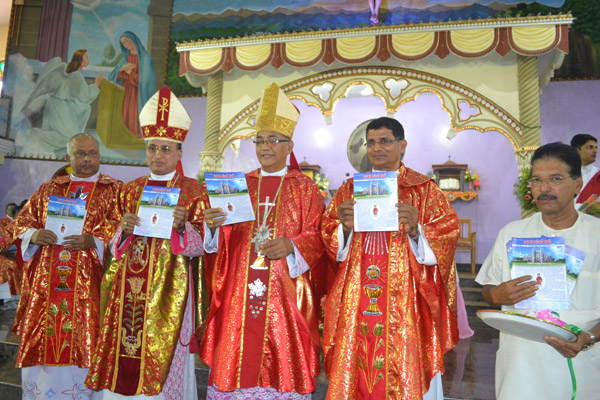
At the end of the Feast Mass, one book in Konkani titled “Sant Loresachim Dhirvim” (Treasures of St. Lawrence) and informative pamphlet on the history of the Shrine of St. Lawrence written by George Castelino, recipient of National Award for Best Teacher were released by Bishop Aloysius P. D’Souza along with the Bishop of Udupi, and Vicar General. Bishop of Mangalore also honoured George Castelino with a shawl and bouquet of flowers. Steven and Florine Mendis, proprietors of the Divine Channel and producers of the film on the life of St. Lawrence were also felicitated by the Bishop of Mangalore.

Most Rev. Dr. Gerald Isaac Lobo honoured Most Rev. Dr. Aloysius P. D’Souza by offering him shawl and Rev. Fr. George D’Souza offered him a bouquet of flowers as a sign of respect to the Bishop of Mangalore who obliged the diocese as the chief celebrant of the solemn annual feast mass.
Earlier in the morning at 8.30 am, most Rev. Dr. Lawrence Makkuzzi, Bishop of Belthangady offered Holy Mass in Malayalam language. The Bishop of Udupi Gerald Lobo accompanied the Bishop of Belthangady to the altar. Rev. Fr. George D’Souza, Rector of the shrine welcomed the Bishop of Beltahngady and offered him a bouquet of flowers. This was the first time that a Bishop offered mass in the Malayalam language in the Shrine of St. Lawrence. Quite a large number of people attended the mass. The choir and the faithful participated in the singing.

ChurchBF08feb2014

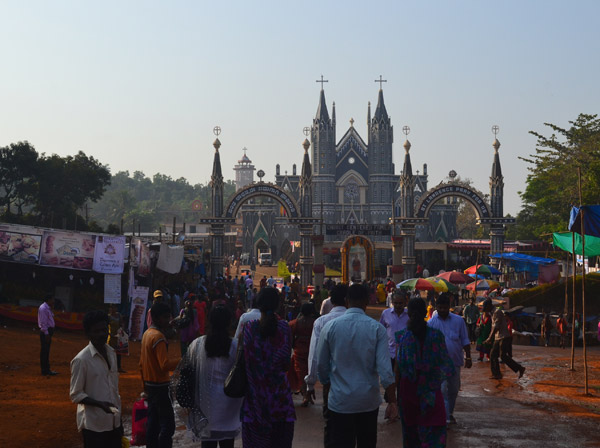
There has been continuous flow of pilgrims to the shrine throughout the day. Masses for the benefit of the pilgrims have been arranged right from 12.30 pm till 11.30 pm including one at 5 pm in English and another at 8.30 pm in Kannada.

source: http://www.bellevision.com / Bellevision.com / Home> News / by Dr. Eugene DSouza, Moodubelle / Bellevision Media Network / Karkala – January 29th, 2014

Return of the native

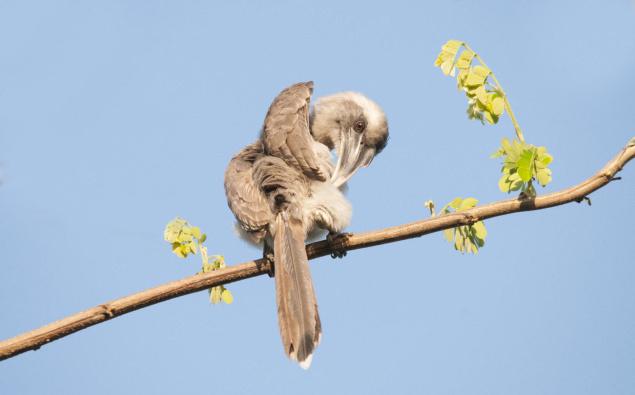
They make their nests in avenue trees./  Photo: Saandip Nandagudi / The Hindu
They make their nests in avenue trees./ Photo: Saandip Nandagudi / The Hindu

Recent sightings of the Indian Grey Hornbill in city limits is cause for much cheer

There was a loud and heavy flapping near an old and thick Banyan (Ficus benghalensis) tree growing in a village in Hoskote, just off Old Madras Road, where we had recently gone bird watching. We peered up at a large hole high up in the trunk of the tree, where an Indian Grey Hornbill (Ocyceros birostris) had nested. Looking up at the hollow we noticed that the entrance had been sealed, through which the male bird was feeding the female, who was obviously incubating her eggs. We crept away so as not to disturb them and watched through binoculars from a safe distance.

Similar sightings have been voiced by other bird lovers across the city. With great excitement, Deepa Mohan, a bird lover, who organises children’s nature walks, revealed, “I went to Puttenahalli Lake yesterday with a friend to try out my new binoculars, and to do a recce for a children’s nature walk I am doing there. We saw an Indian Grey Hornbill fly across the lake and go and settle in the foliage of an African Tulip near the western end of the lake.  The closest I have seen these birds before is in the Valley School area.”

The birds are not commonly found within the city limits, but with Bangalore’s boundaries expanding by leaps and bounds they have been sighted in the quieter areas, which still boast of a few large and old trees, much to the delight of bird lovers.

“There are a couple of Indian Grey Horn bills at Hulimangala…. usually seen near a lonely big old tree next to the lake,” says Swaroop Bharadwaj another birder from the city.

With its abundance of trees, Bangalore University is another great spot to see the magnificent birds. “I have seen a pair in Bangalore University Mysore Road side. And have frequently seen several in Kukrahalli Kere which is in Mysore,” says Saandip Nandagudi.

The birds are arboreal, hardly ever alighting on the ground and most often are seen in pairs. Grey in colour the Indian Grey Hornbill has a black or dark grey curved and prominent beak. They are one of the few hornbill species found within urban areas in many cities, where they are able to make their nests in the trunks of large avenue trees.

Indian Grey Hornbill sightings seem to be excitingly on the rise for bird lovers. In the past they were found only from Valley School in the South and from Hessarghatta in the north but there have been recent reports on a birding fora that the birds have been spotted in Lalbagh and also in Sahakarnagar.

They require large and old trees to nest in which Bangalore has lost over the years with uncontrolled felling of all our avenue trees. But the fact that they are making a come back into our city, is exciting and holds the promise of hope for all avid bird lovers.

source: http://www.thehindu.com / The Hindu / Home> Features> MetroPlus> Travel / by Marianne De Nazareth / Bangalore – January 30th, 2014

Three-Day workshop on Sanjhi Mask Art from tomorrow

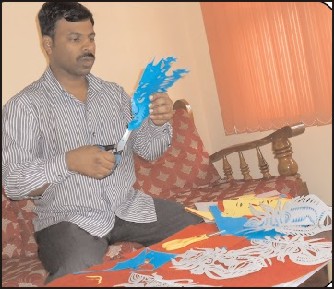
MysoreHuseiniMPos06feb2014

Mysore :

Mysore Art Gallery and Saanjhi Kala Loka have jointly organised a three-day workshop and exhibition on ‘Sanjhi Mask Art’ by artist S.F. Huseni (Mysore Huseini) at Mysore Art Gallery premises on Ramanuja road in city from tomorrow.

The programme will be inaugurated tomorrow by D. Mahadevappa, Chief Editor of ‘Prajanudi’ at 11 am.

Nirmala Matapati, Assistant Director, Dept. of Kannada and Culture and Littereteur P.M. Subramanya will be the chief guests.

A workshop and training programme on Sanjhi art will be held on Feb. 2 and those interested may register their names through Mob: 98451-53277.

The exhibition and the workshop will conclude on Feb. 3.

Artist’s Profile

S.F. Huseni (Syed Fakruddin Huseni), was born on April 15, 1976 to Syed Peer and Zeenatunnisa Bi at Shivana Samudram (Bluff) in Mandya district.

He completed his Diploma in Fine Arts, Art Master (A.M) and BFA in painting at K.P.J. Prabhu Artisan’s Training Centre (Canara Bank PRJD Trust).

Huseni, who is gifted with this art, received encouragement from his parents right from his study time. The present theme of paintings created by the artist mainly depict the theme “Home in every Heart.”

Huseni has participated in many solo exhibitions and group exhibitions besides conducting camps and is a recipient of various State Awards and scholarships. For details, log on to mysorehuseini.blogspot.com or call Mob: 98451-53277.

source: http://www.starofmysore.com / Star of Mysore / Home> General News / January 31st, 2014

Down memory lane : Udaya Ravi : A fitting memorial with museum to Kuvempu

1) Kuvempu  (2) A front view of Kuvempu's house 'Udaya Ravi.'
1) Kuvempu (2) A front view of Kuvempu’s house ‘Udaya Ravi.’

by  K. Vijaya Kumar, Former Jt. Director of Information & Publicity

Udaya Ravi, Rashtrakavi Kuvempu’s house in Mysore (5th Cross, V.V. Mohalla), is not just a simple house but has a greater significance since Kuvempu wrote his magnum opus Sri Ramayana Darshanam sitting in his room from this home. Acharya Vinobaji during his padayatra in Karnataka (Kuvempu had great reverence to him) was eager to visit Kuvempu’s house since he had come to know about Ramayana Darshanam. When (on 25.9.1957) Vinobaji enters inside Udaya Ravi, Kuvempu records in his diary, he pronounces in Hindi three times ‘Bahut prashanth hai’ (very peaceful atmosphere).

Tarini Chidananda, Kuvempu’s daughter, in her book Magalu Kanda Kuvempu (Kuvempu as seen by his daughter), vividly describes how much Kuvempu was sentimental and attached to Udaya Ravi and the garden he had raised with various flowers and fruit plants in front of the house. Kuvempu built this house in 1937 and the then President of Ramakrishna Ashrama Swami Deshikanandaji sent a Bengali contractor, one K.C. Dham (who had migrated to Mysore and a devotee of Ramakrishna Mission) who had earned a good name as a committed person in his work.

Tarini, who spent most of her life in Udaya Ravi and taking care of Kuvempu after the death of her mother Hemavathi, writes how her father after building and living in Udaya Ravi, got married, worked in the University, wrote most of his works and breathed his last in the midnight on 11.11.1994 in Udaya Ravi.

Many of those who had visited this house, just to cite a couple of them as recorded by Tarini — a Soviet Delegation, UGC Chairman C.D. Deshmukh and his wife Durga Bai Deshmukh had expressed great appreciation of Udaya Ravi and its garden and complimented Kuvempu and his wife Hemavathi for their efforts in maintaining it so neat and tidy.

It is appreciable that the State Govt. has declared Kuvempu’s native place Kuppalli where his body has been laid to rest in Kavishyla as a memorial of Kuvempu and entrusting it to Rashtrakavi Kuvempu Pratishtana to maintain it, who have opened a Kuvempu Museum for visitors.

I recollect here my memory of 30-35 years back, when my Dept. of Information was producing a documentary film on Kuvempu, directed by Chaduranga, the noted writer, my numerous visits to Udaya Ravi to meet Kuvempu in that connection and on many several other occasions, I fondly remember the pious moments spent with the poet in his house.

Many felicitations to Kuvempu used to take place at Udaya Ravi only as the poet was reluctant to accept it and I remember one such felicitation organised by State Bank of Mysore in early eighties wherein I was made the chief guest.

I sincerely feel and as many other literary figures of yesteryears, who were direct disciples of Kuvempu, with scores of others who have high liking for Kuvempu’s literature, might also agree that Udaya Ravi in Mysore where Kuvempu spent most part of his life needs to be declared by the Govt. as a Memorial in his memory and a Museum could be established entrusting it to be run and maintained by an organisation locally, either University of Mysore or a similar body like Kuvempu Prathistana. I am sure scores of Kannadigas will support this cause.

Even now, quite a few visitors, particularly student groups on conducted tour visiting Mysore do come to see Udaya Ravi. Though inconvenient to Tarini and her husband Prof. Chidananda Gowda who reside there, do not disappoint the visitors. Besides many even in Mysore and around have not been able to see the place though they have a desire to visit.

source: http://www.starofmysore.com / Star of Mysore / Home> Feature articles / by K.Vijaya Kumar   e-mail: kumarkv59@gmail.com / January 29th, 2014