Category Archives: Travel

Give a boost to religious tourism in Mandya: SP

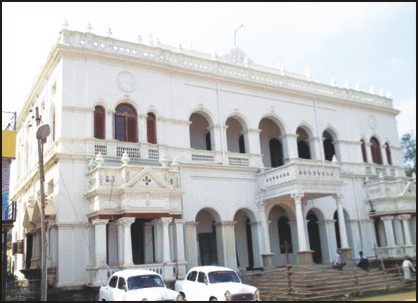
The Dariya Daulat Bagh (Tipu Sultan’s summer palace) at Srirangapatna in Mandya. Superintendent of Police Borase Bhushan Gulabrao has suggested that the Tourism Department appoint trained guides at popular tourism spots in the district. / File photo / The Hindu

‘Develop well-known religious places into tourism hubs’

Superintendent of Police Borase Bhushan Gulabrao has suggested that the Tourism Department initiate measures to give a boost to religious tourism in Mandya.

Mr. Gulabrao convened a meeting of religious leaders at his office on Sunday.

He said there were several tourism spots of religious importance in the district. “However, many tourism spots are yet to be developed,” he said.

The district has war memorials, archeologically important temples, ancient churches, centuries-old mosques, Buddhist temple and other pilgrimage-cum-tourism destinations.

Emphasising the need to promote religious tourism in the district, Mr. Gulabrao requested department officials to develop well-known religious places into tourism hubs.

Uniforms for guides

He said that thousands of tourists came to Srirangapatna every day to visit the tourism spots. But, guides did not have enough knowledge about the historical significance of places in the town. The department should provide information and uniforms to the guides, Mr. Gulabrao said. He suggested that the department appoint trained guides at popular tourism spots in the district.

‘Several plans made’

Adilakshmi, Assistant Director of Tourism Department, also underlined the need to promote religious tourism in Mandya.

She said the department had several plans to strengthen pilgrimage-cum-tourism destinations in the district.

Suggestions received

Mr. Gulabrao and Additional Deputy Commissioner Shankarappa received suggestions during the meeting on popularising religious tourism. Karnataka Dalit Sangharsh Samiti leader Venkatagiri, activists Jayaramu and Mahesh, senior citizen Shivaramaiah, social worker Mehboob Pasha and others requested the district administration to develop Kere Thonnur, Kere Thonnur dargah, Kunti Betta, Balmuri waterfalls, war memorials at Srirangapatna and other popular tourism spots by improving infrastructure.

Additional Superintendent of Police Puttamadappa, Deputy Superintendents of Police B.J. Shobharani and Geetha were present.

source: http://www.thehindu.com / The Hindu / Home> News> National> Karnataka / by Staff Correspondent / Mandya – November 11th, 2013

Bonding at 19,000 feet

There’s the Adam’s Family, the Jetsons, the Simpsons and The Flintstones and then there is Bangalore’s very own biker family —the Acharya family. This family of five — mother Jayashree, 56; father GV Acharya, 64; brother Srikanth, 31 and sister-in-law Namitha, 30 — led by daughter Shubra Acharya, holds the Limca Book Record of being the only family to have crossed the world’s highest motorable pass the Khardung La pass in Leh in 2011.

Riding through the 18,379 ft pass, Shubra, anardent biker, says, “We felt like we had conquered the world! My father owned a Bullet. Since then, we are familiar with the thump of the bike.”

It was during her MBA in 2010 that Shubra’s brother got her a Bullet Classic 500cc on her birthday. The brother-sister duo would set out on road trips around Bangalore with their dad; who would borrow a bike from friends and set out on a road trip. “I would write about the trips on my blog. Once my mother read the stories and wanted to be with us on a trip.”

It was during the Tonnur Kere ride on Mysore Road in December 2010 that they decided on a bike trip to Ladakh. “We just wanted to do it with mum. So we coaxed her to ride pillion with dad.”

It was a surreal experience for the Acharya family. “We stopped after the two and- a-half hour ride from Leh to the top of the pass and were drinking a lot of lemon tea because it was freezing,” says Shubra. They met other bikers who told them to send applications to the Limca Book of Records. They garnered two records: GV Acharya at 64 became the oldest man to have crossed the pass and the Acharya family became the “largest family” to have conquered Khardung La pass. For this family, no mountain is too high!

source: http://www.bangaloremirror.com / Bangalore Mirror / Home> Columns> Work / by Ayesha Tabussum, Bangalore Mirror Bureau / November 11th, 2013

Up, up and away

India’s first hot-air balloon flight celebrates 50 years on Children’s Day.

Anil Kumar’s kin watch him board the hot-air balloon on 14 November 1963

“I was called the Yuri Gagarin of India,” says Anil Kumar, recalling his experience of having travelled on India’s first hot-air balloon ride on 14 November 1963. The hydrogen gas balloon, launched by the then Karnataka chief minister S. Nijalingappa from the Race Course grounds in Bangalore, was part of Children’s Day celebration. The plan to build a Pestalozzi Children’s Village (based on the principles of Johann Heinrich Pestalozzi, a Swiss educational reformer) was also announced. “They wanted to have a grand event to make the announcement and so a hot-air balloon was brought in from Germany,” recalls Kumar, who was 14 years old at the time. The village was never built, but the memories of that balloon ride remain.

Two trained and licensed pilots from Germany, Hermann Johannes Scheer , the then director of Pestalozzi Kinderdorf, Germany, and Alfred Schulz were flown in for the event. Since the pilots were both German nationals, it was thought appropriate that at least one Indian should fly along with them to mark Children’s Day. “I was at the press conference two days before the event, along with my father who ran a magazine for the Karnataka Electricity Board. Since I was the only child they saw, they asked me if I would like to come along. Of course, I said yes,” says Anil Kumar.

Two trained and licensed pilots from Germany, Hermann Johannes Scheer and Alfred Schulz were flown in for the event. Anil Kumar (fourth from left), then 14 years old, was the only Indian on board.

The event made front page news in all the leading Indian newspapers. From a height of 18,000ft, Kumar recalls Bangalore as being green and gorgeous. “But the sight I can’t forget was the railway lines and the network,” he says.

“India Post brought out a First Day Cover with a photograph of Kumar and the two pilots in the balloon. “They handed us two mail bags containing the First Day Covers, to be carried as Balloon-Mail,” says Kumar, adding, the balloon landed about 20 miles (around 32km) away in a village called Cholanayakanahalli, on Magadi Road. Kumar was trained by the Bangalore city police to use a wireless communication handset and to keep them informed of the route they were taking. “The direction of a hot-air balloon is guided by the wind, so we couldn’t entirely determine where we would land,” says Kumar.

To celebrate 50 years since the country’s first hot-air balloon flight, Kumar, who runs a placement agency in Bangalore, will travel to Germany and launch another balloon flight in the presence of the Alfred Schulz, the only surviving pilot.

Anil Kumar also plans to start licensed balloon club in Bangalore this year.

India’s first hot-air balloon flight was launched by the then Karnataka chief minister S. Nijalingappa from the Race Course grounds in Bangalore on 14 November 1963.

source: http://www.livemint.com / Live Mint & The Wall Street Journal/ Home> Leisure / by Pavitra Jayaraman / Tuesday – July 05th, 2013

Dewan Poornaiah’s Yelandur bungalow to be converted into a museum

Bungalow was gifted to Poornaiah by Wadiyars

DewanPoorniahBF30oct2013

Mysore :

Come 2014 and the more than 200 year-old bungalow of Dewan Poornaiah, Dewan of erstwhile Mysore State in Yelandur, Chamarajanagar district, will be turned into a museum to give a glimpse of his persona and achievements.

Heritage Commissioner Dr. C.G. Betsurmath has said that as per the deadline of December set by the Department of Archaeology, Museums and Heritage, which is overseeing the renovation works, the works are almost complete and added that they were now focussing on developing a museum at the bungalow.

The fact that the revenue administration adopted by Poornaiah two centuries ago is still the guiding force for administration in the State speaks volumes about his acumen as he not only streamlined revenue but also conducted land surveys in a methodical manner and we want the museum to depict this and speak about his acumen, Betsurmat said.

After inspecting the site, the Heritage Commissioner said that only about 5% civil works were pending and added that they were collecting the belongings of Poornaiah to put the same on display at the two-storied structure. He also said that officials of the department had contacted Poornaiah’s family members in this regard.

Dewan Poornaiah was a leading administrator who served under three kings namely Hyder Ali, Tipu Sultan and Mummadi Krishnaraja Wadiyar as Dewan before retiring, which was followed by his death in 1812.

He was also well known for his skills in accounts and proficiency in several languages, Besturmath said and added that the department was spending Rs. One crore to renovate and open a museum at the bungalow where Dewan Poornaiah lived.

source: http://www.starofmysore.com / Star of Mysore / Home> General News / October 24th, 2013

Rolf Frei, Aruna Sunderlal gets a dose of Swiss Orchestra

It was an evening of soul-stirring music as the Swiss Orchestra performed for the first time in India at the Movenpick Hotel & Spa Bangalore over the weekend. 

The event saw music lovers — including Rolf Frei, Aruna Sunderlal, Michelle and Aslam Gafoor and Manjusha Maheshwari — turn up in droves to get a chance to listen to the orchestra. The guests first spent some time catching up over drinks before they sat down to listen to the orchestra, which was headed by Christopher Morris-Whiting. Later, everyone headed home after an evening they would not forget in a hurry.

source: http://www.timesofindia.indiatimes.com / The Times of India / Home> Entertainment> Bangalore / TNN / October 16th, 2013

WoNoBo.com, India’s first and only 360-degree-view platform, launched

Announces tie-up with Ministry of Tourism’s Incredible India campaign

Bangalore, India :

Genesys International Corp., India’s leading geospatial solutions company, announced the launch of WoNoBo.com.

Users will be able to search, explore and share ‘points of interest’ across the length and breadth of the country. At launch, the service will be available for 12 major Indian cities and will soon be expanded to 54 cities.

WoNoBo.com also announced a tie-up with Incredible India, Ministry of Tourism, Government of India, for the launch of Walking Tours, a unique and exciting product that will enable users to navigate and route their way through cities based on a number of interesting themes.

“The Ministry of Tourism is partnering with WoNoBo.com to create a Walking Tours platform, one of the first such initiatives to be undertaken in any country. We believe that this innovative and entertaining technology – aimed at making our most-visited cities extremely easy to walk or drive through – will add a completely new facility to our Incredible India campaign,” said Parvez Dewan, secretary, Ministry of Tourism.

WoNoBo.com also offers several other services. One, for instance, enables users to illustrate, using 360-degree views, the colourful, chaotic, dramatic lives they lead in different corners of the country. It also offers guides, created by users as well as experts, showing locals where to eat, what to shop for, where to take your children while visiting and a lot more.

source: http://www.ciol.com / CIOL / Home> Developer> News / by CIOL Bureau / Tuesday – October 15th, 2013

Bangalore hosts first ‘Fairfield by Marriott’ hotel in Asia Pacific

Bangalore :

Marriott International plans to open 12 ‘Fairfield by Marriott’ hotels in India in the next two years. The company has opened its first property in Asia-Pacific region in Bangalore.

‘Fairfield by Marriott’ is a mid-end hotel brand targeted at business and leisure travellers.

“Marriott is banking on partnering model in India. Investors locally offer expertise and finance, we in turn bring in best hotel management skills,” said Don Cleary, COO, Marriott International in Asia.

“The company already has few hotels being constructed in major cities in India, which are located in tier II cities such as Lucknow, Amritsar and Katara in north India,” he added.

In addition, the company is also eyeing hotels in Nepal, China, Indonesia, Thailand and Korea.

For its India foray, Marriott has partnered with SAMHI, a hotel investment and development firm, to develop few properties.

RIGHT TIMING

On the entry of ‘Fairfield by Marriott’ hotels in India, Cleary said “The timing is right with burgeoning middle class and the market is prime for a brand like Fairfield.”

“We chose Bangalore for it is a great market. We also have a lot of our brands which have opened for business in the city. It is a healthy market in the country for us as it is has already beginning to deliver,” he added

“SAMHI for the first ‘Fairfield by Marriott’ property in India, acquired a half-completed project and invested Rs 100 crore to build 148-room hotel in the heart of Bangalore city,” said Ashish Jakhanwala, Managing Director and Chief Executive, SAMHI. “The company has spent Rs 60 lakh per room and this is expected to withstand lot of economic pressures. By fixing room rate at around Rs 6,500 for now, we expect to break even in a couple of years,” he added.

source: http://www.thehindubusinessline.com / Business Line / Home> Companies / by Our Bureau / Bangalore – October 09th, 2013

Pages from history : The magic spell of Dasara

by Prof. A.V. Narasimha Murthy, former Head, Department of Ancient History & Archaeology, University of Mysore

All roads lead to Mysore, the royal city, because it is the time of Navaratri also called Dasara and Mysore is glittering with electric lights. Infact ancient Dasara of Vijaynagara times was glittering with gold and gold but our Dasara has substituted electric bulbs in place of gold. Even this is a luxury and a symbol of pomp. Actually it is called Sharannavaratri or Navaratri during the autumn season as different from Vasantha Navaratri which is celebrated during spring. In the former, nature also plays a role with good climate and the season of flowers and hence flower show is also held during this period. Navaratri is basically the celebration in honour of the mother Goddess, called by different names according to the role assumed by her in destroying the wicked demons who were tormenting the good people. It has been so arranged by our ancient people that the pre-navaratri fortnight is called Pitrupaksha or the fortnight of the ancestors culminating in the Mahalaya Amavasya on which day even the poorest of the poor offer prayers to their ancestors. Thus the ancestors are worshipped first and then comes the Navaratri, the worship of the mother goddess.

According to mythologies, the goddess amalgamated the power and prowess from gods Vishnu, Shiva, Brahma and Agni so that she could destroy the powerful demons. These demons had obtained boons from the same gods that they should not be killed by ordinary methods and persons. Hence the goddess had to assume special forms by ingenious combinations which could not have been imagined by the demons while requesting the boons. Thus the arrangement was such that the validity of the boons was not disturbed and vanquishing of the wicked demons also took place. The work Devimahatme describes in details the various forms of supreme goddess like Mahishamardini (demon Mahishasura), Kali (Madu and Kaitabha), Chamundeshwari (Chanda and Munda), Raktadanti (Demon Danti), Durgi (demon Durga), Bhramani (demon Aruna) etc. Of all these goddesses, Mahishamardhini, Durgi and Chamundeshwari are more popular. In fact as it is well known, our city Mysore got the name from Goddess Mahishasuramardhini, the vanquisher of the demon Mahishasura. Its ancient name was Mahishapura or Mahishuru which got corrupted by the British as Mysore. In fact southern Karnataka was referred to as Mahishamandala and this name found mentioned during the period of Ashoka almost 2,200 years ago.

Another significant feature of Navaratri, is the exalted position given to Kannike or unmarried girls. They are supposed to be personifications of the Goddess of Navaratri. They are to be worshipped as Kumari, Trimati Kalyani, Rohini, Chandike, Shambhavi, Durgi, Subhadra and Kali. Each one of these forms was worshipped and presents given to them and it is believed that the great Goddess would be pleased by the worship of the unmarried girls.

It is of interest to note that the Goddess of Navaratri was worshipped by epic heroes also. It is said that Sri Rama worshipped the goddess before going to fight Ravana and achieved success. Mahabharata heroes also worshipped the goddess and took out their weapons of war which they had hidden under a Shami (banni) tree and started their victorious march. Our kings of historical dynasties were not slow to imitate Sri Rama and the Pandavas in this respect. Unfortunately the history of Navaratri festival celebrated by the pre-Vijayanagar dynasties is not known to us as it has not been recorded. But we are fortunate that many foreign travellers like Nikitin, Barbosa, Abdul Razzak, Domingo Paes, Nuniz etc. who had the good fortune of participating in the Dasara festival as special invitees of various Vijayanagara kings have described in glorious terms even the minutest details of Dasara held during the period.

The most luxurious Dasara of the Vijaynagara period was held during the reign of Krishnadevaraya, the most distinguished emperor of this dynasty. The foreign traveller Domingo Paes was an eye witness to the Dasara of Krishnadevaraya which was celebrated for nine days from Sept. 13 to 21, 1529 AD. Its luxury and pomp can be estimated by the presence of gold images of gods and goddess and the rich gold ornaments worn by royalty and common women who attended the celebration. The speciality was that celebrations took palace both in the day time as well as during nights. One the tenth day called Vijayadashami, Krishnaradevaraya held a review of the army of the State. It was an occasion for Krishnadevaraya to exhibit his military strength in public.

The Wadiyars of Mysore are the cultural successors of Vijayanagara and hence celebrated Dasara on the pattern of Vijayanagara. Raja Wadiyar (1578-1617) celebrated Dasara at Srirangapatna and codified the rules and regulations in this regard. He even ordered that Dasara should not be stopped even if there was a death in the royal family. During the days of Kanteerava Narasaraja Wadiyar, Dasara became more glorious. Dasara became a grand affair during the period of Krishnaraja Wadiyar III in Mysore.

During the period of Krishnaraja Wadiyar IV Dasara became a great spectacle and attained fame even abroad and it became world famous. Then came Jayachamarajendra Wadiyar who continued the traditional Dasara in a glorious manner. The last Dasara of this type was held in the year 1969.

The Vijayadashami procession held on 10th day popularly known as Jambo Savari was the greatest attraction. Govinda Vaidya (1648) refers to it as Jambi Savari, meaning a procession to Banni tree. It is said that there was an elephant in London Zoo and it was called Jambo and hence British called it Jumbo Savari and in course of time it became Jumbo Savari.

This is all history and at present Dasara is celebrated as Naada Habba with the procession of the idol of Chamundeshwari.

The government is trying to make it more attractive by innovative additions. But is lacks religious fervour and traditional glory of the days of the Wadiyars. In spite of all these changes, Mysore Dasara is attracting people in large numbers. That is the magic of the word Dasara.

source: http://www.starofmysore.com / Star of Mysore / Home> Feature Articles / by Prof. A.V. Narasimha Murthy, former Head, Dept. of Ancient History & Archaeology, University of Mysore / October 12th, 2013

Uusung heroes of Jumboo Savari

Mysore :

Although lakhs of visitors flock the Royal Route of Jumboo Savari from the Palace to the Bannimantap grounds to have a glimpse of the 5,535 kg howdah elephant Arjuna majestically carrying the 750 kg golden howdah with the idol of Goddess Chamundeshwari placed in it and seek the blessings of the presiding deity, the real heroes of the event go unnoticed.

Akram Pasha, an employee of the Forest Department, who is specialised in tying the howdah to the Ambari elephant, is on the job for the past 20 years. He along with 68-year-old Zakhaulla, a resident of Ghousianagar, is busy preparing the Gaddi on which the Ambari will be placed atop Arjuna besides tailoring flaps of clothes to be placed on either sides of the 14 Dasara elephants.

Pasha claims that he learnt the art of tying the Ambari to the elephant from Mahouts after joining the Forest Department and adds that with the help of his father he learnt the art of stitching decorative flaps used in decorating the elephants for the occasion.

Claiming that he had prepared Gaddis for Dasara elephants like Biligiriranga, Rajendra and later Drona, Pasha adds that lot of gunny and grass are required to prepare the Gaddi.

To prevent any inconvenience from citizens, Mahouts and Kavadis of the 14 Dasara elephants and those preparing these costumes are provided security by 24 Police personnel at 14 specially erected sheds.

The district administration had spent more than Rs.12 lakh for purchase of necessary decorative items to be used for decorating these elephants for the grand finale of the Dasara festivities.

However, this year, it is said that approximately Rs. 15 to 16 lakh is required for purchase of decorative items to be used on these elephants on the Jumboo Savari day itself and the State Bank of Mysore which is celebrating its centenary year has come forward to donate Rs.15 lakh for this purpose, said Palace Board Deputy Director T.S. Subramanya.

Whether those taking part in decorating the Dasara elephants get their due recognition or not, the Jumboo Savari leaves an indelible mark in the hearts of those who witness the spectacle.

source: http://www.starofmysore.com / Star of Mysore / Home> General News / October 11th, 2013

Up Up… In the air !

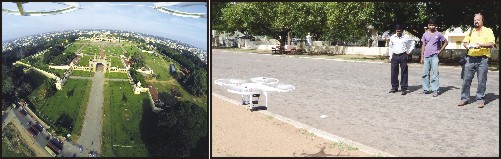
Left: 1) An aerial view of Mysore Palace shot by Ramesh Sarkar with his Phantom Go Pro Hero-3 Camera (Right) ( 2) Ramesh Sarkar is seen operating the Phantom Go Pro Hero-3 Camera.

A shot from above

by Anagha Mahesh

How about a camera that flies in the air just like a toy plane? Is it a toy camera or a real camera? It is indeed a proper camera, which can shoot upto 15 minutes of video or photo mid-air.

The camera — Phantom Go Pro Hero-3 Camera, with a quadcopter (four-winged tiny helicopter), is a brain child of a company in USA. The camera is fixed in the middle of a 4-winged small helicopter kind of thing (see pic). It comes with a monitor and battery operated remote with two joysticks for movement. The person operating this camera uses the monitor to view the images captured from the camera when in air. The camera can capture 60 shots within a second.

In India, only about ten people know how to operate this camera and one among the ten is Ramesh Sarkar, a photographer from city. Sarkar has been into photography since the past 35 years. Basically a Science graduate, he has many firsts to his credit — was the first person in city to use video coverage at a wedding, first to use a digital camera for wedding and the most recent and the coveted one, the first one to use an Aerial camera to shoot wedding videos and photos from the sky.

Apart from this, he has also done the wedding shoot for families of the Wadiyars, Cycle Agarbathi Brand, MPs and MLAs in city. He has made documentaries for Coorg Public School, Gonikoppa and KALS, Mysore. He was also the official Dasara photographer for covering the festivities in all its hues and colours from 1990-99 and again from 2006-12. Till date, he has shot more than 6,000 weddings! That’s quite a figure.

The Phantom Go Pro Hero-3 Camera was introduced to India in the year 2012 by AVCS Systems India Pvt. Ltd., New Delhi. They are the only agents, distributors in the country. The company provides a 10-day training at Delhi for those who buy this camera.

Camera Stats

Cost: Rs. 4 lakhs

Weight: In all, 750 gms.

Batteries: Runs on a rechargeable nickel-cadmium battery (comes with 4 batteries in total).

Kinds of shots: Wide-shot, narrow-shot and a normal-shot.

Has the option of shooting both videos and photos upto 10 hours; once in air it can shoot upto a max of 15 mins.

Usage: Mainly for weddings and for big industrial plants and other industries.

Memory: 32 GB; expandable upto 64 GB.

Application: GoPro

Video type: mp4

Monitor: Wireless and 14” wide

Compatible with any smart phone, tablet or ipad.

A higher version of the same is on the anvil with a 3-wing Tricopter instead of the 4-winged Quadcopter.

For more details, contact Ramesh Sarkar, Sarkar Video Trix, Saraswathipuram on Mob: 99800-89345 or e-mail: sarkar.camera@gmail.com.

source: http://www.starofmysore.com / Star of Mysore / Home> Feature Articles / October 12th, 2013