“May the Dasara festivities continue to bring in unity and harmony among the people,” said renowned litterateur Dr. Chandrashekar Kambar, in an interview with SOM yesterday.
Dr. Kambar, 77, who arrived in city yesterday at 2 pm, inaugurated the Dasara festival atop Chamundi Hill this morning.
Dr. Kambar said that he is penning another novel in Kannada, but refused to divulge its name as yet. Here are the excerpts of the interview:
SOM: How do you feel about inaugurating Naada Habba tomorrow?
Dr. Kambar: I feel honoured. The royal tradition is now being carried forward under a democracy. The Vijayanagar empire’s tradition was revived by the erstwhile rulers of Mysore, the Wadiyars. We must really appreciate the patronage given by them to art, literature, culture and Kannada language.
SOM: The religious festivities of yore are being continued even now… aren’t they?
Dr. Kambar: So, what’s wrong in that? True religion that preaches good things must be accepted. This is not only a religious festival, but encompasses art, culture and literature.
SOM: Can’t Dasara be bifurcated from religion and celebrated as Naada Habba?
Dr. Kambar: Why oppose religion? But too much religion is also not good. Mysore State had given the first people’s representative government. They also introduced the reservation facility which became exemplary for the country. People of different communities have been living in harmony here. There are some Mutts that have Samadhis of Muslims. The Veerashaiva Swamijis of the Mutt wear green cloth and visit the Dargahs for 15 days while the Muslims, wearing saffron, visit the Mutts. Why I am saying this is there should be no individuality.
SOM: Have you seen Dasara before?
Dr. Kambar: I had inaugurated the Dasara cultural programmes once and also inaugurated Dasara Poets’ Meet a few years ago. That apart, I had heard a lot of legends about Dasara, which I liked.
SOM: There is a dissent from some about the achievements of the Wadiyar rulers…
Dr. Kambar: The erstwhile rulers might not have fought wars. But their model of administration, foresight and public services are truly commendable.
source: http://www.starofmysore.com / Star of Mysore / Home> General News / October 05th, 2013
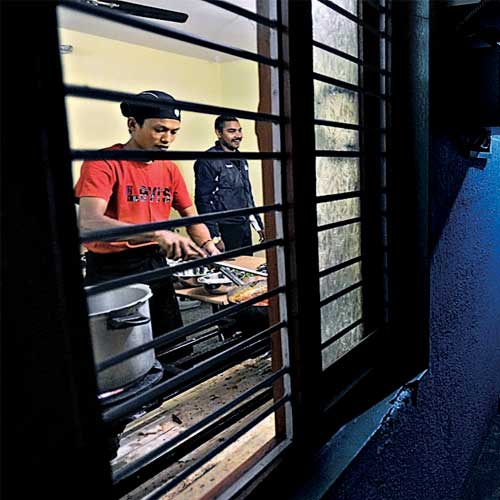
Enterprising individuals have begun door-delivery of food and booze right through the night to cater to the demand of graveyard shift workers.
– Anantha Subramanyam K/ DNA
“When I finish work and come out of office, I find that there is nothing to eat or drink,” says Tushar Nadkarni, an online retail businessman. Tushar’s lament is the lament of scores of people and professionals working in Bangalore, which calls itself a global city but behaves like a small town.
But not all have surrendered to the temptations of a goodnight sleep, as Tushar recently found out.
Tushar had a gastronomic surprise when he discovered Biryani Night Out through a phone inquiry service. “I ordered food at 1.30am for myself and two colleagues. The food was superb. We felt like ordering more, and there it was, again, with the delivery boy at our doorsteps smiling,” says Tushar.
Like Tushar, many professionals working in the IT/ITeS sectors are a relieved lot to find midnight eating options in the city: where there is demand, there will eventually be supply.
Enterprising individuals in the city are supplying food and drink right at the doorsteps between 11.30 pm and almost until pre-dawn.
For instance, one such enterprise Biryani Night Out in Yeshwanthpur even has a Facebook page which states “Treating tastebuds at midnight”. It caters to clients until 3am from its outlet in Yeshwanthpur.
Nayaz Pasha, owner of Biryani Night Out, says that he always wanted to be his own boss; and after completing his engineering degree last year, he did just that: he opened Biryani Night Out after realising that there was a large demand for night delivery services.
On Jan 18, 2013, based out of Yeshwanthpur, Biryani Night Out began dishing out biriyanis to famished Bangaloreans within a 10-km radius.
“I don’t charge for delivery as everyone gets hungry. So even if someone wants just one biryani, we deliver,” he says, adding that response has been so good that he now has five delivery boys, two chefs, a manager and a marketing consultant.
Vaibhav Ali, who runs Midnight Hunger Solution 24/7 from Indiranagar, used to be an event manager. “Events and parties go on till late night. After all the hard work, when we are hungry, there were very few options. I wanted good, hygienic, tasty and reasonable food available 24/7. That apart, MHS was born out of another need too. February-March-April season is a lean period for events. So there was a gap in business for me then. That’s prompted us to come up with Midnight Hunger Solution,” says Vaibhav Ali, co-owner.
Then there is SRS Restaurant 24/7. Started six months ago by Satish M, the restaurant is now doing roaring business, confirming once again that the city is very alive, kicking and hungry through the night.
Satish’s biryanis (chicken and mutton) and Andhra-style meals are a hot favourite and he delivers “anywhere in the city”, he says.
Senthil Kumar, owner of KFDS 24/7 (KFDS stands for Kevin Food Delivery Service), too has a smile on his face, as his gamble to open a 24/7 restaurant paid-off. He has a regular clientele with IT offices. “They (IT professionals) asked me to start late night delivery as well. I tried it out and found the business to be roaring,” says Senthil.
According to legal experts, there is no prohibition on delivering food after 1pm. “A commercial establishment has to be closed at 11pm. However, there is no prohibition on delivering food to homes post 11pm,” says senior advocate Ravi B Naik.
Former advocate general Uday Holla, too, agrees: “There is absolutely no bar on delivering food post 11pm. Home delivery for food is not illegal post 11pm.”
However, such night delivery services are set to witness a boom in the near future with National Association of Software and Services Companies (Nasscom) predicting more than a three-fold increase in IT/BPO workforce by 2020 — a sizable portion of which will be Bangalore-bound.
(Inputs from Suchith Kidiyoor and Odeal D’Souza)
Midnight Hunger Solution 24/7
Phone: 080-66534184,
8088922299, 8088922295
Email: midnighthungersolution@gmail.com
Service started on Feb 24, 2012.
They deliver anywhere in the city.
Serves Mughlai, Indian and Chinese food.
Meal for two would approximately cost Rs 300-400. Delivery charges are Rs 100.
Biryani Night Out
Phone: 09741109909
Serves chicken, vegetable biryani, kababs and soft drinks.
Veg biryani is priced at Rs 139, chicken biryani at Rs 159 and kababs at Rs 159 or 179 for 10 pieces.
SRS Restaurant 24/7
Phone: 080-49152614, 9738973503
They deliver anywhere in the city.
Late-night delivery charges around Rs 100-Rs 150 (based on the distance from Kammanahalli — their base).
Biryanis and Andhra-style meals are hot favourites.
Serving of nostalgia: The Fish Canteen in Cubbon Park, run by the Karnataka Fisheries’ Development Corporation, was once the only place in Bangalore where one was guaranteed fresh fish./ Photo: Karan Ananth / The Hindu
Cubbon Park has always meant different things to different people. To some, it is a colonial relic, to others a botanical treasure trove. A lovers’ glade to some and joggers’ park to others.
Through the late 1980s and 1990s, Cubbon Park was also the go-to place for fish lovers of the city, thanks to the Fish Canteen run by the Karnataka Fisheries’ Development Corporation.
Those were the days when the Fish Canteen was the only place in Bangalore where one was guaranteed fresh fish, raw or cooked. Mackerel and seer fish kebabs served with slices of salted bread and onion rings was a combination that was as popular as the fish thali.
The boom years of the late 1990s saw many restaurants sprout in the city, including those that served sea food. This period also saw a decline in the standards at the Fish Canteen.
Things continued to slide for over a decade with patrons at the canteen slowing down to a trickle. In 2010, the government finally gave the place a facelift, spending over Rs. 1 crore on turning it into a swanky restaurant from a basic canteen.
The menu though remained the same — fish kebabs (minus the bread) and thalis made up of ragi balls, rice, rasam, buttermilk and of course, fish curry.
Although the menu remained the same, there was a huge improvement in the quality for the first two years.
Standards have fallen again in the last year. The fish is often stale and rarely marinated. As a result, it seems like the fish and the curry were cooked separately and dunked together just before serving. The kebabs still have some sting left, though not half as good as what was served even 10 or 15 years ago.
Visit the Fish Canteen for the love of the place and the abundant fresh air, the prices aren’t bad either. But if you are have a desperate craving for fish, look yonder.
source: http://www.thehindu.com / The Hindu / Home> News> Cities> Bangalore / by Sudipto Monday / April 11th, 2013
At Rasa India, the Quick Lunch is your best option
Rasa India, Bangalore. Photo:
Rasa, the chain of restaurants in London, is now in Bangalore as Rasa India. Chef and food writer Das Sreedharan is excited about his new experiment that launched quietly on CMH Road, Indiranagar, less than a month ago. “I have so many plans, but it will all have to roll out slowly,” says Sreedharan, who opened his first restaurant, Rasa, in London in 1994. The author of four cookbooks who has featured on No Reservations with Anthony Bourdain , sources all his vegetables from organic farmers around Bangalore.
The good stuff
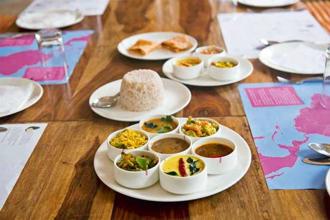
Although the present menu (vegetarian only) suggests a bias towards Kerala food (Sreedharan lived in Kerala until he was 19), the cuisine is Indian, says the chef, pointing out that the menu will change every eight weeks. Our meal began with a basket ofpoppadams, murukku and banana chips and an assortment of pickles, all made in Sreedharan’s kitchen. We got puli inji, a tamarind chutney with ginger, coriander and garlic chutney. These change as per season and availability of vegetables. Sreedharan plans to jar these and sell them at the restaurant starting next month. We ordered a Quick Lunch and Yam Sear with red rice from the a la carte menu. Quick lunch includes a salad, two vegetables curries (we got avial and olan), rasam, rice andpayasam. My dining companion, who hails from Kerala, gave the Quick Lunch a thumbs-up for authenticity. What was missing was a banana leaf, but if you remove that association from your mind, the meal is well presented. The Yam Sear was low on spice, which suited us well. The must-order from the menu is the tea. Sreedharan grew up helping his father run a tea stall in Kerala, which he brings to the Rasa menu. The tea is brewed in Kerala style with a layer of froth on top.
The restaurant will obtain a licence to serve wine soon.
The not-so-good
We were piqued at the presence of Aubergine Tikkis on the menu and wondered how they fit in amid all that Kerala food. They turned out to be brinjal bhajiyas. The co-diner found a stone in his red rice. If you drop by during lunch, go with the set lunch. While we did order partially from the a la carte menu, not everything was available.
Talk plastic
The Quick Lunch costs Rs.250 while the Super Set lunch is Rs.300. A meal for two, if you choose to order a la carte, comes to Rs.1,000.
Rasa India, CMH road, Indiranagar, Bangalore, will host Onam meals from 14-16 September. For reservations, call 8041518237.
source: http://www.livemint.com / Live Mint & Wall Street Journal / Home> Lounge Review / by Pavitra Jayaraman / Saturday – September 14th, 2013
Early on Sunday evening, the sky was clear and a soft wind blew across Ulsoor, lined by the lake on one side and expensive real estate on the other. There was an edge to the traffic racing towards the city’s downtown area, dodging pedestrians and potholes.
A young girl of perhaps 18 was at the front of the traffic on Gangadhar Chetty Road, close to the Thiruvalluvar statue. A pothole that had matured into a crater with water from early morning showers flooding the area, lay ominously across the road.
The girl and her two-wheeler, followed closely by an autorickshaw, were stalled by the condition of the surface. The slightly-built teenager, who was trying to manoeuvre her bike through the slush, lost her balance and tumbled into the muck.
The auto driver and the passengers in his vehicle sat unmoving. Behind them, traffic started piling up. A young man on a bike suddenly raced through the crowd and tossed his vehicle to the side. He didn’t even pause to take off his helmet before pulling the girl out of the slush and depositing her on the footpath. He then returned to move her vehicle.
For a while, people just watched, stunned by the little drama playing out before them. I realized the girl might need medical attention and got out of my car, leaving it in the middle of the road. By then, a biggish crowd had gathered around.
It took me a couple of minutes to get back to my vehicle which was clearly blocking the traffic. But no one objected. No one honked. There was a considerable pile-up and people in the vehicles in the rear probably didn’t even know what was happening up in front, but nobody made a sound. Everyone waited patiently. At a time when rapes and crimes against women headline newspapers every day, it was an especially sweet moment. The rider who cared, the crowd that paused.
As Metallica’s James Hetfield’s told the city’s rapt audience not so long ago, “Bangalore, you’re beautiful.”
It might have been the time of day, that day of the week, when the mood relaxed. It might have been the most patient were in the pile-up. Or maybe, just maybe, the city is regaining some of its lost temperament. Fair-weathered, pot-holed Bangalore.
source: http://www.articles.timesofindia.indiatimes.com / The Times of India / Home> City> Bangalore> Auto Driver / by Prajwal Hegde, TNN / September 04th, 2013
Jumboo Savari, the finale of Dasara festival is no doubt the prime attraction in city especially the golden howdah being carried by a mighty humble elephant.
Many are unaware of the intricate preparations to be made before the howdah could be mounted on the back of the elephant.
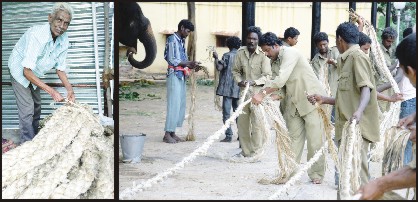
The howdah is actually placed on a thick mattress which is fastened to the back of the elephant using jute ropes.
The mattress is actually a combination of three different layers colloquially called Gaadhi, Namda and chapu.
The bottom layer Namda is actually a combination of gunny cloth and white cotton cloth woven together to get a soft texture.
Over Namda is Gaadhi which is a huge square gunny sack stuffed with wild grass grown on the bank of lakes.
Chapu is the top most layered thick cloth cover.
In short the three layer mattress is supposed to provide a firm soft support for the howdah and make the bearer elephant comfortable to carry the heavy load for a good distance.
The unsung hero instrumental in making the mattress is Pasha, a mahout of elephant Sarala who retired in 2006 but has also been doing this job of stitching the three-layer mattress right from 1971. His passion for the job and love of elephants has been recognised by the Forest Department to still keep him on the rolls. Pasha’s father Sultan too was a mahout for the Pattada Aane Hamsaraja of Jayachamaraja Wadiyar.
Pasha does not just make Namda, Gaadhi and Chapu but also weaves the thick jute rope from strands which takes about three days to make.
Speaking to SOM, Pasha said that he would begin making the jute rope ten days before Dasara. He added that he has been training other mahouts to make the mattress and rope. However he said that he was not happy to be in the forest all through and wanted his son Mansoor not to step into his shoes.
source: http://www.starofmysore.com / Star of Mysore / Home> General News / September 12th, 2013
Yet another roof-top delight where one can sit, relax and enjoy the city’s good weather along with some good food and let time melt away.
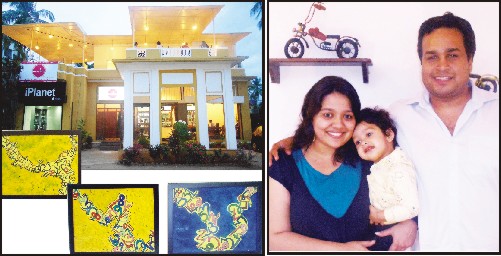
Located atop a heritage structure in V.V. Mohalla’s Gokulam road, Melt, a pizzeria is already turning out to be a popular roof-top restaurant. The decor is simple and sober yet classy and the food served is mouth-watering Italian delicacies.
Melt is the outcome of an enterprising couple, Neha and Ratan Singh, one interested in art, and the other in food. “We want to offer Mysoreans tasty food but more importantly it must also be fresh,” says Ratan, a hospitality Graduate from Switzerland.
“Though it is more of a Pizzeria, we are open to taking customised orders. We even make butter chicken if requested. “We want the customer to be satisfied,” says Ratan.
Their pizza named ‘Loaded’ on the menu, made with homemade tomato sauce, chicken, ham, sausages, onions and mozzarella and the vegan pasta with fresh veggies and white sauce has already become their signature dish.
Also while you devour the food, if you happen to catch a glimpse of colourful paintings all around the pizzeria, do not miss to compliment Neha, Ratan’s wife, for having painted them. Neha, who loves painting, has also designed the decor. This seems to be a family involved in their pizzeria as their two-year-old daughter Kiara, is often seen running around. While parents cook-up recipes that melt in our mouth, looks like the daughter melts customer’s heart.
Melt offers services from 11 am to 11 pm.
source: http://www.starofmysore.com / Star of Mysore / Home> Feature Articles / by Ambika Nagaraj / August 29th, 2013
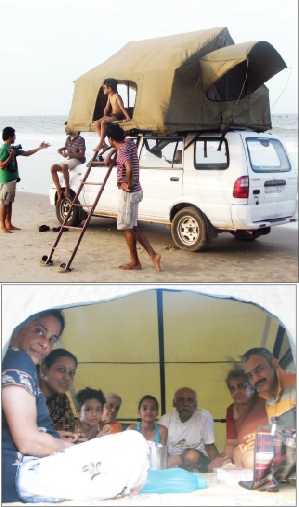
A city-based mechanical engineer’s passion for outdoor adventures has led him to build a tent on the roof of his Chevrolet Tavera four-wheeler.
C.S. Ramaswamy, the owner of Sumuki Associates which designs, develops and manufactures machinery and equipment at Lakshmipuram in city, says he always wanted to build a mobile shelter that was practical and affordable.
When asked about what inspired him to build such an innovative equipment, he said that 25 years ago, a foreign magazine carried a photo of a jeep with camping equipments on the roof top and since then, it had become his dream to design a tent on the roof of his father’s Ambassador car. “Unfortunately my creation could not be mounted on it as the car was sold three months ago.” After this, it seems he decided to design the tent to be mounted on his Tavera.
Recalling his inspiration for the mobile shelter, Ramaswamy said that years ago when he and his friends who were into photography and adventure went out, sometimes they would get stuck in the rain and since then he wanted to invent a mobile shelter.
Ramaswamy began to work on a solution for this ‘rainy’ problem way back 1979 in his garage workshop set up at his residence by his encouraging father by tinkering with his father’s scooter, trying to change its body shape and improvise a shelter over the seats.
Now speaking of his mountable tent, Ramaswamy said the tent is made of imported waterproof fabric measuring 8ftx8ft and weighing approximately 80 kgs. The tent also houses many essential camping accessories such as rocket stoves, chemical toilets, change room and compact showers. “In fact, it is a star mobile hotel room,” he says in delight. But he is not far from truth; this is indeed a luxury when out camping in a forest and all this right on top of one’s vehicle.
Ramaswamy says this is a design he came up with after many tries and once he had the design in place, he single-handedly built the tent. “The work began in May and was completed in August of this year,” he said.
He said that the tent can be custom-built for any car ranging from a SUV to even the most compact cars like Nano, albeit the smaller the roof, the lesser number of people it can accommodate.
Ramaswamy feels his tent is a great solution especially for people who want to trek and travel in India where camp facilities do not exist. Also the fact that the tent can be set up in jiffy makes it even more practical. “The tent is easy to set up even in the dark, and can be easily folded back in the morning,” says Ramaswamy.
These, he says, are not meant only for campers and adventurers. “It can be useful during disaster management and can also be used by the army, forest per- sonnel & security forces, site managers in remote areas, field scientists, outdoor shooting crew, media etc.” When asked about the cost involved in making the rooftop tent, he said that it cost him Rs. 52,000. Ramaswamy says he doesn’t plan to mass manufacture it but if any one wants one, he would build it for them. Interestingly, he has good hands to support him from his wife Savithri, his eldest son Shravan also a mechanical engineer and younger son Pranav an IP student at NIE. Looks like many more innovations may come out of this innovative family. Ramaswamy can be contacted on email- sumukiassociates@gmail.com.
source: http://www.starofmysore.com / Star of Mysore / Home> Feature Articles / by S. Kenneth Shishir / August 22nd, 2013
Bangalore Metro Rail Corporation (BMRC) might still be stuck with the pre-feasibility study on extending the Metro till Bengaluru International Airport (BIA). But the BIA has already chalked out an elaborate plan to welcome the Metro right at its front door.
The BIA will accommodate the upcoming ‘High Speed Metro Connectivity’ near the terminal, as part of its Phase II expansion plan. The BIA authority, in its Environment Impact Assessment (EIA) for Phase II submitted to the state government recently, said the Metro line would enter the airport from the west and run in the vicinity of the main access roadway.
The EIA will be followed with a public hearing, after which it will get final approval.
The current plan for the Metro station assumes that underground walkways will connect the station to Terminal 1, and one underground station will be located within the terminal area and serve both the existing and upcoming terminals, the report said.
A senior BIA official said Metro connectivity till the heart of the terminal means passengers from the city can just hop off the Metro and board their flight after going through the security checks. “A state-of-the-art baggage tunnel (from Metro station to terminal) will assist passengers in easy boarding,” he added.
Roads to the airport
A copy of the EIA report, available with TOI, says there are plans to improve road connectivity to BIA.
* Currently, NH-7 (Bellary Road) is the single major arterial road providing access to BIA-bound traffic
* Envisages two more access roads – a six-lane divided road from the Southwest and another from SH-104 on the East
* The new roads will cater to eastern section of BIA, comprising cargo, MRO and proposed commercial development
Not just an airport
Phase II expansion comes with a number of non-aeronautical development activities spread over 1,011 acres. It will include amenities like hospitality, entertainment, healthcare, business park, institutional, recreation and commercial facilities, convention centre etc. The proposed non-aeronautical development will support and complement aviation operations.
New-look terminal 1 by October
In 2010, BIAL started augmentation of the existing infrastructure to enhance passenger handling capacity from the existing 11.4 Million Passengers Per Annum (MPPA) to 17.2 MPPA.
A BIAL spokesperson said Terminal 1 (T1) would be open to passengers in a phased manner from October. The highlight of the expansion would be Airport Operational Control Centre, which acts as a nerve centre in monitoring airport activities on a real-time wall monitor. T1 expansion comes with additional check-in counters for passengers, seating capacity and other amenities on a floor area almost double the existing one.
Bigger, better BIA
* After expansion, BIA will cater to 55 million passengers per annum and about 1 million tonne of cargo by 2029-2030
* A new south parallel runway — 4,000m long and 60m wide — will support Code F aircraft and be CAT IIIB compliant to operate in low-visibility conditions
* Terminal 2 to accommodate domestic and international network airlines with a space of 3,65,500 sqm dedicated to passenger facilities.
source: http://www.articles.timesofindia.indiatimes.com / The Times of India / Home> City> Bangalore> Metro Station / by Rohith B R , TNN / July 31st, 2013
If you love bird-watching and are on the look-out for spots in the State where you can spot an exquisite kind of birds such as flamingos, look no further than the banks of the backwaters of Krishna river in North Karnataka, or near Bagalkot.
You can also spot these birds in Raichur’s Manchalapura. The many lakes and tanks here are home to flamingos which land here in January. You can spot them till the months of May-June.
The flurry of activities revolving around the flight of these birds is a treat to watch. A feast for any photographer. The birds gather in huge flocks; their attempts at self-defence, their foraging for food and their mutual co-operation are all worth observing.
The Greater Flamingo (phoenicopterus roseus), the species that can typically be spotted in India is the most widespread species of the flamingo family. It is found in parts of Africa, southern Asia (coastal regions of Pakistan and India), and southern Europe.
source: http://www.deccanherald.com / Deccan Herald / Home> Supplements> Spectrum / by M. R. Manjunath / DHNS – June 11th, 2013