Category Archives: Travel

Honey Badger thrives in K’taka forests, finds study

Mysuru:

The elusive Honey Badger has been spotted in Karnataka forests and that too in large numbers. It’s good news for the highly protected furry ferocious animal as well as for wildlife conservationists. For the first time, scientists have got photographic evidence of the occurrence and distribution of Honey Badgers (Mellivora capensis, and also called ratels) in their extensive study across the state.

 
The research paper presented by wildlife conservationist Sanjay Gubbi and four others recorded 41 camera trap records from Cauvery Wildlife Sanctuary, encompassing forests surrounding the picturesque Male Mahadeshwara hills. The study was carried out between January and March this year. Before this, the paper says, only two sightings of the animal in the wild were reported from Karnataka — by Ullas Karanth in 1986, after the animal was caught from Srinivasapura in Kolar district, and an earlier sighting in the 1960s. An animal was also rescued from a well in Sathanur of then Bangalore Rural district decades later.

 
Wildlife activists say understanding of the ratels in the Indian sub-continent is hindered due to their elusive nature. The 41-camera trap records show their existence in the sanctuary’s different forest types, from scrub to riverine to deciduous forests. This indicates absence of habitat selectivity by the Honey Badgers.

 
Gubbi said it was earlier believed the Honey Badger population was very low in Karnataka. But their study offers fresh perspective and suggests they may not be all that uncommon locally. “For the first time, we have recorded the distribution pattern of Honey Badgers that are enlisted as highly protection deserving species (Schedule 1) along with the tiger, elephant and lion,” he pointed out.


Gubbi said studies have shown that Honey Badgers aren’t restricted to the sanctuary and occur even in M M Hills forest ranges.
“Their similar ecological characteristics and habitat continuity mean the strong likelihood of Honey Badgers occurring in MM Hills Wildlife Sanctuary and eastern parts of Biligiri Rangana temple tiger reserve that adjoins the sanctuary,” he said, adding that beyond Karnataka, the animals may be found in Sathyamangalam tiger reserve, North Cauvery wildlife sanctuary and reserve forests of Kestur, Bilikal, Mallahalli, Natrapalaiyam, Biligundlu, Voddappatti, Bevanurmalai and Badanavadi.


Gubbi’s other team members are V Reddy, DCF of Cauvery Wildlife Sanctuary, H Nagashettihalli, R Bhat and M D Madhusudan.

source: http://www.timesofindia.indiatimes.com / The Times of India / Home> City> Bengaluru / TNN / June 01st, 2015

Wadiyar Portraits : A tradition of capturing grandeur


1) Mysore style portrait painting of Srikanta Datta Narasimharaja Wadiyar seated on the Golden Throne based on the 2013 Khas Darbar. Artist: K.S. Shreehari, 2014. Size: 41x51 cms. Collection: Ramsons Kala Pratishtana, Mysore. 2) Portrait painting of Yaduveer Krishnadatta Chamaraja Wadiyar seated on the silver Bhadrasana. Artist: Manish Verma, 2015. Size: 37x51 cms. Gouache on paper. Collection: RKP, Mysore.
1) Mysore style portrait painting of Srikanta Datta Narasimharaja Wadiyar seated on the Golden Throne based on the 2013 Khas Darbar. Artist: K.S. Shreehari, 2014. Size: 41×51 cms. Collection: Ramsons Kala Pratishtana, Mysore. 2) Portrait painting of Yaduveer Krishnadatta Chamaraja Wadiyar seated on the silver Bhadrasana. Artist: Manish Verma, 2015. Size: 37×51 cms. Gouache on paper. Collection: RKP, Mysore.

by R.G. Singh, Secretary, Ramsons Kala Pratishtana, Mysore

Peacock pavilion of the Mysore Palace is where the coronation of the new Scion of the Mysore Royal family is scheduled to be held tomorrow. In the hall adjacent to this pavilion is the portrait gallery that has on its walls the official portraits of several Wadiyar rulers along with their family members. It is here that one begins to realise the importance that a royal portrait played in private and public life of the nobility.

Nalwadi Krishnaraja Wadiyar IV

But it was also special events that were to be immortalised on canvas or photographed or painted. The Daly Memorial Hall of the Mythic Society in Bengaluru greets the visitor with a portrait officially commissioned of Nalwadi Krishnaraja Wadiyar IV on the him being conferred the honour of Knight Grand Commander Star of India on January 1, 1907.

The oil on canvas portrait shows the king partly in profile. The Honour is pinned to a sash. The bejewelled necklace covering the neck of sherwani only adds to the richness of the attire. The fluted and feathered plume with a jewelled brooch holding it in place to the turban also adds to the portrait’s grandeur.

11-year-old Krishnaraja Wadiyar IV

Royal portraits have hidden sutras embedded in them that takes the viewer back in time. The Official Coronation portrait of the 11-year-old Krishnaraja Wadiyar IV is one such portrait.

This is a stylised photographic portrait and has several artfully placed emblems; the jacquard seat of the chair, the three-legged table with a curved triangular holder, a clock and some leather covered folders. The young prince is shown resting one hand on them while the other is on his hip. A Beagle stands motionless under the table.

Photographer Buranuddin of Mysore has used all possible elements that signify royalty in composing this photograph.

Nalwadi Krishnaraja Wadiyar

The autographed official photograph of Nalwadi Krishnaraja Wadiyar to mark the Silver Jubilee of his coronation in 1927 shows the then King dressed sombrely resting one hand on the back of a chair. The single-row bejewelled necklace and the chain and fob in the upper coat pocket add a touch of elegance. Even the Mysore peta is unembellished. The photograph was printed in Germany on water-marked archival paper.

Chamaraja Wadiyar

Another painting at the Jaganmohan Palace is the coronation scene of Maharaja Chamaraja Wadiyar. The painting was created by the artist Venkata Subbu in 1868.

There is an official portrait of Chamaraja Wadiyar on being conferred with the Knight Grand Commander of the Order of the Star of India in 1892. The above photograph reproduced here was ‘clicked’ by the famous Raja Deen Dayal of Hyderabad.

While the English royalty painters used pastoral themes their Indian counterparts used the very ‘Indianness’ of such public events of those days to display their virtuosity.

For instance, the 1927 Silver Jubilee of Nalwadi’s coronation has been commemorated with a beautiful portrait done by artist Keshavaiah; this masterpiece is on display at the Banquet Hall of the Vidhana Soudha. Interestingly, the advent of photography did not deal a death knell to the art of portrait paintings. Instead it led to another innovation – the painted photograph.

Jayachamaraja Wadiyar

By the time Jayachamaraja Wadiyar ascended the throne, both photography and painted photographs were very much in vogue. But such was the ingenuity of the Indian photographers that their photographs of the Royalty was a marriage of these several stylisations. Thus you have photographs of Jayachamaraja Wadiyar shown in what was supposed to be a candid form. At various times you had special photographs of Jayachamaraja Wadiyar ‘clicked’ by the then well-known City Studios like Star Studio, Palace Studio and Raj Studio. The variation was of course the painted photograph of Jayachamaraja Wadiyar by M.N. Murthy.

The photograph taken by the unknown photographer of Palace Studios of Jayachamaraja Wadiyar in 1940 to commemorate the king’s coronation has been replicated as a painted photograph by artist M.N. Murthy and is now in the RKP collection. But at no stage did photographs or painted photographs replace the portrait painter.

The tradition of painting historical events continues to this day. The last scion of the Royal House of Mysore, the late Srikanta Datta Narasimharaja Wadiyar along with his sisters and their husbands have been painted as several individual portraits by M. Ramanarsayya, the former Superintendent of Jaganmohan Palace.

Keeping the art of Painted Portraits alive

Ramsons Kala Pratishtana, in its efforts to keep alive the art of painted portraits, first commissioned artist K.S. Shreehari in 2014 to paint a classical portrait of Srikanta Datta Narasimharaja Wadiyar in the Mysore style (see pic. top right) based on photographs of 2013 Navaratri Khas Darbar.

This was followed by commissioning artist Manish Verma to recreate a Mysore style painting using a photograph of the Yaduveer Krishnadatta Chamaraja Wadiyar. This classic Mysore style portraiture shows the young scion accoutred in his royal vestments and Mysore peta adorning his head while his posture follows the classic from that can be seen in many of the older Wadiyar portraits. He is seated on the silver Bhadrasana which suggests that he has just been invested with the (symbolic) royal authority of Mysore Kingdom.

source: http://www.starofmysore.com / Star of Mysore / Home> General News / Wednesday – June 02nd, 2015

Historical location, historical figure

The Hindu
The Hindu

On Thursday, a historical location was named after a historical figure; with the Bangalore City Railway Station rechristened Krantivira Sangolli Rayanna Railway Station. The Centre approved the name change on request from the Karnataka government.

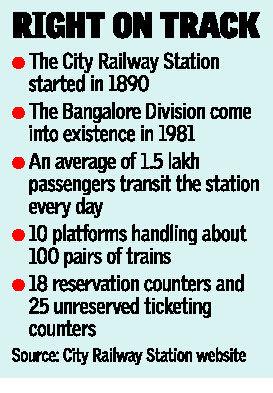
Just like there is a story to tell about the freedom fighter who fought the British till his death in 1831, the railway station named after him too brags about a long journey that began way back in 1890. Initially part of the Mysore State Railways promoted by the princely State of Mysore, the Bangalore Division come into existence in 1981.

HistoryDataBF04may2015

It was only recently that the Bengaluru division achieved its highest ever earnings under the Passenger Reservation System Rs. 10.53 crore.

As it stands today, the Krantivira Sangolli Rayanna Railway Station is connected to most major cities in the country, handling an estimated 1.5 lakh passengers and 105 trains on an average each day. Also a major coaching terminal, the railway station earned the distinction of becoming the first in the country to have WiFi facility for passengers last year. Said to be one of the busiest stations in India, it has 18 reservation counters and 25 unreserved ticketing counters to cater to the huge number of passengers.

source: http://www.thehindu.com  / The Hindu / Home> News> National> Karnataka / by Staff Reporter / Bengaluru – May 02nd, 2015

Bike ambulances launched; air ambulances by year end

View of Bike Ambulance First Response Unit (FRU) inaugurated by the Health Minister U.T. Khader in Bangalore on Tuesday. Photo: Sampath Kumar G.P. / The Hindu

Two companies had evinced interest in taking up the air ambulance project in the State, the Minister said.

The much-awaited two-wheeler ambulances will hit the streets in the State from Wednesday. Health Minister U.T. Khader, who launched 30 first responder bike ambulances in the city on Tuesday, said his department was working at introducing air ambulances in the State by this year end.

Two companies had evinced interest in taking up the air ambulance project in the State, the Minister said.

Terming the bike ambulance project as a “platinum ten minutes” trauma care initiative, Mr Khader said the bikes will be flagged off by Chief Minister Siddaramaiah on Wednesday.

Aimed at reducing deaths due to road accidents, the platinum trauma care initiative is useful for negotiating heavy traffic in urban areas where it will be difficult for four-wheeler ambulances to reach the accident spot at the earliest.

Of the 30, 21 will be stationed at strategic locations in the city and one each in the districts of Mysore, Mangaluru, Kalaburgi, Belagavi, Hubballi-Dharwad, Davangere, Tumkuru, Vijayapura and Shivamogga.

The initiative will be implemented through GVK-EMRI, the organisation that is running the 108 Arogya Kavacha ambulance service. The bike ambulance rider will be a trained paramedic who has a driving licence. “The paramedic will reach the spot in ten minutes and give first aid and start resuscitation measures to save the victim till the four-wheeler ambulance arrives,” he said.

Each bike ambulance will carry 40 medical items including stethoscope, pulse oxymeter, bandages and IV normal saline apart from 53 basic drugs. The government has spent nearly Rs 2 lakh on each of the bike ambulances.

source: http://www.thehindu.com / The Hindu / Home> News> Cities> Bengaluru / by Afshan Yasmeen /Bengaluru – April 14th, 2015

A self-sustaining art village in Haveri

Artists busy at work at the Utsav Rock Garden in Gotagodi of Haveri district.

With the government not keen on recruiting Fine Arts teachers, Yallappa Uppar, with his ‘Art Master Course’ certificate, would have ended up opting for a job that had nothing to do with his passion. But, a chance to work with a different media saved him.

Ten years after he made the choice, Yallappa is a happy man doing what he loves, making sculptures and getting paid for them.

Like Yallappa, there are 100 more sculptors and Fine Arts graduates, who are now able to make a living in an art village in Haveri district.

Located off the Pune-Bengaluru National Highway (No. 4), 37 km from Hubballi, the Utsav Rock Garden at Gotagodi in Shiggaon taluk of Haveri district, is a prime example of the transformation of an art village concept into a revenue-generating model.

The Utsav Rock Garden has already become a picnic hotspot for the people of the northern districts of Karnataka, where people love to spend the day experiencing ‘village life’ recreated by artisans.

The enjoy the art works, which are a mix of both contemporary and traditional art forms, fashioned out of cement.

What is unusual is that the ‘art village’ keeps on expanding, adding new creations while providing work to the artisans and the sculptors. The brainchild of senior artist, art teacher and folklore scholar, T.B. Solabakkanavar, and given shape by his son, Harsha Solabakkanavar, the rock garden, is an attempt at preserving Kannada culture and traditions.

“The set-up is in the form of a company now, but will soon get converted into a trust,” says Managing Director of the garden, Prakash Dasanur.

The art village is a training ground too.

“We provide training along with food and accommodation, and remuneration for the artists work. Over 2,000 artists have been trained here and they are taking up individual and group art assignments,” said Vedarani P. Dasanur, curator of the rock garden.

“There are around 80 Fine Arts schools in Karnataka, and not many who pass out are able to eke out a decent living. We experimented and recreated a revenue-generating model. The government could facilitate creation of such art villages in other places or involve artists in beautification projects and in preserving art and culture,” said Mr. Solabakkanavar.

“If the artists team up, there are various opportunities for them, especially in the wake of a growing demand for cement sculptures,” said Harsha.

source: http://www.thehindu.com / The Hindu / Home> News> National / by Girish Pattanashetti / Hubballi – April 06th, 2015

New Tech in City Station to Help Seniors Climb Stairs

Bengaluru :

The City Railway Station is likely to become the first station in the country to get a stairlift, a mechanical device to carry people up and down stairs.

Essentially a chair mounted on rails, the stairlift helps the elderly, differently abled and those with knee problems. It is new in India, but has been around in the United States since the 1930s, helping victims of polio negotiate stairs.

Picture for representation

In Bengaluru, product testing is under way on Platform 1 since Thursday, and so far, no problems have been reported. A woman passenger, weighing 120 kg, was among those who volunteered to test the stairlift.

Dr Arun Kumar Manocha, chairman and managing director, Indian Railway Catering and Tourism Corporation (IRCTC), Delhi, is in town to demonstrate the technology to Railway Minister Suresh Prabhu.

“The stairlift is imported from the Netherlands from a reputed company with a long innings in manufacturing safety products. It meets European passenger safety standards,” Manocha said.

The company’s Indian franchisee is in Bengaluru and so the City Station emerged as a natural choice to test the technology.

IRCTC is only looking at Platform 4 as it is the only one that lacks a pedestrian subway, Manocha added. The staircase is ‘Z’-shaped with a flight of stairs followed by a landing and another flight of stairs.

“We are looking at introducing two stairlifts, one for each flight of stairs. The passenger will have to walk the one or two metres between the two,” he told Express.

The cost of the two stairlifts and the 15 metres of railing it needs will work out to around Rs 6 lakh, he said. “We initially planned installing a railing on the flat surface also so that the passenger need not disembark and all steps leading to Platform 4 could be covered in one go. But it worked out very expensive (Rs 16 lakh),” he said.

New Tech in Station to Help Seniors Climb Stairs

The equipment and the railings can be installed in just two hours. If trials succeed in Bengaluru, many stations across the country will have it.

It works out much cheaper than an escalator or a lift, which require more time and space for installation, Manocha said.

Simple Apparatus

The stairlift, which can carry a passenger load of 140 kg, runs on mains, but will also have a chargeable battery so that it does not stop midway in case of a power disruption.

Initially, an attendant will man the operations, but gradually, the public will be allowed to handle it, Manocha said, describing the procedure as simple. To ensure safety, it will have a seatbelt.

After being approved by Suresh, the stairlift has to be okayed by the directors of IRCTC.

The operation is likely to begin in three months. IRCTC is installing the stairlift as part of a corporate social responsibility initiative.

“The Delhi passport office introduced a stairlift recently, but it was not working when I checked it out a few days ago,” Manocha said.

At the City Station, the IRCTC has also donated flashlights and horns for golf carts, four sophisticated wheelchairs (Rs 12,000 each) and a superior filtration system that can purify 200 litres of water an hour.

source: http://www.newindianexpress.com / The New Indian Express / Home> Cities> Bengaluru / by S. Lalitha / April 04th, 2015

Needed: Intelligent design solutions

by Naresh V Narasimhan

Better connectivity and space utilization can make Church Street a great urban hangout

Church Street is perhaps one of the most well-connected and accessible roads in Bengaluru. In fact, its name has been derived from the fact that it used to lead directly to St Mark’s Church, which was also visible while walking on the street. This trivia, however, alludes to a time when buildings were much smaller and before the strong axis connecting the street and the church was lost due to replanning. Today’s Church Street is replete with businesses, restaurants, pubs and arcades, and retains most of its road connections.Mahatma Gandhi Road, St Marks Road, Museum Road and Brigade Road surround and flow into this modest street that ensures a continuous flow of people passing by . If one were to look at high streets or shopping streets around the world, one would encounter `accessibility’ as the overriding factor -accessibility with respect to their space utilization and how well connected they are to the surroundings.
An analysis of high streets in London (as per the land use pattern) by Space Syntax would reveal that 80% of retailers have located themselves on the 20% most spatially accessible streets. This revelation seems to be a no-brainer as shops cater to locations frequented by people. The literal meaning of the Greek word Agora is a “gathering place” or an “assembly”. This also highlights the twin function of the well-connected marketplace, as both a po itical and commercial space. The Italian Piazzas are commonly found at the meeting of two or more streets. Several businesses and small shops are located within the Piazzas, which form the leitmotif for the traditional Italian city. The modern shopping street, traditional Agora and Piazza are perfect examples of what a good urban space is like when integrated into its urban setting.Such spaces create an ecosystem that thrives on their diversity.What makes Church Street so special is that it shares characteristics of all three archetypes of a great public space.

Sensitive placemaking through intelligent urban design solutions has given New York its Highline project, Seoul its Cheonggyecheon and Japan its Isezakicho of Yokohama. Why not start with Church Street for Bengaluru? Discontinuing street parking will do its bit to encourage public transport and make room for pedestrians on the footpath. Regulating food and garbage truck movement will ensure pedestrians don’t have to hold their breath while walking around. Street furniture will definitely be convenient for those who shop till they drop. Putting dustbins and planters in place will ensure a clean and green street.

While these solutions may improve the image of Church Street, they fail to address more serious underlying issues. The need of the hour is to call on experts and placemakers who understand the need to relay the underground sewage system in tandem with the existing network.

(The writer is an architect)

source: http://www.timesofindia.indiatimes.com / The Times of India / Home> City> Bengaluru / by Naresh V. Narasimhan / April 02nd, 2015

No monkeying around with history

The historical banyan tree inside the Bidar fort.

Campaign by Team Yuva saves a huge old banyan tree from the axe at Bidar fort

Campaigns to save trees are aplenty, but the one taken up by a group of youngsters in Bidar is unique because it is linked to history and a particularly quirky detail of history at that. At the centre of a campaign by Team Yuva is a banyan tree inside the Bidar fort, in front of the Rangeen Mahal. The Archaeological Survey of India (AIS) is rethinking its proposal to cut the tree thanks to this campaign.

The historical importance of the tree dates back to the time of Nawab Nasir Ud Daula Bahadur, the Governor of Bidar appointed by the Hyderabad Nizam. He had created a “department of monkeys” and appointed “monkey inspectors” (Daroga-E-Bandaran). They were supposed to keep a count of the langurs and feed them. Every day at noon, the guards fed the monkeys rotis, fruits and jaggery. This unusual ritual often happened under this tree, says Ghulam Yazdani in the book ‘Bidar: Its History and Monuments’.

The grants given by the Nizam for this purpose, started in early 19th century, continued till Independence.

“Losing the tree is like losing a part of our heritage. We have petitioned the State government, district administration and the ASI,” said Vinay Malge, secretary of Team Yuva. The team has asked ASI to include the tree in their landscaping plans.

Mouneshwar Kuruvatti, Conservation Assistant of ASI at Bidar, said they had asked the Forest Department to assess the health of the tree as it was old and could fall on tourists. “We will take steps to preserve the tree, after consultation,” he said.

Deputy Conservator of Forests S. Dhananjay said the ASI had earlier submitted a requisition to cut down the tree.

“However, we will assess the condition of the tree to see if it poses danger to passersby or nearby buildings. If it can be saved by pruning or by supporting, we will take those steps,” he said.

source: http://www.thehindu.com / The Hindu / Home> News> National> Telangana / by Rishikesh Bahadur Desai / Bidar – March 30th, 2015

KSRTC Receives Two Awards for Its Projects

Bengaluru :

State-run transport utility KSRTC has bagged two awards at the annual ASRTU (Association of State Road Transport Undertakings) National Public Transport Innovation Awards in Gujarat.

The awards, announced at the 59th annual conference of STU recently, were in recognition of two KSRTC projects.

One of the project is a staff duty rota system which helps in leave management and duty assignments of 37,831 employees.

“Allocation of duty and leave management is very critical and this project ensures removal of manual process, brings transparency and eradicates corruption,” a statement from KSRTC said.  The other project was the move towards increased usage of alternative fuels in KSRTC buses. “Fuel blending, clean development mechanism project, surprise and regular emission checks, afforestation, solar lighting, water recycling, rain water harvesting and new technology adoption are some of the  programmes run by KSRTC,” the statement said.

KSRTC managing director Rajender Kumar Kataria received the awards. ASRTU consists of 62 members from various states.

source: http://www.newindianexpress.com / The New Indian Express / Home> States> Karnataka / by Express News Service / March 17th, 2015

Exploring Palace Road’s rich heritage

BangaloreHeritageBF19mar2015

Efforts under way to retain the majesty of Palace Road and declare the entire stretch as heritage zone.

Palace Road became a focal point after a controversy broke out over the proposal to demolish Balabrooie, a heritage structure.

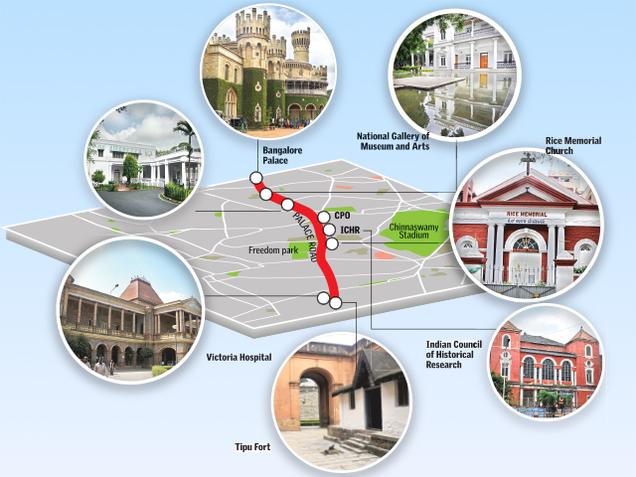
However, not many realise that the 4.7-km long Palace Road — sans one ways — also connects Tipu Sultan’s Summer Palace in south Bengaluru to the Bangalore Palace in Palace Grounds.

Efforts underway to retain the majesty of ancient buldings on Palace road and declare the entire stretch as heritage zone

1 Survey conducted by Venkatramanan Associates named ‘Palace to Palace’ (Tipu Sultan’s Summer Palace in Chamarajpet to Palace Grounds) is nicknamed ‘Swarna Marga’.
2 Survey urges the government to demarcate the area as heritage zone.
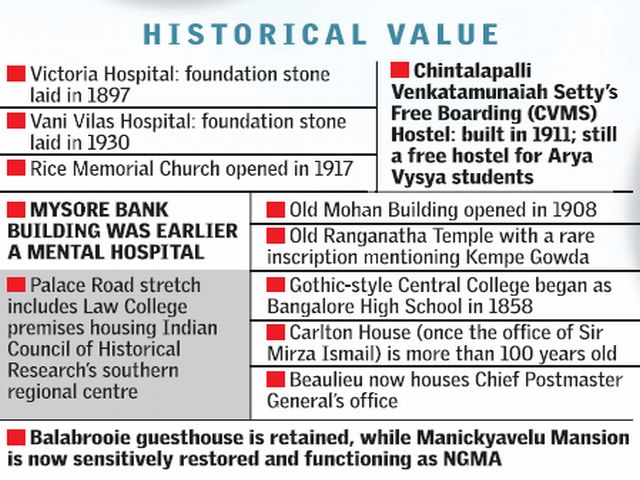
3 Prominent structures, parks and public utility spaces here: Bangalore Gayana Samaj, K.R. Market, Victoria Hospital, Tipu’s Palace, Bangalore Medical College and Research Institute, Fort High School, Carlton House, Vidhana Soudha, Vikasa Soundha, Maharani College, Freedom Park Central College, University Law College, Historic Centre of Bangalore (near Avenue Road junction), Raj Bhavan, Niton Building, Golf Course, Balabrooie guest house, Manikyavelu Mansion, Bangalore Palace and several residential mansions.
4 The smart step will be to pedestrianise the entire stretch for passerby to walk and appreciate the heritage value. Mumbai, Hyderabad and Barcelona have demarcated heritage sites; such ideas can be replicated in Bengaluru. An Urban Arts Commission is needed to identify and conserve heritage sites.

A survey by architect Naresh V. Narasimhan of Venkataramanan Associates has now made efforts to visualise the wider Palace Road that houses several such mansions and public utility spaces as ‘Swarna Marga’.

“I was curious to observe and study Palace Road and the buildings on the stretch,” says Mr. Narasimhan, who has brought out a special Survey on Palace Road, suggesting guidelines for its heritage labelling.

_______________________________________________________________

“ Avenue Road is important for its heritage buildings and intangible history. This is where a battle for Bangalore, a battle between the British and Mysoreans, took place. We have to have awareness panels installed on the road, like for example- ‘On this very spot, the British erected a battery and fired at the Fort’ It is here that many communities helped build Bengaluru, each with their own temple, for example.- Meera Iyer ”

________________________________________________________________

“We brought out a map that reflects more than 40 massive heritage buildings on this road. Palace Road earlier extended from Fort High School in Chamarajpet to the Bangalore Palace on Palace Road, cutting across Avenue Road. For retaining the majesty of Palace Road, we are urging the government to take a collective relook at restoring and declaring the entire stretch as a heritage zone,” says Mr. Narasimhan.

It is up to the government to have the Bangalore Heritage Preservation Act in place to recognise the intrinsic value of these traditional structures. If the move materialises, it is worthwhile adding a tagline to Palace Road as ‘Swarna Marga’ or the Golden Road, says Mr. Narasimhan.

“The stretch is beyond Tipu’s Palace and begins at 5th Main Road, K.R. Road junction, and runs up to Palace Grounds. It is along this path that the city’s oldest areas have grown,” adds Mr. Narasimhan.

Not just that these mansions have to be remodelled for housing museums and galleries, but owners can simply have their “old gold” retained for their antiquity value, instead of falling prey to land sharks and losing out on their heritage value.

A superficial-makeover of buildings without disturbing the original design is all that is needed, says Mr. Narasimhan, known for his hand in restoration of Hotel Metropole in Mysuru and the Maharaja’s Hotel in Brindavan Gardens.

HistoricalBF19mar2015

source: http://www.thehindu.com / The Hindu / Home> News> Cities> Bengaluru / by Ranjani Govind / Bengaluru – March 19th, 2015