A boy from Raichur was declared young scientist of the district for 2015-16 by the Karnataka Rajya Vijnana Parishat. Pampana Gowda, 17, bagged the title for his idea of a machine for shifting trees and also devising fuel-saving technology.
Pampana studies at the SVST High School, Kidiyoor, and represented Udupi district in the contest. Pamoana said people are aware of damage to the environment while cutting a tree for development. They also want to protect trees, but they don’t have the means to shift them.
“This inspired me to come up with a model of a tree-shifting machine,” Pampana said. The teenager is sure his model will be an asset to protect the environment. “The project needs a crane and a blade. Depending on the size of the tree, a suitable blade will be used. The machine will lift not only the tree roots but also the mud surrounding the tree. The project cost will be around Rs 2 lakh,” he said.
He also devised fuel-saving technology using two metal cylinders, one filled with petrol and the other with water. It’s a better option than a gas cylinder and environmentally-friendly too. “I’m working on an improved model. I want to be an engineer,” he added.
source: http://www.timesofindia.indiatimes.com / The Times of India / News Home> City> Mangalore / August 06th, 2016
IISc scientists develop new bio-molecule to treat cancer using light as a source for burning away malignant cells
Conventional cancer treatment methods of surgery, chemotherapy and radiation — known as cut, slash and burn for the brutal side-effects they cause on patients — are largely unsuccessful in differentiating between healthy non-cancerous cells and tumour-causing cells.
A team of scientists from the Indian Institute of Science have developed a new bio-molecule that can help treat cancer using light as a source for burning away malignant cells, a method which is more successful at targeting only cancerous cells.
This bio-molecule can be used in a relatively new form of cancer treatment known as photodynamic therapy, where a chemical (called a photosensitiser) is used kill small groups of cells. Put simply, the new molecule acts as a photosensitiser, which when exposed to a specific wavelength of light, gets triggered and kills nearby cancerous cells, leaving healthy cells intact, according to an IISc release.
Akhil R. Chakravarty, professor at the Department of Inorganic and Physical Chemistry, IISc, and his team are behind the development. The major benefit is that medical professionals have more control over which cells are targeted in the patient’s body. “Photodynamic therapy kills off cancer cells selectively, meaning toxicity to healthy cells can be reduced,” Dr. Chakravarthy told The Hindu.
Multiple methods
The bio-molecule, a vanadium (chemical element) containing complex molecule, targets cancerous cells through multiple methods: it carries a separable chloride ion due to which it caused cross-linking in DNA, leading to cell death. Cross-linking occurs when chemical agents react at two different positions in the DNA.
The molecule, when exposed to visible light, also generates a form of oxygen which can kill nearby cells. The team found that this bio-molecule was non-toxic in normal cells. This has major implications in the field of cancer treatment as existing treatments cause indiscriminate harm to healthy living cells, along with cancerous cells.
“Photodynamic therapy is an emerging field of cancer treatment. It may take some time for doctors in India to start using it,” said Dr. Chakravarthy. Their research was published in the July edition of peer-reviewed journal MedChemComm, produced by the Royal Society of Chemistry, United Kingdom.
source: http://www.thehindu.com / The Hindu / Home> News> Cities> Bengaluru / by Staff Reporter / Bengaluru – August 05th, 2016
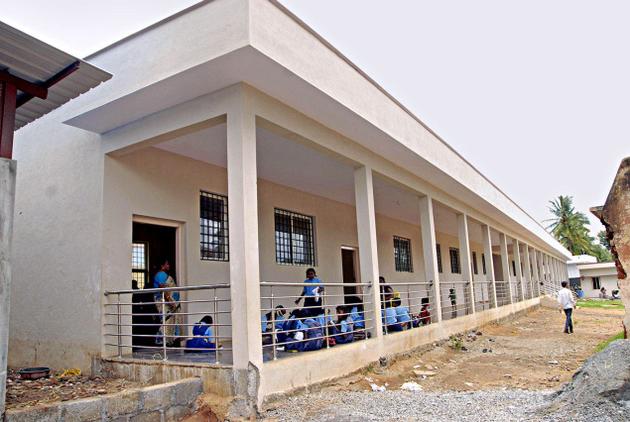
But just two years ago, the Government Model Higher Primary School in Guluru was a crumbling edifice lacking basic infrastructure
A 108-year-old government school at Guluru in Tumakuru taluk has embraced modernity gracefully and has become a model for others. Just two years ago, the Government Model Higher Primary School was a crumbling edifice lacking basic infrastructure. However, today it boasts of computer labs, airy classrooms, a library, science labs, separate toilets for boys and girls, and all other amenities offered by private schools that charge hefty tuition fees.
“We proudly tell our friends who go to private schools that we work on computers,” says Nethravathi. V. G, an eighth standard student. Like his friends, he can’t get over the fact that till recently, their school was in a dilapidated state with broken tiles, leaky roofs and cracks in walls.
Worried about the safety of their children, villagers approached MLA Suresh Gowda seeking a new school building. Mr. Gowda sanctioned Rs. 80 lakh from the MLA LAD (Local Area Development) funds.
MLC Lehar Singh offered Rs. 10 lakh and former minister V. Somanna contributed Rs. 5 lakh towards construction of a new building. L&T, an Indian MNC, offered Rs. 10 lakh as part of its corporate social responsibility initiative, which is being used to pay the salaries of LKG and UKG teachers, the computer teacher and a sweeper.
“Earlier, our friends used to make fun and tease us, as we were studying in an old building. But now, we are happy to show them our new school,” said Vinutha N., a seventh standard student.
The co-ed school, which has LKG, UKG and classes from I to VIII, has a total strength of 282. The pride of the school is the computer laboratory, which has 20 computers and Wi-Fi connection.
Another student Akbar Khan adds, “Seeing us in such a nice building, now my friends want to join our school.”
Headmistress N. Hemavathi says, “After the revamp, we have been getting applications from students of private schools nearby.”
The school will be celebrating its 108th anniversary on Friday.
source: http://www.thehindu.com / The Hindu / Home> News> Cities> Bengaluru / by S. B huvaneshwari / Bengaluru – August 05th, 2016
Table Tennis is a global sport which is popular in the world sporting scene. It needs excellent hand and eye co-ordination combined with skill and physical fitness to excel in the higher level. Mysuru has always been producing talented players who have gone on to represent the country and the State in different events in this popular sport.
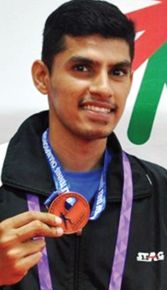
One such talented table tennis player is our city’s youngster Ullas Naik, who has made every-one proud with his feats by representing India in the World Deaf Table tennis Championships 2016 held at Samsan, Turkey, from July 18-24, 2016 and won the men’s doubles bronze medal teaming up with Tanuj Mukherjee. An excellent performance in the world arena by this youngster from our city is a fit choice for this week’s ‘Star This Week.’
Ullas Naik, 24, is the son of Udhayshankar and Prafulla, who reside in Saraswathipuram, Mysuru. Ullas Naik who cannot hear from a young age, took up to Table Tennis in 2002, when his mother took him to Umesh Urs, the chief coach at the Harsha Table Tennis Centre in Kuvempunagar.
Umesh has been coaching him since then giving him all the needed encouragement and is responsible for his improvement in the sport.
Ullas Naik, a II year B.Arch. student at the University School of Design at the Manasagangotri, Mysuru, representing India in the World Deaf TT championships 2016 at Turkey from July 18-24, 2016, won bronze in the men’s doubles. Earlier in 2013, he had represented India in the Deaf Olympics in Bulgaria and in 2006 had represented India in the Friendly International Tournament at Pakistan and won gold in the men’s singles event.
Earlier, Ullas Naik, did his Diploma in Architecture in JSS Ploytechnic and was encouraged to the maximum by HOD Chandrashekar to pursue his sporting interests.
Ullas also takes part in the State Ranking TT Championships when he finds time now and earlier was regularly taking part in the Championships from time to time and has won medals.
He has been supported and encouraged well by his parents, coach Umesh Urs (HTTA), the Mysuru University and PG Sports Centre in continuing to play this sport in the highest level.
Ullas Naik intends to continue playing this sport and aims to perform well in the National and International level for the country. This multi-talented lad needs to be encouraged and hope he goes on to achieve greater laurels in this sport in the days to come.
source: http://www.starofmysore.com / Star of Mysore / Home> Sports News / July 31st, 2016
Fears three kinds of dangerous silence that would make democracy dictatorial
Renowned poet and author Jayant Kaikini (front row – fourth from left) and Padma Shree awardee Prof. G.N. Devy (fifth from left), who were the chief guests during the inauguration of Mysore Literary Association at the A.V. Hall of Mahajana First Grade college in Jayalakshmipuram last evening, are seen with (front row – from left) Prof. K. Latha Biddappa (Association Treasurer), Prof. P.N. Sridevi (Executive Committee Member), Prof. K.C. Belliappa (President), Prof. B.N. Balajee (Secretary), Prof. Nalini Chandar (EC Member); (back row – from left) Prof. H.S. Shivanna, K.C. Haridas, Prof. Anitha Braggs (partly seen) and A.K. Monnappa (all EC Members).
Mysuru :
Two distinguished speakers last evening captured the minds, hearts and imagination of the people gathered at the A.V. Hall, Mahajana First Grade College and set them, hopefully, on the path of thinking and acting on what they conveyed in the speeches.
The occasion was the inaugural ceremony of the Mysore Literary Association (MLA). Highlighting the importance of the year 2016, Prof G.N. Devy, a renowned literary critic, an activist and the Founder-Director of Bhasha Research and Publication Centre, Vadodara and Adivasi Academy at Tejgadh, Gujarat, in his inaugural address, began his talk going back to the years 1616 and 1756 and their significance to Indian history and literature.
He then talked about the identity issues that were prevailing during the pre-independence days and how those issues are considered in the post-independence days of our country. He then came to the most important subject of the day that has been confronting the people of the country but are afraid to address them directly.
“I am talking about Silence now, which is completely different from the identity issues. There are three types of silence that the world is facing today and our country is no exception to this,” said Prof. Devy even as the audience were just warming up to the subject.
“There were around 6,000 languages in the world out of which 4,000 have disappeared. This is the first type of silence where a systematic attempt to impose ‘Aphasia (Inability to use or understand language)’ is going on. From a multi-lingual society we are becoming a monolingual one,” he cautioned.
Is all this bad, he asked and then added, “it is an evolutionary process and the present day youth are exposed to the multi-planetary, multi-temporal consciousness and the cyberspace is also imploding.”
“However, there was a time when I came to Mysuru and remembered 25 phone numbers of my friends. Sadly, now I don’t remember my wife’s telephone number. It is the telephone which remembers it,” he said.
The second silence, he spoke about is the lack of conversation between people. “Society has become successful. But with the mobile phones, texting has become the norm and even there, in the texts there are no full sentences. It is a networking society of silence,” he regretted.
The third type of silence is the most disturbing and to which most of us are helpless witness or a part of it. “This is the silence of protests all over the world. Most of the Democratic Governments in the world are becoming monopolitical and India is no exception,” Prof. Devy said and added, “All democracies are becoming dictatorial.”
“Any kind of protest or anyone who protests is termed as a traitor. I was in Grenoble in France, where the night talks were banned by the Corporation there. When I asked the Mayor, he said that it cannot be allowed. I cried that day because that is the place where the idea of freedom of free speech had begun,” he revealed and said, “as littérateurs you have to voice against this kind of silence.”
He spoke about the three writers who had great influence on his life and they are: Dr. U.R. Ananthmurthy, Naryan B. Desai and Mahsweta Devi and how the fears of all these three about the government suppressing the voice of dissent have come true.
Prof. Devy called on the members of the Association to take up the issue of silence ‘again and again’ and said, “only then will Mysuru, one of the cradles of civilization, will stand in the front and the forming of the Mysore Literary Association will have a meaning.”
Then, it was the turn of renowned Kannada poet and author Jayant Kaikini who preferred to speak in Kannada. Taking a dig at Prof. K.C. Belliappa, the President of MLA, in lighter vein, he said that, the President called him and wanted him to speak in English. When he (Kaikini) refused, he (Belliappa) agreed and then only he agreed to come.
Peppering his talk with a great sense of humour, Kaikini regaled the audience about how he was not able to connect with Mysuru though he had heard so much about it simply because there was no direct bus to Mysuru from his home town Gokarna.
“Every town is becoming a Vriddha Ashram (old age home) and unlike our childhood where there was so much about connecting, the children today have completely lost it,” he said.
Giving example of how a family boards a bus in Bengaluru and talks to their children only in English and how by the time they reach Chitradurga their languages becomes a mix of English and Kannada and finally pure Kannada when they reach Gokarna, Kaikini explained how languages are used in our country.
He exuded much of bonhomie and exuberance as he spoke. He was full of information about the way the society was moving, the sounds of silence, where the parents were going wrong etc. that brought applause from the audience.
However, after the talk, when this writer tried to connect with Kaikini, somehow, he could not find the same warmth that Kaikini exuded on the stage both with his words and body language.
President of MLA Prof. Belliappa welcomed the gathering and spoke about the Mysore Literary Association and how they planned for a Mysore Lit Fest on the lines of other Lit fests being held in the country in near future.
Ms. Ayesha Huq introduced the speakers and Prof. Balajee proposed a vote of thanks.
source: http://www.starofmysore.com / Star of Mysore / Home> General News / July 31st, 2016
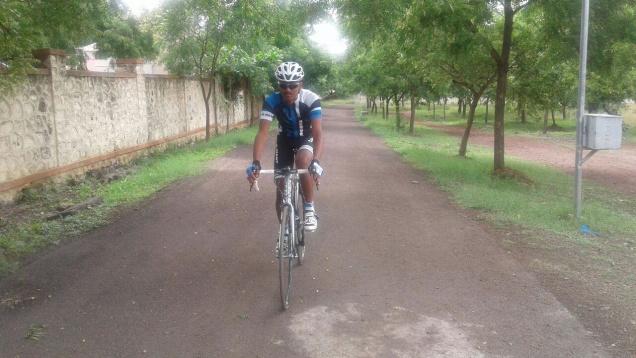
Cyclist Sandesh Uppar dreams of qualifying for the Olympics
Sandesh Uppar has always been interested in sports. Born in Shiggaon, a town in Haveri district, he would keenly follow every sporting event. A snippet on cycling caught his attention and he was soon hooked on to cycling.
He got in touch with a cycling institute in Vijayapura, Karnataka’s cycling hub. The 19- year-old has gone on to win medals in State and National Championships. He also excelled in the MTB National Championship in Pune last year. However, lack of funds seemed to have put breaks on his career.
Help came from Starkenn Sports Private Ltd, a bicycle company. He says, “Starkenn believed in my talent. They helped me with money and other resources.” Sandesh hopes to participate in the Asian Championships in New Delhi next year and dreams of qualifying for the Olympics.
He says, “In a couple of decades, I want to start a coaching centre where I can guide and train young passionate cyclists who don’t have adequate resources.”
source: http://www.thehindu.com / The Hindu / Home> Features> MetroPlus / T.R.Karthik / Bengaluru – July 30th, 2016
The house of gardener Sampangi, which was built using the funds collected under the Rupee
Bengaluru:
For over 30 years, 44-year-old Sampangi and his wife and three daughters lived under a leaky roof which they called their home. “The roof would leak every time it rained and we’d have to shift clothes and electronic items to one corner of the house. The house would shake whenever there’s heavy wind,” the gardener recalled.
Today, Sampangi lives in a two-bedroom home with a garden and three dogs that he found abandoned on streets. His eldest daughter is now married, while his two younger daughters are school students. A photograph of Japanese volunteers from NGO Habitat for Humanity, who constructed the house, is displayed on top of the TV shelf, and his eyes light up whenever he sees the people who made this possible.
“As my children got older, my wife and I would talk about building a better home. We had even begun saving some money from the meagre amount we earned. But four years later, we were left with only about Rs 1 lakh,” he said.
Things changed for the better when he met a person from the Habitat for Humanity, through whom he learned about interest-free loan. The rest, is history. Rupee for change
What can you do with Re 1 is a question that everyone asks. Apparently, you can build houses.
Habitat for Humanity has tied up with 20 schools in Bengaluru. Students, parents and teachers contribute Re 1 per day towards funds to construct houses for people from low-income group. In the past two years, the NGO has raised Rs 10 lakh which has gone into constructing 14 houses in Nagenhalli, Byrathi, Bagalur, Yerapanahalli and other parts of the city. Students, through the volunteer build programme, are also assisting in renovation activities.
India faces a shortage of about 6 crore housing units, said Rajan Samuel, managing director, Habitat for Humanity India. 12 lakh in need of houses
“In Karnataka alone, over 12 lakh people don’t have a decent home while 49% of the population does not have access to a toilet. The Centre has introduced policies like ‘Housing for All’ to provide adequate shelter to each and every family by 2022. The state government too has undertaken measures to provide affordable homes to the poor and to redevelop slums. About 70% per cent of the urban housing need is in the affordable segment and this is where Habitat for Humanity is working,” he said.
In Karnataka, the NGO is building 74 homes and 123 toilets for the low income, marginalized people, he added.
According to him, in most cases, women bear the brunt of lack of housing or toilets. Learning experience for students
While lives of people like Sampangi or Kaliyamma, who recently moved into her newly constructed two-bedroom home are being transformed, student volunteers are learning as well.
“Recently, our students painted a government school as part of the volunteer build programme and they were surprised to see a blackboard. Most of them have seen white boards in classrooms, but never a blackboard on which chalk is used,” said Asha Samuel, faculty incharge of CAS at Canadian International School.
“These activities help them grow. They come back realizing that there are so many things that they take for granted and so many things they should be grateful for,” she said.
Poor women bear the brunt
Women and girls from the lower income families live in highly unsafe and substandard conditions without access to basic sanitation. Majority of them suffer from poor health since they do not have the liberty to relieve themselves when required and have to wait till dusk to go out and defecate. Owning a house with proper sanitation facilities is a deep desire of all poor women across the country. By providing access to decent housing and sanitation facilities, Habitat for Humanity India intends to improve health and provide security for the whole family
– Rajan Samuel, managing director, Habitat for Humanity India
source: http://www.timesofindia.indiatimes.com / The Times of India / News Home> City> Bangalore / Merlin Francis / TNN / July 31st, 2016
City-based Glorious Festival of Harmony is set to celebrate 25 years of harmony singing on July 30 and 31. From its quiet start in 1996, Glorious is a much-awaited festival today.
“When we started, it was difficult to put together six choirs from the city because there were no choirs then and nobody was excited about harmony singing. It is starkly different today, with harmony singing being a part of mainstream music. Every year, when schools and college reopen we have students waiting for the festival,” says Regi Chandy, co-founder of the festival, in which over 1000 people participate every year.
This year, the silver jubilee celebrations include performances by the city’s best schools, colleges, churches and even children’s choirs. Besides independent choir Astrophels, from Kottayam in Kerala, a performance by popular singer-songwriter Sheldon Bangera from Mumbai is another highlight.
For Chandy, harmony singing is more than just a music performance. “It is not about giving prominence to only one singer. It’s a performance where every voice comes together to make beautiful music,” says Chandy.
The 25th Glorious Festival of Harmony will be held on July 30 and 31, 5.30pm to 9.30pm, in Dr B R Ambedkar Bhavan, Vasanthnagar.
source: http://www.timesofindia.indiatimes.com / The Times of India / News Home> City> Bangalore / TNN / July 29th, 2016
The Magsaysay Award winner says India still has over two lakh manual scavengers
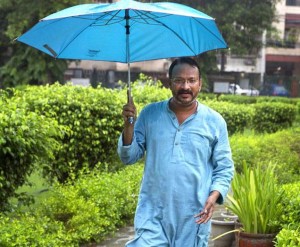
Fifty-year-old Bezwada Wilson, national convenor of the Safai Karmachari Andolan (SKA), was declared one of the six recipients of the 2016 Ramon Magsaysay Award by the Philippines-based award foundation, in Manila on Wednesday. Recognised for his efforts to eradicate manual scavenging, Mr. Wilson told The Hindu that India still has over two lakh manual scavengers who needed to be rescued, according to a nationwide survey by the SKA.
The award citation recognises Mr. Wilson’s work in “asserting the inalienable right to a life of human dignity”. Of the estimated 600,000 scavengers in India, SKA has liberated around 300,000, the citation notes.
Hailing from a Dalit family in Kolar, Karnataka, Mr. Wilson said his first brush with the local authorities over the abominable practice was in 1986-87, when he saw poor Dalit women cleaning human waste in the public latrines of Kolar Gold Fields. His own family members had been manual scavengers for generations.
“It was a big town, and in those days KGF was known to be the most electrified town after Tokyo,” he said. Yet, the town lacked public toilets with running water. Moved by the plight of the women who had to clean them every day, Mr. Wilson decided to petition the local town municipality to improve facilities. In 1986, he sent a complaint about dry latrines to the authorities and, when it was ignored, he sent the complaint to the Prime Minister, threatening legal action, the award citation notes. As a result, the town’s dry latrines were converted into water-seal latrines and the scavengers transferred to non-scavenging jobs.
Despite his 32 years of activism, Mr. Wilson says challenges remain in putting an end to the practice. “No thorough survey has been conducted as yet to enumerate manual scavengers though State governments have been promising one since 2010,” he said. Expressing scepticism over the implementation of the government’s flagship Swachh Bharat Abhiyan, he said the scheme did little to address the plight of manual scavengers and only sought to build more and more toilets.
Mr. Wilson formed the SKA as a network of activists in 1993. A PIL he filed in the Supreme Court, naming all the States, Union Territories, and relevant government departments as violators of the 1993 Manual Scavenging Prohibition Act, produced positive results. In 2014, the SC ruled in his favour demanding that all States ban manual scavenging and even fixed a compensation of Rs. 10 lakh for families of scavengers who had died on the job.
“In 2014, we gave the Centre a list of 1,073 people who had died while cleaning sewers, but the families of the dead are yet to be compensated fully. Only 36 people from the families of dead sewer cleaners have been compensated, but they did not get the full amount prescribed by the court,” he said.
Our Special Correspondent from Bangalore adds:
Practice still rampant in Kolar
In the hometown of Bezawada Wilson, who has been honoured with the Ramon Magsaysay award for 2016, manual scavengers are not hard to find.
The century-old mining set-up at the Kolar Gold Fields (KGF) saw thousands of people — primarily from Dalit communities — being brought in to deal with night waste. Mr. Wilson’s father was among those brought from Andhra Pradesh to KGF.
Though mining operations ended in 2001, the prohibited practice continues in the town where dry latrines are abundant.
The government claims that there are only 82 manual scavengers in KGF. This is disputed by activists and government officials who peg the figure at 800 families — making it the highest density of manual scavengers in Karnataka.
“While more than 12 criminal cases have been filed across the State for manual scavenging, there is little clarity on the prevalence of the banned practice. A 2007 survey threw up a figure of 15,375 manual scavengers. This is clearly under reporting, says Narayana, Chairman of Karnataka State Commission for Safai Karmacharis.
“The number is higher than 25,000,” he alleged. “We have sought a re-survey, but government officials are looking at their list and claiming that the number has reduced.”
The announcement of the Magsaysay award for Mr. Wilson did not trigger celebrations in KGF. Much of his activities have been in Andhra Pradesh or at the national level.
source: http://www.thehindu.com / The Hindu / Home> News / Vidya Venkat / Chennai – July 27th, 2016
Memorabilia brought from Chennai being arranged for display at the Museum.
MCC Commissioner Dr. C.G. Betsurmath is seen displaying the Padma Bhushan Award Certificate of late R.K. Narayan at the writer’s house in city this morning. Others seen are Corporator D. Nagabhushan, MCC Superintending Engineer Suresh Babu, RKN’s grandson Karthik Krishnaswamy and nephew R.S. Jayaram.
Mysuru :
With the renovation work of Novelist late R.K. Narayan’s house on Vivekananda Road in Yadavagiri reaching completion, the arrangement of the writer’s memorabilia brought from Chennai commenced this morning at the house turned museum, which will be inaugurated soon. The memorabilia include RKN’s cot, chair, table, watch, glasses, books, medals, awards and certificates won by him.
The photographs and paintings that adorned the walls of the house earlier too have been brought back.
RKN’s nephew R.S. Jayaram and grandson Karthik Krishnaswamy have arrived in city from Bengaluru to inspect and guide the arrangement of memorabilia. Incidentally, Jayaram too had been living in the same house and was very familiar with the arrangements of all items.
MCC Commissioner Dr. C.G. Betsurmath, Superintending Engineer Suresh Babu, Assistant Executive Engineer Manjunath, Development Officer Jagadish and Corporator D. Nagabhushan were supervising the arrangements at the museum.
Speaking on the occasion, Dr. Betsurmath said that MCC had spent Rs. 29 lakh for renovating the house and another Rs. 5 lakh for landscaping.
He pointed out that the building has been renovated to the original looks including the colour of the paint and wood structures to bring back the memory of yesteryears. He added that the maintenance aspects have to be worked out in future.
Speaking to Star of Mysore, Jayaram recalled the nostalgic memories of his stay in the house and his association with his uncle RKN. He expressed happiness in conversion of the house into a memorial keeping the heritage intact.
Dr. Betsurmath has requested people who are in possession of any memorabilia of RKN to pass it on to MCC which could be exhibited at the Museum.
source: http://www.starofmysore.com / Star of Mysore / Home> General News / July 21st, 2016