Category Archives: Records, All

A Home in Malgudi …

Writer R.K. Narayan’s house in Yadavgiri, Mysuru, which is being developed into a memorial on the lines of Shakespeare’s house in Stratford-on-Avon in England.

by June Gaur

Brand Mysore is set to get a fillip with the restoration of R.K. Narayan’s Yadavagiri bungalow opening up exciting possibilities not just for tourism but also for scholarship, part of the city’s raison d’ etre. Ironically, this comes at a time when Mysureans are locked in a battle to save Chamundi Hill, foremost among “the really worthwhile things” in the city as listed by R.K. Narayan (RKN).

One Vijayadashami, prodded by his grandmother, RKN pulled out a brand new notebook and wrote down the first sentence about his town. ‘It was a Monday and the train had just arrived at Malgudi station.’ India’s best-known fictional town was born.

From this home in Lakshmipuram, he sallied forth every day without fail into “the loved and shabby streets” (Graham Greene) of Malgudi (Mysore). The city of talkers yielded rich material for his characters. His destination was the town centre at K.R. Circle and Srinivasa Stores, from where he got a special kind of lavanga without which he couldn’t write, and M. Krishnaswamy & Sons on Sayyaji Rao Road, who supplied him with the tools of his craft. He made several stops along the way, antennae on the alert for stories. There was always time for stimulating conversation with the people he met. Indeed, as he notes in his 1974 memoir, My Days, many pressing issues of the day, “were settled on the promenades of Mysore.”

A backbencher at the Maharaja’s College from where he graduated, Narayan honed his writing skills and powers of observation working as a stringer for a Madras newspaper, The Justice. The joint family he lived in shored him up financially. When he decided he wanted to be a full-time writer of fiction in English, Narayan knew he was opting for a vocation that had not been heard of in India. In the 1930s, there was no literary tradition he could fall back on; no publisher or audience waiting to receive his first novel, Swami and Friends.

For years the manuscript sat on various publishers’ desks in England. A despondent Narayan gave up hope of ever finding a home for his “ugly orphan” as he called it. Yet somebody other than his grandmother believed in him. That was Kittu Purna, a friend from Mysore studying at Exeter College, Oxford. Purna disregarded Narayan’s entreaty that he “weight the manuscript with a stone and drown it in the Thames.” He did go to London however, and, with a phenomenal heave of the imagination, landed the manuscript, not in the Thames but at the door of one of England’s great writers: Graham Greene. Charmed out of his skin by the sheer theatre of Narayan’s little provincial town and its delightful people, Greene saw to it that Swami and Friends was published in England.

A series of wonderful novels, 14 to be exact, and scores of Narayan’s short stories written over a period of 60 years, are set in Malgudi. For many, the town, nestling somewhere between the forested Mempi Hills and the Sarayu River, is the real hero in his fiction. In its creator’s lifetime, speculation about Malgudi’s exact location fuelled an industry of research and never failed to amuse him. A New York researcher even went so far as to compile a map of Malgudi, a cartographic fiction of course, which pleased the author and was published in his 1981 collection, Malgudi Days.

Did Mysore inspire Malgudi? Most of Narayan’s contemporaries, among them Dr. M.N. Srinivas and H.Y. Sharada Prasad, thought so. Ramchandra Guha thinks it’s the town of Nanjangud while former ambassador A. Madhavan sees typical Mysore signposts of the 1960s in the Boardless Hotel, a popular eating joint of those times, and the ubiquitous jutkas, then the undisputed kings of the road.

While the exercise of matching up Malgudi with Mysore continues to draw the nerds, RKN himself was always non-committal on the subject. Though he did take a BBC crew around Mysore to familiar landmarks such as the Chamarajapuram Railway Station, where his story apparently began, he insisted that Malgudi existed only in his imagination and, therefore, he was free from the constraints that chronicling an actual place would impose. “I wanted to be able to put in whatever I liked and wherever I liked – a little street or school or a temple or a bungalow or even a slum, a railway line, at any spot, a minor despot in a little world. …..I began to be fascinated by its possibilities; its river, market-place, and the far-off mountain roads and forests.”

Despite the ambivalence here, there can be little doubt that many of RKN’s memorable characters were inspired by the real life people he met in Mysore. Syd Harrex, the Australian poet and Narayan scholar, once told me he’d met Cheluva Iyengar, undoubtedly the model for Mr. Sampath, at the writer’s Yadavagiri house for an interview recorded in 1972. Syd recalled that RKN had gifted Cheluva Iyengar a copy of Mr. Sampath – the Printer of Malgudi and had inscribed it so – ‘To Sampath the original.’

Cut to the present and the mammoth task confronting the authorities with regard to converting RKN’s home in Yadavagiri into a fitting memorial for the writer. Ten years ago, when the Sahitya Akademi held a seminar in Mysore to mark Narayan’s birth centenary, scholars visited this intriguing double-storied, cream-coloured house. In the semi-circular first floor study with its eight windows and criss-cross grills, they lingered to let imagination take wing, picturing the bird-like figure of the writer hard at work spinning the Malgudi magic that brings the world to Mysore’s doorstep.

The recent centenary celebrations have reinforced Mysore’s reputation as a University town. No doubt the decision to involve the University in establishing a Research Centre for archival and scholarly materials pertaining to R.K. Narayan will also involve Dhvanyaloka, the Centre for Literature and the Arts set up by the late Prof. C.D. Narasimhaiah (CDN). R.K. Narayan, scholars from India and around the world have always homed onto Dhvanyaloka where Prof. CDN guided countless numbers painstakingly through their research. The tradition has continued with CDN’s family, all English teachers, and CDN’s pupils from the University of Mysore who pioneered research into Indian Writing in English, having picked up the baton.

Among the resources which should be available here are T.S. Satyan’s priceless photographs of the writer, including one of him playing cricket in the compound of his Lakshmipuram house. A Trust run by Satyan’s family now takes care of all his work. However, one hurdle which will somehow have to be circumvented is the fact that all the writer’s manuscripts are with the Boston University Library, preserved in air-conditioned lockers. Only recently, in an expression of goodwill, the US has returned precious artefacts to India. Surely, Boston University can be persuaded to part with at least a fraction of the Malgudi man’s work from their archives. And hopefully, we’ll be able to take good care of this gift.

However, Mysureans looking to perpetuate RKN’s legacy please be a

source: http://www.starofmysore.com / Star of Mysore / Home> Feature Articles / July 13th, 2016
The voice that wakes Bengaluru up

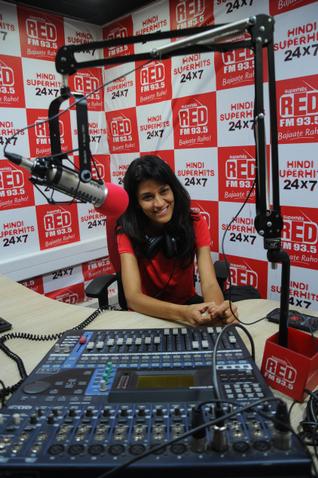
Spotlight On RJ Disha’s Morning No. 1 Photo: Sudhakara Jain

Radio Jockey Disha Oberoi tunes in with Morning No. 1 and sums up the latest laurel her show has received, thanks to Namma Bengalureans

Each one of us would jump at the opportunity to represent our city and country in any way possible. That’s exactly what Radio Jockey Disha Oberoi did at the recent New York Festival for World’s Best TV & Films. The host of Red FM Bengaluru’s morning show Morning No.1, Disha brought home accolades and a medal for the country and city, with the show’s recent social initiative ‘Bengaluru’s Most Wanted’.

Bagging the bronze medal under the Best Human Interest Story category, the show was an endeavour to felicitate the people of Bengaluru who have been doing selfless work for the city behind the scenes.

Elaborating on the award, Disha says it happens every year in Manhattan with over 30 countries participating from across the globe. “The kick here is as a kid, I’ve always wanted to wear the Indian jersey and play a sport or be a bomber pilot for the Indian Air Force. But I couldn’t do either. So this was the closest I could come to wearing an Indian jersey, putting my country out there and represent.” She adds that this was also a way for people to realise that this is very progressive radio from India. “It’s a bigger playing field. And we have scope to grow.”

For the award, they sent three entries. “One was about a gentleman called Mahadev whose job is to dispose unclaimed dead bodies. The interesting thing is he had his sense of humour intact. He said he’s not scared of dead bodies, but rather scared of the ones who are alive! He was a funny man and he made me feel grateful for my life.” The second was a real-life personal account of a lady who was on the same flight as Neerja Bhanot, the flight crew member who saved hundreds of lives in the Pan Am Flight 73 hijacking in 1986. “The narration by the survivor was of personal interest to me since I was flight crew too,” Disha says. The third was an interview with Air Marshal K.C. Cariappa, the son of Field Marshal General K. M. Cariappa, the first Indian Army Commander-in-Chief.

“K.C. Cariappa was a prisoner of war in the 1965 Indo-Pakistan War. The head of Pakistan had served under his father. So he called the father and asked if he can send his son back. The General said all the PoWs are his sons and he wanted them all back. He brought out the spirit of our Army. These are all moving stories with strong emotions,” she adds.

Moving on to talking about the show, an animated Disha says: “When people get on radio, they get excited that they have a couple of minutes on air. A good conversation and a good laugh can change your day.” She adds: “Radio is the only medium that is truly and wholly live. It’s as live as you can keep it. The show is exclusive to Bengaluru – we talk primarily about the city. And it’s for everyone. After all you can’t define a typical Bengalurean today. The city has people from everywhere. It comes with the weather, food and the easy life. Bangalore is cosmo and so is the show.”

How much do you let loose on the show? “I am not allowed to be myself a 100 per cent,” replies Disha with a glint of naughtiness in her eyes. “Most of it is me. Only when the listener comes on and I don’t know what they are talking about, I let them take the lead.”

“A lot of my personality gets enhanced by the people I speak to. I’m a sucker for good conversations. And the people who call are fascinating. For instance, a barber who opens his shop at 7 a.m. and his first customer hasn’t yet come, so he calls to say hello. For me, somebody is Hosur in a small dingy shop is connecting with me. Or even a guy in a car who’s upset about potholes and traffic. I get to talk to so many people, I consider myself very lucky.”

When asked to tell her story, Disha gets nostalgic and says she never really planned to be where she is now. “I was flying for an airline as cabin crew. A friend complimented my announcements and said I should give radio a shot. I was on a six-month sabbatical, travelling, so I walked into a radio station and asked if I could do some ads. They agreed and led me to voiceover artiste Niladri Bose. It was an audition for an RJ. He put me in front of a mike and told me to talk about whatever I wanted. So I went nuts. I was surprised when I came out and he said I can take the job. It happened so naturally, I didn’t plan it.” Having moved from Chennai to Bengaluru six years ago and having dabbled in everything from journalism to flight crew and triathlon to squash, the RJ says the show is just like her. “I don’t have a plan for a future, and that’s what’s worked for me and the show.”

“I have the power to give people some of the sweetest memories of their life. Radio is the most personal medium. When a person is listening to me, I am talking to him or her directly – that can be any of the 18 lakh people in the city.”

source: http://www.thehindu.com / The Hindu / Home> Features> Metroplus / by Allan Moses Rodricks / Bengaluru – July 11th, 2016

MCC gets ‘Centre for Science & Environment Clean City Award’

MCC Commissioner Dr. C.G. Betsurmath is seen receiving the award from Union Minister for Urban Development Venkaiah Naidu in New Delhi.

Mysuru :

The ‘Centre for Science and Environment Clean City award’ instituted by the Centre for Science and Environment was received by Dr. C.G. Betsurmath, MCC Commissioner from Venkaiah Naidu, Union Minister for Urban Development at a function held at India Habitat Centre on Lodhi Road in New Delhi yesterday.

Praveen Prakash, Joint Secretary, Ministry of Urban Development, MCC Assistant Commissioner Satyamurthy and Health Officer Dr. Nagaraj were present on the occasion.

Speaking to Star of Mysore, Dr. Betsurmath said that the award was in recognition of good zero waste management units and segregation of waste and has been given by the Union Ministry of Urban Development to three cities — Panaji (Goa), Aleppey (Kerala) and Mysuru (Karnataka). He added that the award was declared after a thorough study of cleanliness, education and tourism facilities in 20 cities and expressed happiness in receiving the award for city.

A book ‘Not in My Backyard’ was released on the occasion.

source: http://www.starofmysore.com / Star of Mysore / Home> General News / July 12th, 2016

Two Bengaluru based researchers bag Gandhi Award in London

 ResearchersBF11jul2016

_____________________________________

Highlights

  1. Dr Ratnavalli Ellajosyula and Nidhi Dev get the prestigious Gandhi International Fellowship Award.
  2. The CNC has been working on research projects in the fields of dementia.
  3. The Gandhi Fellowship Award was set up by a UK based neuropsychologist Dr Narinder Kapur

________________________________________

Bengaluru :

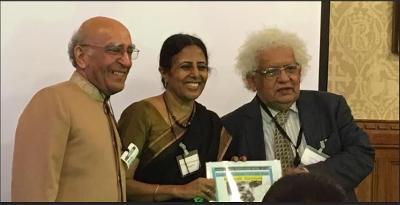
Two researchers from Bengaluru have been awarded with the prestigious Gandhi International Fellowship Award by Lord Meghnad Desai in the House of Lords, London, recently.

Dr Ratnavalli Ellajosyula, founder, Cognitive Neurology Clinic (CNC), and Nidhi Dev, Neuropsychologist, CNC, were among the ten doctors and researchers who were honoured. The team was awarded this fellowship for their outstanding research in the fields of dementia.

The CNC has been working on research projects in the fields of dementia that was presented at the mid-year Meeting of the International Neuropsychological Society in London.

Dr Ratnavalli Ellajosyula, a senior consultant neurologist, did her medical and neurological training in New Delhi. She was faculty, Department of Neurology at the National Institute of Mental Health & Neurosciences (NIMHANS), Bangalore for a decade. She started the behavioural neurology clinic there. She has a fellowship in Cognitive Neurology from the University of Cambridge, UK. She was also a research fellow at the University of North Carolina, Chapel hill. Currently, she heads the Memory Clinic at Manipal hospital.

She has more than a decade’s worth experience in cognitive neurology and neuropsychology. Her clinical interests are stroke, neuroinfections and dementia. Her research interests are multilingualism and dementia, breakdown of memory and mechanisms and neural substrates of language. She has several research projects and has published in the area of stroke and cognitive neurology.
Nidhi Dev is a Consultant Neuropsychologist at CNC with her areas of interest being epilepsy, dementia and children with neurological disorders. Her core research emphasis has been on epilepsy in children and in adults.
Dr Ratnavalli and her team study patients with stroke, dementia, head injuries, and encephalitis as well as healthy adults. Their research focuses on the neural underpinnings and mechanisms of cognitive functions like memory, language, and executive functions. Their work primarily involves doing detailed clinical and neuropsychological assessments that aid in accurate diagnosis of neurological conditions, treatment and designing of rehabilitation plans.
The Gandhi Fellowship Award was set up by a UK based neuropsychologist Dr Narinder Kapur in the memory and spirit of Mahatma Gandhi, to promote neuropsychology in India. Dr Kapur is currently visiting Professor of Neuropsychology at University College London.

source: http://www.timesofindia.indiatimes.com / The Times of India / News Home> City> Bangalore / by Sunitha Rao R / TNN / July 08th, 2016

Down the memory lane : A pious and honest hotelier N. Munshilal

Rise & Fall following True Values of Life

Left: 1) N. Munshilal (died in 1970). / Right : 2) Munshilal with Gandhiji's grandson Dr. Kantilal Harilal Gandhi and his wife Saraswathi Gandhi of Kerala (standing behind) in Mysore. In the centre is the then city's popular Dr. Annajappa, Physician and on the extreme left standing is his young son Parameshwar Dayal. (Photos: Parameshwar Dayal's album)
Left: 1) N. Munshilal (died in 1970). / Right : 2) Munshilal with Gandhiji’s grandson Dr. Kantilal Harilal Gandhi and his wife Saraswathi Gandhi of Kerala (standing behind) in Mysore. In the centre is the then city’s popular Dr. Annajappa, Physician and on the extreme left standing is his young son Parameshwar Dayal. (Photos: Parameshwar Dayal’s album)

by K. Vijaya Kumar, Former Jt. Director of Information & Publicity

Migrating from UP (Bulandshahr) in mid- twenties to Mysore, late N. Munshilal at his young age of around 25 showed Mysoreans what a real hotel meant for. This is the story of a pious and honest hotelier, who founded the earliest hotel Sri Krishna Bhavan between 1925-30 (just opposite to Dufferin Clock Tower in a portion of present Visvesvaraya Building) and later adding a chain of hotels rising to great heights and going down for following true business ethics in running his hotels.

His son M. Parameshwar Dayal

Remembering late Munshilal, as his son M. Parameshwar Dayal and myself were classmates in Yuvaraja’s College in 1954-56 becoming very close friends and tasting Munshilal’s hospitality while experiencing the fatherly-love shown to me in the company of his son, how can I forget the taste of the ghee dosa personally prepared by him and fed to us on our return from the college.

Close contacts with Palace

Munshilal’s fame and the delicious pure ghee sweets brought him close to the Royal family and he became the caterer for the Palace functions and weddings. Carrying choicest sweets in big steel plates as gift during birthday celebrations to the Palace received the personal attention of Jayachamarajendra Wadiyar who liked the sweets as well as Munshilal. When the Maharaja came to know that Munshilal had to shift his hotel to give way for the construction of Visvesvaraya building, he even offers help to provide a new place for him which Munshilal politely declined, his son tells me. Who knows, if both were alive today, he would have been the caterer for the recently held Royal Wedding in the Palace !

Chain of hotels, next

Probably, the shifting of Krishna Bhavan to a new place — the present Indra Cafe Building on Sayyaji Rao Road — opened a new vista for Munshilal to establish a chain of hotels starting with Chamundeshwari Bhavan on Shivarampet Road, next to Gayatri Bhavan on Dhanvantri Road and later a hotel in Bangalore. It is interesting to know he grew to own even Rajkamal Theatre, Shivarampet, in the beginning with a partner one B.K. Gupta. He also opens a Departmental Store at that time itself.

Late Badri Prasad of Indra Bhavan Hotel and late Revati Prasad of Bombay Anand Bhavan were his contemporaries.

A Gandhian

Following Gandhiji’s ideals in life, he had close contacts with Gandhians of that time like H.C. Dasappa and others. Gandhiji’s first grandson Kantilal Harilal Gandhi was studying MBBS in Mysore and he came in contact with Munshilal, who introduced him to his physician Dr. Annajappa, a popular doctor of those times. I am told even Dr. Rajendra Prasad in his early days during a visit to Mysore had tasted the hospitality of Munshilal.

Did following ethics in his running of hotel business bring him down having reached such heights? Yes, partially, his son, my friend Parameshwar Dayal tells but more on believing and depending with good faith on his own staff, so much so one of his Managers occupies a position as partner of his father.

Parameshwar Dayal, now living in Channapatna with his wife Mithilesh and children, is doing well with his sweet stall business popularly known as Dayal Sweets. [Mobile: 94487- 40008].

e-mail: kumarkv59@gmail.com

source: http://www.starofmysore.com / Star of Mysore / Home> Feature Articles / July 10th, 2016

City doctor receives national honour

DrHarinarayananBF08jul2016

Bengaluru :

Exposing your face and forearms to 30 minutes of sunlight between 11 am and 4 pm will get you sufficient Vitamin D for a day, says Dr C V Harinarayan of Sakra World Hospital, Bengaluru.

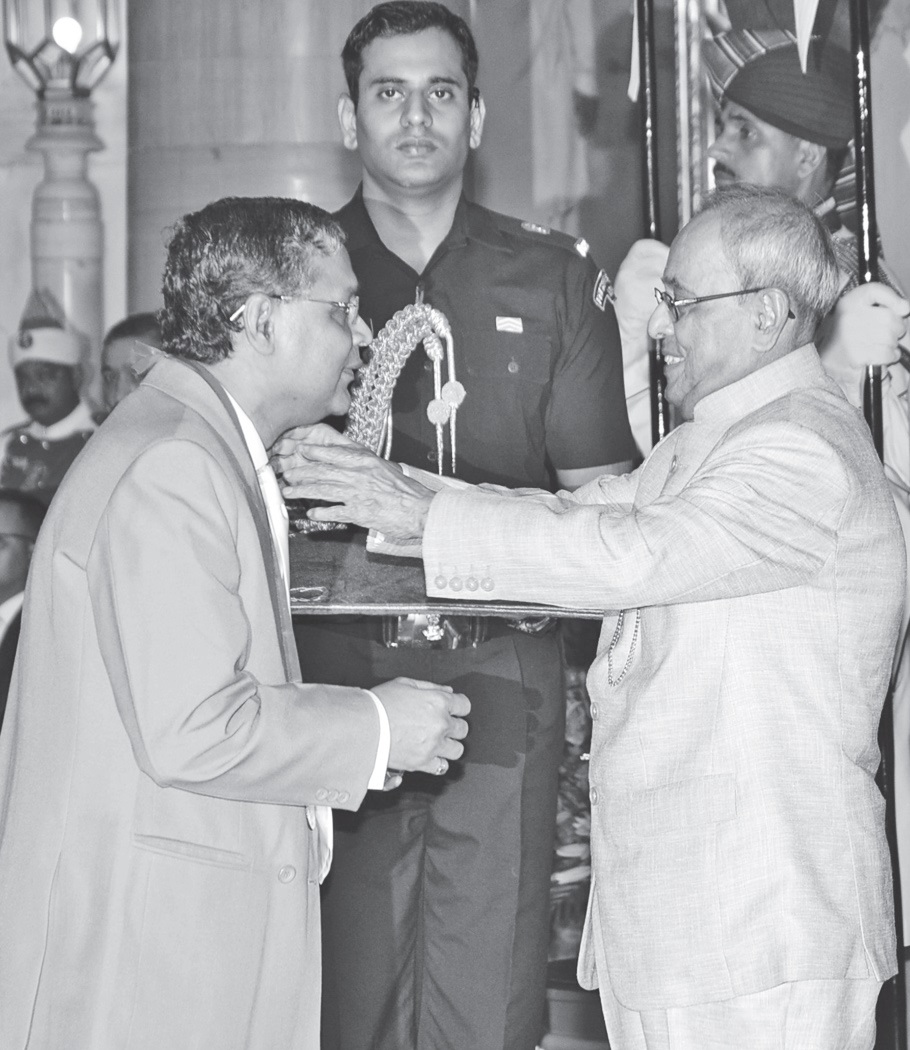
The Medical Council of India recently conferred him with the BC Roy Award for his work in the field of endocrinology and metabolic bone diseases.

Twenty-five other doctors of various fields also received the honour from President Pranab Mukherjee on World Doctors’ Day.

Despite India being a hot country, most of the population is affected by Vitamin D deficiency.

In 1990, a team led by Harinarayan conducted a study among the people of villages surrounding Tirupati in Andhra Pradhesh. The doctor was working with Sri Venkateswara Institute of Medical Sciences then.

“We found that the agricultural labourers of the region, despite exposing 80 per cent of their bodies to the hot sun for over eight hours a day, suffered from a deficiency of Vitamin D. The reason, research revealed, is that they don’t include sufficient calcium in their diet, which prevents the Vitamin D from being synthesised,” he explains.

The human body requires 1,000 mg of calcium a day. The labourers of the villages were found to consume only 260 mg, the study showed.

The urban population, on the other hand, consumes 600 mg a day. Vitamin D deficiency and bone diseases were found to be common among them too.

“People in metropolitan cities work in air-conditioned offices all day. Lack of exposure to sun makes them vulnerable to bone ailments,” Harinarayan says.

The doctor explains, “When the body faces a calcium deficiency, the parathyroid hormone – which makes the bones release more calcium into the blood – is released. Patients with hyperparathyroidism and calcium deficiency are prone to bone diseases as excess secretion of the hormone weakens the bones.”

He advises the urban youth to take a half-hour walk post lunch. “Besides speeding up your metabolism, it will expose you to sunlight and get you your daily dose of Vitamin D,” he says.

Children too should be allowed to play in the sun for an hour every day, he adds. “Milk and dairy products can be natural sources of calcium. Supplements are also advisable.”

While at SVIMS, Harinarayan and his team of doctors developed a IRMA radioimmunoassay with financial aid from Baba Atomic Research Centre, Mumbai.

“It is a kit that is used to deduce the parathyroid hormone levels in the blood. Earlier, we used imported kits. Under Prime Minister Modi’s Make in India intiative, we’re trying to develop the technology here,” he says.

The imported technology that costs Rs 35,000 will be available for Rs 3,500 once the indigenous kits gain popularity, he adds.

Currently the director of the Institute of Endocrinology, Diabetes, Thyroid and Osteoporosis Disorders at Sakra World Hospital, Harinarayan is working on a research project on Vitamin D deficiency in children.

source: http://www.newindianexpress.com / The New Indian Express / Home> Cities> Bengaluru / by Express Features / July 07th, 2016

New script to save Everest

Yogi Kshatriya, owner of Everest Theatre at Fraser Town, wants to reinvent the 10,000 sq. ft. space. Photo: K. Murali Kumar

The iconic Everest Talkies could soon be repurposed from a single-screen theatre to a cultural space

It could turn out to be a David vs. Goliath story, with a modern twist. At a time when single-screen theatres are being gobbled up by multiplexes, the young proprietor of the iconic Everest Talkies, in Fraser Town, Bengaluru, has a new survival concept for his theatre.

Yogi Kshatriya (29) wants to repurpose his single-screen theatre into a cultural space. This idea that has been in “incubation” since 2015, is now taking shape. He is in talks with an interested party to begin a joint venture, which could turn the 10,000 sq.ft space, run by three generations of Kshatriyas, into a profitable enterprise next year.

His idea is simple: build a stage, but retain the screen. The space can then be thrown open to jazz jam sessions, stand-up comedy gigs, product launches, poetry readings or screenings of international films. “With proper investment on board… maybe an F&B space,” he says.

Limited choices

“When I studied in the U.K. in 2009-10, there were multiple things to do every weekend. I remember a huge warehouse, with second-hand sofas lying around; we just bought a ticket and lounged around. But here, our options are limited; we go either to a bar, pub, a café or restaurant. I want to hold events,” he says.

In spite of overhead costs cutting into profits at Everest, Mr. Kshatriya joined up with Vikalp, a network of documentary filmmakers in India, in 2014, to screen documentaries every fourth Thursday of the month at the theatre. The goal: to have a constant audience and to make the sessions interactive.

“My condition was that it should be free and an educational experience,” says Mr. Kshatriya, who studied Imaging and Communication at Goldsmiths, University of London, and is making a documentary film himself.

A donation box has been placed at the theatre entrance for contributions. After the screening, there is a Q & A session with the director or anyone associated with the film. “We now have 40 to 50 regulars who come for the viewing. This has been a test for me,” says Mr. Kshatriya, who views the screenings as the first step towards the theatre’s transition to an event hub.

Stiff competition

Two landmark single screens Tribhuvan and Kailash shut down in April in the city, and Mr. Kshatriya has been approached by big builders.

“My heart won’t let me sell it. I can’t put a lock on this iconic place. I ran around here as a child and watched the spools unwind. We still have an audience. But, just 1 km away a multiplex with six screens is about to open,” he says, ruefully.

But the show must go on… And this time next year, we could be lounging on sofas laughing at a stand-up comedian at Everest Talkies.


  • Yogi Kshatriya, current owner of the theatre is in talks to begin a joint venture
  • He wants to throw the space open for jazz jam sessions, stand-up gigs, among others


  • Documentaries are screened every fourth Thursday of the month at the theatre
  • Afterwards, there is a Q & A with the director or anyone associated with the film


  • Two landmark single screens Tribhuvan and Kailash shut down in April in the city
  • ‘My heart won’t let me sell it. I can’t put a lock on this iconic place’
  •  __________________________________

source: http://www.thehindu.com / The Hindu / Home> News> Cities> Bengaluru / by Litta Jacob / Bengaluru – July 08th, 2016

Royal Family Tailor no more

TailorRaoBF05jul2016

Mysuru :

Mysore Palace Tailor Rama Rao, who used to stitch long coats and suits of Mysore Royal Family members, passed away here yesterday following brief illness. He was 97.

A resident of Ramakishnagar ‘K’ Block, he leaves behind his wife, three sons, including KMF Dairy employee Mukund Rao, seven daughters and a host of relatives and friends.

An expert in stitching long coats and suits, Rama Rao was well-known as ‘Royal Family Tailor.’

Rama Rao, who was close to Chamaraja Wadiyar, used to take part in Palace Durbars, earning a good name for himself among the Royal Family members. Rama Rao, who was well-versed in gold decoration for long coats, used to remove the gold jewellery from the coats after functions and hand them over back to the Royal Family members.

Last rites were performed at the foot of Chamundi Hill last evening, according to family sources.

source: http://www.starofmysore.com / Star of Mysore / Home> General News / July 04th, 2016

23 books on Kanakadasa to be released on July 3

FILE PHOTO
FILE PHOTO

After five centuries of the birth of the poet, philosopher, musician and composer Kanakadasa, Bengaluru is witnessing a release of 23 books written on the 16th-century social reformer. Brought out by the Rashtrakavi Kanakadasa Study and Research Centre, the books are part of a series taken up for propagating the poet’s works.

Amongst the releases would be 15 translations of the Kannada book Sant Kavi Kanakadasa,written by Chikkamangaluru Ganesha and released earlier by the Centre. The other eight books are the research studies of scholars from Karnataka who were given a fellowship by the Centre. All 23 works will be released by Chief Minister Siddaramaiah at 3 p.m. on July 3, at Yavanika Auditorium, Nrupathunga Road.

“The marathon translation work in 15 languages, including in English by D.A. Shankar from Mysuru, was completed in 10 months!” says K.T. Chikkanna, co-ordinating officer, Kanakadasa Study and Research Centre. While the translation received a State government grant of Rs. 5.25 lakh, the other eight researched books received a grant of Rs. 7.9 lakh for the project.

Kanakadasa, who has left behind 1,700 pages of his literary work, was born as Thimmappa Nayaka and belonged to a chieftain family of Kaginele village in Byadgi taluk of Haveri district. Also referred to as Kanaka Nayaka as he shunned the treasure-trove of gold he chanced upon, some of Kanaka’s compositions reveal that a grievous injury in war turned him towards composing couplets, kritis, and music to spread social unity and devotion, leading him on the path of ‘living a meaningful life.’

Sea of work

Apart from workshops and appreciation courses in each district covering 100 colleges, and a website (www.saintpoetkanaka.in) containing all his works, the Kanakadasa Study and Research Centre is receiving an annual government grant of Rs. 50 lakh for a slew of ambitious projects involving 200 scholars in Kannada and other languages. Amongst others, works in the last leg of completion include a ‘cultural lexicon’ to understand the original language used by the erudite Kanaka. “Ten scholars are involved in this work as they are re-showcasing lakhs of words used by Kanaka with the cultural and historical background in which the saint weaved them,” says K.T. Chikkanna of the centre.

The 50-volume project Karnataka Tatvakaarara Samagra Sahitya has 125 people working on the compilation of Karnataka’s pre-eminent wandering minstrels or saint-poets. With each volume containing 400+ pages, the work of nearly 250 saint-poets like Sishunala Sharifa, Gattihalli Anjanappa, Shankarananda Jogi, Chidananda Avadoota, and Lingannacharya are being recorded.

source: http://www.thehindu.com / The Hindu / Home> News> Cities> Bengaluru / by Ranjani Govind / Bengaluru – July 02nd, 2016

A Royal Interview …..: “It is an arranged , not a love marriage ,” says Yaduveer’s Father-in-Law

If there was one constant refrain in the last ten days in Mysuru it was “Are you attending the royal wedding, did you get the invitation?” This was to witness a historic wedding after 40 years when the titular head Yaduveer Krishnadatta Chamaraja Wadiyar tied the knot on June 27, 2016. The royals from different parts of the country had descended to watch the six-day wedding in all its pomp and glory. Rajmata Pramoda Devi Wadiyar had planned the whole marriage to perfection that was watched by the whole world on their television screens and the lucky few in the opulent, magnificent Mysore Palace. The focus was also on the beautiful bride Trishikha Kumari Singh and her father Maharaja Kumar Harshavardhan Singh of Dungarpur and mother Rajkumari Maheshree Kumari.

After the six-day wedding, Star of Mysore caught up with a relaxed Harshavardhan Singh at Hotel Radisson Blu. The handsome Mr. Harshavardhan Singh, 60, was sitting relaxed in the lobby of the hotel after participating in the six days of hectic wedding rituals of his daughter. He was very articulate, witty and spoke at length about the wedding, the wonderful preparations made by Rajmata Pramoda Devi Wadiyar, about the young, newly-married couple, about whether it was love marriage or an arranged one, his entry into politics as the Rajya Sabha MP and how he has fallen in love with Mysuru. Excerpts.

Harshavardhan Singh being interviewed by N. Niranjan Nikam at Radisson Blu.

by N. Niranjan Nikam, Senior Journalist

Star of Mysore (SOM): Sir, just as Mysuru is in the Southern-most part of Karnataka, Dungarpur is a city in the Southern-most part of Rajasthan. The coincidence begins from here. You also have a grand legacy like the Wadiyars. How do you feel about the union of the two Princely families?

Harshavardhan Singh: Well, I feel very elated and happy that we are being part of the great Wadiyar dynasty. This is the first time we have come to the South. We had never gone South to find brides or grooms from Dungarpur. Our relations have always been with the Royal families of Madhya Pradesh, Gujarat and Rajasthan, like the Royalty of Bharathpur.

SOM: The match between Yaduveer and Trishikha, as everyone gushes, is a match made in heaven? As Mysureans we are very proud of our titular head of Wadiyar dynasty. What is the reaction in Dungarpur?

Harshavardhan Singh: Everyone is happy in our city also like they are happy here. I am getting calls from all over India. There is lots of excitement and this marriage is covered in all Rajasthan newspapers and a very prominent national newspaper carried the wedding photograph on their front page in their Delhi edition. I am also happy that Star of Mysore has covered this historic wedding very well.

SOM: Rajmata Pramoda Devi Wadiyar as we all know has planned the whole wedding meticulously and the whole world is a witness to it. What has been your experience in the last seven days?

Harshavardhan Singh: Well, it has really opened our eyes. We also follow the rituals and other ceremonies in our families. But it will last for just two or three days and a couple of hours each day. However, what we saw here was the Wadiyar dynasty culture and tradition being kept alive to the last detail. Madam has planned everything so well that every day the rituals were conducted according to the family traditions and it began in the morning and went on till the evening. That is how it should be; one must maintain our culture and traditions like visiting the temples for puja. I must tell you that both Yaduveer and Trishikha are also fully aware of the traditions and I am sure they will also keep it alive. They are young but still very mature. I have no words to thank Mrs. Wadiyar for all the wonderful arrangements she has made. We are all going back with very fond and ever-lasting memories.

SOM: There is a confusion about whether this is a love marriage or an arranged marriage. As the father of the bride, please clarify once and for all what it is?

Harshavardhan Singh: I am glad you asked me this question because there is so much being written about it. It is not a love marriage. Trishikha’s mother’s younger sister is married to Kamakshi Devi’s (daughter of the late Maharaja Jayachamarajendra Wadiyar) son. Hence, there is already a Mysuru connection among us. Yaduveer and Trishikha would meet on social occasions. When we were looking for a boy for our daughter, she said that she would not mind marrying Yaduveer. We knew Swarup Anand Gopal Raj Urs and Leela Tripurasundari Devi (biological parents of Yaduveer). We approached them. But they said that it was too early as their son was studying in the US.

After a lot of convincing they agreed but still said they had to think about it as the horoscopes (Janampatti) had to match. There are about 34-36 points which have to match and there is the ex-amount of marks for that. Luckily, they matched. However, you must also remember that first Yaduveer had to agree to the match. Again, luckily he also did. Then we have what is called ‘Roka’ which means ok or in other words you have locked it in (laughs loudly). This happened in 2013. The late Highness Srikantadatta Narasimharaja Wadiyar came to the engagement and also hosted a dinner for us at the Bangalore Palace with the band playing. We were just beginning to get to know him. He had attended one of our relative’s wedding in Mount Abu. It was a tragic shock for all of us. But Her Highness has very bravely withstood the shock and then adopted Yaduveer. I came for the adoption ceremony, but I was not able to come to the coronation as we were opening a museum in Dungarpur.

You must remember that my Sambandis (He asked for an equivalent word in Kannada and I told him that it is Beegaru which he then kept repeating) have changed between the engagement and marriage. If it was Swarup and Leela when the engagement took place it is now Her Highness. It must be a very unique occasion that has happened. I reiterate that it is an arranged marriage and not a love marriage.

SOM: Yaduveer has captured the hearts and minds of the younger generation and the people of Mysuru and it is just a matter of time before Trishikha also does. Do you want to give any advice to them?

Harshavardhan Singh: You are sitting on a very high pedestal. People have lots of expectations from you. This is a very huge responsibility. There are lots of problems. I would tell them, keep life simple and be grounded. But, I know that the young couple are very mature and grounded and they will rise to the occasion.

Theirs is more of an intellectual match. He studied economics and she used to lecture on a few subjects in her class. Both read a lot of books. Hence, I don’t think I need to give them any advice at all.

SOM: You have been elected as the Rajya Sabha Member as a BJP candidate. Why did you seek to be a member of the Upper House?

Harshavardhan Singh: I didn’t seek the membership. I have never sought it. It was a pleasant bolt from the blue, so to say. I have been a great supporter of Rajasthan Chief Minister Vasundhara Raje and a great fan of our Prime Minister Narendra Modi and also Amit Shah.

Unlike many who try for the Rajya Sabha membership, I did nothing. My grandfather, the last Princely ruler of Dungarpur, Maharwal Shri Lakshman Singh Bahadur was elected to the Rajya Sabha in 1952. He was also a four-time MLA. He was in State politics and became the Speaker.

Probably because of all this I have been chosen, thanks to the CM. The area I come from is a tribal area. I have been chosen because it is reserved for the tribes. I belong to the Swara Jathi. It is an upper caste. This is my first time in politics. People of Dungarpur have lots of expectations. You must see the interest and the adulation that people accord me.

My grand uncle, Dr. Nagendra Singh was the President of the International Court of Justice, The Hague and also one of the persons involved in framing the Constitution. My uncle the late Raj Singh Dungarpur (my father’s younger brother) was the President of the Board of Control for Cricket in India. We all love sports and I play cricket, squash and tennis.

SOM: That means both your son-in-law and you are charting the same path?

Harshavardhan Singh: Yes, we are on a similar journey. We now have to brace it out and both of us have two responsible postings (smiles).

SOM: Will you influence your son-in-law to enter politics since he has shown his inclination?

Harshavardhan Singh: I will not influence him. I will never do it (he tells very emphatically). I don’t think Yaduveer will enter politics. He has lots of responsibilities and he has to look after many things. Of course, Her Highness is there to guide him through. He may be interested in politics. Being interested and getting into it are two different things. Most Indians are interested in politics and that is why you cannot take the electorate for granted. Even the very poor know how to vote. Hats off to the Election Commission for doing a great job. The corruption and booth rigging have more or less come down.

SOM: The Royalties in the North, especially from Rajasthan and Madhya Pradesh and a few other States have always had a better deal from the respective governments, unlike in Karnataka where people feel the Wadiyars have not been treated so kindly. Will this change now?

Harshavardhan Singh: I hope so. In Karnataka, Mysuru is the only State, unlike, in Rajasthan where we have so many States and hence there used to be many rulers.

There is no doubt that the Wadiyars have been treated unkindly in spite of their immense contribution to the State. There are lots of heritage properties in India, which only the Royals know how to maintain. The criticism against the Royals is that all they were interested in is girls, wine and song. Only Princes know how to look after the heritage. It is an inseparable part of their life.

SOM: The kings among hoteliers Maharana Arvind Singh Mewar and Maharajah Gaj Singh of Jodhpur were some of the distinguished guests at the Royal wedding. Have the Dungarpur Royals also been inspired to start hotels?

Harshavardhan Singh: Maharaja Kishangarh is also a big name in the hotel industry, though he was not present at the wedding.

I started the Udai Bilas Palace Hotel in Dungarpur in 1993 and it is doing quite well. It is the only heritage hotel in that part of a 100 km stretch. It is close to Gujarat and however, in Rajasthan, tourism has been given a big boost. The poorest of Rajput has become a tourist guide and is earning well. He also runs a home stay. I only hope that the Mysuru Royal family gets back its properties.

Coming to Mysuru, the more I see of it, I fall in love with it. You have such a nice Race Course and inside it a Golf Course, boulevards built during Nalwadi Krishnaraja Wadiyar’s time, you feel like you are in Europe. It is a clean and green city, a heritage city with lovely gardens and it has a good education system.

SOM: What is the emblem that is carried on your business card?

Harshavardhan Singh: The emblem or the crest depicts two tribals holding the shield with Hanuman inside carrying the Sanjeevini, the chink (antelope) on the top and with the motto inscribed “Nyayam Chirajayam,” meaning Justice for All.

SOM: After the wedding reception in Bengaluru on July 2, will you host a reception in Dungarpur?

Harshavardhan Singh: A few reports have said that I will be hosting a reception in Delhi. It is not true. You can’t go on and on. Her Highness has already done the best in hosting this wedding.

I have got both my daughters married off. My elder daughter Shivatmika is married to Tikka Saheb Jaideepsinhji Mandhattasinhji, the grandson of HH Thakore Saheb Shri Manoharsinhji Pradyumansinhji of Rajkot, last year in January.

source: http://www.starofmysore.com / Star of Mysore / Home> Feature Articles /by N. Niranjan Nikam, Sr. Journalist / July 02nd, 2016