Category Archives: Records, All

The family that engraved its name in Record Books long ago .…

Picture shows Yoganand and Shyla Yoganand posing with their sons Manu and Prithivi during their visit to Surya Kund in Gangotri in 1993. Picture right shows Yoganand’s family during their visit to Death Valley in California (2011) — (From left) Prithvi, his wife Seema, Yoganand, Shyla Yoganand, Nishita and her husband Manu.

by S.N. Venkatnag Sobers

These days, when people are setting records in sports, entertainment, science, technology etc., every other day, here is a family that achieved the same feat way back in the 1990s. This family has its name engraved in the Guinness Book of World Records and Limca Book of Records for Travelling to the Highest Motorable Road- Khardung La in Ladakh and for being the Youngest Marathon Luna Riders in 1989 and 1993 respectively.

Though the news was widely published in many newspapers across North India, not many know that the couple and their children, who created the record, are natives of Mysuru. Yoganand, a retired bank employee, and his wife Shyla Yoganand, who lived in Pune for most of their lives, have returned to their native to live the rest of their lives at the place where their ancestors had roots. In fact, Yoganand’s father Dr. Ramaraju, lived in Vidyaranyapuram for many years.

While Yoganand and Shyla became the first couple to travel to the highest motorable road-Khardung La on a Kinetic Honda during 1989 creating a Guinness Record, their sons Prithvi and Manu entered the Limca Book of Records as the Youngest Marathon Luna riders in 1993. They travelled from Dehra Dun to Gangotri covering a total distance of 3,250 kms on 35cc Luna Wings. The journey, which started on May 9, 1993 ended on May 26, 1993. The purpose of this expedition was to collect water samples from River Ganga and spread the message to save the holy river from pollution. Prithvi was 11-years-old and Manu was 9-years-old when they undertook this expedition. Currently, Prithvi works as a software engineer at San Francisco and Manu works for a private bank in Dubai.

While this is the story of the two sons, their parents’ story is even more fascinating. Initially, Shyla did not know how to ride a two-wheeler. While Yoganand left early for work after dropping the kids to school, both found it difficult to bring back the kids from school. Yoganand was busy with work and Shyla was left with no option but to learn riding as the rickshawallas had refused to ply to their kids’ school as it was located in a restricted area under Indian Military.

The couple, on separate Kinetic Hondas, travelled 11,000 kms across Maharashtra, Gujarat, Rajasthan, Haryana, Delhi, Punjab and Jammu and Kashimir. Interestingly, when the couple wrote to various State Governments seeking help for their expedition, none responded. It was only Farooq Abdullah, the then Chief Minister of Jammu and Kashmir who offered to help the couple complete their expedition.

Speaking to Star of Mysore, Yoganand said that they were treated like State Guests in Jammu and Kashmir and Farooq Abdullah had himself enlightened the couple to apply for Guinness Book of Records.

“We had to pass through 200km of swamps of the Kutch in Gujarat, 600 km of Thar Desert in Rajasthan, 250 km of dense Amar-Kantak forest in Madhya Pradesh and 3,700 km in Himalayan stretch across the dangerous Zojila pass. With no experience of travelling to such an extent, we were supported by Kinetic Honda,” he added.

Shyla Yoganand and Yoganand entered the Guinness Book of Records as the ‘first woman’ and ‘first man’ and the ‘first couple’ to have taken a normal ‘civilian’ scooter to the highest motorable point in the world. Kinetic celebrated this achievement on Indian television during the 1990 by sponsoring a weekly program on ‘Guinness records.’

The Yoganand couple fondly remembered Kinetic Engineering Managing Directors S. Hirose and Koji Wanaka for their help during the expedition. Yoganand has also helped biking enthusiasts draw the route map for their expeditions. The couple lives in an apartment in Vontikoppal close to Sri Lakshmi Venkataramana Swamy Temple.

source: http://www.starofmysore.com / Star of Mysore / Home> Feature Articles / Saturday, April 30th, 2016
North Karnataka got raw deal, reveals a Book written by Shivanand Jamdar

Dharwad:

Retired IAS officer Shivanand Jamdar has come out with a book which highlights the step-motherly treatment meted out to north Karnataka as far as creation of infrastructure is concerned.

 
In the book, Taratamya, he has said barely any efforts have been made to develop the region, backing his claims with statistics. The disparity in allocation of funds and lack of commitment from the elected representatives collectively ensured the region remains backward.

 
Former journalist Patil Puttappa will release the book on Thursday at Suvarna cultural complex at 6.30pm.

source: http://www.timesofindia.indiatimes.com / The Times of India / News Home> City> Hubli / TNN / April 28th, 2016

City’s Jatin wins World Amateur Chess Championship

JatinBF28apr2016

Mysuru :

S.N. Jatin, a resident of Yadavgiri in city, won the World Amateur Chess Championship held at Greece yesterday. Jatin, who participated in the U-1700 ranking, scored a total of 8.5 points from 9 rounds to emerge as the world champion.

Jatin defeated players from Mongolia, India, Israel, Romania, Russia and other countries to win the coveted title becoming the first player from the State to win the tournament.

A student of the JSS Public School (SJCE campus), Jatin is also a trained flautist. Jatin’s father Nagabhushan runs a small scale industry in Bannimantap and Vani, his mother is a teacher. Meanwhile, M.P. Ajith, a resident of T.K. Layout, who participated in U-2000 ranking category, won the silver medal.

source: http://www.starofmysore.com / Star of Mysore / Home> Sports News / Thursday – April 28th, 2016

12-year-old Bengaluru girl to perform at Carnegie Hall

NilanjanaaBF27apr2016

Bengaluru :

Performing at the prestigious Carnegie Hall, New York, is a dream for any musician. And a 12-year-old Bengaluru girl is all set to live this dream.

Nilanjanaa Jayant will join a handful of musicians like Pandit Shivkumar Sharma and Ustad Zakir Hussain when she performs at the hall in October. The honour follows her victory at the Golden Voices of America competition.

In March, Nilanjanaa’s mother asked her to send an entry for the event. The girl sent a clipping of her performing Frank Sinatra’s popular jazz number Fly me to the Moon.

Declared a winner in the Musical Theater/Disney/Broadway/Jazz category a month later, Nilanjanaa will perform live the same song at Carnegie Hall this October. Winners in other categories will also perform with her.

Music and Nilanjanaa go a long way, recalls her mother, Sangeeta Ananth. “Even as a young girl, she’d hum the tunes of songs really well. When she turned six, we made her join Carnatic music classes. Though she was left-handed, she was expected to put the tala only with the right hand. This she couldn’t digest and refused to attend the classes.”

“I didn’t understand why I had to use my right hand,” says Nilanjanaa, who was later introduced to Bengaluru-based music school Taaqademy, founded by musicians Rajeev Rajagopal and Bruce Lee Mani.

“It was so much more fun learning music at Taaqademy. They encourage you to do what you want to rather than what you are expected to do,” said the 12-year-old.

The only child of JP Nagar residents Jayant Ananthkrishnan and Sangeeta Ananth, Nilanjanaa studies in class VIII at The Samhita Academy, Bannerghatta Road.

Not just Nilanjanaa, even her teacher Ragini Ramanathan will get a certificate of recognition from the Golden Voices of America for having trained her. “When she came to Taaqademy, she showed a lot of potential. Her voice was loud and clear and her pitch would hit the right notes. She is so determined to learn and so hard working that she wouldn’t give up even if she didn’t get it right after trying 3-4 times,” said Ragini, 25, faculty at Taaqademy.

For IT professional Jayant Ananthakrishnan, Taaqademy was the best thing that happened to his daughter.

“The experience with the music school has been very fulfilling. This success is the result of the training she has been getting there. Coming from a south Indian background, people kept advising us against western music, telling us that she will get used to using the right hand to put her talas. But we know we weren’t wrong in choosing Taaqademy,” he said.

“I have a bit of stage-fright. I’m just going to try and calm myself down before I get on the stage there,” said Nilanjanaa, gearing up for an experience of a lifetime.

Golden Voices of America

Golden Voices of America is an international competition, open to all countries for vocalists of different age groups. It began in 2009 under the American Fine Arts Festival.
Vocalists compete on this global platform and the winners get to perform at the Weill Recital Hall in Carnegie Hall and at Bruno Walter Auditorium in Lincoln Center.

source: http://www.timesofindia.indiatimes.com / The Times of India / News Home> City> Bangalore / Deepika Burli, TNN / April 27th, 2016

80 works, and there’s more to him

He grows from one book to the other …. And even the best book has more to say

Muralidhara Khajane scans the innumerable books written on the iconic actor Rajkumar, and finds that every book remains incomplete, simply because the man was multi-dimensional

Even after ten years of his ‘physical departure’ from this mortal world, there’s no remote possibility of anyone filling the vacuum created by Dr. Rajkumar, the cultural icon of Kannada land, language and culture. To this day, he occupies a position most unique in the culture-scape of the land. Rajkumar is an institution, a status that few film stars boast of in India. He is still “Annavru” for the true-blue Kannadiga. Rajkumar’s stardom doesn’t merely come from the fact that he was an actor exemplar, but because he was an ideal, a role model for the Kannadiga. In the absence of a dedicated political movement for the cause of Kannada and local culture, he came to symbolise the hope and angst of a large section of Kannada-speaking people. He was a singer par-excellence. There was no character which he had not portrayed with distinction. It is hard to find an actor in Kannada, who has not acknowledged him as his idol.

It is not possible to capture the persona of this legendary actor in one visual or literary piece. Those writers, who have tried their hand at capturing the ‘spirit’ of Dr. Rajkumar in the last five decades still feel that they have touched only the peripheral aspects of his personality.

According to film historians, as many as 71 books have been published on Rajkumar so far, besides nine souvenirs. Rajakumara – a small book written by Kannada activist Kodihosalli Ramanna in 1964 is said to be the first work on the actor. Bhagyada Bagilu — a work by V. Nagaraju was published when the film with the same title (Rajukmar’s 100th film) was released; it is an important work. Padmabhushana brought out by Karnataka Film Chamber of Commerce, which has complete details of all the 170 films of Rajkumar is another such work. Kathanayakana Kathe by filmmaker Dattu serialised in a Kannada film magazine, enjoys the credit of chronicling the life of Rajkumar for the first time. Besides, Jananayaka by Baraguru Ramachandrappa and Rajamuttu by journalist and script writer Satyamurthy Ananduru are other important works on the actor.

Dr. Rajkumar Samagra Charitre by film writer Doddahulluru Rukkoji, a 2148 page, two volume work with 8,700 exclusive photographs, published recently is being considered as the latest and complete work on the iconic actor. Works on the actor, published till date, pales before this work, be it in size, content, quality of publishing or in terms of the depth of the author’s analysis. The weight of these two volumes is a humungous 10 kilos and they were ferried to Bengaluru all the way from the press in Sivakasi for the launch!

This voluminous work won the Swarna Kamal at the 63rd National Awards recently and the citation described the work as an “encyclopaedic study into the life and career of one of India’s greatest screen legends, Dr. Rajkumar. The 15-year research behind the writing of this twin volume makes it a valuable resource for scholars, students and cinephiles of the present and future. ”

Rukkoji described the award as: “another award for Dada Saheb Phalke recipient actor Rajkumar at the national level. It is posthumous award to the great art soul.”

While the first volume chronicles early life, times and family details of Rajkumar, the second volume delves in to 206 films in which the actor acted. Rukkoji started writing about Rajkumar when he was working for Kajaana a film weekly. The writer travelled to various places to source material and pictures. Over 140 persons including directors, producers, artistes, technicians and family members of the thespian were interviewed and over 20,000 exclusive pictures were collected. It cost Mr. Rukkoji nearly a crore for printing and publishing the book.

Dr. Rajkumar: The Person Behind the Personality by thespian’s son and popular actor Puneeth Rajkumar is another picturesque volume on the actor. This coffee table book is a record of the legendary actor’s life and career, packed with no less than 1,750 photographs, many of them never published before. According to Puneet, who teamed up with Prakruthi N. Banavasi to bring out this bilingual volume, it is an attempt to preserve the soul of the legendary actor for posterity. This work is replete with anecdotes and incidents that shaped Rajkumar’s persona and tracks his early life, childhood, adolescence, early career in company drama, cinema, his stint as a singer as well as defining moments in his personal life and the Kannada film industry itself. Puneet tried to understand his iconic father through the eyes of his mother, brothers, family and friends. According to him, it is not a documentation of Dr. Rajkumar’s life, but simply unveils the persona of the great artiste through the words of those who knew him from close quarters.

Rajkumar Ondu Belaku and Rajkumar: A journey with the Legend – another bilingual work on the thespian by filmmaker and writer Praveen Nayak. This work with 47 small chapters delineates every aspect of Rajkumar’s life with a personal touch. This film maker, who was associated with the actor for more than 30 years, etched a picture of the actor with vivid details. Praveen Nayak says that his interaction with Rajkumar over a period of time had made him realise that at his core, he always remained Mutturaj — a name and personality he was born with. “He never lost his Mutturaj-ness,” he says.

Praveen Nayak, a still photographer, has a huge collection of Rajkumar’s photographs; he followed the actor like Nemai Ghosh followed Satyajit Ray. He selected best of his works and sourced rare pictures from others to make the volume picturesque besides being poetic.

Kannadada Muttina Kathe: Rajkumar by cine-writer and journalist B. Ganapathi is another important work on the actor. The author put together all his articles and interviews with Rajkumar for over two decades. There is a long chapter on the days the actor spent in forest, when the brigand Veerappan abducted him. A chapter on fifty years of his professional life is an important chapter. Here, which is a powerful instance of his humility, the actor says that the film industry gave him all the necessities of a good life, and what he gave in return was meagre. The most interesting chapter in the book is of his childhood years.

Bangarada Manushya by writer and a bureaucrat Aa. Na. Prahlada Rao is another important work on Rajkumar. It closely examines the achievements of the actor both on and off the screen. The writer delves into genres of films Rajkumar acted — mythology, social dramas, etc. besides exploring his role of a singing star. This too has rare photographs of his films and other achievements. Bangarada Manushya can also be considered as a referral volume, because of its rich details on the growth and evolution of Kannada film industry. This was published first in 2005, when Rajkumar was alive and has run into four editions so far.

source: http://www.thehindu.com / The Hindu / Home> Features> Friday Review / by Muralidhara Khajane / Bengaluru – April 21st, 2016

JSS Mahavidyapeetha : Golden Jubilee 1954-2004

A pictorial capsule ‘Chitra Samputa’

The front cover of the book.

Adi Jagadguru Sri Shivarathreeshwara Shivayogi (JSS)established the Suttur Mutt in deference to the wishes of an emperor of Chola dynasty about 1,000 years ago, according to the apocryphal records of history.

Since then (950 AD) till now there have been 24 Jagadgurus for the Suttur Mutt, located 24 kms from Mysuru city by the side of the quiet flowing Kapila river.

The present Pontiff is Jagadguru Sri Shivarathreeshwara Deshikendra Swamiji, who at age 30, after succeeding Dr. Sri Rajendra Swamiji, who passed away in 1986, has taken the educational service, cultural and social activities of the Mutt to such dizzy heights that today Suttur Mutt has established under the umbrella of a common name JSS Mahavidyapeetha more than 300 different educational, social and cultural institutions. It is thus serving the society at large at a time the government is unable to fulfil its obligations. In a sense, JSS Mutt is effectively supplementing the government’s efforts in helping the poor and the needy. In the absence of royal patronage that was available during the days of the Maharajas in Mysuru for promoting art and culture the JSS Mutt is playing that role also to some extent.

The JSS Mahavidyapeetha had decided to publish four commemorative books on the occasion of its Golden Jubilee Year in 2004 and one among them was a Coffee – Table book aptly called ‘Chitra Samputa,’ a pictorial book of 301 pages that reflected the history of Suttur Mutt and also the JSS Mahavidyapeetha. By any imagination this is a daunting and time-consuming task for anyone but to imagine that it has taken inexplicably 11 years, despite the resources available, makes one wonder why.

My guess is getting old pictures, some from the archives, some from different sources must have taken time. But after going through the book, I felt the wait and the delay have not gone in vain. The quality and selection of pictures tell it all — the history of the JSS Mutt and its institutions are well and effectively put between the covers of this 301-page book with high production value. Kudos to its editor S.M. Jambukeshwar, who is a talented professional photographer, who retired after serving the JSS Mutt for many years.

The JSS Mutt could not have chosen a more deserving and qualified person for this responsibility for the simple reason that Jambukeshwar, as I know him for the last over 35 years, is a serious and committed person when it comes to discharging his given responsibility or in whatever he does. In our early days, he would willingly give Star of Mysore and Mysooru Mithra news-photographs not only that related to the Mutt and the JSS educational and cultural activities but also of wildlife and other news pictures he had taken. A task master, he would never accept the second best. These personal and professional qualities of Jambukeshwar are seen on each page of the book and in each photograph thus enhancing the book’s value and in achieving the goal for which the book is published.

While I was perusing this book in my office, a friend barged in on some errand and was curious. Our conversation went at a tangent to the complex character of Hindu religion, the way it evolved over four thousand years in the Indian Sub-Continent and beyond leaving remnants of temples, idols and religious practices among the people from the early Vedic period.

Of the primordial divine Trinity of Brahma, Vishnu and Maheshwara, each with a responsibility of creating, preserving and destroying repeating itself to infinity, only Vishnu and Shiva are dominant in Hindu religion — Vaishnavites and Shaivites.

Jss Mutt follows Shiva traditions going back to 10th century, as I mentioned earlier.

In Karnataka, Lord Basavanna gave Shaivism a new thrust in the 12th century, whose followers are known as Lingayats.

Be that as it may, my friend tells me that there are five Veerashaiva Mutts in India known as ‘Pancha Peeta,’ each headed by a Jagadguru. They are Kedar, Kashi, Sreeshaila (in Andhra), Ujjain and Balehonnur (in Karnataka).

For me the idea of Shiva is that of Pashupathinatha originating from the Mohenjodaro and Harappan civilisation (now in Pakistan).

Vishnu is seen in the avatar of Rama and Krishna appearing in the epic Ramayana and Mahabharata as also Bhagavatam respectively.

As for Shiva, we have Shiva Purana mythology.

The Hindu pantheon is said to have 33 crore Gods and Goddesses — flight of imagination — and it is a religion of celebration that provides inspiration to artists — actors, painters, writers, dancers, sculptors, musicians and who are in the creative world — to express themselves in each one’s medium as an offering to the divine.

For Hindus God could be formless but in worship and celebration they find God in the form of an idol or a picture or a carving. For the lay person sans any creative talent, there is Bhakti Marga, simply pray all by oneself, not in the congregation as in other religions. That is the uniqueness of Hinduism. Let it be.

Now to revert to the book, here are some of the photographs I think will interest our readers. The book is clearly divided into different sections beginning with the first one titled ‘History’ giving a brief history of the Mutt. There are 12 sections, the last one being on ‘Buildings.’

Present Pontiff Sri Shivarathri Deshikendra Swamiji will be 60 years come August 20, 2016. It is learnt, Sri Shivarathri Deshikendra Swamiji has discontinued the tradition of annually sitting on the throne and also of being carried in a palanquin. Well, when kingdoms have fallen and thrones are destroyed, why continue the incongruous tradition created by the sycophants? Saints should indeed lead a frugal, simple, austere life, not succumb to the pomp and pageantry of thrones and palanquins that should belong only to kings. Sri Shivarathri Deshikendra Swamiji has indeed set a very good example to those Swamijis who are still trapped in this show of temporal power in place of spiritual power.

And finally, if one wants to see VIP politicians since independence, this book will help. However, I found VVIPs like Gandhiji, Nehru, Vallabhbhai Patel, C. Rajagopalachari and Mrs. Indira Gandhi missing…

The book at Rs. 1,500 is worth as a Coffee-Table book and as an addition to the library.

e-mail: kbg@starofmysore.com

source: http://www.starofmysore.com / Star of Mysore / Home> Abracadabra….Abracadabra / by K.B.Ganapathy / April 22nd, 2016

125-Year-Old living legend Pandit Sudhakar Chaturvedi

Pandit Sudhakar Chaturvedi [Pic. courtesy : Taranga]
by H.R.Bapu Satyanarayana

This article refers to the ‘Health Capsule’ published in Star of Mysore dated April 14, 2016 under the caption: ‘Who is the oldest person who ever lived?’ The name of the oldest verified person was stated to be a French woman Jeanne Calment, who lived to be 122 years and 164 days old and died on Aug. 4, 1997.

In this connection, I would like to mention about Pandit Sudhakar Chaturvedi, who is presently staying in Jayanagar 5th Block, Bengaluru, and celebrated his 124th birthday on Ramanavami Day (April 15, 2016). This reminded me of Babasaheb Ambedkar whose 125th birth anniversary was celebrated on Apr.14, 2016. Charlie Chaplin was also his contemporary for he would have been 127 years old on Apr. 16, 2016.

I personally spoke to the Pandit and wished him on his birthday. An article has appeared in the Kannada Magazine ‘Taranga’ (dated Apr. 21, 2016) giving a brief account of his life. My wife and I met him about two years ago when he was invited to a function and stayed at the Mysore University Guest House and presented a book on my father. A bachelor, the Pandit has witnessed three centuries during his lifetime and yet his vigour never runs short. Even now, on every Saturday between 5.30 and 6.30 in the evening, he meets people in his house for Satsang to disseminate Vedic knowledge.

His ancestors hailed from Moghul Sarai near Kashi and settled down in Kyathasandra in Tumakuru district. Here are some excerpts from the aforementioned article:

Pandit Sudhakar Chaturvedi is a master of the four Vedas and has published the same in 20 volumes. He was drawn by Mahatma Gandhi’s credo and had a very intimate association with him. Gandhiji, recognising his keen intellect, invited Pandit to work with him and that is how he stayed in Gandhiji’s Sabarmathi Ashram.

He was a person of independent mind and would quote the authority of Veda for everything. In fact, he made it clear to Gandhiji that his first calling was spreading Vedic knowledge and that he would work without compromising his focus on it.

Pandit has participated in the freedom struggle, served the cause of Dalits, helped remove caste discrimination, overseen thousands of inter-caste marriages (under the aegis of Arya Samaj) and has spread Vedic knowledge in Kannada, Sanskrit, Hindi and English. In short, he is a multi-dimensional personality with knowledge of Veda, Upanishad, grammar, ganitha, astrology, yoga etc. Though he has slowed down due to advanced age but while reciting Veda he will not stumble. He can recall facts with encyclopedic memory. The Pandit, who has spent 13 years in jail, is a very simple person and follows a simple life-style. Whoever comes to meet him he talks to them with a smiling face and will not fail to impress them with his humorous quotes.

It is hard to tell that this man, convivial in every sense of the word, has suffered from a heart problem twice and has only one working kidney. During the freedom struggle he also had to suffer Police brutalities which only compounded over his jail term.

During his association with Gandhiji he met many eminent personalities. There are many interesting incidents connected with his life and the following few facts would serve to highlight a measure of his personality.

1. He was the sole person who performed the last rites of all those who were massacred during Jallianwala Bagh firing in 1919. At that time, he was just 24-years-old.

2. In Sabarmathi Ashram, Khan Abdul Gaffar Khan and his son Wali Khan were staying for a week as his guests. On the fourth day of their stay, Gandhiji was in a dilemma and called Pandit Chaturvedi and said, ‘Poor chaps without non-vegetarian food their meals might not be satisfying, shall I call a butcher and arrange for non-vegetarian food?’ In reply, Chaturvedi said, ‘I will bring them what they want, just ask them.’ The guests, however, said that they would abide by the rules of the Ashram.

3. What Chaturvedi says on dharma is noteworthy: It is believed that in Krutha Yuga there was respect for dharma and it is getting reduced gradually in other Yugas and in Kali Yuga there is no dharma. Chaturvedi says this is sheer bunkum. Adharma existed in all Yugas.

4. Pointing out certain contradictions, he says that Bhagavad Gita has changed to suit the times but the original version was not like this. How it has changed only the scientists can unravel.

source: http://www.starofmysore.com / Star of Mysore / Home> Feature Artices / April 22nd, 2016

Lighting the 12th century lamp

Seeking the truth: The objective of science and philosophy is the same, says Basrur Subba Rao Photo : Bhagya Prakash K

Basrur Subba Rao, a former IAS officer, began to study the philosophers of Karnataka after his retirement. His fascinating book, Lingayat Philosophy, will be released on Saturday

Ask Basrur Subba Rao about his career before he began the study of the mystics post-retirement, he dismisses it in one stroke as “hale kathe” (old story)! An IAS officer formally, Subba Rao worked as Deputy Secretary to the Ministry of Petroleum and Natural Resources. He began to study and translate the philosophers of Karnataka, and published his books ‘Kanaka Dasa’ in 2001, and ‘Allama Prabhu’ in 2007. His research paper titled ‘Role of Buddhism and Kashmira Shaivism in Lingayata Philosophy of Karnataka’ was accepted for presentation at the Indian Philosophical Congress, 90th Session, held in Bodh-Gaya in February 2016.

He is all set to release his third book, ‘Lingayata Philosophy’, an outcome of six years of research. The book, as he himself explains, elucidates the philosophy of 12th century Lingayatism embodied in 15,000 Kannada spiritual poems or vachanas. It presents translations and analyses of over 520 vachana extracts taken from the works of 60 Lingayata sharanas and sharanes. It includes historical reviews, photographs and a comparison of Lingayata and Virashaiva philosophies.

Excerpts from an interview with the author:

The title of your book in Kannada is ‘Lingayata Darshana’ while in English it is ‘Lingayata Philosophy’ which is not exactly the same. Isn’t darshana a more loaded word vis-à-vis philosophy?

You have made a sharp comment. ‘Philosophy’ refers to a body of knowledge; ‘darshana’ implies effort to acquire that knowledge. The first word is ‘passive’ the second is ‘active’, it connotes seeing, looking, observing, perceiving (see Monier Williams Dictionary, p 470). A book title permits space only for a word or two, not a sentence. So I chose ‘philosophy’. It is not wholly correct, but will do.

What led you to the study of Lingayata dharma? The profession that you pursued earlier on in your life was on a totally different trajectory.

I took up the study of Kannada mystics after retirement. The methodologies of science and philosophy do not conflict. The objective is the same: seeking the truth, but the means are different; in science, it is research and experimentation, in philosophy it is thinking and introspection. The Lingayata sharanas combined both. They were medieval scientists. For example: they knew about how the moon affects tides, and how gravity ‘pulls down the winds to earth’ (many years before Newton ‘discovered’ gravity). I have devoted a whole chapter to the ‘scientific spirit’ of the sharanas. They were fascinated as to why flood water destroys land but not itself, why a flint sparks a fire but does not catch fire, why water ‘swallows’ fire but does not get burned? What is the explanation for this ‘selectivity’ in nature? Today’s scientist knows the answers, but these questions were asked by sharanas almost a 1000 years ago. That is where the credit must go.

Your earlier book was on Allama Prabhu. He is truly one of the greatest vachanakaras and also the most abstract of them all. Can you speak about your journey with him.

Allama Prabhu opened my eyes to 12th century vachanas. But there were many sharanas who were as great as Allama but remain unknown. Molige Marayya, Arivina Maritande, Chennabasavanna, Ghattivalayya, Madara Dhulayya, Chandimarasa were philosophers of equal rank. Further, Lingamma, Mahadevi, Muktaykka, Akkamahadevi and Nilamma were sharanes who were as profound as Allama but remain unrecognised. The sky of 12th century Karnataka literature is aglow with a hundred brilliant stars.

The fact that Allama is difficult also makes him inaccessible to the Veerashaivas who would have institutionalised him as they have done to Basavanna. What do you think?

You are right. But this sort of selectivity happens. Over a hundred sharanas and sharanes of the 12th century have composed nearly 15,000 vachanas. In a basket full of diamonds which do you pick? In my book I have included extracts of some 520 vachanas in order to increase their number and show that vachana literature is not just poems of a few but a mammoth literature arguably unmatched in Indian literature.

Lingayatism is heterodox and therefore moderate. In comparison, Veerashaivism is more militant. Is this the right way to look at this?

The structure of the two Shaiva faiths is different because the sources of the philosophies are different in time. It is not fair to look at this as some sort of war between the two sects and compare the warriors! They are like brothers in the same family. Sure, there are major differences, but both were born to the same father. The Krishna Yajurveda is the common source of Sadyojata (Lingayatas), Shiva and Rudra (Virashaivas). Hopefully, a time will come when Lingyatas and Virashaivas will consider themselves as brothers, as two limbs of one great Karnataka faith.

You have dedicated an entire chapter to Memory and Computer. It is fascinating reading. This connection of science and vachanakaras seems unprecedented.

You have touched on a key point. I was astonished when I first read the vachanas and saw that they had discovered the mechanism by which the brain receives, stores and retrieves thoughts the way our computers do. I hope present-day scientists realise that 12th century Kannadigas had already thought of what they think is their stunning discovery! In fact, as I have described in my book, the role of memory was first described in the Chandogya Upanishad, thousands of years ago.

Lingayata Philosophy will be launched on April 23 at 10.30 a.m. at the Alliance Franciase de Bangalore. The book launch will be followed by a performance based on the book, ‘Like camphor on Fire’ choreographed by Kathak-dancer Madhu Nataraj.

source: http://www.thehindu.com / The Hindu / Home> Features> Friday Review / by Deepa Ganesh / Bengaluru – April 21st, 2016

Miss India runner-up dons a traditional avatar in Bengaluru

SushruthiBF21apr2016

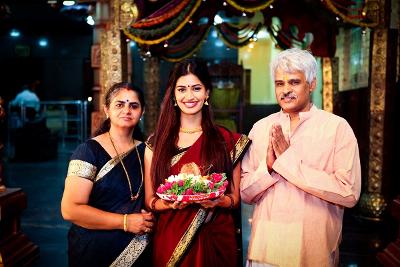
Decked in a neatly draped maroon silk sari, complemented by a bindi, jhumki and fragrant jasmine tucked in her hair, fbb Femina Miss India 1st runnerup 2016 Sushruthi Krishna’s visited Sree Tirumalagiri Lakshmi Venkateshwara Swamy Devasthanam at JP Nagar on Tuesday, where she offered her prayers to every deity.

Later in the evening, Sushruthi visited Nritarutya — an Indian contemporary dance studio at Jayanagar, where she used to spend hours honing her performing arts skills.

Later in the evening, she visited the city’s famous food street in VV Puram.

She frolicked around various snack counters, tucking into some of her favourite traditional South Indian delicacies.

source: http://www.timesofindia.indiatimes.com / The Times of India / News Home> City> Bangalore / Leena Gowalla, TNN / April 21st, 2016

IIMB team comes third in leadership contest at Yale

A team from Indian Institute of Management, Bangalore (IIMB), has secured the third position globally at the Integrated Leadership Case Competition 2016, held at Yale University recently.

The IIMB team finished ahead of teams from Yale School of Management and MIT Sloan School of Management. The winning team was from the Asian Institute of Management, Philippines, while the one from University of South California, United States, stood second.

The IIMB team comprised Rajat Mangla, Nakul Sehgal, Nitish Ranjan and Kshitij Chaudhary. According to a release from the institute, in round one the teams were asked to submit a video/PPT/essay on integrated leadership and its impact on a real-life problem.

The IIMB team was shortlisted based on a written submission that focused on integrated leadership in the automotive industry in light of the massive disruption caused by autonomous driving and cab aggregators.

Fifteen teams from 11 countries qualified for the next round, which was held at Yale University in New Haven. The teams were given a case study to solve in seven hours. The case study was about solving the challenges created by palm oil production in Indonesia.

The team from IIMB presented an innovative solution, creating a comprehensive action plan for all stakeholders in the case study.

Based on these presentations, three teams were selected for the final round in which the teams presented their solution to a panel of judges comprising experts from both industry and academia.

The team finished ahead of those from many reputed international institutions

source: http://www.thehindu.com / The Hindu / Home> Cities> Bengaluru / by Staff Reporter / Bengaluru – April 20th, 2016