Category Archives: Records, All

Giving Voice to the Voiceless

Dr. Vishal Rao | Pushkar V

Losing one’s voice after an operation is very traumatic, and for patients with throat cancer, it becomes an added burden. India witnesses about 25,000-30,000 throat cancer cases each year, out of which at least 5,000 patients stand to lose their voice box due to the advanced stages of the disease.

Thanks to Dr. Vishal Rao, head and neck surgeon at Bengaluru-based HCG Hospital who has come up with a simple and affordable voice box prosthesis, patients can ‘speak’ again and swallow food.

According to Rao, one of the major disadvantages for throat cancer patients is the loss of their voice box when they undergo laryngectomy, the surgical removal of larynx. This is a hollow muscular organ forming an air passage to the lungs and holds the vocal cords.

Rao, a visiting scholar to the Pittsburgh School of Medicine in the US, says, “The larynx houses the vocal cords through which sound is produced. It also lets air travel from the lungs to the mouth. During laryngectomy, when the trachea (windpipe) and esophagus (food pipe) are separated from each other, an opening is created between them which is called the tracheo-esophageal puncture. The device is placed in this opening. Though the patients can eat through their mouths but they cannot speak due to the absence of the voice box.” Once he saw a villager who couldn’t speak for 16 years because he could not afford the imported device. Rao thought, speech and communication are not only the basic tenet to life force but a right to freedom, peace, dignity and justice. “These poor patients were bereft of this essential means of communication owing to costs only,” he says.

Rao realised there was a need for an improved device with a one-way valve enabling laryngectomy patients to speak. In 2013, he started researching on this problem. He and his industrialist friend Shashank Mahesh came up with a technical plan to develop such a device. After working for two years with engineers, physicists, biomedical and material experts, the voice box was built.

Explaining his innovation, the 37-year-old doctor adds, “Regaining one’s voice is much like a rebirth. We have named the artificial voice box as Aum device, because that sound first resonated across the universe. If air passes through the food pipe into the lungs, it will vibrate and create noise, which can be converted into intelligent speech, with coordination from the brain. As food or water should not fall into the lungs, it is a one-way valve device. It weighs about 25 grams and is 2.5 cm long.”

An imported prosthesis is available for Rs 20,000-45,000 and needs to be changed once in six months. “As 80 per cent of patients belong to the poor socio-economic strata, a majority of them are unable to afford the western prosthesis. Our innovation comes as a boon to them. We have priced it at Rs 50, which is less than a dollar at the moment. Presently, there is a clinical study going on at HCG, after which we will take it to other cities, especially to the regional cancer centres where there is a need for such device,” says Rao.

He has used the device on a few patients. Ramakrishna, a 55-year-old watchman from Bengaluru needed to change his imported prosthesis but could not afford it. “When my voice box was removed,  I was given an imported machine, which  I used for two years. I had trouble eating as the food leaked through the device. I am doing better after using the Indian device,” says Ramakrishna.

With more than 20 national and international publications to his credit, Rao has also received many global awards.

source: http://www.newindianexpress.com / The New Indian Express / Home> LifeStyle> Health / by Meera Bharadwaj / March 26th, 2016

Karnataka’s special olympics bharat gets accreditation

Mangaluru :

Special Olympics Bharat, National Sports Federation and Union ministry of youth affairs and sports accredited Special Olympics Bharat – Karnataka, a sports event for people with intellectual disability.

To celebrate the landmark achievement, officials of Karnataka State Association for Special Educators and Supportive Staff, Bengaluru said they are organizing a felicitation programme at the Town Hall here on Monday.

Vasanth Kumar Shetty, secretary of the association, said special olympics programme brings the joy of sports to people with intellectual disability by providing life transforming experiences for athletes, coaches and volunteers. Special Olympics Bharat, which offers 25 different sports, has its presence in 36 states and union territories in India. It serves 679 districts and has 12,43,246 registered athletes. In Karnataka, it has 67,662 registered athletes.

Vasanth Kumar, who is also the administrator of Saanidhya Residential School and Training Centre, Mangaluru, was the area director of Special Olympics Bharat from 2001 to 2006. He is named the area director again this year.

The event is being conducted at eight regions in Karnataka. The event will have district-, region- and state-level sports. The programme envisages training special educators in different sports and make them certified coaches. “Our aim is to bring out the hidden talents of the intellectually disabled persons and bring them to the main stream of the society,” Vasanth Kumar added.

source: http://www.timesofindia.indiatimes.com / The Times of India / News Home> City> Mangalore / by Jaideep Shenoy / TNN / March 25th, 2016

Glorious memory

Dilip Gurumurthy (extreme right)

Basketball player Dilip Gurumurthy, the only player from Karnataka on the Indian team that went to the 1980 Moscow Olympics, gets nostalgic over the experience

There were whispers among those present at the Shyama Prasad Mukherjee Indoor Stadium, at Bambolim. “Did an Indian basketball team really make it to the Olympics?” they asked.

This wonder was evoked during the Federation Cup Basketball Tournament recently, where the cagers who represented the country at the 1980 Moscow Olympics were felicitated by the Basketball Federation of India (BFI).

On the podium, the players exchanged stories from their heyday. Among the many other topics covered in their conversation, one stood out. How did our national side gain a spot in the most coveted of sporting events?

Led by then U.S. President Jimmy Carter, 65 countries boycotted the Games, in protest of Soviet Union’s invasion of Afghanistan. This left gaping holes in the entry list, across disciplines.

India – ranked fifth in Asia – suddenly found itself in the main draw, after Japan, South Korea and Philippines (all ranked above India) withdrew. In a twist of fate, the rank outsiders took the court against Brazil, Soviet Union and Czechoslovakia in the main draw. Unable to keep up with their vastly-superior opponents, India was blown away by over 60 points in all three group stage fixtures. In the placement encounters, the hoopsters once again fell short, this time to Senegal, Sweden and Australia.

The results may have been a downer, but overall, there was an undeniable feeling of euphoria among the members of the squad. India had made its debut on the Olympic basketball court, and this feat has not been repeated since.

Centre Dilip Gurumurthy, the only player from Karnataka on that team, speaks about the experience with pride. He says that staying at the Olympic Village felt like heaven, even if the other athletes did not speak the same language. The Vijaya Bank stalwart, however, stated that the nation has a long way to go before dreams of reaching another mega-event can be realised. Excerpts:

Talk us through the Olympic qualification process.

We were fortunate to gain a spot. On the political level, India and the Soviet Union had a very good relationship, so that helped. The National Basketball Federation and the government pushed our case, and it worked. The Indian Volleyball Team was also slated to travel to Moscow, but somehow we got the nod. Of course, all of this was possible only because so many countries withdrew from the Games. After receiving news of the entry confirmation, we had only three weeks to get ready. The team selection was done during the Inter-Zonal Tournament in Calcutta.

What was it like to stay at the Olympic village?

It was like heaven. World-class athletes, from all over the world, interacted with one another in a friendly manner. We would exchange medals, badges and jerseys. There was a lot of security, as those were the days of the Communist regime. Our basketball team followed the fortunes of our countrymen with great interest. If you had the correct ID card, you could enter any stadium and watch any event. Language was never a problem, and we would use sign language to convey our thoughts. The facilities were unbelievable. I saw the marathon guys train even past midnight. I felt like I was living in a dream.

Who were the biggest stars that you wanted to meet?

Sebastian Coe (British middle-distance runner, who won the 1,500m gold at Moscow) and his countryman (track and field legend) Edwin Moses. Unfortunately, we could not meet them as security was too strict. I also saw Cuban boxer Teofilo Stevenson (one of the greatest amateurs in boxing history. He is best known for refusing to defect to the USA in order to fight pro heavyweight champ Muhammad Ali, despite being offered one million dollars to do so).

On the floor, the Indian basketball team could not compete against its rivals. We were able to score about 60 points in each match, but that was never going to be enough. The other teams were superior is many aspects – physique, skill and strategy. A side like Senegal which was supposed to be the lowest-ranked Africa unit, was tough to guard. We just could not match their physique. In fact, the average height for a player in any team was around 6’6”. And not only were they big, they were athletic as well. We could do well only till half-time, and after that, they would take over.

How did life change after the Olympics?

I came back with a strong desire to prove myself as a good player. I was supposed to get selected for the 1982 Asian Games, but somehow, that did not happen. So I decided to give up my international dreams. In 1983, I had an ACL injury which required surgery. Those days, even techniques like orthoscopy did not exist. The surgery was done and though, I was supposed to rest for six months, I returned to action in three months. I went on to play regularly for several more years. Towards the end of my career, I helped the Vijaya Bank side by being a player-coach. I retired from my service at Vijaya Bank only last year. They have supported me well for many years.

You are here to watch the best in the country compete in the Federation Cup. How would you compare your generation to the current generation?

We never had these facilities. It makes me cherish all the hardships we went through. Travelling in unreserved tickets to tournaments, eating whatever we could – all for the sake of basketball.

I was known for my defence and asked to mark the toughest man. I’m not boasting, but I was never taken out of the game for not doing my job. See these current players. After their match, they should sit in the venue and analyse other matches. But they never do that. Doing your homework is important. Somehow I feel that current players have no real fighting qualities in them. Players may be taller now, but where are the results? That drive to succeed is not there. Coaching wise, the emphasis should be on defence. My take is that if you stop two points on defence and then score on the counter, you are up by four points.

I don’t know, these guys seem casual in their approach. If a team is winning by 20 points, they want to try fancy passes and dunks. At the national level, players should remain serious and composed, with a sharp focus on being productive.

source: http://www.thehindu.com / The Hindu / Home> Features> MetroPlus / by Ashwin Achal / Bangalore – March 28th, 2016

Bengaluru gears up for a new vintage car museum

Car collector Dr Ravi Prakash promises to pull the wraps off over 900 classic beauties

Classic car lovers may soon be spotted wheeling down the state highway more frequently than ever before. Giving the finishing touch to his glossies, doctor-turned-vintage-car-collector Ravi Prakash is almost ready to steer open the doors of a nine lakh square feet property on the fringes of Bengaluru that will house a covetable collection of more than 900 classic cars, together with a range of time-honoured motorbikes and carriages.

Describing it as an ‘auto-history museum’, Dr Ravi says, “More than a treasure trove of vintage automotives, I hope to create an aural-visual and educative experience that every vehicle enthusiast and historian would want to have. The museum will illustrate the evolution of motor vehicles through its exhibits. But more importantly, it will replicate the bygone era, complete with the classic favourites, road networks as well as the people and attire of old times.”

From the Bentleys, Aston Martins and Rolls-Royces to the Mini Coopers, the museum will showcase a diverse collection of glistening steel beauties that could make even the most hard-nosed cynic quiver with excitement. Located on a farmland near Rajarajeshwari Nagar along the Mysore Road, the museum will not just line up the cars in an array. “Expected to be one of the 10 largest vintage car museums in the world, this state-of-the-art venue will promote awareness about old-style vehicles. The property will also comprise an automotive mall, serving as a platform for buyers and sellers,” adds the collector, who himself was a national rallying and racing champion between 1981 and 1984, and is a die-hard fan of the Mercedes Benz classics.

It’s not just this cardiothoracic surgeon who likes to travel back in time. His daughter Rupali also takes interest in old cars. “She is into vintage car merchandising and is quite passionate about it,” sums up Dr Ravi, who dreams to make this museum a major tourist hub in the coming years.

Zooming facts

The museum will be equipped with advanced technology, wherein each car will be displayed under individual sheds.

Among the lot will be a car driven by Motilal Nehru.

Visitors will have access to an enviable collection of 18,000 books and journals on automobiles, apart from other antiques.

Typically, the restoration and modification process for every car takes around six to nine months, while it may also vary between three to four years, depending on the amount of work required on the vehicle.

The restoration of the vehicles is a done by a team of 15 motor experts at a special workshop.

A restaurant featuring car-themed design and decor will be the star attraction of the auto-mall.

A charitable foundation will run the museum, the proceeds of which will be primarily spent for the treatment of road accident victims, while the rest of the money will be used for the acquisition and restoration of cars.

source: http://www.timesofindia.indiatimes.com / The Times of India / News Home> City> Bangalore / by  Reema Gowalla / TNN / March 28th, 2016

S.V.N. National Award for Kadri Gopalnath

Kadri Gopalnath will receive the award on May 1.

Kadri Gopalnath of Mangaluru may have bagged a multitude of awards, but this year’s S.V. Narayanaswany Rao National Award from the Chamarajpet Ramaseva Mandali seems extra special to him.

“It was nearly 40 years ago that I was in the process of rediscovering and exploring the Belgian instrument for adapting it to Carnatic genre. After years of research and modifications to suit the genre, I was rearing to showcase my Carnatic experimentations when mandali founder S.V.N. Rao was open-minded to offer me a morning slot. Today, I feel rewarded to be taking an award instituted in his name,” says Mr. Gopalnath, who will receive the award during Ramothsava on May 1.

Mr. Gopalnath was at the right place at the right time, according to S.N. Varadaraj, general secretary of the mandali.

“In 1977, when some of the best Nadaswara professionals were unable to make it to the mandali, Gopalnath’s approach proved timely as audiences were exposed to a foreign instrument on a classical platform,” says Mr. Varadaraj.

Belgian instrument-maker and musician Adolphe Sax, who invented saxophone in 1840, would never have imagined that his invention would one day see Carnatic flourishes on it.

“My modifications with controlled blow, apart from altering the pads and fastening some keys for easier Carnatic oscillations helped me tackle every composition in every raga. In a way, my hard work not only helped me propagate classical Indian music on an established European instrument, but it is more rewarding to see hundreds of enthusiasts taking to the instrument in the last two decades. The instrument has gained a niche in Carnatic,” says Mr. Gopalnath.

source: http://www.thehindu.com / The Hindu / Home> News> Cities> Bengaluru / by Ranjani Govind / Bengaluru – March 28th, 2016

‘Sneha Spandana ’ conferred with Youth Club Award

SnehaSpandanaBF28mar2016

Mysuru :

City’s Sneha Spandana Mahila Mandali, Kuvempunagar, was conferred with District Youth Club Award at the District Youth Convention jointly organised by Nehru Yuva Kendra, Department of Collegiate Education, Student Welfare Wing and NSS Unit, University of Mysore, (UoM) at Humanities auditorium, Manasagangotri here recently.

The award carries a cash prize of Rs. 25,000 and a citation.

Speaking on the occasion of award presentation, Mayor B.L. Bhyrappa said that Mysuru bagging the ‘Cleanest City in India’ tag for the second consecutive time, has brought enormous joy to him.

Pointing out that many Self Help Groups had joined hands with the MCC in keeping the city clean, Bhyrappa observed that relentless co-operation by Associations and Organisations, civic groups and members of the public, will go a long way in the city retaining the tag for a long time.

Maintaining that the MCC has launched several initiatives for making the city plastic-free, he called upon the co-operation of all stakeholders in this regard.

Noting that every individual has his/her own strengths, he opined that everyone should utilise their strengths for the betterment of society. He called upon Organisations to guide the youths in the right direction.

Joint Director of Collegiate Education Prof. Morabada Mallikarjuna, University of Mysore Dean Dr. M. Rudraiah, Administrative Officer Prof. C. Ramaswamy, Nehru Yuva Kendra’s M.N. Nataraj and others were present.

A total of 25 youth groups of the district were presented sports equipments on the occasion.

source: http://www.starofmysore.com / Star of Mysore / Home> General News / March 28th, 2016

Inner Wheel Club of Mysore celebrates Golden Jubilee

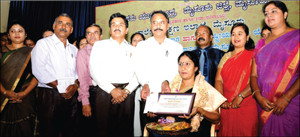
Seen on the dais are (from left) Annes Selina Vagh, Binnie Nanaiah, Naina Achappa, Past Association President Shailaja Bhat, Inner Wheel Mysore President Seijal Luthra, Inner Wheel District - 318 Chairman Sudha Prasad and Inner Wheel Mysore Secretary Sujatha Bhat.
Seen on the dais are (from left) Annes Selina Vagh, Binnie Nanaiah, Naina Achappa, Past Association President Shailaja Bhat, Inner Wheel Mysore President Seijal Luthra, Inner Wheel District – 318 Chairman Sudha Prasad and Inner Wheel Mysore Secretary Sujatha Bhat.

Mysuru :

The Golden Jubilee celebrations of the Inner Wheel Club of Mysore was held last evening at Wind Chimes in Nazarbad with the Past Association President of Inner Wheel Clubs in India Shailaja Bhat as the chief guest and Sudha Prasad, District Chairman-318, as the guest of honour.

The senior-most member of the Club, who is the first Charter Treasurer and a Past District Chairman Binnie Nanaiah and Selina Vagh, a dedicated member and major donor of the Club were recognised for their service and involvement in the Club’s activities.

Speaking on the occasion, Shailaja Bhat stressed on the need for personal Service and commitment to the cause of Service.

She appreciated the Club’s Project of Organ Donation awareness as a need of the hour and Swachh Bharat programme as an attempt to work towards a cleaner city.

Sudha Prasad emphasised on the need to develop the Happy School Project of Building Toilets in Schools which the Club has taken up and the growth of the Club in its 50 years of Friendship and Service.

She said the Club was engaged in various social service activities such as installation of drinking water units in schools, construction of school toilets, distribution of wheel chairs to the specially abled and other such activities.

She further said that the Club has come with three more plans — Swachh Bharat campaign, creating awareness on organ donation and construction of toilets in villages.

Swachh Bharat campaign and organ donation posters were released by the dignitaries. The Club’s blue coloured collar was changed to yellow colour to mark the occasion.

Inner Wheel Mysore President Seijal Luthra, Secretary Sujatha Bhat, senior members Naina Achappa, Geetha Kuttappa, Chandrika Raghu, Jahnavi Murthy and others were present at the celebrations.

The 50 Past Presidents of the Club and 12 Past District Chairmen were recognised. It was a gala evening of cultural programme and celebrations

source: http://www.starofmysore.com / Star of Mysore / Home> General News / March 26th, 2016

In a first, Korean mastiff worth Rs 1 crore comes to India

KoreanMastiff02BF24mar2016


Bengaluru :

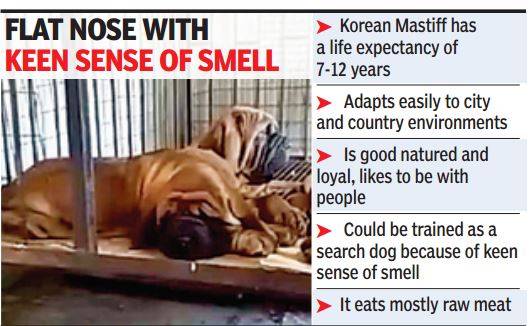
The Korean Dosa mastiff has a heavy wrinkled skin, hanging jowls and a blunt nose, but it is entitled to put it up in the air. For this rare bundle costs an eye-popping Rs 1 crore-as much as a good-sized villa. And the nose may be flat, but it smells sharp.

Bengalurean Satish S, who is importing this exotic breed, is set to become the first owner of the Korean breed in India. Satish, breeder and president of Indian Dog Breeders’ Association, said two two-month-old pups, each costing Rs 1 crore, are flying in from China. This is the first time the breed is entering India, he claimed.

“This is a dream come true, I wanted this dog for over 20 years,” said Satish, who has over 150 dogs, a combination of rare and big breeds, at his farmhouse in Kumbalgodu, and has been in the business for over 25 years. “After a long and exhausting search, I finally got good news. I was in touch with a breeder in China whose Korean mastiff littered recently. I’m importing one female and one male pup,” he said.

“It is one of the rarest breeds, known for its heavily wrinkled body. The body is so wrinkly that even its eyes are barely visible,” he said.

The pups are on their way to Bengaluru, with a day’s rest to break their long and strenuous journey. They were put on a plane from Beijing to Bangkok, where they rested on Monday, and will arrive on Wednesday.

Satish is rolling out the red carpet for the two pups-one will be picked up in a Rolls Royce and another will travel in a Range Rover from the airport to his house in Banashankari II Stage. “I’ve rented a Rolls Royce for a day. The Range Rover belongs to a friend,” he said.
“They are coming from a cooler place, so I will keep them in an air-conditioned room till they adjust a bit to the heat here,” said Satish.

KoreanMastiffBF24mar2016

The most expensive dog Satish has imported till date is the Tibetan mastiff, for which he paid Rs 65 lakh. “But the Korean mastiff will be my most expensive buy now,” he said.

source: http://www.timesofindia.indiatimes.com / The Times of India / News Home> City> Bangalore / by Aditi Sequeira, TNN / March 22nd, 2016

Striking the golden mean

ProfSastryBF21mar2016

Prof. T.V. Venkatachala Sastry is an authority on ancient Kannada and Sanskrit classical texts. Speaking about the waning interest in this area of study, he tells DEEPA GANESH that we must be open to multiple interpretations of the text

It would well be a high pedestal if the acclaimed grammarian, lexicographer, Sanskrit and Halegannada scholar T.V. Venkatachala Sastry (TVV) sat on his achievements. But, on that cloudy morning in Mysore, the 83-year-old scholar was waiting at his gate. “You had to come all the way here, excuse me, I could not make it more convenient for you,” he said, with genuine concern. With over hundred books to his authorship, TVV is an authority on prosody, pre-modern classical texts, aesthetics, languages, literary criticism and more. He served the University of Mysore for several decades, and was later the director of Kuvempu Kannada Adhyayana Samsthe — the outcome of his erudition and vision has been huge. He has been guru to several generations of Indian students, and also to foreign scholars like Prof. Laurie Honke (who famously said to TVV: ‘You are Panini to me’), Prof. Showman, Prof. Karl Johanssen, and Prof. Stefan Anacker. Also teacher to the renowned Indologist, Prof. Sheldon Pollock, who attributes the idea of his book, “The Language of the Gods in the World of Men” to “the greatest living scholar in the field of old Kannada, T.V. Venkatachala Sastry”.

SastryStudyBF21mar2016

We settle down in his modest study, packed with books from all sides. On his bed by the window, are books that people have sent him, manuscripts, reading material etc. Lean that he is, TVV tucks in comfortably. The phone rings. It is a student who needs help with historical data. Yet again the phone rings, and this time in Telugu he tells the caller: “Of what use are these controversies? Chaduvukopora… Go to your studies, and I will also continues with mine.” In his home library of over 15,000 books, TVV knows exactly the location of each book. With undiminished energy after a conversation that ran into several hours, he explains his collection. “You must come again, I will keep some books for you,” he says with a rare generosity. The doors of his house constantly kept open for students, scholars, researchers and friends, TVV is so eager to give and share that 21st century ideas like “creative commons” seem outdated. For him, it is a way of life. Issues like intellectual property rights are hardly a matter of concern. Hence, if you discuss the global publishing industry, its politics and economics, you find that it lies outside his worldview. All that matters to him is the pursuit of knowledge.

Excerpts from the interview.

One often hears that soon there will be no one studying the classical texts in India, and the western world will be custodians of Indian classical studies. How do you react to this?

It is hard to give a yes or no answer. I don’t think that is expected of me either. Steadily, as someone who has been associated with the University, one see the dearth of students for Indian classical studies. About five decades ago, almost every Indian University had a department of Indian classical studies. We are hardly left with any now. With the advent of modern technology, it has become difficult even for departments of philosophy, science and literature to survive. Sanskrit and Halegannada became unpopular with students rather early.

We have had a continued relationship with Western scholars. They came from Germany, France, Finland, America… and worked extensively in India. For instance, Sir Monier Williams who studied, documented and taught Asian languages, wrote “An Elementary Grammar of the Sanskrit Language” (1846), compiled a Sanskrit-English dictionary (1899), A.B. Kieth wrote “The Sanskrit Drama” (1923), Weber’s “The Religion of India” (1916), F. Edgerton’s “Studies in the Veda” (1915), E.V. Arnold’s “Vedic metre in its historical development” (1905), Max Mueler’s “Sacred Books of the East” (1879-1910) and several others are early works by Westerners in the field of classical studies. There was rich literature available here and scholars have always been interested in studying it. Even back then, a lot was said about how they came with religious interest. It may be true, but it is not entirely true. They were genuinely attracted to languages, history and culture and worked assiduously. Karnataka has 25,000 to 30,000 inscriptions. Epigraphica Indica, the first volume of which was edited by James Burgess (1888) is the most competent. The later versions are just photographs of these inscriptions with no analysis whatsoever.

Their rigour was similar to that of our good old Pandits, who lived and breathed the subjects of their interest. The old school western scholars were also similar; however, you still find that this is a tradition continuing in their part of the world. Look how the outlook of our universities has changed so completely! They want to give you what is easy and what brings in many. The bulk of our literary, cultural-historical practises, has gone on reducing. Even if there is one single student, it is the responsibility of the University to keep the department functioning. You should be able to convince people to take it. However, ironically, now Universities ask, “What is the use of such a study?” Once you start asking questions of “usefulness” linked to material benefits, pursuit of knowledge simply moves to the background.

Do you think the Nehruvian imagination of State is also responsible for this?

Well… perhaps. It was a language of development, of course different from how we speak of it today. Also, these factions of Right and Left, have done more harm than good to classical studies. We must remember that the path of the King is flanked by a right and a left, but neither is complete in itself. Everyone wants to read their ideologies into these texts. Society is not just what constitutes our imagination. In this tussle for upholding one view, we have lost pride in what belongs to us. An anti-Sanskrit campaign started when ideologies began to take over.

Having said this, I think classical studies will survive. It will be sad that it may soon disappear from our formal educational processes, but it will live on, like it has all these years. I from my end, have started conducting workshops all over Karnataka for various interest groups.

Do you think the study of Halegannada and Sanskrit would help contemporary thinking, including the study of literature?

The classical way of learning is of no use to the “productive” outlook, to get jobs in this world. Let me tell you a story. A friend of mine, a solid pandit, was trained in the traditional way. Because he had not gone through formal schooling, he ended up as a middle school teacher. He took it as a challenge and did SSLC to MA from the Banaras University and became a lecturer. Isn’t this sad? The government must nurture this kind of scholarship.

The best of students go to other streams, and what we are left with is a disinterested bunch. My friend, a professor of philosophy, told me that he lectured on the philosophy of death for two hours, and at the end of it, students went out of the classroom laughing and whistling!

In your own personal interactions with several western scholars, were there moments when you felt “this far and no further”? Did you feel the “insider” was essentially different from the “outsider”? The outsider had an omniscient view, but a tad reductionist?

Hangal Virupaksha Shastrigalu, in the course of a conversation, had apparently mentioned to DVG that Westerners had done a lot of work. And DVG had remarked in a loaded statement: “Houdappa, they have. But with their mind.” (TVV laughs)

That’s exactly what they are saying about Sheldon Pollock too…

Is this great tradition of knowledge any single man’s property? It is for all. You have a problem with Pollock’s views? Let’s have an academic debate. Truth doesn’t change with somebody’s reading of it. I don’t understand this anxiety of representation!

Sheldon Pollock maybe alien to Indian culture and society. But the fact that he has spent four or more decades of his life studying all this, his readings will certainly not be grossly off the mark. Think of this – he could have chosen to study American literature which is closer to his culture. Why did he make this choice? He has been studying Sanskrit since he was 18. The respect he has, his passion, the depth and engagement, it is special. If you have to read old Kannada texts, you have to Shabdamani Darpana, which is no easy nut to crack. Pollock reads it. He comes back with doubts, and then when you give him an answer, he will tell you: “But this is what D.L. Narashimhachar has said…” Always thorough in his research.

Now listen to this. Kuvempu used to tell us in class that for us goddess Lakshmi comes with a whole emotional world of meanings, and therefore she means to us more than what she signifies. But for a Westerner, at best, she will be goddess of wealth. We recognise that difference. By virtue of being insider what is possible for you may not be exactly possible for them. But their research is also first hand. I personally feel that it is a great service that they have brought global attention to our ancient texts.

Having said this, let’s not even take away the merit of a discussion or of differences. Once, G.S. Shivarudrappa and I had a difference in a seminar about interpreting a verse from the Bhagavadgita. Should that take away our respect for each other? B.M. Shrikantaiah had once remarked that Halegannada poetry is kagga, old-fashioned and of little significance. Does that mean he had no respect for it? There are several instances to prove that he valued it immensely. I don’t understand this raising cudgel for everything.

I’m sure there have been discussions and disagreements between scholars in the past. Also inter-cultural. Can you recall some of those exchanges?

There have been famous exchanges, ones that have been documented. V. Sitaramaiah and R.V. Jagirdar (Sriranga), K. Krishnamurthy and Raganantha Sharma, Masti and Kuvempu, There are several others, academic and honest. That was the spirit of those times. The kind of teachers we had, and the writers of those times…. remarkable people who nurtured youngsters.

At the Shivagange Sahitya Sammelana for which Ram. Shri. Mugali was president, Masti had come. I had written a couple of essays for his journal Jeevana, so I went and introduced myself. He drew me into an embrace and said: “Chinnadanta baravanige. Golden writing…” There was nothing great in my writing, but it was their way of encouraging. Such generosity. Masti was so great a man that he apologized to Tirumalamba saying his observations on her writing were faulty. There was an intellectual atmosphere. Today, politics is dangerously ruling our cultural world.

Sediyapu Krishna Bhatta was an outstanding chandassu (metre) expert and a vedic scholar. S.D. Velankar had read all the Prakrit and Sanskrit texts. He had read so much more than Sediyapu. When he presented his views, Sediyapu didn’t take offence. Isn’t that a growth in pursuit of knowledge?

Let me tell you of A. Venkatasubbiah. He was a wonderful scholar. He was a master of vedic studies and Panchatantra. He had a doctorate from a German University in 1910. He wrote a 650-page book on the Veda. During the period even Western scholars were majorly into research. Venkatasubbaiah who had read all their works went on record to say – “Their estimate of several things are wrong because of cultural gap. I will revise the work of these German and French scholars.” In reply, one of them wrote, “Venkatasubbaiah is a great scholar but is not aware of recent research.” Isn’t this an ongoing process in the pursuit of knowledge?

I remember once Pollock asked me a question related to the works of Rice and Kittel. He had disagreements with their findings. He could have easily said, “What does this Venkatachala Sastry know? Kittel is the greatest afterall!” But that is anti-academic culture.

We have lost the tradition of Pandits. It has been replaced by professors. What is your reading of this situation?

The Pandits were unshakeable scholars. They had complete hold over the texts. They could extempore quote hundreds of poems, they could tell you the source of the words, their meaning, grammar… etc. University trained professors are aware of the modern tools of criticism, but their scholarship is limited. Also, the passion and commitment of the pandits cannot match that of professors. It is indeed a loss. In fact, DVG and Ti.Nam. Shrikantaiah have discussed this issue.

What is the difference between Indian and Western students?

It is very different, yet what I say are not generalisations. I have had fine students in the past who have become reputed scholars. Now, our students are not interested in the foundation. They are always trying to see how they can fit their ideologies into it. I always tell them to enjoy reading poetry for the sheer experience of finer feelings. Once that is done, you can start analysing and exploring other things. They are not prepared to enter the gateway of classical literature. They have lost patience, interest, engagement and the tools.

The West is interested in research, and wants to find new dimensions. They don’t get satisfied easily and work with perseverance and patience. Also, there is an academic system that is interested in the work of these scholars. They ask them questions, and engage with their work. There is a world that is watching them with interest. Here, even if I put out a great work, I am not sure if another scholar working in the same area as I do, will even read it. That makes a huge difference to your outlook.

You must understand one more thing, you get huge honours easily now. Social justice is fore-grounded and talent takes a backseat. Neralige sanmana madovaaga, akruti beke (when they felicitate shadows do you really need the real persona?)? Nevertheless, passion and interest needs no justification.

U.V. Swaminath Iyer, the Tamil scholar, writing about Malur Ranaganathachar who taught Sanskrit at the Presidency College says, “his head was constantly buried in some book or the other”. M.S. Puttanna writes about Triyambak Shastri: “He was always reading or writing. In case he felt drowsy in the afternoon, he would sleep over his book, wake up and start reading.” Ralapalli, our teacher, was an outstanding scholar. He would say, “I am slightly doubtful of this. I have asked D.L. Narasimhachar to help me with this.” Chidananda Murthy, at his age, calls me frequently to discuss something or the other. Learning is not easy. It is upasane. I feel thrilled when I read of such things. It is hard to find such people now. They all believed in the power of the text. Tell me, will Bhagavadgite get burnt if you burn it…?

You are quintessentially a traditional scholar who is not anxious about other readings of our texts…

Let me clarify this. I am a traditional scholar who has immense faith in the kind of learning that was imparted to me. We have a tradition and I believe in its values and respect it. I am also aware of its weaknesses. In a sense, I am also a moderner and in many ways I subscribe to some aspects of modernity. For instance, the liberal outlook that came with it. I stand in this new world, and would like to envision the ever expanding meanings of the old world order. I will not impose my beliefs on it. I adhere to the text, and am interested in its interpretation. No political ideology or country stamp will take me away from my commitment to the text. I will stand by what I find correct. If Pollock or whoever makes a mistake I will tell them my views. Since I respect scholarship, I respect Pollock’s dedication and good work too.

I want to quote Kavirajamarga. In a verse, Nrupatunga raises this question: “What is kasavara (gold)?” If you can accept another’s thoughts, another’s religion with antahkarana (feeling), that is gold. Else, he says, kasa (dirt) and kasavara (gold) are the same.

Corrections & Clarifications:

This report has been edited for factual errors.

source: http://www.thehindu.com / The Hindu / Home> Features> Friday Review / by Deepa Ganesh / Bengaluru – March 17th, 2016

KIA logs 100 millionth passenger

Bengaluru :

The Bangalore International Airport Limited (BIAL) on Friday greeted its 100 millionth passenger at the Kempegowda International Airport. He was Vinay Kulkarni, 50, who arrived from Mumbai on a Jet Airways flight.

On an average, 52,000 passengers transit through KIA every day, officials said.

BIAL MD GV Sanjay Reddy said: “This is a special moment for us. The achievement comes within 8 years of operations and is a testimony of our ability to meet the rapid demand and growth of domestic and international air traffic.”

BIAL determined the 100 millionth passenger after it created an algorithm based on actual passenger numbers from the start of airport operations in May 2008 to March 2016.

KIA is India’s third busiest airport with the highest passenger traffic in southern India.

source: http://www.timesofindia.indiatimes.com / The Times of India / News Home> City> Bangalore / TNN / March 19th, 2016