Category Archives: Records, All

Older than Bengaluru, Stands a Grizzled Guard

Pics: Pushkar V
Pics: Pushkar V

Bengaluru :

The Devannahalli fort, which stands 35 kms away from Bengaluru, is older than the city itself by 37 years.

The fort has been occupied by different dynasties over time. It was built in 1501 by Kempegowda’s ancestor, Malla Baire Gowda. But in 1747, in a battle led by Nanjarajaiah, the dalwai of Mysore, the clan lost it to the Wadiyar dynasty. Marathas later claimed it and lost it back to the Mysore state, in a siege led by Hyder Ali in 1746.

Arun Prasad, from Discover Bangalore Project, says that though Hyder captured the fort, it was his son Tipu Sultan who was responsible for modelling and building the Pulkad fort.

The town surrounding the fort was meant to be a a centre of learning and arts. “The Devannahalli town was supposed to be a place for learned artisans and intellectuals to inhabit,” says Prasad.

Devannahalli was a town typical of the time, with protected farmlands and fields. A lake, behind the fort and seen from the bastions, was meant to serve the needs of the inhabitants.

Today, the lake is dried up and is a sad sight to notice. Prasad blames it on poor urban planning. Earlier, a highway used to pass through the western part of the town. Now, a road has been built, which passes over the lake. A  good portion of the lake was used up for it.

“The lake has always been rain-fed. But the new road cut the lake away from the adjoining canals and channels,” says Prasad. “The rain water could not flow in and the lake dried up. The vast area of 400-500 kms metres has only weeds and little water due to rains. You can also spot some tattered measurement devices, which was a failed attempt to study the level of water in the lake.”

Pics: Pushkar V
Pics: Pushkar V

Bastions

Built on a higher ground, the bastions were used to keep a watch out for the enemy. The fort is 30 to 35 feet high and bastions, along the fort, are placed at equal distance from each other. “The bastions have well protected chambers, used by soldiers. The gun points are holes in the wall which can still be seen today. They are built from lime and brick. The holes were used to keep guns during the war,” adds Prasad.

Tipu’s Birthplace

South-west of the fort, there is memorial with a board, which proclaims that Tipu was born here. A six-foot-tall enclosure marks the spot.

When Tipu was born in 1750, his father Hyder Ali was engrossed in a battle. His mother, Fatima Fakhr-Un-Nisa, was secretly ushered into a carriage to give birth at the fort, as it was considered a safe place. However, she ended up giving birth inside the vehicle, right outside the fort. The monument is built over this birth spot.

A pond was built under the administration of Purnaiah, the then Dewan of Mysore. It is a beautiful pond with the stones and excavations intact. “The water is used for rituals and festivals,” says Prasad. “People take baths here as well.”

Pics: Pushkar V
Pics: Pushkar V

Temples

Inside the Devannahalli fort, there is the Venugopalswamy temple. The temple, which was built in the Vijaynagara style, has several depictions from the Ramayana on the walls. “At the entrance, the two horsemen are believed to belong to the Western Ganga dynasty (which ruled 350 and 1000 AD),” said Prasad.

Pics: Pushkar V
Pics: Pushkar V

There are sculptures of seamstresses, as you enter, from the same era. The north and south walls have sculptures showing Rishyasringa being brought from a forest to Ayodhya accompanied by dancing girls. There is also a scene of Vishwamitra caught in a  an archery battle with Rama. The south wall has ten incarnations of Lord Krishna and Rama’s father performing a sacrifice.

The fort gate and the fort walls are crumbling and there are scribblings on the walls. There is no security at the entrance and anyone can walk in. The commercial establishments all around have failed to preserve the authenticity of the past. “An ASI (Archeological Survey of India) office is located at the entrance, which is always closed and does not provide much information,” says Prasad. “The fort area needs to be protected by ASI and does not come under the corporation. The northern gate is crumbling as well.”

How it Began

Refugees on the run from Kancheepuram settled down near the Nandi Hills. Legend has it that Rana Baire Gowda, their leader, was told in a dream that he had to build a settlement in this region. This family goes by the name of Morasu Wokkalu. His son Malla Baire Gowda founded Devanahalli. Kempegowda also belongs to this family.

source: http://www.newindianexpress.com / The New Indian Express / Home> Cities> Bengaluru / by Seema Prasad / January 28th, 2016
New Mangalore Port is first port to start Ro-Ro service to Hazira port

Mangaluru :

New Mangalore Port Trust (NMPT) has given fillip to industrialization in Karnataka by means of offering most comparative rates as compared to other major ports. The port has given all facilities to encourage coastal movement of traffic and now is the first Indian port to start the Ro-Ro service from Mangaluru to Hazira port, noted P C Parida, chairman, NMPT at the Republic Day celebration organized by the port at Dr B R Ambedkar Stadium, Panambur here.

Port has registered growth of 15% in container traffic. Based on Boston Consultant Groups report, port has taken steps to increase container traffic further and further develop container terminal by outsourcing container handling. Port has taken up upgradation of fire-fighting facilities to handle VLGCs and it shall be operational by September. NMPT is planning to have LNG terminal which shall be operational in 2017. This will facilitate citizens get clean fuel at cost effective rates.

To encourage agro products, port has already commissioned two warehouses and one is under construction. Under the green city project, the process of commissioning a 350-kW roof-top solar power plant is under progress which will meet the power requirement of administrative building, hospital building and guest house and street light. Port has planned to commission 5-mW solar power plant by November 2016 which will meet power requirement of the port.

Long pending demand of locals for fisheries harbor is in planning stage and work may commence from last quarter of this year. Under corporate social responsibility scheme, port has contributed Rs 98.5 lakh for providing LED street lights on the national highway from KIOCL junction to Bykampady. A similar project from KIOCL to Thannirbavi village too is under consideration, Parida said, thanking the employees for their participation in Swachh Bharat Abhiyan.

source: http://www.timesofindia.indiatimes.com / The Times of India / News Home> City> Mangalore / by Jaideep Shenoy, TNN / January 26th, 2016

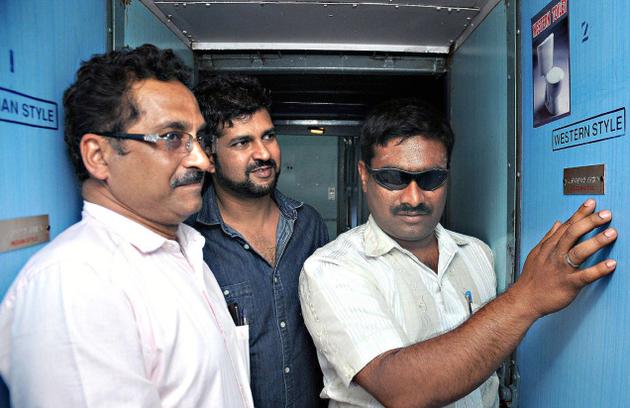
Braille-embedded train to chug out of Mysuru today

BrailleMaleBF26jan2016

All reserved coaches of Mysuru-Varanasi Express to bear Braille signage

The Mysuru-Varanasi Express will become the country’s first Braille-embedded train. The bi-weekly express (Train No. 16229/16230), which chugs out on Tuesday, will leave Mysuru for Varanasi on Tuesdays and Thursdays.

It has been provided with metallic Braille signage indicating berth numbers, location of alarm chains, toilets, and emergency windows. There are also instructions on how to operate the emergency exit windows. The initiative has been financed by Mysuru MP Pratap Simha from the MPLAD fund.

Though the Puri-Delhi Purushottam Express was the first train in the country to have a Braille-embedded coach, the Mysuru-Varanasi Express will be the first in the country where all reserved coaches have been embedded with Braille signage, said Rajkumar Lal, Divisional Railway Manager, Mysuru Division, South Western Railway.

Braille signage has been introduced on one rake of the express and it will soon be introduced in the second rake as well. The Chamundi Express and the Mysuru-Talguppa Express are the other two trains that will be provided with Braille displays after this, Mr. Lal said. “The plan is to extend the facility to all reserved coaches of long-distance trains in a phased manner,” he added. Braille signage indicating the coach number is next on the agenda.

The Braille signage indicating berth numbers and location of toilets will be of great help to the visually-challenged travelling on the Mysuru-Varanasi Express.— PHOTOS: M.A. SRIRAM

Netravati, a visually-impaired person, welcomed the initiative and said that it will help them identify the seats or berths without seeking help from others. “We will be more independent as sometimes, people do not respond to us as they tend to be in a hurry to locate their berths,” she said.

source: http://www.thehindu.com / The Hindu / Home> National> Karnataka / by R. Krishna Kumar / Mysuru – January 26th, 2016

Women’s folk fest kicks off in style

The city on Friday saw the inauguration of the three-day All Women World Folk Arts Festival. Pegged as a first of its kind, the arts festival was launched at the Ravindra Kalakshetra by KA Dayananda, director, department of Kannada & culture and actor and classical dancer Lakshmi Gopalaswamy.

Not just a man’s domain:

Setting the evening on an energetic note were folk dance performances by all women groups. This included a Dollu Kunitha performance by M Sujatha Murthy and ensemble and Kaikottikali performance by the Monisha Arts Dance ensemble. “The reason we chose to focus on women’s folk dances is because there’s a stereotypical thought that folk dances and music are a men’s-only arts. By getting all women performers and groups to perform, we hope to dispel this myth,” said Srivatsa, managing trustee of International Arts and Cultural Foundation that’ s organiz ing the festival.

Talking about what’s in store for interested viewers on Saturday, he said, “There’s a workshop on Hejje Kunitha that will be held at the Maharani’s College in the morning. The highlight of the day will be a musical performance in the evening by Gangamma Keshavamurthy at Kalagrama in Malathahalli.She will be presenting a very rare form of folk songs called Hase Hadu – these are wedding songs that are sung by the (Havyaka) community and what’s really unique is that these songs are passed down by word of mouth and have never been recorded. On Sunday, we again have an all-woman’s group that will perform folk music on classical instruments such as the ghatam, morsing and the mrudangam.”

While the festival has just begun, Srivatsa said the dates for the next year have already been set: The festival will be held on January 27, 28, 29, 2017. This is to facilitate easy travelling for international dance groups,” he said.

source: http://www.timesofindia.indiatimes.com / The Times of India / News Home> City> Bangalore / TNN / January 23rd, 2015

Carmelites create Guinness world record

CarmelitesBF23jan2016

More than 900 students of Mount Carmel College created a Guinness world record for opening the most number of softdrink cans simultaneously at their annual ‘Cul-Ah 2016’ fest on Friday.

They broke the previous record created by Ltd CidoGrupa (Latvia) in Ligatne, Latvia, on August 2, 2014, involving 689 people. Representatives of the Guinness World Records, who were present on the occasion, validated the new world record and an official certificate will be issued in a week, said a release.

Niveditha Umesh, general secretary, Students’ Union, Mount Carmel College, said, “We at Mount Carmel College always look for something different in whatever we do and that has been our key differentiator. We are happy to partner with TWISS to set this new record. We hope to become the first college in India to take away this kind of Guinness World Record honour. Cul-Ah, our annual cultural fest, is the right platform for this.”

source: http://www.deccanherald.com / Deccan Herald / Home> City / DHNS – Bengaluru – January 23rd, 2016

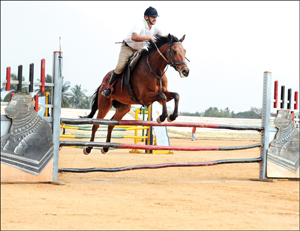
Rehearsal for Republic Day Celebrations in City : Show Jumping to be the highlight of R-Day at the new venue — Torchlight Parade Ground

ShowJumpingBF23jan2016

Mysuru :

With the District Administration taking all measures to ensure total success of the Republic Day celebrations at the new venue — Torchlight Parade Ground in Bannimantap, the Police Department held a rehearsal at the venue this morning.

A total of 30 contingents, including more than 15 Police teams (City Police, Mounted Police, CAR, DAR, KSRP, Home Guards, Traffic, Women, Fire Services, Police Band, etc.) and hundreds of children from schools, including NCC and Scouts & Guides across the city took part in the rehearsal.

For the first time, the Mounted Police will be performing equestrian events and show jumping during the celebrations.

The participants were rehearsed to a few patriotic songs and march past. Pavani, an LKG kid of Teresian School, who was the youngest participant at the parade, presented an attractive dance performance.

KSRP Commandant Ramdas Gowda supervised the rehearsal, which was led by CAR ACP K.N. Suresh. CAR DCP B.V. Kittur, Palace Police Inspector Chandrasekhar and others were present.

The rehearsal will also be held tomorrow, which will be attended by City Police Commissioner B. Dayananda.

source: http://www.starofmysore.com / Star of Mysore / Home> General News / Saturday – January 23rd, 2016

St. Joseph’s Convent School to celebrate 125 years on Friday

St Joseph’s Convent High School for Girls will observe its quasquicentennial (125 years) jubilee in a grand manner here on Friday. Superior General of the Canossian Daughters of Charity from Italy M. Annamaria Babbini will be present to witness the celebrations.

Addressing a press conference, school principal Thankam Michael said here on Tuesday that the school had been functioning under the management of the Canossian Sisters Congregation since 1891.

It was founded 125 years ago when the British civilian and military officers petitioned the then Archbishop of Goa to establish an English-medium school here.

In response to the request from the Archbishop, Mother Stella of the Canossians in Hong Kong sent five nuns who reached Cochin by ship and then Belgaum (now Belagavi) covering the distance by bullock cart and on foot. Since then the school has shaped the lives of a large number of girl students of Belagavi, Goa and north Karnataka region.

To commemorate the occasion, the school has given a facelift to basic infrastructure and also launched a project, Light a Lamp, to help the poor and deserving girl students. Donors and philanthropists could sponsor a girl child for education.

About 15 former students, including social activist Olive D’silva, Anita Rodrigues, Ruhi Sait, Padmashree award winner Sucheta Dalal, psychiatrist Belinda Viegas Muller, Sadhan Pote, renowned artist and sculptor Veena Chandavarkar and the former Deputy Mayor of Belagavi Asma Tahsildar, who have excelled in various fields, would be honoured.

source: http://www.thehindu.com / The Hindu / Home> National> Karnataka / by Special Correspondent / Belagavi – January 21st, 2016

Crochet for a cause and a record

At the Bengaluru chapter. Photo: K. Bhagya Prakash / The Hindu

The day to reveal the largest crochet blanket in the world stitched by Indian women is fast approaching. Karnataka too has contributed to this cause.

There’s a movement happening as you read this. The protagonists are women and children from age eight to 85.

Since August 2015, the group Mother India’s Crochet Queens, spearheaded by Subashri Natarajan in Chennai, comprising nearly 1,000 Indian women from India and other countries, including the USA, the Gulf, Europe, and Australia, have been busy with their hooks and yarn to beat the current record of the biggest crochet blanket in the world, that stands at 3,377 square meters set by South Africa in April 2015. But the intention is not just to create a world record, but to donate the blankets to the needy.

Subashri, who has been crocheting since she was 10 years old, says the idea for making the world’s largest crochet blanket was to make it a nationwide movement.

“I first approached my friends and relatives who know crocheting, but then the movement grew with people joining the Facebook group, and through word of mouth. Every thing these days is made out of machines. But crocheting is all hand work.”

She adds that crocheting isn’t a dying art, considering the number of women who are passionate about it. “Even children are participating. Our youngest participant is an eight-year-old girl. There are even young boys. There are schools in Kerala who have participated. It’s not true that children are only interested in technology and video games.”

Women from Karnataka have contributed to the event too. In Bengaluru, at Cubbon Park earlier this month, on a pleasant Saturday afternoon, colourful blankets were laid out, with women engaged in crocheting blankets. Padma Srinivasan, 75, and her friend Thiru Rajan sat together chatting and laughing as they nimbly crafted blankets. “Crochet has been a hobby since ten years for me,” says Padma. “I came to know about this event from a friend of mine in Chennai in December. I completed eight blankets in one month.” Thiru adds: “I have completed two blankets.”

Padma and Thiru are glad that they are contributing to a noble cause. “Through the thread—this mission binds women to bring love, peace and harmony. It is similar to the Swadeshi Movement, when it was the charkha and the thread that brought people together,” says a passionate Padma. Thiru adds: “Doing this for others is a great honour for me.”

A vibrant Varalakshmi S. had a number of blankets laid out in front of her. “I have stitched 67 blankets since August 2015. I learnt crocheting from my neighbour, from 1997 to 2002. I got to know of this event from Facebook.” What appeals to her is the passion behind the cause and that the blankets will go to charity. “Over the weekends I would decide colour combinations, and would crochet one blanket per day during weekdays.” For Mughda Manasa too, it is the cause that matters. “What interested me is that this is going to charity, and that this event has brought Indian women together from across the world.”

Poornima Kannan also says that she joined because it brought people from diverse backgrounds together. Dina Sengupta says blankets have been crocheted in Mangaluru, Hubli and Mysuru. “We had about five meets in the city. And subdivided groups according to area.”

Through Facebook and Whatsapp, crochet meets were organised. Technology, Subashri says, has been a boon. “We realised that Facebook alone wasn’t enough to get everyone together. So we created Whatsapp groups. We have co-ordinators and associate co-ordinator to help organise meet ups.”

Though the event was mostly self-funded, Subashri adds they received support from Knit Pro and Ganga wool manufacturing company in Noida. “Harish Mehta, secretary of MNM Jain Engineering College in Chennai, has also been very supportive,” says Subashri.

The initial target was to join 5,000 blankets together, but Subashri says they have even exceeded that. The final event will be held on January 31 at MNM Jain Engineering College, Chennai.

source: http://www.thehindu.com / The Hindu / Home> Features> MetroPlus / by  Sravasti Datta / Bengaluru – January 20th, 2016

Reviving Bhakti movement to mark 1000th Birth Anniversary of Sri Ramanujacharya

Enchanting Evening with ‘Bibi Nachiyar’

RamanajuBF20jan2016

Nearly a millennium has passed since Sri Ramanujacharya (ca. 1017-1137) travelled through India, spreading the Bhakti Movement. The year 2017 marks the 1000th birth anniversary of the great Social Reformer, Saint and Guru Sri Ramanujacharya. At a time when the society was gripped with the social evils of untouchability and class based discrimination, Ramanujacharya made history by propounding Equality of all people. The depressed classes (now called Harijans) of the Melukote were of great service to Ramanujacharya and he gave them the right of entry inside the temple which he constructed at Melukote and gave them the name “Tirukkulathaar,” meaning “Children of Lakshmi.” Throughout India he spread the Bhakti Marga. He was an exponent of “qualified non-dualism” known as Vishishta-Advaita. His life and works show a truly unique personality, combining charismatic energy, logical acumen, contemplative insight, catholicity and selfless dedication to God.

At that time the king Krimikanta Chola, in Tamil Nadu, started relentless persecution of Sri Vaishnavas. Though Ramanujacharya was not afraid of the king or of his own death, on his disciples’ insistent prayers, he left Tamil Nadu and travelled to Karnataka. He reached the foot-hills of the Western Ghats, about forty miles west of Mysore. The king of the place was Bitti Deva of the Hoysala dynasty. The Raja’s daughter was possessed of some devil and nobody was able to cure her. Ramanujacharya succeeded in exorcizing the devil and the princess was restored to her former health. The king was very much pleased with Ramanujacharya and readily became his disciple and became a Vaishnava.

“Bibi Nachiyar” was presented as a dance-drama by Sri Vaishnavi School of Dance on 10th January at the Jaganmohan Palace auditorium, Mysuru. The aesthetic sensibility through the entire presentation held our rapt attention. When the programme ended one could not but wonder how the time passed. Generally when a dance programme is presented with recorded music there are glitches and even with live music sometimes the programme does not flow smoothly. It was incredible that the whole dance-drama with recorded music flowed like a taila daara (flow of oil) without a break. Every aspect of this programme was superb. The choreography was so artistic with different patterns formed on the stage by the dancers without confusion; symmetries in the patterns, the use of the entire stage, the graceful movements, statuesque poses, correct postures, footwork and facial and body expression (abhinaya) of the dancers were superb.

The dance-drama opened with a scene from Vaikunta and devotees worshipping Narayana. In a sloka, the Mascha (fish), Koorma (tortoise), Varaha (boar), Namahari and Vamana-Trivikrama avatara episodes were depicted in a crisp, clear and brief manner. Omitting Parasurama, Sri Rama and Balarama avatars, the dancers moved on to show Sri Krishna who becomes the centre of Bhakti Marga. Mithun Shyam appears on the stage as Ramanuja. His expression throughout all the episodes was so serene, and his dance perfect with grace and no excessive movements, portraying a spiritual guru perfectly. Following the instructions of the Lord he goes on to find the Narayana inside the anthill. The tribal people are enjoying themselves in a dance and Ramanuja tells them that they should break the anthill and take out the idol. The tribal people are terrified and ask how they can touch the idol. Ramanuja tells them all are equal before God. The idol is taken out and installed in the temple. The tribal people are allowed to enter the temple and worship the deity. In a vision, Ramanuja is told that the utsava moorthy is with the Sultan’s daughter in Delhi and he should bring it back and install it in Melukote.

The next scene opens with the Sultan’s daughter Mumtaj playing with the idol from childhood and loving the idol. Even after she has blossomed into a beautiful maiden she cannot live without the idol. The Sultan is worried about this and at this time Ramanuja arrives and requests the return of the idol. The Sultan challenges him to call the idol from where he is and Ramanuja calls out endearingly ‘Selva Pillaiye Vaarum.’ The idol, in child form, comes dancing to Sri Rama- nuja and sits on his lap. The Sultan is stunned and allows Ramanuja to take the idol. He returns to Melukote and installs the deity.

The last scene shows the Sultan’s daughter unable to bear the separation from her idol follows Ramanuja to Melukote and Sri Ramanuja allows her to enter the sanctum where she merges with her idol.

“Bibi Nachiyar” enchanted and elevated the audience to a higher plane through its dance and music suffused with Bhakti Bhava. It was an artistic triumph through the grace of Sri Ramanujacharya.

Bharatanatyam, Folk, Kathak and Mohini Attam have been blended without sacrificing the special beauty of each one. The costumes have been designed in a very attractive manner. Bharatanatyam and Kathak (in respective costumes) together, for the same music using ragas common both to Karnatak and Hindusthani systems, depicted the Sultan’s daughter playing and dancing with the idol, the Sultan’s court and the Sultan’s daughter following Ramanuja to Melukote.

Mohini Attam was selected with Mohini costume because Vishnu appeared as Mohini when the Asuras and Devas were fighting over who should get the Amrit. Since Krishna was enticing all beings, Mohini Attam was appropriate. The Raga Ananda Bhairavi selected for Ramanuja’s lyrics was the most suited. It portrayed Peace (Shanti), Dignity (Gambhira) and Confidence. The inspiration for this dance-drama was from Sri Melukote Jeeyar Swami. The script and lyrics were by Smt. Dwaraki Krishnaswami. She along with Balasubramanya Sharma composed the music and the singers were Balasubramanya Sharma and Samanvita. Every one of them and each one of the dancers gave their best for this production. Omkar Sound & Light System provided excellent support. I congratulate all of them on a scintillating and spiritually elevating presentation.

Sri Yathiraja Jeeyar Swamy of Melukote Yathiraja Mutt graced the programme and stayed till the end. He said he has begun going to every nook and corner in India taking Sri Ramanujacharya’s padukas for reviving the Bhakti Movement. Let us be blessed to be a part of it.

—Bhaagavata Paada Renu

source: http://www.starofmysore.com / Star of Mysore / Home> Feature Articles / Wednesday – January 20th, 2016

New genetic condition, likely genetic defect causing it discovered

Manipal :

The clinicians and researchers at Kasturba Medical College (KMC), Manipal University, Manipal and Center for DNA Fingerprinting and Diagnostics, Hyderabad in collaboration with scientists of University of Hamburg, Germany have discovered a new genetic condition and the likely genetic defect that causes it. The work was published in the online edition of the European Journal of Human Genetics.

Giving details of the discovery, team leader Dr Girish Katta, professor and head, department of Clinical Genetics Kasturba Hospital, Manipal said that the patients with this condition have joint dislocations at birth and have a generalized bone disease. “It was about six years ago that Dr Hitesh Shah and I came across two brothers with the disease. There are very few conditions with such severe dislocation of joints at birth. In addition, both had lax joints,” he said.

“Ever since seeing the two, we realized that brothers had some unknown disorder and so kept working to identify genetic basis,” he added. “Shared genes were first identified by chromosomal microarray and then we performed whole exome sequencing to identify shared genetic defect. German collaborators performed bioinformatic analysis. Proof of causation of disease by EXOC6B gene will require reporting of more patients with similar condition, he added.

Meanwhile, surgical team lead by Dr Hitesh Shah operated on the brothers and they are now mobile and even go to school. The team’s focus was to detect genetic cause of rare disorders. Dr Hitesh is specialized in correcting pediatric bone deformities. Other members of research team are – Dr Ashwin Dalal and Dr Kerstin Kutsche, both adjunct visiting professors of KMC, Manipal.

Vinod Bhat, VC, Manipal University said, “This is one of the very few new genes discovered by Indians. As of today, we have diseases identified for less than quarter of known genes”. Manipal University has a MoU with University of Hamburg on research collaboration for past two years, said Poornima Baliga, Dean KMC, Manipal. Indian Council of Medical Research funded the work. To facilitate research, KMC has established a Central Research Laboratory, she added.

source: http://www.timesofindia.indiatimes.com / The Times of India /News Home> City> Mangalore / by Jaideep Shenoy, TNN / January 12th, 2016