Photographs depicting the Madras Sappers, who designed the Bangalore Torpedo were part of an exhibition exploring India’s role in the First World War
Over a million Indian soldiers fought in World War I of which 60,000 were killed in the fighting.
First encounter, Bangalore Digging deep, Crossing far
Elke Falat and Julia Tieke put together Digging deep, Crossing far, a series of workshops and exhibitions to throw light on hitherto unexplored aspects of the war.
“The objective is to start a discussion on topics in the first World World that are often neglected in the writing of history, such as the German perspective on the prisoner of war camps or how the non-European world was involved,” says Julia. “This is the first part of a long-term project we will continue in other countries. Through questions and archives, we will get into conversation with artists and through them, the audience on topics like war, nation building, propaganda and recognition.”
First encounter, Bangalore Digging deep, Crossing far
Their stopover in Bengaluru, titled ‘First encounter, Bangalore’, was on display at the Max Mueller Bhavan and the Bangalore Literature Festival.
They will also be taking their work to Pakistan, Morocco Tunisia, Algeria, the village of Wunsdorf and Berlin.
“It is not as though we are revealing something new. Everybody knows what we are talking about, but it is not in their collective consciousness,” says Elke.
One of the focal points of the exhibition is the German Prisoner of War camps near Berlin, on which Julia was conducting research for a radio programme.
“I stumbled upon the image of a postcard showing the first mosque built in Germany which was in the camp. Then I found articles by academic institutions which were involved in research on the type and history of sound archives in the prisoner of war camps,” she recalls.
“I thought it was a contemporary topic, it can relate to so many things like the German call for jihad or the relationship between the so-called Western world and Islam. The idea was to involve artists so they would work with the material in different ways and try to get into conversation about what it means.”
These camps, explains Elke, hosted a constellation of Colonial soldiers from North Africa and British India, even Bangalore. And so the exhibition in Bangalore featured four artists who each explored different perspectives of the war in the context of India.
Surekha, a Bangalore-based artist, explored the city’s connection with the war through ‘Black Pepper & Red Pepper’, a series of photographs depicting the role of the Madras Sappers, who designed the Bangalore Torpedo war weapon and the Mysore Imperial Army. The artist captured the bravery and skill of the Indian soldiers; the socio-political context of the war, through the code words ‘Red pepper’ for British soldiers and ‘Black pepper’ for the Indian soldiers; and depictions of the Indian soldiers in the war.
“The photographs printed on aluminium are quite uncanny. They are clear yet capture the passage of time. The people in the photographs appear like ghosts. Viewers will be able to understand what happened just by looking at the photographs, it is almost like a history lesson,” says Elke.
The exhibition featured yet another Bengaluru-based artist, Ayisha Abraham, whose grandfather fought in the war. Through a deconstructed photograph, Ayisha explored the consequences of a self-transformation of identity on his heritage.
Artist-author Sarnath Banerjee offered a national perspective through his notice boards titled The reduced history of the First World War, 2015. Through his series of black and white drawings, he captured scenes from the war featuring the Indian independence as well as the racial contexts.
While Gilles Aubry, a Berlin-based Swiss artist, known for his research on the history of sound, explored the Indian prisoners’ recordings in the German prisoner of war camps. He presented two tuning forks, of the note ‘A’ and the sound ‘Om’ which play in between the recording of a Hindi song sung by an Indian prisoner. He also presented the recording of a voice reciting a translated list of words recorded in the camps.
“His work is a reflection on what these techniques of recording tell us about science, the grammar of power and the knowledge of Colonial practices. He presents a link between Berlin and India,” explains Elke.
source: http://www.thehindu.com / The Hindu / Home> Features> MetroPlus / by Harshini Vakkalanka / Bengaluru – December 07th, 2015
Pradeep Kumar Saxena, General Manager, SWR, is seen flagging off the First Bio-diesel Powered Train at Hubballi on Dec.3 as S.S. Soin, Chief Electrical Engineer, SWR, Shyamadhar Ram, Chief Motive Power Engineer, SWR and others look on.
Mysuru :
The first Bio-Diesel Fuelling Loco, attached to Bio-Diesel Powered Train No.12080 Hubballi-Bengaluru City Jan Shatabdi Express, was flagged off on Dec.3 at Hubballi Railway Station by Pradeep Kumar Saxena, General Manager, South Western Railway (SWR).
Speaking on the occasion, Saxena said that bio-diesel blending powered loco consumes lesser diesel rate of 5% in the regular High Speed Diesel (HSD). The locos are filled bio-diesel blending oil at Railway Consumer Depot adjacent to Platform No.5 of Hubballi Railway Station situated adjacent to Hubballi Workshop.
He said about 50 Diesel Locomotives are fuelled daily with 100 Kilo litres of HSD at Hubballi Railway Station. These locomotives will hereafter be fuelled with the Biodiesel blended fuel.
He further stated that Biodiesel is an alternative to conventional diesel fuel made from renewable sources such as non-edible vegetable oil. Fuel extracted from plants are being mixed at the rate of 5% with normal High Seep Diesel. Hence, these organic fuel extracts biodiesel, have better lubricity when mixed with normal HSD, this B5 Diesel (5% biodiesel and 95% normal diesel) is reported to provide better engine life, Saxena said.
While briefing the advantages of biodiesel, he said that biodiesel produce less toxic pollutants than other petroleum products; it reduces foreign oil dependence; biofuels are produced locally and thousands of people are employed in biofuel production plants. Since biodiesel is produced from crops, an increase in demand for biodiesel leads to increase in demand for suitable biofuel crops. Besides, biodiesel is a renewable energy source unlike other petroleum products that will vanish in the years to come, he added.
P.A. Lamhare, Chief Mechanical Engineer, SWR, S.S. Soin, Chief Electrical Engineer, P. Ganeswara Rao, Chief Operations Manager, SWR, K. Harikrishnan, Chief Personnel Officer, Vishal Agarwal, Chief Commercial Manager, Shyamadhar Ram, Chief Motive Power Engineer, Swayambhu Arya, Deputy Chief Mechanical Engineer (Diesel), SWR and other Senior Railway Officials, staff of SWR and officials from Indian Oil Corporation (IOC) were present.
source: http://www.starofmysore.com / Star of Mysore / Home> General News / Saturday – December 05th, 2015
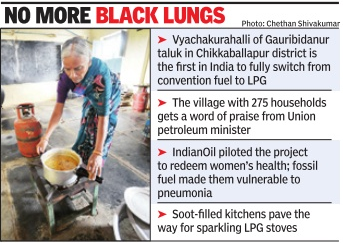
Lakshmidevamma in her clean kitchen in Vyachakurahalli village, Chikkaballapur district, Karnataka, on Thursday.
Gauribidanur (Chikkaballapur District) :
Until last month, Thimmakka had to blow her lungs out even to make a cup of coffee. And this has been her ritual for 40 years now . Not any more. Her kitchen is now fitted with an LPG stove. Like 274 other households in Vyachakurahalli of Gauribidanur taluk in Chikkaballapur district.
Cooking with firewood is passe in Vyachakurahalli since all households here have LPG. The Union petroleum ministry has officially declared it as India’s first smokeless village, owing to its conversion from conventional fuel to LPG. “My compliments to the residents of Vyachakurahalli which has been declared as the first smokeless village in India,” tweeted petroleum minister Dharmendra Pradhan.
Indian Oil Corporation (IOC) piloted the ‘Mission Smokeless village’ project here, about 77km from Bengaluru. “The idea was to redeem women’s health,” said Moti Sayi Vasudevan, general manager (smokeless villages) at IOC. “Due to the continuous inhalation of particles, women are more prone to pneumonia due to usage of firewood as a fuel.”
For over four decades, firewood had been the only fuel for the most of the village’s women. Wracked by bouts of cough caused by the soot-filled air in the blackened kitchens, cooking was an ordeal for them.
But that was until last week. Now, the kitchens have got swanky steel gas stoves and red cylinders. While a separate plank has been built to accommodate the new gas stove in Lakshmidevamma’s kitchen, Saraswathamma is looking forward to cooking these days. “I would frequently have bouts of cough due to the continuous use of firewood,” she said. “This is the best thing that has happened to women in the village.”
In drought-hit Gauribidanur, this recognition for clean fuel comes as a huge relief. As Ratnamma put it: “No more black roofs and black lungs.”
Learning safe handling of LPG
Gita Jayender sits with a group of women in a small thatched roof kitchen, telling them how to operate an LPG stove, how it is important to switch off the regulator at the end of the day, how not to leave utensils on the stove and go away, among other things. Shrenik Enterprises on Railway Station Road is buzzing with activity as entire families walk in to purchase new LPG stoves. “We had to first conduct an awareness campaign for villagers to tell them why it is important to go smokeless. Drought is staring at them. Why LPG, they asked,” said Shrenik R J, who is spearheading the smokeless movement in the village. The next project will be taken up at Gandhian Dr H Narasimhaiah’s birthplace, Hosur, in Chikkaballapur district, he said.
source: http://www.timesofindia.indiatimes.com / The Times of India / News Home> City> Bengaluru / by Seetha Lakshmi, TNN / December 04th, 2015
She had been engaged to pilot Rajiv Hoskote who perished in a Pawan Hans chopper crash in Arunachal Pradesh 3 months ago and cremated in city on Aug.14
Mysuru :
Nischitha Ramakrishna,who was engaged to marry city based pilot Rajiv Hoskote, who perished in a Pawan Hans Chopper crash in Arunachal Pradesh on Aug.4, 2015, passed away at a private hospital in city following brief illness.
It may be recalled that Rajiv Hoskote, a resident of Ramanuja Road was engaged to marry the Delhi-based techie Nischitha, daughter of Ramakrishna, a resident of Srirangapatna in Mandya district and the reception of their wedding had been slated for Oct.4 in Mysuru.
Pilot Manjunath, a friend of Rajiv told Star of Mysore that Nischitha, who could not bear the loss of Rajiv had slipped into depression for which she had been treated at several hospital but in vain.
Manjunath also said that Nischitha’s last rites were performed at Srirangapatna yesterday.
source: http://www.starofmysore.com / Star of Mysore / Home> General News / November 29th, 2015
The centuries old Kayani at Hinka village which is being renovated by the Yuva Brigade and the villagers.
Mysuru :
Villagers of Hinkal on Hunsur road in the city have pledged to save the centuries old Kalyani (water pond), a portion of which was about to become the property of someone else due to the negligence of MUDA authorities.
The historical Nanneshwara Temple of the village originally had an area of 42 acres, out of which only about 3 acres is now remaining with the temple. The MUDA after acquiring a portion of this land, sanctioned it to an educational institution. The land sanctioned by MUDA included centuries old Kalyani (water pond) measuring 100ft x 100ft.
The Kalyani had shrunk to a large extent as time went by, with mud and shrubs covering more than half of the pond, posing a threat to the very existence of the Kalyani. The villagers drew the attention of the people representatives about the status of the pond. But the people’s representatives including the MLA, MP and other local leaders did not pay much attention to saving the Kalyani then.
The Yuva Brigade along with Hinkal villagers taking keen interest in saving the pond, visited almost every household in the village seeking co-operation.
A few days later, the villagers led by Yuva Brigade leader Lohit Urs, started a voluntary Shramadan to save the pond.
MP Pratap Simha who came to know of the villagers resolve to save the pond, visited the spot and summoned MUDA officials, who later took up works on cleaning the pond of weeds, mud and filth by deploying excavating machines.
But the MUDA which began renovation works with great enthusiasm a few days ago, stopped the works all of a sudden yesterday, which angered Hinkal residents.
Strongly condemning the MUDA’s action of abruptly stopping the renovation works, thousands of Hinkal residents staged a demonstration at the site yesterday.
MUDA member Rakesh Papanna, who hails from Hinkal, held talks with MUDA officials and asked them to resume renovation works immediately, it is learnt.
MUDA Commissioner Dr. N. Mahesh reacting to the protest, admitted that the CA site allotted to the education institution included a portion of the Kalyani and added that the confusion arose as the Kalyani’ appeared to be a small water pond.
Meanwhile, MUDA Chairman K.R. Mohan Kumar speaking to SOM said that “As soon as we came to know of the existence of the Kalyani, we cancelled the allotment of sites around the pond and took possession of the Kalyani. The MUDA sent a JCB to excavate the pond for development and added that measures are taken to develop the Kalyani.
source: http://www.starofmysore.com / Star of Mysore / Home> General News / November 29th, 2015
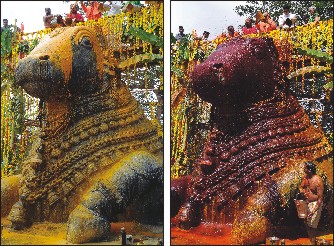
The more than 360-year-old monolith of Nandi, located mid-way on Mysuru-Chamundi Hill Road, was today, bathed in more than 30 items like milk, honey, curds, kumkum, ghee, dry fruits, tender coconut, sandal, turmeric, rice flour, etc., as devotees performed ‘Mahabhishekha’ to it.
It may be recalled that the event is being jointly organised annually by the members of ‘Bettada Balaga’ (a group of regular morning walkers to the hill) and ‘Srikshethra Chamundi Bettada Sri Nandiya Puja Mahotsava Samiti’ since 2006.
Legend has it that performing the ritual on third Sunday of Kartikamasa of the Hindu calendar enhances the life of the stone statue. It is also said that the practice of performing Mahasbhishekha to the monolith existed during the reigns of Wadiyars.
Prior to the Mahabhishekha, the statue was cleaned with water before a group of over a dozen priests conducted the abhishekha, which was witnessed by thousands of devotees and tourists.
The ritual, which began at around 10.30 am with Suttur Seer Sri Shivaratri Deshikendra Swamiji performing the ‘abhishekha’ in the presence of Pramoda Devi Wadiyar, Yaduveer Krishnadatta Chamaraja Wadiyar, Datta Vijayananda Swamiji, Junior Pontiff of Ganapathy Ashram, Chidananda Swamiji of Hosamutt, Jamanagiri Swamiji, Vyaghramukharudrapada Cave in Nandi premises and others, continued for more than four hours.
Interestingly, both Pramoda Devi and Yaduveer also performed abhishekhas.
It is said that this is the 10th Mahabhishekha being performed by the ‘Bettada Balaga’ which spends more than Rs. 2 lakh for the ‘Mahabhishekha’ annually.
Organisers had arranged lunch for more than 5,000 devotees and visitors while the employees of JSS Hospital have organised a Deepotsava at the Nandi premises on Nov.30 at 6.30 pm.
Samiti Convenor S. Shivakumar, Balaga President S. Prakashan, Working President N. Govinda, Secretary H.S. Jagannath, Treasurer V.N. Sundhar were among those present.
Scenes of foreign tourists and locals clicking pictures of the celebrations on their mobile phones and cameras were common at the venue which had been provided tight security with vehicular traffic being restricted.
source: http://www.starofmysore.com / Star of Mysore / Home> General News / November 29th, 2015
Jyoti Hegde, India’s only woman rudraveena artist, talks to Sowjanya Peddi about conquering the unconventional rudraveena and storming a male bastion
On a quiet farm away from the glitz of the urban art world, in a village near Sirsi about 125 km from Dharwad in Northern Karnataka, lives a young woman with her husband. Her name is Jyoti Hegde and she might not be splashed on newspapers but she is the first woman performing artist of the rudraveena in India. Rudraveena is a world heritage instrument, protected and promoted by the UNESCO. Jyoti follows the Khandarbani school of Dhrupad and her guru is the illustrious Ustad Asad Ali Khan.
Jyoti Hegde with Ustad Asad Ali Khan. Photo: Special Arrangement
In the rustic peace and unpretentious but generous hospitality of her home, she talks about her life and her views on Dhrupad and the rudraveena with Sowjanya Peddi. Here are the translated excerpts.
I was born in Dharwad, Karnataka, where my father was a range forest officer. I grew up in Belgaum and Sirsi. I liked dance and was particularly talented in drawing. I might have become a painter if a chance encounter with the rudraveena had not transformed my life. I was learning the sitar from my first guru Dr. Bindu Madhav Pathak and in a lec-dem one day, he played the rudraveena. The sound of the instrument haunted me. The gambhirta (sonorous resonant sound) of its tones was very different from the chanchalata (playfulness) of the sitar. I requested Pathakji to teach me, but he refused, saying it is not a woman’s domain. I persisted. I told my father about my wish. Initially, Pathakji refused my father too, but later he relented and said that “playing the rudraveena is not a woman’s forte but since she is so insistent, let us give her an old rudraveena that is lying at my house. Once she plays it for a while, she will give up the idea of her own accord”. This was like a secret pact between my father and him, unknown to me. But when Pathakji saw my commitment and determination, he eventually advised my father to get me a new rudraveena, at the age of 16, which I continue to play even today. I would go to Pathakji’s house by 7 a.m so that he could set me an exercise for the day.
He would return at 5.30 p.m. The entire day I would practise the single phrase he had taught me that morningI was so focussed that he once said I had gained the expertise of 10 years within a year. Within a year I won the first prize for rudraveena in the Akhil Bharatiya Akashvani Sangeeth Spardha in 1981-82. I was also enrolled as a regular artist at All India Radio. I also won the first prize in the Karnataka Youth Festival for three consecutive years from 1981 to 1983.
My gurus chronicle my journey from Khayal to Dhrupad. I learnt from Pathakji in the Khayal tradition. He used to compliment me, saying “she knows how to get knowledge from me”. Now after many years of teaching, I understand this was the biggest compliment. An early review commented that “the artist did not spare enough time for bandish rendition with sat sangat (jointly) on pakhawaj”. I felt the most prominent attribute of the rudraveena is its capability for nadopasana through alap. Playing with the accompanist is less important. I understood then that this instrument is not best supported by the Khayal. I discovered a book on Dhrupad by Thomas Marcotti titled The Way-Music: How to conjure with sounds? The book had a 90-minute music cassette attached to it. I was transfixed by the depth and richness of the notes and its emphasis on slow measured movement. I was drawn to Dhrupad from then on. Whenever an artist performs in the Dhrupad ang, whether sitar, surbahar or rudraveena, it will entail more emphasis on alap than on bandish.
I studied with Pt. Indudhar Nirodi for three years, who gave me a deeper understanding of Dhrupad through vocal training and taught me the subtleties of Dhrupad. After he left Dharwad, I approached Ustad Asad Ali Khan where I learnt for five years.
Rudraveena is known as the king of instruments. All string instruments are shaped after it. According to Hindu mythology, Shiva is said to have taken inspiration from Parvati’s form and created this instrument. Shiva was the first to play this instrument and he taught it to Parvati who in turn taught it to Saraswati. It was restricted initially to the dev loka and was used for aradhana (devotion) alone. Later, Narad learnt it from Saraswati and brought it down to earth. In earlier times, it was used as accompaniment for veda mantra pathan (vedic recital) and with the yaga yagna (vedic rituals) of the rishi munis (sages). It held a place of reverence equivalent to that of the shank (conch) or jagate (circular plate/gong used in temples) that produce sounds during worship rituals but are not specifically used for producing music. It was treated with the same sanctity accorded to the sacred idol. Only select people were allowed to touch it and that only after purifying themselves.
Rudraveena is considered a measure to weigh the principles and grammar of the Dhrupad style of music. As Dhrupad evolved out of Sama veda chanting, the rudraveena also came to be considered the instrument to accompany Dhrupad. The shift must have been sharp and swift, as the music left temples and entered the Mughal courts. This brought a change in lyrics, tempo and style of playing. Dhrupad lyrics were chiefly based on the varnanas (description) of deities following the earlier devotional context. In the new context, more preference was given to prakriti varnana (nature description), shringar ras (romantic feelings) and songs praising the emperor/royalty. Both the rudraveena and Dhrupad rose to popularity from the 8th to the 15th and 16th centuries. This is the golden period for rudraveena, which produced artists such as Swami Haridas, Miya Tansen, Baiju Bawra, Gopal Nayak, Nayak Bakshu and Nayak Charju among others.
In Akbar’s times the instrument was very popular and prevalent. The rise of Khayal can be seen as a development of the above context. With Khayal, the sitar emerged as a more apt accompanying instrument its playful and rapid explorations. The rudraveena receded from the scene.
The rudraveena is a large and heavy instrument. Its strings are thick and plucking them requires strength. In addition, the original posture requires keeping the instrument on the body, which means carrying 3.5 kg to 5 kg for two or three hours in one sitting. Also, the sacred context of the instrument conventionally permitted only select classes of men to play or even touch it. It was a superstition that if women played it they will not be able to conceive children. One reason could be that the Vajrasan posture might have been considered harmful for the uterus. When my mother heard this she asked me to stop playing, but I was already so much in love with it that I could not think of leaving it. Eventually I got married and conceived a son. But some controversies persist. I could not play in the Vajrasan posture during my pregnancy and adopted the Sukhasan posture. After delivery, I continue to play in Sukhasan. I don’t believe earlier restrictions on women are valid in present times. The measure of what is sacred and pure is redefined in every era. We should interpret cultural norms and injunctions as indicative of demanding inner purity from the artist.
We live a quiet life on our farm. I get much support from my husband, son and daughter- in-law who help me with modern technology to take my art forward. I relish the peace and rhythm of farm life; it brings depth and anubhav (experience) to my music.
Dhrupad is the foundation for Hindustani classical music. Unless young people take it up, it will be lost to us. The rudraveena is also disappearing because no new generation is passionate enough to learn this demanding skill. They find it difficult to support themselves [financially]…. they look for quick fame. But the foundation of our newness should be based on our own culture. If we just rush into modernity that is not our own, it will be meaningless.
The instrument
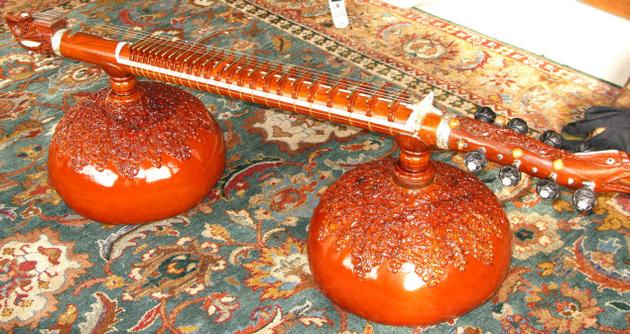
The rudraveena cannot be bought off the shelf. Its making is unique, as it is connected to the player’s body. For instance, its length should be 11 times the hand span of the player. The tuning can be completed only after it is placed on the body. The playing is connected to the player’s breathing rhythm. Traditionally, it was played only in the vajrasan pose.
One tumba (gourd) is kept on the right thigh and one on the shoulder, the right hand plucks the strings going over the right tumba and the left holds the strings with the left ear touching the left tumba. Khanji used to associate this posture with the sacred Swastika.
The instrument’s centre falls between the navel and the heart. The vibrations circulate in our inner body with the sound of ‘om’ entering the left ear from the left tumba. The right tumba’s vibrations go through the lower body through the right thigh. These vibrations produce inner well-being and tune us to the universal nada (sound). The instrument is itself a tool of pranayam and yoga. For those who have not mastered breathing, it is a difficult instrument to learn.
source: http://www.thehindu.com / The Hindu / Home> Features> Friday Review> Music / Sowjanya Peddi / November 26th, 2015
• Dr. Vyjayanthimala Bali to deliver convocation address
• Hon. Doctorates to be conferred on Prof. Ra. Visweswaran, Pt. Indudhar Nirodi and Natyacharya C. Radhakrishna
Dr. Vyjayanthimala, Prof. Ra. Visweswaran, Pt. Indudhar Nirodi and C. Radhakrishna.
Mysuru :
The First Annual Convocation of Karnataka State Dr. Gangubai Hangal Music and Performing Arts University, Mysuru, will be held on Nov. 30 at the Crawford Hall of Mysore University here from 4 pm.
Governor Vajubhai R. Vala, who is also the Chancellor of Universities, will preside over the event. Minister for Higher Education T.B. Jayachandra, who is also the Pro-Chancellor of the Universities, will grace the occasion.
Actress and Bharatanatyam exponent Padma Shri Dr. Vyjayanthimala Bali will deliver the Convocation address.
The Music Varsity, as part of its first Convocation, will confer Hon. Doctorates on renowned Veena artiste Prof. Ra. Visweswaran, Hindustani vocalist Pt. Indudhar Nirodi and Bharatanatyam artiste C. Radhakrishna.
Music University Vice-Chancellor Dr. Sarvamangala Shankar, Registrar Dr. A. Rangaswamy and Registrar (Evaluation) Dr. M.S. Shekar will be present on the occasion.
source: http://www.starofmysore.com / Star of Mysore / Home> General News / Thursday – November 26th, 2015
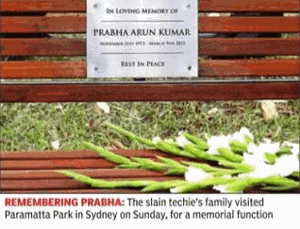
About 9,000 km away, Bengalurean Arun Kumar helplessly heard his wife Prabha, 41, crying for help on the phone when she was being stabbed inside the Paramatta Park, Sydney , on March 7.
Eight months on, Arun, his 11-year-old daughter Meghana and in-laws visited the park on Sunday as the pathway was named after the 41-year-old techie who was killed when she was walking through it. It was an emotional moment for the family of the Bengalu ru techie to witness the nction where memorial function where plaque was unveiled in the memory of Prabha. The New South Wales (NSW) government had made arrangements to fly Prabha’s family members to attend the ceremony . “This shouldn’t happen to anyone else and it shouldn’t have happened to my wife either,” said Arun Kumar, in his address to the media.
Prabha would have turned 42 on Saturday. The pathway links Argyle Street and Amos Street. Prabha’s killer is still at large. Arun Kumar made an appeal to people to come forward and share information with the investigating authorities.”She was very caring; she sa crificed many things, especially by staying away from family , for us. But we are happy that she will be remembered here,” he added.
When asked how their daughter was coping with loss, Arun said: “She is moody but we are taking care of her.”
The investigation into the case has not yielded any result so far. NSW police have not been able to ascertain the motive behind the murder. According to them, the case is open and all angles are still being probed.
“We are happy that the lane way has been named after Prabha and a plaque has been installed at the site where she was senselessly murdered, but our community is disappointed that culprit(s) have not yet been found. We urge NSW police to put every effort in finding out the perpetrators and bringing them to justice. Our true tribute to Prabha will only be fulfilled when perpetrators are arrested and charged,” said Dr Yadu Singh President, Federation of Indian Associations of NSW.
source: http://www.timesofindia.indiatimes.com / The Times of India / News Home> City> Bengaluru / TNN / November 24th, 2015
Writer Rohini Mohan’s ‘The Seasons of Trouble’ has won the Shakti Bhatt First Book Prize 2015. “The shortlist this year was diverse and spectacular, but we unanimously agreed to award the prize to Rohini Mohan,” said judge Samhita Arni, who, along with authors Mohammed Hanif and Krys Lee, chose the winner.
The award will be presented in New Delhi on December 22. The Shakti Bhatt First Book Prize carries a cash award of `2 lakh and a trophy. It is funded by the Shakti Bhatt Foundation and Apeejay Trust. ‘The Seasons of Trouble’ focuses on the Sri Lankan conflict.
Arni said, “Mohan’s book is the stark, brutal, often unsparing portrait of three desperate lives, struggling to navigate the realities and brutalities of war and peacetime in Sri Lanka.”
source: http://www.newindianexpress.com / The New Indian Express / Home> Cities> Bengaluru / by Express News Service / November 25th, 2015