Category Archives: Records, All

City Rly. Station gets automated ticket vending machines

TicketAtmsBF27oct2015

Mysuru :

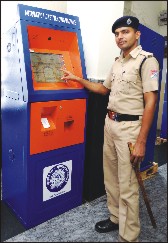
Now passengers will not have to stand in long queues for the tickets at the City Railway Station. The South Western Railway (SWR), in an effort to ease ticket purchase, launched the Automatic Ticket Vending Machines (ATVMs) at the Railway Station this morning.

The machines were commissioned by SWR DRM Rajkumar Lal at the entrance of Railway Station in the presence of SWR Senior Divisional Commercial Manager Anil Kumar.

The AVTMs, which are introduced for the first time in Karnataka, works on smart card which is made available at the ticket booking counters. A total of five machines are installed at the City Railway Station. While three machines are installed at the main entrance, the other two are installed at the back entrance (CFTRI gate). Passengers can top-up the smart cards in multiple of Rs. 50 to a maximum of Rs. 5,000. Initially, passengers have to pay Rs. 70 (Rs. 50 towards security deposit and Rs. 20 towards ticket value).

Passengers can purchase unreserved and platform tickets and also renew season tickets through smart cards.

Smart cards come with a one year warranty after which it can be renewed. The security deposit is refundable after deducting Rs. 10 in case a passenger decides to return the smart card.

The operation of ATVM facility is similar to that of Bank ATMs and for the benefit of the public the display is made available in Kannada, Hindi and English languages.

This apart, the much awaited e-toilet, battery operated vehicles for senior citizens and electrically operated laundry facilities will be launched on Nov.3, according to the South Western Railway authorities.

source: http://www.starofmysore.com / Star of Mysore / Home> General News / Tuesday ,October 27th, 2015

Kittur Chennamma’s victory over British celebrated

The 192nd anniversary of the victory of Kittur queen Chennamma against the British was celebrated in a simple manner in view of farm suicides and drought, here on Friday.

The programme was organised by Veerashaiva Sanghatana Samiti. Gurusiddha Rajayogindra Swami of Moorusavir Mutt and others garlanded a statue of Rani Chennamma.

Recalling the fight of the queen against the British, the swami said that the courage and valour of Rani Chennamma should motivate us to face any odds in our life and called on farmers not to lose hope. President of the samiti, Viranna Kallur, Channabasappa Dharawadshettra, C.H. Gobbi, and P.M. Hooli were present.

In a programme held by the Basava Parisara Samrakshana Samiti, tributes were paid to the Kittur queen. Releasing pamphlets against the use of crackers during the forthcoming Deepavali festival, president of Karnatak Chamber of Commerce and Industry, Ramesh Patil, said that the State government should take steps to celebrate the occasion annually.

President of Basava Parisara Samrakshana Samiti S.V. Pattanashetti, and secretary Suresh D. Horakeri were present.

Meanwhile, in a programme related to Dasara celebrations by Moorusavir Mutt, Gurusiddha Rajayogindra Swami and the former Chief Minister Jagadish Shettar gave away compensation cheques to the family members of six farmers who committed suicide in Hubballi taluk.

The mutt had decided to celebrate Dasara in a simple manner this year in the wake of farmers’ suicides and utilise the amount saved by cancelling the grand procession to give compensation to the farmers’ families.

source: http://www.thehindu.com / The Hindu / Home> National> Karnataka / by Special Correspondent / Hubballi – October 24th, 2015

Isro receives 1st astronomer’s telegram

Bengaluru  :

The first astroronomer’s telegram (Atel no. 8185) from the Scanning Sky Monitor (SSM) observations on-board Astrosat – India’s first astronomy satellite – has been received by Isro.

The SSM was pointed to “GRS 1915+105”, an X-ray binary star system which features a regular star and a black hole, and caught it exhibiting the ‘beta’ class of variability on October 14, one of the many types of variability this source exhibits, some of which are associated with its spectral states.

“On October 15, the Soft X-ray Telescope (SXT) door was opened successfully and it will observe the sky after 10 days,” Isro has said.
Earlier in the month on October 9, Astrosat spotted the Crab Nebula using the Cadmium Zinc Telluride Imager (CZTI) instrument. The Crab Nebula is the brightest hard X-ray source in the sky.

Isro officials described the sighting of the Crab as significant and said that this furthers Isro’s chances of other celestial X-ray sources, aiding researchers. Astrosat has also spotted and viewed Cygnus X-1, a black hole source and now, the High voltage of Near UV, Visible channel and Far UV channel of the UV Imaging telescope (UVIT) has been switched on and detectors have been tested with low gain and found satisfactory and put back in off condition.

source: http://www.timesofindia.indiatimes.com / The Times of India / News Home> City> Bengaluru / by Chethan Kumar, TNN / October 21st, 2015

Hubballi youngster gets patent for three products

Hubballi  :

When Anup Vijapur, 26, was in his final year of mechanical engineering studies, he received three job offers. However, hepatitis affected his progress. He had to attend the examination, carrying a glucose bottle. He failed in one subject, but fortunately cleared it after applying for revaluation.

When Anup failed in the exam, it was Nanopix CEO Sasisekar Krish who recruited him and encouraged him to develop his innovative ideas into products. Thus started Anup’s success story. He now heads the innovation department of Nanopix, a startup. Anup aimed at social entrepreneurship when he was in college. Now he is realizing his dreams, emerging as an innovator to simplify the lives of farmers.

Recently, the youngster got three patents for his innovation. These innovations pertain to grading of cashew nuts. While a normal grading machine can probably classify cashew nut into three qualities, Anup three patents are more than a notch better. With his technology of installation of camera, pick and place mechanism for irregular object and conveyor and grading machine, one can classify cashew nuts into seven categories.

Though Anup pursued BE (mechanical) at Proudhadeveraya Institute of Technology, Hospet, he is well versed in computers and technology. Speaking to TOI, Anup said that he got opportunity to materialize his ideas at Nanopix. He has special words of gratitude towards Krish. “We have already got three international patents for our products. If we get all applications approved, it will be a pride for our company and a tier-2 city like Hubballi,” he said.

There is more in store as his 28 applications are waiting for patent. Anup said that he developing a technology to read the face of drivers. “To prevent road accidents, we are developing a camera that can recognize facial expressions of drivers. If the driver is sleepy, it will warn him immediately. If the vehicle is connected with some networks, corporations or companies, it will alert their control room so that the backend can intervene and avoid possible accidents,” he said.

Pramod Tonapi, public relation officer at Nanopix, said that Anup’s innovation has given a boost to the startup. “He is very passionate about science and even teaches engineering students at a private study centre during his leisure time. His innovations are going to change the food processing industry in the coming days. Because of his innovation, we have been able to apply for patent for 28 more products,” he said.

source: http://www.timesofindia.indiatimes.com / Times of India / News Home> City> Hubballi / by Sangamesh Menasinakai, TNN / October 21st, 2015

Pages from History : Dasara through the ages

DasaraBF180ct2015

by Prof. A.V. Narasimha Murthy, former Head, Department of Ancient History and Archaeology, University of Mysore

Navaratri or Dasara is one of the most popular festivals in our country but it is celebrated in a variety of ways in different parts. Actually it is a festival symbolising the destruction of evil and establishment of good (dushta sikshana and shista rakshana). This festival has a hoary antiquity going back to the time of the puranas and epics. The word Dasara is derived from the Sanskrit Dashahara meaning ten days. Basically, Navaratri is a festival of Mother Goddess who received power from no less than Vishnu, Shiva and Agni. Each one of the Gods gave different powers to Her so that She could free the world from the tormentors of different types. Thus was born the indomitable energy personified in the form of Goddess and people heaved a sigh of relief. Navaratri means paying respects and showing gratitude to Mother Goddess.

As the demons had obtained various boons from Shiva or Vishnu, the Goddess had to assume different forms to achieve her goal. She is worshipped in the following nine forms namely, Mahakali, the destroyer of Madhu Kaitabha; Mahishamardhini, the destroyer of Mahishasura; Chamundi, the vanquisher of chanda-munda; Kali, the killer of Raktabija; Durga, the harbinger of destruction of Kamsa; Raktadantri, the great destroyer; Shakambari, the destroyer of famines; Durga, the destroyer of demon Durga; Bhramari, the killer of demon Aruna. Thus Devi assumed these forms to accomplish her task. In course of time, the worship of Saraswati and Lakshmi were also added.

Another significant aspect of this ritual is the exalted position of unmarried girls (kannikas) who are supposed to personify the great Goddess. These unmarried girls are worshipped as Kumari, Trimurti Kalyani, Rohini, Chandike, Sambhavi, Durga, Subhadra and Kali. Each one of them is worshipped during the nine days; they are fed and given gifts too.

It has been our unique tradition that these festivals are recommended to human beings only after they are tested by the Gods. The Gods themselves did this after vanquishing the demons. It is said that Sri Rama invoked the Goddess and achieved great victory over Ravana on the day of Vijayadashami. Thus even Sri Rama worshipped her before taking up a major fight. Even the great epic Mahabharata extols the greatness of this festival.

The Pandavas, who had hidden their weapons under the Shami tree (banni mara) worshipped the Goddess, took out the weapons and started their Digvijaya or Victory March and consequently achieved great success over the Kauravas. It has to be noted that in all these instances, the great Goddess is invoked and worshipped not for any personal gains but for the annihilation of the wicked people, upholding of dharma and to save the good people.

Thus when it was useful to the Gods, the human beings felt that it should be useful to themselves also and hence began celebrating Navaratri. No dobut, it was celebrated in the ancient period but it has not been recorded either in literature or in inscriptions till we come to the medieval period. It was believed that Samudragupta, Harsha, Vikramaditya VI, Ballala II, Singhana and a host of others started their Digvijaya on the Vijayadashami Day.

However, with the dawn of Vijayanagar period, historical records are available in plenty. Particularly, the writings of the foreign travelers who stayed for a short period in Vijayanagar empire have given graphic description of the various rituals and durbar during this period. The earliest reference to Dasara festival during the Vijayanagar period is seen at the time of King Devaraya II (1424-1446). Abdul Razzak, a Persian traveler, who was invited as a guest for Dasara, was greatly impressed by the festival and has given a long description. The infidels of this country who are endowed with great power are fond of displaying their pomp and glory. Navaratri was celebrated at Mahanavami platform (dibba) in Hampi. All the subordinate kings assembled here and made gifts to the emperor. Elephants played an important role besides horses. There were many pavilions and some of them revolved around. The King sat on the gold throne kept on the ninth storey. Acrobatics displayed were of high order and people enjoyed it. The King gave prizes to the participants who included men and women. The last three days, namely Durgashtami, Mahanavami and Vijayadashami were spectacular. Krishnadevaraya’s Dasara was held from morning till night and thousands of lamps were lit during the night. Wrestling was a great attraction. Fire works were of high order.

On the Vijayadashami Day, the King held a review of the forces. Another traveler by name Nuinz has also given a similar description, besides Barbara, Nikitin and others. From all these features, it becomes clear that Vijayanagar Kings laid the firm foundation for the pompous but religious celebration of Dasara.

The Wadiyars of Mysore can easily be regarded as the cultural successors of Vijayanagar empire. They improved upon the Dasara of Vijayanagar period to suit their own needs and requirements in such a manner that it became more pompous and dazzling than Vijayanagar Dasara. In fact, Dasara has become synonymous with Mysore Wadiyars.

The earliest reference to Wadiyar Dasara is found during the period of Raja Wadiyar, who ruled from 1578 to 1617. Not only did he celebrate it at Srirangapatna but codified the rules and regulations for its celebrations. Though his son Narasaraja died a day earlier (7.9.1610) to Dasara, he celebrated the Mahanavami festival and further ordained that the death of a close relative of the royal household should not become a cause to stop or postpone Dasara. Dasara of this period was celebrated in three stages: The first one was the celebration of first eight days; the second is the Mahanavami festival and the third is the Vijayadashami. This has become more or less standardised from the period of Raja Wadiyar. He took up diksha by wearing a separate dress and kankana and worship of the Navagrahas, worshipped the throne and ascended it. The relatives, brahmanas and officials paid respects to the King. On the moola nakshatra day, Saraswathi Puja was performed. The Mahanavami Day was reserved for the worship of Royal Sword (Pattada Katti). Then the homa at Chamundi Hill concluded with poornahuti. In the evening, the durbar took place. On the Vijayadashami Day, he sent the weapons to the Banni tree with royal honour. In the evening he went in a procession to that place, worshipped the Banni tree and returned in the night with lights.

During the period of Kanteerava Narasaraja Wadiyar, the festival was celebrated with traditional grandeur. Special worship was offered to the images of Ranganatha and Narasimha. During the durbar, the chiefs, feudatories and others would pay respects. The tenth day was reserved for public procession of the King to conduct Sami puja.

Krishnaraja Wadiyar III (Mummadi) performed Dasara in the traditional manner. Queen Mother Lakshmammanni also worshipped the throne and blessed the King. The Maharaja used to come from the Palace in Nazarbad and return after the function. British Durbar was an added attraction. One particular day was specially reserved for them from 1814.

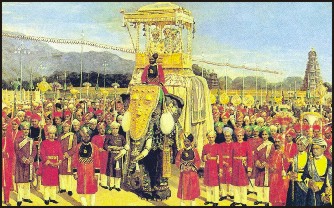
In the meantime, the present Palace was completed in 1912 and it became the venue of Dasara durbar. Krishnaraja Wadiyar IV (1895-1940), who won the admiration from Mahatma Gandhi and generally referred to as Rajarishi, conducted Dasara in a pompous and meaningful manner. On the very first day of Dasara, he worshipped Goddess Chamundeshwari on the hillock. The evening durbar was meant for officers and invitees. They had to come in a special dress of white trousers, black long coat, uttariya and a laced turban to be in the durbar. All the invitees were garlanded according to their status. On the ninth day, he performed Ayudha Puja which included worship of Lakshmi, Royal sword, royal horse, royal elephant, royal chariot etc. On Vijayadashami Day the Maharaja used to go to Bannimantap sitting on a howdah mounted on an elephant. Maharaja, Yuvaraja Kanteerava Narasaraja and Jayachamaraja Wadiyar were seated in the howdah. The same procedure was followed during the rule of Jayachamaraja Wadiyar. As Ashoka road was too narrow, the procession passed through Sayyaji Rao road and the whole route was illuminated. This type of Dasara was held till 1969.

In the year 1970, Dasara was not held publicly. The Karnataka Government decided to hold Dasara as Nada Habba or the festival of the people. However, religious ceremonies were performed in private at the Palace. Cultural events, poets meet, cultural and industrial exhibition were conducted. On Vijayadashami Day, an idol of Goddess Chamundeshwari in the golden howdah was taken in procession. At Bannimantap, the Governor took the salute at the torch-light parade. Thus Dasara or Navaratri became a cultural event and a festival of the people and not of the royalty. This festival not only reminds us of our past glory but is a symbol of our unity and strength to move towards our democratic goal. Whatever may be its form, we pray to Goddess Chamundeshwari to shower her blessings on all of us for a better tomorrow.

source: http://www.starofmysore.com / Star of Mysore / Home> Feature Articles / October 17th, 2015
Belagavi based lyrics writer’s song in ‘Bajirao Mastani’ enters into Guinness Records

Belagavi :

Prashant Ingole, Belagavi based lyrics writer is now shining in Bollywood. His recent song, written for still unreleased film ‘Bajirao Mastani’ is entered into Guinness Book of Records.

Ingole has written four songs for Sanjay Leela Bhansali’s film ‘Bajirao Mastani’ in which ‘Gajanana..’ is making buzz. The launch of film’s first track was done in record breaking fashion at Pune last month, by creating biggest human formation of Lord Ganesha. More than 5,000 students from across India created 194 foot versions of Ganesha at the time.

Ingole said song has entered into Guinness Book of Records because it has been sung by Sukhavindar Singh along with the chorus of 15,000 students. “In the song of 3.37 minutes, I have used 17 names of Lord Ganesha. Initially, Bhansali asked me to write a song on Ganesha. Being a devotee of Ganesha, I planned to make it differently which he liked immensely. Now the song is making big sound before release of film”, Ingole said.

Born in Belagavi, Prashant Ingole studied at Bhatkkhande School here till SSLC. Although he started lyrics writing for Hindi movies since 2001, his struggle for eight years to get recognized. He got first break in 2008 for writing a song for the film Paisa Hai Power. His first hit came in 2012 through the song ‘Party On My Mind’ in Race-2. Song became hit with 26 million hits. Later in 2014, he got opportunity to write four songs for hit film Merry Kom. So far, overall 13 movies to his credit.

source: http://www.timesofindia.indiatimes.com / The Times of India / News Home> City> Hubballi / byu Ravindra Uppar, TNN / October 06th, 2015

‘Mysore Memories’ : Mysore in the 1920S

by Girija Madhavan

Mysuru has a tradition of holding concerts for festive occasions like Ramanavami and Vinayaka Chathurthi. Lovers of music eagerly look forward to these events. The concerts held at 8th Cross in Vani Vilasa Mohalla have been going on for decades. Even earlier there were recitals in Bidaram Krishnappa Prasanna Sri Rama Mandira in the heart of the city. A temple as well as a venue for “kacheris,” it is the confluence of two streams of art. As music swirls around the room, the walls display precious paintings in elaborately carved frames. Some of them are in the Mysore tradition of art, depicting themes like Durga’s victory or Rama’s coronation. Some are adorned with gold leaf and some are in the style of Raja Ravi Varma.

MysorePaintingBF12oct2015

In a folder of sketches by my mother, Mukta Venkatesh, I found two water-colours. The first depicts a Karnatak concert (kacheri) with the musicians seated on a striped durrie. The small picture hanging above the door is the ‘Ala-ele Krishna’ (the infant Krishna on a peepul leaf), a theme favoured by both Tanjore and Mysore style artists. The paintings of Goddesses Lakshmi and Saraswati in traditional style flank a larger picture of Rama Pattabhisheka. Mukta depicts herself and two sisters in the audience. This is a sketch of Bidaram Krishnappa Prasanna Sitarama Mandira, a personal portrayal of a heritage landmark of Mysuru.

The second picture is set in Lakshmipuram of those days. The architecture is drawn with care. The people on the street belong to different classes of society. The vendor woman, accompanied by her small child, is dressed in a crumpled cotton sari, the head covered with the end of the sari or “seragu.” In contrast, the ladies in silk saris worn in the “kachche” style (perhaps of Madhwa origin), flowers adorning their hair, have returned from a puja, holding coconuts and betel leaves in their hands.

Just beyond these figures is a mendicant with a white beard. A toddler rides on his shoulders. This poor man and his child “Vasuki” occasionally visited my mother, had a meal and left with a present of money, clothes or toys. She was attached to Vasuki and was distressed when the visits suddenly stopped. Perhaps that is why she painted them as pale, ghostly figures.

In the Tonga, a dignified, Muslim gentleman travels to his appointment. Another older man in a three-piece suit wearing a Mysore Peta is walking down the pavement. A young man lounges against the wall. This picture was a microcosm of life in suburbia.

Old photographs capture past reality in their sepia tints. But drawings like these can be even more evocative, bringing up a flavour of a bygone time through the eyes of a person who lived then and translated these perceptions into art.

source: http://www.starofmysore.com / Star of Mysore / Home> Feature Articles / Monday – October 12th, 2015

BAI confers “Builder of the Year” and “Project of the Year” Awards

City-based builder P. Nithyanand (left), who was conferred ‘Project of the Year’ award and A.S. Yoganarasimha of Sharp Engineers, who received ‘Builder of the Year’ award during the Builders Day-2015 function organised by Builders Association of India (BAI), Mysuru Centre, at Kalamandira last evening, are seen with (standing from left) BAI Mysuru Centre Chairman M.S. Ramprasad, Builders’ Day Convenor M.S. Nandakumar, Industrialist Dr. M. Jagannath Shenoy, BAI State Chairman A.R. Ravindra Bhat and BAI Mysuru Centre Hon. Secretary J.V.R. Naidhruva. Picture right shows noted dancers Nirupama-Rajendra and troupe of Abhinava Dance Company, Bengaluru, presenting a scintillating cultural programme ‘Rang’ on the occasion.

Mysuru :

Marking the Builders Day-2015, the Builders Association of India (BAI), Mysuru Centre, conferred ‘Builder of the Year’ award to city builder A.S. Yoganarasimha, proprietor of Sharp Engineers and ‘Project of the Year’ award to builder and promoter P. Nithyananda of Nithyotsava Convention Hall, at a function held at Kalamandira in city last evening.

Speaking after receiving the award, builder Yoganarasimha said that he was ever grateful to his parents for always supporting him in his endeavours.

Expressing his gratitude to his guru and city’s well-known architect M.S. Vijayashankar for guiding him on discipline, commitment and honesty, Yoganarasimha recalled the support extended by BAI Mysuru Centre to the staff of his company over the years.

Industrialist Dr. M. Jagannath Shenoy, BAI State Chairman A.R. Ravindra Bhat, Mysuru Centre Chairman M.S. Ramprasad, Hon. Secretary J.V.R. Naidhruva, Event Convenor M.S. Nandakumar and others were present at the programme which also marked the inauguration of year-long Platinum Jubilee celebrations of BAI.

The programme was followed by a cultural event titled ‘Rang’, celebrating colour, culture and creativity, an enchanting evening of dance by Nirupama and Rajendra troupe of Abhinava Dance Company in Bengaluru. Endowed with brilliant talent and stage presence, appropriate expressions, timing and razor sharp precession in synchronisation, the couple’s performance was truly a connoisseur’s delight.

‘Rang’ took the audience into an enchanting world of Indian traditional and contemporary sequence, providing a spectacular view of creativity through exquisite thematic compositions, soulful music, period costumes combined with unique artistry.

source: http://www.starofmysore.com / Star of Mysore / Home> General News / Friday – October 09th, 2015

Bengaluru hospital introduces world’s fastest German built vitrectomy machine

Bengaluru :

A centre of ocular oncology installed with the world’s fastest German built vitrectomy machine, along with electroretinogram (ERG) and Pascal laser has been inaugurated today in a city eye hospital to provide a comprehensive treatment in the field of vitreoretinal and ocular oncology.

One of the first of its kind in Asia, ‘megaTRON S4 HPS’will ensure safer and faster vitreoretinal surgeries with its double cutter and integrated laser translating into better outcomes, say the doctors of Sankara Eye Hospital, where it has been introduced today.

“This allows 12000 cuts a minute. Pascal laser with yellow 577 nm is the only laser in the county that allows effective treatment of diabetics with minimal collateral damage. This allows 16 simaltaneous laser shots, enhancing patient’s safety and comfort,” said Dr P Mahesh Shanmugam, head of Vitreoretinal and Ocular Oncology Services, Shankar Hospital.

“megaTRON S4 HPS helps to easily recognize the steps for programming and calibrating the equipment and to decide the type of surgery to be made. Different users can be programmed with the pre established parameters, offering more agility in the proceedings in case the machine is used by different surgeons,” he added.

UT Khader, minister for health and family welfare, said: “I am delighted that the state-of-the-art excellence begins from our state and I am sure that a similar centre enabling such technologies will; soon come up across India.”

source: http://ww.timesofindia.indiatimes.com / The Times of India /News Home> City> Bengaluru / by Sreemoyee Chatterjee, TNN / Octobter 01st, 2015

Khadi as symbol of Swaraj

Thoughts from the Diary of a Gandhian

On the occasion of 147th birth anniversary of Mahatma Gandhi, here we publish an article titled ‘Khadi as Symbol of Swaraj: Thoughts from the Diary of a Gandhian’ by T. R. Dwarakanath of Srirampura 2nd Stage, Mysuru, highlighting how Khadi had shot to importance and was a means of livelihood in the run-up to freedom, from the diary notes of this correspondent’s father late T. K. Ramakrishna

T. R. Dwarakanath & Late T. K. Ramakrishna

by T. R. Dwarakanath

In the second and final article as a sequel to ‘Badanavalu Movement: A Nostalgic Perspective’ (SOM dated May 17, 2015), I wish to share with the esteemed readers some of the thoughts captured as diary notes in 1946 by my father late T. K. Ramakrishna, who was the Manager of Badanavalu Spinning Circle between 1957-61. The 70-year-old manuscript (see photo) throws light on the connotations attached to khadi as symbol of Swaraj that Gandhiji championed in the run up to freedom. It also gives a kaleidoscopic view of life and times in a world that was grappling with the fallout of the Second World War.

The central role of khadi in the lives of people just before independence is indeed noteworthy. To quote from Nehru’s An Autobiography (pp. 61, Allied Publications) “… (The British) Government had decided to crush the movement. Hand-spinning on the charaka was then spreading among the peasantry at the instance of the Congress. A charaka therefore became the symbol of sedition and its owner got into trouble, the charaka itself being often burnt….” It is commemorative and significant that we are revisiting sustainable means of livelihood through the Badanavalu movement spearheaded by Prasanna and other social activists. The English translation of the article follows:

Khadi for forty crore people: Late T. K. Ramakrishna Circa 1946

About forty crore people live in our motherland ‘Bharata Bhoomi.’ Many of them have been haunted by the question, “Is it possible to provide khadi for all the forty crore people of our country?” Despite the many mills in existence in the country, the textile production capacity does not fulfill the needs of our people and such being the situation, the obvious question in the mind of common man is whether mere hand-spinning and hand- weaving is able to cater to the demand. Further, it is natural to ask: What is khadi’s relevance and stature in the present world? What are its basic principles? We should examine these aspects in the right perspective one by one.

Before World War II, it was estimated that the quantity of cloth produced per person in the country was just about twenty yards and apart from domestic production, clothes worth sixty crore rupees were supplied from outside. How do we bridge the deficit by spinning charaka and weaving in handlooms and be self-reliant with it was food for thought. In the year 1940, prior to World War II, there were one crore handlooms in the country. As a consequence of the war, many mills stopped producing textiles for the common man for over five years. Indeed, clothes to fulfill needs of military personnel gained precedence and were produced abundantly.

Further, in the wartime years of 1940-42, the number of handlooms also reduced for the reason that the cost of clothes had escalated significantly and the supply of yarn coming out of mills decreased somewhat. Additionally, market conditions were exploited by unscrupulous businessmen to their advantage by hoarding yarn to create scarcity that had a cascading effect on the prices of essential clothes. People experienced immense difficulties without actually being aware of the ill effects of war.

The situation eased a bit with the intervention of the government. Over a few years later the number of handlooms gradually increased to about 1.5 crores, partially also due to decrease in industrial textile mills resulting in an overall increase in handwoven cloth. Even so its progress was diminished as it became difficult to source sufficient yarn. The prices of clothes continued to remain high. This made us think how to improve the helpless situation in the post-war years.

When Sabaramati Ashram was opened by Gandhiji in 1918, yarn was used to be bought locally and khadi clothes were produced in the ashram although the difficulty in getting yarn locally quite persisted due to invasion from vested interests. Knowing fully well of this circumstance the only option then was to get hanji (sliver) from the mills and spin yarn with charaka by hand. Realising the danger in excessive dependence on mill owners Gandhiji got even the hanji done in the ashram itself. As an offshoot of all these turn of events, the Akhila Bharata Charaka Sangha came into existence with its initial capital of forty lakhs.

Over the years, Akhila Bharata Charaka Sanghas provided employment opportunities to about 4.5 crore people in about fifty thousand villages across the country. Wages to the extent of seven crore rupees were distributed. There is not a single cooperative institution in the world that provided employment at such a scale. We need to encourage such institutions in India as our country is not as economically strong as England. We have to provide more employment with least capital investment. Unlike America, we are a country with large human capital and therefore our dependence on machines could be minimal. In the circumstances as ours, unemployment due to mechanisation of textile production is dangerous for it robs of an opportunity to keep people employed and help sustainable living with other essential things.

Our country’s total requirement of cloth is about 800 crore yards. It is not difficult for a weaver to weave 800 yards a year. This translates to a requirement of one crore handloom weavers to fulfill the country’s needs. Now we do have as much handlooms but there is still a need to increase them. Secondly, around 55 lakh bales of cotton is required to produce as much cloth. India’s production volume of cotton currently is about 60 lakh bales. Therefore, we are self-sufficient with respect to cotton production.

Let us examine how we are positioned in spinning. For the targeted quantity of cloth, about 3,200 crore spun yarn is required. At about two hours a hank to spin a total of 6,400 crore hours would be required in a year. That amounts to about 20 crore man hours a day. Therefore, theoretically it is just sufficient if everyone in the country commits to spin for half-an-hour. Assuming that out of the whole population of about 40 crores, there are 11 crore farmers and about five crore people are involved in other forms of employment. Farmers typically have no agricultural activity for about three months a year. Should they all be able to contribute to spinning at two hours per day, the nation already gets about 22 crore man hours of spinning effort.

Further, realistically assuming that of the remaining population, about half of them contribute to spinning at one hour per day we would end up having an additional effort of 12 crore man hours. Going by an extra margin to about 32 crore man hours a day instead of twenty crore, we are still comfortably placed with 44 crore man hours to produce the desired quantity of cloth and by doing so khadi can be supplied to whole of India. By spinning for about half-an-hour a day and making clothes ourselves, we would save at least Rs. 20 from what would have otherwise been expended.

During the pre-war period, China was importing cloth from Japan that has stopped now. Due to scarcity of cloth, China is following the Indian model. In fact, it is interesting to note that the Chinese have named their looms the Gandhi Loom. “Khadi is not a symbol of slavery but a symbol of Swaraj,” the truth that Gandhiji spelled should be understood well by people. In order to maintain peace and harmony in our country we must be self-sufficient in all respects. The present ad hoc government is moving in this direction. As an example, let us consider the Madras province khadi industry that has been setup in twenty five hoblis (village clusters) at a cost of three crores. In a year or two, most textile mills will be out of business or there’s a chance that people will themselves reject machine-produced cloth. This is what will lead to Village Republic as Gandhiji has propounded. Our government should achieve all these objectives in totality.

2nd October 1946 Bapu’s 78th Birthday

[T. R. Dwarakanath can be contacted on Mob: 9448363395]

source: http://www.starofmysore.com / Star of Mysore / Home> Feature Articles / Friday – October 02nd, 2015