Category Archives: Records, All

125-year-old school’s new building to be inaugurated today

It is the second oldest educational institution in Udupi

The new building of the Board High School, now known as the Government PU College, which is celebrating its 125th year celebrations this year, will be inaugurated here on Friday.

The Board High School, located on 3.2 acres in the heart of the city near the Service Bus Stand, was established in 1890. It is the second oldest school in Udupi. It was called the Board Middle School when it first started functioning.

It has produced many illustrious students including the former Union Minister late T.A. Pai, the former Union Minister Oscar Fernandes, the former Minister late V.S. Acharya, and veteran journalist late M.V. Kamath.

Mr. Oscar Fernandes’s father late Roque Fernandes was the headmaster of this school from 1940 to 1948.

The institution now has both Kannada and English mediums from class 8 to 10, while its PU wing has courses in Arts, Commerce and Science streams.

It presently has about 150 students in the high school section and about 400 students in the PU college.

The existing building of the Board School used to serve as Magistrate’s Court and a jail during the British times. It got converted into the Board School in 1890.

The auditorium of the school, known as ‘People’s Hall’, was constructed in the mid-1940s.

The Board Middle School was upgraded into a high school in 1918, and as a Multipurpose High School in 1955. The PU college section was started in 1972. The institution is popularly known as Board High School because the Taluk Board and District Board administered it for a long time.

Most of the students coming to this institution now are from economically weaker sections.

The new building of the Government PU College is built at a cost of Rs. 2.5 crore due to the efforts of Mr. Oscar Fernandes, Pramod Madhwaraj, MLA, and the former Minister late V.S. Acharya.

source: http://thehindu.com / The Hindu / Home> National>  Karnataka / by Ganesh Prabhu / Udupi – October 02nd, 2015
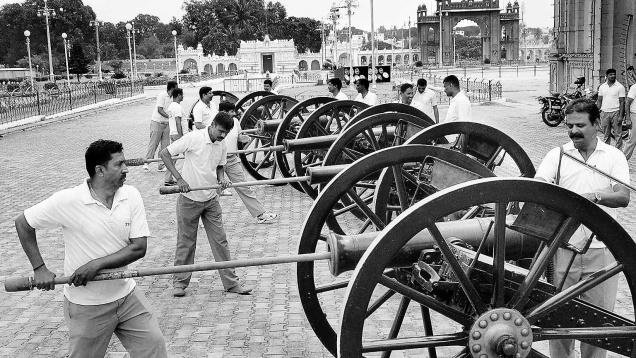
Vintage cannons ready to boom

Policemen cleaning the vintage cannons as part of the forthcoming Dasara festivities.— PHOTO: M.A. SRIRAM

As Dasara approaches, seven cannons, which had been housed at the iconic Mysuru Palace, had been handed over to the Gun Shed Troupe, a team of police personnel attached to the City Armed Reserve (CAR) which operates the cannons.

The vintage artillery, used to fire 21 gun shots on the day of Jamboo Savari, is being readied for the big day.

A 32-member police team has cleaned the cannons, which are installed on two-wheeled carts.

The team is expected to start rehearsals to acclimatise elephants to the booming sound of the cannons firing.

The rehearsal is done under the watchful eyes of Forest Department officials and the elephants’ mahouts and kavadis.

On the day of Vijayadashami, cannons are fired 21 times outside the palace fort to signal the beginning of Jamboo Savari.

Rehearsals are conducted three to four times in the run-up to the Dasara finale every year to prevent the elephants from getting nervous as a result of the sound and smoke.

Siddaraju, a head constable of CAR, who is part of the Guns Shed Troupe, said ammunition for the cannons – gun powder – is procured either from Arsikere or Channarayapatna in Hassan district.

The powder is first dried and then about 1.8 kg is packed in a cotton bag and tied with a thick thread.

The bag is then inserted into the barrel of the cannon for firing. Three rounds each are fired from seven cannons to complete a 21-gun salute. The cannons are fired at the palace and also at Bannimantap, where the procession concludes. Each round of fire needs cleaning to remove leftovers inside the cannon, before another round.

Earlier, two kg of gun powder was used for firing but the quantity had been reduced over two years. Each cannon needs about five persons to operate.

source: http://www.thehindu.com / The Hindu / Home> National> Karnataka / by Shankar Bennur / Mysuru – September 30th, 2015

Post Offices to go paperless

Core System Integration (CSI) pilot project to be launched at 70 POs in Mysuru Division tomorrow

The staff of Central Post Office in Nehru Circle in city are seen upgrading for the CSI project to be launched in Mysuru Division tomorrow

Mysuru :

The Department of Posts (DoP), in its attempt to integrate all solutions implemented under the IT Modernisation Project across different channels, levels and locations, is all set to implement the Core System Integration (CSI), a pilot project, in Mysuru Division tomorrow — the first in the country.

A special software has been created by Tata Consultancy Services (TCS) for this project.

The objectives of CSI are: To lay down a robust IT infrastructure; Implement software applications for various business areas of the department like Mail Operations, HR, etc. and to provide IT-enabled services to the rural community among others.

It is envisaged that CSI will be responsible for overall integration of the solution and thus accountable for successful implementation of India Post-2012 project across channels, across various levels and locations, and for all business operations and supporting functions of DoP.

In addition to the overall responsibility as mentioned above, the CSI will have direct delivery responsibility for mail and logistics operations, enterprise wide human resources and payroll, finance and accounts, and customer interaction management services.

The CSI shall ensure that the components that are delivered to the end-users are seamlessly integrated onto a common front-end and are successfully deployed onto the client hardware. The pilot project will be implemented in all 40 Post Offices in the city and 30 in Mysuru Division.

Meanwhile, Senior Post Master of Mysuru HPO H.S. Hunagund, speaking to SOM this morning, said that in view of the implementation of the project tomorrow, all the Post Offices in the city remained closed today to upgrade to the new system.

With the launching of CSI, the customers will get good and speedy service, he said and added that almost all services of the Postal Department would go online from tomorrow.

source: http://www.starofmysore.com / Star of Mysore / Home> General News / Wednesday – September 30th, 2015

Golden jubilee of St Michael’s Seminary in Belagavi on Friday

Belagavi :

The alma mater of many priests in the diocese of Goa, Karwar and Belagavi — St Michael’s Seminary here will be observing its golden jubilee celebrations on Tuesday.

Located at Macche on the Belgaum-Goa road via Chorla, about 12 kms from city, the seminary is well known amongst the Catholic religious circles across the nation and is hailed as one of the finest seminaries where more than 200 priests including two bishops have passed out.

At the celebrations that will be held at the premises of the seminary, three archbishops and six bishops will be taking part in the holy eucharistic celebrations that will be held at 4pm followed by a programme to commemorate the golden jubilee.

Archbishop of Bengaluru Rev Bernard Moras will be the main celebrant for the mass accompanied by archbishops, bishops and about 500 priests from three states of Karnataka, Goa and Maharashtra will be celebrating the mass.

Rev Fr Joseph Rodrigues and team of priests under the guidance of bishop of Belagavi Rev Dr Peter Machado have made elaborate arrangements for the golden jubilee celebrations.

source: http://www.timesofindia.indiatimes.com / The Times of India / News Home> City> Hubballi / by Ravindra Uppar, TNN / September 28th, 2015

Advani pockets 14th World title

India’s most successful cueist Pankaj Advani today added another feather to his cap by winning the IBSF World Billiards Championship after outplaying his opponent in the final to take his world title count to 14 here.

AdvaniBF27sept2015

Advani, 30, left the spectators spellbound with his prolific play and indisputable mastery over the 3-ball game, demolishing Singapore’s Peter Gilchrist by 1168 points.

On lifting his 14th world crown in style, the Indian ace said, “I was determined to get even with Peter (Gilchrist) after losing the point format final to him. A productive chat with my sports psychologist brother Shree and a good night’s sleep did the trick. We discussed my strategies and mental approach the night before the big final and it all panned out perfectly.”

Bengaluru’s ‘Golden Boy’ was in roaring form and appeared keen to not only defend his Time format world title but also avenge his loss of the Point format championship to Gilchrist, which happened under a week ago.

In the opening visit, Advani fired in a quick century (127) to take the initial lead. Failing to capitalise, Gilchrist handed over an opportunity to the Indian star and it was taken full advantage of.

The 2015 6-red snooker world champion showed his fine prowess in billiards by smashing in two back-to-back triple centuries (360 and 301), making the match a foregone conclusion in the first hour itself.

With a comfortable 700-point lead, India’s posterboy of cuesport continued to add insult to injury with breaks of 284, 119, 101 and 106 in quick succession to extend his lead to 1100 points at the halfway mark of the 5-hour final.

On resumption in the second half, Advani continued to punish his opponent with two more centuries but a spirited fightback by the Singaporean in the form of a big double century (284) along with a couple more centuries reduced his deficit.

But Advani was not quite done yet. He continued his devastating form with some aggressive scoring. The last nail in the coffin was a fluent and flawless 430 break that was unfinished as the match reached the end of its 300 minutes duration.

Advani has stamped his authority yet again in billiards at the world level for a few years now. After annihilating England’s Mike Russell in the final of 2012 edition of the Time format, Advani went on to win twin titles in both Point and Time formats in 2014.

The champion further added, “I’ve been on the move last couple of months competing in many tournaments back to back, in both snooker and billiards. The stint started with winning the world 6-red snooker championship and ended with this world title in billiards making it a very satisfying phase of the year for me.”

Result:

Pankaj Advani (India) defeated Peter Gilchrist (Singapore) 2408 – 1240 (final of Time format)

Breaks: Pankaj Advani (127, 360, 301, 284, 124, 101, 106, 171, 114, 430*)
Peter Gilchrist (102, 156, 249, 107, 198).

source: http://www.deccanherald.com / Deccan Herald / Home> Sports  / PTI / Adelaide – September 27th, 2015

A dance through royal history

The legacy of the 600-year-old Wodeyar dynasty is the subject of the Bharatnatyam dance presentation, Under The Double Eagle. Choreographed and performed by Lakshmi Gopalaswamy and Satyanarayana Raju, exponents of the dance form, it is being presented as part of the Bangalore International Arts Festival to celebrate the 40th anniversary of the International Music and Arts Society.

Talking about the genesis of the production, Gopalaswamy shares that the two of them were commissioned by the Chennai-based Narada Gana Sabha Trust to do a piece on the Mysore royal family in 2013. “Natyarangam, the dance wing of the sabha, holds a thematic dance festival every year and in 2013, the programme was called Bhoopala Bharatam and focused on good Indian kings who had ruled their provinces efficiently. The Wadiyars were among the dynasties that were chosen and it was the trust members who suggested that Satyanarayana Raju and I collaborate. That’s how Under the Double Eagle was conceived,” recalls Gopalaswamy. Considering the historical nature of the theme, preparation for the presentation entailed delving into quite a bit of research into the royal family, to ensure authenticity. “To begin with, the sabha put us in touch with Vikram Sampath who’d written the book, Splendours of Royal Mysore. But besides accessing and reading books on the royalty’s 600-year-long history , a major challenge was to use lyrics and music pieces that were relevant to the time,” explains Gopalaswamy who according to Raju, “sat and did all the research because I am not someone who can read texts.”

“To get the right music, we met composers who have studied the Mysore royal family’s contribution to classical music.We also had Lakshmi’s mother, Dr Uma Gopalaswamy , who is a musician, giving us inputs on what ragas to use,” informs Raju. Gopalaswamy adds, “Prof Srikantam Nagendra Shastry was another key source of information. He even shared certain authentic Javali compositions with us.” While the research took them two months to finish, Raju informs the pair managed to complete the choreography in 15 days. The story of the production, if one may call it that, charts the life and times of 8 Wadiyars kings. “With the Wadiyar dynasty spanning generations, it was almost impossible to show all the rulers. Instead we chose the rulers based on their cultural contributions,” says Gopalaswamy.

Starting with Yaduraya Wadiyar, who founded the dynasty in 1399, the kings who are depicted in the production are Narasaraja Wadiyar I (Ranadhira Kantheerava), Chikka Devaraja Wadiyar, (Immadi) Krishnaraja Wadiyar II, Chamarajendra Wadiyar X, Nalwadi Krishnaraja Wadiyar IV and Jayachamarajendra Wadiyar.

About the choreography itself, Raju says that what proved quite the challenge was, “translating contemporary subjects into Bharatanatyam movements. For in stance, we had to work a lot to choreograph the portion that talks about the construction of the Krishna Raja Sa gara (KRS) Dam by Krishnaraja Wadi yar IV. I mean, how does one show something like this through simple hand movements and little else?” Gopalaswamy believes that the production will be nothing short of an education for the audience. “You learn about the kind of visionaries, and good leaders the kings were. You will also realize how the subtle influence of the Mysore royalty may have played its part in cultivating Kannadigas in to the gentle, cosmopolitan and culturally-oriented community we are.”

source: http://www.timesofindia.indiatimes.com / The Times of India / News Home> City> Bengaluru / by Mahalakshmi P, TNN / September 26th, 2015

Book on Kerala’s Cultural Symbols Launched at KMB

Writer Sethu handing over ‘Virali Pattu, Valampiri Shankhu, Kannadi Bimbam’ to Biennale director of Programmes Riyas Komu. Artist Balan Nambiar and writer-journalist Jose Panachippuram are also seen

For the past four decades, veteran artist Balan Nambiar has been researching on three key religious and cultural symbols of Kerala. Now, their key features found compilation as a book that was launched at a function at the ongoing Kochi-Muziris Biennale (KMB).

‘Virali Pattu, Valampiri Shankhu, Kannadi Bimbam’ was released at KMB ‘14 ‘History Now’ event last weekend, when writer Sethu handed over a copy of the multi-colour work to Biennale director of Programmes Riyas Komu. The book has been translated into Malayalam by writer-journalist Jose Panachippuram.

The tastefully published work looks at the history of the three iconic objects and their cultural and artistic evolution. The ‘virali pattu’ is a silk double ikat or Patola textile, which was traditionally hand-woven in Gujarat, Maharashtra and Karnataka. It has been used for centuries in Kerala as garments by priests, theyyam dancers and to clothe deities. Even in the kalam art portraying Bhagavathy, the goddess is depicted wearing the distinctive ‘virali pattu’ design.

“The weavers calculated the design through the warp and weft as if on a mental computer,” said Bengaluru-based Nambiar, who is a native of North Malabar.

“It was believed that silk cloth was unpolluted; so it was ideal for ritual use. Today, there are only five Jain families in Gujarat who still possess the weaving skills,” the 77-year-old artist noted at a function in Aspinwall House, the main KMB’14 venue, at Fort Kochi.

The ‘valampiri shanku’ is a sacred Hindu conch, in which spiral twists right when the spout is pointed up.  Nambiar, who is from Kannapuram near Kannur, has exhibited at the Venice Biennale, has used this and the ‘kannadi bimbam’ as inspirations in his many sculptural works, which have been exhibited around Europe and in India. The ‘kannadi bimbam’ is a metal mirror used as the deity in some temples in upstate Kerala, where devotees meditate upon their own reflection.

Sethu, also former chairman of the National Book Trust, suggested that the internationally renowned artist was giving back to his home-state through the book.

“It is sad that he has not got due recognition in Kerala, where none of his sculptures are exhibited,” he said. “But through this book, he is giving back stories of our tradition to our people.”

The evening ended with artist Shiva Shankaran rendering songs from the medieval ‘vadakkan pattu’ (ballads from north Malabar), which makes reference to the ‘virali pattu’ in the context of a baby’s cradle, and in the dressing up rituals of warriors’ Thacholi Othenan and Unniarcha.

source:  http://www.newindianexpress.com / The New Indian Express / Home> States> Kerala / by Express Features / March 27th, 2015

A first of its kind

Naanu Avanalla, Avalu by B.S. Lingadevaru Halemane, which bagged two-national awards, is claimed to be the first such film for the Kannada film industry.

“Of course there were films on transgenders. But they dealt their issues as a sub-text, not a main-text. Our film is inspired by I am Vidya, a transgender’s journey , an autobiography of Living Smile Vidya”, said Mr. Lingadevaru.

Sanchari Vijay, who essayed the role of the protagonist, won the best actor award, which came to Kannada after a gap of 27 years. For the first time in the history of Kannada cinema, the film got the award in the make-up category.

Initially, he thought of casting a transgender for the role of Madesh, who transforms later as Vidya in the film, but that did not materialise. Many transgenders have acted in various roles, including that of Sharada Nani and Danamma.

source: http://www.thehindu.com / The Hindu / Home> News> Cities> Bengaluru / by Muralidhara Khajane / Bengaluru – September 24th, 2015

Manipal university team help discover four exotic atomic nuclei

Manipal :

Researchers from Manipal Centre of Natural Sciences (MCNS) at Manipal University in collaboration with GSI-Giessen, Germany have discovered four new atomic nuclei to be added to the chart of the nuclides. The study focuses on developing new methods of synthesis for super heavy elements. The newly discovered, exotic nuclei are one isotope each of heavy elements berkelium and neptunium and two isotopes of the element americium.

H M Devaraja, a PhD student at MCNS, participated in experimental work along with an international team of researchers at GSI Helmholtzzentrumfur Schwerionenforschung. Other participants included scientists from Justus Liebig University Giessen, Germany, Japan Atomic Energy Agency, Lawrence Livermore National Laboratory, USA and the joint Institute for Nuclear Research in Russia. The results are published in Physics Letters B.

Apart from discoveries themselves, first proof of the new technique for production of these exotic nuclides will pave way for a new generation of exciting experiments at the frontiers of experimental physics. It is a proud moment indeed for the team and the collaboration. I expect that continuing investigations will uncover many more surprises as our team explores previously unknown areas and extends the chart of the nuclides, Dr Bhat said.

Gottfried Munzenberg who initiated the Giessen-GSI-Manipal collaboration together with Mohini Gupta expressing happiness at the discoveries, said “Synthesis of new isotopes in nuclear transfer reactions is milestone in search for new methods for SHE synthesis, the principal research goal of our collaboration”. Mohini Gupta, director, MCNS said, “Now that we know this method is viable, interpretation and prediction is two other important aspects of the discovery.”

Newly discovered isotopes have fewer neutrons and are lighter than previously known isotopes of the respective elements. To date, the known Periodic Table comprises over 3,000 isotopes of 114 chemical elements. According to scientific estimates, more than 4,000 additional, undiscovered isotopes should also exist. “By using this method, we have succeeded in generating many different atomic nuclei at once,” says Dr Sophia Heinz who headed the experiment at GSI.

source: http://www.timesofindia.indiatimes.com / The Times of India / Home> City> Mangaluru / TNN / September 16th, 2015

City girl bags Gold Medals in Naturopathy Sciences

Dr. Jasmine D’Souza is seen receiving the certificates from Dharmasthala Dharmadhikari Dr. D. Veerendra Heggade at the convocation ceremony held at Dharmasthala as Delhi Chief Minister Arvind Kejriwal and Health Minister U.T. Khader look on.

Mysuru :

City girl Dr. Jasmine D’Souza, a student of SDM College of Naturopathy and Yogic Sciences, Ujire, affiliated to Rajiv Gandhi University of Health Sciences, has won two gold medals for academic excellence and Best Outgoing Doctor for the Year 2014-15.

She received President’s gold medal and Sitaram Jindal Foundation gold medal from Delhi Chief Minister Arvind Kejriwal at the convocation ceremony held at Srikshetra Dharmasthala on Sept. 9.

Dharmadhikari of Dharmasthala Dr. D. Veerendra Heggade and Health Minister U.T. Khader were present on the occasion.

Jasmine had bagged 2nd rank in 1st and 2nd year cousre, 1st rank in 3rd year and now being the University gold medalist in the final year. She has been honoured with Dr. M. Gayathri Silver Medal, Dr. B. Narayana Rao Endowement Cash Prize, Dr. J.V. Chandrika Cash Prize and Dr. Ashok Kumar Memorial Cash Prize.

She is the daughter of John William D’Souza (BEML employee and Secretary of Konkani Christian Association, Mysuru) and Florine D’Souza, residents of KHB Layout, Hootagalli, Mysuru. She completed her schooling at Notre Dame School securing 87.6% in 10th ICSE board exam (topper of Notre Dame school in 2007-08) and PU from Sri Raghavendra Gurukula, Mysuru, with 94.3%.

source: http://www.starofmysore.com / Star of Mysore / Home> General News / Tuesday – September 15th, 2015