Category Archives: Records, All

Nominated as Advisory Panel Member of Finance Ministry

NarasimhmurthyBF15sept2015

Mysuru :

The Ministry of Finance, Department of Economic Affairs (Currency and Coinage Division), New Delhi, has nominated Star of Mysore columnist Prof. A.V. Narasimha Murthy (AVN), former Head, Department of Ancient History and Archaeology, University of Mysore, as a member of its newly-constituted Advisory Committee.

The Committee will advise the government on various matters including the shape, size, weight, metal, face value of the money, cost of production of the coins, etc.

Prof. AVN is an expert in ancient Indian coinage and has written many books on the subject. He was the Chairman of the Numismatic Society of India (Varanasi) and General Secretary of South Indian Numismatic Society (Chennai) and has been honoured with many awards for his contribution to Indian coinage.

Currently the Chairman of BVB, Mysuru, Prof. AVN was recently honoured with the title Karnataka Puratatva Ratna by Chief Minister Siddharamaiah.

source: http://www.starofmysore.com / Star of Mysore / Home> General News / Tuesday – September 15th, 2015

Strategic crude oil caverns await their day in the sun

CrudeOilBF14sept2015

Mangaluru, the only port city in Karnataka, is already in the world map for its educational institutions, medical colleges, birthplaces of five banks (including four nationalised banks), the only refinery in Karnataka, and for the lone urea manufacturing facility in Karnataka — among many other firsts.

Now, as the work on the underground rock caverns for strategic storage of oil is almost complete, coastal districts Dakshina Kannada and Udupi are in the news again.

While oil major Royal Dutch Shell is said to be in talks to lease India’s new strategic oil caverns at Permude (near Mangaluru in Dakshina Kannada district) and Padur (in Udupi district), the authority concerned — Indian Strategic Petroleum Reserves (ISPRL), a wholly owned subsidiary under Oil Industry Development Board (OIDB) of the Union Ministry of Petroleum — is taking all steps to speed up the work on both the projects to meet the December 2015 deadline.

In fact, out of the three underground rock caverns in India, one is in Visakhapatnam (9.75 million barrels capacity, which is ready for commissioning), while the other two are in Permude (11 million barrels) and Padur (16.12 million barrels). In all, 36.87 million barrels of crude (five million tonnes). The three facilities will be able to store crude for 12 days in case of emergency.

As on date, if all refineries in India are put together, they will be able to store crude oil for only three days of consumption. Hence, when the three facilities are commissioned, India will be able to store crude for 15 days of consumption, much less compared with developed nations which store crude oil for up to 90 days of consumption in their underground caverns.

At both the sites, underground work is almost over. What remains are electrification and laying of pipelines. Awaiting completion are pipeline work extending to nearly 4 km (of the 12 km) from shore to Permude, and 34 km (of the total 36 km) from Permude to Padur. The existing, 17-km-long  pipeline from mid-sea mooring system to seashore, presently being used by Mangalore Refineries and Petrochemicals (MRPL), will be used for shipment of crude oil to ISPRL caverns as well.

The beginning

It may be recalled that the government of India proposed to construct the underground cavern storage at Mangaluru based on the detailed feasibility report prepared by Engineers India (EIL) along with Geostock Engineers, France. SKE&C, part of the $138.7-billion South Korean SK Group, with vast experience in the construction of such caverns, tied up with Karam Chand Thapar (KCT) for the execution of the project worth Rs 403.5 crore.

In case of Padur, there are two underground rock cavern divisions, each with 8.6 million barrel capacity worth Rs 375 crore each. While one is being constructed by SKE&C-KCT, the other is being constructed by Hindustan Construction Company (HCC). Work on both cavern divisions is complete and has been sealed a few months ago.

While the work on the underground rock cavern in Mangaluru began in April 2009, the work on the Padur caverns began in May 2010.

tnam, Mangaluru, and Padur are Rs 1,178.35 crore, Rs 1,227 crore and Rs 1,693 crore respectively, and the total cost of all three projects is Rs 4,098.35 crore.

The compensation bug

When contacted, Karnataka Industrial Area Development Board (KIADB) Special Land Acquisition Officer Dase Gowda said that nearly 1,250 notices have been issued to provide compensation for owners of the land through which the 48-km-long pipelines would pass through.

Though 1,250 notices have been issued, the affected persons/families are only 600 (400 in DK from 17 villages, and 200 in Udupi from seven villages) as notices have been issued to all the persons whose name appears on RTC (rights, tenancy, and crop inspection) documents in the proposed land through which the pipeline passes. Interestingly, only 40 persons/families have availed the compensation in DK and 12 persons/families in Udupi district so far, amounting to Rs 55 lakh (out of the Rs 2.5 crore released in the first phase).

“While many could not claim compensation due to lack of documents, improper documents, or lack of documents on inheritance, others want more compensation,” Gowda said. He claimed that the compensation provided in the case of ISPRL pipeline is 10-fold of what is usually paid in such cases. This was done to expedite the pipeline work, he said.

“Under Right of Use (RoU), landowners are free to grow any crop, including paddy, ragi, vegetables, or do any other activity except construct permanent structures (homes) and plant saplings which could grow into huge trees. Though only 10 per cent of market value is given as compensation for RoU, it has been now raised 10-fold. Despite this, many are not coming forward, perhaps due to misguidance by a few leaders,” he rued.

To another query, Gowda said that if the persons concerned fail to accept the compensation, the only other option was to deposit the amount in court as it is a national project. Owners can move court whenever they want settlement, he said.

When contacted over phone, ISPRL Chief Executive Officer Rajan K Pillai said the special purpose vehicle (SPV) is trying its best to complete the project by December 2015. When pointed out that as on date, hardly 10 per cent of persons/families have availed the compensation and work on the pipeline could be started only after that, he said he is trying his best. “We have given the deadline to the contractor and we hope to complete the project by December 2015,” he said. Sources in the district administration, however, said that the completion of the pipeline may be delayed by a few more months, though nothing is impossible.

Once all the work is completed, attention would turn to filling up these three caverns with 36.87 million barrels of crude oil. By some estimates, it will cost more than Rs 25,000 crore. Considering the fact that oil prices are ruling low at present, the speedy completion of the project and quick purchase of crude oil would save a tidy sum for the exchequer.

source: http://www.deccanherald.com / Deccan Herald / Home> Supplements> Economy & Business / by Ronald Anil Fernandes / DHNS – September 14th, 2015
SJCE students win prize at PACE Forum, Brazil

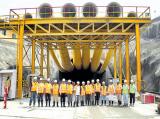
 From left: Prof. V. Basavaraj, SJCE- PACE Coordinator and Dr. K. Chandrashekara, SJCE - CIC Project Mentor, along with the students of SJCE, seen receiving the award from Dr. Delia J. Valles Rosales (extreme left), Professor & PACE- CIC Coordinator, New Mexico State University
From left: Prof. V. Basavaraj, SJCE- PACE Coordinator and Dr. K. Chandrashekara, SJCE – CIC Project Mentor, along with the students of SJCE, seen receiving the award from Dr. Delia J. Valles Rosales (extreme left), Professor & PACE- CIC Coordinator, New Mexico State University

Mysuru :

The “iREACTOR” project by the students of Sri Jayachamarajendra College of Engineering (SJCE), Mysuru, won the II prize in Pace Global Annual Forum held in Sao Paulo, Brazil. It was a Collaborative Innovative Challenge competition in University of São Paulo, Brazil.

The students involved in this project were Aniketh Mohan Rao, Abhiram Madenur Venkatesha, Suraj Handithavalli Purushothama and Vadiraja Mysore Nagendra. This project was guided by Dr. K. Chandrashekara and mentored by Prof. V. Basavaraj.

“A Comparative FEM Analysis of Tribological and strength characteristics of composites of PF and ER matrices reinforced with GF and other filler materials with commercially available Brake pads” won the III prize for outstanding poster preparation and presentation. The students involved in this project were M.N. Vadiraja and Mohan Kumar. This project was guided by Dr. K. Chandrashekara and mentored by Prof. V. Basavaraj.

In addition, 1 CIC project, 2 CIC poster presentations and 2 Technical paper poster presentations were presented by SJCE in the Global Forum, which consisted of 65 globally recognised PACE institutions from all around the world, five of which are located in India. A total of 5 students participated in the Siemens NX Basic certification training programme in the Forum and Srikanth of I&P and Mohammad Anshad of Mechanical Engineering cleared the NX Certification exam and they were awarded the Basic NX trainer certificates by Siemens PLM software, USA.

Further, the students of SJCE who participated in RSMS (Reconfigurable Shared use Mobility System) project as TEAM 6 with other Universities — PES University, Bangalore, MSRUAS, Bangalore, Wuhan University of Technology, China, Michigan Technological University, USA and ITAM, Mexico — prepared a prototype model of RSMS which is a four -wheeler vehicle with the provision of reconfigurable and shared use mobility system.

SJCE students Srinidhi Bukkapatanam, Nikhil Somashekar Murthy, Vijayeendra Rao Harnall Padmanabh, Suraj Handithavalli Purushothama and Srikanth Nanjundaswamy participated in this project. RSMS project was sponsored fully by General Motors and PACE consortium. This project was guided by Prof. V.Basavaraj and Dr.R.Srinidhi and mentored by Dr. V. Ramesh.

SJCE PACE Coordinator Prof. V. Basavaraj along with project mentor Dr.K. Chandrashekara with 13 students of SJCE attended the PACE Global Forum and received these awards.

This is the 5th consecutive time that SJCE has excelled at the Forum.

source: http://www.starofmysore.com / Star of Mysore / Home> General News / Monday – September 14th, 2015

B’luru lab to co-develop Ebola drug with Public Health England

(Representative Image)

Bengaluru :

Nine months after two novel compounds or drug candidates for Ebola from the Jawaharlal Nehru Centre for Advanced Scientific Research (JNCASR) were shortlisted among 20 globally by the Public Health England (PHE), one of them has made it to the final three.

And having realised the potential, PHE, which built and commissioned the first bio-safety level (BSL)4 facilities in the world (1976), designed the world’s first Class III safety cabinets, and used them to co-discover and characterise the Ebola virus, has signed a memorandum of understanding with JNCASR to co-develop the drug.

This contribution to the world from Dr Jayanta Haldar and two of his students–Chandra Dhish Ghosh and Mohini Mohan Konai–will be the first serious one from a developing nation.

The two drugs which were shortlisted, codenamed NCK-8 and D-LANA-14, were lead candidates from two classes of peptide mimics (a molecule global researchers have created to fight the virus) with high activity against a range of multi-drug resistant bacteria and malarial parasites, including clinical isolates.

TOI was the first to break the story in its December 20, 2014 edition under the title “Drugs for Ebola likely to have an Indian connection”.

Speaking TOI on Tuesday, Haldar said: “After extensive trials, one of them along with another from PHE proved to be very active in in-vivo (guinea pig) tests, which has prompted PHE to sign the MoU. From here on we will be working together and we hope to bring out a drug soon.”

Haldar while refusing to still disclose the exact materials used in NCK-8 and D-LANA, reiterated that they are made in three steps with easily available and inexpensive starting materials which do not require any difficult conditions for synthesis.

Dr Seshadri Vasan of PHE had said in December that PHE has a track record of scientific innovation and development, and the funding from Wellcome Trust will allow it to utilise our experience and expertise to assist in the fight against Ebola.

source: http://www.timesofindia.indiatimes.com / The Times of India / Home>City> Bengaluru / by Chethan Kumar, TNN / September 08th, 2015

Indian e-mail tech start-up strikes it big

The Strike team which won the regional round of Seedstars World competition.

Wins Swiss-based Seedstars World regional competition

Strike, a start-up which helps people do research inside their Gmail App, has won the regional round of Seedstars World, a global start-up competition.

Based in Geneva, Switzerland, and founded by Alisee de Tonnac and Pierre-Alain Masson, the competition is supported by the venture builder Seedstars. It promotes, connects and invests up to $1.5 million (Rs 9.9 crore) in start-ups in emerging markets, ranging from Shanghai to Cairo.

The Strike team will now travel to Geneva in March 2016 and win up to $500,000 (Rs. 3.3 crore) in equity investment. It will compete with regional winners from 55 countries as part of the Seedstars World final event in front of top investors and an international jury.

“We have developed a global product in India. Seedstars’ network will help us to target almost every market in the world,” said Aishwarya Jain, 25, chief executive at Strike. “It is rare to find product start-ups getting funded by venture capitalists in India.”

Mr. Jain cofounded Strike last September along with Akshay Katyal, his former colleague at tech company HackerEarth. The start-up has developed a technology that provides insights to users about people while checking mails on mobile. For example, how they look like, where they work, their social profiles and public updates. The start-up aims to provide all the public information about anyone through its app.

Ten start-ups from different parts of the country pitched their ideas to an audience of angel investors and industry experts at the one-day event held in Bengaluru on Saturday.

“Strike, by its unique idea of giving an outlook of personalities of people with one tap on your phone, has won the chance to represent India,” said Mahesh Bhalla, president at gift card tech firm QwikCilver. Mr.Bhalla was one of the jury members at the event.

EventsHigh, a local event discovery platform that brings all the events and things to do in a city, was placed second in the competition. The firm was founded by former WalmartLabs engineers Nikesh Garera, Arvind Batra and Parag Sarda last year. Another start-up, SayPay Technologies, co-founded by Ramsyam Missula was placed third in the competition. The firm enables users to make bill payments and online purchases on their mobile device by using their voice.

Last year, Scandid, a Pune-based shopping technology start-up, won the regional round of Seedstars World. The venture enables shoppers do price comparison by scanning the product barcodes with their mobile phones.

source: http://www.thehindu.com / The Hindu / Home> News> Cities> Bengaluru / by Peerzada Abrar / Bengaluru – September 08th, 2015

The Kasaragodu spark

Work is my God: Kaiyyara Kinhanna Rai worked tirelessly and did not lose hope till his end Photos: courtesy family album

For six long decades Kaiyyara Kinhanna Rai kept his movement alive – Kasargod had to become part of Karnataka. RAHMAT TARIKERE writes that the meaning of all the writings of this writer who passed away recently is to be found in his social activism

My meeting with Kaiyyara Kinhanna Rai was an accident. There was a programme at the Kannada Sahitya Parishath in Bangalore. Kinhanna means little brother, but our Kaiyyara Kinhanna Rai was a strapping six and a quarter feet, well-built man. Dressed in his trade mark white khadi kurta and dhoti, he was sitting all by himself in the last row. With the sweet memories of his poem I had learnt in school Neenanagiddare Naaninage, which unfolds as a dialogue between a horse and a donkey, I walked up to him and greeted him. Holding my hand he ushered me to the chair beside, pulled out a four page resume from his bag and gave it to me. In that resume the list of his non-literary activities outnumbered his literary activities. For instance, his participation in Quit India Movement, submission of a memorandum to the Unification committee urging that Kasargod should be absorbed into Karnataka, winning the Best Teacher national award, his administration for 15 years as the chairman of Badiyadka village panchayat, the two schools and community hospital he built, the Swadeshabhimani newspaper of which he was editor, president of Weaving and Weavers Khadi Co-operative society… so on and so forth. It felt unusual that the resume of a Kannada writer read like this. Everything in it said that Kaiyyara Kinhanna was more a political activist than a writer. Once I had finished reading it, Kaiyyara Kinhanna Rai started speaking about Kasaragodu. Now, even the programme had begun. He was speaking softly, just for me, but his gravelly voice overpowered the speaker’s voice and was audible to everyone in the auditorium. Some of the audience members turned back impatiently and gave us dirty stares. I didn’t know how to stop this senior writer, nor was I in a state to listen to him – I was getting restless. By this time, the writer Boluvar Mohammad Kunhi walking straight up to us, in a brusqueness that is unique to Coastal people, said: “If you want to talk, please go outside.” I fled from there. That was my first and last meeting with Kaiyyara Kinhanna Rai.

***

Between 1930-40, Coastal Karnataka was tense with three major movements. Foremost of them was to free the country from the clutches of the British. Second was to unify the regions that shared a common language but had been distributed among various presidencies, the Unification movement. Third was the communist movement that was fighting against the ruthless zamindars who had the support of the colonial rulers, and then there were other social movements like untouchability, caste system etc. For Karnad Sadashiv Rao the country’s freedom was most important. For someone like Kudmal Rangarao who had been ostracised by the Brahmin community, building a free hostel and school for the Dalits was of utmost importance. For B.V. Kakkilaya and Niranjana, labour movement was important. B.M. Shrikantaiah, Kuvempu, Alur Venkatarao and others felt that Unification was more important than Independence. Kaiyyara Kinhanna Rai had twin obsessions – freedom and Unification. After Independence in 1947, his only mission was Unification. When Potti Sriramulu fasted for three weeks and gave up his life, the Nehru government, unwillingly constituted a committee for the linguistic reformation of States. The committee recommended that Kasargod, Dakshina Kannada and Bellary which were a part of Madras presidency, should henceforth become a part of the Mysore presidency. What eventually happened was however different – they included Kasaragod in Kerala. The Kannadigas of Kasargod were heartbroken. It was at this juncture that Kaiyyara Kinhanna Rai began his movement for Kasargod’s absorption into Karnataka. This became a question of life and death for him. A full-time preoccupation, he discussed this with all and sundry, and in every place. But death has terminated his relentless struggle of a lifetime. His dream remains unfulfilled.

***

It is a matter of surprise that Kaiyyara Kinhanna Rai kept this spark burning in him for six long decades. His commemorative volume, in fact, is called Kasaragodina Kidi. There is a story behind calling it a spark. When he realised that Kasargod did not become a part of Karnataka, in anger and sorrow he wrote a poem, Manege. He tried to ignite everyone else with the fire that had caught him. In every public forum this was what Kaiyyara Kinhanna Rai spoke. Once, chief minister Gundu Rao was present at the function. “We, two and a half lakh Kannadigas, have been orphaned. Our language and culture is getting erased. The water that flows in Payaswini is our tears,” Kaiyyara Kinhanna Rai had cried in public. Kaiyyara Kinhanna Rai belonged to that generation which dedicated its entire life to a cause it believed. The question is however, why could he not realise his dream? To get absorbed into Karnataka, or to get separate statehood is perhaps a political dream, and it can bear fruit only when it becomes the dream of the community.

If the dream does not have economic and political dimensions, and is merely an emotional one, it is even more difficult to keep it alive. For the new generation of Kannadigas in Kasargod, Kaiyyara Kinhanna Rai’s dream must have seemed unrealistic. When there are more important questions than Unification, the poor or the locals will not make this a significant issue of their lives. Also, Kerala tops the country for its administration, education and other vital issues; it may have therefore appeared to them that they do not want to be a part of Karnataka. There was no political outfit like MES in Belgaum to fight the case of Kasargod. Kaiyyara Kinhanna Rai therefore became lonely in his struggle. That he could keep this Unification dream alive in him for six long decades became his achievement.

***

Born in Peradala in Kasargod (1915-2015), Kaiyyara was a school teacher. Writing was his hobby, though not a very powerful writer. The other important writers from this area are Govinda Pai, Parvatisubba, and K.V. Tirumalesh. His best writings are his poems for children. His other poems tended to be verbose and heavy with idealism — it lacked creative energy. One has to recognise this as the limitation of a Kannada school teacher. Gourish Kaikini is among the few teachers who could transcend this limitation. Even his autobiography that contains many intense and intimate experiences of his life is bland.

Yet, his writing has a historic importance. It becomes important because of its dynamic social and political consciousness. And this was shaped by Gandhianism. Gandhi’s visit to Mangalore filled youngsters with new ideals. By refusing to enter the Udupi temple that denied entry for the Dalits, Gandhi had stirred up the consciousness of the society. By then, Kudmal Rangarao had already been ostracised. Narayana Guru had launched his temple agitation against the upper class. People had laid down their lives in the communist movement in this part of Karnataka. Shivarama Karanth’s Chomana Dudi had been written. Kaiyyara Kinhanna Rai’s social writing was an extension of this. He, however, was not critical of the society, but instead glorified the tolerance of Dalits who put up with these social evils.

***

Truly Kaiyyara Kinhanna Rai’s contribution should not be sought in his writing. It has to be seen in his social activism. This trait could also be found in B.M. Idinabba. We can see it in H.N. Doreswamy too. In fact, the title of his autobiography Work is my God suggests this.

At a time when governments have absolved themselves of community responsibility, a corporatized education that is available only to those who have money, the hospital, and school Kaiyyara Kinhanna Rai built as panchayat chairman is important. Freedom fighter, social activist, journalist, poet Kaiyyara is no more. With him, we have lost the link to a generation that dedicated its life for a cause.

Translated by Deepa Ganesh

source: http://www.thehindu.com / The Hindu / Home> Features> Friday Review / by Rahmat Tarikere / Bengaluru – August 27th, 2015

Bengaluru team conquers English Channel in 14 hours

Bengaluru :

Until six years ago, Rajan Srinivasan, the 47-year-old vice-president of British Telecom, didn’t know how to swim. On Wednesday evening, as he stood at the White Cliffs of Dover, he felt a deep sense of accomplishment. It wasn’t without reason. Srinivasan was part of a team from Bengaluru that crossed the English Channel.

The Swimlife Seagulls, an eight-member team led by coach M Satish Kumar, crossed the 63km distance (they took the longer route because of high tide) in 14 hours and six minutes. What sets the team apart from other swimmers is the diversity. Homemaker Suman Singhi was the lone woman in the team, entrepreneur Tejas M Sati was the youngest at 34 and 67-year-old Mohan Sawkar, a lawyer practising at the Karnataka High Court, was the oldest.

It was Srikaanth Viswanathan, an engineer, who mooted the idea in July last year. And the team began its training soon.

Preparations took them to Kodi Beach in Kundapur and Calangute in Goa. In March this year, they did a trial swim, crossing the 40-km stretch from Khanderi to Gateway of India, Mumbai. The team, which landed in Dover on August 28, initially planned to cross the Channel on September 11, but when the window to accomplish their mission came up on Wednesday, they took up the challenge after three days of practice. They began their arduous journey at 2 am.

“It’s a great feeling to have crossed the Channel,” Satish told TOI from Dover. “It’s special because most of the members initially started swimming for health reasons and to overcome their fears. But through the past year, our goal was crossing the English Channel. We had to overcome many challenges, sea sickness being the biggest. We were not used to the temperature, 14 degrees Celsius. Each of us feels we have accomplished something.”

While the actual distance is 32km, the Seagulls had to cover 63km because of high tide. Each person swam for an hour at a stretch before the next one took over. “It is an over-the-moon feeling,” said an elated Suman. “I began to swim to battle high blood sugar and cholesterol. I never thought I would conquer the Channel and my ailments.”

Still in celebratory mode, the team is game for the challenge one more time.

source: http://www.timesofindia.indiatimes.com / The Times of India / News Home> City> Bengaluru / by Manuja Veerappa, TNN / September 04th, 2015

India Gets its 1st Health Exchange Website

Hemant Bhardwaj, CEO, MD and co-founder of PMHLC, said, “With our business model which is a win-win for each stakeholder in the ecosystem, we anticipate achieving one million transactions within 12 months of operations. Zigy.com will connect chemists and druggists with consumers.”

Zigy.com, integrated with Zigy HealthVault, is a first-of-its-kind patient-controlled electronic health record system that will use technology to connect Indians needing health products and services with doctors, clinics, hospitals and other healthcare providers.

Zigy HealthVault provides a highly secure and completely confidential way of storing all health-related information for patients and family members. Zigy facilitates its easy retrieval, upon the patient’s authorisation, to enable doctors and other healthcare providers to fully understand the case history. This structured flow of information will result in better diagnosis.

Phaneesh Murthy, co-founder and executive chairman of PMHLC, called Zigy the first step towards realising “our dream of a Swastha Bharat”.

The online marketplace will initially serve customers in five cities – Bengaluru, Chennai, Hyderabad, Mumbai and Delhi. The product portfolio on the marketplace will include allopathic, homeopathic, ayurvedic and other wellness products.

The operations will be extended to 50 cities within 18 months, and PMHLC expects Zigy to serve rural India after a while.

Zigy is available on both the web and mobile platforms.

source: http://www.newindianexpress.com / The New Indian Express / Home> Cities> Bengaluru / by Express News Service / August 25th, 2015

Pages from history : A Chinese Inscription in Karnataka

by Prof. A.V. Narasimha Murthy, former Head, Department of Ancient History & Archaeology, University of Mysore

India and China had cultural relations with each other in the early centuries Before Christ (BC). In fact, the name China or Cheena is a Sanskrit form of a dynasty named Tsin, which ruled in China. Thus China owes its modern name to India and this is a great Indian contribution.

India and China had political and cultural relations around third century BC. According to traditional stories, King Ashoka is said to have sent 18 Buddhist monks to China for the propagation of Buddhism there. One such group reached China in 218 BC. The story of Bodhisattva was quite popular in China around the second century BC. By about third century, the Hanas invaded China and the Chinese King requested help from many countries including India. During that period, he saw cotton cloth which the Indian merchants had brought for trade, and they liked the cotton cloth and traded in them. In fact, China was famous for silk (Chinambara) which is mentioned in our epics and puranas.

During the rule of Ming dynasty, the Buddhist monks, Dharmaraksha and Kasyapa Matanga were taken to China and they translated many Buddhist works into Chinese language. Those Buddhist monks passed through Bamiyan, Kashgar, Kuchi, Karashahar and they became great Buddhist centres.

People from India used to go to China through two routes which were full of risks. More than 500 years later, devotees used to go through Nepal and Tibet and it became quite popular. Special mention should be made of great saints like Dharmaraksha, Kumarajiva, Vimalaksha, Punyatrata etc. In fact, many great Buddhist scholars of Nalanda went to China to get better recognition there. The celebrated travellers Fahien and Huentsang made everlasting contributions towards Buddhism in China. The latter stated that he is unwilling to go back to China leaving the sacred land of Buddhism. Gradually, Buddhism declined in China and Tao and Confucian leaders became more important and began giving trouble to Buddhists. Sacred Buddhists texts like Vinayapitaka, Sutrapitaka, Abhidamma- pitaka were translated into Chinese language. In fact, some of these are not available in India and Buddhists had to depend upon Chinese texts. This glorious period came to an end in early medieval period. It never saw such a glory again.

Under this background, a Chinese inscription found in Karnataka may be examined. There is an inscribed stone in the Shantika Parameshvari Temple in Kumta, North Canara district of Karnataka. It contained letters which were neither Brahmi, Nagari or Kannada and created a furore among the local people. But the people were helpless and even the traditional epigraphists were of no avail. Today people do not know how this stone came to the local temple. At that juncture, a photograph and a estampage were taken and they were sent to Prof. Noboru Karashima of Tokyo University, who was studying Indian inscriptions. In fact, Tokyo University had a course of study on Indian epigraphy under Dr. Karashima. The latter conducted an international conference on Indian epigraphy at Tokyo, which I had the good fortune to attend.

After getting the estampage of the inscribed stone, Karashima deciphered it and read it as ‘Guong Dong Kaiyi Kasshong Ven Veng Jhima.’ It means that this is the Samadhi (tomb) of Guong Dong Ven Veng who established this township. Further Guong Dong is a town in Southern China. He established this in honour of the great God. This information is not sufficient to write more about the saint whose tomb was established here. Obviously, it was meant for worship in those days but it lost its significance and importance in course of time. Suryanath Kamath had published a note in a newspaper.

Further research on this problem yielded some more interesting information. By about 1850, the British were scary of the Chinese individuals who were known to be robbers and were deported to an Island as life sentence. By about 1833 roughly, fifteen men and ten women were freed. Among them some were Buddhists while others were Christians. The Christians married Goan girls or boys and began working as labourers in tea estates, some took up basketry. However, they continued to do thefts and hence local Police kept a strict eye on them and their movements. It is said that most of these people, both men and women, went and settled in Karwar. The bamboo and basketry work done by these people was famous till recently.

Now, we may come back to the saint whose Samadhi has been described above. Hence, it is quite likely that the Samadhi stone which was set up there might have been brought to Kumta where it is now lying.

According to the local people, some of the Chinese merchants who were moving from place to place for the purpose of trade noticed a Chinese inscription and out of respect for the saint brought it to Kumta. It was lying somewhere in the town. In India, local people play an important role in the preservation of our ancient relics in general and inscriptions in particular. As there were no museums in those days, inscribed stones used to be brought to the local temples and kept in a corner. The same thing should have happened to this stone also. In the early days the Chinese merchants used to visit Kumta and had a temporary settlement there.

In other words, this confirms that the Chinese merchants used to visit Kumta for the purpose of trade. They used to be in good numbers and spread themselves in different parts. Thus Kumta became an important centre for the Chinese merchants.

The North Karnataka gazetteer prepared over a hundred years ago, quotes many elders of Kumta who had seen Chinese merchants staying there. In fact, they used to develop friendship with young and beautiful local girls and paid them heavily to be with them. This also made the local Chinese merchants closer to the local people, for their generosity in paying money. This normally happens with foreign visitors. Having come to India and settled down here, the Chinese elevated their saint to greater heights and began worshipping them. In fact, they must have converted them to the level of Gods. In that way, this Chinese inscription though short, is significant and adds a page in the cultural history of Karnataka. The tradition continued till recently is a point of importance, in spite of the present political scenario. Let us bow to saint Guong Dong.

source: http://www.starofmysore.com / Star of Mysore / Home> Feature Articles  / Saturday – August 29th, 2015

Steps initiated to protect century-old war memorial

The historically significant war memorial ‘French Rocks’ at Harohalli in Pandavapura of Mandya district is in a pathetic condition.

Officials start evicting encroachers of the area

Evicting the encroachers from the historical war memorial at Harohalli in Pandavapura taluk of Mandya district has finally begun.

The memorial, known as ‘French Rocks’, was set up in memory of French soldiers, who had come to Pandavapura to help Tipu Sultan during his battles against the British. Tipu Sultan had granted a plot to the French army for establishing a burial ground for soldiers.

The war memorial once had at least 65 graves of different styles and structure.

As the graves were architecturally significant and contained the details of names of deceased soldiers, age and their ranks and file etched in marble plaques.

Nevertheless, the local people had encroached a major portion of the graveyard by demolishing several graves.

Historians had been requesting the district administration to protect the memorials by evicting the encroachers.

A team of revenue officials, led by Assistant Commissioner of Pandavapura (Revenue) H.L. Nagaraju and tahsildar B. Shankaraiah visited the war memorial on Wednesday and cleared the encroachments. The team had destroyed various crops cultivated at the graveyard. Mr. Nagaraju said the taluk administration would initiate steps to facelift the memorial soon.

“We will first remove the weeds and then protect the graves,” he said.

source: http://www.thehindu.com / The Hindu / Home> National> Karnataka / by M.T. Shiva Kumar / Mandya – August 27th, 2015