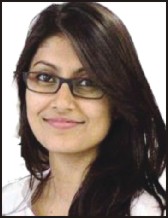
City girl Rini James, studying in Weinhenstephan – Triesdorf University of Applied Sciences, Germany, was awarded “Outstanding Achievement of a Foreign Student Award” in Germany on July 10.
Rini James, who completed her Bachelor of Architecture from the University of Mysore, is also a Deutscher Akademischer Austanschdienst (German Academic Exchange Service), DAAD Scholar having received a scholarship for a student exchange at the Technical University, Berlin, Germany in 2011-12.
During her Master’s Programme in Germany, she has won many awards and prizes for her excellence in Studies.
Rini James is the daughter of James Balu and Alice J. Balu of Mysuru.
source: http://www.starofmysore.com / Star of Mysore / Home> General News / Saturday – July 18th, 2015
Chief Minister to inaugurate CCL’s Centenary celebrations; Kuvempu Mobile Library to roll on city roads
A view of the City Central Library on Sayyaji Rao Road.
Mysuru :
Libraries should be established in all taluks and villages across the State to improve the literacy rates, said District In-charge Minister V. Sreenivasa Prasad.
He was addressing a meeting to discuss the upcoming State Level Library Day celebrations and also the Centenary celebrations of City Central Library (CCL) on August 12 at the Deputy Commissioner’s (DC) Office, here recently. The Minister instructed the officials to seek the opinions of scholars, writers and intellectuals in city on celebrating the Centenary of CCL.
Library at People’s Park: The meeting also discussed the technical difficulties being faced for the construction of Library at People’s Park in city. MLA Vasu requested the Minister to take up the matter with Chief Minister Siddharamaiah.
He also mentioned that former Chief Minister D. V. Sadananda Gowda had laid the foundation stone for the library but the project failed to take off owing to technical problems. Making changes in the Comprehensive Development Plan (CDP) would help in construction of the new library building, Vasu added.
The Centenary celebrations will be inaugurated by Siddharamaiah on August 12 by laying foundation for the renovation of CCL on Sayyaji Rao Road.
Librarians from all over the State will participate in the Library Day celebrations. A procession of librarians and cultural troupes will be taken out from Kote Anjaneyaswamy Temple which will pass through the main streets of city before culminating at Kalamandira, where the celebrations will be held.
CCL, a landmark structure: CCL, a landmark structure on Sayyaji Rao Road in Mysuru, has been the fountain of knowledge for Mysureans and is one of the oldest libraries in India. Nalwadi Krishnaraja Wadiyar, Sir M. Visvesvaraya and Sir Mirza Ismail were instrumental in the construction of CCL. B.M. Shri, Rao Bahadur Ranga Iyengar, Janab M. Hussain, M. Venkatakrishnaiah, E.W. Thomson, N.S. Subbarao and B.G. Lakshman Rao were the other key players in the establishment of CCL.
According to Deputy Director of Department of Public Libraries B. Manjunath, the library was formally inaugurated on October 15, 1915 by the then Mysore ruler Narasimharaja Wadiyar. However, with the advent of television and computers, the number of people visiting CCL has come down considerably. There are over a lakh books including literary books, novels, fictions and reference books for competitive exams at CCL. Apart from Kannada, Hindi and English, the library has books in Tamil, Telugu, Urdu and Marathi, he added. “Computerisation was being done in the library at a cost of Rs. 32 lakh,” he said.
An Online Public Access Catalogue (OPAC) would be provided so that people sitting at home could know whether a particular book was available at the library or not, Manjunath said.
CCL building is being given a facelift with new furniture being readied; Karnataka Rural Infrastructure Development Limited (KRIDL) has been given the responsibility of making heritage furniture for CCL while the PWD is renovating the heritage building, he added.
Ladies Managing Committee in CCL: Prof. S. Radhakrishnan of Maharaja College in city was actively involved in developing CCL. He used to spend most of his time reading books here. The then junior professor in Maharaja College Prof. B.M. Srikantaiah was one of the members of CCL Administrative Committee and was Secretary until 1927. B.M. Shri was instrumental in setting up of the Ladies Managing Committee in CCL. The Department of Libraries took over CCL in 1967 after the Karnataka Public Libraries Act was passed.
Father of Library Science: National Librarians’ Day will also be observed on August 12. The day is celebrated to mark the birthday of Shiyali Ramamrita Ranganathan, considered the Father of Library Science.
Manjunath said that the best librarians from across the State would be felicitated on the occasion. Kannada Book Authority, Kannada and Culture Department and National Book Trust of India have joined hands in organising an exhibition, the Deputy Director said.
Kuvempu Mobile Library: The Department of Libraries has purchased a new chassis at a cost of Rs. 11 lakh and the vehicle’s body will be built at a cost of Rs. 14 lakh. The Kuvempu Mobile Library is expected to be ready by August 10. The mobile library, which was launched in city in 1984, stopped functioning in 2011 after the RTO refused to give a Fitness Certificate to the old vehicle.
source: http://www.starofmysore.com / Star of Mysore / Home> General News / Saturday – July 18th, 2015
Mysurean Vasudesh H. Bhat has bagged 17th rank at the all-India level in the final examination of Chartered Accountants course.
He had entered the CA through the CPT route in June 2011 after completing Class 12 in the Demonstration School here.
He had also secured All India 29th rank in CA Intergrated Proficiency Competence Course in May 2012. Vasudesh also served as the Secretary of the Southern Indian Chartered Accountants’ Students’ Association, a press release said here.
source: http://www.thehindu.com / The Hindu / Home> National> Karnataka / by Special Correspondent / Mysuru – July 22nd, 2015
Cultural programmes planned, cine stars to participate; Rs. 5 crore sanctioned for modernisation of Mysore Silk weaving factory
Mysuru :
The Karnataka State Silk Industries Corporation (KSIC) in city has also planned to celebrate 100 years of its service to the people in a big way in August, similar to the Centenary celebrations of the University of Mysore and the City Central Library.
Addressing a press conference at Pathrakartara Bhavan in city yesterday, KSIC Chairman D. Basavaraju said that Chief Minister Siddharamaiah has given his consent to prepare the schedule for the KSIC’s Centenary celebrations in Mysuru in August. The KSIC has completed 103 years of its inception.
KSIC’s delayed Centenary event will be a memorable one as the Chief Minister has agreed to inaugurate and planning has begun, said Basavaraj and added that to mark the celebrations, efforts will be made to offer Mysore Silk saris at cut-price.
Replying to questions, as to why the Centenary celebrations of KSIC were not held in 2012, Basavaraju said the celebrations were postponed due to professional commitments.
A Centenary Bhavan had been built at the factory premises on Mananwadi Road in city but the centenary had not been publicly celebrated, he added.
Basavaraju pointed out that the 100 years of Mysore Silk will be showcased along with cultural programmes and other events and added that cinema stars will also be invited for the Centenary celebrations of KSIC.
The Silk factory in Mysuru is one of the oldest and historical silk manufacturing units in the country. It was founded by the Wadiyars in 1912 for manufacturing silk fabrics for the royal family and ornamental fabrics for armed forces.
Rs. 5 crore sanctioned for modernisation of Mysore Silk weaving factory
Stating that the State Government through Karnataka Silk Industries Corporation (KSIC) has sanctioned Rs. 5 crore for modernisation of the Silk weaving factory in Mysuru, the KSIC Chairman said: “new technology will be adopted to manufacture better quality silk sarees for the customers. About 645 people, including management staff and workers have been employed at the Silk weaving factory and 254 people have been hired on contract basis.”
Basavaraju said that fresh recruitments have not been made at the factory since 21 years despite shortage of workers even after retirement of several employees and added that steps were being initiated to recruit employees.
KSIC, in its first phase, has installed modern machines at a cost of Rs. 68 lakh at the thread spinning unit in T. Narasipur, said Basavaraju. The spunk silk factory at Channapatna will be restored at a cost of Rs. 9.26 crore and the unit is expected to produce low-cost silk sarees priced at Rs. 4,000 to cater to middle class and economically weaker sections, he added.
The KSIC Chairman pointed out that KSIC had a record transaction of Rs. 146.42 crore in 2014-15 — an increase of Rs. 20 crore when compared to Rs. 127.15 crore in 2013-14. The profit earned during the current fiscal is Rs. 25 crore and Rs. 1.10 crore has already been deposited to the Government as its share dividend, he added.
As there is more demand for setting up of Mysore Silk retail units in the State, 6 units in Mysuru, 7 in Bengaluru, one each in Channapatna, Chennai, Hyderabad and Vijayawada have been functioning and from these 17 units 72,000 silk sarees were sold during the last year, said Basavaraju. New retail units will be set up by the end of this year at Davanagere, Hubballi, Dharwad, Tumakuru, Belagavi and Kalaburgi, he added.
KSIC officers N.H. Thimappa, Krishnappa and Suresh were present at the press conference.
source: http://www.starofmysore.com / Star of Mysore / Home> General News / Thursday – July 16th, 2015
A baby boy was born to Devegowda and Channamma couple at a small village Mudigere, about a hundred years ago, in a poor family. Naturally, the father asked him to a look after the sheep he had. But the boy had other plans; he wanted to study and get educated and come to the mainstream of the society. Hence, against his father’s wishes, he joined the local school and passed the Lower Secondary examination.
This made great news in the family circles as also in the village. The boy entered into High School and passed SSLC. At that time, Mahatma Gandhi came to Channapatna and the young boy Javaregowda made it a point to see him even from a distance. He was greatly influenced by Gandhiji and decided to work for the cause of the country in his own way.
Then he went to Bangalore to study Intermediate (present PUC). He had an opportunity of going to Ramakrishna Hostel where a new vista of the literature of Ramakrishna Paramahamsa, Vivekananda and Gandhiji beckoned him. He wanted to go to Kolhapur but could not. Then he joined as a clerk in the Education Department. The corruption that was rampant made him leave this job.
In the meantime, he completed MA degree and rejoined as a clerk in the Secretariat and worked there for three years. At this time, he got two openings: the first one was the job of a Sub-Registrar (a lucrative job not by salary but by extra income) and the other was the job of a lecturer in University of Mysore. Friends and relatives advised him to join the Sub-Registrar’s post and earn a fortune in a short time. But his inner conscience told him that Sub-Registrar’s post was not his cup of tea and the service as a lecturer in Kannada will give him job satisfaction and allow him to write in his mother-tongue.
Fortunately for Kannada, he joined as lecturer and was posted to Central College, Bangalore. After two years, he was transferred to Mysore University and he never looked back. He began contributing articles in Kannada on Kannada literature and culture. He was invited to be one of the editors of the prestigious journal Prabuddha Karnataka. It came to be published as a good journal and its circulation was increased. Scholars thought that it was a prestige to get their research articles published in Prabuddha Karnataka.
Subsequently another Kannada journal called Manavika Karnataka, meant for articles on Social Sciences, was added with the vision of Dejagow. Thus the three journals Prabuddha Karnataka (literature), Vijana Karnataka (Science) and Manavika Karnataka (Social Science) became the most prestigious research journals in Karnataka.
With his scholarly contribution, he was elevated to the position of Assistant Professor in 1955. Dejagow, following the footsteps of his Guru Kuvempu, emphasised that a University should give equal importance to Bodhane (teaching) Samshodhane (research) and Prasara (publication). The first two were already there and he strengthened the publication unit called Prasaranga. During the period of Dejagow at the helm, one book a day used to see the light of the day. Thus Mysore University became famous for its publication not only in Kannada but also in English.
The University depended upon the local printing presses for printing the books which caused inordinate delay as well as lack of quality. To overcome this, Dejagow started a University printing press which was well-equipped with latest machinery. University text book and research publications began to see the light of the day in a methodical way. Seeing his dynamism, the authorities appointed him as the Principal of the prestigious Sahyadri College at Shimoga and during his tenure, the college developed by leaps and bounds and became an ideal college. The authorities felt that he should be transferred to Mysore to develop the University in all its facets and he became a Professor and Head in 1964. Next year, he was chosen as the Dean of Arts faculty. In the meantime, he was also the Controller of Examinations.
To centralise all Kannada academic activities, the Institute of Kannada Studies was started at Manasagangotri and he became its first Director. The Institute became the hub of all Kannada activities. Dejagow felt that scholars depend on encyclopaedia for information in English. This knowledge should be available to Kannadigas in Kannada itself. He organised a branch of the Kannada Encyclopaedia and got articles written by specialists which has not been surpassed in other languages. The fourteen volume Kannada Viswakosha series is a boon to the Kannadigas and you mention any important topic in the world, you will find its entry with details, in this work. Practically, I use this encyclopaedia for all my writings in ‘Pages from History.’
Folklore was an important subject of study in foreign countries but we had neglected it. Dejagow recognised the importance of folklore in understanding the culture of Karnataka. He started a Folklore Museum in Manasagangotri and collected unique items. Soon it became famous internationally with foreign scholars thronging its portals and it became a great attraction in Mysore University. It got appreciation from Ford Foundation also. It was considered a must for any distinguished visitor to Mysuru. Folklore also became a subject for Master’s and Diploma level.
Dejagow became the Vice-Chancellor of University of Mysore on Kannada Rajyotsava Day, November 1, 1969. A felicitation function was arranged in his honour. Prof. S.V. Ranganna, who spoke on the occasion, said Kannada has attained a horn (Kannadake indu kodu bandide). That Kodu has developed as a sharp instrument for those who oppose Kannada. That is the most powerful weapon of Dejagow.
I faintly remember a meeting in which the then Chief Minister D. Devaraja Urs spoke. He used strong words and said that he is prepared to resign for political reasons. In his speech, Dejagow said he is prepared to resign any moment if Kannada is shown disrespect by people however high they may be. The entire audience was stunned at the guts of Dejagow before a Chief Minister.
Dejagow considered Kuvempu as a divine human being. If anybody wants to know how a Guru has to be respected, they must read the utterances of Dejagow in this regard. If my memory is correct, Dejagow once told me that he worships the photograph of Kuvempu. Dejagow followed the footsteps of Kuvempu in all ethical principles. Kuvempu’s respect and regard for his Guru T.S. Venkannaiah is well-known and if you want to know it, please read the dedication page of Kuvempu’s Ramayana Darshanam. The same type of respect Dejagow developed towards his Guru Kuvempu. Kuvempu was pleased at the attitude of Dejagow. ‘I do not know by which words I can convey my relationship with Dejagow. Love? Sincerity? Faithfulness? Friendship? Devotion? Respect? Each of these words is not adequate. I have no words to express my relationship with Dejagow; words fail. Hence I keep silent.’ Swami Siddhesvaranandaji is my spiritual guru while Dejagow is my guide in secular matters. Getting a certificate to this effect from Kuvempu is not an ordinary feat.
Dejagow has distinguished himself as a prose writer (gadyabrahma, gadyashilpi). When everybody was running after poetry, he realised it was not his cup of tea and hence chose prose to express himself. Thus he is considered as Banabhatta in modern Kannada literature.
In a short article of this type, all his works and translations cannot be mentioned. Those who are interested may refer to a Kannada book ‘Dejagow Vanmayasuchi’ edited by Dr. T. K. Kempegowda. He has more than hundred works to his credit and thus he has hit two centuries, one by his age and the other by the number of his works. I do not think any Kannada author has this distinction. Thus he holds a unique academic record. The literary output of Dejagow is vast and varied that many research scholars have been doing research on his works.
In spite of his busy academic schedule, Dejagow has found time to visit many foreign countries including Russia, Britain, Africa and Europe. He has written on these foreign visits which are educative in nature.
My acquaintances with Dejagow are also interesting. I wrote my Ph.D thesis on the topic ‘The Yadavas-Sevunas of Devagiri.’ The uniqueness of this thesis is that I propounded the theory that the Yadavas were Kannada people and not Marathis as believed by great historians like Bhandarkar, Altekar, Yazdani, etc. I wrote an article in Kannada on this and it was published in Prabuddha Karnataka. It drew the attention of Dejagow; he was curious to know as to who was the youngster who has added one more dynasty to Karnataka. He complimented me and published my book from the University.
Another work of mine which attracted Dejagow was a Kannada book on the origin and evolution of Kannada script. This was published as the first book from Institute of Kannada Studies. It has brought name and fame and seen seven editions. I am grateful to Dejagow for this encouragement, which made me a writer in Kannada.
From his encouragement I have published about 20 books in Kannada on history and culture of Karnataka, including Karnataka Coinage. At his instance, I took up the publication of Kannada translation of all the English works of Kulapati K. M. Munshi, the Founder of Bharatiya Vidya Bhavan. As the Chairman of BVB Mysuru Kendra, I have published 26 books of Munshiji in Kannada. At his instance, I have also edited 25 parts of the series called ‘History and Culture of the Indian People,’ running to about 20,000 pages in Kannada.
I live in Jayalakshmipuram, very close to Prof. Dejagow. In fact, he has a role in my getting this plot of land. Till recently, I used to meet him almost daily and pay my regards and if he was free, talk to him on academic matters. But nowadays, he goes by car and I am deprived of the privilege. Hence, I go to Kuteera to talk to him and pay my regards.
When our MLA Vasu asked me to be the Chairman of the Centenary Committee to honour Dejagow, I accepted it in all humility because it gave me one more opportunity to pay our respects. But Dejagow did not agree to this celebration saying, ‘I have done my duty to Kannada; what is great about it.’ We had to persuade him to accept our love, affection and regards through a public function. Thus, he has become a Sthithapragnya.
Finally, I pray to God to give Dejagow health, peace and more laurels in the days to come. I hope every Kannadiga will say ‘Amen.’
source: http://www.starofmysore.com / Star of Mysore / Home> Feature Articles / Sunday – July 12th, 2015
The Indian pair of Sonam Chugh from Mysuru and Shashidhar Reddy saw off 31 other teams to win the 22nd World Corporate Golf Challenge at the Oitavos Dunes Golf Course in Cascais, Portugal, recently.
Sonam Chugh is a product of the JWGC, Mysuru. In a tournament that was played in the stableford format on a par-71 course, Sonam Chugh (handicap 3) scored a total of 66 points over two days (34, 32) while Reddy (handicap 5) collected 62 points (33, 29).
The two, representing Ramesh Swiss Watch, posted a total of 128 to claim a seven-point victory.
Chugh and Reddy reached the World Finals after edging out 13 corporate teams in the National Finals of the Take Solutions Corporate Golf Challenge.
source: http://www.starofmysore.com / Star of Mysore / Home> Sports News / Monday – July 06th, 2015
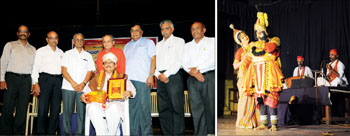
Yakshagana Scholar Dr. Kabbinale Vasantha Bharadwaj, who was conferred with ‘Chittani Award’ during the valedictory of the three-day Badagu Yaksha Vaibhava, organised under the aegis of Innovative, Mysuru and Department of Kannada and Culture, Mysuru, at Jaganmohan Palace in city yesterday, is seen with LabLand Chairman Dr. Sudhir Shetty, Yuvaraja College Registrar (Evaluation) Dr. S.N. Hegde, Mysore University former Vice-Chancellor Dr. J. Shashidhara Prasad, Yakshagana exponent G.S. Bhat of Innovative Mysore, Bellipadi Yaksha Samskrutika Vedike President Dr. Bellipadi Satish Rai, Journalist Ravindra Bhat and others. Picture right shows a scene from Yakshagana ‘Sri Krishna Sandhana’ performed last evening.
Mysuru :
Expressing concern over the lack of recognition and exclusion of Yakshagana Poets in the history of Kannada Literature, Yakshagana Scholar and artiste Dr. Kabbinale Vasantha Bharadwaj said that the yakshagana-poets in Karnataka have not got the required space in Kannada literary history and added that while Himmela, Mummela, Chenda and others belonging to the Yakshagana troupe are being recognised, the poets have been neglected.
Dr. Bharadwaj was speaking, after being conferred with the Chittani Award, at the closing ceremony of the three-day Badagu Yaksha Vaibhava held at Jaganmohan Palace in city yesterday evening. Dr. Bharadwaj said that there are around 1,500 yakshagana-poets in the State who have composed around 5,000 literary works while unfortunately, a person who writes four lines for a film song gets more recognition and this has been the same even with the Kannada literary circles.
He further said that the poetry is the basis of Yakshagana and the poems become an inspiration to the actor while the actor’s enactment justifies the poetic elements in the composition. Dr. Bharadwaj dedicated the award to all the Yakshagana-poets in the State who still remain unrecognised even in the literary field.
Bellipadi Yaksha Samskrutika Vedike President Dr. Bellipadi Satish Rai, who was the chief guest on the occasion, said that Yakshagana is one of the most attractive forms of stage-based art forms and it would not be an exaggeration if he says that the people of coastal Karnataka have learnt Kannada language through Yakshagana. He further urged the people of Karnataka to protect the art form and added that the State Government should do its best to protect and propagate Yakshagana like how it is done in Kerala for Kathakali.
Former Vice-Chancellor of University of Mysore, Dr. J. Shashidhara Prasad, presented the Chittani Award to Bharadwaj.
LabLand Chairman Dr. Sudhir Shetty, Yakshagana exponent G.S. Bhat, Dakshin Kannada Zilla Sangha President V. Sreenivasa Rao, Yuvaraja College Registrar (Evaluation) Dr. S.N. Hegde and others were present.
The award ceremony was followed by the staging of the Yakshagana ‘Sri Krishna Sandhana.’ The three-day workshop was organised by Innovative, Mysuru and Department of Kannada and Culture, Mysuru.
source: http://www.starofmysore.com / Star of Mysore / Home> General News / Monday – July 06th, 2015
The names of 19 railway stations in the state will have to be changed to their new names, as per a notification issued by the Indian Railway Conference Association, New Delhi.
The letter was issued on July 7 by the Secretary General of the Association, Sudhansu Jyoti Sinha, to the Chief Commercial Manager, South Western Railway, Hubballi.
The following will be the altered names of stations (old names in brackets):
Bengaluru Cantonment (Bangalore Cantonment); Bengaluru City Junction (Bangalore City Junction), Bengaluru East (Bangalore East), Ballari Cantonment (Bellary Cantonment), Ballari Junction (Bellary Junction), Vijayapura (Bijapur), Belagavi (Belgaum), Chikkamagaluru (Chikkamagalur), Mysuru (Mysore), Mysuru New Goods Terminal (Mysore New Goods Terminal), Hosapete D Cabin (Hospet D Cabin), Hosapete (Hospet), Shivamogga Bidare (Shimoga Bidare), Shivamogga H (Shimoga H), Shivamogga Town (Shimoga Town), Hubballi Junction (Hubli Junction), Hubballi Shops (Hubli Shops), Hubballi South (Hubli South) and Tumakuru (Tumkur).
Ghanshyam Verma, Deputy General Manager and Chief Public Relations Officer, South Western Railway told Express that the process of implementing the order has already begun. “It will take some time to change the display names on both sides of the station, on the official letterheads, on trains and on tickets. But the work has commenced,” he said.
source: http://www.newindianexpress.com / The New Indian Express / Home> Cities> Bengaluru / by Express News Service / July 09th, 2015
In Wipro’s annual report for the year ended March 2015, Premji said he has now allocated the equivalent of 39% of the company’s shares to a trust focussed on philanthropic initiatives, mainly primary education.
Bengaluru :
Wipro’s billionaire chairman Azim Premji, the first Indian to sign the Giving Pledge, has set aside more than half of his wealth for charity by allocating an additional 18% stake in the company to fund philanthropy.
Premji, who will turn 70 this month, controls a 73.39% stake in India’s third-largest software company, which is worth about Rs 99,500 crore ($15.7 billion). In Wipro’s annual report for the year ended March 2015, Premji said he has now allocated the equivalent of 39% of the company’s shares to a trust focussed on philanthropic initiatives, mainly primary education. The additional 18% stake forms the latest tranche of shares Premji has allocated for charity.
The Giving Pledge is an effort to invite the world’s wealthiest individuals and families to commit half of their wealth to philanthropic causes and charitable organisations. In his pledge in 2013, Premji said he believes that those who are privileged to have wealth should contribute significantly to try and create a better world for the millions who are far less privileged. “Over the past 15 years, I have tried to put this belief into action through my personal philanthropic work. Over these years, I have irrevocably transferred a significant part of the shareholding in WiproBSE -0.03 %, amounting to 39% of the shares of Wipro, to a trust (of which ownership of 21.14% was transferred and for the balance, the trust is entitled to the beneficial interest of dividends and sale proceeds),” Premji wrote in a letter to shareholders.
People close to Premji said he has been quietly and steadily been transferring wealth to fund philanthropy.
“Apart from the Tata Trust, nothing comes close to the commitment made by him on this front,” said a person who knows him well. “And now, he has two engines to carry on philanthropy—the Azim Premji Foundation, and the newly formed Philanthropic Initiatives formed to making grants to NGOs.”
Last year, Premji hired Amnesty India head G Anantha Padmanabhan to build an organization that will offer grants to external agencies.
“The new initiative of making grants to NGOs has just started under what we call Philanthropic Initiatives. We are continuing to look at various areas, e.g., nutrition, water — the only area that we have decided on is support to NGOs working with the most vulnerable people — eg, street children, urban homeless, teenage girls from disadvantaged communities, women at risk of violence,” said Anurag Behar, CEO of Azim Premji Foundation and vice-chancellor of Azim Premji University.
“The Foundation’s work continues to expand and deepen in helping improve public (government) school education across seven states, which have about 350,000 schools. The university that we run also continues to expand. This year, we have launched a Master’s in public policy and governance and also our undergraduate programme,” Behar added.
Philanthropy has been on the rise among the rich in India as Microsoft cofounder Bill Gates , the world’s richest person, and business magnate Warren Buffet urged the wealthy to give their fortunes to charitable causes.
According to the Hurun Research Institute, at least 50 individuals donated over Rs 10 crore to philanthropic causes in 2014.
Premji, Anil Agarwal, Shiv Nadar and Ratan Tata were the most generous givers in India, according to the Hurun India Philanthropy List 2014.
source: http://www.timesofindia.indiatimes.com / The Times of India / Home> Business> India Business / by Pankaj Mishra, ET Bureau / July 08th, 2015
They got her an imported ‘body cream’ and she is massaged to sparkle her pista green colour every Sunday. A 1968 Volkswagen Beetle, she is the “happiness” of GB Ravichandra’s family. The best-selling car for the longest time, she has a unique body shape with fins, a rear engine, and a huge boot space at the front.
A classic beauty, she was the childhood dream of Ravichandra who says, “I watched the Beetle rallies as a kid. It was after 20 years that I am able to own one.”
He adds that his dream would not have been fulfilled if it was not for his wife Bharathi. “Although I wanted to own a Beetle, I was skeptical about spending money on it, as it is an expensive hobby. My wife’s support was and is still the biggest boost to my passion.”
It is not just the Beetle that takes him back to his childhood. He also owns a Bajaj scooter. He explains, “It belonged to my dad Bhaskarayya. A family of four — my father, mother, sister and I — have travelled all around in this scooter. With the four of us, there would be some extra luggage too. My father was very passionate and cared more for his scooter than his wife!” A layman’s mode of transport, it is in good running condition and has a humble charm.
His passionate collection of many antique and classic things has led his daughters — Aishwarya and Aashika — to follow his footsteps.
“The passion is completely passed on as we, at the beginning, did not understand the so-called antique charm. But we are a part of it now and have emotions attached to our Beetle,” they say in unison. They call it a package of love and happiness and Aashika says, “I love the rallies that happen in the City and it is exciting to see many colourful Beetles moving in a single lane. We have made so many friends who share the same passion because of this car.”
Bharathi is equally passionate about this small car and she has made it a point to include the car in every family celebration. “During birthdays or anniversary celebrations, we make sure to deck the car with flowers and placards and take her for a drive with all family members. She is a part of every special
occasion.”
There is a story behind the car’s arrival which he summerises, “I saw an advertisement and she was in Cochin. Hesitant, but later encouraged by my wife, I flew to Cochin. She was in a bad condition and it was an expensive affair. However, I picked her up and got her to Bengaluru in a truck.” She was restored and it took him a year to find the right mechanics and get her back in shape. “Some parts were not original and I had to source them from abroad. It took me a year to get everything fixed — all to her original charm,” he adds.
A left hand drive car, she is a showstopper in the busy traffic and Bharathi says, “While taking her for a drive, people first tend to look at the driving seat, which is usually on the right and jovially think that a lady is driving. Sometimes, we even pretend to hold a rod in the front trying to fool them and this is a fun process.” She adds that the car is a bit tougher to drive because of the left hand steering.
They own another unusual car — 2004 Ambassador Avigo — that has a body shape of a classic ambassador, but a power steering with all the modern amenities. “There are about only hundred cars produced in India and this is made to look like a 1960 model,” he says. He comments on the technology of the classic cars and says, “They are very superior and reliable. The engine parts of this Beetle are rugged and the car does not topple.” With a dream to own many cars including the Citroen 1970 and a classic Mercedes Benz, he concludes, “It has taken me twenty years to own a Beetle and I will never let go of her.”
source: http://www.deccanherald.com / Deccan Herald / Home> Supplements> MetroLife / by Prajna GR, Bengaluru / DHNS – July 07th, 2015