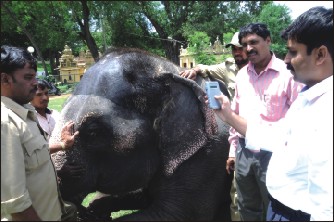
To prevent illegal sale and for easy identification
Mysore :
Hereafter identifying captive elephants in the State will be very easy as microchips are being implanted in them to help their identification and prevent illegal transportation of such elephants.
There are 42 elephants maintained by private players like Mysore Palace which has six (Chanchala, Ruby, Neeta, Preethi, Jamuna and Rajeshwari) Suttur Mutt which has two (Champa and Drona) and Nanjangud Srikanteshwara Temple has one (Gauri).
Elsewhere in the State, there are 188 elephants including 125 in Mysuru Division housed in elephant camps like Dubare,Thithimathi, Balle, Veeranahosahalli, Sakrebailu, Bandipura, K.Gudi and 26 in Mysuru and Bengaluru Zoos.
For the first time in the State, nine captive elephants coming under the jurisdiction of Mysuru Territorial Range got the chips implanted on Wednesday in the inner portion of the left inner lobe of their ears by Dr. Nagaraj, under the supervision of DCP Dr. V. Karikalan.
The microchip displays a 10-digit number read on a chip reader and the unique identification number will be recorded in the registry maintained by the Forest Department and linked to its server. Right now, the elephants are identified only through mahouts which are not fool proof as it widens the scope for illegal transportation.
It is said that 9 of the 10 chips, produced by an Indore (Madhya Pradesh) based company at Rs. 2000 per chip has been given to the Mysuru Zoo to be implanted to the main captive elephants there.
“Microchips will become mandatory for seeking licence to maintain captive elephants. The microchip implantation will be permanent and the licence should be renewed once in five years,” said DCF Dr. Karikalan.
source: http://www.starofmysore.com / Star of Mysore / Home> General News / Friday – June 26th, 2015
Bengaluru girl Rebecca Taylor has sealed her place in the Guinness Book of World Records.
Rebecca has made the largest tealight candle, which is 5’5″ in diameter.
The previous record-holding candle measured 3’3″ in diameter.
“I had applied for the record on June 1, 2014, but got the confirmation only on June 27 this year,” said the 27-year-old cartoonist.
Rebecca took five hours to make the candle through a unique process called hand moulding, in which semi-hot wax is sculpted into different shapes.Each petal of the pink rose-shaped candle is unique in shape and size, and measures one-and-half to two feet.
“This is an amalgamation of my love for nature and passion for the arts. However, it turned out to be a Herculean task to work on a candle of this magnitude.
It took me a lot of time to understand the behaviour of the wax and work in various temperatures,” she added.
source: http://www.timesofindia.indiatimes.com / The Times of India / Home> Life & Style> People / by Stuti Agarwal, TNN / July 02nd, 2015
Kavana Mallanna (left), a National Chess Medallist and an eight-time State Champion from Mysuru, is seen being felicitated by a representative of JSS Spiritual Centre, Maryland, USA, for conducting chess coaching classes.
Mysuru :
Kavana Mallanna, a National Chess Medallist and a eight time State Champion, from Mysuru, conducted a free chess coaching camp under the banner of JSS Spiritual Mission, Maryland, USA, recently.
Kavana’s credentials and JSS SM attracted over 30 Chess players and enthusiasts from the Washington DC area. Players got encouraged to pursue this mental game and have shown inclination for more courses by her at the Spiritual Centre.
Kavana was felicitated by the organisers on the last day of the camp. Kavana, who hails from Mysuru, currently works as a Business Process Consultant at IBM, USA.
source: http://www.starofmysore.com / Star of Mysore / Home> Feature Articles / Thursday – June 25th, 2015
She looks like a toy car. Yet, she is just like the present-day automobiles. The ‘queen’ who once graced the French roads, she remained a competitive car for a long time because of her front wheel drive and fuel efficiency. The 1973 Citroen Dyane 6, she is the prized possession and a ‘member’ of Steven Rebello’s family.
“She is a second generation car in our family. It all started with my dad Ronald Rebello, who was a car afficionado. I lost my parents early in life but I have terrific memories associated with them. The same holds true for the car. Whatever was close to my father is very precious to me,” says Steven.
His passion is an inherited one as “the only talk in his house would be about cars, gear boxes and power steering.”
A small but strong car, she came all the way from Delhi to Bengaluru. “It was in 1975 that my dad learnt about this car, which was in Delhi then. An adventurer, he took my mother and my infant brother to Delhi. He bought this little car and started his journey to Bengaluru. It took him three days in that sweltering heat to reach but the car did not give any problem,” he explains.
It was after this journey that Ronald fell in love with Citroen and from here began Steven’s passion for these unmatched machines as well.
“This car looked very funny when we saw it the first time. But then, they were far ahead in terms of technology. She has travelled the rough terrains of Chikkamagaluru and Shivamogga and she is perfect till date,” he says.
A 600 cc air-cooled engine, this car has a canvas roof, radial tyres, high clearance, synchromesh gearbox and is one of the first cars to have a front wheel drive. While it is the mechanism of these cars that holds great value to Steven, it is also the priceless memories attached to it that makes it a part of his family. “We have spent our childhood popping our heads out from its roof and waving at people. It has a bouncy suspension, which is why the villagers would start shouting ‘kappe car’ (froggy car), whenever they saw her on the estate roads,” he reminisces and laughs.
As the saying goes, ‘history repeats itself’, Steven’s daughters, Keya and Fiona, treasure the beautiful car. “It has been great having this car,” says Keya. The story does not end here.
“I have always been a lover of Citroens. As a teenager, I had seen another Citroen in Shivamogga that was owned by two Catholic nuns and was used as an ambulance. I admired it back then and moved on. But after 20 years, when I had the money, I went looking for this van.” He made a sketch of the van, which was a 1974 Citroen AK 400, and went to all the garages of Shivamogga.
“The nuns still had it and one of the mechanics told me the rank of the nuns and where it was available. It wasn’t an easy task as I had to beg them for it,” he explains. As the van needed restoration, Steven restored it with a touch of creativity by combining two of his passions — Citroen and coffee. “I am into the coffee business, so I converted the Citroen van into a mobile cafe,” he says. As the coffee was brewed and cookies were baked, the van surely “steered up all his five senses” and his love for the Citroen grew multifold. His wife Anjali too has a soft corner for it.
“While dating her, I used to pick her up in this car and it has been a part of our lives. These cars have a mind and soul,” he says.
source: http://www.deccanherald.com / Deccan Herald / Home> Supplements> MetroLife / by Prajna GR / DHNS – June 30th, 2015
Their poor economic background proved to be no deterrent for two students who carved a niche for themselves through sheer hard work.
This translated into three gold medals and a cash award for Karunya Shetty, a botany student of Mangalore University, and two gold medals for Shwetha Bhandary P of SVS College, Bantwal. Shwetha completed her MCom from Bantwal College.
Overjoyed after receiving these gold medals and cash award at the 33rd convocation of Mangalore University on Wednesday, both Karunya and Shwetha exemplified their thirst to overcome their economic status and excel academically. Karunya’s father Shekar Shetty is a shopkeeper and her mother Shoba is a housewife. Venkatesh Bhandary, Shwetha’s father, too is a shopkeeper and her mother Vrinda rolls beedi for a living.
Eligible for Inspire scholarship awarded by the department of science and technology, Karunya said she wants to do research in plant bio-technology.
Incidentally, she is the first postgraduate in her family. She is presently working as a guest faculty in the same department.
Shwetha repaid her parents by winning two gold medals. Having already landed a job as a clerk in Indian Overseas Bank at Padubidri, Shwetha said it was marks that she scored in first semester that motivated her to do well in the remaining semesters. She is keen to pursue a course in ICWA.
The convocation also saw history student Preethi R Udupa of Dr G Shankar Government First Grade College of Women, Ajjarkad walk away with the loudest applause for her two gold medals and five cash awards. Sangeetha Karanth, chemistry department; Logeshwari K, department of human consciousness and yogic science; and Shalini Shetty, chemistry department, Mangalore University, walked away with two gold medals each.
source:http://www.timesofindia.indiatimes.com / The Times of India / Home> City> Mangaluru / TNN / June 18th, 2015
Front Page of The Hindu on June 25, 1975. Photo: The Hindu Archives
The Emergency was declared on June 25, 1975. The writer recalls the day her mother Snehalata Reddy was imprisoned, and underlines the need to keep memories of those dark years alive.
Artist, actor and political activist Snehalatha Reddy was incarcerated in the Bangalore Central Jail during the state of Emergency declared in June 1975, first under the Defence of India Rules and then under Maintenance of Internal Security Act with no hearing. No charges were filed and she had no recourse to a court of law. She died on January 20, 1977, before the Emergency was lifted. / by Special Arrangement / The Hindu
The sudden ringing of the phone rips the silence. I rush down the stairs, hoping it won’t stop before I reach. I hear my mother’s disembodied voice. “They have brought me here again, can you come?” I race to the Victoria Hospital, praying I get there before they take her away.
These images continue to haunt me after 40 years. I still wake up in a sweat to the ringing of that phone, trying to comprehend the madness of the Emergency. I can never compensate for losing her so soon, so young, so pointlessly, still wondering ‘why’ and to put things right by assuaging my anger with constructive actions. As if by doing so, I can bring her back or fulfil her aspirations. Each day, I realise how miserably I fail. Now, with a cultist Prime Minister, the old fears resurface.
I find her, as always, sitting in the RMO’s room having an animated discussion about public health and the care of female prison inmates. She turns to me, almost regal in her bearing, but there is pain and sadness in her beautiful eyes. We hug and kiss wordlessly. I cling to her for a moment; almost believing that if I hold her tight enough they can never separate us.
Time is up. We hug hurriedly whispering “I love you”. The police have come to escort her back. I feel limp and helpless as I watch her being led away to the police van. The doors shut and I can barely see her through the grill. Our eyes lock. I follow the van through the streets of Bangalore to Central Jail. The large almost fortress like doors open with a loud grating metallic echo followed by a deafening thud as they hit the inner walls. The van drives in; I lift my hand to wave, she does the same. Our hands freeze in mid-wave till the doors shut with a final bang. I stare at nothing for a long while following her with my mind. The body search. The long walk to the cell. The clang of the cell door, rattle of the key, warden’s shrill laugh. Her sitting defeated on her cot. Tears begin to roll uncontrollably. She is so near; yet so far away!
Snehalatha Reddy — or Sneha as she was affectionately called — was born to Indian Christian parents, second-generation converts. My mother resented the British and the colonial rule, so she reverted to her Indian name and wore only Indian clothes. She could spin magic, turning gloom into sunshine and fear into the excitement of adventure. She had a tormented childhood and understood my anxieties. She loved people and abhorred cruelty and injustice. She always paid scant respect to caste and class, with no national boundaries, harboured no discrimination. She taught us to value people and to treasure knowledge and experience. As a feminist she believed in equal rights and abhorred men who used tradition as a cover up for exploiting women.
My parents were Socialists, greatly influenced by Dr. Lohia. Though they expressed themselves through arts, their activism and ideology permeated their lives. Theirs was a partnership based on love and respect. She was passionate and warm; while he was calm, a voice of reason, the tranquil revolutionary. He was the shade that protected her flame.
We find a notebook among her meagre possessions. In it she has written, about the Bangalore Central Jail. “As soon as a woman comes in, she is stripped naked in front of everyone else. When a human being is sentenced, he or she is punished enough. Must the human body be degraded and humiliated as well? Who is responsible for these perverse methods? Shouldn’t intelligent Superintendents, IG of Prisons, etc. go on improving conditions? What is the purpose of every human being born in this world? Is it not to lift mankind a little higher towards perfection? No matter which walk of life a human being is born, his mission is to raise standards in human feelings and thoughts in every possible way.”
On June 9, 1976, she wrote; “At least I have achieved something here. I have stopped the horrible beatings the women prisoners used to get. The food has slightly improved for them. And though the water supply is appalling, yet there are promises for pipes to be connected and that is not bad at all. And most of all, I have made them unafraid a little. I went on a hunger strike till the food improved slightly.”
Though, in 1971, Indira Gandhi was on the crest of popularity after victory against Pakistan, by 1973, North India was rocked by movements against high inflation, economic instability, corruption and deterioration of living standards. In June 1975, the High Court of Allahabad found Mrs. Gandhi guilty of using illegal practices during the previous election and ordered her to step down. Amid nation-wide demands for her resignation, Mrs. Gandhi declared Internal Emergency on June 26, 1975.
George Fernandes proposes to start an underground movement. My mother vehemently argues for it to be non-violent while he defends selective violence. I have volunteered to join in. My mother, though afraid for my safety, grudgingly agrees. She understands I have to discharge my political obligations in keeping with my beliefs. She has taught us well. We cannot be mere bystanders when our constitutional freedoms are being denied.
These are the principles she set for herself and for us all.
She was a most caring mother, giving me courage to explore the unknown, feel grounded even when out of my depth, have the guts to do things not attempted before and to discover through experimentation and experience, secure in the knowledge that I was loved. This was her gift.
On May 1 1976, my mother wrote: “In a real dark night of the soul, it is always three o’clock in the morning day after day.” I wake up in a cold sweat. It is three o’clock in the morning. I keep my eyes closed to stay with my dream. The sound of the closing jail doors, the disappearing police van, her hand frozen in a wave. But I do not let it end there. I take her with me. Now we are sitting by the beach watching a glorious sunset, arms around each other. She is relaxed and at peace. I am safe. I have repaid my debt.
But now we are faced with a repeat performance — a dark shadow that is lengthening and threatening to engulf us, our Constitutional freedoms and fundamental rights. This time it is more subtle and savvy, but blatantly authoritarian all the same. My pact with my parents will not allow me to stand by and watch. I will fight it with all I have.
The writer is a human rights, social and political activist.
(nandanareddy54@gmail.com)
source: http://www.thehindu.com / The Hindu / Home> Features> Magazine / by Nandana Reddy / June 27th, 2015
The sesquicentennial celebration of Bishop Cotton Boys’ School hosts a special play entirely done by the Old Cottonians. Allan Moses Rodricks draws open the curtains on the project ahead of the grand reunion.
For Cottonians, by Cottonians, of Cottonians: Chris, Kartik and Abhijit
‘Nec Dextrorsum! Nec Sinistrorsum! For those of us who don’t know Latin or are someone who has not passed out of Bishop Cottons, these words may seem meaningless. But for those who have studied in this prestigious institution nestled in the heart of Bengaluru city, the quote brings a tonne of nostalgia. Meaning ‘Neither to the right nor to the Left’ from the Bible, the school motto rings louder than before this year as the educational establishment comes to the end of its sesquicentennial celebration (read 150th year). And the Old Cottonians’ Association of Bishop Cotton Boys’ School find no better fitting tribute to give to the school than to present a play directed and performed entirely by Old Cottonians to herald in the festivities ahead of the grand reunion at Old Cottonians’ Day on June 30.
So, for the first time ever, the talented Preetam Koilpillai (Class of 1990) will spearhead the performance of Yasmina Reza’s Art, translated by Christopher Hampton, featuring Kartik Ganapathy (Class of 1991) as Marc, Abhijit Madhwaraj (Class of 2001) as Serge and Chris Avinash (Class of 1992) as Yvan on June 27 and 28 at Jagriti Theatre.
For Cottonians, by Cottonians, of Cottonians: Preetam Koilpillai
Art is a classic Yasmina Reza powerhouse that brings into sharp focus the chinks in the friendship of three friends – Marc, Serge and Yvan over a piece of art. Set in Paris, it mixes levity with drama over an obscenely expensive painting bought by Serge, which he sees as exquisite and tries to get his friends to see that way too, with bewildering results for all.
Chris says he’s incredibly, madly excited about the whole event. “For someone like me who has been typecast in a musical role usually, this is out of the blue. I’m famous for having people throw things at me,” he laughs and adds: “It’s great to do something where I’m not holding a guitar on stage. PerformingArt is a dream come true. Over the last couple of years, nothing has demanded so much from me as this play. The impact is a learning curve for me.”
Karthik points that they updated the play a bit. “We’ve added some modern elements in it which were not there in previous versions. It’s also our school’s moment of pride and it’s a lot of excitement. I also share a deep-rooted connection with the school since my grandfather, my uncle and I studied there and perhaps, someday my kids will go there as well. Cottons is like an adopted family with a legacy of its own. We all respect what we got in school and who it made us. At the end of the day – the school anthem, the motto and the battle cry – it all gave us so much. This is our way of giving back.”
Preetam adds his two bits. “Art is a great script. But for me the experience goes beyond the technicalities of putting a play together. I’ve made friends. The great thing is that over the last few months, we’ve become close and supportive of each other. To me the process of going through the play with these guys is really cool and I’ve enjoyed it immensely.”
The connection with Cottons is absolutely phenomenal, he shares. “The reason why I’m into music and theatre is because of Cottons. It seemed right to do a play as part of the sesquicentennial year. And something like this has never been done before. It’s an interesting thing to be part of.”
What’s the take away from the play? Chris says people are going to find it funny. “Everyone will find a different kind of play. The set doesn’t change even though its three different houses – only one painting changes. It will remind them of themselves with a familiarity of the situations and humour on how silly life can be.”
Karthik says: “Art is also about how friendship transcends everything – characters, words, deeds and who we are. I hope people appreciate the beauty of friendship from the play that also reflects on the friendship we share despite leaving school long ago.”
From the perspective of the 150th year celebrations, what better time to act, one-lines Chris. Preetham echoes the same thought. “I hope this paves the way for other initiatives hopefully. People who have not really known each other before have gotten to know each other now. So it’s brought us together in a much more comprehensive way than online portals. Opportunities like this don’t come around every day.”
The play will be held at Jagriti Theatre, Whitefield, on Saturday, June 27 at 8 p.m. and Sunday, June 28 at 3 p.m. and 6.30 p.m. Entry is for 18 years and above. Tickets at Jagriti box office and bookmyshow.com
(The author is also a Cottonian)
source: http://www.thehindu.com / The Hindu / Home> Features> MetroPlus / by Allan Moses Rodricks /June 26th, 2015
It was all about music. / Photo: Elvin Lonan / The Hindu
As CounterCulture shuts down, founders Guru Somayaji and Vishwaraj Mohan recap their favourite shows in no particular rank
Whitefield venue CounterCulture underwent a management change last month, hosting its last show as a major music venue on May 30. While it would have been difficult for any live venue to survive while meeting the city’s demand for local and out-of-town bands, CounterCulture had the biggest space to offer bands and gig organisers – perfect for festivals like Bangalore Open Air and album launch concerts by bands ranging from Swarathma to Skyharbor since 2011.
We spoke to CounterCulture founders Guru Somayaji and Vishwaraj Mohan, who are now moving on to managing music programming and events at other venues, to recap their favourite shows in no particular rank.
Somayaji says, “At CounterCulture, pretty much every gig I have put on has been a favourite. As a programme director, there are pressures of choosing the right artiste for a night, but in the last few years, given the feedback and response, I guess, I have done some gigs right!”
The Bicycle Days and Tempo Tantrick(February 2011): This was CounterCulture’s first gig. None of us had a clue when we set up this gig that we would go on to host and produce some crazy gigs!
Peter Cat Recording Co. and Gowri (April 2011): This is the first time I got a call from this band saying they were driving down to Bangalore from New Delhi and were looking for a gig. It was also the first time we were hosting an artiste away from Bangalore. The magic of this gig and the music still remains fresh to a lot of people.
Pinknoise – Indie March Festival (March 2013): I think this was the first proper gig the band played after (bassist) Gyan Singh’s passing away. As a tribute to Gyan, we placed a Bass Amplifier right at the front of the stage and his recorded tracks were playing through it.
The intensity of the music and the love for him was felt through the gig. This to me was musically the most powerful gig!
Vedanth and Bindu – Indie March Festival (March 2013): For a brief while, we experimented with hosting classical music gigs. I still don’t know how this gig went on for two hours and 58 minutes non-stop, and the crowds refused to move. I never thought a combination of Kabir, Hindustani and Carnatic can have someone gripped for as long as this.
Parvaaz – Behosh Album Launch (July 2012): I first saw Parvaaz at The Big Mushroom Cloud Festival and didn’t like them at all. So when they landed up at CounterCulture to meet me to discuss their album launch, I approached it with some amount of cynicism. At around their album launch, I went on a motor-biking trip across South India. On the morning of the gig, I decided to brave incessant rains and walked into the venue soaking wet, and my, what a transformation the band had gone through since I first saw them in 2009.
Parvaaz – Baran Album Launch (September 2014): After the Behosh album launch, we kind of became friends with the band and when the time for their second album launch happened, I decided to make this an album launch to remember. I sat through their rehearsals, plenty of meetings, designing lighting spots, and a fully setup dress rehearsal. We never even expected to see that many people in one place singing out all their songs. It was possibly one of the best album launches.
The Bicycle Days – Calamitunes Album Launch – (July 2013): This was conceptually one of the craziest gigs I designed. For the first time, there was a band agreeing to my method of madness. I covered the entire stage with a screen made of “dizzy lizzy” cloth, the fabric that is used to stitch blouse and petticoat lining.
The band was lit up from behind and all the audience could see were silhouettes of musicians and that’s it. The focus was on forcing people to listen through the music as opposed to watching a band. As a lighting designer, this was quite a gig!
source: http://www.thehindu.com / The Hindu / Home> Features> MetroPlus / by Anurag Tagat / June 24th, 2015
It’s not everyday that a student from Bengaluru wins laurels in sports on an international level. Meet Meghna Shetty, a final-year B.Com student of St Joseph’s College of Commerce, who recently took part in the Asian Junior Athletic Championship and emerged triumphant.
The athlete came second in the 100 metres hurdle competition of the event that was held in Taipei, Taiwan and terms the experience as an amazing one. “It was my first international competition and I saw so many athletes and learnt a number of different exercises from them,” she recalls.
Meghna started training at the age of ten. “I always loved sports and entered the field thanks to my mother. At first, I was not that serious about athletics and would just train in the mornings. But later, I thought I should start competing and now, I have been hurdling for ten years,” she adds.
Ask her about her daily routine and she says, “I start my day at 5.45 am and train till 7.30 am. Then after college, I train once again between 4 pm and 6.30 pm.”
Is it hard to balance it with her academics? She answers, “I have been managing it with my studies for ten years now. So the practice actually helps me focus better. I know that the little time that I have in the evenings is all that I have to study properly.” However, during exams, it does get challenging. “I am not off from training at that time and sometimes, even I am injured or exhausted from training, I can’t take a break,” she notes.
Meghna feels that there are plenty of talented sportspeople in the country, yet India is unable to make a mark worldwide in sports due to less exposure.
“Just like how the cricket team is sent for different tournaments abroad and appreciated when it wins, all sportspersons should be sent for more international competitions and given a chance to showcase their talent abroad,” she explains.
source: http://www.deccanherald.com / Deccan Herald / Home> Supplements> MetroLife / by Deepa Natarajan Lobo / DHNS – June 11th, 2015
Policemen deserve better salary and housing facility: MP
Eight Police Constables of the District were presented the ‘Knights in Khaki’ Shield for their commendable service at a function held at Darbar Hall, Hotel Regaalis, in city last evening under the joint auspices of Mysore Round Table – 21 and Mysore Ladies Circle – 9. Seen in the picture are (standing from left) Mysore Round Table – 21 Chairman Tharun Giri, International Round Table Treasurer Harish Shenoy, MP Pratap Simha, Mysuru SP Abhinav Ashok Khare, City Police Commissioner B. Dayananda, National Ladies Circle President Masuma Vagh and Mysore Ladies Circle – 9 Chairperson Preethi Agarwal Ranjan.
Mysuru :
The 43rd annual ‘Knights in Khaki’ Police Shield, instituted by Mysore Round Table-21 and Mysore Ladies Circle-9, was presented to eight Police Constables of the District at a function held at Darbar Hall of Hotel Regaalis, in city last evening, for their exemplary service.
The recipients of the ‘Knights in Khaki’ Shield are M. J. Shankar (Mandi Police Station); H. V. Madhukesh (Nazarbad Police Station); M. Pushpa (City Crime Branch); K. C. Basavaraju (K. R. Traffic Police Station); Ravi (K. R. Nagar Police Station); T. H. Manchigaiah (Talakad Police Station); Umesh (Periyapatna Police Station) and M. J. Raghu (District Armed Reserve Police).
Speaking on the occasion, the chief guest for the event, Mysuru-Kodagu MP Pratap Simha, said that the society always criticises the Police Department but conveniently fails to appreciate them when they do a good job. He added saying that the Police do a very good job considering that they are heavily understaffed.
Pratap Simha pointed out that while many army-men are rightly hailed as martyrs as they succumb to the bullets of terrorists, we forget the numerous Police personnel who have died in the hands of naxalites and are never called martyrs. He then recalled the heroics of Constable Tukaram Kamble who helped in apprehending Kasab during the 26/11 attack on Taj Hotel in Mumbai.
Later, he said that Police need the society’s support to do their job well and can’t always be criticised by citing a corrupt few.
He also suggested that the salaries of Policemen be increased, their children be given free education and proper housing be provided to them close to their stations as their’s is a 24×7 job.
Simha lauds SP Khare
Pratap Simha praised SP Abhinav Khare for the way the officer handled the recent case involving the death of four-year-old boy in Periyapatna.
He also said that Mysore is lucky to have an officer like Dayananda as Police Commissioner and that he was an upright officer. Simha recalled how the officer had helped him when he had a death-threat a few years ago.
Our duty is to deliver justice: Police Commissioner
City Police Commissioner B. Dayananda, who was the guest of honour, said that the Police Department is always at the forefront to maintain peace and harmony in the society, adding that the honour to the eight Police constables is a recognition given to the entire Police force in the district.
He said that social media had helped in recognising the services rendered by the men in khaki and it has given the Police a positive image in the minds of the public. He cited the example of Bengaluru Police constable Bhaskar, popularly known as ‘Singham’ Bhaskar, who has a fan following for his sincere service.
Speaking of pleasing the public, he said, “We can never make everyone happy, after all, there is always an accused and a complainant, and one of them is bound to be upset with us. It is not our job to make everyone happy, and our duty is to deliver justice.”
Absorbing negativity in society
SP Abhinav Ashok Khare, who was also the guest of honour, said that he was glad that his men had won awards and added that people do not realise that the Police not only stop the evil, but also absorb the negativity in society by taking most of the blame. He then added saying that the Police must not be judged by an inefficient few.
Round Table International Treasurer Harish Shenoy, National Ladies Circle President Masuma Vagh, Mysore Round Table-21 Chairman Tharun Giri, Mysore Ladies Circle – 9 Chairperson Preethi Agarwal Ranjan and families of the Police personnel were present at the event.
source: http://www.starofmysore.com / Star of Mysore/ Home> General News / Thursday – June 18th, 2015