Category Archives: Records, All

‘Mysore Memories ’: A convent school in old Mysuru

ConventBF12jun2015

by Girija Madhavan

The other day I saw two nuns at a stationery shop in Mysuru — one dressed in a simple brown sari, with a crucifix around her neck and the other in a dress with a veil half covering her head. They were so different from the nuns I had known in 1943, when, as a five-year-old, I joined the Good Shepherd Convent of Mysuru as a day pupil.

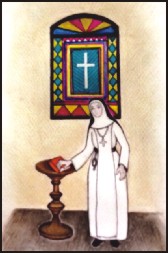
In those days, the nuns were mostly English women, wearing the traditional nun’s attire… a white habit belted at the waist with a woollen cord to which a rosary was fixed, a long panel of cloth over the habit called the ‘scapular,’ a tight fitting wimple framing the face, topped by a black veil. A chain bearing a heavy crucifix hung over the scapular. Stockings and sensible flat shoes completed the outfit which was stiff and crackling with starch. Mother Dominic was a stern disciplinarian and could use her cane too. Mother Martha taught the piano and was given to outbursts of temper. Young Mother La Salatte was gentle and sweet tempered allowing small children to sit on her lap, hold the crucifix or even to stroke her clipped hair under the wimple.

I had special piano lessons with Mother Martha and learnt to sing and play two lines:

‘Little birdie on a tree

Shakes his head and

looks at me.’

The notation as I remembered it, went C B C D C B C. But I am told that could not be right. The lessons ended in floods of tears after Mother Martha ‘accidentally’ poked me in the eye. Another song that all the children sang together was, as I later learnt, a hunting song.

‘Do you ken John Peel, do

you ken John Peel,

At break of day, with his coat

so gay,

Do you ken John Peel?’

The last line went into the upper octave and I loved shouting it out with no idea what it all meant.

In those days of the World War, some Anglo-Burman children lived in the Convent. I was fascinated by Pauline, who always wore white stockings. I so longed for such a pair that they were ordered from Bengaluru for me. I put them on without a belt or garter and by the time I walked into class they were forming pouches at the knees and soon drooping down in sagging folds. I began to cry. Children then had their faces powdered with talcum, the popular one being Johnson’s. Soon my face was streaked with runnels of grey and brown where teats washed away the powder. Pauline was beside herself and everyone was tittering until Mother Dominic settled them in neat rolls around my ankles. One remembers a shame into old age!

Years later one of Mother Martha’s successors, a nun who was an excellent pianist, did some innovative work on the piano. This was Sister John Britto. She belonged to a Railway family of the Dorechettis, who had Pondicherry connections. Years ago when we went to visit her at the Convent, she received us in the Music Room and played a few bars of Raga Hamsadhvani for us. The tune was recognisably that of the Kriti, ‘Vatapi Ganapathim Bhaje,’ the room with the cross and the pictures of saints on the wall, an unusual place to hear this composition. Sister John later held a full concert of Karnatak music in Jaganmohan Palace. The piano was set at an angle so that the pianist had her back partially to the audience but her hands were visible to the listeners. She was accompanied by musicians on the mridanga and the ghata as well as a sari-clad lady who kept the tala. Surely this was a Catholic with very Catholic tastes. At 91 years of age, she no longer plays the piano but lives in Bengaluru with a community of nuns who work for St. Martha’s Hospital.

The nuns were very dedicated to their work. They asked for no favours, only asking children who had gardens for flowers for the altar, help with the reredos, or, rarely, to ask the loan of a car for medical appointments. I never knew what became of them because I myself fell ill and stayed in bed for a whole year and stopped going to school to be tutored at home. Our tradition is to acknowledge every teacher, however, short the learning period. To the distant memory of these teachers I tender my salutations.

source: http://www.starofmysore.com / Star of Mysore / Home> Feature Articles / Sunday – June 07th, 2015

At Ballari, a Museum to Tell Stories of a Forgotten Past

A worker giving final touches to a replica of Sanganakallu gudda, said to be South India’s largest neolithic site, inside the museum

Ballari  :

To preserve the stone artifacts found in South India’s “largest neolithic site” located in Sanganakallu village, Ballari, and other places such as Vijayapura and Kurnool, Andhra Pradesh, a mini museum is being readied at the cultural complex here.

The goal behind setting up this museum is preserving  the neolithic stone artifacts in a scientific manner and documenting them properly to help research scholars. A few artifacts will also be kept on display for the public.

According to Prof Ravi Korishettar, who conducted research on the site in Sanganakallu for 10 years, the site is the largest neolithic site in South India.

The hilltop site is spread over 1,000 acres.  However, he told Express that rampant stone quarrying has been destroying the site. At the museum, the artifacts Korishettar found during his small-scale excavations will be preserved.

He said as part of his research, he explored around 40 neolithic sites in Karnataka and Andhra Pradesh, and found artifacts after excavations in 20.

In 2008, he appealed to the Ballari deputy commissioner to take steps to set up a mini museum to preserve the artifacts. The DC approved the proposal, but work was delayed for years due to technical reasons.

But the museum is now nearing completion and according to sources, is expected to be thrown open in two months.

source: http://www.newindianexpress.com / The New Indian Express / Home> States> Karnataka / by Bhukker Madhu Kumar / June 10th, 2015

Pages from History : Musings on Royal Saint Pipa

by Prof. A.V. Narasimha Murthy, former Head, Department of Ancient History & Archaeology, University of Mysore

Royal Saint Pipa or Pipadeva was the king of a small State called Gagaraunghra. Actually his correct dates are not known but he is said to have flourished in the 16th Century. He was famous as a righteous king and particularly showed great respect to saints and his position did not come in the way of serving them. His family deity was called Jagadambadevi (mother of the earth). According to stories current in that area, Pipa was capable of talking to the Goddess and he even fed her. Thus she would accept the offerings directly from king Pipa.

He led a simple life and never indulged in royal luxuries. He was very regular in reading scriptures and meditation. Ascetics who passed that way would normally visit his Palace and talk to him about dharma. Once a group of ascetics came to the Palace. He welcomed them and made arrangements for their comfortable stay. As usual he went to the temple of Jagadamba for worship. To his surprise she told him that she would take the offerings only after his guests had their food. Accordingly, Pipa offered them food and had their blessings. Then Pipa requested them to guide him to have the darshan of Lord Rama. They told him to start this procedure through a Guru and asked him to go to Varanasi and became a disciple of Swami Ramananda.

Pipa went to Varanasi and sent a message that he wanted to meet him. Ramananda sent the reply saying that his hermitage is open only to poor people and not kings. Immediately Pipa gave up his kingdom and distributed his wealth among the needy and the poor. To test his devotion, Ramananda asked him to jump into a well. Pipa was ready to do that. Ramananda stopped him and went to his Palace. Pipa was impressed by his guru Ramananda and wanted to be his follower listening to his religious discourses. Ramananda disuaded him and told him that it would be difficult for a king who had so much of royal responsibilities to be a disciple of an ascetic because of the hard life involved. He asked, ‘Can you fast for days together because you may not get food at all. Even if you get something to eat, it will be so simple and may be unpalatable because of its tastelessness. That too you have to beg and get the food. Nobody will supply the food.’ Pipa agreed.

But to test him further, Ramananda sent him to a place where no offerings were available. Pipa came back empty handed. The Saint asked him what he will do for food. Pipa replied, God wants that I should fast and try to understand how poor people led their lives days together. This is a lesson for me from the God divine. He fasted but concentrated on reading the scriptures and doing meditation.

In the meantime, Ramananda wanted to go to Dwaraka, the place of Lord Krishna. Pipa expressed his desire to go with the saint to Dwaraka. Ramananda told him that the journey by walk would be highly difficult for a king like Pipa. But Pipa was steadfast in his resolve to go to Dwaraka, the great pilgrimage centre of Lord Krishna. Then Ramananda told him that he could go with him as an ascetic and not as a king. Pipa immediately abdicates his throne and becomes an ordinary man. Hearing this news his wife too refuses to live in a Palace where her husband is not there and hence expresses her desire to accompany him to Dwaraka. Thus both husband and wife go to Dwaraka.

After reaching Dwaraka. Pipa is supremely happy and worships Lord Krishna with all devotion. He refuses to take food and is simply immersed in meditation at the holy feet of Lord Krishna. Lord Krishna is pleased with Pipa, gives him darshan, blesses him and tells that he would get moksha or salvation if he continued in the same path uninterrupted by worldly desires. Pipa returns to his place.

The people of the State to whom he was a king were surprised and adore him as a great saint. They come in large numbers and pay respects to him. He tells them not to bring any worldly offerings but to come with devotion to Lord Krishna. Some jealous people kidnap his wife but Pipa prays to Lord Krishna who saves her through some pious people. Pipa was very happy and his devotion to the Lord increased manifold.

Another incident is equally interesting. Once Pipa and his wife were passing through a forest and suddenly a lion accosted them. His wife was afraid but Pipa told her that God would reside in a lion also and we should not be afraid of him. Pipa spoke to the lion as if he was his friend and advised him not to trouble the people who did not harm him. The lion came nearer Pipa and licked his feet showing friendship and affection. Pipa patted him and prayed to the Lord to give him a human birth next time and whispered Rama- Krishna mantra in his ears. The ferocious lion became a tamed animal and local people were surprised at this sudden change in the lion. They knew it was the magic of Pipa. It is said, this lion was born as Narsi Mehta in the next birth.

Once Pipa found a vessel full of gold coins. When he mentioned this to his wife, some thieves overheard this and went there to take away the gold coins. But to their disappointment they found a snake in the vessel. But when Pipa went there, he found the gold coins which he distributed among the poor people.

Pipa had a cow which supplied milk to the ascetics. One day some thieves stole the cow and ran away. Pipa ran after them along with the calf and shouted, ‘Friends, you will not get the milk without the calf, please take the calf also.’ The thieves were taken aback and ran away leaving the cow.

Once Pipa went to a friend’s house for food. He noted the absence of his wife as the husband alone was serving food. Pipa understood that she was hiding herself because she did not have decent clothes to come out. Immediately Pipa blessed her and there was no dearth of clothes and food at her house thereafter. Impressed by this, the friend and his wife became devo- tees of Pipa.

Many devotees came to Pipa for advice and guidance. He refrained from giving them discourse or lecture but asked them to lead a simple life following ethical principles. He specially told them to avoid luxury. Rich people can see God if they can serve the poor. God is a friend of the poor people. Many rich people came to him and offered gold and money to exhibit their richness and show their vanity. The first advice of Pipa to such people was to come with empty hand after distributing all money to the poor and needy. Then only one would understand the secret of life. Thus many rich people went away disappointed and Pipa felt sorry for their ignorance of the divinity.

Once a rich merchant came to Pipa and requested him to visit his mansion so that he could show him his wealth. But Pipa did not accept his invitation because he did not want to disappoint the common people. The rich merchant tried to entice Pipa by telling him that his visit may enrich his wealth. Pipa did not go to his house and told him to distribute his wealth to the poor. A disappointed merchant went back cursing him. In the meantime, the merchant incurred heavy losses and became poor. Even then his greed for wealth did not diminish. He came to Pipa and requested him to bless him with original wealth and in return he would give him some wealth. Pipa advised him to pray for permanent divine wealth and not temporary monetary wealth. Ultimately he became his disciple.

Thus Pipa became a household name in 16th Century for his simplicity and religious life. Though he is not known widely in South India, his impact on dharmic way of life is felt in North India. That is the greatness of king Pipa.

source: http://www.starofmysore.com / Star of Mysore / Home> Feature Articles / Sunday – June 07th, 2015

MAN AND MACHINE – Fiat 1100 charms the millennials too

A still from Pannaiyarum Padminiyum, a film woven around the love for the Premier Padmini. The film had a young director and story-screenplay writer in S.U. Arun Kumar

‘Fiat 1100 Club Bangalore’, has used Facebook to create a wider network of the car’s owners.

“Do not speak ill of the dead” is an often-repeated exhortation. And it is one that usually goes unheeded. But when it comes to automobiles that have gone out of production or ‘departed’, we follow it to the letter, all the time.

Even when the negative features are brought up, they only serve to further glorify the ‘departed’ automobile.

Sujith Thomas, a car enthusiast and an automobile engineer, ‘treasures’ memories of his family’s Premier Padmini stalling in rush-hour traffic, and them pushing the vehicle away from the chaotic blares of horns. There are also vivid and happy recollections of rainy days, when a loose distributor cap would allow water to seep in and cut off the electricity supply to the spark plugs. The Padmini has helped Sujith realise that the world is not as uncertain a place as it is painted to be; there are certain things one can count on. “The Premier Padmini’s radiator hose could be counted on to blow out anytime,” says Sujith.

Sujith will continue to add to these memories, because he is keeping a 1978 Premier Padmini 1100 Deluxe BE on ‘life support’, by connecting with other Fiat 1100 enthusiasts and scouring the scrap yards for spares.

In 2009, he joined three other Fiat 1100 enthusiasts – Arun Srinivasan, Karthik Makam and Karthik M.B. – to form the ‘Fiat 1100 Club Bangalore’, which has used Facebook to create a wider network of the car’s owners.

The club has over 200 members, with the majority coming from Bangalore, and some even from European countries. Sujith has learnt from them that sourcing spares for Fiat 1100 cars in Europe is more difficult than in India. The success of the initiative, according to Sujith, is the exchange of information on availability of spares.

What I find most impressive about the club is that it is helmed by millennials. When the club was formed six years ago, its founders were in their twenties. Sujith is 27 now and the other three are in their early 30s. The majority of the club members are in their fifties and sixties.

It augurs well for the Fiat 1100. It is a crucial time for the car. Unless youngsters carry the baton and pass it on to the following generation, the Fiat 1100 may not have a great future as an antique car.

Sujith, however, does not see anything unusual about youngsters being drawn to the car. He believes it could appeal to any car enthusiast, irrespective of age. “It has more pluses than minuses. The best quality about the Fiat 1100 is its simplicity — due to its simple design, it can be easily repaired by any mechanic. Even the owner, without a profound knowledge about how automobiles work, can understand its mechanism and, if he applies his mind to it, carry out a few repairs on the car himself,” says Sujith.

I am impelled to believe the millennials have done for the Fiat 1100 more than we credit them for.

The greatest tribute to the car has come from a young film director, S.U. Arun Kumar. He was the story and screenplay writer and director of Pannaiyarum Padminiyum, an engaging film woven around the love for this car.

source: http://www.thehindu.com / The Hindu / Home> Features> Metroplus / by Prince Frederick / June 10th, 2015

Gold medals presented to the College toppers

Gurikar Marimallappa Samsmaranotsava: 2014-15

S. Neha, M. Nischay Prasad and M. Ravish, toppers of Marimallappa’s PU College, were presented with gold medals during Gurikar Marimallappa Samsmaranotsava: 2014-15 at the College premises in city on Saturday.

Mysuru :

Three top ranking students (Science, Commerce and Arts) of Marimallappa PU College were presented gold medals at ‘Sri Gurikar Marimallappa Samsmaranotsava: 2014-15’ organised at the College premises here on Saturday.

Speaking after inaugurating the programme, AIISH Director Dr. S.R. Savitri said there is no short cut to success.

It is only dedication, concentration and hardwork that matters in every achievements, she said and urged the students to develop a probing attitude.

Stressing on the need for allowing the students to make their own choice of subjects, the AIISH Director called upon the students to take suggestions from elders and teachers and shape a good future for themselves.

On the occasion, gold medals were presented to the PU toppers — M. Nischay Prasad (590/600 – Science stream – Gurikar Gold Medal), S. Neha (578/600 in Commerce – Bhagya Shilpi Gold Medal) and M. Ravish (559/600 – Arts – Mathrushri Gold Medal).

Also, 276 other students of the college, who passed out with distinction, were presented merit certificates on the occasion.

Marimallappa Educational Institutions Hon. President S. Paramashivaiah, Hon. Secretary Prof. E.N. Panchaksharaswamy, DDPU K.M. Puttu, College Principal Dr. B.S. Parvatharaju, Managing Committee Convenor S. Basavaraju and others were present on the occasion.

source: http://www.starofmysore.com / Star of Mysore / Home> General News / Monday – June 08th, 2015

Mobile Veterinary Service launched at Bandipur to treat injured wild animals

Brunda Malhotra of Aircel is seen handing over the keys of the Mobile Veterinary Service vehicle to H.C. Kantharaju, Conservator of Forests, Bandipur, yesterday as others look on.

Chamarajanagar :

In what could be said as the first ever in the State, a Mobile Veterinary Service (MVS), to treat injured wild animals, was launched at Bandipur Tiger Reserve (BTR) yesterday.

Wildlife Trust of India (WTI), in collaboration with the Forest Department and Aircel, launched the service for the first time in Karnataka to facilitate the rescue of wild animals and respond to all wildlife emergencies.

A vehicle to carry out the service was handed over to Conservator of Forests and Bandipur Project Tiger Director, H.C. Kantharaju, by WTI Zonal Head Jose Louis and Brunda Malhotra of Aircel.

Kantharaju, speaking on the occasion, said: “In the past couple of years, there have been instances of large carnivores venturing out of the forests into human habitations which has resulted in human and animal deaths. With an MVS like this, we can immediately tend to these animals and put them back into the wild or provide necessary treatment, if needed.”

The mobile unit will have a trained veterinarian, two wildlife conservation staff and a driver, who would respond at any time for any emergency reported from the region, Kantharaju added.

BTR is surrounded by close to 200 villages with a population of more than three lakh inhabiting these villages and over two lakh cattle. These areas surrounding Bandipur have witnessed frequent occurrences of conflict with tigers, leopards and elephants. In addition, the spurt in poaching activities and use of snares in Bandipur over the past few years have had authorities and conservationists on their toes.

The unit would be based at Special Tiger Protection Force (STPF) camp at Melkhamanahalli and will be operational 24×7 and villagers can call Ph: 08229-236043 or Mob: 87621-11704 in case of an animal emergency.

Meanwhile, WTI Zonal Head Jose Louis said that the vehicle, apart from responding to emergencies in Bandipur limits, will also provide service in Biligiri Ranganatha Temple (BRT) Wildlife Reserve, Nagarahole, Malai Mahadeshwara Wildlife Reserve and would also provide services in Mudumalai Forest in Tamil Nadu and Waynad Forest Reserve in Kerala.

DCF Keshavamurthy, Wildlife Warden D. Rajkumar and others were present

source: http://www.starofmysore.com / Star of Mysore / Home> General News / January 10th, 2015

Bhramara lifetime achievement and lifetime services awards presented

to Prof. K. Vijay Raghavan and Dr. N. Chandrashekar

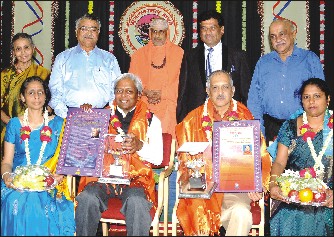
Sri Shivarathri Deshikendra Swamiji of Suttur Mutt (standing centre) presented Bhramara’s Lifetime Achievement Award to Prof. Krishnaswamy Vijay Raghavan (seated second from left), Secretary, Department of Biotechnology, Government of India and Bhramara’s Lifetime Service Award to Dr. N. Chandrashekar (seated second from right), Chairman and Director, Aadithya Adhikari Hospital, Mysuru, at a function held at Rani Bahadur Auditorium on Hunsur road in city yesterday. Usha Vijay Raghavan (seated extreme left) and Rani Chandrashekar (seated extreme right) were also felicitated on the occasion. They are seen with (standing from left) Madhuri Thathachari of Bhramara Trust of Y. T. & Madhuri Thathachari, Mysuru; K. B. Ganapathy, Editor-in-Chief, Star of Mysore and Mysooru Mithra; Prof. K.S. Rangappa, VC, University of Mysore and Prof. Desirazu Narasimha Rao, Divisional Chairman of Biological Sciences, Indian Institute of Science, Bengaluru.

 Mysuru :

The Bhramara’s Lifetime Achievement Award for Science-2015 was conferred on Prof. Krishnaswamy Vijay Raghavan, Secretary, Department of Biotechnology, Government of India and the Bhramara’s Lifetime Service to Humanity Award-2015 on Dr. N. Chandrashekar, Chairman and Director, Aadithya Adhikari Hospital, Gokulam, Mysuru, at a function held at Rani Bahadur Auditorium in Manasagangotri, Hunsur road here yesterday.

Sri Shivarathri Deshikendra Swamiji of Suttur Mutt presented the annual awards to Prof. Vijay Raghavan and Dr. Chandrashekar and delivered the benediction address.

Speaking on the importance of science and technology, Suttur Swamiji said we should not forget the roots of our spiritual needs.

Usha Vijay Raghavan and Rani Chandrashekar were also felicitated at the function.

In his acceptance speech, Prof. Vijay Raghavan said that more number of efficient Professors were required in the field of Biotechnology as the research work continued to grow.

Technology has been playing a key role in biological sciences, he said and added that education is important for every child in the country.

Prof. Vijay Raghavan pointed out that there was rapid progress in science and technology which has helped in reducing some of the problems in our society.

Dr. Chandrashekar, who also spoke, said that his first priority was social service as advised by his teachers and was grateful to his teacher Raghavendraswamy. He said that he would continue his service in the field of medical service, specially procuring of cornea from the eyes of the donors after death.

Prof. K.S. Rangappa, Vice- Chancellor, University of Mysore, who presided, said that Prof. Y.T. Thathachari was a great Scientist, Pandit and also a Visionary.

The VC congratulated the two eminent personalities who have distinguished themselves in their respective fields for being honoured with the prestigious awards by the Bhramara Trust.

A great offering to God

K.B. Ganapathy, Editor-in- Chief, Star of Mysore and Mysooru Mithra, who introduced Dr. Chandrashekar, said that he (Dr. Chandrashekar) has been rendering yeoman service to humanity, which indeed is a great offering to God. He recalled a saying and said that the birth of a man is God’s gift to mankind, but what that man becomes in life is man’s gift to God. One such gift of man to God is Dr. Chandrashekar.

Prof. Desirazu Narasimha Rao, Divisional Chairman of Biological Sciences, Indian Institute of Science, Bengaluru, introduced Prof. Vijay Raghavan.

Managing Trustee of Bhramara Trust Madhuri Thathachari, Trustee Prof. Srinivasan and others were present.

source: http://www.starofmysore.com / Star of Mysore / Home> General News / June 10th, 2015

Basic course in Automobile Technology at NIE

Students from NMMIT, Nitte, BMSE, Bengaluru and SJCE, Mysuru, who underwent training last week, are seen with Dr. T.N. Shridhar, Head - NECAT, Mohan, Asst. Manager, NECAT and others.
Students from NMMIT, Nitte, BMSE, Bengaluru and SJCE, Mysuru, who underwent training last week, are seen with Dr. T.N. Shridhar, Head – NECAT, Mohan, Asst. Manager, NECAT and others.

Mysuru :

The NIE-EICHER Centre for Automobile Technology (NECAT), the first of its kind centre in India, established in collaboration with VOLVO-EICHER Commercial Vehicles Ltd., at the National Institute of Engineering (NIE) on Manandawadi Road here, conducted training to the first batch of students from NMMIT and Nitte last week.

During this week, the Centre is conducting Basic Course in Automobile Technology (BCAT) course for 25 students per batch for six days for the students from NMMIT, Nitte, SJCE, Mysuru and BMSE, Bengaluru.

Apart from this course, NECAT conducts advance courses and modular courses apart from tailor-made courses regularly for the engineers from L&T, Meritor, Bosch among others.

The Centre provides top-notch training and education to students and faculty members of industrial and vocational training institutes, polytechnics and engineering colleges.

It also conducts training programmes for the industry and automobile dealers with extensive hands-on practical sessions in a most scientific way of repair, maintenance and overhaul of commercial vehicles.

Engineering students of various institutions across the country are undergoing training programme especially for BCAT course and the Centre has conducted BCAT course for more than 100 batches.

source: http://www.starofmysore.com / Star of  Mysore / Home> General News / Thursday – June 11th, 2015

Hubballi optometrist gets UK fellowship

Hubballi :

Kunal Shah , 35, a BS optometry graduate from BITS, Pilani-Sankara Nethralaya, and CEO of Hubballi-based startup Eyesavers has got a fellowship from the British Contact Lens Association (BCLA). He is the fourth India optometrist to receive the BCLA fellowship. Professor James Wolffsohn of Aston University honoured Shah in Pune recently.

Expressing joy on receiving the fete, Kunal told TOI that the adoption of technology has been instrumental in getting the fellowship.

“Our startup, floated two years ago, has been the first in India to adopt I-profiler technology by Zeiss and Visio Office Plus by Essilor from France which can calculate the position of eyes in front of the lenses at a precision of 1/10th mm at a click of a button. Now, 4-5 other optometrists have borrowed these technologies in India,” he said.

Kunal’s father Prakash Shah, who is also involved in optical business for the past five decades, said that he was worried when Kunal wanted to invest Rs 20 lakh on I-profiler and Rs 8.50 lakh on Visio Office Plus. “Now I am convinced by his innovations. Though we have Hubli Opticals since 1953, he floated separate brand at his own risk,” he said.

Kunal is offering free service using Visio Office Plus technology to avoid fitting errors. . “Usually, we don’t consider the size of nose, eyes and forehead while suggesting a frame for patients. This technology considers whether the wearer of the glass is head-mover or eye-mover while preparing the perfect frame,” he claimed.

Kunal is the only optometrist in North Karnataka to provide cosmetic eye to fill self-confidence among people who have only one eye by birth.

source: http://www.timesofindia.indiatimes.com / The Times of India / Home> City> Hubballi / by Sangamesh Menasinakai, TNN / June 10th, 2015

Damini dazzles as BAC dominate

Basavanagudi Aquatic Centre swimmers set the pool ablaze, creating five new meet records on the third and penultimate day of the State Junior and Sub-junior Swimming Championship here on Wednesday.

Damini K Gowda clinched the Group I, 50M butterfly gold in a record time of 29.89. The BAC swimmer erased the previous meet record set by Arhatha Magavi (30.17), four years ago. Damini added one more gold to her tally by winning the 200M backstroke (2:30.67) and in the process surpassing Nisha Millet’s State record of 2:32.49, set in 1999.

Dolphin Aquatics’ Sanjay CJ put up an impressive show and powered to gold in the boys’ Group II, 100M freestyle. Sanjay clocked 55.22 seconds for a new record. Sanjay bettered Aniketh D’Souza’s (JSC) timing of 58.20.

Malavika V also kept her fine form going, bagging her third yellow metal of the meet. The 17-year old from BAC won the Group I 100M freestyle (1:00.22) and went past Nisha Millet’s meet record of 1:00.37 set in 1999.

Results: Group I: Boys: 400M freestyle: Avinash M (BAC) 4:14.75, 1; Mohammed Yaqoob Saleem (DA) 4:16.90, 2; Rahul M (BAC) 4:23.24, 3. 100M freestyle: Mohammed Yaqoob Saleem (DA) 56.34, 1; Vishwesh C Dudham (BAC) 56.82, 2; Rahul M (BAC) 57.13, 3. 200M backstroke: Joseph Padavath (BAC) 2:23.30, 1; Hemanth Jenukal V B (GSC) 2:23.70, 2; Nishanth Kumar (GSC) 2:28.25, 3. 50M breaststroke: Vaishnav Hegde (DA) 30.70 (NMR; OMR: Likith SP 31.22 (BAC) 2013), 1; Pruthvik D S (BAC) 33.00, 2; Rakshith R (GSC) 34.57, 3.50M butterfly: Avinash M (BAC) 26.82 (NMR; OMR: Rahul Batra 26.94 BAC, 2001), 1; Vishwesh C Dudham (BAC) 27.26, 2; Suhas P M (Aims) 29.06, 3.4x200M freestyle: BAC ‘A’ (BAC) 8:44.87, 1; BAC ‘B’ (BAC) 8:53.79, 2; GSC 1 (GSC) 9:14.79, 3.

Group II: 400M freestyle: Sanjay C J (DA) 4:27.21, 1; P Kushal (DA) 4:40.23, 2; Mihir Ahuja (DA) 4:51.80, 3. 100M freestyle: Sanjay C J (DA) 55.22 (Aniketh D’ Souza 58.20 JSC 2002), 1; Siddharth Rai (BAC) 1:01.61, 2; Vinod R (BAC) 1:03.70, 3. 200M backstroke: N Sri Hari (GSC) 2:20.62 (NMR; OMR: S Siva 2:21.15 (BAC) 2014), 1; Bhavesh R (DA) 2:36.93, 2; Mihir Ahuja (DA) 2:43.18, 3.50M breaststroke: Manohar M Prabhu (MAC) 33.61, 1; P Kushal (DA) 35.45, 2; Naveen Kumar T (BAC) 36.22, 3. 50M butterfly: Vaishnav V Rao (BAC) 30.69, 1; Anirudh J (BAC) 30.77, 2; Uday M L (PETAC) 31.44, 3. Group III: 50M freestyle:Prasidha Krishna P A (GSC) 28.57, 1; S Hiten Mittal (BAC) 29.05, 2; Abhay Kumar (SL) 29.16, 3. 100M backstroke: Shivansh Singh (BAC) 1:14.07, 1; R Vaibhav Shet (GSC) 1:17.66, 2; Deep Gilda (PMSC) 1:18.37, 3. 50M butterfly: Prasidha Krishna P A (GSC) 29.40, 1; S Hiten Mittal (BAC) 30.07, 2; Raj Vinayak Relakar (PMSC) 30.57, 3.

Group IV: 50M breaststroke: Shoan Ganguly (DA) 42.14, 1; Utkarsh S Patil (PMSC) 42.90, 2; R Akshaya Shet (GSC) 43.17, 3.

Girls: Group I: 100M freestyle: Malavika V (BAC) 1:00.22 (NMR; OMR: Nisha Millet 1:00.37, BAC, 1999), 1; Damini K Gowda (BAC) 1:00.90, 2; Deeksha Ramesh (GSC) 1:04.23, 3. 400M freestyle: Malavika V (BAC) 4:34.23, 1; Nikitha SV (BAC) 4:51.02, 2; Rhia Singh (BAC) 4:52.04, 3. 50M breaststroke: Charu Hamsini (BAC) 35.70 (NMR; OMR: Divya Guruswamy 36.45 GSC, 2011), 1; Riddhi S Bohra (PMSC) 37.02, 2; Deeksha Ramesh (GSC) 37.65, 3. 200M backstroke:Damini K Gowda (BAC) 2:30.67 (NMR; OMR: Nisha Millet, 2:32.49 BAC, 1999), 1; K Harishree J Rai (GSC) 2:36.71, 2; Jhanati Rajesh (BAC) 2:41.05, 3. 4x200M freestyle relay: BAC A (9:37.04), 1; BAC B (9:37.59), 2; GSC 1 (10:54.41), 3. 50M butterfly: Damini K Gowda (BAC) 29.89 (Arhatha Magavi 30.17. DOL, 2011), 1; Charu Hamsini DA (BAC) 31.38, 2; Chandana (VSC) 31.70, 3.

Group II: 100M freestyle: Harshitha (BAC) 1:05.87, 1; Saloni Dalal (PMSC) 1:08.55, 2; Harshitha Jayaram (GSC) 1:08.74, 3. 400M freestyle: Nandini SS (BAC) 4:57.65, 1; Harshitha J (BAC) 5:04.64, 2; Abhigna Anand (BAC) 5:10.68, 3.200M backstroke: Vibha Aparna Bhovnsle (BAC) 2:46.40, 1; Sushma S Bharadwaj (ASC) 2:53.30, 2; Hita Juneja (BAC) 2:58.43, 3 50M breaststroke:Saloni Dalal (PMSC) 37.13 (NMR; OMR: Charu Hamsini DA 37.51, BAC 2011), 1; Harshitha Jayaram (GSC) 37.71, 2; Pratiksha Patel (DA) 40.53, 3. 50M butterfly:Mayuri Lingaraj (BAC) 31.67, 1; Thanuja S (BAC) 31.69, 2; Sunaina Manjunath (BAC) 32.40, 3.

Group III: 50M freestyle: Smruthi Mahalingam (BAC) 30.44, 1; Khushi Dinesh (BAC) 30.58, 2; Riddhi Juyal (PMSC) 31.00, 3. 100M backstroke: Suvana C Baskar (DA) 1:14.82, 1; Kshithija K (BAC) 1:18.82, 2; Vaishnavi P (BAC) 1:20.22, 3.

50M butterfly: Smruthi Mahalingam (BAC) 32.92, 1; Poojitha G Murthy (BAC) 33.11, 2; Suvana C Baskar (DA) 33.59, 3.

Group IV: 50M breaststroke: A Jedidah (DA) 44.34, 1; Latiesha Mandanna (Young Challengers) 46.11, 2; Keerthi B (PMSC) 46.64, 3.

source: http://www.deccanherald.com / Deccan Herald / Home> Sports / DHNS – Bengaluru , June 11th, 2015