Ameet Deshpande, a 17-year-old student from AECS Maruti Public School, has been selected for the International Chemistry Olympiad (ICO) to be held in Bratislava, Slovakia.
Of the 30 students who participated from India, four students were selected for the International Olympiad and Ameet is one of them. Ameet has also enrolled at FIITJEE Bangalore.
Ameet is also an avid footballer. The Olympiad consists of two sessions that run for five hours each and the winner will be decided by a scientific jury set up by the host nation.
“I enjoy chemistry because it is one of the most practical subjects, but I am undecided whether I will pursue it as a career. I am very happy and thankful to all my teachers who helped me to achieve this goal,” said Ameet.
source: http://www.timesofindia.indiatimes.com / The Times of India / Home> City> Bengaluru / TNN / June 07th, 2015
1) The Royal staircase, constructed using white marbles was used by VVIPs at the Lalitha Mahal Palace. 2) The bed room of the Viceroy’s room. [Pics by Ramesh Sarkar]by S.N. Venkatnag Sobers
One of the must visit places in Mysuru is the famous Lalitha Mahal Palace which is located in Siddharthanagar. Lalitha Mahal Palace is the largest Palace in Mysuru after Amba Vilas Palace.
Lalitha Mahal Palace was built by the then King Nalwadi Krishnaraja Wadiyar in 1921 for the Viceroy of India, who visited Mysuru. Built on a raised ground, the Palace was fashioned on the lines of St. Paul’s Cathedral in London and is one of the imposing structures of Mysuru city.
Painted in pure white, Lalitha Mahal Palace was converted into a heritage hotel in 1974. The hotel is now run by the Lalit Ashok Group belonging to India Tourism Development Corporation (ITDC), Government of India. Despite the hotel being taken over by the Government, it has made sure retain the royal ambience.
Set amidst sprawling landscaped gardens below the Chamundi Hills, the Lalitha Mahal Palace was planned by E.W. Fritchley, the architect from Mumbai and constructed by B. Munivenkatappa. The Palace built in Renaissance architectural style is considered as an adaptation of the St. Paul’s Cathedral in London, particularly the central dome. The architecture of the Palace reflects English manor houses and Italian Palazzos. It is a two storied structure. The supporting structure of the Palace is of Ionic double column. At the ground level, there is a projecting porch. Spherical domes with the dominating central dome sets the front elevation of the Palace. Decorative stained glass has been extensively used to enhance the elegance of the Palace, both in the exterior facades and in interiors doors, windows and ceilings. A lovely view of the Chamundi Hill to the left and in front the Mysuru city is seen from the balcony.
The Palace has exquisitely designed Viceroy Room, a Banquet Hall, a Dancing Floor and an Italian Marble Staircase and is also embellished with small ornamentations, which are said to be replicas from various Palaces in Britain. The full length portraits of the Wadiyar Kings, Italian Marble Floors and Belgian Crystal Chandeliers, Cut Glass Lamps, Heavy Ornate Furniture, Mosaic Tiles and a couple of exquisite Persian carpets gives the Palace its regal ambience. With conversion of the Palace into a heritage hotel, interiors have been modified to provide modern conveniences but most of the earlier sections of the Palace such as the dancing and banquet halls have been retained in their original elegance but adopted as dining halls and conference halls for holding meetings and conventions; these have polished wooden flooring and three stain glass domes in the ceiling. The ballroom in particular, which has been converted into the Dining Hall, is a baroque hall with immensely high ceiling with domed skylights made of Belgian glass. The floor of the ballroom is also fitted with springs that are adjustable. The ballroom was used by the British for organising parties. The floor was made adjustable to the type of dance they wished to perform on that day. A swimming pool is now an additional provision. The elevator which was installed here in 1921 is still in working condition and is used by the guests who visit the hotel.
Unique features of Lalitha Mahal Palace
Lalitha Mahal Palace is known for some unique features which are not seen in any hotels in city. Paintings of Nalwadi Krishnaraja Wadiyar and Jayachamaraja Wadiyar which are displayed here are unique as they are three dimensional. One can see the painting turning towards us as we move to different directions in front of the paintings displayed in the lobby area. This was discovered only when the paintings were sent for restoration at Regional Conservation Laboratory a few years ago. The paintings were done by artistes A.R. Vasu and Nagaraj in 1944.
The ITDC has also maintained the fittings in the bathroom which were installed during the construction of the Palace.
Speaking to Star of Mysore, Lalitha Mahal Palace Hotel General Manager Joseph Mathias said that the ITDC had taken up restoration works of the Palace since it was old. “The Palace was constructed using the mixture of limestone and mud. For the Palace to be restored, we need experts to take up the restoration works. The ITDC had approached the Regional Conservatory Laboratory (RCL) for the restoration works, they have prepared a Detailed Project Report (DPR) which has been submitted to our head office in New Delhi. The works will be taken up soon after an approval is given for the same”, said Joseph Mathias.
The ITDC plans to take up the restoration of the domes of the Palace in the first phase soon after the monsoon season ends and in the later stages it will take up the renovation of rooms and other works.
No information on disinvestment
Joseph Mathias said that neither he nor ITDC had received any information with respect to Central Government’s decision to disinvest in Lalitha Mahal Palace Hotel. He added that though the Minister had expressed his opinion, no official communication had been received.
Further, he added that the Lalitha Mahal Palace had earned a net profit of Rs. 27 lakh in the past couple of months after he took over the charge as the General Manager of the hotel. He also said that the ITDC had earned a total profit of Rs. 40 crore in last fiscal year.
The reason for the Lalitha Mahal Palace Hotel to incur loss in the last fiscal year was due to expenditure on repair works. The ITDC has spent Rs. 54 lakh on repair of roads within the hotel premises, Rs. 26 lakh on Effluent Treatment Plant (ETP) and Rs. 10-15 lakh on electrical works, said Mathias.
If the hotel is privatised it will become a concrete jungle and the green space which is surrounding the Lalitha Mahal Palace will vanish. People living in surrounding areas of Lalitha Mahal Palace will have no place to go for their morning and evening walks.
The Palace is located on 46 acre land, only 10 acre of land is used for the construction and the rest has been preserved as green cover to provide fresh air for the guests as well as the people living in surrounding areas.
Training for students
ITDC has been conducting training programme for the students who have been brought from the North Eastern States of the country. The corporation has been a part of a programme called Development of North East Region (DONER) which focuses on giving exposure to the students of North-East region.
They are trained for a year in various aspects of Hotel Management such as the Front Office, Food and Beverage Department and others. ITDC also helps in placing these trained students in various hotels across the country.
New initiatives
General Manager Joesph Mathias said that he plans to introduce new schemes for the benefit of Mysureans who wish to visit the Lalitha Mahal Palace.
He added that soon, ITDC would introduce a programme where a person can visit the Palace Hotel paying Rs. 1,200 and stay till evening. The day starts at 11 am; he/she will be given a traditional welcome with a welcome drink. Later, the visitor will be taken on a tour of the Palace Hotel, lunch will be served, he/she can also use the swimming pool. Before checking-out the visitor will be served with tea/coffee and cookies. Others, who do not wish to pay Rs. 1,200 and just want to visit the Palace, will have to pay Rs. 100 as cover charge. They will be allowed to go around in the ground floor of the Palace Hotel and later will be served with coffee or tea. However, they will have to pay extra for having food and beverages.
Mathais also said that he has plans to organise ‘Steak and Sizzler’ festival during August or September and later ‘Dandiya Nights’ during Dasara festivities.
A place for marriages
Lalitha Mahal Palace Hotel is known for hosting wedding events. The elite class in Mysuru have had their marriages arranged at the Palace Hotel. The hotel rents out the entire Palace for the wedding and other events. There is also a banquet hall, ball room, swimming pool area, front area of the Palace which are rented out for wedding and other occasions.
Film Shooting
Lalitha Mahal Palace has been a popular destination for film shooting. There have been more than 600 films been shot here. Films starring Rajnikanth, late Vishnuvardhan, Akshay Kumar, Sonakshi Sinha and other superstars have been shot in Lalitha Mahal Palace premises.
With ITDC coming up with new initiatives, we only hope the Lalitha Mahal Palace Hotel continues to attract a lot of guests who will enjoy their stay at the magnificent structure in city.
source: http://www.starofmysore.com / Star of Mysore / Home> Feature Articles / Saturday – June 02nd, 2015
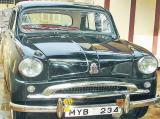
As a school-going boy, he saw the Mysuru Maharani’s Daimler pick his grandmother up from his house. Fascinated by the Daimler, the young boy came running out and sat on the compound wall staring at this royal beauty.
He had made up his mind. He was firm on owning this royal machine one day. Now a retired businessman, Ramanna is the enthusiastic owner of a 1951 Daimler Consort, which he has named — Betty.
“It is a Daimler passion rather than a vintage passion,” says Ramanna proudly. Recalling his school days, he says, “When I used to sit on the wall watching the Daimler, the driver of the car came up to me one day and said, ‘Boy…you will become a driver like me if you sit here and watch. Go inside and study,’ and these words thrilled me and I decided that I will own a Daimler one day, instead of sitting in my grandfather’s Austin 7.”
The original Daimler company closed down but Ramanna’s dream was still alive. Years passed, and one day, in 1998, his brother rang up saying, “There is a Daimler for sale, are you interested?” Without wasting a second, Ramanna said yes and there was his dream. “The car was in pieces. There was no wiring, no headlights. But she was a Daimler,” he says. She lay in their house in pieces for four years and the mission of fixing her began after Ramanna’s retirement.
“There were hardly any mechanics who were ready to come and she would not go out of this house. Finally, I got my father’s mechanic, Murthy. He was old and we used to work from morning to noon and take a break,” he explains.
The slow process kickstarted again when Ramanna’s daughter went to London Business School. “I did not know the technicalities of the car. As my daughter was in London, I could get in touch with ‘Daimler and Lanchester Club’ and many other Daimler owners,” he informs.
He wrote about his Daimler dream in the Club’s journal and it is then that he met a British guy who owned three Daimlers. He let Ramanna rip the parts of one of his spare Daimlers and Ramanna says, “He asked me to take all the parts I needed and I sat for four hours removing just four bolts! The British guy then came with a hammer and ripped all the parts and gave it to me,” he reminisces.
The parts were transported to India and he recalls, “My wife Mridula safely trolleyed the parts and no one questioned her at the customs.”
Ramanna’s Betty has undergone various stages of restoration and each part of hers has a story to tell. While Betty’s upholstery was done by a local sofa repairer riding a bicycle, her wiring was done by a mechanic who was a Dubai return.
“I had to pick up this Dubai returned mechanic in my Mercedes car. But later he did not finish the work and I completed it referring to the book given to me by the Daimler Club,” he says. The book was given to him as an appreciation for his passion by one of the British guys.
His strong passion for Daimler has also taken him to Gujarat as he says, “One
of the Daimler club members wrote to me to get the measurements of Maharaja’s Daimler in Gujarat, as he had the same model. I went till Gujarat and took the measurements and sent it to Britain. I did this, also because, I would get a ride in my dream car,” he explains.
Betty has rewarded Ramanna with a lot of new friends in the City and abroad. She has also let them be part of many vintage rallies including the ones in London.
Betty is taken out on Saturdays and Sundays on Sankey Tank Road or Cubbon Park. “We have three cars. One is Betty. The Mercedes we have is Veronica and the Esteem is Lucy. Veronica comes out for clubs and dinners and Lucy for all the regular work,” he says lovingly.
“Our children are abroad and now these three are our daughters,” the couple say. Ramanna adds that it has been a great journey with the Daimler and concludes, “Daimler was a dream and now it has become a reality after Betty came home.”
source: http://www.deccanherald.com / Deccan Herald / Home> Supplements> MetroLife / by Prajna GR, DHNS / June 02nd, 2015
A student, native of Hassan, has won a prize at the Intel International Science and Engineering Fair held at Pittsburgh, US recently.
S. Komal, a native of Nittur village near Hassan, participated in the fair with his classmate Aditya Bhargav. The device designed and displayed by the duo is used for knowing the carbon monoxide in air. The duo won the fourth award carrying $ 500. Both are class XII students at Sharada Vidyanikethana Public School in Mangaluru.
The fair was organised by the Society for Science and the Public in partnership with the Intel Foundation at Pittsburgh between May 10 and 15. Students were selected for the fair through competitions. Aditya Bhargav and Komal presented highly sensitive Nano-Ferrite meant for detection of carbon monoxide in air.
“Air pollution is a big problem in India. Vehicles have been contributing high rates of carbon monoxide to environment. We made efforts to develop a device to detect carbon monoxide content in the air, ” he told the media.
source: http://www.thehindu.com / The Hindu / Home> News> National> Karnataka / by Satish G.T, / Hassan – June 02nd, 2015
4 students from PESCE, Mandya, develop an app to count RBC on mobile phones
Seen in the picture are (from left) K.N. Pooja, H.S. Shwetha, Harshita Sinha and R. Parag of the Department of Information Science and Engineering, PESCE, Mandya, at the National Conference on ‘Recent Innovations in Information, Communication Technology and Management (RIICTeM-2015)’ organised at Visvesvaraya Technological University (VTU) PG Centre and Regional Office, Kalaburagi, on May 21 and 22 where the team presented a paper on ‘A Smart Phone Based Solution for Extracting and Counting of Red Blood Cells in a Blood Smear Image’ under the guidance of S.M. Bramesh, Assistant Professor of Dept. of Information Science and Engineering, PESCE, Mandya
by Kedar Koushik
Imagine a future where you neither have to visit a clinic nor have to depend on the laboratory specialist to count the Red Blood Cells (RBC). All you need is your Smart Phone and the app developed by the students of PES College of Engineering (PESCE), Mandya, to generate a RBC report, which means, you can detect leukemia, anaemia and other undetected heart and lung problems right at the comfort of your home.
At the recently concluded National Conference on ‘Recent Innovations in Information, Communication Technology and Management (RIICTeM-2015)’ organised at Visvesvaraya Technological University (VTU) PG Centre and Regional Office, Kalaburagi, R. Parag, Harshita Sinha, H.S. Shwetha and K.N. Pooja, all studying 8th semester at the Department of Information Science and Engineering, PESCE, Mandya, presented a paper on an app they have developed — RCB Counter, that could change the way RBC reports are generated.
Their paper titled ‘A Smart Phone Based Solution for Extracting and Counting of Red Blood Cells in a Blood Smear Image,’ presented under the guidance of S.M. Bramesh, Assistant Professor of Dept. of Information Science and Engineering, PESCE, Mandya, has been selected for the publication in International Journals.
Here is how the ‘RBC Counter’ app works. The microscopically magnified images of blood samples are captured by the smart phone and are enhanced using various techniques to get a sharper and detailed image. This pre-processed image undergoes Hough Transform — a digital image processing technique, which isolates the Red Blood Cells in the image. Later, the presence of RBC is counted and is further appropriated to a cubic millimetre of blood volume rendering the RBC count with an accuracy rate of 95.67 per cent.
Speaking to Star of Mysore, Parag, one among the four students who presented the paper, said, “This is perhaps the first time that one can count their RBC on their Smart Phone. We have had the same technology on the laptop, like MATLAB, but not on the Smart Phone.”
Parag said that the idea was provided by their mentor S.M. Bramesh and added, “Our main concern was with the poor and the people in rural areas. They cannot afford to spend a lot of money to come to urban areas for the tests, and even if they do, it’ll take an entire day to get their results. With our app — RCB Counter — they can make their own test and the results will be given instantly. There is also no need for secondary confirmation since the device is quite accurate.”
Parag also said that it took the team of four almost six months to complete the thesis and added, “When we presented the paper at the National Conference in front of the Vice-Chancellor of VTU, Prof. H. Maheshappa, told us that he would get us the patent rights after we are awarded the degree, so we are really looking forward to it.”
Parag said that another team in their college is working on counting WBC (White Blood Cells) on the smart phone, and that they are planning to combine both for a comprehensive app for smart phones.
source: http://www.starofmysore.com / Star of Mysore / Home> General News / Wednesday – June 02nd, 2015
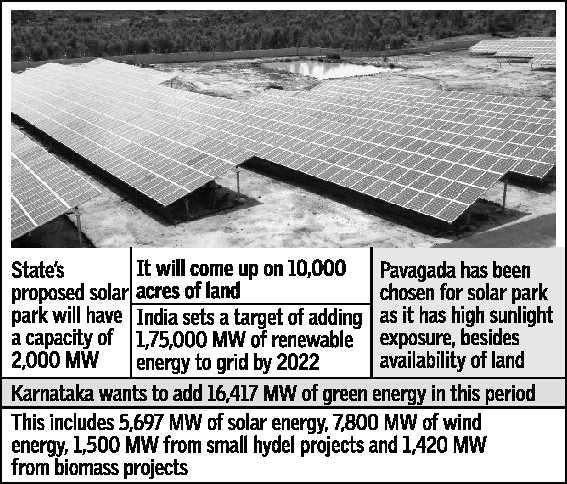
Karnataka, which entered the global power map by setting up Asia’s first hydroelectric station, is now embarking on another milestone mission of setting up a mega solar power park, said to be the world’s biggest. The park, with a capacity of 2,000 MW, will come up on 10,000 acres of land in the parched Pavagada taluk of Tumakuru district.
Secretary, Union Ministry of New and Renewal Energy, Upendra Tripathy and Additional Chief Secretary, Karnataka Energy Department, Ravi Kumar, who announced this at a press conference here on Friday, said the work on the proposed park would start soon.
The 1,000 MW solar park being implemented in Andhra Pradesh is the biggest such project so far in the country. The Centre would support the park by offering a subsidy of Rs. 20 lakh per mega Watt, Mr. Tripathy said.
According to sources, Pavagada was chosen for the solar park because of a combination of various factors, including high sunlight exposure, backwardness of the area, and lesser demand for land. In addition to the park, Karnataka has bigger plans for the renewable energy sector as the State on Friday committed itself to setting up projects to tap green energy to the tune of 16,000 MW in the next five to seven years.
The commitment was made at a meeting with Ministry of New and Renewal Energy authorities here where the Centre wanted the States to take up the responsibility of executing green energy project proposals to the tune of 1,75,000 MW received by it during the renewable energy global investors’ meet.
To facilitate evacuation of such a massive quantum of renewable energy from the generation sites, the Centre has also decided to set up an exclusive pan-India green corridor at a cost of Rs. 36,000 crore, Mr. Tripathy said. To raise resources for renewable energy sector infrastructure, the Centre would float tax-free green bonds to the tune of Rs. 5,000 crore in about three months from now, he said.
source: http://www.thehindu.com / The Hindu / Home> News> Cities> Bengaluru / by B.S. Satish Kumar / Bengaluru – May 30th, 2015
Passion has little to do with euphoria and everything to do with patience,’ said American author Mark Z Danielewski. Having an unaltered passion for antique beauties is Ashwath Narayan, an automobile engineer. A collector of vintage and classic cars, Ashwath bought his first car when he was 15 years old. “My first ride was a Morris Minor,” Ashwath says proudly. An automobile consultant then, his career doubled his love for cars, which he says will never perish.
“The love for cars dates back to my childhood. My father had Dodge, Rampage and Plymouth…then. I grew up with these cars and this is the root to my enduring passion,” he explains. A youthful person, he now owns the 1936 Austin, 1956 Super 10, 1949 Morris Minor and 1964 Morris Traveller. The list does not end there as he has a unique and a popular two wheeler — Rajdoot Runabout. “This bike was not very popular at the time of its manufacture. But it became a household name after Dimple Kapadia and Rishi Kapoor’s movie ‘Bobby’. In the movie, the hero and the heroine elope on this bike. It is after the success of this movie that this bike came to be called as ‘Bobby’ bike and everyone wanted to own this then,” he explains.
Parked with utter care in his garage, the Super 10, a raven beauty with red upholstery, is as good as it was during its time of manufacture. “This car was restored completely by me from scratch. I am its only owner and I have done everything from suspension, gear box, tinkering, painting and upholstery. It was in complete clapped out condition when I bought it,” he says. The Morris Traveller, an English beauty with wooden framed doors, was directly imported from the UK in its original form. The other convertible car — Austin, is part of a family as his sons Sanjay and Rajeev say, “We have grown up with Austin.”
Sanjay adds saying, “Austin is a very reliable car that has a rich heritage. We have spent our childhood in this and there were times when the car has given up on us, especially during the rallies. But the power of this car is such that people came readily to help push it to start. However, these things are very rare to be experienced now. There is no such camaraderie anymore and there is no human touch to all of it, which I sometimes miss.”
As the phrase goes — like father, like sons — Sanjay and Rajeev both share a connection with the classic machines and Rajeev puts it across as, “We have this passion in our DNAs.” While Rajeev is enthusiastic about these cars, Sanjay has added more to this inherited passion as he has developed an ultra-lightweight road bike Colnago Master, which is the only surviving bike of its sort in India. The passion bug has also smitten Ashwath’s wife Sulochana and Ashwath says, “My wife is very supportive about my passion and she is equally enthusiastic about these cars.”
The rallies are also a time for family outing in these cars. Ashwath, has also driven his Super 10 and Morris Minor till Mysuru to take part in the rallies.
Maintained in first-rate condition, Ashwath says, “I am sometimes scared to take these cars out on the roads as there is a lot of attention pouring in while driving them, which sometimes becomes disturbing.” He comments on the technology of these cars as rough and tough. “It is a costly affair. But once restored and maintained well, they will not give you any problem,” he adds.
source: http://www.deccanherald.com / Deccan Herald / Home> Supplement> Metrolife / by Prajna GR, DHNS / May 26th, 2015
City’s IM M. S. Thejkumar of South Western Railways, Mysuru, taking part in the Ist TTCA All India Open FIDE Rating Chess Tournament 2015 at Panaji, Goa, won his final round tie against Goa’s Audi Ameya (Rating 1924) and clinched the title with 8.5 points from nine rounds yesterday.
IM M S Thejkumar won a cash prize of Rs. 50,000/- along with a trophy.
With this performance, Thejkumar earned 11.4 points to his present rating points of 2450.
M.S. Thejkumar was followed by Akshat Khamparia (MP) with 7.5 points, Navalgund Niranjan (TN) with 7.5 points, M. Vijay Anand (TN) with 7.5 points and J. Ramakrishna (Andhra Bank) with 7 points in second to fifth place respectively.
source: http://www.starofmysore.com / Star of Mysore / Home> Sports News / Saturday – May 23rd, 2015
by Prof. A.V. Narasimha Murthy, former Head, Department of Ancient History and Archaeology, University of Mysore
I am eighty now and I write this in all humility and gratefulness to my readers for following my weekly column and for your affection. Time and chance have always helped me. Eighty years ago I was born to a highly traditional family which had intimate connections with the Jagadgurus of Sringeri Sharada Peetha. I proudly remember my grandfather Aradikoppam Subramanya Sastri, a great scholar in Sanskrit who was a tutor to the great pontiff His Holiness Chandrasekhara Bharati Swamiji. At the invitation of the Maharaja of Mysore, he was sent to Mysore to become a Professor at Maharaja’s Sanskrit College and he served that institution with great distinction and consequently became close to the Mysore Palace. As a young boy of ten or so I wanted to become a scholar emulating my grandfather and that became my aim.
After passing my Intermediate (PUC), I joined the MA Indology course to study under the great South Indian scholar Padma Bhushana K.A. Nilakanta Sastri at Maharaja’s college, Mysore. This was a turning point in my career because I was a student of Nilakanta Sastri who was held in great esteem throughout the country. Just a telephone call by Sastriji to Dr. B.K. Thapar of the Archaeological Survey of India got me a job of Exploration Officer in ASI. At that time I was noticed by Prof. Oruganti Ramachandrayya of the Andhra University and he took me to his Department as a Faculty, even without an application. Professors had such powers in those days. But my mind was wandering in USA and I wanted to study at Harvard, perhaps the best and reputed University in the world.
At that time, an advertisement calling for Fullbright Scholarships appeared in newspapers. I applied to this scholarship with the blessings of my Professor Nilakanta Sastri. Dr. Olive Reddick was the Director of United States Education Foundation in India. I cleared the tests and interviews at National and International-level and being a student of Nilakanta Sastri was an added advantage. I was selected to study at Harvard University, a wish I had expressed in my application. I had the good fortune of studying under world famous Gordon R. Willey and Hallam L. Movius at Harvard, which perhaps no other student from Karnataka can boast of. I salute all these scholars for moulding my career in Archaeology.
I was dreaming to settle down in Harvard and at that time Pandit Jawaharlal Nehru gave a call to all Indians working or studying in foreign countries to return to India and serve their motherland. It touched my heart and immediately I came back to India.
Another chance presented itself to me. My Professor at Mysore University wanted that I should return to Mysore and take up Readership in Archaeology. My entire family was in favour of this proposal. I returned to Mysore and faced an interview when K.L. Srimali was the Vice-Chancellor. Prof. Dejagow was the Dean and he recognised my potential and with his blessings I became a Reader at a young age. He has been showering the same affection towards me till date and it was he who inculcated in me the workaholic culture. Many of the books I have authored have the stamp of his guidance. This I would say is another chance which came my way.
With Dejagow’s guidance and my own enthusiasm, I built up a Department of Archaeology which won the admiration of scholars not only in India but also abroad. When the Fifth Plan Academic Committee visited my Department they were greatly impressed and sanctioned many faculty positions and a vehicle (jeep) for conducting archaeological explorations. I also organised a small University Museum which used to be visited by distinguished visitors to the campus. I could not have done this all alone and naturally all my colleagues helped me. I also introduced excavation as part of our training and excavated Banavasi, Heggadehalli etc. I retired from the University in 1995 when I was 60 and I thought I could write some books. At that time I was made Professor-Emeritus by the UGC for two years. I completed that also.
One day Mathoor Krishnamurthy and N. Ramanuja came to my house and asked me to be the Chairman of Bharatiya Vidya Bhavan (BVB), Mysore. His Holiness Sri Ganapathy Sachchidananda Swamiji’s blessings were there for this proposal. Having lot of respect for the Swamiji, I accepted the offer. I immediately roped in K.B. Ganapathy, Editor, Star of Mysore and P.S. Ganapathy, owner of a Printing Press. With the enthusiasm of the culture-loving Mysureans, Vidya Bhavan has become a household name.
Another thing which gave me full scope and satisfaction was the publication of Kannada translation of all the literary works of Kulapathi K.M. Munshi. The authentic history and culture of India in eleven volumes planned by Munshiji and executed by R.C. Majumdar is a valuable contribution. This was not available in Kannada. I took up the Kannada translation of these volumes with the help of many good translators. This is available in 25 parts in Kannada. Now most of these volumes have seen many editions.
In the wake of the success of this publication, I initiated translation of all the English works of Kulapathi Munshi into Kannada. Now we have published 22 works in this series so that the thoughts of Kulapathiji can reach the Kannada reading public. I can take great pride because perhaps no other Indian language (excluding Gujarati and Hindi) except Kannada has this great distinction. Many awards have been conferred on me for my academic contribution including the Puratatva Ratna award and Kannada Rajyotsava award by the Karnataka government. Another award which I cherish and value greatly is the Kulapathi K.M. Munshi award.
K.B. Ganapathy, Editor-in- Chief, Star of Mysore and Mysooru Mithra gave me an opportunity to write a weekly column under the title ‘Pages From History’ and this has made me quite popular in Mysuru which is being well-received by the readers in English and Kannada since seven years. Thus I am greatly indebted to KBG.
When I take stock of my life, I become conscious of the fact how various people have helped me in their own way. Without their support, I would not have been what I am today. That only shows the historical truth that man is governed by circumstances and chances. Chances never come again and again. Only a city bus comes again and again though at irregular intervals. Hence, a person with a purpose and aim in life should be open-minded and grab a chance when it arrives or go after it, if necessary.
This is what life has taught me during these eighty years and I have always tried to adjust to the circumstance without compromising the basic values of ethical and purposeful life. I am fortunate that my family members always stood by me during my life’s journey through thick and thin.
Again it is my good fortune that Mysore District Kannada Sahitya Parishat under the leadership of M. Chandrashekar, President, along with T.S. Chayapati of Talukina Venkannayya Publication, have arranged a felicitation function on 29th of this month in Jagadguru Sri Shivarathri Deshikendra Swamiji’s saanidhya. It is my good fortune that MLA Vasu, MUDA Chairman K.R. Mohan Kumar, scholar Dr. N.S. Taranath and Dr. C. Naganna have agreed to take part in this programme. Two of my books, Yadavas and Indian Epigraphy will be released on the occasion. I think, I could not have bargained for a more meaningful 80th birthday. This is traditionally referred to as Sahasra Chandra Darshana ritual. This is next in importance to 60th birthday (Shastipoorthi).
I and my wife Kamalamba consider ourselves fortunate and we simply accept it with gratitude. We look forward to 29th May. However, I continue to meet you all through my column every week as usual.
A Big Thank You to all.
source: http://www.starofmysore.com / Star of Mysore / Home> Feature Articles / Saturday – May 23rd, 2015
J. Jayalalithaa was born on February 24, 1948, in Mysuru. She began schooling at the Bishop Cotton Girls High School in Bengaluru and later attended the Presentation Convent at Church Park, Chennai, when her mother began a career as a Tamil film actress. The family had moved to Chennai after Jayalalithaa’s father died when she was just two.
Woman, actress, Brahmin, Kannadiga. Conventional wisdom would suggest that resume is all wrong for the hard playfield of Tamil Nadu politics and in a Dravidian party.
But then J. Jayalalithaa’s life and career are the stuff fairy tales are made of. Or movie scripts with happy endings.
The fame and celebrity she earned as a successful actress would pale in comparison with what she would achieve in later years.
At 67, Jayalalithaa is a political giant not only in Tamil Nadu, where she took oath as Chief Minister for the fifth time today, with two of her three terms punctuated by brief spells of political exile. Brand Jayalalithaa is an undeniable presence at the national level, most emphatically after last year’s national election, when her party swept 37 of Tamil Nadu’s 39 seats, making her AIADMK the third largest party in the Lok Sabha after the BJP and the Congress.
Her stunning victory in the Assembly elections of 2011 had ensured that her party’s tally of 11 in the Rajya Sabha or upper house of Parliament cannot be scoffed at either, especially in times when the BJP-led Central government is in a minority in the house and often depends on regional parties like Jayalalithaa’s to help it pass crucial legislation.
When Jayalalithaa was convicted in September last year in a corruption case by a Bengaluru trial court, her political rivals celebrated the possibility that she would not be able to contest elections for another decade. That, they reckoned, would mean the end of AIADMK, a party that revolves completely around its chief.
But eight months later, the Karnataka High Court has acquitted Jayalalithaaa and she is back.
To her many supporters, Jayalalithaa is Amma (mother) or Puratchi Thalaivi (Revolutionary Leader). She was Ammu to M.G. Ramachandran or MGR, her political mentor at whose statue she paid tribute in her first public appearance in eight months today.
She acknowledges MGR as one of the most important influences in her life. The other is her mother, Sandhya, an actress who fell on hard times and had to send her 15-year-old daughter to a film studio rather than college.
Jayalalithaa was born on February 24, 1948, in Mysuru. She began schooling at the Bishop Cotton Girls High School in Bengaluru and later attended the Presentation Convent at Church Park, Chennai, when her mother began a career as a Tamil film actress. The family had moved to Chennai after Jayalalithaa’s father died when she was just two.
Jayalalithaa was a good scholar and is said to have wanted to become a lawyer and be rich. She wouldn’t be a lawyer, but she would be rich — a successful film career lay ahead. Chinnada Gombe, her first film (in Kannada) was a major hit.
She was revolutionary and is said to have been the first to wear skirts on screen.
Jayalalithaa also acted in a few Bollywood films.
She starred in 28 films with Tamil Superstar MGR, who would later found the AIADMK.
Jayalalithaa’s last film was Nadhiyai Thedi Vandha Kadal in 1980. In 1982, at the age of 34, she joined the AIADMK and went straight to the top echelons of the party as Propaganda Secretary, much to the chagrin of many seasoned partymen and was soon nominated to the Rajya Sabha.
MGR died in 1987, in harness as Chief Minister. The next year the AIADMK split with one faction supporting MGR’s wife Janaki and the other supporting Jayalalithaa, who laid claim to her mentor’s political legacy.
In 1991, Jayalalithaa became Chief Minister for the first time. She lost the 1996 Tamil Nadu elections and the DMK government that succeeded her filed the corruption case that she was acquitted in earlier this month.
She won her second term in 2001 and her third in 2011.
Jayalalithaa, who is single, speaks English, Tamil, Telugu, Kannada and Hindi fluently. MGR is said to have sent her to the Rajya Sabha as she spoke English very well.
An accomplished dancer, Jayalalithaa trained in classical dance forms like Bharatnatyam, Mohini Attam, Kathak and Manipuri and performed all over India. She also started learning Karnatak music at the age of four and sang several songs in her own films.
The AIADMK chief is a voracious reader and has a large private library with a huge collection of books. Her favourite authors are Charles Dickens, Jane Austen, Oscar Wilde and George Bernard Shaw. Also Sidney Sheldon, Danielle Steel, Pearl S. Buck and James Hadley Chase.
Even as an actress, she would always carry books with her to the studio, and would sit quietly by herself in a corner and read between shots.
source: http://www.starofmysore.com / Star of Mysore / Home> General News / Saturday – May 23rd, 2015