Category Archives: Records, All

SPI among top 100 fastest growing Pvt. Cos in Atlanta

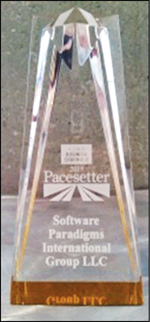
Receives Atlanta Business Chronicle Pacesetter Award-2015

SPIbf29may2015

Mysuru :

Software Paradigms International Group, (SPI) was honoured as one of the fastest growing private companies in Atlanta, Georgia, at the Atlanta Business Chronicle Pacesetter Awards ceremony held recently at the Georgia World Congress Centre.

The Atlanta Business Chronicle Pacesetter Award publishes the list of top 100 fastest growing privately held companies in Atlanta, Georgia. This year’s Pacesetter event saw participation of over 500 attendees.

“SPI is a technology provider of choice for Retailers worldwide. The firm’s growth has been driven by changes in the Retail industry particularly the rapid adoption of online and mobile channels by shoppers. SPI’s expertise in multi-channel planning and analytics as well as supplier management have helped our retail clients come out ahead in creating a world class experience for their customers across channels,” said Sid Mookerji, Global CEO, SPI

The 100 Pacesetter companies were announced in their index ranking order from 100 to 1. Top 5 companies included 1-800-COURIER, Castle Medical, SalesLoft, Ely Concrete Construction, and Priority Payment Systems. SPI ranked 44th in the top 100.

This is the second Pacesetter award for SPI.

Caroline Dunn, Head of Marketing, SPI, received the award on behalf of SPI.

source: http://www.starofmysore.com / Star of Mysore / Home> General News / Saturday – May 23rd, 2015

NIE Professor receives Research Award

ProfSureshaBF29may2015

Mysuru :

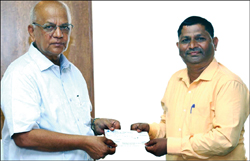
S. R. Patil, Minister for Infrastructure, Information Technology, Biotechnology, Science and Technology, Planning and Statistics, recently handed over the prestigious “Award for Best Research Publication” instituted by the Vision Group of Science and Technology (VGST), Karnataka government, at Vikasa Soudha in Bengaluru, to Prof. Suresha, Department of Mechanical Engineering, NIE, Mysuru. The award carries a cash prize of Rs. 25,000, a memento and a citation.

Prof. Suresha specialises in Polymer Composites Technology, Micro and Nano-based Polymeric Composites for automotive applications, non-materials and materials science. He has contributed 206 research articles to various international and national journals.

source: http://www.starofmysore.com / Star of Mysore / Home> General News / Saturday – May 23rd, 2015

Students develop rotating solar panel

Hubballi :

Students of electrical and electronics of SDM College of Engineering and Technology have developed a solar tracker solar panel that rotates in the direction of the sun and taps maximum energy.

While conventional solar panels fixed to face at one direction and hence capture limited energy, rotating panels can absorb energy all through the day as they move from east to west in the direction of the sun. Speaking to TOI, team member Vallabh Kulkarni said, “We noted that conventional panels do not absorb energy fully. If the panel is facing towards the east, it harvests minimum energy when the sun moves towards the west after 12 noon. This made us think of coming out with a rotating panel.”

The project, named as Harnessing Maximum Energy from Solar Panel took five months for completion. Another teammate Nikita Pinto said that they approached their faculty members and browsed internet for supporting information. “We found that there are hardly any attempts in adopting micro controller in the panel in the country whereas demand for solar energy is increasing by the day. Then we started working on the project,” she added.

Arun Chachadi noted that the new model would produce 25-30% more energy as compared to the conventional model.

Another team member Sushma G S said that they bought a micro-controller from the market and programmed it by using the flow code software, which is freely available on internet. “We used components like solar panel of 3 watt capacity, DC geared motor, LCD display and micro-controller. We spent Rs 2,100 for this project and a prototype is ready in our college,” she added.

Prof Mrutyunjay R Kappali, guided the team. Prof SB Vanakudri, principal, SDM College of Engineering and Technology, Dharwad, said the principle of the rotating panel is based on sunflower, the flower which tracks sun up to 180 degree.

“We will send a proposal to the Union government to consider the model in research and development works in its institutions. If Karnataka State Council of Science and Technology sanctions some aid, we will improve this model in coming years.”

source: http://www.timesofindia.indiatimes.com / The Times of India / Home> City> Hubballi / by Sangamesh Menasinakai, TNN / May 22nd, 2015

The receptionist who blazed a cricketing trail

Jacinta Kalyan, a ground curator at Chinnaswamy stadium takes pride in being the only woman doing that job in the country

JacintaBF04may2015

Jacinta Kalyan, AKA Jessi, is the go-to ‘man’ at the M Chinnaswamy Stadium. Be it accounting, greeting visitors or handling ticket sales – Jessi is a master of all trades and a proven asset for the Karnataka State CRICKET Association. What sets her apart from the rest is that she is perhaps the only woman stadium curator in the country.

“Well, I don’t know if I am the only one. But I sure am one,” Jacinta was at her modest best when Mirror spoke to her on Sunday. “And hopefully, there will be more.”

 
Currently, Jacinta is one of the three curators at the stadium along with Sriram and Prashanth. She has been taking care of the pitch for over a year but she made her IPL debut only after the showers greeted the city before Royal Challengers Bangalore’s match against Sunrisers Hyderabad on April 13. On Saturday too, when rain delayed RCB’s tie against Kolkata Knight Riders, Jacinta was seen running around the ground overseeing the removal of covers for the pitch. “I have been doing it since the Ranji Trophy last year,” she said.

 
She also supervises pitch work and likes to call her staff “my boys”. “The reason I was appointed to this post is because the KSCA needed someone with a commanding voice. I also know my boys well since we have worked together over the years and that made me a good choice for this job too,” she said, all while asking one of her boys – Ravi – to check if water had been drained properly from the pitch.

 
The big responsibility is not a worry for fearless Jessi. “I am a woman but that does not change the work that has to be done. That’s why it’s been no different,” she said. “That said, there are the usual challenges of lethargy when you keep asking yourself ‘Why the hell should I go out in this boiling summer’ or ‘Who will work in this rain’. But I believe that if you’re really interested in doing something, nothing can stop you – even a hurricane.”


You know you have made it big when everyone passing you by salutes you. And Jacinta has made it big. An old-timer at the KSCA, she first joined as a receptionist in 1993 after finishing Class 10.
“I was born in a village in Kanakapura in 1974. I was first a receptionist near the terrace rooms at the stadium. I was then transferred to handle the accounts for a while. A few years ago, I also started handling ticketing. Now I am basically telling the boys to cover the pitch properly and also learning how exactly to maintain the grass on the ground,” she said. “There are various technicalities regarding the ground I am yet to learn like the constant level of grass to maintain, pores for draining water, etc. It’s all part of the process.”

 
CRICKET has always been a passion for Jacinta. The thought of a KSCA job sprang to mind while she was watching TV at home. “I was fond of these cricketers I saw, on screen, the likes of Sunil Gavaskar and Kapil Dev. So when it came to making a career out of handling a cricket stadium, I naturally said yes,” said Jacinta, who now lives in KR Puram.

“I also came to Bangalore at that time and joined the VV Puram evening college. So mornings I was the receptionist at the stadium and evenings I would be a college girl. It was good plan.”

source: http://www.bangaloremirror.com / Bangalore Mirror / Home> Bangalore> Others / by Aravind Suchindran & Durgesh Kumar, Bangalore Mirror Bureau / May 04th, 2015
Historical location, historical figure

The Hindu
The Hindu

On Thursday, a historical location was named after a historical figure; with the Bangalore City Railway Station rechristened Krantivira Sangolli Rayanna Railway Station. The Centre approved the name change on request from the Karnataka government.

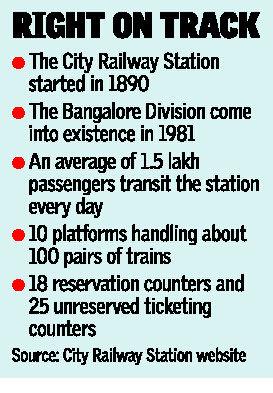
Just like there is a story to tell about the freedom fighter who fought the British till his death in 1831, the railway station named after him too brags about a long journey that began way back in 1890. Initially part of the Mysore State Railways promoted by the princely State of Mysore, the Bangalore Division come into existence in 1981.

HistoryDataBF04may2015

It was only recently that the Bengaluru division achieved its highest ever earnings under the Passenger Reservation System Rs. 10.53 crore.

As it stands today, the Krantivira Sangolli Rayanna Railway Station is connected to most major cities in the country, handling an estimated 1.5 lakh passengers and 105 trains on an average each day. Also a major coaching terminal, the railway station earned the distinction of becoming the first in the country to have WiFi facility for passengers last year. Said to be one of the busiest stations in India, it has 18 reservation counters and 25 unreserved ticketing counters to cater to the huge number of passengers.

source: http://www.thehindu.com  / The Hindu / Home> News> National> Karnataka / by Staff Reporter / Bengaluru – May 02nd, 2015

Hairdresser’s Son Wins Four Gold Medals in MA

Jayaprakash R with his parents and brother at the convocation of Davangere University on Monday | Express Photo

Davangere :

His is a story of struggle and success. Coming from a poor economic background did not deter him from pursuing his goal of getting a first rank, which had eluded him in BA and B.Ed.

On Monday, Jayaprakash R, the son of a hairdresser, stood beaming when he was awarded four GOLD medals for getting the first rank in MA Economics, at the convocation of Davangere University.

“I wouldn’t have achieved my goal without the support of my family, especially my elder brother who discontinued his studies after PUC I to enable me to pursue my education,” Jayaprakash told Express after receiving the GOLD medals from Prof Devaraj, vice-chairman of the UGC.

It was Jayaprakash’s mother Anjinamma’s dream too to see her sons well educated. Though she was uneducated, she encouraged them at every step. Jayaprakash’s father Ramanna K B runs a salon. “I assist my father in his salon during my leisure hours daily as it is our family profession. Though I made every effort to shine in academics, the first rank eluded me in BA and B.Ed,” he said.

When he joined MA, he pushed himself hard to get the dream rank.

“I devoted six hours daily for my studies despite all odds. I am delighted that I have achieved what I have set out to do,” Jayaprakash said.

His next goal is to get a lecturer’s post. “I have written the KAS exams and am preparing for the Karnataka State Eligibility Test and the National Eligibility Test,” he said.

At present, he is working as a field investigator at the National Sample Survey office in Hubballi.

However, this golden boy has one unfulfilled dream. “I want to do PhD, but our economic background may not allow me to study further,” Jayaprakash said.

source: http://www.newindianexpress.com / The New Indian Express / Home> States> Karnataka / by Express News Service / April 28th, 2015

B’luru scientists find drug which could cure malaria with one dose

Bengaluru:

Three scientists from Bengaluru, who led a team of global researchers looking for an antimalarial drug, have found a fast-killing solution. After completing some tests, it’ll go in for clinical trials on humans. That this drug has the potential to cure the dreaded disease in one dose makes it more attractive to healthcare providers. The Bengaluru solution — Triaminopyrimidine (TAP) — comes with many advantages over existing drugs. Vasan Sambandamurthy, one of the senior authors of the research paper, said: “It’s a fast-killing and long-acting antimalarial clinical candidate. TAP acts exclusively on the blood stage of Plasmodium falciparum (the stage responsible for clinical symptoms) in a relevant mouse model. This candidate is equally active against causative agent Plasmodium vivax.” He added, “The compound has shown good safety margins in guinea pigs and rats. With a predicted half-life of 36 hours in humans, TAP offers potential for a single dose combination.” The rapid spread of Plasmodium falciparum, the parasite which causes malaria in humans, has left nations battling it with a weakened arsenal and coping with thousands of deaths every year. This parasite has gradually become resistant to available medication. The World Health Organisation (WHO) estimates that 3.2 billion people in 97 countries, including India, are at risk of being infected with malaria. In 2013, WHO reported an estimated 198 million cases and the disease was responsible for an estimated 5.84 lakh deaths, including 4.53 lakh children less than five years old. Every person infected with malaria has to deal with millions of parasites and existing drugs have a limited effect in humans. “The half-life, which isn’t more than 2 hours, means it allows parasites to bounce back. Existing drugs are not fast-killing, which means that not only does a human need more doses but each dose is capable of only killing a few parasites,” he said.

Besides, a potential side-effect of existing drugs is liver damage. “This doesn’t happen all the time, but the possibility does exist. Also, the parasites have become resistant to these drugs. With TAP, there are now known side-effects and the parasites are unable to develop resistance at the same pace as they do for existing drugs,” he said. TAP was discovered by a team at pharmaceutical company AstraZeneca. “The main research happened in its R&D centre in Bengaluru between 2011 and 2014), which has since been shut down. It took us three years of rigorous work by teams across the globe. Today, we confidently nominate TAPs as a clinical candidate to treat drug-resistant malaria,” Vasan said. Shahul Hameed and Suresh Solapure were the two other team leaders.
Active against drug-resistant malaria TAP has a novel mechanism of action that specifically inhibits targets a protein involved in maintaining specific and localised agents that serve as the major route to disturb the proton gradient inside the parasite hydrogen ion levels. Vasan Sambandamurthy | researcher

Global work, delivered in Bengaluru The project was partnered and partially funded by Medicines for Malaria Venture (MMV) based in Switzerland. This work showcases collaboration among big pharma companies (AstraZeneca, Glaxo Smith Kline) and several labs worldwide (Columbia University, Harvard Medical School) for a disease highly prevalent in the developing world. The research was primarily conducted at AstraZeneca’s R&D center, Bengaluru, while safety and toxicology studies supported from its other sites. While Glaxo Smithkline, Spain conducted some of the proof of concept studies, Columbia University, New York and Harvard School of Public Health did the target identification studies.

source: http://www.timesofindia.indiatimes.com / The Times of India / Home> City> Bengaluru / by Chetan Kumar, TNN / May 01st, 2015

Heritage conservation: small towns leave city behind

Even as Bengaluru is still thinking of heritage conservation, smaller towns seem to have jumped into ACTION.

The Anekal Planning Authority (APA), which oversees development of Sarjapura, Anekal, Attibele and Jigani, has specific provisions in its master PLAN. The APA Master Plan 2031, which was approved by Bangalore Metropolitan Region Development Authority in September 2014, says any development around “heritage structures, precincts of historic, aesthetic, architectural, cultural or environmental significance and natural features and sites of scenic beauty” should be approved by a special heritage committee.

Though the region does not have any declared monument, Lakshmipathi, Deputy Director of the APA, said the rule could be APPLIED if approvals are sought close to the 17th century Sri Thimmaraaya Swamy temple, among other “old structures”.

PWD has no clue about restoration

For the Public Works Department, there is little difference between a two-century building and a recently built government office. This lack of distinction was highlighted during the restoration of the 150-year-old office of the superintendent of Lalbagh Gardens in Bengaluru. Conservation experts claimed the PWD used “modern, improper MATERIALS” to restore the limestone and mortar building.

Officials admit that there are no rules regarding restoration or protection of “heritage BUILDINGS”. “The tender process is the same, except for the High Court and the Vidhana Soudha. There are no restrictions on materials used or type of construction,” said a senior official.

source: http://www.thehindu.com / The Hindu / Home> News> National> Karnataka / by Special Correspondent / Bengaluru – April 18th, 2015

Remembering R. Shamasastry of Oriental Research Institute

The renovated building of Oriental Research Institute, which was inaugurated by Richard Verma, US Ambassador to India, New Delhi on Mar. 31, 2015.

On reading the article of Nahush Bhat, who is currently working with the University library in the US, helping them catalogue over a hundred thousand books of all shapes and sizes, some dating back almost 60 years, I was reminded of Rudrapatna Shamasastry (1868-1944), a Sanskrit scholar and librarian at the Oriental Research Institute (ORI), Mysore.

The ORI, set up in 1891, housed thousands of Sanskrit palm-leaf manuscripts. Shamasastry examined these fragile manuscripts daily, to determine their contents and catalogue them. In 1905, he discovered the Arthashastra, an ancient Indian treatise on statecraft, economic policy and military strategy among a heap of manuscripts. He transcribed, edited and published the Sanskrit edition in 1909 and also proceeded to translate it into English, publishing it in 1915.

This discovery, “an epoch-making event in the history of the study of ancient Indian polity,” brought fame to the Institute some 100 years ago. Until it was identified from a manuscript by Shamashastry, Chanakya’s opus was known only from references. Will our engineering graduate-cum-librarian-in-the-making bring fame to his alma mater and to Namma Mysuru?

—KBG

source: http://www.starofmysore.com / Star of Mysore / Home> Feature Articles / Friday – April 10th, 2015

Achievers tie the knot

Dinaker Kenjur and Sabita Gundmi got married in Udupi on Tuesday.

Both – Dinaker Kenjur (32) and Sabita Gundmi (29) – have firsts to their credit in the most backward Koraga community, a Scheduled Tribe, and both entered the wedlock in a simple ceremony on the Ambedkar Jayanti here on Tuesday.

The main occupation of the community is basket weaving and collection of minor forest produce. The population of this community in Udupi and Dakshina Kannada, and Kasaragod district of Kerala taken together is about 17,000.

While Ms. Gundmi is Assistant Professor at the Department of Sociology in Mangalore University for last one-and-a-half years, Mr. Kenjur is guest lecturer in the Department of Commerce in the same university since 2009.

Both Ms. Gundmi and Mr. Kenjur overcame heavy odds to make a mark in their community. While Ms. Gundmi is the first person from the community to pass National Entrance Test (NET) for lectureship conducted by the University Grants Commission in 2010, Mr. Kenjur is the first in the community to have done M.Com.

Ms. Gundmi lost her father, when she was five while her mother died in an accident when she was studying SSLC. She had to discontinue her studies for two years after SSLC due to financial problems.

But she persevered and completed M.A. in Sociology standing second in Mangalore University in 2010. She cleared the NET in the first attempt.

She also cleared the State-level Eligibility Test (SLET) for lectureship conducted by the University of Mysore. She is pursuing Ph.D. for the last two years.

Mr. Kenjur too was born in a poor family. He suffered a polio attack when he was young and it affected his leg. He too had to struggle to complete his education. He has also completed third semester in MBA course from Karnataka State Open University. He is trying to clear the NET.

Both are childhood friends. They had both decided to marry nine years ago. Both have no superstition and decided to marry on Ambedkar Jayanti here.

“I told my well-wishers that I was born on a Tuesday. I joined work on a Tuesday. It would make no difference to me to marry on a Tuesday [which is considered inauspicious]. I have been deeply influenced by Dr. Ambedkar’s philosophy. Hence I and Dinaker decided to get married on Ambedkar Jayanti,” he said.

source: http://www.thehindu.com / The Hindu / Home> News> National> Karnataka / by Ganesh Prabhu / Udupi – April 15th, 2015