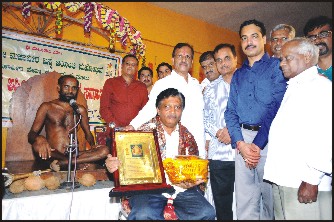
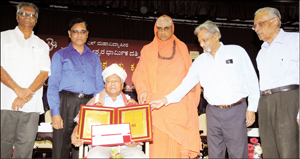
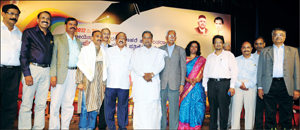
Medical Practitioner and Social Worker Dr. Chandrashekar was conferred ‘Sri Mahaveer Ahimsa’ award at the Bhagawan Mahaveer Jayanti celebrations organised under the aegis of Sri Mahaveer Seva Samsthan at M.L. Jain Boarding Home on Chandragupta road in city yesterday.
Speaking on the occasion, Srirangapatna Court Judge Sushat Mahaveer Chowgule, who was the chief guest, said that he had previously listened to a discourse presented by Munimaharaj Swamiji, when the Swamiji had explained on how we had deviated from Jain religion’s philosophies and principles to suit out selfish ends. He stressed on the need for making a pledge on following Jain religion philosophies in our daily life. Digambar Jain Samaj President S.N. Prakash Babu presided.
Mahaveer Bhavan working President M.A. Sudhir Kumar, M.L. Jain Boarding Home Secretary Madan Kumar and others were present.
source: http://www.starofmysore.com / Star of Mysore / Home> General News / Friday – April 03rd, 2015
“Can you not manufacture a pocket-sized electronic tambura,” the doyen M. Balamuralikrishna had asked G. Raj Narayan of Radel Electronics, the pioneer of electronic tambura, and a flautist, in the 1980s.
“Miniatures don’t serve the purpose as the size of the speaker determines the needed tonal throw and quality,” explains Mr. Raj Narayan, who first brought out electronic tamburas in 1979 and bagged several awards for his innovation.
Tambura apps are linked to fashion and the mindset of people now, Mr. Raj Narayan says, and adds that such apps cannot go beyond a point as “an external amplifier and speaker have to be connected for use on stage, which makes it cumbersome.”
There are seven variants in Radel’s electronic tamburas, catering to both the Carnatic and Hindustani genres. The price ranges from Rs. 3,000 to Rs. 6,500 and “some are even shaped like a tambura,” he says
Honour for tambura artistes
Despite not many artistes using tamburas, all concerts at the Sree Ramaseva Mandali, Chamarajpet, feature the instrument. For the first time, three well-known tambura artistes V. Jagannatha Rao, Sripada Rao and Hulikal Prasad will be honoured by the mandali.
Family members of the tambura artistes cherish the days when artistes such as T. Chowdiah, Honnappa Bhagavathar, Doreswamy Iyengar, T.R. Mahalingam, Bhimsen Joshi and M.S. Subbulakshmi used to send inland letters requesting them for their tambura accompaniment. All India Radio, until the late 1970s, used to appoint tambura artistes with an underlying rule that they possess good vocal knowledge.
source: http://www.thehindu.com / The Hindu / Home> News> Cities> Bengaluru / by Ranjani Govind / Bengaluru – April 06th, 2015
US Ambassador to India inaugurates renovated ORI building
US Ambassador to India Richard Verma being felicitated by University of Mysore Vice-Chancellor Prof. K.S. Rangappa with a Mysuru Peta, silk shawl, sandal garland and a memento (wood-inlay of the Crawford Hall) during the inauguration of the renovated building of Oriental Research Institute (ORI) in city last evening. Also seen are Director of ORI Dr. H.P. Devaki (extreme left) and Registrar of UoM Prof. C. Basavaraju.
Mysuru :
US Ambassador to India, Richard Verma inaugurated the renovated building of the Oriental Research Institute (ORI) here yesterday. The renovation was funded by the US Consulate, which had donated $50,000 in the year 2012.
Speaking on the occasion, Verma said that both India and the United States have entered into a ‘strategic plus’ phase in their relationship, sharing a common vision of a peaceful, prosperous and stable world. He further stated that the partnership is bolstered by people-to-people ties between the two nations and said, “How we work together to achieve a common vision defines our strategic plus partnership, be it with regard to economic and trade relations, energy, space, climate change, science and technology etc.”
The US Ambassador referred to the ancient Indian treatise of Arthashastra by Chanakya and said that Chanakya had told that a ‘true friend’ in international affairs was someone who shared common objectives and added that India and the US share democratic values and can be called ‘true friends,’ if they accept the wisdom of Chanakya.
Speaking at the programme, Vice-Chancellor of University of Mysore (UoM), Prof. K.S. Rangappa requested Verma to contribute $2,00,000 dollars for the restoration of various heritage buildings of the University.
The ORI now houses more than 30,000 paper and palm-leaf manuscripts and over 45,000 rare books. The items were put on display for the Ambassador including a rare manuscript of Chanakya’s Arthashastra, transliterated versions of the religious work commissioned by the then Maharaja of Mysuru, Nalwadi Krishnaraja Wadiyar and rare palm-leaf manuscripts with treatise on astronomy, medicine and mythology.
Looking at the manuscripts, Verma said that he was thrilled to see the only copy of the Arthashastra in Mysuru.
Registrar of UoM Prof. C. Basavaraju and Director of ORI Dr. H.P. Devaki were present during the VIP’s visit.
Richard’s Mysuru Connection
It might be surprising to know that the US Ambassador to India, Richard Verma has a closer connection with Mysuru than we had thought.
Richard’s sister Roma Murthy is married to Bala Murthy from Mysuru. Bala Murthy’s father late N. Narasimha Murthy was the former Principal of National Institute of Engineering (NIE).
Speaking after the inauguration of the renovated ORI building, Verma said that it was a great honour to be in the city where he was able to meet some of his family members. He recalled that his father, who went to the US to pursue a Master’s degree in English Literature, had a close interaction with scholars of the Department of English, UoM.
source: http://www.starofmysore.com / Star of Mysore / Home> General News / Wednesday – April 01st, 2015
The ‘Bangalore Rose Onion,’ which is almost exclusively grown for the export market, has managed to get the coveted Geographical Indication tag. It is the 217th product in India to get the tag. The GI tag is an intellectual property right that not only indicates the geographical origin of that product but also conveys an assurance of quality and distinctiveness of the product. The Bangalore Rose Onion tag means that this onion is grown in one of the 16 taluks of Bengaluru rural, Kolar and Doddaballapur. The GI tag was announced late last week.
Bangalore Rose Onion growing areas
Bangalore Rose Onion is the only product from Karnataka to get the tag this year (2014-15) out of the 20 given products across the country. This is only the second item to have ‘Bangalore’ in its name. Out of the 235 products that now have the GI tag in India, 29 are from Karnataka. Out of these, edible products include the Coorg Orange, Mysore Betel Leaf, Nanjangud Banana, Monsooned Malabar Arabica Coffee, Coorg Green Cardomom and the Bangalore Blue Grapes.
The effort to get the GI tag for BRO started with the Bangalore Rose Onion Growers’ Association facilitated by the horticulture department of the state government. In their detailed application before the Geographical Indications Registry, they pointed out the uniqueness of the onion.
What makes it Special
What is unique about the BRO is that the bulbs have a flat base. The shape is spherical with deep scarlet red colour, anthocyanin, phenols and high pungency. The high pungency makes it preferable in making pickles. It also has higher levels of protein, phosphorus, iron and carotene. “Bangalore Rose Onion is grown only in and around Bengaluru, that is Bengaluru urban, Bengaluru rural, Kolar and Chikkaballapur districts. The climate and soil conditions of the area are ideally suited for this variety of onion. Deep fertile mekklu soil and sand mix of red soil of the area with good infiltration, soil pH ranging between 6.5 to 7, atmospheric humidity of 70 to 75% and average temperature of 25 to 350 C is most suitable. BRO is not consumed locally and the tag could only be a status symbol. TN Prakash Kammardi, Chairman of the State Agriculture Prices Commission, said, “You can find them in super markets these days, usually in pickled form. What the GI tag will do to the product and how far it will benefit farmers has to be seen.”
source: http://www.bangaloremirror.com / Bangalore Mirror / Home> Bangalore> Others / by Shyam Prasad S, Bangalore Mirror Bureau / April 06th, 2015
The City Railway Station is likely to become the first station in the country to get a stairlift, a mechanical device to carry people up and down stairs.
Essentially a chair mounted on rails, the stairlift helps the elderly, differently abled and those with knee problems. It is new in India, but has been around in the United States since the 1930s, helping victims of polio negotiate stairs.
Picture for representation
In Bengaluru, product testing is under way on Platform 1 since Thursday, and so far, no problems have been reported. A woman passenger, weighing 120 kg, was among those who volunteered to test the stairlift.
Dr Arun Kumar Manocha, chairman and managing director, Indian Railway Catering and Tourism Corporation (IRCTC), Delhi, is in town to demonstrate the technology to Railway Minister Suresh Prabhu.
“The stairlift is imported from the Netherlands from a reputed company with a long innings in manufacturing safety products. It meets European passenger safety standards,” Manocha said.
The company’s Indian franchisee is in Bengaluru and so the City Station emerged as a natural choice to test the technology.
IRCTC is only looking at Platform 4 as it is the only one that lacks a pedestrian subway, Manocha added. The staircase is ‘Z’-shaped with a flight of stairs followed by a landing and another flight of stairs.
“We are looking at introducing two stairlifts, one for each flight of stairs. The passenger will have to walk the one or two metres between the two,” he told Express.
The cost of the two stairlifts and the 15 metres of railing it needs will work out to around Rs 6 lakh, he said. “We initially planned installing a railing on the flat surface also so that the passenger need not disembark and all steps leading to Platform 4 could be covered in one go. But it worked out very expensive (Rs 16 lakh),” he said.
New Tech in Station to Help Seniors Climb Stairs
The equipment and the railings can be installed in just two hours. If trials succeed in Bengaluru, many stations across the country will have it.
It works out much cheaper than an escalator or a lift, which require more time and space for installation, Manocha said.
Simple Apparatus
The stairlift, which can carry a passenger load of 140 kg, runs on mains, but will also have a chargeable battery so that it does not stop midway in case of a power disruption.
Initially, an attendant will man the operations, but gradually, the public will be allowed to handle it, Manocha said, describing the procedure as simple. To ensure safety, it will have a seatbelt.
After being approved by Suresh, the stairlift has to be okayed by the directors of IRCTC.
The operation is likely to begin in three months. IRCTC is installing the stairlift as part of a corporate social responsibility initiative.
“The Delhi passport office introduced a stairlift recently, but it was not working when I checked it out a few days ago,” Manocha said.
At the City Station, the IRCTC has also donated flashlights and horns for golf carts, four sophisticated wheelchairs (Rs 12,000 each) and a superior filtration system that can purify 200 litres of water an hour.
source: http://www.newindianexpress.com / The New Indian Express / Home> Cities> Bengaluru / by S. Lalitha / April 04th, 2015
Spoorthi S. Kamaradgi has been adjudged the State champion in the Handwriting Olympiad, conducted by the Madhya Pradesh-based Master Mind Tutorials.
Ms. Spoorthi, a Class 10 student of Sharanabasaveshwar Residential Public School in Kalaburagi, with her prowess in legible cursive writing skills, beat the stiff challenge of other students drawn from different schools throughout the State.
Skills
The contestants were judged on legibility, size, spacing and slant of their handwriting skills.
Greeted
President of the Sharanabasaveshwar Vidyavardak Sangha Poojya Sharanabasvappa Appa and principal of the school N.S. Devarkal congratulated her for her achievement.
source: http://www.thehindu.com / The Hindu / Home> News> National> Karnataka / by Special Correspondent / Kalaburagi – April 06th, 2015
I was recently reading ‘Rosary of Saints’ by Meera S. Sashital and published by BVB, Mumbai. It is an interesting book and acquaints the readers with many saints who are normally not known to most of us. The life-sketch of a saint, Gudidi Baba of the 19th century, appealed to me the most and I thought of sharing it here.
The word Gudidi means a thin light cotton blanket stuffed with cotton. It is stitched by joining small pieces of cloth of different colours. It is generally known to us kaudi or datta. It is also called comforter. This saint always used to carry this kaudi or gudidi and people began to call him by that name as Gudidi Baba as they did not know his original name. This Baba used to wear a loin cloth even during winter. He always carried a small brass vessel and a bamboo shell to eat food and drink milk or water. The bamboo shell was also used as a musical instrument whenever he went on singing in praise of the divine. He would normally sing songs written by Kabir, Nanak, Tulsidas, Dadubaba and others which were quite popular. He had a rich and melodious voice to attract people. He used to get into ecstasy that would turn into trance. All these qualities endeared him to the crowd in the town Pilkhuva.
People liked him, his songs and talked to him with respect and affection. But nobody knew his name, caste, age and personal details. Slowly he became a mystic saint. People would throng to see him and get blessed. Even non-believers used to visit him out of curiosity and most of them became his devotees. Some admired his yogic powers. He used to bring people to the divine path. This became well-known and made him famous as a miracle man.
All these attracted more number of people to his fold. Pilkhuva was a great centre of the movement of Arya Samaj and they criticised him for his teaching which would bring religious chaos. They insisted that religion should function within the purview of social and religious traditions of the society.
Though Gudidi Baba differed from them, he never went into any arguments with them. He always said people should have religious freedom. At times he preached devotion to Krishna (Krishnabhakti), Vedanta which meant advaita or non-dual philosophy. He would declare “I’m alone there and there is no second or other person.” This is closer to the philosophy of ‘I am Brahman’ (Aham Brahmasmi) the traditional saying of ancient India. He knew that this concept was very difficult to comprehend and hence avoided such topics.
Baba chose to perform miracles to drive home his philosophy because common people believed and understood miracles. Once Baba called some children, removed some threads from his kaudi, gave each of them a thread and asked them to keep them in their fist. After sometime he asked them to open their fist and to their utter pleasant surprise, they found grapes, almonds and dry fruits and this made great news in the town. Children began to follow him and their parents would also come behind to see this miracle. Thus, more people began to walk around him making him more popular.
People, who did not like the Baba, called him a black magician and accused him of cheating the simple-minded devotees. Once they poured milk into his bamboo vessel and asked him to turn it to grapes. Baba closed his eyes for a minute and took out grapes from the vessel and distributed it to the people assembled there. On many occasions he drew grapes from the vessel and distributed to devotees. On another occasion, a non-believer came to test him. Baba asked him to shake the empty glass and people heard some sound and on examination, it was found to be a one-rupee coin. Then Baba asked him to shake it five more times and five more coins were seen in it.
Atmaram Maharaj came to stay in his ashram. He was an atheist. He wanted to test the Baba. Baba understood this and asked him what he wanted. Atmaram, who wanted to test him, asked for pomegranate grown in Kandahar. Baba smiled at him and closed his eyes and raised his hands and got the pomegranate fruit. Atmaram was surprised and became a devotee of the Baba. A person by name Lala Jagannath was going go Ghaziabad. Baba, who saw him, put his hand into the well and got a bottle of oil and a piece of soap and gave them to Jagannath. On another occasion, a devotee came to him and lamented that he was not blessed with a son. Baba gave him gold ash (Suvarna Bhasma) and asked him to take it. After some time, he came to Baba, prostrated before him and showed him his son and requested for his blessings. Baba was happy to do that.
Gudidi Baba had a good knowledge of medicine. He was capable of extracting oil from sulphur. Others also tried but failed. Baba said that it requires a combination of mantra, tantra and devotion. Thus Baba had cured many patients in whose cases the local doctors had failed. He used to say that God is the healer and he was only an instrument. Baba was familiar with leaves and herbs and he himself would bring them from the forest and give it to patients. Thus he became a Siddha Purusha.
Baba was active serving the people in various ways. He used to visit Pilkhuva often for almost thirty years. Whenever he went to any place, he was helping the people. In 1951, he came to Pilkhuva and understood that this was his last visit as God wanted him to leave this old body and change to a new one. He called his devotees and told them about this and asked them not to weep but to be happy as he is going to adorn a new body. He told them the date and time of his departure. He cast-off his body on his way to Meerut at the (6.3.1951) exact time. His body was then consigned to mother Ganga at Garmuktesvar where his Samadhi can be seen even now.
Thus Gudidi Baba led a life of activity which included mainly serving the people and showing them the right path of ethical principles. This he did living in the midst of the people and transformed the people who came in contact with him. This was the greatness of Gudidi Baba, a good example of simple living and high thinking.
source: http://www.starofmysore.com / Star of Mysore / Home> Feature Articles / Saturday – March 28th, 2015
Prof. Chandrashekaraiah, retd. English Professor, Mysuru, who was conferred with ‘Sri Shivarathreeshwara Award,’ is seen with Suttur Seer Sri Shivarathri Deshikendra Swamiji, National Institute of Advance Studies (Bengaluru) Visiting Professor Dr. S. Shettar, Prasaranga Director Prof. C. Naganna, JSS Mahavidyapeetha Executive Secretary B.N. Betkerur and others.
Mysuru :
Prof. Chandrashekaraiah, retd. English Professor, Mysuru, was conferred with ‘Sri Shivarathreeshwara Award’ at a programme organised by Sri Shivarathreeshwara Religious Endowment, JSS Mahavidyapeetha, at Navajyothi auditorium in JSS Women’s College here on Wednesday.
Suttur Seer Sri Shivarathri Deshikendra Swamiji presented the award to Prof. Chandrashekaraiah for his book ‘A Survey of Veerashaiva Religion and Literature.’
National Institute of Advance Studies (Bengaluru) Visiting Professor Dr. S. Shettar released eight books on the occasion — Vid. Dr. Sri Immadi Shivabasava Swamiji’s Allamaprabhudevara Teekina Vachanagalu (2nd edition), Dr. H. Thipperudra Swamy’s The Virasaiva Saints – A Study (2nd edition), Sri Siddeshwara Swamiji’s Devotional Sayings of Basaveshwara (3rd edition), Prof. B. Somashekarappa’s Divya Chethana, Prof. Chandrashekaraiah’s Ghanalinga Shivayogi – Vicharasankeerna, Dr. Sangamesha Biradara’s Vachanagalalli Bhakti, Dr. B.V. Vasanthakumar’s Vachanagalalli Sthavara – Jangama and Dr. Rajashekara Jamadandi’s Vachanagalalli Drushtantagalu.
Prasaranga Director Prof. C. Naganna and Shivamogga litterateur Jayadevappa Jainakeri spoke about the books.
Prof. S. Nanjundaiah delivered the felicitation address on the occasion.
JSS Mahavidyapeetha Executive Secretary B.N. Betkerur presided over the programme.
source: http://www.starofmysore.com / Star of Mysore / Home> General News / Saturday – March 28th, 2015
Chief Minister Siddharamaiah presented TSR Memorial, Mohare Hanamantharaya, Development Journalism and Environmental Journalism awards to senior journalists at a function held at Sulochana Auditorium of Vartha Soudha in Bengaluru yesterday. Seen are (from left) Journalists Dr. Narendra Rai Derla, Dr. Sadananda Perla, Amshi Prasanna Kumar and Deepak Sagar, Media Academy Chairman M.A. Ponnappa, Information Minister R. Roshan Baig, Senior Journalist N. Arjun Deva, Information & Public Relations Department Principal Secretary Dr. Nagalambika Devi, Senior Journalists P.S. Eshwar Bhat and Raghavendra Aravindrao Joshi, Information Department Director N.R. Vishu Kumar and Star of Mysore Editor-in-Chief K.B. Ganapathy.
Bengaluru :
Chief Minister Siddharamaiah presented the prestigious TSR Memorial, Mohare Hanamantharaya, Development Journalism and Environmental Journalism awards to eight journalists at a colourful function organised by the Department of Information and Public Relations at Sulochana Auditorium, Vartha Soudha on Bhagavan Mahaveer Jain Road here last evening.
The TSR Memorial Journalism award- 2012 was presented to veteran Journalist N. Arjun Deva, who is presently the Editor of ‘Jaana,’ a publication dedicated to Science articles and the TSR award for 2013 was given to senior Journalist P.S. Eshwar Bhat (Eshwar Daitota), who has served in Print Media, Radio, Television and Internet Journalism for over three-and-a half decades.
The Mohare Hanamantharaya award for 2012 was presented to Belagavi-based senior journalist Raghavendra Aravindrao Joshi, who started ‘Nadoja,’ a Kannada weekly, which later became a daily newspaper while Mohare Hanamantharaya award for 2013 was presented to K.B. Ganapathy, Editor-in-Chief, Star of Mysore, an English eveninger and Mysooru Mithra, a regional Kannada morninger.
Mysuru-based Journalist Amshi Prasanna Kumar, who has been serving in Kannada Prabha daily since 1995, was presented Development Journalism award for the year 2012 and the year 2013 award was conferred on Dr. Sadananda Perla, currently serving in the programmes section of Akashavani.
Dr. Narendra Rai Derla, a lecturer by profession and who had worked as a Sub-Editor of Taranga weekly magazine, was presented Environmental Journalism award for 2012 and journalist Deepak Sagar, who is working as a reporter of Vijayavani at Sagara in Shivamogga district, was presented the award for the year 2013.
Both TSR Memorial and Hanamantharaya awards comprised a cash prize of Rs. 1 lakh each and a citation while the Development Journalism and Environmental Journalism awards carried a cash prize of Rs. 50,000 each and a citation.
Veteran Journalist Arjun Deva, who spoke on behalf of the awardees, observed that the print media has not lost its sheen despite the advent of electronic media.
Stressing on the need for brining the electronic media under the ambit of the Press Council of India, he said that with the media becoming highly powerful, shedding light on all issues, politicians are making a beeline to enter the media field.
Maintaining that politicians with different backgrounds and conflicting views were confusing the people, Arjun Deva regretted that the present situation was conducive only for the wealthy to start news- papers.
Shedding light on the growth of media over the years, he referred to a recent incident where it was reported that the High Court was haunted by spirits and questioned whether the reported missing of certain documents from the High Court can be attributed to the spirits, which remark sent the entire audience into peels of laughter.
Information and Infrastructure Development Minister Roshan Baig presided.
Information and Public Relations Department Principal Secretary Dr. Nagalambika Devi, Awards Selection Panel head former Justice Arali Nagaraj, Information Department Director N.R. Vishu Kumar, Karnataka Media Academy Chairman M.A. Ponnappa and others were present at the function.
source: http://www.starofmysore.com / Star of Mysore / Home> General News / Saturday – March 28th, 2015
Better connectivity and space utilization can make Church Street a great urban hangout
Church Street is perhaps one of the most well-connected and accessible roads in Bengaluru. In fact, its name has been derived from the fact that it used to lead directly to St Mark’s Church, which was also visible while walking on the street. This trivia, however, alludes to a time when buildings were much smaller and before the strong axis connecting the street and the church was lost due to replanning. Today’s Church Street is replete with businesses, restaurants, pubs and arcades, and retains most of its road connections.Mahatma Gandhi Road, St Marks Road, Museum Road and Brigade Road surround and flow into this modest street that ensures a continuous flow of people passing by . If one were to look at high streets or shopping streets around the world, one would encounter `accessibility’ as the overriding factor -accessibility with respect to their space utilization and how well connected they are to the surroundings.
An analysis of high streets in London (as per the land use pattern) by Space Syntax would reveal that 80% of retailers have located themselves on the 20% most spatially accessible streets. This revelation seems to be a no-brainer as shops cater to locations frequented by people. The literal meaning of the Greek word Agora is a “gathering place” or an “assembly”. This also highlights the twin function of the well-connected marketplace, as both a po itical and commercial space. The Italian Piazzas are commonly found at the meeting of two or more streets. Several businesses and small shops are located within the Piazzas, which form the leitmotif for the traditional Italian city. The modern shopping street, traditional Agora and Piazza are perfect examples of what a good urban space is like when integrated into its urban setting.Such spaces create an ecosystem that thrives on their diversity.What makes Church Street so special is that it shares characteristics of all three archetypes of a great public space.
Sensitive placemaking through intelligent urban design solutions has given New York its Highline project, Seoul its Cheonggyecheon and Japan its Isezakicho of Yokohama. Why not start with Church Street for Bengaluru? Discontinuing street parking will do its bit to encourage public transport and make room for pedestrians on the footpath. Regulating food and garbage truck movement will ensure pedestrians don’t have to hold their breath while walking around. Street furniture will definitely be convenient for those who shop till they drop. Putting dustbins and planters in place will ensure a clean and green street.
While these solutions may improve the image of Church Street, they fail to address more serious underlying issues. The need of the hour is to call on experts and placemakers who understand the need to relay the underground sewage system in tandem with the existing network.
(The writer is an architect)
source: http://www.timesofindia.indiatimes.com / The Times of India / Home> City> Bengaluru / by Naresh V. Narasimhan / April 02nd, 2015