Category Archives: Records, All

Gallery blended in heritage structure

National Gallery of Modern Art celebrates its 6th anniversary on February 18

Manikyavelu Mansion on Palace Road, Bengaluru, houses the National Gallery of Modern Art. File Photo: V. Sreenivasa Murthy

Until June 2001 when the foundation stone for NGMA was laid, the Manikyavelu Mansion on Palace Road was a verdant 3.5-acre campus with a stunning but crumbling colonial-style mansion.

“It is to the credit of Ministers, activists and officials, including Ananth Kumar, Maneka Gandhi, K.N. Srivastava and Chiranjeev Singh, that the building was restored for housing the National Gallery of Modern Art (NGMA), which is celebrating its 6th anniversary on February 18,” says architect Naresh Narasimhan who redesigned Manikyavelu Mansion. “Today, the NGMA stands as the premier cultural institution of Bengaluru and the gallery demonstrates how a heritage structure can be adaptively reused for public spaces that throb with international art and culture exhibitions.”

Mr. Narasimhan, who has also had a hand in the restoration of Metropole in Mysuru and the Maharaja’s Hotel in Brindavan Gardens, is of the view that city planners should see an ‘opportunity’ to conserve and restore heritage spaces rather than treat them as a ‘burden’.

Manikyavelu Mansion on Palace Road, Bengaluru, houses the National Gallery of Modern Art. File Photo: Bhagya Prakash K.

“It was an interesting experience to take up the over 90-year-old Manikyavelu Mansion, once the property of the Mysuru royal family,” he says. It later came to be owned by Raja Manikyavelu Mudaliar, a mine owner. It was taken over by the State government in the late sixties and handed over to the Ministry of Culture for constructing an art museum. NGMA was formally inaugurated in 2009.

The historic heritage mansion, transformed from a residence into a museum gallery at a cost of Rs. 8 crore, has been further supplemented by a Gallery Block. A 1,260-square metre extension has been added to the 1,500-square metre of the mansion, making it the best example of a surviving bungalow.

“The new design blends with spaces required for a modern museum, and coexists with the ambience of a traditional mansion,” says Mr. Narasimhan, adding that the first floor has the capacity to hold sculptures weighing up to five tonnes.

The NGMA includes a smartened up auditorium, open-air theatre, reference library, offices and art storage area, a cafeteria, and a museum shop-cum-facilitations block.

Minimalist design

Architect Sathya Prakash Varanashi of INTACH says the new NGMA building fits perfectly with the endearing old mansion in a balanced way. “With the central open space swaying with trees amidst the stone seating and water bodies, the minimalist design brings in a subdued non-dominant character required for public spaces. The external façade is skilfully retained to bring in a sense of déjà vu, which is all about adaptive re-use in conservation architecture,” he says.

Activities for art lovers

NGMA is conducting activities for art lovers on its premises on February 18 from 10.30 a.m. to 5p.m. Contact ngma.bengaluru@gmail.com

Other restored beauties

RBANM's Educational Charities building in Ulsoor. Photo: Sampath Kumar G.P.
RBANM’s Educational Charities building in Ulsoor. Photo: Sampath Kumar G.P.

RBANM’s school building in Ulsoor

Fab India building in Koramangala that retains original character of architect Charles Correa’s house

Basava Ambara near Krishna Rao Park in Basavanagudi. Photo: Bhagya Prakash K.

Basava Ambara in Basavanagudi that maintains the splendour of the original bungalow

source: http://www.thehindu.com / The Hindu / Home> News> Cities> Bengaluru / by Ranjani Govind / Bengaluru – February 15th, 2015

A Parichay with Avenue Rd’s heritage

Bengaluru:

Avenue Road may be known as the city’s wholesale trading and business hub but it’s more than that. Not all would know that the thoroughfare is probably as old as Bengaluru. Come Sunday, a group of 25 enthusiasts will take a stroll down the iconic road to discover its history.

Organized by the Bengaluru chapter of Intach, the Parichay walk aims to familiarize citizens with historical monuments and heritage sites along the road, that have survived the depredations of time. Rice Memorial Church, Rangaswamy temple, Maramma temple and the old post office are some of the structures that dot the road, which has been the city’s lifeline since its birth over 500 years ago.

The monuments are lost in the hustle and bustle of the area. “Parichay will highlight the importance of the heritage sites, when were they built and by whom, and how they should be preserved for posterity as well as for tourists,” C Aravind, chapter coordinator, told TOI.

The organizers have conducted 60-65 such walks in areas like Gavipuram, Fraser Town and Shivajinagar. “We want to make locals proud of their area and take an active interest in protecting it,” said Aravind.

Endorsing Aravind’s view, SK Aruni, deputy director, Indian Council for Historical Research (ICHR), said Avenue Road is perhaps as old as the city itself. “The aim of the walk is to explain how the city originated and trace its history through Avenue Road. Though citizens today may pass by a number of monuments, they are hardly aware of their importance,” he said.

What: Avenue Road Parichay. When: Sunday. Where: From State Bank of Mysore, K G Road, to Tipu Palace in Chamarajpet covering the Fort. The walk will begin early morning and may take around 3 hours to cover the distance of nearly 2 km.

One road, many names

SK Aruni, who will lead the guided tour giving the participants a peek into the monuments’ history, said Avenue Road is a modern name for the thoroughfare. “I think it was called Chandra Beedi or Surya Beedi or even Dodda Beedi, because of its vastness. It must have been renamed Avenue Road later as it was lined with massive trees on either side,” said Aruni. The road was also called Raja Beedi as it served as a main entrance to the city and important personalities came to Bengaluru via the road, he added.

source: http://www.timesofindia.indiatimes.com / The Times of India / Home> City> Bengaluru / by GS Kumar / February 12th, 2015

Marching first on R-Day

The SARS platoon of Carmel School, Padmanabhanagar, won the first place in Group IV, for march past at the Republic Day Parade at Manekshaw Parade Grounds this year. Himagowri, platoon leader, received the prize. High school principal Ganapathy Rao said, “We’re proud of our physical education instructors, who trained students in a short time. Our sc hool gives importance to co-curricular activities and academics, which culminates in awards!”

Kalam on confidence 

“I will fly! I will fly! I am confident I will fly!” This was the mantra former President A P J Abdul Kalam taught children assembled for the Annual Day celebrations at United International School, Kannur, on January 19, 2015.

Children and parents were spell-bound as chief guest Kalam spoke on the topic “I have confidence, I will fly”. He encouraged them to nurture a positive attitude, dream big and work to make it happen. He also spoke on how to make a happy home and challenged kids to make their mothers happy, adding that only then will society and the country be happy.

He answered questions of the motivated children, offered to answer more questions over email and posed for photographs with students and teachers. He presented the school library a set of his books, with his autograph.

The school presented him a beautiful painting by a student Jebastin. Earlier, he was received by founder-chairman John Peter Kirubagaran, principal Chithra Mony and admini strator Rajini Alexander and was escorted by the school band.The principal highlighted activities of the year. Students from neighbouring schools also participated .

Dance and drama 

SG International Public School celebrated its 24th Annual Day on January 7. The school staged two spectacular shows. Ekta (Jack and the Bean Stalk) by the juniors included resplendent dance forms from various states of India. A dance drama Navarasa by seniors was a potpourri of legends from Hindu mythology. The participants, benefactors and choreographer received an ecstatic ovation.

The chief guest for Ekta was singer LN Shastri. Renowned playback singer and actor Rajesh Krishnan was the chief guest for Nava rasa. He also enthralled the audience with a song from the new movie Melody.

Earlier, academic advisor Anuradha Ramesh welcomed the gathering. Principal Varsh Jaideep presented the annual report. The chief guests and dignitaries were honoured by chairman Palanetra and secretary Sunandha.

source: http://www.timesofindia.indiatimes.com / The Times of India / Home> City> Bengaluru / TNN / February 23rd, 2015

A Museum That is a Repository of the Past

Bengaluru :

Is it enough to preserve the past or do we also need to maintain its particularities with informed respect?

museum01bf24feb2015

Architect and restoration expert H C Thimmaiah, who is part of The Indian National Trust for Art and Cultural Heritage (INTACH) in Bengaluru says, “It is heartening that we are at least talking about Bengaluru’s heritage but we must be careful with how we maintain it. The Government Museum is a beautiful building. The brick red colour of such classical buildings must not be tampered with. The museum has very specific features right from the details on its pillars to its windows that have been maintained well but all old structures require an understanding of historical and architectural context. And sensitivity towards just how they must be painted, how the flooring, ceilings, the facade must be treated.”

Restore with sensitivity

As the debate about the need to retain and maintain heritage structures in Bengaluru warms up, we are told by a source that The Bowring Institute was considering a facelift sometime back. Thankfully, the plan to replace the original flooring with marble was met with some resistance within the circle of influential members who asked for Attangudi tiles or something more contextual considering it is hard today to reproduce the classic mosaic from the past.

museum02bf24feb2015

Thimmaiah, who built a house in Kodagu with upcycled elements taken from destroyed old homes, is passionate about authenticity and recalls, “A few years ago when Bangalore Club was being repainted, a paint manufacturer scratched the walls to take a sample of the signature greyish blue paint and recreated it for a fresh coat. He later told me that the paint colour would be called Bangalore Club Blue from now on.”

Prominent buildings like the Bangalore Club and the Government Museum may be better off but the architect wishes that INTACH was more active in the city for the sake of other structures. After the death of convener H R Pratibha, INTACH has been keeping a low profile. He says, “Today, bodies like INTACH and The Archeological Survey of India (ASI) must come together to guard even the lesser known aspects of our heritage and not just the showpieces. In Bengaluru, you won’t find even a single space like Mumbai’s Dadabhai Naoroji Road.”

Are private spaces not our heritage?

Architect and urban planner Dyan Belliappa is happy that the city is looking with fresh appreciation at buildings like the Government Museum and says, “The interest in Bengaluru’s public buildings post the Balabrooie Guest House debate is welcome but the city also has a built heritage of private structures some of which were a lot older than the Guest House and have been demolished with nobody even coming to know about them. While we will probably continue to revere a Vidhan Soudha, there are private structures in the Ulsoor area, around Majestic which are going with not one voice raised in protest.”

To the right of the new Airport Road, he shares, there was a fantastic old structure built with stone masonry. He says, “That kind of stone masonry will be hard to find or duplicate and yet it was destroyed. In Begur, there is a temple linked to a lake. The temple may outlast change but will the lake be treated as part of our heritage too? Even the Malleswaram Market is a heritage sprawl but will BBMP treat it as such? One building or two or just a few are not our heritage. Our lakes were our heritage too but they were just treated as water bodies and so many are gone, as are our trees.”

He adds, “Mumbai has a structured approach towards the preservation of   spaces. Some private buildings cannot be touched. Others can be modified but with sensitivity. The fact that an independent body like the Bangalore Urban Art Commission was dissolved in 2001 says a lot. Today the BMMP reflects what we value in our city but our heritage was our way of life. How does one codify that or our memories? How does one resist the haste to acquire and sell land and knock off structures because they get in the way of ‘urban development’? Our priorities are misplaced and we need to rethink the meaning of heritage.”

Contextualise the past

Organic architect professor A R Jaisim has the last word, “The Bengaluru Museum is a beautiful building. Attara Kacheri has been beautifully preserved too. Our city’s present must make space for its past because if the past is erased, we  will have no memories. Heritage must be contexualised and included in the present because without it, we have no stories to pass on to the next generation.”

Trivia

The Government Museum on Kasturba Road is a reminder of Bengaluru’s colonial heritage. In 1851, after the Madras Government Museum was established, Bengaluru got its own museum in 1865 and is today, the second oldest in South India. E G Balfour, a medical officer of the Madras Army, came to Bengaluru in the 1860s and with his support, the Chief Commissioner of Mysore State, L B Bowring established the Government Museum or the Mysore Government Museum on August 18, 1865. The museum was originally housed at the Cantonment’s jail building but then a site in Cubbon Park was selected. Col R S Sankey, the Chief Engineer of Mysore planned and built the museum in 1878.

Fun facts: The museum was once known as ‘Thamashe Bungalow’. On Mondays, women in purdah visited the museum and men were not allowed.

Collections: The museum has two exhibition floors which are divided into 18 galleries covering sculpture, natural history, geology, art, music and numismatics. It has a collection of archaeological, geological artefacts and artefacts belonging to the Neolithic period.

Timings: 10 am to 5 pm (except on Wednesday when it is closed)

source: http://www.newindianexpress.com / The New Indian Express / Home> Cities> Bengaluru / by Reema Moudgil / November 03rd, 2014

Karnataka’s first silver industry park to come-up in Mangur village

Belgavi  :

The first silver industry park of the state will come up near Mangur village of Chikkodi taluk in Belagavi district. CM Siddaramaiah will lay foundation stone to the project on Saturday, participating in a South India’s largest agriculture summit ‘Agrovision South’ in Belagavi.

Karnataka Small Scale Industries Development Corporation (KSSIDC) will be implementing the project in 16 acres provided by the state government that generates around 10,000 employments for locals. “The park will be ready to use within next four months”, said B Gurappa Naidu, chairman of KSSIDC.

Border village Mangur is located around 28kms away from Chikkodi and 93kms away district headquarter. Village has around 1,400 families with 7,000 population. Almost all families in this village do the silver work, which is sub-profession for them. All family members including men, women and kids are well known about the art of making silver ornaments.

Another village Hupari, just 5kms away from Mangur falls in Maharashtra is also famous for silver jewellery making. The handmade silver foot chains for ladies designed in these villages do not made anywhere in the country, Gurappa Naidu says. Other silver ornaments like earrings, necklaces, chains, bracelets etc., also manufactures here. However, most of the jewellery artists of Mangur are depending on Hupari for marketing and raw materials.

Speaking to the TOI, Naidu said silver industrial park will be developed with concrete roads, drainages and chemical water treatment plants and facilities like water and electricity. “There is a plan to develop the silver park into silver industrial cluster with the help of central government aid. Already, I have written letter to union minister for micro- small and medium enterprises Giriraj Singh in this regard”, Naidu said.

source: http://www.timesofindia.indiatimes.com / The Times of India / Home> City> Hubballi / by Ravindra Uppar, TNN / February 20th, 2015

Yaduveer Raj Urs adopted as heir of Mysuru Royal Family

A view at Kalyana Mantapa in Mysuru Palace, where Yaduveer Gopal Raj Urs was adopted on Monday. Photo: M.A. Sriram. / The Hindu

Yaduveer Gopal Raj Urs has been rechristened to Yaduveer Krishnadatta Chamaraja Wadiyar

Twenty two-year-old Yaduveer Gopal Raj Urs was, on Monday, formally adopted as the heir to Wadiyar dynasty, the erstwhile rulers of Mysuru.

Yaduveer, grandson of Princess Gayathri Devi, is the eldest daughter of the last Maharaja of Mysuru Sri Jayachamarajendra Wadiyar, is pursing his BA at Boston in United States.

He was rechristened Yaduveer Krishnadatta Chamaraja Wadiyar at the hour-long adoption ceremony, which began at 1.15 p.m. Yaduveer arrived at the specially erected ‘mantapa’ in the Kalyana Mantapa of the Palace accompanied by his parents Tripura Sundari Devi and Swarup Anand Gopal Raj Urs.

Yaduveer Gopal Raj Urs and his family at Mysuru Palace during the adoption ceremony on Monday. Photo: M.A. Sriram. / The Hindu

Yaduveer was wearing a resplendent golden-coloured sherwani and sporting a red coloured turban and a necklace in line with the royal traditions.

A team of priests supervised by Brahmathantra Swatantra Paraka Mutt Swamiji overlooked the adoption rituals conducted by Indrakshi Devi, sister of late Srikantadatta Narasimharaja Wadiyar and monitored by Pramoda Devi Wadiyar.

Ms. Pramoda Devi Wadiyar with the heir of Mysuru royal family, Yaduveer Raj Urs, during the adoption ceremony. Photo: M.A. Sriram. / The Hindu

The adoption ceremony, which was a private affair, was conducted in the presence of the royal family’s friends and relatives.

Apart from Home Minister, K.J. George and Housing Minister, M.H. Ambareesh, a host of senior officials of the district administration including Deputy Commissioner, C. Shikha and City Police Commissioner, M.A. Saleem attended the adoption ceremony.

source: http://www.thehindu.com / The Hindu / Home> News> National> Karnataka / by Shankar Bennur / Mysuru – February 23rd, 2015

History of Varsity Athletic Grounds

by K.R.Dinakar

This refers to a news item in SOM dated 9.2.2015 about the renovation of the University

Athletic Ground [opposite Crawford Hall]. It is laudable that the University has kept in mind both the sportspersons and the public. Hundreds of citizens including me, regularly use this beautiful ground for morning or evening walks.

VarsityBF22feb2015

This is a historic ground, which was part of what was earlier known as ‘Gordon Park.’ It was a cricket ground, popularly known as ‘The Ovals’ and was a regular venue for many eventful league matches of the State Cricket Association. My grandfather used to play on this ground in the 1940s. Even I played a practice match here [besides several tennis-ball cricket matches] in 1980-81 for The Mysore Gymkhana [TMG], before it was converted into a full-fledged ground for athletics in 1982. I am sure the University will keep the present ambience of this ground intact, with the lovely surroundings of Crawford Hall, DC Office and the Oriental Research Institute, when it is renovated.

Many are not aware that this very ‘cricket ground’ is where a world record was created 80 years ago, which still stands unsurparssed.

The year was 1934. M.N.Parthasarathy [‘Pachu’] who was an English teacher at Maharaja’s College, a well-known radio commentator and an important member of The Mysore Gymkhana, wrote a tribute to Y.S. Ramaswamy [YSR], the leg-spin bowler, who created the world record, mentioning the historic event in a souvenir [brought out for the Ranji Trophy match between Mysore and Andhra at Maharaja’s College Grounds -1972].

It was a School Tournament where high schools from all over the State used to participate. YSR was representing Marimallappa’s High School, captained by N. Krishnaswamy [who later became a Sports Correspondent in Bengaluru], was meeting Methodist Mission High School, Bengaluru. It was the Final. YSR was bowling from the District Office end. Pachu writes that he saw something sensational in YSR’s leg-breaks on the first day and so, he sat at the Oriental Research Institute end to watch the game. All ten wickets in the first innings had fallen to YSR. In the second innings too, YSR repeated this feat, much to the excitement of one and all as Marimallappa’s won. No one else, other than YSR, has taken ‘all twenty’ in a match till this day, at any level.

YSR went on to play for the State. The Y.S. Ramaswamy Memorial Tournament is being held by the State Cricket Assosiation every year.

I hope that after renovation, this ground does not become a victim during Dasara for various activities.

source: http://www.starofmysore.com / Star of Mysore / Home> Sports News / Monday – February 16th, 2015

State Central Library, 100 years and counting

StateLibraryBF20feb2015

The State Central Library, one of the oldest and largest libraries in the country, is all set to celebrate its centenary this year.

The government plans to use this occasion to give a fillip to all State libraries. It also plans to construct a library on the lines of the Anna Centenary Library in Chennai.

After meeting 40 writers and academicians from across the State on Thursday, Minister of State for Primary and Secondary Education Kimmane Ratnakar said the government plans to launch a movement to promote libraries and inculcate the habit of reading among children. “Various writers and academicians from every district took part in the meeting on Thursday to discuss the campaign that will begin in May or June,” Mr. Ratnakar said.

Some of the prominent personalities who attended the meeting were Kannada filmmaker Nagathihalli Chandrashekhar, journalist Ravindra Reshme, and politician and writer B.T. Lalitha Naik.

Satish Kumar S. Hosamani, Director, Department of Public Libraries, said the department would send a proposal to the BBMP and BDA to construct a centenary library building.

source: http://www.thehindu.com / The Hindu / Home> News> Cities> Bengaluru / by Tanu Kulkarni / Bengaluru – February 20th, 2015

WKC strives to safeguard Konkani heritage

Mangaluru :

Konkani Language and Cultural Foundation took the first step towards safeguarding intangible cultural heritage (ICH) of Konkani by organizing a national workshop at the World Konkani Centre (WKC) on Sunday.

Shubha Chaudhuri, associate director general, American Institute of Indian Studies, New Delhi, told TOI that dealing with intangible cultural heritage of any community is a big challenge. “No one can fully finish the process of documenting it,” she said, adding the first step in that direction should be making an inventory of what needs to be documented by consulting various stakeholders. “Community participation holds the key in this direction,” she said.

Explaining reasons for this approach supported by Unesco, which adopted ICH convention at its 32nd session in Paris from September 29 to October 17, 2003, Chaudhuri said, “There is no point in reviving the old. The focus is now on trying to promote existing cultural heritage and how best to stop them from going extinct,” she said.

It is always easy to document the tangible heritage of a community in terms of its buildings and other assets. But there are many communities in faraway islands tucked away in remote corners of the world, which have their own rich oral tradition.

Chaudhuri, who has worked in this area in Nepal, said: “If communities sans tangible assets have healthy transmission of their intangible oral tradition, that should suffice rather than worry about traditions dying,” she said.

Shigeru Aoyagi, director and Unesco representative to Bhutan, India, Sri Lanka and Maldives, said, “Safeguarding intangible heritage requires far more complex exercise than preserving a monument, because its survival depends on human factors,” he said.

He pointed out that the latest technologies cannot help much because intangible heritage by nature has to be safeguarded alive, and cannot be recorded or conserved as museum piece out of its social context. “What sustains intangible heritage is nothing but existence of a group of people – practitioners, scholars and public alike – who continue loving and giving sense to the tradition and perhaps this is the ultimate key to safeguarding intangible heritage,” he said.

Kiran Budkuley, HOD of English, Goa University, said, “We will be more than willing to share our experience with the World Konkani Centre to safeguard Konkani’s intangible cultural heritage,” she said. Goa University could moot signing MoU with the Centre if needed to formalize the same, she added.

source: http://www.timesofindia.indiatimes.com / The Times of India / Home> City> Mangaluru / TNN / February 09th, 2015

Neeraja Puthiamadom bags 15 gold medals in B.SC

Horticulture College felicitates meritorious student

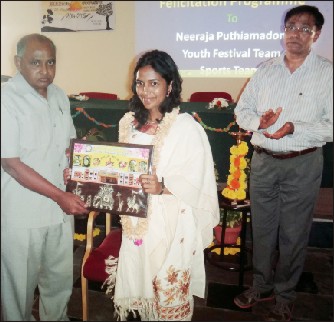
Neeraja being felicitated at Horticulture College, Mysuru, recently.

Mysuru :

Neeraja Puthiamadom, a B.Sc Horticulture student at the Horticulture College, Mysuru, who topped the B.Sc Horticulture examinations and was awarded 15 Gold Medals at the recently held 4th Convocation of University of Horticultural Sciences, Bagalkot, was felicitated at her college in city recently.

Winners of Inter-collegiate Youth Festival and Inter-collegiate Sports and Games meet of the college were also felicitated on the occasion.

College Dean Dr. K.M. Indiresh, who was the chief guest on the occasion, lauded the brilliant performance of Neeraja and her achievement.

Dr. B.G. Prakash, Professor and University Head, Dept. of Crop Improvement and Biotechnology, College of Horticulture, Mysuru, who also spoke, explained the academic activities of Neeraja in different stages and stressed that apart from academic performance, personal behaviour was also important in achieving success.

Later, the College’s Inter-Collegiate Youth Festival team which achieved success and the College sports team which won the overall championship at the Inter-Collegiate Sports & Games Meet were also felicitated.

Professors Dr. Prasad Kumar and Dr. G. Janardhan and Assistant Professors Dr. B.N. Dhananjaya, Dr. K.P. Mangala and Dr. Vikram Appanna were present.

source: http://www.starofmysore.com / Star of Mysore / Home> General News / Wednesday – February 11th, 2015