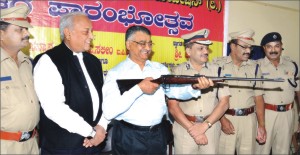
K.B. Ganapathy, Editor-in-Chief, Star of Mysore, is seen posing with a rifle during the inaugural function of Mysuru City Civilian Rifle Association at CAR grounds here this morning. Others seen (from left) CAR Deputy Commissioner of Police (Mysuru) B. Shivanna, Prof. Shivaram Malavalli, City Police Commissioner Dr. M.A. Saleem, DCPs A.N. Rajanna and M.M. Mahadevaiah.
Mysuru :
“One bullet is equal to one life,” said City Police Commissioner Dr. M.A. Saleem.
He was delivering his presidential address during the inaugural function of Mysuru City Civilian Rifle Association, a unit of Mysuru City Police, at City Armed Reserve Grounds premises here this morning.
Dr. Saleem said that one should know the proper usage and maintenance of rifles as in the past many people had lost their lives because of accidental firing while cleaning their rifles.
He said that one bullet is equal to one life as it can take the life of a person instantly.
Dr. Saleem, recalling his rifle training practice while undergoing Anti-terrorism training in America, said that in America, they first teach about the proper usage of Rifle and the safety of the person using the rifle and the people with him. Only when a person knows the right usage thoroughly, he is allowed to practice Rifle shooting there.
Earlier, K.B. Ganapathy, Editor-in-Chief, Star of Mysore, inaugurated the function by lighting the lamp.
In his inaugural address, he noted that many people had lost their lives due to firing of the Rifles accidentally.
He suggested the participants to never keep the rifles loaded at their homes as children may think that it is a toy and may accidentally trigger it.
Appreciating Dr. Saleem for his efforts in reducing the crime rates in city and for enforcing strict traffic rules, Ganapathy said, “Many Police Commissioners have served in Mysuru. However, four among them have made a difference to the city and one among them is Dr. Saleem.”
B. Shivanna, Deputy Commissioner of Police, CAR, Mysuru, who welcomed, noted that civilian rifle training was first started during II World War as there was a necessity of soldiers then. During II World War, civilians were trained in rifle shooting and were appointed into army those days, he added.
Shivanna said that more than 150 people from Mysuru have enrolled for the Rifle shooting training programme which will begin from tomorrow. In each batch, 40 members will be trained for one week.
Commandant of KARP Mounted Police Janardhan, DCPs Mahadevaiah and Rajanna, Mysuru City Civilian Rifle Association’s Joint Trustee Shivakumaraiah, Assistant Police Commissioner, City Armed Reserve, Mysuru and the Association’s Executive Committee Members Dr. Javeed Nayeem, Shreehari, Jainsingh Raj Purohit, Nabeel Mohammed, Den Thimmaiah, Prof. Shivaram Malavalli, Dr. Latha Muthanna, Rifle Training participants and others were present.
Mallikarjunappa, CAR ACP, proposed a vote of thanks.
source: http://www.starofmysore.com / Star of Mysore / Home> General News / Monday, February 09th, 2015
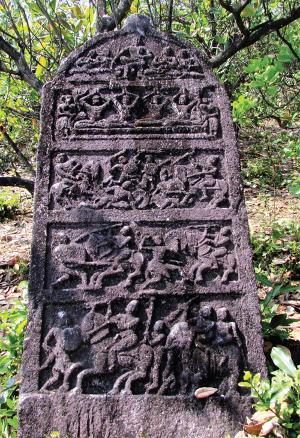
A typical hero stone has been discovered 5 km from Kollur Mookambika Temple by Murlidhar Hegde, a junior engineer of the temple. This discovery is significant for the cultural history and antiquity of Kollur, said professor T Murugeshi, an archaeologist and associate professor in Ancient History and Archaeology, M S R S College, Shirva in Udupi district. Kollur Mookambika temple, 135 kms from Mangaluru, is an important pilgrim centre. Goddess Mookambika is in the form of Jyotir Linga here, incorporating both Shiva and Shakthi.
Murugeshi says erecting memorial stones in honour of the deceased was an ancient practice in India. Menhirs were erected in the megalithic period in honour of the dead and different types of memorial stones such as hero stones and sati stones were raised in different forms and styles. It was also introduced in coastal Karnataka where it is found in different styles and forms. The hero stone is divided into five strips with bottom three depicting war scenes. The fourth shows four dead warriors sitting with palms joined over their heads in salutation. The fifth has carved figures of four dead persons seated on either side of a royal figure, seated in a heroic posture. This is a distinct feature of this hero stone. In medieval hero stones the deceased are generally depicted sitting near god.
“The hero stone under study was prepared in the style and form of medieval ones. It is datable to the 13th-14th century AD. The temple’s history dates back to 17th century to the Keladi kings. But there is a belief that Shankaracharya established the temple in the 8th century. There is no historical evidence of the period between 8th and 17th centuries, and hence, this Hoysala-style discovery is crucial,” said Murugeshi.
source: http://www.bangaloremirror.com / BangaloreMirror / Home> News> State / by Deepthi Sanjiv, Bangalore Mirror Bureau / February 11th, 2015
The Fort High School at Chamarajpet in Bengaluru was built in 1907. File Photo: V. Sreenivasa Murthy
INTACH has taken up the structure for preliminary assessment to suggest areas that need restoration
The 108-year-old Fort High School building in Chamarajpet has braved the vagaries of time. The school that was built in 1907 has also witnessed several students graduate from its portals, right from freedom fighter H.S. Doreswamy and political statesman V.S. Krishna Iyer to the former cricketer G.R. Vishwanath.
However, the old building is crying for attention. The clay-tiled roof needs urgent replacement, while the walls are damp due to leakages. The steel and wooden trusses in the building need to be treated, the walls need plastering, and flooring and wooden staircase need work. Even the stucco work on the walls look damaged.
The structure has now been taken up for preliminary assessment by Indian National Trust for Art and Cultural Heritage (INTACH), which will suggest areas that need restoration so as to bring back its colonial grandeur. “We will share our study with the Department of Public Instruction and anyone who is interested in taking up the restoration,” said Meera Iyer, co-convener of INTACH.
There are thousands of such old buildings in the city that can be preserved for value of antiquity. “As per INTACH’s listing, Ulsoor alone has nearly 90 heritage buildings,” she said.
The buildings in INTACH listing are grouped into various categories and grades, as per international standards. This helps identify the heritage potential of the buildings. Some of the buildings that have a public connect are assessed in depth by restoration experts and conservation architects to establish their social relevance.
“Recently, INTACH took up a study in Lalbagh to advice the Department of Horticulture for the restoration of three buildings — Library Building, Krumbigal Hall and Old Aquarium,” Ms. Iyer said.
It is the cost-factor that plays the spoilsport in the restoration of heritage structures, she said, and added that to bring back the bygone glory of a building, one requires not just “a feel for the old”, but also flair to identify the techniques required for restoration.
source: http://www.thehindu.com / The Hindu / Home> News> Cities> Bengaluru / by Ranjani Govind / Bengaluru – February 09th, 2015
When was the last time you went to a museum? If you can’t recall, this NGO’s project will help refresh your memory and revitalise the idea in your head
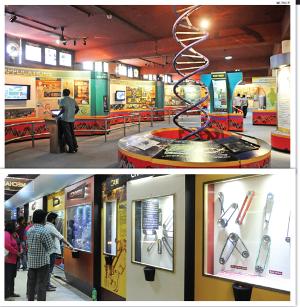
The Visvesvaraya Industrial and Technological Museum attracts 10 lakh visitors per year. (Top right) The National Gallery of Modern Art where they’re are organising new exhibitions, workshops, family quizzes, gallery walks and auditorium programmes to attract visitors
Swords, guns, king’s outfits, utensils, palanquins, artefacts, lamps, artworks… and life itself. Museums are much more than storerooms of strange and fascinating objects from a bygone era, preserved and labelled in glass cases with ‘Do Not Touch’ signs on them. They’re repositories of a way of life, showcasing a history and continuum that has brought us where we are today — whether sociologically or culturally. So why is that most of us rush to visit museums in other countries, but haven’t gone to one in our immediate vicinity since our school days, or without our children and grandchildren? Bengaluru NGO ReReeti, which hopes to transform Indian museums into spaces of learning, delight and meaningful engagement for Indian and overseas visitors, is attempting to answer that very question with a project called ‘Object of my Affection’.
In an effort to contemporarise the museum experience and re-introduce its value to a young audience, ‘Object of my Affection’ invites people to contemplate the value of objects in their home and imagine them in a museum 60 years from now. After all, “citizens get a sense of their ethnological ancestry, their nation’s cultural, scientific, historical, and technological progress through the materials on display at museums,” says Tejshvi Jain, Founding-Director of ReReeti. If you admire an object for its design, functionality or aesthetic appeal, and think it is precious today and may not be in use say 60 years from now, take a picture and upload it to Twitter or email them. Tell them when was the last time you visited a museum and why this object is museum-worthy or valuable to you. Through the exercise, which commences today and will go on for a month, ReReeti hopes to spark a thought process about the purpose of museums and help people look at them anew — as spaces that tell a narrative of a way of life.
More than objects
SK Aruni, City Director of Indian Council of Historical Research Bangalore, believes the time is ripe for such an initiative. Ruing that the revival of museums is not taken seriously, he says, “Each object has its own history, its own growth. But a museum needs to go beyond just labelling and displaying these items,” he believes. That could be done via cultural entertainment, “to show how life was lived at the time” and interactive displays or stories of the way art developed from ancient to modern times, “in art galleries”, he believes.
Great ideas, but not always successfully implemented. DK Chowda, General Secretary, Chitrakala Parishat says, “We have some of the best collections in the world including works by Bengal artistes and folk artistes, leather puppets and Mysore traditional paintings, among others.” He admits there is a need to attract newer audiences by making this a more lively space — by way of storytelling sessions around paintings, audio and visual aids, and a focus on promoting art and culture. “But we need funding and space,” is his refrain. Simple changes — like making the third floor “easier to reach”, and employing guides who can take people through the rich tapestries of the Mysore paintings (“Where did this style start? How did it emerge? What are the myths?”) are his suggestions, and hopes for the art school and museum.
Jain agrees. “Museums are perceived as dull, boring spaces,” she says. But that can be changed, if they work to fulfil people’s needs. She cites the examples of sleepovers in some US museums.
And in the UK, museums such as Tate and Victor and Albert Museum are, every so often kept open till late in the evening, and the look is changed, complete with disco lights and bars. “That attracts youngsters. Architecture students create theme-based activities — like games related to the architecture of the museum.” In Scotland, she recalls a Christmas-themed day at a museum when adults stood in a huge line, excited to make small badges with selfies on it. “In that process, they end up visiting the museum,” she says.
Have activities
It’s a philosophy KG Kumar, Director, Visvesvaraya Industrial and Technological Museum, has been trying to further ever since his return to the institution two years ago. Proudly citing a figure of 10 lakh visitors per year “highest in the science council of museums”, he talks about the various initiatives he has undertaken to make the museum a more interactive space. These include storytelling around exhibits like the spinosaurus, attended by 700 children over two days, multimedia projections, the use of miniature props that add to the storytelling sessions, and the Wright Brothers Flight Simulator that replicated the first flight in 1903, complete with controls.
“Next, I’ll have an exhibition on natural disasters and how to prevent them, a science show using dry ice, an interactive exhibit around the meaning of DNA…” The list is long.
Outreach programmes, he stresses, are necessary to attract audiences. From activity corners to demonstrate small processes in the biotechnology lab to an innovation festival where the public is invited to demonstrate their ingenious daily innovations, Kumar is making an effort to generate interest in museums. “You’ll see a king’s or a Nizam’s outfit on display, with a boring label next to it. Why not create a story around it? When did he wear it and why?” he asks. At the National Gallery of Modern Art, where he is the “borrowed” Director, he is making similar attempts with new exhibitions, summer workshops, family quizzes, gallery walks and auditorium programmes. “There are original paintings, which immediately relate to history, and contain stories of the times they were created — say Partition. We need to tell those stories in a more engaging fashion.”
We can almost see Jain nod. “Museums are holders of tradition and history. Once you make them personal enough, make a connection and make it contemporary, people will see that.” With Object of my Affection, she hopes people start with themselves. “What would you want to preserve for your next generation,” she asks. How can you be proud of your city, your time and your history? “People take selfies every now and then. So we’re connecting it to what is around them with this project,” she says. All of which will finally culminate in an exhibition of things that are important to Bengaluru. There you have it — your very own museum of memories. Not so boring anymore, right?
Object of my Affection: Choose any object from your home: spoon, hair brush, cushion cover, cooking utensil, graphic novel, lamp, whatever strikes your fancy you would want to preserve for the next generation. Click a photo, upload the photo and type ‘Object of my Affection: xyz, tag @ReReeti, use the hashtags #ReReeti #museumworthy and post your tweet. Or email: ReReeti13@gmail.com. All photo submissions will be added to their Flickr account.
source: http://www.bangaloremirror.com / Bangalore Mirror / Home> Columns> Sunday-Read / by Sowmya Rajaram, Bangalore Mirror Bureau / February 08th, 2015
City’s upcoming golfer Pranavi S. Urs, a student of National Public School and a product of JWGC, Mysuru, taking part in the South Zone JWGC Junior Golf Tournament conducted by JWGC on Jan. 31 January and Feb.1 won the Category ‘C’ title with a two-day aggregate score of 153 (79+74).
Aryan Roopa Anand bagged the top honours in the Category A & B with a two-day aggregate score of 155 (76+79). Mysuru’s Dristi Karumbaya secured the sixth place in the Category A & B with a two-day score of 168 (88+80).
Aryan Roopa Anand also won the Category ‘B’ title. Drishti Karumbaya of Mysuru, secured the third place in the Category ‘B’ section with a two-day aggregate score of 168 (88+80).
City’s Disha Kavery secured the ninth place overall in the Category ‘C’ section with a two-day card of 179 (89+90) and finished third in the girls section.
Milind Soni triumphed in the Category ‘D’ with a two-day aggregate score of 184 (96+88). Mysuru’s Vidhatri K. Urs finished 11th overall in Category ‘D’ with a two-day aggregate score of 198 (102+96) and secured the third place in the girls section.
Manoj Sree Ramappa triumphed in the Category ‘E’ section with a two-day score of 69 (34+35).
The Results: Category A & B: 1. Aryan Roopa Anand (76+79=155); 2. Vrushank Balu (87+77=164); 3. Nikhil Pai (87+79=166).
Dr. B. Suresha, Professor, Department of Mechanical Engineering at the National Institute of Engineering (NIE), Mysuru, has been selected for the Best Research Publication Award instituted by Vision Group on Science and Technology, Department of IT, BT and Science & Technology, Government of Karnataka for the year 2014-15.
His research publication titled ‘Investigation of organo-modified montmorillonite loading effect on the abrasion resistance of hybrid composites’ has bagged the award.
This award is being given to recognise and encourage quality research publications in Science and Engineering by the faculty members serving in University Departments, Colleges and Research Institutions in the State. This award carries a prize money of Rs.25,000 and a citation.
source: http://www.starofmysore.com / Star of Mysore / Home> General News / Monday , February 02nd, 2015
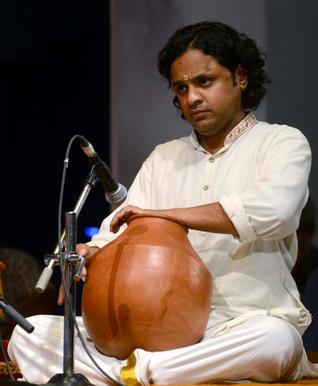
Ghata artiste Giridhar Udupa from Bangalore who bagged the Best Upa-pakkavadya Award from the Music Academy in the 2014 Music Season is just back from a whirlwind tour of concerts across Europe. “I am happy to dedicate this prestigious award to Karnataka as I owe everything to my State where I received lessons,” said the young percussionist who is a regular at the senior slots of the Academy. Udupa is indeed a unique artiste who is at equal ease with Carnatic, Hindustani and global music. Giridhar has been tapping on this Indian clay pot since he was a four-year-old when his father mridanga vidwan Ullur Nagendra Udupa set him on the ‘beat.’ He later honed his skills with Sukanya Ramgopal and V. Suresh. Today, as a 34-year-old, Giridhar has visited 40 countries and has been part of global collaborations on world platforms. “I can’t forget my accompaniment to R.K. Srikantan and Umayalapuram Sivaraman in 2007 at the Music Academy,” recalls Giridhar. “That was a phenomenal accompaniment on the ghata,” Ustad Amjad Ali Khan had commented after a concert, and Giridhar’s adaptation has impressed stalwarts such as Shiv Kumar Sharma, Pt. Jasraj, Vishwamohan Bhat and Sultan Khan in the innovative amalgams.
“I love to be exploratory in my approaches and my travel helps me get familiarised with wide-ranging global beats,” says Giridhar, who heads three European bands dealing with Spanish Flemenco, Polish-based jazz and Irish western music. “I am trying to internalise every rhythm of the world into my ghata and konnakkol, hoping to set in motion innovative ideas…,” says Giridhar.
source: http://www.thehindu.com / The Hindu / Home> Features> Friday Review / by Ranjani Govind / February 05th, 2015
Passing out parade of Karnataka Industrial Security Force Women Trainees
District In-charge Minister V. Sreenivasa Prasad is seen presenting all-rounder trophy to S. Shilpa of Mysuru at the passing out parade held in city this morning.
Mysuru :
The passing out parade of the first batch of women trainees of Karnataka Industrial Security Force (KISF) was held this morning at the DAR grounds in Jyothinagar here.
Totally, 163 women trainees of KISF have emerged out of District Police Training School spread among six teams after undergoing nine-month training which covered indoor and outdoor activities.
The indoor category included Indian Penal Codes, industrial and general security, labour laws, knowledge of psychology and computer and behavioural skills. The outdoor activity included physical fitness, arm handling, mob control, anti-sabotage check, dog and bomb squad, karate, yoga and drills.
Interestingly, though the eligible qualification prescribed for the post was just SSLC, only 2 out of 163 trainees were matriculates, 68 were graduates and 16 were post-graduates and the rest being PUC, D.Ed and others. The trainees took out an attractive march past with District In-charge Minister V. Sreenivasa Prasad taking the salute.
Speaking on the occasion, Sreenivasa Prasad said that the KISF personnel were groomed on the lines of CISF to tackle army emergencies. He advised the women trainees to work honestly and diligently without buckling to any pressure.
He expressed happiness that the trainees were used for security purposes during Dasara. He recalled that a Woman Wing Commander had for the first time led the guard of honour for US President Barack Obama recently at Rastrapathi Bhavan in Delhi which was commendable.
The prize winners in the competitions are as follows:
Indoor competition: 1. Chaitra Gopal Nayaka from Karwar; 2. Kusuma from Shimoga.
Out-door competition: 1. S. Shilpa from Mysuru; 2. Shruthi Bai from Hassan.
Rifle shooting: 1. S. Shilpa (Mysuru) and Vani from Mandya; 2. Nagarathna from Kalburgi.
All rounder trophy was bagged by S. Shilpa.
The parents and relatives of the trainees too had come to witness the parade.
SP Abhinav Khare, Police Training School Principal and Additional SP Kala Krishnamurthy, Retired Additional SP Pradeep Kumar and others were present on the occasion. The event was compered by Babu.
source: http://www.starofmysore.com / Star of Mysore / Home> General News / Friday – January 30th, 2015
The contributions of Rev. John Hands, a lesser-known missionary who spent more than three decades in Ballari towards popularising Kannada and establishing Kannada medium schools, much earlier to Rev. Fernand Kittel, is being recalled by celebrating bicentennial celebrations of his arrival here way back in 1810.
John Hands has many firsts to his credit. He was the first Protestant missionary to be sent by the London Missionary Society to come over here on May 5, 1810, with a view of establishing a Canarese (Kannada) Mission. He commenced the study of the ‘Canarese’ language. On realising that it was difficult for him to study without a dictionary or grammar book, he laid emphasis on preparing a lexicon from English to Kannada and vice-versa, as well as studying Kannada grammar.
In 1811, he established a Kannada-medium residential school in Fort area of the city, and an English-medium school for the children of the British. He was also instrumental in setting up a school for girls in Fort area.
Rev. Hands was also the first to translate the Bible in Kannada.
In recognition of his pro-academic activities, the East India Company allotted ‘Neelamma Garden’ to him in Brucepet, which came to be known as mission garden, where Rev. Hands established a Kannada school, a church, a Kannada printing press (the first to be established).
In 1844, the first Kannada news paper ‘Samachar’ was printed at the Ballari Mission Press. Several Kannada books, including Bible, were also published from here.
source: http://www.thehindu.com / The Hindu / Home> News> National> Karnataka / by Special Correspondent / Ballari – February 04th, 2015
SHARING DIVERSE EXPERIENCES The core team of the India Theatre Forum.
The first phase of SMART, India’s first theatre management programme, was held at Fireflies, near Bengaluru. The residential course had some of the best theatre groups gather to learn the nuts and bolts of purposeful planning
Passion alone sustains theatre practitioners in India. Despite lack of government funding and inadequate infrastructure, there is plenty of theatre happening all around us, in big cities and small towns, alike. In an endeavour to propel the art form forward, India Theatre Forum, a theatre network run by and for people in theatre, conceptualised and implemented, with support from Mumbai-based Junoon and India Foundation for the Arts (IFA), India’s first theatre management programme.
The initiative, Strategic Management in the Art of Theatre (SMART) is divided into three phases, which takes theatre groups from across the country through a practical roadmap or a strategic plan to make them more sustainable, effective and financially viable. The first phase of SMART was held at Fireflies near Bengaluru, where 17 theatre groups from across the country, participated in a 10-day residential workshop. Sanjna Kapoor and Sameera Iyengar of Junoon, Sudhanva Deshpande of Jana Natya Mancha and Studio Safdar, Delhi and Arundhati Ghosh, executive director, IFA, at a press conference held in the city, spoke of their experiences at Fireflies and of the road ahead for SMART.
Sanjna said the time for capacity building within the theatre community had finally arrived. “It seemed necessary to try and cultivate theatre management,” Sanjna said. Sameera added: “Theatre is an informal sector. In India, theatre survives and thrives despite everything. Theatre practitioners are often the managers. We felt we needed to look at what it means in the Indian context. We put together a fairly detailed survey. We sent it out to our database. We got 72 responses. We were very clear that SMART would be for theatre groups. We wanted theatre groups to send two people who are key decision makers in the group.” Sudhanva said the quality of groups who responded were outstanding. “It wasn’t just new groups that had responded, but older, more well-established groups who have been in the field for 20 to 30 years. Each one of the groups is first rate theatre groups, who do different kinds of theatre.”
Sanjna added, “We got participants not just from the metros, like Delhi, Mumbai and Bengaluru, but also from small towns such as Allahabad, Nasik, Pondicherry.”
Professor Milena Dragicevic Sesic, UNESCO chair in Cultural Policy and Management and professor at the University of the Arts, Belgrade, Serbia was the course mentor. She said the conclusion of the first phase signalled the “end of one process and the beginning of another process— a long journey of theatre development.”
The residency at Fireflies, Arundhati said, was magical. “We had something in the evening which we called adda. We had researchers and practitioners from the international community, including Ruth Bereson, an arts manager and teacher, Alessandra Gariboldi, Milena and the Freedom Theatre group that have worked in Palestine, share their diverse experiences.”
Apart from Sanjna, Sameera, Sudhanva and Arundhati, the other facilitators were Sunil Shanbag, theatre director, Arpana, Mumbai, and Swati Apte, director, Junoon.
Every group has been given one mentor, and in the next phase, theywill work with them over their respective mentors over six months.
“Among the mentors are Pravin K.P., Rajiv Krishnan and Menaka Rodriguez. They will be facilitators and will act as a bridge. The groups will come back this year again to discuss a strategic plan for the next three years,” said Arundhati. She added that they will announce SMART’s next year’s programme, in August.
source: http://www.thehindu.com / The Hindu / Home> Features> MetroPlus / by Sravasti Datta / February 01st, 2015