Category Archives: Records, All

A little bit of history you should know before you bite into an Indian Coffee House cutlet

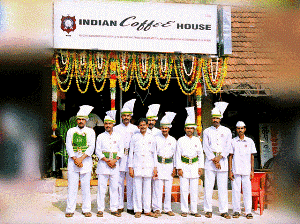
CoffeOneBF23oct2014

For most people, a beetroot is not something that they would eat with relish. But the Indian Coffee House (ICH) chain in Kerala has used the vegetable to make its signature cutlets that many of its patrons swear by.

From almost being shut down in the mid 1950s, the restaurant chain has held its own against stiff competition to be one of the most popular eateries in the state.

The coffee house chain was first started in 1936 by the Coffee Cess Committee, the first restaurant was opened in Bombay. There are now around 400 outlets all over India, and it is the biggest chain of restaurants in the southern state.

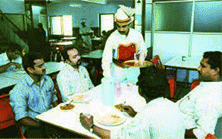
coffeeTwobf23OCT2014

Over the years, however, the chain incurred losses, forcing the union government to consider shutting it down. At this point, Communist leaders, especially those from Kerala, took a special interest in it and began a movement demanding that the ICH outlets be handed over to the workers of the Coffee Board.

Once the government agreed, the workers organized themselves into the Indian Coffee Workers’ Co-operative and since then the ICH has been achieved not just financial stability, but more importantly it had secured for itself a place in the palates of its patrons.

The first Society was formed in Bangalore on August 1957 and the outlet by the newly formed society opened in Delhi on 27th December 1957.

In Kerala, Communist leaders like A.K. Gopalan, T.K. Krishnan and N.S. Parameswaran Pillai spearheaded the movement. The ICH in Thrissur was the first to be started in Kerala in 1958, and it was the fourth in the country.

Despite stiff competition from new restaurants, the ICH in Kerala has managed to continue to run all of its 51 outlets. There are a few specific cuisines in the ICH outlets in the state like French toast, bread omlette, etc for which attract large number of people. The coffee powder sold at reasonable prices is also a good source of revenue for the co-operative society in Kerala.

ICH Thiruvananthapuram

 In that the movement for the chain’s survival was spearheaded mostly by Communist leaders, after Kerala, another communist bastion – West Bengal – has the second largest number of outlets.

The ICH outlet in Kolkata opposite to the Presidency College is the most famous among all. Popular singer Manna Dey, immortalized the coffee house chain in a song “Coffee Houser Shei Addata”. The song is about a group of friends who would meet there regularly and how they now had little contact.

The Kolkata coffee house was truly an “adda”, or a meeting place for many leading intellectuals of the time, like Rabindranath Tagore and Netaji Subhas Chandra Bose. When the government decided to shut down the outlet in 1958, some professors of the Presidency College successfully petitioned the government against it, asking the government to take into consideration the heritage value of the hotel.

ICH Kolkata
ICH Kolkata

 “Over the years, the society (Indian Coffee House) has stuck to the traditional values of good taste, courteous service and unmatched quality” and it is because of this that it still remains the biggest restaurant chain in Kerala, says their website. Now, the ICH is governed by an eleven-member body elected from within its employees.
CoffeeFiveBF23oct2014

source: http://www.thenewsminute.com / The NEWS Minute / Home / by Siddharth Mohan Nair / October 22nd, 2014

Farmer among five to get Rachana awards

Gabrial Stany Veigus lauded as agriculturist of the year

Farmer Gabrial Stany Veigus of Perar, a retired forest official who turned a 37-acre land into a model farm with innovative practices, is among five persons to receive the Rachana awards, instituted by Rachana, the Mangalore Catholic Chamber of Commerce and Industry, for 2014. Mr. Veigas has been recognised as Rachana agriculturist of the year for introducing sustainable farming practices.

He has planted 3,400 coconut saplings, mango, rambutan, cashew, grafted variety of jackfruit and breadfruit over the last 10 years and converted his land into a high-yielding agricultural plot. Jenette Pinto, a social activist from Mumbai and a professor of history who co-authored the book ‘Slavery in Portuguese India’ will receive the outstanding woman of the year award. Raphael Sequera has won the entrepreneur of the year award.

Anil Keith D’Cruz, a Mumbai-based Oncology surgeon, has won the professional of the year award and Ligoury D’Mello, chairman of the D’Mello group of companies, Oman has won the NRI entrepreneur of the year.

source: http://www.thehindu.com / The Hindu / Home> News> Cities> Mangalore / by Govind Belgaumkar / Mangalore – October 22nd, 2014

Union Health Minister to lay foundation stone for the ‘Centre of Excellence and Museum’ at AIISH tomorrow

Inauguration of ‘Audiometric Block’ and ‘Knowledge Park’

Model of the proposed Centre of Excellence and human face-shaped Museum.

 Mysore :

Dr. Harsh Vardhan, Union Minister for Health & Family Welfare, will lay the foundation stone for the ‘Centre of Excellence and Museum’ and inaugurate a newly built ‘Audiometric Block’ and ‘Knowledge Park’ at All India Institute of Speech and Hearing (AIISH), Naimisham Campus, Manasagangotri, here on Oct. 17 at 9 am.

U.T. Khader, State Minister for Health and Family Welfare, V. Sreenivasa Prasad, Revenue Minister and District in-Charge Minister and Pratap Simha, MP, Mysore & Kodagu, will be the chief guests. Dr. S.R. Savithri, Director, AIISH, will be present.

Centre of Excellence: The institute was given the status of Centre of Excellence by the Ministry of Health & Family Welfare, Government of India, New Delhi. Under this project, it is envisaged to initiate 5 research centres, 5 clinical centres, 2 other centres and a museum on speech and hearing.

The building is housed in G+3 floors with a basement for 2/4 wheeler parking space. The building consists of the following units: Centre for hearing sciences, Centre for hearing impairment in children, adults and senior citizens, Centre for persons with swallowing disorders, Centre for persons with tinnitus and vestibular disorders, Centre for speech and language disorders in Children, Adults and senior citizens, Centre for Speech and Language Sciences, Centre for AAC and sign language, Centre for prevention of communication disorders, epidemiological research and cognitive behavioural sciences in communication disorders, Centre for Informatics & Patents and Rehabilitation engineering, Acoustics & Biomedical engineering (CRAB), Centre for surgical Rehabilitation of Communication Disorders, Centre for public education in communication disorders.

Museum: The museum, first of its kind, would be in the shape of a human face and would be a great learning experience about how we speak and hear.

Audiometric Block: The newly-built Audiometric Block housed next to the Department of Clinical Services, is a boon to the patients with hearing impairment. In total it has 18 double room suites and 3 single room suites, meaning an infrastructure where 21 clients can be tested simultaneously.

The set up has a dedicated block for paediatric and geriatric patients with independent patient waiting areas. All these rooms are acoustically treated and have state-of-art technology equipment that meets international standards. The new block will cater to the needs of growing number of patients visiting AIISH for audiological evaluation and management.

Knowledge Park: The knowledge Park houses 10 classrooms and a seminar hall.

For details, contact PRO A.R. Keerthi on Mob: 98441-81080.

Minister to visit ESI Hospital

Addressing media persons at his office in Jaladarshini on Hunsur Road in city on Wednesday, MP Pratap Simha said that Dr. Harsh Vardhan would be taken to ESI Hospital on KRS Road where he would discuss the issue of providing equipments before the Minister proceeds to Periyapatna. In Periyaptna, Dr. Harsh Vardhan will address tobacco growers before returning to Bangalore in the evening, said th MP.

Earlier, the Minister will inspect K.R. Hospital and hold meeting with officials.

source: http://www.starofmysore.com / Star of Mysore / Home>General News / Thursday ,  October 16th, 2014

Pushing women scientists

Participants at the Ada Lovelace Edit-a-thon 2014 workshop held in Bangalore last week. At least 15 participants added content about women scientists over two days to Wikipedia as the first step in bringing public awareness about them.

Wikipedia edit-a-thon attempts to raise awareness of the contribution of Indian women to science

Ask anyone to name an Indian scientist and the answer is likely to be a man, and not a woman scientist. To let more people know about the unsung heroines of science in India, a workshop called the Ada Lovelace Edit-a-thon 2014 was held here recently. At least 15 participants added content about women scientists over two days to Wikipedia as the first step in bringing public awareness about them.

The edit-a-thon (a large number of people adding or modifying content on Wikipedia at once) concluded on October 14, which was Ada Lovelace Day, an international day to celebrate the achievements of women in science, technology and maths. The event was organised by BioScienceIndia Programme, a non-profit science outreach initiative, and Bangalore-based Centre for Internet and Society.

Participants added information about at least 40 women scientists. Information on 80 more would be added in a year’s time, said Nandini Rajamani, Co-director, BioScienceIndia Programme.

The aim, however, is to go beyond edit-a-thons, to examine issues that have not received the attention they deserve. Women scientists in India are not on par with men for several reasons (see info box) and the “leaky pipeline” theory is used to describe their decreasing visibility. Vishnu Vardhan, Director, Access to Knowledge team, CIS, said the aim is to motivate a new and younger generation of women scientists.

Karthik Ramaswamy, visiting scientist at the Indian Institute of Science (IISc) and a participant in the edit-a-thon, said science in India has a ‘diversity problem’ with Indian women and minorities represented inadequately. “There are very few women scientists among faculty of science institutions because they have no role models. Hopefully, this (presence on Wikipedia) will provide them with role models,” he added.

source: http://www.thehindu.com / The Hindu / Home> News> Cities> Bangalore / by Renuka Phadnis / Bangalore – October 19th, 2014

Beating gender divide

Inspired by her father, Bhagyalakshmi took tomorsing and is going places

BhagyalakshmiBF21oct2014

Women percussion instrument players are few and far between. Rarer are women playing a percussion-twang instrument like morsing. Vijayanagar resident Bhagyalakshmi M. Krishna is, perhaps, the only woman performer of morsing in Karnataka.

Renowned vocalist M. Balamuralikrishna, when he met her in 2006 in Chennai, had told her that she was the first woman morsing player he had met in his long musical career.

Father’s legacy

Bhagyalakshmi taking to the art is no surprise, considering that she is the daughter of the legendary morsing player Bheemachar. She recalls with fondness that her father was a big source of inspiration with a progressive attitude at a time when percussion playing was not regarded a woman’s forte.

He was happy to bring Bhagyalakshmi too into the world of laya , just as he had trained both his sons Dhruvaraj and Rajashekar, both well-known percussionists today.

“When renowned percussionist H.P. Ramachar’s revolutionary experimentation, Karnataka Mahila Laya Madhuri ensemble, had brought in women for mridanga, khanjira, ghata, thavil and konakkol, only morsing was missing. Ramachar’s plea to teach me the art of morsing not just saw my father start the lessons almost immediately, but his conscientious effort enabled me to absorb the nuances like a blotting paper. I was on the dais even as I was a sixth standard student,” she recalls. Thirty-eight-year-old Bhagyalakshmi, a resident of Govindarajnagar in Vijayanagar area, holds a B.Sc. in Electronics.

She is happy that her father brought in some radical changes in his morsing schooling as the “sol-kattu” or percussion syllables he used was stretched with precision and lucidity.

“He believed that clear verbal expressions of laya (the art of konakkol) helped transform the beats onto morsing more effectively. To the lyrical flow of the instrument sheltered in the traditional Pudukottai styling, my father brought in innovative embellishments. What gave it the true ‘Bheemachar stamp’ was the ‘kirra’ sound generally heard from the dhol that was infused into morsing to bring in a dramatic effect,” she explains.

Travels abroad

Bhagyalakshmi, through Mahila Laya Madhuri, travelled to Egypt, Algeria and Tunisia on a concert tour through the ICCR. If that was the starting point, today, as a member of the popular Stree Taal Tarang steered by ghata artiste Sukanya Ramgopal, she has toured extensively through the length and breadth of the nation and globe, and has participated in more than 1,000 concerts and accompanied star performers of the Carnatic genre.

Bheemachar’s Morsing Tarang also had the entire family of four percussionists travel to Amsterdam to take part in the global Jew’s Harp Fest.

“It’s a treat to represent India and present the Indian harp,” she says. Morsing, used in Rajasthan folk music, is called ‘murchang’ there, while the same instrument exists in Germany, Hungary, Japan, Vietnam and Russia under different names that come together during international harp fests.

Says Bhagyalakshmi: “Only when we go abroad and participate in percussion ensembles do we realise the importance this small instrument enjoys. It’s comforting that our own Laya Vadya ensembles have helped morsing to gain more importance. Gender bias is also fading out.”

A knack

On the question of whether morsing can seriously hurt the tongue, she says: “It’s an art you get used to. There is a knack in making music by holding this instrument made of mild steel between your tongue and lips.”

Bhagyalakshmi is now a regular at the Music Academy, Chennai, concerts. This year, during the December season concerts, she will be beside Bangalore’s renowned music guru Neela Ramgopal.

source: http://www.thehindu.com / The Hindu / Home> National> Karnataka / by Ranjani Govind / November 12th, 2013

Girls & Ghatam: a new symphony

Sukkanya Ramgopal is India’s first woman ghatam artiste.She learnt from the legendary Vikku Vinayakaram who gave India its first ‘Ghatam Grammy’.She’s the first to create the unique concept of Ghata Tharang playing six ghatams at the same time.And the first to set up Bangalore’s all-woman Carnatic ensemble.

Sukkanya Ramgopal
Sukkanya Ramgopal

Sukkanya,who has been invited to perform at the prestigious Madras Music Academy festival with the ensemble the ultimate accolade in the Carnatic domain shares her thoughts on women,ghatam and Carnatic music.Excerpts from an interview: 

Tell us about the place of the ghatam in Carnatic music today.

 Her guru Vikku Vinayakaram
Her guru Vikku Vinayakaram

Things changed for the ghatam after Vikku Vinayakaram.He has given it a place no one has,got it the right attention.Vikku has also made the ghatam internationally popular he’s played with an African ensemble that won him the Grammy,the only ghatam artiste to do so.Thanks to him,ghatam artistes can travel abroad today,which was once unthinkable.Ghatam is number five in Carnatic music vocals,violin,mridangan,khanjira and then ghatam.But,if it is taken more seriously than it was a decade or two ago,it means Vikku made the difference.

Why are there so few women ghatam artistes

It is very difficult to produce sounds from the ghatam.Even men find it difficult! It’s still seen as a ‘masculine’ instrument.Parents have to be convinced there is a future in the ghatam and that women and ghatam go together.

How did you get into it

I started on the violin,then learnt the mridangam.I then heard of Vikku and began to go to his concerts.I was awestruck.I asked him to take me as his student.He said,It is difficult for a girl to produce sounds on the ghatam.You are playing mridangam nicely,why not continue with that At that point,his father intervened.There is no difference between a boy and a girl for the ghatam.Teach her.She’s very hardworking. Vikku’s magic and his father’s perception of me made me his student.

And your family’s reaction

My mother was very encouraging.My father didn’t like it.He didn’t come for the first few concerts.A while later,he got interested and began accompanying me.Gradually,my entire family liked it and backed me all the way.

How do other musicians perceive you,a woman as a ghatam artiste

Generally,musicians are not very happy with women accompanists.It’s a long-held feeling and it’s still there.Even organizers are careful in engaging artistes.That’s why it becomes difficult for me to play with a stalwart like U Srinivas.And where musicians allow me to accompany them,I find the mike won’t be set right! It’s strange there is accommodation but not accommodation in entirety on stage.Shouldn’t all of us be one in a concert 

How accepted do you feel in the music world

I do feel accepted.I have the highest ranking on All India Radio and musicians are comfortable with me.I perform at the Ramaseva Mandali at Chamarajpet and Seshadripuram every year.I go abroad too.This apart,I am saying the comfort factor for the woman ghatam artiste in a concert should be complete,no different from the comfort factor other artistes enjoy within the ensemble.

Is that why the all-women ensemble came about

Partly.The stage just had to be more accommodative or I had to find a way out.I found it an allwomen ensemble,the Stree Taal Tharang,was born.We found women for everything mridangam,veena,violin,morching and ghatam.While we do perform in Bangalore,performing at the forthcoming Madras Music Academy festival will be an honour.

How else did you innovate to ensure that ghatam’s up front

The most difficult thing in a Carnatic concert is to make people sit and listen to laya vinayasam.When it is the turn of the mridangam and ghatam,people walk out.I had to find a way out to make them stay,had to innovate.I brought six ghatams together and started playing melody on them at one go.Ghata Tharang is what I call it.It made a difference.People began to sit and listen.It is a first in percussion.No one plays melody on the ghatam.I had promised myself to move the ghatam from number five to number one.I am on the way to do that.Ghatam cannot and will not remain on the margins.

You are a Mathematics degree holder.How does it figure in music

Lekkachara is always fun even if it’s integral to music.What’s better than indulging in permutations and combinations to make phrases I enjoy making korvais thoroughly.

What’s your advice to students

Work hard.There is no alternative.

Do you have a woman student

Interesting you should ask.Very recently,I got my first woman student,the first in my 30 years of playing the ghatam.

Does it say something about women and ghatam

I am happy she has taken up the ghatam.But I’m aware there are very few women who do it.That’s precisely the odds.Braving that speaks for character and conviction.The impression that ghatam is masculine is very fundamental and changing it will be the challenge.
toiblr.reporter@timesgroup.com

source: http://www.mobiletoi.timesofindia.com / E-Paper / The Times of India / Home> Times of India / Prashanth G. N, TNN / August 03rd, 2009

Hon. Doctorate for Sankalp Group CMD Jagadish Babu

 V.K. Jagadish Babu is seen receiving the honour from University President Prof. Dr. Marco E. Grappegia during the convocation of Universita Popolare Degli Studi Di Milano.
V.K. Jagadish Babu is seen receiving the honour from University President Prof. Dr. Marco E. Grappegia during the convocation of Universita Popolare Degli Studi Di Milano.

City’s V.K. Jagadish Babu, Chairman and Managing Director (CMD) of Sankalp Group and President-Elect of CREDAI (Confederation of Real Estate Developers Association of India), Karnataka, was conferred the Degree of Honorius Causa – Doctor of Philosophy (Honorary Doctorate) in Civil Engineering for his achievements and contributions in the field of Construction Science recently by Universita Popolare Degli Studi Di Milano, Milano, Italy, a top ranking European University.

He is seen receiving the honour from University President Prof. Dr. Marco E. Grappegia during the convocation of Universita Popolare Degli Studi Di Milano.

source: http://www.starofmysore.com / Star of Mysore / Home>General  News / Saturday,  October 11th, 2014

Devanahalli mud is just right for ghata

Forty-four year old D.K. Gopal (Left in the picture) is chosen for the prestigious Sri Kalajyothi Award of the Gayana Samaja and would receive it during the Sangeetha Sammelana on October 19. Photo: Special Arrangement / The Hindu

Even as serene Devanahalli may boast of its glamorous international airport, the modest town, located 40 kms north-east of Bangalore, is grounded with an inbuilt pride. The area’s speciality mud has helped carry forward a hoary tradition, the making of the percussion instrument ‘Ghata.’ Devanahalli’s mud is said to possess a composition most suited for pots. And Ghata-making is a 100-year-old vocation being pursued by 44-year-old D.K. Gopal, the only family in Bangalore that has hands-on contact with the clay for making the musical instrument. Nearly 60 pieces are sold in a month and exported too.

Gopal’s family belonging to the Kumbara Beedi of Maralu Baagilu in Devanahalli has always lived alongside the pot-makers of the area, but it is the bond with music that led his forefathers to lay their hands on Ghata-making. “My grand-father Munishyamappa conducted bhajans at the nearby Kumbeshwara Temple every Saturday,” recalls Gopal, who has learnt 20 varnas and 40 kritis and passed exams in music. Gopal’s family even includes violinists, vocalists, tabla-and harmonium players. “My vocal knowledge helps me immensely as we make a variety of Ghatas to suit every shruti,” he says. “My father Krishnappa had specially made a Ghata for the veteran K.S. Manjunath, and later on for Bangalore K. Venkatram too on personal requests,” says Gopal. “One of his deft creations remains showcased in the Government Museum on Kasturba Road even today,” says Gopal.

Just as Manamadurai in interior Tamil Nadu where the musical Ghatas are made, Devanahalli’s pot is a mixture of three varieties of mud gathered from in and around the three lakes of the area for the perfect blend – the Devanahalli kere’s red clay for the sheen, the Bhuvanahalli kere’s dark-toned clay for the conch-like naada, and the Venkatagiri kere’s mix of shades that not only balances the sound, but makes the Ghata strong. “While we mix the three varieties with water, it is in the singularly unique kneading with hands and foot and the addition of metals that makes it compatible for melodic tapping,” explain Gopal and his son G. Mahesh. These craftsmen tap nearly a thousand times on their “sacred pots” with special tools for the “right thickness that brings in the required shruti.” They are meticulously sun-and-shade dried, and then burnt in natural coconut-husk furnaces. It takes 25 days to make a single pot, and they cost anywhere between Rs. 850 to Rs. 2000 a piece.

Gopal and Mahesh explain that Ghata is an instrument purely made from the five elements of Nature. “We start work with a prayer to Lord Kumbeshwara. The Ghata’s resonances – Akaara, Ukaara, Makaara and Omkaara – are considered comprehensive. Most saint-poets as Basavanna, Sarvagna and Kabirdas referred to the ‘Ghata’ as a metaphor to human body in their poems,” explains Gopal.

With the international airport at Devanahalli now, furnaces for baking the pots are not allowed as the process emanates smoke. So Gopal is exploring newer technologies in controlled environment, with a marketing unit set up at Byatarayanapura.

The research

Sumana Chandrashekar, Programme Executive, India Foundation for the Arts, has done a research study on ghata. Sumana, a student of Sukanya Ramgopal says, the Devanahalli Ghata is a lighter one when compared to the Manamadurai instrument. “While both have their unique tonal effects and are equally used in Carnatic music, the Devanahalli Ghata is easier to carry and play on, while the Manamadurai pot is a heavier version that can withstand intense thumps,” she says. Actually, the technique for playing both these instruments have evolved over the years in response to the way these instruments have included their material composition, she added.

Sukanya Ramgopal. File Photo: V.V. Krishnan / The Hindu

First lady ghata player

The first girl to hold the Ghata on her lap in the world of percussion was the 12-year-old Sukanya Ramgopal, a student of the veteran Vikku Vinayakram. Originally from Tamil Nadu, the 57-year-old Bangalore-based Ghata artiste has had to boldly tackle the gender discrimination she witnessed quite often on stage. “My guru nurtured and guided me into the Vinayakram schooling, as well as helped me get used to the heavy Manamadurai Ghata. Today I take part in several percussion festivals across the globe,” she says. Sukanya’s four decade career has helped her lead an all-women ensemble, Sthree Thaal Tharang, where she handles six Ghatas at a time, making them fundamental to the concert.

The Devanahalli Ghata

My father used the Devanahalli Ghata for nearly six decades, says V. Krishna, mridangist, son of the Ghata-ace (Late) Bangalore K. Venkatram. Venkatram, who had one specially made from Krishnappa of the Devanahalli family in the early 1960s, is said to have preferred the Ghata to have an easier entry to performing on stage when there was a dearth of Ghata players and a surfeit of mridangists. Venkatram loved the Devanahalli Ghata as its not-so-thick composition produced defined modulations even with feather-soft touches. Venkatram’s percussion ensemble, Laya Vrushti too helped discover the potential of Indian percussive instruments. His deep study of the Ghata had him once showcase the exceptionally rare low-pitched beats when he accompanied Chembai Vaidyanatha Bhagavatar who had reacted in wonder to say, “This is Ghatoth Ghata.”

source: http://www.thehindu.com / The Hindu / Home> News> Cities> Bangalore / by Ranjani Govind / Bangalore – October 14th, 2014

Jayaram conquers doubts after surgery to win Dutch Open

Ajay Jayaram
Ajay Jayaram

For a long time, Ajay Jayaram was known for losing out on an Olympic berth to Parupalli Kashyap during the 2012 India Open. It seemed as if Jayaram had all but sealed the spot with some good performances round the year, but Kashyap pipped him courtesy a lucky break as the then World No. 4 Chen Jin gave the latter a walkover in the quarter-finals that eventually proved decisive.

Jayaram was crestfallen and since then has been trying hard to bounce back. He enjoyed a decent run but not as much he would have liked. To add to his woes, a shoulder injury during the Hong Kong Open in January this year put him out of action for more than six months.

Jayaram underwent a surgery and did the necessary rehabilitation. But at only his fourth tournament back, the Mumbai shuttler won the biggest event of his career when he clinched the Dutch Open Grand Prix on Sunday.

Ajay Jayaram wins the Dutch Open

“Definitely it has surprised me. I played some good attacking badminton. I need to maintain this level of focus and discipline in the coming tournaments. That will be the key to getting good results,” Jayaram told MAIL TODAY.

“I am elated. It has been a tough few months. Even after I resumed playing, it wasn’t easy to find my rhythm. It took me a while to get back the match temperament and touch. But I am happy I managed to dig deep and get the muchneeded win which also happens to be my first Grand Prix title. I couldn’t have asked for a better comeback,” he said.

The manner of his win, coming against a tough field, should give Jayaram immense confidence. Beating the likes of third seed Dionysius Hayom Rumbaka (World No. 26) of Indonesia and top seed Rajiv Ouseph (World No. 29) of England would do him a world of good.

“With higher-ranked players like Ouseph and Rumbaka in my half, it wasn’t going to be easy. I secured convincing wins against both. The final was against an upcoming Indonesian (Ihsan Maulana Mustofa). It was a hard fought five-game battle which swung both ways. I had to dig deep and bring all my focus into play in the fifth game where I was 1-5 down. But I played well and was positive when it mattered.”

Coming back from the shoulder injury was never going to be easy and Jayaram admitted that he was often frustrated. “The first few tournaments were quite hard to adapt to. But I knew it was a matter of perseverance. There were trying moments when frustration set in. But I had to keep my chin up and keep working.” Now Jayaram has got a feel of the new scoring system that is being introduced at the Grand Prix level on an experimental basis. The 11-points best-of-five games scoring format has been criticised by many top players. “Although the game gets shorter, most of the match is played under more pressure which requires more focus. Hard to say if it is the way to go for badminton, but I’m glad I was able to adjust to it and do well.” Jayaram, who was ranked as high as 21st in early 2013, has now fallen to 66th, and with many Indian players going past him, he was not part of the Asian Games squad. Getting back to the national team is his priority.

“If I am able to maintain the same positive tempo, I’m sure I will regain my place in the core group,” he said.

 source: http://www.indiatoday.intoday.in / IndiaToday.in / Home> Sports / by Avishek Roy / New Delhi – October 14th, 2014

Bangalore’s Gateway Hotel turns 25 on October 10

Bangalore :

The Gateway Hotel on Residency Road in Bangalore, an iconic hotel located in the heart of the city, turned 25 on October 10.

Catering to the needs of the ‘urban nomad’, the hotel is designed with a ‘green’ theme keeping with the changing trends. As a part of its silver jubilee anniversary celebrations, the hotel has lined up various interactive events and activities for the next 25 days. Ranging from eye-catching rare images of the hotel in the archival corridor to retro music tributes, from classical dance performances to an interactive workshop on movies, the Gateway Hotel celebrates the true essence of the city of Bangalore. Guests will also be treated to an extensive culinary journey featuring the 25 years special celebration menu crafted by Chef Naren Thimmaih which pays ode to the city of Bangalore.

Speaking on the milestone, Prabhat Verma, COO, The Gateway Hotels and Resorts said, “The Gateway Hotels and Resorts are full service upscale hotels and resorts in the South Asia offering consistent, quick and crisp service for travelers seeking contemporary experiences. From 1989 to today, the hotel has gone through a host of changes while remaining true to the spirit of the brand Gateway by delivering the brand promise of welcome perfection.

“As an iconic landmark in the cultural hub of the city, it is a property which has grown along with Bangalore, playing host to numerous dignitaries, film thespians and artists. Needless to say, we remain grateful to the support we have received from our guests and patrons and look forward to a brighter future,” said Albert Rebello, general manager, The Gateway Hotel.

source: http://www.timesofindia.indiatimes.com / The Times of India / Bangalore / by Saswati Mukherjee, TNN / October 10th, 2014