Category Archives: Records, All

Fashion treat in city

Designer Rocky S with actress Evelyn Sharma

Mysore Fashion Week-2014 to feature 14 of country’s top designers starting with Rocky S. Actors Mugdha Godse, Gauhar Khan, Nidhi Subbaiah, Priyamani and model Muzammil will be the show stoppers.

C. Krishniah Chetty & Sons, the famed Jewelleres along with Mysore’s Sound and Light specialists Rock Salad, will be presenting the first ever edition of Mysore Fashion Week (MFW) from Sept. 5 to 7 at Country Inn & Suites, Mysore.

Directed by Jayanthi Ballal of Needle Works and Snehal Igoor of Creative Studio in Mysore, MFW 2014 moves beyond just Fashion Show and more into design aspect of fashion by featuring for the first time in Mysore 14 of the fashion industry’s biggest designers. The clothes will be modelled by 24 of the top female models in the country along with celebrity show-stoppers from Bollywood and South Indian film industries.

The fashion designers who will be showcasing their collections are:

Rocky S, who has designed for celebrities like Katrina Kaif and Priyanka. Then there is Aslam Khan, the popular Designer from Delhi whose designes represent the fine art of tailoring, fascinating pin tucks, piping, cuts and frills.

The show will also have Ashok Maanay, a designer known for his drawing strengths and inspiration from India’s rich traditions. Ashok Maanay’s designs are a breathtaking amalgamation of intricate hand embroidery and karigari. There is Ramesh Dembla, who is also a celebrity designer for actors such as Sudeep and Raagini.

The Mysore Fashion Week will also feature Reshma Kunhi, a designer who was quoted in Femina magazine as “Generation Next Designer.” Since then she too has become a favourite for celebrities.

The other young design talent is Sagar Tenali, who has been termed as one of the brightest stars in the Southern Fashion Industry.

Also presenting will be Bangalore’s foremost fashion designer Anil Hosmani, who has his own label ‘IHITA.’ Then there is Roohafza, who studied finance, but transformed into a designer by passion. She specialises in ethnic and bridal wear. She has also established her own brands called Mysore Silk Udyog, as she wanted to bring Mysore silk on the Indian map.

While the show may be in Mysore, Roshan, who won the Bangalore’s Young Stylish Designer award, is all set to introduce Mysore to his fashion. He designs for both men and women, everything from bridal wear to casual smart. Finally, there is Sumit Dasgupta — a designer who came into fashion because it was his passion. He studied fashion designing at National Institute Kolkata and has Master’s in Fine Arts from Chandigarh. He launched his first collection at the Kolkata Fashion Week in 2008.

It may be a Fashion Week but it’s incomplete without the glorious sprinkle of make-up and to do that Robert, one of the most sought after make-up artist and stylist across the country, will be part of the event. Robert has been the official styling director of Bangalore Fashion Week and has worked with many renowned choreographers.

Of course, no Fashion Week is complete without a show-stopper and Mysore Fashion Week will have a few — some of them being Gauhar Khan, Nidhi Subbaiah, Bhavana Rao, Mugdha Godse, Muzammil, Priyamani and Raagini Dwivedi.

source: http://www.starofmysore.com / Star of Mysore / Home> Feature Articles  / September 02nd,  2014

Just Heat and Eat

For the first time in the country, city based food industry manufactures Heat and Eat food products.

ReadytoEatBF05sept2014

by S. Kenneth Shishir

In the current fast changing and fast moving lifestyle we have all failed to realise the importance of nutrition in our food intake. With no time to cook a good healthy meal, most of the working class couples and families are moving towards heat and eat food products.

Although the Ready to Eat (RTE) food category was first introduced in India in 1987, it was not well received by Indian consumers due to the dependence on traditional cooking and in the early 2000s, with the advent of new technology that improved the shelf life of products and the growth of storage and distribution centres, RTE products began to gain popularity.

The heat and eat food industry in India, has been growing for the last three years and is expected to grow in the next five years due to rapid urbanisation.

Food has always been an important part of every Indian no matter which country he/she lives in.

This has prompted lots of food manufacturing companies to come up with new innovative ideas to woo its customers and one such popular city based company is KAVERI FOODS which was established in the year 2013.

Noticing the growth potential in this particular sector, Mysore based Kaveri Foods has launched their Heat and Eat products brand called RefriFresh.

They manufacture Ready-To- Eat products made out of 100% natural ingredients without any Preservatives, Artificial Colours or Flavours. Their USP lies in their ability to deliver home-cooked freshness and taste in the refrigerated format through minimal processing.

SOM met Ashwin Rajagopal, CEO of the company which is marketing its Heat and Eat products under the brand name ‘RefriFresh’ at his industry at Hebbal Industrial Area in city and had a brief chat about his products.

Ashwin, a MBA graduate in International Marketing from Australia speaking to SOM said that the company Kaveri Foods, sister concern of Kaveri Enterprises, a company which holds a strong market presence in edible oil industry sector was established in the year 1945 with the brand name R.G. manufactures of R.G brand Vanaspati and is popularly known as R.G Ghee among old Mysoreans.

Speaking about the new venture, he said that the company was looking at diversification into new areas in the food industry and thought of Ready to Eat industry which is growing at a tremendous rate with bright growth prospects.

He further said that as they decided to venture into Ready to Eat segment, they thought of coming out with a product that is unique with regards to technology and consumer requirement and decided to come out with South Indian delicacies, as they wanted to be known as a company that introduced south Indian delicacies on Heat and Eat format.

The company is currently concentrating in South Indian Breakfast and Dinner category.

They manufacture combo packs like Idli Sambar, Masala Paddu with Tomato Chutney, Mini/Button Idli with Sambar, Set Dosa with Coconut Chutney and Rava Idli with Coconut chutney apart from Sambar and Tomato Chutney which are all on ready to eat format and all that the consumer has to do is just open the pouch heat them in microwave or on a stove for a minute or two and it’s ready to be consumed.

All their products are manufactured only after consultations with CFTRI.

RefriFresh currently has nine Stock/Store Keeping Units (SKUs) and are planning to introduce more products like Pongal, Kesari bath, Onion Dosa which at present are available in Mysore and Bangalore and by the end of 2015 they would expand the market in Tamil Nadu and other States in South India, by targeting working families and senior citizens as their products have the traditional aroma and taste, said Ashwin and added that their products are minimally processed to keep up with the quality, taste, texture and quality of the products and added that the lifespan of the products are 35 days which would be increased to 60 days.

As the pioneers and one-of-its-kind in the industry ‘Refrifresh’ brand is being recognised as a synonym for tasty, fresh South Indian delicacies.

Asked if he was looking at other segments like spices or ready mixes he said there are ideas for the same and are still in the pipeline.

He ended by saying that his company is proud to have implemented successfully a unique technology that was pioneered by them for the first time in India.

The products are available at More Mega Stores, Easy Day and Loyal World in city.

source: http://www.starofmysore.com / Star of Mysore / Home> General News / August 31st,  2014

All-India Open Dog show

357 dogs of 37 breeds participate

 District Minister V. Sreenivasa Prasad is seen releasing catalogues on dogs at the All-India Level Dog Show conducted by the Canine Club of Mysore (CCM) at the Dasara Expo Ground this morning while MLA G.T. Devegowda, CCM President B.P. Manjunath, former MUDA Chairman L. Nagendra and others look on. Picture right shows a lady holding a St. Bernard, which was a star attraction at the Show.
District Minister V. Sreenivasa Prasad is seen releasing catalogues on dogs at the All-India Level Dog Show conducted by the Canine Club of Mysore (CCM) at the Dasara Expo Ground this morning while MLA G.T. Devegowda, CCM President B.P. Manjunath, former MUDA Chairman L. Nagendra and others look on. Picture right shows a lady holding a St. Bernard, which was a star attraction at the Show.

Mysore :

The people assembled at Dasara Expo Grounds here watched in sheer awe and praise as dogs of various breeds sashayed on the ramp with immaculate behavior at the first All India Open Dog Show organised by Canine Club of Mysore (CCM) this morning.

In all, 357 dogs of 37 breeds including Siberian Husky, Pinscher, Great Dane, Pug, Boxer, Saint Bernard, German Shepherd, Mudhol, Chow, Hound, Labrador, Dachshund, Beagle and Cocker Spaniel participated in the show.

The show was judged by Edwina Thomas, Yvonne Meintjes from Austrialia, C.V. Sudarshan from Chennai and T. Preetham from Bangalore. Prizes will be awarded in the evening.

The dogs were judged on seven parameters like gait, health, looks, behavior and taking orders from the owner. The smallest of the dogs weighed just 1.5 kg.

The dog owners had come from Delhi, Tamil Nadu, Kerala, Pune, Karnataka, Andhra Pradesh and other places.

It was a common sight to find some of the owners pampering their prized exotic possessions in the air-conditioned comfort of their vehicles as they did not want to take any chance with the vagaries of weather which could affect the dogs.

Some of the participating dogs were seen draped in dazzling clothes to beautify them.

A few stalls had cropped up at the grounds to sell dog biscuits, belts, leads and toiletries, making good business.

District In-charge Minister V. Sreenivasa Prasad inaugurated the dog show which was dedicated to late Srikanta Datta Narasimharaja Wadiyar.

Earlier to that, Pramoda Devi Wadiyar offered floral tributes to a portrait of Wadiyar kept on the dais.

MLA G.T. Devegowda, CCM President B.P. Manjunath, BJP leader L. Nagendra and others were present on the occasion.

source: http://www.starofmysore.com / Star of Mysore / Home> General News / August 31st,  2014

DVD on Daasara Padagalu

 Mysore :

The premier launch of Daasar – The Fables, India’s first DVD with animated visuals on Daasara Padagalu, will take place at 6 pm on Sept.1 at Bhavan’s Priyamvada Birla Institute of Management auditorium, Bharatiya Vidya Bhavan, Vijayanagara First Stage.

Prof. Bhashyam Swamiji, founder of Vijayanagar Yoganarasimha Swamy Temple will be the chief guest. N. Ramanuja, Chairman, BVB Bangalore and Dr. A.T. Bhashyam, Hon. Treasurer, BVB Mysore, will be the guests of honour. BVB Offg. Chairman & ‘Star of Mysore’ Editor-in-Chief K.B. Ganapathy will preside.

source: http://www.starofmysore.com / Star of Mysore / Home> In Brief / August 30th,  2014

__________________________________________________________________ 

Daasa Sahitya Animated DVD released 

BVB Mysore Officiating Chairman and Star of Mysore Editor-in-Chief K.B. Ganapathy (centre) released the DVD ‘Daasa - The Fables’ in city yesterday. Others seen are Vedatma Animation Studios Director B.S. Srinivas, Gundlupet Municipal Councillor S. Govindarajan, BVB Karnataka Chairman N. Ramanuja, BVB Mysore Hon. Treasurer Dr. A.T. Bhashyam and Vedatma Animation Studios Managing Director Sukanya Srinivas.
BVB Mysore Officiating Chairman and Star of Mysore Editor-in-Chief K.B. Ganapathy (centre) released the DVD ‘Daasa – The Fables’ in city yesterday. Others seen are Vedatma Animation Studios Director B.S. Srinivas, Gundlupet Municipal Councillor S. Govindarajan, BVB Karnataka Chairman N. Ramanuja, BVB Mysore Hon. Treasurer Dr. A.T. Bhashyam and Vedatma Animation Studios Managing Director Sukanya Srinivas.

Mysore : (SBD&DM)

India’s first DVD with animated visuals on Daasara Padagalu (Daasa – The Fables), brought out by Vedatma Animation Studios, Bangalore, was released at a function organised at Bhavan’s Priyamvada Birla Institute of Management, Bharatiya Vidya Bhavan (BVB), Vijayanagar, here yesterday.

Speaking after releasing the DVD, BVB Mysore Officiating Chairman and Star of Mysore Editor-in-Chief K.B. Ganapathy said that the DVD is a very useful tool in developing a devotional mindset among the people, who are living in the midst of a confused society.

Ganapathy further said that this DVD was brought out not purely for commercial purpose but also as a service to the society.

BVB Karnataka Chairman N. Ramanuja complimented Vedatma Studios for bringing out the DVD with the united efforts of everyone involved. Terming late Mathur Krishnamurthy, K.B. Ganapathy, P.S. Ganapathy and A.V. Narasimha Murthy as pillars of Bharatiya Vidya Bhavan, Ramanuja recalled their services in the growth of the BVB.

Vedatma Animation Studios Managing Director Sukanya Srinivas, who delivered the keynote address, gave a brief on the greatness of Daasa Sahitya.

BVB Mysore Hon. Treasurer Dr. A.T. Bhashyam, Gundlupet Municipal Councillor S. Govindarajan, Vedatma Animation Studios Director B.S. Srinivas and others were present on the occasion.

source: http://www.starofmysore.com / Star of Mysore / Home> General News  / September 02nd,  2014

Sea Shell Ganesha

seashellGaneshaBF02sept2014

Mysore :

City’s noted Sea Shell artist Radha Mallappa is seen giving final touches to the 11 feet tall idol of Ganesha made out of sea shells at her residence in Bannimantap.

She has worked on it for the past three years, using 260kgs of sea shells of 240 types, including some exotic varieties, the entire project costing approximately Rs. 8 lakhs.

source: http://www.starofmysore.com / Star of Mysore / Home> General News  / August 27th,  2014

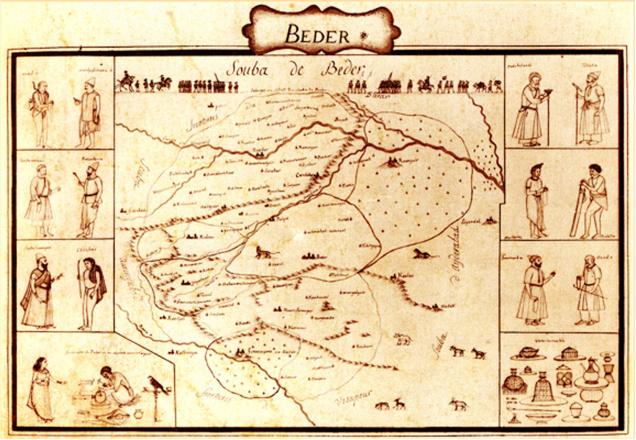
LINK TO THE PAST – Ancient map of Bidar unearthed in London

Historian and painter Rehman Patel says illustrations on the political and social history of India are included on either side of the map. / The Hindu

The map is included in an atlas produced by Colonel Jean Baptiste Gentil, Military Adviser to the Nawab of Awadh Shuja-ud-Daula

In exciting news for historians, an ancient atlas, which includes a map of Bidar, prepared by French officer Colonel Jean Baptiste Gentil, Military Adviser to the Nawab of Awadh Shuja-ud-Daula (1763 to 75), was found tucked away in the India Office Library at London. The map shows Bidar, which was once a capital city of the Bahamani Kingdom and an educational centre with historical importance.

Historian and painter Rehman Patel, who reproduced the map, said that in the interests of preserving the historic post and throwing more light about the history of the Bidar and its cultural heritage, the State government should put pressure on the Union government to bring it back to India and place it in Bidar.

Illustrations

He added that Col. Gentil had utilised the services of local artists to produce a series of illustrations on the political and social history of India.

Dr. Patel pointed out that illustrations were included on either side of the map. They reveal the representatives of different Sufi orders and thick forests with drawings of wild animals. These drawings also include Bidri craftsman and the different wares that were produced in Bidar. The bespectacled artisan at the bottom left of the page is portrayed as engraving a floral pattern on the side of a globular huqqa, with his wife and pet parrot looking on.

The illustration is reinforced by having a caption: ‘Fabrique de Beder ou on incruste en or et argent’ (Beder workshop for inlaying in gold and silver).

At the bottom right corner, there is a drawing of the types of wares produced: ‘vases incrustes’, or ‘inlaid vessels’. These include a globular huqqua on a stand, a bell-shaped huqqua, spittoons, boxes, a ewer and wash basin.

Reference to Bidriware

Dr. Patel said so far, the earliest unambiguous reference to Bidriware was in the Chahar Gulshan, written in Persian in 1759 AD. This includes a statistical account taken, on internal evidence, from an earlier compilation of about 1720 AD.

Book II of the Chahar Gulshan is ‘an account of five Subhas (administrative divisions) of Deccan’, one of the five being Bidar, referred to by its Bahmani and Mughal names. A manuscript in the British Library has the following passage: ‘The subah of Mohammadabad called Zafarabad (Bidar).

Bidar was also known from an illustration in an atlas produced in Faizabad, Uttar Pradesh in (1770 AD) under the Nawab of Awadh (Oudh) Shuja-ud-Daula, who ruled from 1754-75 AD. During this period, Bidar was under the control of Muhammad Ghauth Saif-ud-Daula, but he died shortly after his appointment, and his brother Saif Jang Najm-ud-Daula Bahadur became the governor in his place.

Dr. Patel said that enquiries at the office of the Deputy Commissioner in Bidar revealed that the district administration did not have a copy of the manuscript and the atlas produced by Col. Gentil.

source: http://www.thehindu.com / The Hindu / Home> News> National> Karnataka / by T. V. Sivanandan / Gulbarga – September 01st, 2014

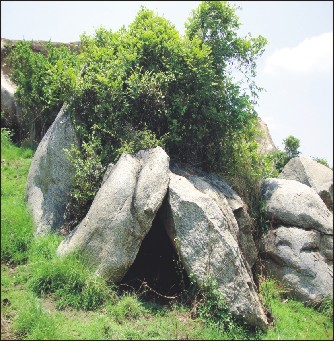
A rare discovery of ‘ Stone Hut ‘ at Kunti Betta

StoneHutBF01sept2014

Kunti Betta is a hillock near Pandavapura Taluk head quarters in Mandya District. It is a mine of ancient archaeological site of importance for the researchers. Situated at about 2882 ft above the sea level it has the evidences of Megalithic culture. Stone hut of the Stone Age man was discovered at this place, which is a rare and a unique discovery in the subcontinent.

Dr. S.G. Ramadasa Reddy, HoD of History and NSS officer of Govt. First Grade College, Kuvempunagar, Mysore, along with Prof. B.S. Manjunatha, D. Banumaih’s College, Mysore and NSS volunteers, conducted field survey of Kunti Betta and were successful in tracing the rare stone hut of Stone Age man.

At the outset, the stone hut appears triangular in shape and seem to be constructed by the ancient man. It appears that they must have cut stone rocks and inclined in a triangular shape with a supporting heavy rock at the back, and stone slabs fixed to the floor. The door of the hut is of 5.7 ft width and 6.5 ft height. The inside dimension is 8 ft wide, 6.5 ft width in the middle and 8.2 ft width at the back. Considering all these details, one may come to the conclusion, that the ancient man must have used this stone hut for living purpose.

Similar stone huts have been discovered in various parts of the world but is the first of its kind in India. For instance American Research and Preservation Department has discovered four stone huts in Colorado. There is a marked similarity between them and the stone hut discovered at Kunti Betta.

Similar stone hut has been found at Terra Amite in Mount boron in nice in France. This is the first discovery of the stone hut of the old Paleolithic man. Upper Paleolithic man hut was found in Israel’s Bahalo II.

Huts made out of the bones of the mammoth animals, were also discovered at Chi Chu Bu in Japan, Sub Sahara of South Africa and South Russia. The hut at Ukraine is a mammoth animal bone hut in the shape of a room of 8 ft space. Similar hut is also found at Kostenski Bershevo in Malt and Berlet sites near Masco.

Kunti Betta with all such rare evidences of ancient culture and civilisation richly deserves to be taken note of by the concerned departments so as to shed new light on the history of Ancient India by excavation, research and conservation.

[e-mail:ramadasareddysg@yahoo.in]

source: http://www.starofmysore.com / Star of Mysore / Home> Feature Articles / August 26th,  2014

Bangalore’s sacrifices

Peace-loving Bangaloreans even planted bombs, burnt police stations and post-offices and threw stones at the men in Khaki. When Britons used cavalry, Bangaloreans strewed ragi (millet) on the roads to make the horses trip.

Bangalore City has geared up to celebrate 60th Independence Day. Sale of the Tricolour was brisk. Manekshaw parade ground will witness a colourful march-past and cultural show by various contingents and schoolchildren. Politicians will unfurl the Indian flag, while busy bees have a holiday this week.

On this occasion, Deccan Herald dug into the past to explore the role played by the city in the freedom movement. Getting the information was a tough task. However, H Sreenivasaiah, a freedom fighter, who is a ready reckoner when it comes to giving the history of the freedom struggle, offered a lot of details to this paper.

It is amusing to imagine the ‘cosmo city’ in swadeshi mode, when khadi was the dress code (unofficial) and Vande Mataram was the hit song. Peace-loving Bangaloreans even planted bombs, burnt police stations and post-offices and threw stones at the men in Khaki. When Britons used cavalry, Bangaloreans strewed ragi (millet) on the roads to make the horses trip.

Some freedom fighters brought out underground newspapers. Interestingly, the newspaper was typed at a Commerce Institute that was right above the police station in Malleswaram and the police, unknowingly, guarded the publication office. Students used to drop the newspapers in houses after 11 pm to ensure that they were not caught by the police. Law provided for three years’ rigorous imprisonment if caught for the offence, says Sreenivasaiah, who brought out underground newspapers.

Some students, who worked in government offices as temporary clerks, stole rubber stamps from the offices to dispatch the newspaper to government offices. 
The freedom fighters also had their own underground radio station in a village near Kengeri. Some engineers, who worked at Government radio stations, had helped to set it up and operate. Mahatma Gandhi’s call for non co-operation in 1920 had received good response. Schools and factories started by British were closed.
Mr Sreenivasaiah, who is also Chairman of Karnataka Gandhi Smaraka Nidhi, recalled that National college, Basavanagudi, was started as a swadeshi college.

During Quit India Movement (1942), when most of the senior leaders were put behind the bars, students held the reins. Bangalore was no exception. Students and labourers held rallies, processions and public meetings.
Chikkalalbagh (Tulsi Tota), Bannappa Park, Malleswaram Grounds and a school compound in Ulsoor were the usual meeting places for the young feedom fighters, recalls C N Narasimhaiah, another freedom fighter.

K Hanumanthaiah, H S Doreswamy, Vasanthaiah, Kunthala, K S Krishna Iyer and many more came forward to lead the movement. Students used to gather at Central College (near the Tower) in the presence of the police and used to sing Vande Mataram and other patriotic songs. Today’s Bangalore Education Society (school in Malleswaram) was among the usual places for flag hoisting. There was a tall flag pole at today’s KSRTC Bus Station at Majestic (then Dharmambudi Tank and later Subhashnagar), says N Kasturi Rangan (Neelathahalli Kasturi), a freedom fighter.

Firings and lathi charges were common scenes during those days. Many went to jail and many sacrificed their lives. The freedom movement gained the momentum in Bangalore after the police firing at Binny Mill, killing four workers in 1926, freedom fighter M Somashekaraiah recalls.

Many leaders including Mahatma Gandhi, Sardar Patel, Acharya Kriplani, Ashok Mehta and Rajendra Prasad visited Bangalore. Mahatma had come to the city 14 times. In 1934, Mahatma Gandhi was on ‘Harijan Tour’ to mobilise funds. At Malleswaram ladies club, he just touched his ears, nose and hands, when ladies touched his feet. And, in response to it, all the ladies, removed their jewellery and donated them to him. Kumara Park was Gandhi’s prayer meeting venue and today’s Gandhi Bhavan was the place where he used to take a walk. He stayed at Nandi Hills for over two months and at Kumara Krupa Guest House for over a month.

Gandhi Jayanti was celebrated in a big way in 1942 at Bangalore and unspent Rs 125 was used for setting up Gandhi Sahitya Sangha with 25 books. It has 10,000 books on Gandhian and national literature today, Mr Sreenivasaiah says.

AT A GLANCE
According to Karnataka State gazetteer, 10 people died in police firings at City post office, Balepet circle and Cottonpet in 1942. Tippaiah (15), Appaiah (16), H R Srinivasan (16), Narayanachar or Narayana Das (35), Subbasing Ramasingh (25), Ponnuswamy (16) and four others died in the incident.

In another firing, Thimmanna Das died near Mysore Bank Square. According to freedom fighters still alive, there were many more deaths in Bangalore during the freedom struggle. But most of them were not recorded.

source: http://www.archives.deccanherald.com / Deccan Herald / Home> City> Detailed Story / Wednesday – August 15th, 2014

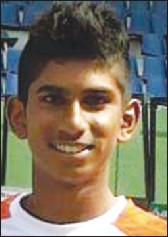
Star this week : Tennis champ : C. Vasisht

VasistBF29aug2014

Tennis is a global sport and Mysore has been producing talented tennis players from time to time who have gone on to represent the country in different levels. One such player who has made his mark in the National and International level in the junior boys section is city’s C. Vasisht. A trainee at Davis Cupper Prahalad Srinath’s Tennis Academy, Vasisht won the National Under-18 Boys singles title in the Adidas National Junior Tennis Championships 2014-15, played in Chennai on Saturday. In the finals, Vasisht beat Nitin Kumar Sinha of West Bengal 6-2,3-6,6-1 and won the National title. He also won a grand double by clinching the U-18 Boys Doubles title with Mysore lad S. D. Prajwal Dev. He is our “Star This Week.

C. Vasisht, a Mysorean, presently trains with Mysorean and Davis cupper Prahalad Srinath. Vasisht is ranked No. 2 in the State in the Under-18 Section and No.19 in the country. Encouraged by his parents, he has been performing well in the National and International circuit. A former trainee at the R . Nagaraj’s Tennis Centre in Mysore, Vasisht is making a steady progress in the junior ranks in the country.

Vasisht has made all Mysoreans proud with his feat of being crowned as the National Junior Tennis Champion. Vasisht Cherukku of Karnataka, the new National Junior Champion with 6-2,3-6,6-1 triumph and Nitin Kumar Sinha of West Bengal, the runner up, provided the right climax at the Championship.

Playing three positive sets, both players displayed excellent ground strokes and mobility. Vasisht broke Nitin twice with strong returns and held the serve to lead 4-1. Nitin then served to reduce the lead. But he was no match for Vasisht as the latter wrapped up the set at 6-2.

In the second set Nitin broke Vasisht in the fifth game to take a decisive lead. He broke his opponent again in the ninth game to win the set 6-3 and level scores.

In the third set, Vasisht served crisply and returned accurately to run up a 4-0 lead and go on to win the set 6-1 and the title.

Vasisht also won the boys doubles title pairing with Mysore lad Prajwal Dev. In the doubles final the duo beat Nenwani Anurag and Venkata Gnana Bhaskar 6-2, 6-2.

Vasisht has represented India in the junior ranks and has been making steady progress in the ITF tournaments in the circuit both in India and abroad. He aims to work hard under the guidance of his coach and with the support of his parents, intends to reach greater heights in this sport in the days to come.

source: http://www.starofmysore.com / Star of Mysore / Home> Sports News / August 24th,  2014

Pages from history : The gold coins of tirumala

by Prof. A.V. Narasimha Murthy, former Head, Department of Ancient History & Archaeology, University of Mysore

Who has not heard of Lord Venkateswara of Tirumala at Tirupathi. Perhaps he has become the most popular Hindu deity in the whole world. Money-wise he is the richest god in India. He is so rich that he supports the entire town, its administration, colleges, guest houses, feeding thousands of devotees daily in an unprecedented manner. The Lord of Seven Hills has become international as can be seen with people from all over the world having darshan of the Lord, may be for two or three seconds.

For this glorious three seconds, pilgrims wait for hours together in the queue. These pilgrims offer gold, silver and cash into the hundi or offer box. These boxes get filled up almost daily. They are emptied, the coins are counted and stacked in treasury safely. Thus thousands of bags of gold and silver coins were stacked and kept in the T.T.D. Treasury. At that point of time, the authorities decided to get all these gold coins examined by ancient coin experts, generally referred to as numismatists. It was my good fortune that I was asked to be the leader of a team of experts to examine gold coins deposited in the ‘Srivari hundi.’ This was conveyed to me through a young epigraphist Dr. Muniratnam Reddy and we began the work. Soon I realised that one life is not sufficient to complete the work and as a pilot project selected about 1,200 gold coins for our study. They were photographed, studied, notes prepared and the first volume of these coins has been published. Subsequent volumes are in preparation.

It is interesting and puzzling to find that the earliest gold coin in this collection was a Roman coin minted by emperor Nero who ruled from 54 to 68 AD. The present gold coin of 7.6 gms in weight has a bust of Nero with writing in Roman script. The next coin from the chronological point of view belongs to Gangas of Talkad. These coins contain on the obverse (main side) a decorated elephant and a floral design on the reverse. The next issues belonged to the Hoysalas. The famous king Vishnuvardhana defeated the Nolambas and assumed the title ‘The conqueror of the Nolambas’ (Nolambavadigonda) and minted gold coins to commemorate this victory. These coins contain Goddess Chamundi on the main side and the writing Nolambavadigonda on the reverse. Such coins being found in Tirupathi hundi shows that devotees from Karnataka had visited Tirupathi at least 800 years ago. There is a single coin of the Alupa dynasty which ruled in South Kanara in the ancient times. It has a fish symbol and writing in Nagari.

The Vijayanagar Kings had very close relations with Tirumala from the beginning. This is reflected by the discovery of gold coins of Vijayanagar Kings like Harihara I, Harihara II, Devaraya I, Devaraya II, Krishnadevaraya, Achyutaraya, Sadashivaraya and Kings of the Aravidu dynasty such as Srirangaraya, Venkatapatiraya, etc. More than 350 gold coins of the Vijayanagara dynasty have been found in the hundi. The most interesting are those of Krishnadevaraya representing Balakrishna on the obverse. Coins of Achyutaraya have Gandabherunda on the obverse. Coins of King Sadashivaraya have seated Siva and Parvathi on the main side. The coins of Aravidu Kings are highly interesting. They contain Lord Venkateswara under an arch holding sankha, chakra and gada in his hands. They contain on the reverse the writing ‘Sri Venkateswarya namah’ (salutations to Lord Venkateswara). In fact Krishnadevaraya performed Kanakabhisheka to Venkateswara by minting special gold coins which contain the portrait of Lord Venkateswara on the main side. All these gold coins represent close relationship of these rulers with Tirumala.

Consequent on the downfall of the Vijayanagara empire, Nayakas of Keladi became important. Their capital Ikkeri assumed importance. Keladi rulers followed the Vijayanagara pattern in minting gold coins. Sadashiva Nayaka minted gold coins which became famous as Ikkeri Varahas. They contained on the obverse Siva and Parvathi seated; Siva holds a trident in his right hand and a deer in his left. The reverse has the writing Sadashiva in Nagari script.

Then we enter into the era of Mysore Wadiyars who ruled from 1399 AD till the modern period, when it was amalgamated into the independent union. Only one coin of Chikkadevaraja Wadiyar has been found which has dancing Balakrishna on the main side. All the remaining coins belong to Krishnaraja Wadiyar III. These coins have on the main side seated Siva and Parvathi while the reverse has the writing Sri Krishnaraja in Nagari. It is of interest to note that about 200 gold coins of this King have been found in the hundi showing that pilgrims from the Mysore State were visiting Tirumala in large numbers.

Princely States of Jaipur and Jodhpur are represented by three gold coins. Many Ramatonka gold coins (tokens) with Sri Rama, Sita, Lakshmana with Hanuman have been found in this collection. South Indian Kings minted small gold coins called panams or fanams. They are very tiny and contain one or two symbols. They are also referred to as Viraraya Panams. Such Panams minted at Coorg, Thanjavur and Travancore have been found in this hundi.

Many gold coins issued by Muslim dynasties arrest our attention. Eleven coins of Akbar have been found here which are circular and square in shapes. They contain good calligraphic writing and are very elegant. Aurangazeb is represented by three gold coins in this collection. They have writing ‘Badshah Aurangazeb Alamgir.’ They have writings on both sides. 84 gold coins of the Asaf Jahi dynasty belonging to different Sultans have been seen in this hundi. They represent dates from 1803 to 1915 AD. This includes the last Nizam of Hyderabad.

110 gold coins of Haidar Ali have been found in this collection. All of them belong to only one type; they contain on the obverse seated Siva and Parvathi while the reverse side has the Persian letter ‘he’ on a granular surface. Siva holds a trident in his right hand while the left hand holds a deer. The other hand is on the waist of Parvathi. It is worth noting that Haidar though a follower of Islam did not hesitate to mint gold coins in Hindu tradition which his son Tipu did not follow. 40 coins of Tipu are found in this collection which belong to Ahmadi, Sultani, Faruqui and fanam denominations. Arcot Nawabs are represented by two gold coins which have Lord Venkateswara on the main side.

Then we come to the early modern period represented by East India Company. They established mints at Madras, Bombay and Calcutta. To please the Hindus they minted pagodas with Lord Venkateswara with Sridevi and Bhudevi on either side. They became famous as Three Swamy Pagodas. Another type has Lord Venkateswara with a star at the reverse. Then came queen Victoria type of coins which contained the bust of the queen with her name on the main side and reverse showing a lion moving in front of a palm tree. Indo-Dutch coins contained Lord Venkateswara on the main side.

In addition to these local coins, the hundi contained, gold coins of foreign countries like Great Britain, France, Spain, Germany, Italy, Venice, Netherlands, Austro-Hungarian monarchs, USA, Iran and Turkey. It is amazing how these gold coins came to the Tirumala hundi. Perhaps Indians living in these foreign lands might have visited Tirumala as devotees and offered the currency of their countries to Lord Venkateswara. At any rate the gold coins are spectacular in Tirumala hundi. That is the greatness of Lord Venkateswara of Tirumala Tirupathi.

source: http://www.starofmysore.com / Star of Mysore / Home> Feature Articles / August 24th,  2014