Category Archives: Records, All

Teresian college bags cross country race trophy

Mysore :

City’s Teresian College bagged the rolling trophy for women at the University-level Cross Country Race held this morning at Hunsur.

ZP President Dr. Pushpavathi Amarnath inaugurated the event at Hunsur Government First Grade College for Women.

Navya Shri, B.G. Anusha, S.P. Bhagya and Likhita, all from Teresian College, Mysore, bagged first, second, fifth and sixth place respectively, thus enabling the college to bag the rolling trophy.

K.R. Pet Government First Grade College bagged the trophy for men.

More than 500 participants from over 100 colleges coming under the University jurisdiction took part in the Cross Country event.

The race was 6 kms for women and 12 kms for men.

source: http://www.starofmysore.com / Star of Mysore / Home> General  News / August 23rd,  2014

Kolkata Vocalist Gets Pandit Rajguru Award

Dharwad :

Classical singer Padmashri Pt Ajoy Chakraborty of Kolkata has been conferred the Pt Basavaraj Rajguru National Award-2014.

Pt Ajoy Chakraborty
Pt Ajoy Chakraborty

Dr Ravikiran Nakod (tabla) of Dharwad and Apoorva Gokhale of Mumbai (vocal) were honoured with annual youth award given by the Swarsamrat Pt Basavaraj Rajaguru National Memorial Trust here on Monday.

While the national award carries a cash prize of `1 lakh, youth awardees were given `25,000 each.

Deputy Commissioner P Rajendra Cholan presented the awards.

Chakraborty saluted the musicians and artistes of the region and said he was blessed by an award from the land which has produced many luminaries in the field of arts, music and culture.

Later, he enthralled the audience with his vocal rendition in Rag Bhairav. Pt Raghunath Nakod (Tabla) and Dr Panchakshari Hiremath (Harmonium) accompanied him. Apoorva Gokhale and Dr Ravikiran Nakod also performed.

The award ceremony scheduled on August 24, was postponed to Monday following the death of Jnanpith awardee U R Ananthmurthy.

source: http://www.newindianexpress.com / The New Indian Express / Home> States> Karnataka / by Express News Service / August 26th, 2014

And the State Film Awards Go To…

Chairman of the State Film Awards selection committee, K C N Chandrashekhar (left), handing over the list of winners to Information Minister Roshan Baig on Monday

Bangalore :

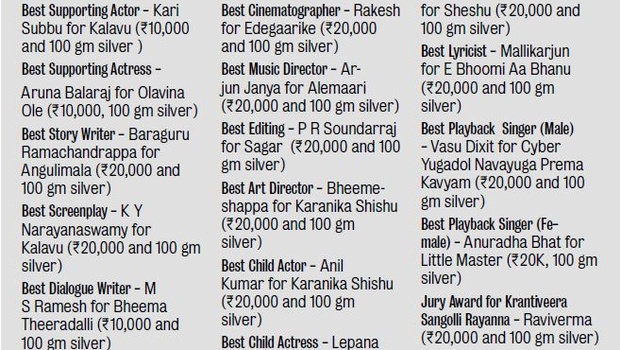
The state film awards for 2012 were announced on Monday. The Best Actor award goes to Darshan for his role in Kranti Veera Sangolli Rayanna and Nirmala Chennappa has been adjudged the Best Actress for her role in Tallana.

Announcing the winners, K C N Chandrashekhar, the chairman of the State Film Awards selection committee, said 58 films vied for the top honours of 2012.

He said M Bhaktavatsala has been chosen for the Dr Rajkumar Award and Chi Dattaraj for the Puttanna Kanagal Award. The Dr Vishnuvardhan Award will be bestowed on senior actor Rajesh. All these awards carry a purse of `2 lakh and a gold medal.

And the Top Films Are

Tallana, directed by N Sudarshan, has been chosen as the best film of the year, followed by P Sheshadri’s Bharath Stores and D Suman Kumar’s Edegaarike. While the winning film gets a cash prize of `1 lakh and 50 gm gold, the second and the third best films will get `75,000 and `50,000, respectively, in addition to 100 gm silver.

C Lakshman’s Karanika Shishu has been adjudged the best movie with a social concern. Naganna’s Kranthi Veera Sangolli Rayanna and K Shivaram Krista’s Little Master have been chosen as the best entertainment and children’s movie,  respectively. Santosh’s directorial effort Alemari has been chosen as the best debut film while Umesh Naik’s Konchavaram has been chosen as the best regional movie.

‘Awards Will be Given on Time’

ActorsBF27aug2014

Information Minister Roshan Baig said from next year onwards, the awards will be given for the same year.

“We are yet to constitute a selection committee for 2013. Awardees will be finalised soon. The date for the 2012 award ceremony will be fixed after consulting CM Siddaramaiah,” he said.

source: http://www.newindianexpress.com / The New Indian Express / Home> States> Karnataka / by Express News Service / August 26th, 2014

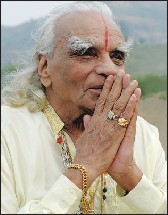
Legendary yoga guru B.K.S. Iyengar passes away

BKSIyengar25aug2014

Pune :

The world renowned legendary Yoga Guru Bellur Krishnamachar Sundararaja Iyengar (96), popularly known as B.K.S. Iyengar, passed away at a private hospital here at about 3.15 am today following poor heart functioning and difficulty in breathing.

A recipient of Padma Shri, Padma Bhushan and Padma Vibhushan awards, the Yoga Guru was ill for three weeks prior to hospitalisation but refused to get himself admitted and was treated at home by his family physician. He was even put on intravenous fluid at home.

His family members finally persuaded him to get admitted after his condition worsened. Though he was admitted to the hospital on Aug. 12, his condition had deteriorated a lot by that time. He was put on non-invasive ventilator for a day but he refused to undergo intensive treatment and hence, he was taken off the ventilator.

Iyengar’s heart muscles had become very weak following which there was less amount of blood being pumped by the heart, according to doctors. Last rites will be held later today.

Profile

Bellur Krishnamachar Sundararaja Iyengar (96) was born into a poor Iyengar family at Bellur, Kolar District in Karnataka and was the 11th of 13 children of Krishnamachar, a school teacher and Sheshamma.

His father died when he was only nine-years-old. As a result, he went to live with his brother in Bangalore. His childhood was further marked by serious illnesses including malaria, tuberculosis and typhoid along with malnutrition.

At the age of 15, Iyengar moved to Mysore to live with his eldest sister and her husband T. Krishnamacharya, an accomplished yogi and Sanskrit scholar, who ran a yoga school in the Mysore Palace and introduced Iyengar to some of the basic yoga postures (asanas) as a method to improve his health.

At the beginning, Iyengar struggled from day-to-day which gradually paid off, as he mastered some of the postures and as a result, his health improved.

In 1937, after two years of study, Krishnamacharya asked Iyengar to go to Pune to teach yoga where he arrived nearly penniless, knowing no one and speaking little English. Iyengar’s only way to make a living was by teaching yoga. With limited experience and almost no theoretical knowledge, he decided to practice with determination.

In the beginning, he would train himself as many as 12 hours each day, usually surviving on only stale bread and tea. Sometimes, he would suffer great pain through incorrect technique, often having to place heavy weights on his body to relieve the aches. However, refusing to give up, he gradually developed a deep personal understanding of the techniques of each posture and their effects. More yoga students began to seek him to learn yoga.

In 1943, he married Ramamani, to whom he had been introduced by his brothers and together they raised five daughters and a son. Both his eldest daughter Geeta and his son Prashant have become internationally-known teachers in their own right. The other children of B.K.S. Iyengar are Vanita, Sunita, Suchita and Savita.

Slowly they worked their way out of poverty and gradually Iyengar’s fame as a yoga teacher spread. In 1952, world renowned violinist Yehudi Menuhin became a student of yoga during a visit to India. Menuhin then arranged for Iyengar to teach in many cities in Europe and he made his first visit to the United States in 1956.

In 1975, Iyengar established the Ramamani Iyengar Memorial Yoga Institute in Pune, in memory of his departed wife, where he resided and taught yoga till his end. By that time, his eldest children, Geeta and Prashant, had also started teaching yoga under his guidance. The Institute quickly became an international centre, attracting thousands of people from all over the world.

Iyengar attracted his students by offering them just what they sought — which tended to be physical stamina and flexibility. He conducted demonstrations and later, when a scooter accident dislocated his spine, he began exploring the use of props to help disabled people practice Yoga. He was awarded Padma Shri in 1991, the Padma Bhushan in 2002 and the Padma Vibhushan in 2014. In 2004, Iyengar was named as one of the 100 most influential people in the world by Time magazine.

B.K.S. Iyengar condoled

Mysore Zoo Executive Director B.P. Ravi, who spoke to SOM, condoled the death of the Yoga Guru and said that B.K.S. Iyengar was an animal lover and he was an inspiration to many across the globe. He said that whenever Iyengar visited Mysore, he never failed to visit the Zoo. He never used to talk unnecessarily but used to speak with his eyes, he said and added that very recently his family members had come to the Zoo and had adopted two tiger cubs. With his demise, the Zoo lost a great animal lover and the world lost a legendary Yoga exponent.

Sharath Jois, grandson of K. Pattabhi Jois, who is running Shri K. Pattabhi Jois Ashtanga Yoga Institute at Gokulam in city, in his condolence message, said that an era has come to an end. Iyengar’s contribution for yoga was immense and the yoga community across the globe has lost a legend.

source: http://www.starofmysore.com / Star of Mysore / Home> General  News / August 20th, 2014

What was it to be a ‘Madrassi’ in Delhi half a century ago

New Delhi :

 I was provoked to write my memories of what was it to be a ‘Madrassi’ which was synonymous of being a South Indian in the late fifties, after being alerted to a Facebook post of a South Indian journalist who recalled his interaction with U. R. Ananthamurthy, who passed away three days ago.
The south Indian journalist narrates that in 2004-5, U. R. Ananthamurthy advised him, “Stay bold, original and South Indian in a Delhi that we may not like. Truth will not get a standing ovation, it will get you harassments, pain and dejection, but one has to stay, put up, unmindful of the push backs.”
The journalist recalls that Ananthamurthy told him to stand up to the patronizing attitude shown towards him by others and uphold the principles of his profession. I admired and respected the late U.R. Ananthamurthy, the Jnanapith and Padma Award winner, who headed the Sahitya Academy, and who was a fellow Kannadiga. He used to invite me to functions at the academy located near Mandi House and had warm interactions with me. I was present when he was awarded the Jnanapith Award by late Prime Minister P. V. Narasimha Rao.
On reading his suggestion to journalist Vinod K Jose, my thoughts also went back to the late fifties when I had first come to Delhi as an escort to my female cousin who was taking part in a classical music competition organized by the All India Radio. My law exam results were due and I was searching for a Bombay newspaper that was to publish the results. My uncle, U. S. Mohan Rao, who was then heading the Publications Division of the Government of India, and with whom I was staying in Delhi, said he would take me to the Press Information Bureau, which used to get the days newspapers from around the country by the evening.
I was escorted to the room of the then Principal Information Officer, T.R.V. Chari. He called for the Times of India of Bombay and asked for my roll number. He saw the results published in the newspaper, and said he did not see the number. As I was dejectedly getting up to leave, he asked for my name. When I gave it, his eyes brightened and said my dear fellow; you have stood first in the state and showed me the paper. They had published my name right at the top with my roll number.
Next, he asked me please go to the adjacent room. “We are recruiting some boys and please appear for the exam and let me see how you fare.” I took the exam and this ‘Madrassi’ boy came to live in Delhi, though his heart was still in Bombay. A law degree and a father’s law practice that I could inherit were not to be my calling.
The time I had arrived in Delhi, South Kanara, the district I belonged to, was a part of the Madras Presidency. The States Reorganization Commission had just submitted its report.
I stayed with my uncle near the Old Secretariat and one of my cousins was staying in South Avenue. I used to visit my cousin in South Avenue and for returning home, I used to take DTC Bus No.9 to go to the Old Secretariat and further to the Delhi University campus. One day, as I was waiting at the bus stop in South Avenue, an old man asked me, “Where are you from, young man? I said, “from the Madras Presidency.” He got annoyed, and told me, “You do not have to crack jokes at me, and I expect you to give me a straight forward answer.” I was puzzled and respectfully replied, “Dear sir, I belong to Mangalore in South Kanara of the Madras Presidency, and I gave you a straight forward answer. I do not know you, and have no intention of misleading you.”
His eyes brightened, and he told me, “I now believe you.” And to my surprise, he started dancing and singing at the bus stop-“I married a girl from Mangalore.” He then told me that his name was Harindranath Chattopadhyaya, and he had married Kamaladevi , a Saraswat Brahmin from Mangalore. Youngsters of today would remember him as the adorable grandfather in the film Bawarchi. Kamaladevi Chattopadhyay of course, was the legendary social reformer and freedom fighter.
He patted me on the back and said, I was always welcome to see him at his house and gave me his address. It was a pleasant change for me to see that somebody could tell the difference between a Canarese (Kannada) accent and a Tamil accent.
I moved home once again to stay with my cousin, who moved from South Avenue to Moti Bagh. After a couple of years, the cousin was transferred out of Delhi, and I had to look for a house. I told my colleagues that I was looking for a house to rent. Their reaction was, ” yaar tu toh Madrassi hai, tereko koi bhi ghar de dega.” (You are a Madrassi, anybody will give you a home). A ‘Madrassi’ was considered an ideal tenant those days, generally vegetarian, god fearing, teetotaler and non-smoker. I barely fitted into that stereotype, but had learned not to correct people when it worked to my advantage to be a ‘Madrassi’.
For couple of days , I trudged the streets of Karol Bagh, which was the popular destination of all South Indians wanting to rent cheap accommodation. I visited realtors and accompanied them to several apartments. House owners would willingly meet with me, but when they got to know that I was a bachelor and that my parents would not be living with me, they were skeptical. And then, when I was asked if I drink alcohol, I would truthfully answer yes. Door shut.
My house hunting went on, as this ‘Madrassi’ still hadn’t learned to fib even a bit. One Sunday, I landed up at Pusa Road and was told that there was an outhouse of a large house available for rent. A tough looking lady opened the door. I was almost resigned to a No yet again, so before the questioning began, I laid it out there in the open. I rattled. “I am single, a bachelor who had no intention of marrying soon, my parents don’t live with me, I occasionally drink and I smoke. I am a Madrassi.” I was quite resigned to the fact that the landlady would not even offer me tea, let alone rent out her outhouse.
There was a twinkle in her eye. She said to me, “beta, you are welcome to stay in my outhouse….I want you to be careful, the adjacent outhouse is rented by Punjabi girls. You are a handsome Madrassi, and one of them may like to hitch onto you. Good luck.”
The Madrassi from Mumbai stayed at the Pusa Road house for over a year and the Punjabi girls used to wave at me when they saw me. It stopped there.
Mr. I. Ramamohan Rao is a former Principal Information Officer, Government of India. He can be contacted at raoramamohan@hotmail.com By I. Ramamohan Rao (ANI)
source: http;//www.aninews.in / ANI News / Home> National / by I. Ramamohan Rao / New Delhi – August 25th, 2014

Champion quest

Bodybuilder Syed Siddiq talks about his journey from a scrawny lad to winning the Mr.Asia title

Mr Asia  - Syed Siddique / Photo: G.P. Sampath Kumar / The Hindu
Mr Asia – Syed Siddique / Photo: G.P. Sampath Kumar / The Hindu

It is hard to miss Syed Siddiq. As he strolls down the road, passersby stop and stare. It would take a brave man, however, to pass a smart-alec comment in his direction, or to antagonise him in any way.

Siddiq is the closest thing to the superhuman comic figure ‘Hulk’ you can hope to see.

Massive muscles seem to rip through every inch of his 105 kilogram body – a truly intimidating sight when he ‘flexes’’ to strike a pose.

Ace bodybuilder

The ripped physique of India’s ace bodybuilder, of course, did not take shape overnight. Siddiq, who recently won the Mr. Asia title at Manila (Philippines), takes out a dusty photo of a scrawny lad. “That was me, eight years ago. I weighed just 48 kilos,” he says with a grin.

That photo is a reminder of his first tryst with the sport. “I was 17 and I enjoyed watching World Wrestling Entertainment (WWE) on television. I admired The Rock , and wanted to be like him. That pushed me to the gym, for the first time,” he says.

Around a year later, Siddiq witnessed a State-level bodybuilding competition, which sparked his desire to take up the sport seriously.

“I saw the crowd’s reaction to the competitors, and I decided that I wanted to be on stage one day. I drew inspiration from Arnold Schwarzenegger. He is an icon for all of us.”

In the documentary Pumping Iron, which chronicles Schwarzenegger’s path-breaking route to stardom, the Hollywood star talks about one of the turning points of his career.

The introduction of big quantities of meat in his regimen, after years of ignoring his diet, finally allowed Schwarzenegger to put on much-needed mass. This aspect is not lost on Siddiq.

The 25-year-old states that he consumes 30 egg whites and two kilos of boiled chicken in a day, apart from large servings of fruits and vegetables.

And three months prior to competition, rice, bread, salt and oil are off the table.

“I don’t drink alcohol or smoke cigarettes. Ever. A strict diet overall must be maintained to succeed as a bodybuilder.”

Acting with Vikram

Director Shankar cast Siddiq in his to-be-released flick, Ai. Siddiq will feature in a few fight scenes with lead actor Vikram, and recalls the experience with excitement.

“It was great fun to be on a movie set. I have been approached to act in Bollywood movies as well, but I think I will focus on bodybuilding for now.”

With the Mr. Universe event coming up in Germany later this year, Siddiq clearly has his hands full.

source: http://www.thehindu.com / The Hindu / Home> Features> MetroPlus / by Ashwin Achal / Monday – August 25th, 2014

State ranking TT: Spoorthy wins women’s title

Belgaum :

M.V. Spoorthy of Mysore won the women’s singles title in the LIC Cup State-Ranking Table Tennis Tournament at the Belgaum Club here on Sunday.

In the women’s singles final, M.V. Spoorthy, student of Learner’s PU College, Mysore, beat V. Kushi of BNM, Bangalore 11-9, 11-8, 11-6, 11-6 and clinched the title.

Mysore lad Vedanth M. Urs of Vidyashram PU College completed a fine double when he won the Youth Boys singles final. (He had won the junior boys singles title earlier). In the Youth Boys singles final, Vedanth beat Shreyas Kulkarni (MSSTTA) 11-5, 11-3, 6-11, 11-5, 8-11, 12-10.

source: http://www.starofmysore.com / Star of Mysore / Home> Sports News / August 19th, 2014

World Photography Day today

 Senior photographer M.R. Manjunath, who was felicitated by MDJA this morning, is seen with (from left) MDJA President K. Deepak, senior press photographers from Bangalore K. Gopinathan and Abdul Hafeez, General Secretary K.J. Lokesh Babu and Treasurer S.R. Madhusudhan.
Senior photographer M.R. Manjunath, who was felicitated by MDJA this morning, is seen with (from left) MDJA President K. Deepak, senior press photographers from Bangalore K. Gopinathan and Abdul Hafeez, General Secretary K.J. Lokesh Babu and Treasurer S.R. Madhusudhan.

Mysore :

As part of World Photography Day today, Mysore District Photographers and Videographers Association had organised a unique programme of clicking photographs of traffic violators in city this morning.

Nearly 35 photographers, went about clicking photographs of those violating traffic rules and sent the same to the office of City Police Commissioner Dr. M.A. Saleem.

At 6 pm, City Police Commissioner Dr. M.A. Saleem will inaugurate a function at Ideal Jawa Rotary School auditorium ,where former Presidents of the Association L. Mahesh and H. Rajagopal would be felicitated. MLA M.K. Somashekar, Leader of the Opposition in MCC Nagabhushan, senior Congress leader Shivegowda and Corporator P. Prashanth will be the chief guests. Association President K.U. Verghese, Vice-President Mukund Singh, Secretary N. Umesh and others were present.

At MDJA

The Mysore District Journalists Association (MDJA) had also organised a function to felicitate senior photographer M.R. Manjunath of Prajavani, Hubli, at its premises on Thyagaraja Road in city this morning.

Senior press photographers from Bangalore Abdul Hafeez and K. Gopinathan were the chief guests. MDJA President K. Deepak spoke. An exhibition of photographs clicked by city press photographers were displayed on the occasion.

MDJA Vice-President Ravikumar, Gen. Secretary K.J. Lokesh Babu and others were present.

source: http://www.starofmysore.com / Star of Mysore / Home> General News / August 19th, 2014

Anglo-Indian Heirloom Cuisine Festival at Taj-Connemara

AngloIndiaFoodCF23aug2014

Chennai :

It’s an heirloom Anglo-Indian cuisine food festival at the Vivanta by Taj-Connemara, a top chef said, proudly showing a 108-year-old notebook containing recipes of a bygone era.

“The deciphering of the handwritten recipes in the notebook was the only challenge we faced while bringing back to life the dishes mentioned in it,” Arzooman Irani, executive chef at Vivanta by Taj-Whitefield Bangalore, told IANS here.

He was here to host the “Chronicles of Whitefield” Anglo-Indian food festival at Vivanta by Taj-Connemara Chennai located on the Binny Road here at The Verandah restaurant Aug 22-31.

The Made in Austria note book contains the recipes of around 120 dishes.

“It was the family recipe book handwritten by Harry Blake, one of the original settlers of Whitefield near Bangalore. The notebook was handed over to us by his granddaughter,” Irani said as he served a ginger wine.

The non-alcoholic drink surprised one with its sweetness – and the ginger flavour that followed.

What is unique about the dishes is that they are not very spicy nor are they bland. The dishes are very tasty, flavourful, mild and light on the stomach.

The only spicy item is the fried masala prawn which Blake himself has termed spicy prawn.

“The dishes are made with locally available ingredients. While Blake made his fish curry with the fish caught in the local lake/pond, the prawns came from Madras (Chennai),” Irani said.

He said the whereabouts of Blake’s granddaughter are not known as she has shifted after her husband’s demise.

“She gave us the notebook two years back. We started our work after that and launched the menu at our hotel in Whitefield recently,” Irani remarked, adding that 35 of the 120 recepies were being served.

The ginger wine was followed by mulligatawny soup – a broth made with lentils and pepper. Blake gave a fruity twist to the soup by adding finely cut apples.

For the main course, Irani offered rice varieties – coconut, tomato, cabbage – along with vegetable stew, muttonball curry, country captain chicken curry and Blake’s signature dish – Harry’s fish curry.

The vegetable stew made with coconut was different from the Kerala variety, which is spicier than Blake’s stew.

Similarly the muttonball curry and the country captain chicken curry were very flavourful and not spicy and could be safely consumed by children as well as adults.

The tasty fish curry gave out the good flavours of mustard.

“True the dishes are not very spicy. But this is how the Anglo-Indians settled in Whitefield cooked their food and ate. We also checked with other Anglo-Indian families there who said their dishes are not spicy,” Irani said.

“For the present generation, we offer an experience. It is an experience of going back into the history and tasting the dishes made during those times,” Irani said.

A meal for two, without alcohol, would cost around Rs. 3,500 including taxes, said Irani.

source: http://www.newindianexpress.com / The New Indian Express / Home> LifeStyle> Food / by IANS / August 21st, 2014

Tapmi professor wins ISB–Ivey global case competetion

Mangalore :

TAPMI professor, Dr A Sivakumar’s Case on UPSL- Exploring Operations Strategy Options won the Best Case under Operations Category of ISB – Ivey Global Case Competition 2014. The award, $2000, is being sponsored by Amazon.

The ISB-Ivey Global Case Competition was launched in 2010, has gained prominence in India and abroad and is widely considered an important source for India-centric cases by B-Schools around the globe. An internationally acclaimed subject expert’s panel judges each case in a double-blind review process and provide feedback.
This year, an unprecedented 109 entries from more than 50 B-schools in India and abroad were received including from the United States, Canada, Australia and Switzerland. The cases spanned different management areas such as Strategy, Marketing and Leadership, as well the growing areas of interest such as, Social Enterprise and Business Ethics. This competition plays a critical role in promoting the development of new case material and the use of the case method in management education.
The top cases from this competition are published to the global audience through Ivey Publishing and Harvard Publishing the two largest sources of business cases in the world. Winners in other categories include Academics from IIM-A, SP Jain, MDI.

source: http://www.timesofindia.indiatimes.com / The Times of India / Home> City> Mangalore / Stanley Pinto, TNN / August 22nd, 2014