Category Archives: Records, All

A Gandhi who studied in Mysore

by  M. S. Diwakar

A few days ago, I read with interest a news item in several newspapers about Dr. Shanti Gandhi, a descendent of Mahatma Gandhi, contesting and winning a seat in an Assembly district in the United States.

Dr. Shanti Gandhi, son of Kantilal Gandhi and Saraswathi Gandhi, had stood for election on a Republican ticket and he defeated his Democratic rival, Theodore Ensley in the elections held in Kansas’ State. Dr. Shanti Gandhi, a cardio vascular surgeon, had contested for the 52nd Assembly district. He arrived in the United States in 1967 as a medical graduate from Bombay.

This news item immediately triggered my memory and I soon realised that Shanti Gandhi’s father, Kantilal Gandhi, had studied medicine in Mysore.

Both Kantilal and his wife Saraswathi had spent several years in Mysore when Kantilal was studying medicine. They had stayed on in separate houses but would meet both during the day and in the evenings and spend time together and join their neighbours in participating in Gandhian activities, including singing Ram bhajans, debates and discussions.

Kantilal Gandhi’s father was Harilal Gandhi, the eldest son of Mahatma Gandhi. Harilal had always dreamt of making Kantilal a doctor. Kantilal passed matriculate when he was 20 years of age and despite disapproval from the Mahatma, his grandfather, he decided to study medicine in Mysore.

The credit for ensuring that Kantilal chose Mysore to study goes to Sir Mirza Ismail, the then Dewan of Mysore State. Mysore was under the Wadiyars and it was steadily making progress in all the fields. It was also one of the most progressive Princely States in India and Gandhi had a fairly good acquaintance with the then Maharaja and Dewan.

Kantilal settled down in Mysore with his wife. They spent several years in Mysore before Harilal came to see them. Harilal stayed with them for several weeks and enjoyed the company of his family. Mahatma Gandhi too was pleased that Harilal had settled down with his family and wrote to Saraswathi about it.

Mahatma Gandhi also addressed several letters to Kantilal, affectionately calling him Kanti. He affectionately called Saraswathi “Saru.” In one of his letters, he says Mysore is a good choice for him to study as it has produced some brilliant people.

Kanti called his wife Saru. By accounts, Kantilal and Saraswathi led a happy life in Mysore. While Harilal (born in 1888) died in 1948, Kantilal died in 1983. His wife Saraswathi died in Tiruvananthapuram, Kerala, on December 15, 2008.

Dr. Shanti Gandhi happens to be the son of this illustrious couple.

A book, Mahatma Versus Gandhi by Dinakara Joshi and letters by Gandhi to Harilal Gandhi and Kantilal Gandhi will give more details on these aspects.

[M.S.Diwakar of Bangalore can be contacted on Mob: 9880046397]

source: http://www.starofmysore.com / Star of Mysore / Home> General News / June 03rd, 2014

JK Tyre & Industries win 40 gold medals at QCFI

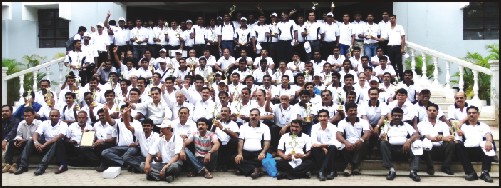
A group photo of the winning teams of JK Tyres at the Qcfi Convention held at Nie premises in city on May 25.

Mysore :

JK Tyre & Industries Ltd., Vikrant Tyre Plant, Mysore, created history by winning 40 gold medals, 9 silver medals and 1 bronze medal — the highest ever medals won by any company — at QCFI (Quality Circle Forum of India) competition held on May 25 at NIE premises here.

JK Tyres also has the distinction of nominating highest number of teams (50 teams), the highest in any such competition of QCFI. G. Rajagopalaih, VP – Mfg (Plant # 2), received the honour on behalf of the participating teams.

Each team comprised 3 members from all sections of people working at JK Tyres including non-permanent and contract labour. The teams made presentations in structured manner of the improvements in processes made in the Plant through various Kaizens & Group exercises. To add one more feather to the cap, G.R. Vinay was honored with ‘Distinguished Facilitator’ award.

source: http://www.starofmysore.com / Star of Mysore / Home> General News  / May 31st, 2014

Pages from history : Indira Belur’s passion for library

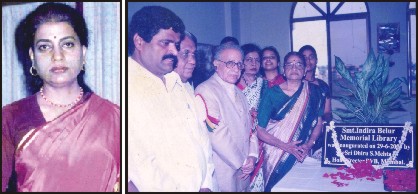
 1) Late Indira Belur 2) A file photo of the inauguration of ‘Indira Belur Memorial Library’ at Bharatiya Vidya Bhavan, Mysore, which adorns the drawing room of Vinuthamma’s residence.
1) Late Indira Belur 2) A file photo of the inauguration of ‘Indira Belur Memorial Library’ at Bharatiya Vidya Bhavan, Mysore, which adorns the drawing room of Vinuthamma’s residence.

by Prof. A.V. Narasimha Murthy, former Head, Department of Ancient History & Archaeology, University of Mysore

A decade ago some of us were visiting houses of friends in Mysore to collect funds for the construction of a building for Bharatiya Vidya Bhavan, Mysore, under the leadership of Dr. Mathoor Krishnamurthy. K.B.Ganapathy was providing wide publicity by publishing the names of donors in his prestigious Star of Mysore and Mysooru Mithra. This enthused the donors. Dr. Mathoor had such a charming personality that he would speak in such a manner that people would not say ‘no’ and contribute donations for the Vidya Bhavan building.

The Mysore people are generally philanthropic and encouraged cultural activities to happen and the result is that we have an imposing building on the Hunsur Road and I do not think that there is anybody who has not seen this building. Thus Mysoreans and others have helped us to establish Vidya Bhavan which runs a school with 1500 students, an MBA (PGDM) College of Management, a school of Fine Arts, conducts monthly music programmes, discourses etc. All this has been possible because of the generous donations of the people of Mysore to whom we are grateful.

At that time, a lady called me on phone and said ‘I would like to contribute rupees three lakhs to Vidya Bhavan. Will it be possible for you to visit my house in Yadavagiri?’ She mentioned the road and said, ‘ask for Kogod House and anybody will show you.’ I jumped with joy. She was none other than Smt. Vinuthamma, a charming lady with a pleasant disposition. Before I could talk to her, she insisted on myself taking breakfast first. Before inviting me she must have told her plan to donate some money to her friends and relatives and the news spread. Many persons either visited her or talked to her on phone. Some others sent some feelers. All of them had an idea of getting an image of God or Goddess be made and consecrated in a temple so that she will get the religious merit (punya).

As she is an Iyengar lady, many offered the suggestion of making sculptures of either Alwars or Sri Ramanujacharya from her donation. But Vinuthamma had a different idea because the donor was her daughter Smt. Indira Belur and the latter had insisted that the money should be used to establish a library.

A highly laudable idea indeed! After hearing this many persons who had shown interest in taking donation suddenly vanished. However, some of them murmured. What is the use of a library? There are many libraries in Mysore and there are not enough readers in them. Most importantly, we have not heard of a crazy idea like this before and she will not get religious merit (punya) by this gift. But, Indira Belur was firm and her mother Vinuthamma was equally firm.

At that time, I had the good fortune of meeting Vinuthamma. When she offered the donation, I immediately accepted it and said a library will be established in Indira Belur’s name: absolutely no problem. She was taken aback by my acceptance and she repeated her library condition over and again. She also cautioned that I should not go back on my words. I re-affirmed and assured her that ‘as per the desire of your late daughter and your own wish to fulfil her desire, I will establish a library in Bharatiya Vidya Bhavan, Mysore and it will be inaugurated by a VIP, most probably our Governor, Dr. T. N. Chaturvedi.’

Before proceeding further, I would like to introduce Indira Belur. After graduating from Mysore University, she did her MBA specialising in marketing. She moved to Madras and became a management consultant and took assignments all over India. In the meantime, she became a consultant to State Bank of India, Bombay. She conducted many programmes in marketing management. Subsequently, she worked with a Japanese company and exported prawns to Japanese market. Subsequently, she became the General Manager for Trans Global Air, U.K. in-charge of South India. I saw this visiting card preserved by Vinuthamma as a memento of her dear daughter. When everything seemed well settled and she was at the top of her career, she became a victim of cancer and passed away in 1998. When she was in the BM Hospital, she celebrated her 50th birthday at the hospital itself. That is how she distinguished herself as a member of the illustrious Kogod Family.She had decided to donate her eyes.

As soon as I received the donation amount, I placed it before the Kendra Committee and apprised it of the details. N. Ramanuja, who was a relative of Vinuthamma, applauded the idea and insisted that the donation should be used for establishing a library in Mysore Vidya Bhavan. As soon as the building was completed, a place was identified for the library and a black granite name plate ‘Indira Belur Memorial Library’ was fixed on the wall. It was inaugurated by Sri Dhiru Mehta, the then Director General of Bharatiya Vidya Bhavan, Mumbai in the presence of Dr. T. N. Chaturvedi. This photograph adorns the drawing room of Vinuthamma’s residence and she proudly shows this to her visitors. Though the loss of a daughter before her own mother is unwelcome, Vinuthamma is proud of the achievements of her daughter and her final decision to establish a library.

This library is just ten feet from my chambers and I daily pass through the library and automatically my eyes go up and look at the name plate ‘Indira Belur Memorial Library.’ Incidentally, library is not just a place where books are stacked, but it is a repository of knowledge. Ancient India was famous for libraries and the Chinese have described the libraries of Nalanda. Chinese scholars used to visit this library for consulting original books (manuscripts) on Buddhism and allied subjects. In the modern period many good libraries have come up. I had the good fortune of visiting British Museum Library in London and Weidner Library (Harvard) which contain excellent and valuable collections. National Library at Calcutta is also a good library. I am a proud owner of a small library which has good books on ancient history and archaeology which I have been using all these days. Maintaining a library is a difficult job because books require daily cleaning and periodical check-up. But a personal library has its own pleasure and advantage.

But, I did not get any clue for the passion and love for library by Indira Belur. Perhaps she understood the secret that library is the source of knowledge and one has to go to that source. Though gifting a library is uncommon, it is welcome and Vinuthamma should take pride in that gesture of her daughter Indira Belur. I would like to say to Indira Belur ‘wherever you are, we remember you with pride and gratitude’ that is the best tribute according to our tradition.

source: http://www.starofmysore.com / Star of Mysore / Home> Feature Articles  / May 31st, 2014

Success Secret: Toppers Stayed Calm in Exam Season

Bangalore :

Apoorva Narayanaswamy was expecting good marks, but she had never imagined she would end up in the national toppers’ league.

A student of St Paul’s English School, Apoorva has scored 98.6 per cent in the Indian Certificate of Secondary Education (ICSE) exams.

“I guess studying and spending some time on hobbies helped me. I watched TV whenever I was stressed,” said Apoorva, a resident of Bannerghatta Road, who studied for three to four hours a day. At the start of the academic year, she would go back from school and study to make sure she wasn’t stressed as exams approached.

Apoorva’s favourite subject is biology and she wants to pursue a career in medicine.

For Shreyas Sudhaman of Sri Kumaran Public School, who scored 98.6 per cent, the results were a shock.

“I was shocked in a positive way, of course. What I believe is if you are consistent and organised in your preparation, it is not impossible to score high,” he told Express.

A resident of J P Nagar, Shreyas is looking forward to becoming an engineer.

“I plan to take up chemical engineering. It can be used in various places,” he said. The Council for Indian School Certificate Examinations (CISCE) considers the best scores in five subjects (best-of-five) to declare the percentage.

In the Indian School Certificate (ISC) exams for Class 12, it is the best of four that is taken for calculation.

Rajat Vadiraj from St Paul’s School secured 98.4 per cent and celebrated it with his family.

“I’ve always loved science since I was a kid. It is very exciting, especially physics and mathematics,” said Rajat, who did not have sleepless nights preparing for the exams. “If you keep calm, it should be easy.”

Dipayan Sinha from Bishop Cotton Boys Schools knows what career he wants to pursue. “Everyone in my family is an engineer and I want to follow them,” said Dipayan, who scored 98.2 per cent.

Studying in Bangalore for eight years, Dipayan’s mantra is hard work, patience and focus. “I don’t keep timetables. I would revise whatever was taught in school the same day,” he said.

With 98.16 per cent in his kitty, Tejas Kumar from Presidency School is chasing two dreams. “I am very good at computers and I think I can develop this into something by becoming a computer science engineer. Further, I want to become an IAS officer and serve the country”.

source: http://www.newindianexpress.com / The New Indian Express / Home> Cities> Bangalore / by Express News Service / May 22nd, 2014

We are the biggest southern state now

by: S Shyam Prasad & Sridhar Vivan

Creation of Telangana and AP has restored geographical supremacy to the state 450 years after the Battle of Talikota. We track the journey of the region from kingdoms to modern-day Karnataka

​History was created on Monday with the creation of Telangana, the 29th state in the Indian Union. It marked another change in the contours and boundaries of southern India and although Karnataka had very little to do with the bifurcation of Andhra Pradesh, the creation of Telangana changed the history of Karnataka — ever so slightly.

Karnataka officially became the biggest of the South Indian states in terms of geographical area (the seventh biggest in the country). With an area of 1,91,791 sq km, Karnataka leads the ‘pack’ in the South, followed by what now remains of Andhra Pradesh (popularly called the Seemandhra region) with 1,60,205 sq km of area.

Being the biggest state in terms of area would have been a great advantage in the age of kingdoms, but no longer. Karnataka may gain very little — indeed nothing — from being the ‘biggest’. Political representation in Parliament is based on the population which means Tamil Nadu will continue to have a bigger say with its 39 MPs. Andhra Pradesh will have a diminished voice as its 42 seats would now be whittled down to 25.

But the ‘biggest’ tag does reflect (historically at least) a sort of pre-eminence. From the beginning of the sixth century, empires founded in Karnataka ruled over much of present day Karnataka, Andhra Pradesh and Maharashtra. These included the Badami Chalukyas, Rashtrakutas, Kalyani Chalukyas, Hoysalas and the Vijayanagara Empire.

According to eminent historian S Shettar, the most enduring (in terms of time) dynasties of Karnataka were the Gangas and the Kadambas. But they ruled small principalities. “The biggest imperial house was that of the Rashtrakutas,” said Shettar. “They were the most influential rulers in India of anytime. Samudra Gupta is just highlighted due to North Indian bias. The Kailasanatha temple, in Maharashtra, alone is testimony to their eminence. Their battles reached the Himalayas and Bengal.”

Karnataka-based empires stayed the biggest in the South until the collapse of the Vijayanagar Empire 450 years ago when the hegemony ended. “The Vijayanagara Empire was different in many ways,” said Shettar. “For the first time people speaking Kannada, Telugu, Tamil, Oriya and Marathi were one empire.”

This year marks the 450th anniversary of the Battle of Talikota (also known as Battle of Rakkasa-Tangadi) which put an end to more than 1,000 years of Karnataka’s pre-eminence in politics of south India and the Deccan.

The political pre-eminence led to some of the most famous medieval cities, centres of trade and temples in India. The most famous of these was the Vijayanagara capital — now Hampi — which is said to have taken six months to destroy. Following the battle in 1565, the Vijayanagara Empire continued to exist nominally for nearly a century. Scores of Vijayanagara feudal lords began ruling over petty kingdoms. Kannada-speaking areas were never united again until 1956.

“The 1565 battle was a colossal loss,” said Shettar. “Like the French will never celebrate the Battle of Waterloo, similarly the Battle of Talikota cannot be celebrated. But there is much to learn from defeats. Now some intellectuals and politicians from the Hyderabad-Karnataka region are demanding a separate state. It is because of the belief that there is neglect and also to some extent jealousy. This is similar to the demand for Telangana. But we have to learn from that battle (1565) and stay united.”

Ironically, says Shettar, the fight for linguistic states began in Andhra Pradesh because they felt dominated by the Tamils of Madras Presidency. “In south India, the opposition to linguistic states was confined only to a small extent from the Tamils because they feared losing territory. But slowly there are feelings that linguistic identity is not giving the requisite economical benefits. People of Karnataka are more or less emotionally reconciled to a linguistic state now.”

MOST BORDERS IN SOUTH

With the creation of Telangana, Karnataka now shares its borders with six states —Maharashtra, Goa, Kerala, Tamil Nadu, Andhra Pradesh and Telangana. The state administration has to get in touch with the Telangana as well as the residual Andhra Pradesh for inter- state issues. Apart from river water sharing — for example, Karnataka needs to deal with Andhra Pradesh for Tungabhadra and Telangana for Krishna —and other border issues, the transport body also has to have new agreement on travel.

‘KARNATAKA’ IN HISTORY

* Sanskrit texts: Shudraka’s Mruchhakatika, Varaha Mihira’s Bruhat Samhite, Somadeva’s Katha Saritha Sagara refer to Karnata
* 455 CE: Kadamba king Shantivarma called, “The master of the entire Karnataka region”
* 7th Century CE: Feudatories Rashtrakutas refer to Chalukyan Army as ‘Karnataka Bala.’
* 850 CE: Amoghavarsha’s Kavirajamarga calls land between Kaveri and Godavari as ‘Karnata.’
* 10th Century CE: Rajashekara’s Kavyamimase: Karnataka
* 14-16 Centuries: Vijayanagara Empire referred to as Karnata Empire by its people.
* After Talikota battle the first of the Aravidu dynasty ruler Tirumala Deva Raya called ‘reviver of the Karnata Empire’ in the Telugu work Vasucharitamu.

THE BATTLE OF 1565

The first skirmishes of the Battle of Talikota started on December 29, 1564. It was on January 26, 1565 that a full-scale historic battle took place at Rakkasa- Tangadi villages — near what is Bijapur district today. The five Deccan sultanates of Ahmadnagar, Berar, Bidar, Bijapur and Golkonda defeated the Vijayanagara army, a defeat that resulted in the dramatic capitulation of the Vijayanagara Empire. For more than 1,000 years prior to that battle, Karnataka as we now know it was part of empires such as Badami Chalukyas, Rashtrakutas, Kalyani Chalukyas and later the Hoysalas. These were the largest empires in South India. The loss in 1565 was so severe that Karnataka was to have a united rule again only in 1956. In between, large swathes of Karnataka were briefly united under Hyder Ali. By the time Karnataka was unified post-Independence, the region was under 20 different administrations ranging from the Wodeyars to the British and a host of small principalities.

source: http://www.bangaloremirror.com / Bangalore Mirror / Home> Bangalore> Cover Story /  S Shyam Prasad & Sridhar Vivan / Bangalore Mirror Bureau / June 03rd, 2014
Karnataka sites make to Unesco world heritage tentative list

Mysore :

Architectural jewels in Belur and Halebid in Hassan, historical monuments in Srirangapatna and remnants of history from Deccan sultanate are in line to be declared as the world heritage site by the Unseco.

Put together, these sites represent the pluralistic spiritual beliefs that the state government is planning to preserve and promote.

The three sites have been included in the Unesco’s world heritage tentative list, thanks to the department of heritage, archaeology and museum which is now working with experts to prepare dossiers of each of them. Experts from across the world will evaluate the submission of the department and make recommendations. To be included on the world heritage list, the sites must be of outstanding universal value, according to the Unesco.

The chief minister Siddaramaiah on Thursday announced the inclusion of the three sites in the tentative list of the Unesco indicating that the government is serious in protecting the monuments. He linked it to tourism promotion in the region where the government is planning to create a tourist circuit comprising Mysore, Mandya, Hassan and Chamarajnagar to revive the local economy pointing out that many nations depend on tourist inflow to sustain their economies.

Heritage commissioner C G Betsurmath said he submitted the proposal to the Union ministry of culture in mid-February. “We consulted the experts and prepared the proposals focusing on the unique character of each of the sites identified,” he told The Times of India. The sites of Belur and Halibedu throws light on the pluralistic spiritual beliefs of Vaishnavism, Shaivism, and Jainism. Here the spiritual intersected with ordinary people while monuments at Srirangapatna we’ve projected different developmental stages of defence architecture in Hindu and Islamic traditions, he stated adding that the fort is a symbol of strength given that it was breached only four times. The Deccan sultanate properties indicate the convergence of different styles of Islamic architecture and their intersections with the prevalent Hindu architecture of the period, he stated.

A string of monuments in historical Srirangapatna, including the Fort, Bahmani monuments at Gulbarga, Bahmani and Barid Shahi monuments at Bidar and Adil Shashi monuments at Bijapur and properties of heritage value at Belur and Halebid have made it to the tentative list. He has received a communication from Shikha Jain, the member-secretary of the advisory committee on world heritage maters, in the Union ministry of culture asking him to work on presenting the dossiers. There are several parameters and we are keenly working them out, Betsurmath stated.

The world heritage site gets international attention for conservation and helps attract visitors from across the globe. The state’s prized possessions have passed the stage two among the five stage process. The next is be evaluation by two advisory bodies– the International Council on Monuments and Sites and the World Conservation Union. They will provide the world heritage committee with evaluations allowing it to make a decision. According to Shikha Jain, the dossiers can be submitted after February, 2016.

Presently group of monuments at Hampi and at Pattadakal are recognized as the world heritage sites by the Unesco. This comes a decade after Srirangapatna, Bidar among other towns were declared as heritage cities.

source: http://www.timesofindia.indiatimes.com / The Times of India / Home> India / by H M Aravind, TNN / May 22nd, 2014

CET: City’s Chinthan Maiya secures 16th rank in engineering

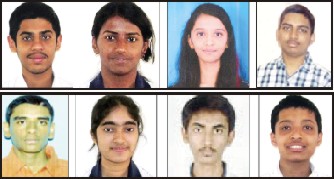
Chinthan Maiya, Y. Poojitha, Apoorva, Aditya, P.S. Ganesh, Ananya G. Bhat, Nitin V. Gowda, Rakshith

Mysore :

U. Chinthan Maiya, a student of Mother Teresa PU College, Srirampura, has secured 16th rank in Engineering CET conducted by Karnataka Examination Authority recently.

Chinthan’s father, Prof. U. Krishnamurthy Maiya, is a Professor in Department of Commerce at Devaraja Urs Degree College and his mother Neerada is a home-maker. Chinthan had scored 576 in II PUC with 100 marks in both Physics and Mathematics.

M.A. Aditya of Vijaya Vittala PU College secured 54th rank in Engineering and P.S. Ganesh Subramanian of VVS Golden Jubilee PU College has secured 66th rank in Engineering.

M.P. Apoorva, a student of Sadvidya PU College, has secured 52nd rank in Medical. Nithin V. Gowda of Marimallappa PU College secured 72nd rank in Medical; Ananya G. Bhat of Mother Teresa PU College has secured 67th rank in Medical and 103rd rank in Engineering. Rakshith R. Gore of the same college secured 80th rank in Engineering. Y. Poojitha, also of Mother Teresa PU College, has secured 35th rank in National Aptitude Test in Architecture (NATA).

Speaking to SOM this morning, Chinthan expressed his happiness over emerging a topper in Mysore and added that it was a surprise for him to have got 16th rank in the State.

Chinthan added that he wants to pursue Computer Science engineering in any one of the top colleges. He also said that he had secured good ranking in some of the other entrance exams and was yet to decide on the college.

Meanwhile, Poojitha, who has secured 35th rank in NATA, said that she wanted to pursue Architecture since her childhood. She expressed her gratitude to her parents and teachers for their support in all her endeavours. She also thanked Gowri, who trained her for NATA.

Poojitha said that she would join R.V. Engineering College or BMS College in Bangalore to pursue her Architecture course. Poojitha had scored 563 marks in II PUC with 98 marks in Physics and Chemistry.

M.A. Aditya of Vijaya Vittala PU College, who has secured 54th rank in Engineering, said that he wanted to study Aerospace Engineering and Nithin Gowda of Marimallappa PU College, who has secured 72nd rank in Medical, said that he wanted to be a Cardiologist.

The students of Deeksha Network at Mother Teresa PU College have also excelled in Manipal University Competitive Exam, results of which were announced on May 23. Manipal Institute of Technology- Ananya G. Bhat (Rank -160); U. Chinthan Maiya (Rank – 16); Manipal Institute of Medicine- Ananya G. Bhat (Rank – 130)

source: http://www.starofmysore.com / Star of Mysore / Home> General News / May 28th, 2014

Indian state of Karnataka commissions largest solar power plant

It is hoped the project will help alleviate blackouts and increase energy security in the state of Karnataka. Image: Welspun.

Sustainable energy developer, Welspun Renewable Energy has announced the commissioning of the largest solar project in the southern state of Karnataka, India.

The twin project totals 19MW, the first 8MW was commissioned last year, four months ahead of schedule, while the remaining 11MW took just three months to complete, coming online ten months ahead of schedule.

The solar power plants use tracker technology to increase the project’s yield and generate more power for the state of Karnataka, which suffers from frequent blackouts.

The project is located in the Chitradurga district and will supply the grid for the next 25 years with enough clean energy to power 48,000 homes.

The 9MW project won a tender in the first phase of Karnataka’s state solar auction, of which, no other entries have commissioned projects yet.

The 11MW project was awarded a tender in the second phase. Welspun is the first project to be commissioned out of 13 other developers who received state Letters of Intent (LoI) as part of the second phase.

Karnataka’s state solar policy for 2011-2016 is for 126MW of solar power to be installed during 2013-2014.

Karnataka Electricity Regulatory Commission (KERC) has set the mandate of 0.25% of new energy procurement to come from solar farms, increasing to 3% by 2022.

According to government run Karnataka Renewable Energy Development, there are 232MW of solar allotted, and 41MW commissioned.

Vineet Mittal, Vice Chairman Welspun said the project will also contribute to the state’s energy security targets.

source: http://www.pv-tech.org / PVTech / Home> News> Article / by Lucy Woods / May 14th, 2014

Tabla Guru Instils Fear and Respect

Bangalore :

It’s hard to imagine an Indian classical music recital without percussion instruments. And yet, it’s not often that you see those who play them taking centre stage. So with an intention to change this, Pandit Rajgopal Kallurkar began Kallur Mahalaxmi Tabla Vidyalaya.

With Bangalore as its home, Karnataka’s first tabla- only school recently celebrated its 29th anniversary, and  featured Ustad Fazal Quereshi (Ustad Allah Rakha’s son and Zakir Hussain’s brother), in a solo concert. “I want all the great musicians and artistes to visit the school,” says Kallurkar.

Starting in 1985, the school follows the guru-shishya parampara model. “I never treat my students as friends,” he says. “And I don’t encourage them to treat me as a friend either. I do inspire a little bit of fear,” he relents.

While the exponent is particular that the school doesn’t become a money-making enterprise, and teaches only students who are dedicated to the art, it doesn’t look down upon people who don’t want to embrace the art as a career.

“I talk to all my students from the beginning about the challenges of choosing this as a career. And if they choose to retain it as a hobby, I’m fine with that too so long as they respect and admire the art,” he shares. “And of course, there are those who don’t have the calibre to learn too well, but we have to make the effort,” he adds.

According to him, a good artiste is a result of a good teacher, dedication and luck.

His definition of luck also includes a home environment conducive to learning the art, and he tries his best to ensure that he solves his students’ problemst. “When students are close to Class 10, parents believe that tabla is a waste of time. But I usually talk to them, and, even if they don’t send the children to class, I convince them to allow the children to practise. After all, no one can study 24 hours a day, and playing the tabla will only act as a stress-buster,” says the tablist who teaches students ranging from five to 60 years.

The school offers no short-cuts. “Everyone wants fame and money immediately — haste has become a way with this generation,” he rues.

Located in Banashankari, the school conducts evening classes from Monday to Friday and morning and weekend classes.

source: http://www.newindianexpress.com / The New Indian Express / Home> Cities> Bangalore / by Express News Service / May 28th, 2014

Kiran Mazumdar-Shaw gets ‘Othmer Gold Medal 2014’

Bangalore :

Biocon has announced that its Chairperson and Managing Director, Kiran Mazumdar-Shaw, has received the ‘Othmer Gold Medal 2014’, in Philadelphia, USA.

Established by the Chemical Heritage Foundation (CHF) in 1997, the annual award honours outstanding individuals who have made multifaceted contributions to chemical and scientific heritage through outstanding activity in such areas as innovation, entrepreneurship, research, education, public understanding, legislation or philanthropy.

Kiran Mazumdar-Shaw is the third woman to receive the Othmer Gold Medal and the first Indian to make it to this prestigious group.

Carsten Reinhardt, President and CEO, CHF, handed over the foundation’s top award to Mazumdar-Shaw during CHF’s Chemical Heritage Day celebration that culminated with the presentation of the Othmer Gold Medal.

source: http://www.thehindubusinessline.com / Business Line / Home> News / by Anil Urs / Bangalore – May 17th, 2014