Category Archives: Records, All

Dr Mohan Alva recieves National Kannada Ratna Award

Mumbai :

“The intelligence of present day children is unique.  Schools have the ability to tie minds as truth.  The educational institutes should not accept failure even when the parents fail.  The institutes should pull the children towards education and morals and tie their minds.  Let us understand the changing times in education and challenges faced due to globalization”, said Alvas Virasat and Nudisiri fame Dr M Mohan Alva, Managing director of Alvas educational institutes.

Dr Alva was speaking after receiving ‘National Kannada Ratna award 2014’ in a programme held at Chembur High School of Chembur Ghatla Village by Chembur Karnataka Sangha.
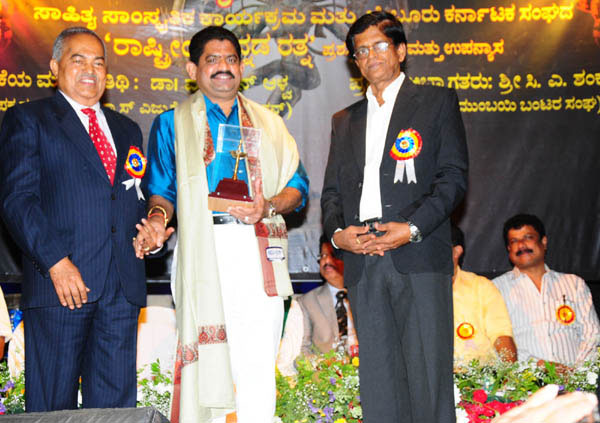
Sangha01BF13apr2014

“It is the responsibility of scholars to inform the difference between culture and entertainment.  As the anniversaries are the mouthpieces of educational institutions, it should be the responsibility of society to impart education and morals.  As we know the youth who lose their way by facebook, whatsup, internet, Skype, Twitter, Vchat etc, we feel insecure.  Let us find the needs of minds in order to know the wealth of humanity and grow value based minds living in harmony”, said Dr Alva.
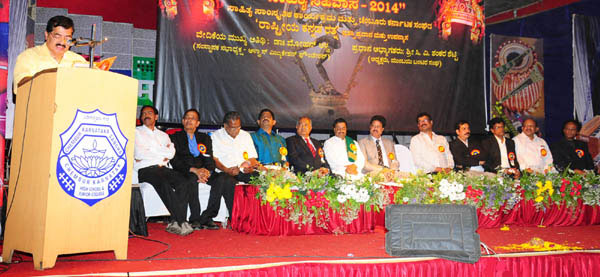
Sangha02BF13apr2014

The programme presided by Sangha president Jaya N Shetty was inaugurated by Vidyavihar Sri Ambika Adinatheshwara Mahaganapathi temple chief priest Vedamurthi Pernankila Haridas Bhat by lighting the lamp.

Bantara Sangha president C A Shankara B Shetty, Vice president Karnire Vishwanatha Shetty and former president of Bhandari Maha Mandal Kadandale Suresh S Bhandary and others were present as guests of honor.

The Sangha develops the minds of Kannadiga’s by literature acquaintance.  It is praiseworthy to see the contribution to the language. The programme of the blind group has added music to the programme and made us see the inner eyes of the blind, said Pernankila Haridas Bhat.

Shanker Shetty spoke that the thoughts of Alva are his too.  Though there are many educational institutions, the ones that make the children grow are handful, he said.

“I have arrived at the Chembur Karnataka Sangha institute in the past also. However the institute has grown and has changed the appearance of the surroundings”, opined Karnire Vishwanatha Shetty.

Suresh Bhandary spoke saying that felicitation to Mohan Alva is like felicitating the culture.  Alva who has grown as a human being with all the good qualities is more valuable than Kannada jewel.  Alva is a talent who materializes the dreams that are not possible by us, said Bhandary.

The institute which has been teaching Kannada, plans to start law courses which is a great project.  It will materialize with the goodwill of people who value education, said Jaya Shetty, in his presidential address.

Senior teacher Y G Shetty was awarded annual excellent teacher award that is given to teachers for their contribution and Subbayya Shetty charity award was given to social worker S K Sunder.  The recipients spoke and thanked for the felicitation.

Sangha vice president Advocate H K Sudhakar, Tresurer Yogesh V Gujaran, Joint treasurer Rama Poojary, former president Prabhakar Bolar and other office bearers were present.

Sangha office bearers, working committee members Vishwanath S Shenava, Devadas K Shettigar, Ranjan Kumar R Amin, Sunder N Kotian, Madhukar G Bailur, Mohan S Kanchan, Raju B Sanil, Chandrashekar Anchan, Jaya M Shetty, Sudhakar Anchan, Sanjiv Shetty, scholars, Tulu Kannadigas and Kannada lovers were present.

The programme started with the prayer by Satish Poojary and Ganapathi adoration. Saumya Acharya presented a devotional dance.  Assistant secretary T R Shetty welcomed.  Dayasagar Chowta introduced the guests and felicitators.  Nandu Kadam and Saumya Acharya presented flower bouquets to the guests.  Honorary chief secretary Gunakara H Hegde thanked.

Akhiyonke Joronkose handicapped troupe presented entertainment programme, Suresh Poojary Irvathur presented devotional song and school children presented cultural programme.

source: http://www.daijiworld.com / DaijiWorld.com / Home> Mumbai / by Rons Bantwal – Daijiworld Media Network –  Mumbai(EP) / April 02nd, 2014
105-year-old IISc has its first formal convocation

Bangalore :

March 29, 2014 will go down in the history of Indian Institute of Science (IISc) as a day when a trend was set. For the first time in its 105-year’s of existence, IISc, a deemed university, held its formal convocation, where 289 students received their degrees. The amusement at the JN Tata auditorium was palpable. None was used to such an event. After all, it was a long-drawn tradition that was being overstepped.

As many as 47 students received gold medals, while 289 students got their degrees. When the institute started admitting students in 1911, it didn't award degrees but only diplomas. It was in 1958 that IISc was declared a deemed university and degrees started rolling out.
As many as 47 students received gold medals, while 289 students got their degrees. When the institute started admitting students in 1911, it didn’t award degrees but only diplomas. It was in 1958 that IISc was declared a deemed university and degrees started rolling out.

But there weren’t the usual formalities of a convocation either. No flowing robes, no flying caps, The participants wore no robes, caps did not fly up in the air, not even the trademark procession. There was no solemn air, but no resounding applause or cheers either.

While most managed to stick to the ‘white’ dress code, some didn’t bother. Looks were the last thing on their mind; One came in mundu, wearing a sunshade with green rim, but appearances did not matter.

It was celebration time for the students and the institute.

P Balram, the director of the institute, read out no annual report as is customary in any convocation. Instead, he chose to speak about the institute. “We never had a formal convocation. Periodically, students wanted it. But from the stories I have heard, the directors resisted it. Any tradition is hard to break. Our tradition has always been to work quietly, take degrees quietly, and go out into the world. Not to have a convocation was not just about modesty, it was also about the tradition. In effect, what we are carrying out is an experiment. We hope to make it more formal in the coming years,” he said.

“A convocation is about getting old students back and the faculty together. There are a lot of people outside the institute who has seen it grown. They are here. And we get to listen to a chief guest every year,” he added.

The award distribution was equally casual. For instance, at one point a gold medal fell off the ribbon to which it was tied and landed on the floor with a clink; another time, the chief guest had to tie the ribbon around the winner’s neck. The degrees too weren’t awarded personally. ; but they posed for photographs, department wise. The groups had a handful of girls each.

As many as 47 students received gold medals, while 289 students got their degrees. When the institute started admitting students in 1911, it didn’t award degrees but only diplomas. It was in 1958 that IISc was declared a deemed university and degrees started rolling out.

From the chief guest

A strong entrepreneurship culture is highly desirable in its planning. The research programmes certainly need to focus on frontier topics and at the same time be selective, thereby helping to channelize its collective energy into solving large scale problems…The Institute in a year or so has to develop a strategy and an action plan to ensure its place among the first 50 of the globally ranked educational institutions in 5 years.

K Kasturirangan, member, planning commission, government of India

“In a recent report, the author observes that many findings of research have doubtful authenticity being the result of shoddy experiment or poor analysis… The issue is a complex interplay of the anxiety to make a mark through “publish or perish” philosophy in a highly competitive field, publisher looking for catchy results and therefore reluctant to publish negative results and peer review process not adequately fool proof.”

Topper’s take

I am from West Bengal. The Howrah bridge and Victoria Memorial always fascinated me. The stint at IISc was an experience. Everybody here is motivated to work and it’s contagious. Now, I am teaching in IIT-Kharagpur and I am enjoying it.. I teach mechanics for under grads.

The interaction with them and challenging questions are fascinating.

Debarghya Chakraborty, best phd thesis in civil engineering

It’s nice that IISc is coming up with a formal convocation. Last year when I came for the convocation, I was in a pair of jeans. This time, we got a late email asking us to come in white shirts. The place where I teach now has a proper convocation. Hopefully, IISc will go to that level, for good or bad, I don’t know.”

source: http://www.timesofindia.indiatimes.com / The Times of India / Home> Education> News / TNN / March 30th, 2014

It’s time to study folk fashion designing

KUD Department of Folk Studies to offer diploma, certificate courses

Like folk arts, folk costumes and designing too will make an entry into academics shortly.

For the first time in India, the Department of Folk Studies of Karnatak University Dharwad (KUD) has come forward with the innovative idea of launching diploma and certificate courses in Folk Fashion Designing. The KUD academic council meeting on Friday approved the proposal submitted in this regard.

The course is expected to be launched in an year’s time after completing the statutory formalities.

The department chairman V.L. Patil told The Hindu that the department had thought of introducing this innovative course with the broader intention of safeguarding the rich folk costume and designing tradition and prevent the techniques of the villages from slipping into the hands of outsiders.

In recent times the fashion and interior designing industry had developed tremendously and those engaged in this industry have begun exploring innovative ideas from Indian folklore. The very concept of fashion designing has changed over the years and the Indian folk tradition was being accommodated in this sector.

Rich folk culture

Karnataka and especially the northern districts have a rich folk culture. One can see various communities and tribes in this region mastering the art of costume designing. Moreover, the people here are expert in manufacturing fabric materials using minimal raw materials and also waste materials. One can hardly match the costumes of the Lambani tribe in matters of their colour combination and designing skills.

Similarly, Kaudi (quilt) is another special material of north Karnataka. The women make patchwork quilts for their families with old sarees and scraps of cloth to stitch Kaudi. It is the glorious tradition of recycling and reusing. These days the Kaudis are being exported also.

To begin with, the university will start certificate and diploma courses in folk fashion designing. The minimum qualification for the certificate course is PUC while it is degree for the diploma course.

Most of the girls in villages and small towns discontinue education after PUC here. Hence, the certificate course will help them to learn fashion designing using technology.

The main intention is to help them explore self-employment opportunities rather than hunt for jobs. The diploma holders will have the choice of joining fashion designing firms as folk designers or go for self-employment, Prof. Patil said.

source: http://www.thehindu.com / The Hindu / Home> Features> Education Plus> Colleges / by Dinesh Nayak / Bangalore – March 23rd, 2014

97-year-old First Voter Does a Class Act in Film on Ballot Power

Shyam Saran Negi, independent India’s first voter, in the film.

A Google initiative to inspire Indians to exercise their right to vote has gone viral. The two- minute-30-second motivational film, part of Google’s Pledge to Vote campaign, has in its lead role 97-year-old Shyam Saran Negi, independent India’s first voter.

Negi, popularly known as Masterji, lives in Kalpa village of Kinnaur district in Himachal Pradesh, along with his son C P Negi, a farmer.  Directed by Bangalore-based leading advertisement film maker Manoj Pillai, the film was released on the public domain on Monday evening with the creative agency being Ogilvy, Mumbai.

Sandeep Menon, Director, Marketing, Google India, told Express via an email interaction on Wednesday that old age hasn’t diminished Negi’s belief in India’s democracy and the power of elections. “India’s first general elections were held in early 1952. But an exception was made for Kinnaur in anticipation of snowfall, and the elections were held there in October 1951. That’s when Negi got a chance to cast his first vote. Since then he has voted in every single elections, including each of the 15 Lok Sabha polls. He also continues to be an inspiration to his family, friends and community in Kalpa,” says Sandeep.

The film, shot in Kalpa in early March, had a 100-member crew closely working with the village folk and Negi, a retired government primay school teacher, in executing the project. “The time spent with our protagonist in this lovely mountain town helped in bringing alive not just his story, but even his commitment to the country,” says Sandeep. To a specific query as to what prompted Google to rope in Negi, he says: “These elections are about capturing the imagination of millions of both first-time as well as experienced voters. This film has been developed to inspire them to come out and vote during this election. The story of Negi is a testimony of Indian voters’ belief in the power of democracy.”

While sharing the challenges of shooting in Himachal Pradesh and also engaging elderly Negi to follow the storyline, Manoj felt that those living in cities like Mumbai, Delhi and Bangalore might not associate with the emotions of Negi. “He lives for the nation and his family comes next. He has seen the birth pangs of India, the problems of Partition and the struggle we are undergoing dealing with many complex issues. Masterji is upset with the happenings across the country, yet he comes and votes every time with the hope that things would change,” says Manoj, who heads Thinkpot Productions. Even the Central Election Commission officials have visited Negi couple of years back to felicitate him.

Negi refused to wear the costume initially as demanded by the storyline, and wanted the crew to take money from him. “He agreed only when we explained about the budget that was set aside for his costumes. He told us that he voted without expecting any favour or help from the politicians. He always walked to the polling booth, which is two km from his home, and never accepted the transportation help offered by parties,” says Manoj. He said the crew had to shoot at temperatures as low as – 6 degrees Celsius. “The physical contribution of Negi to the film, in terms of moving around as per the script, is outstanding. There’s a child-like innocence in him and his eyes light up every time we speak about voting,” he adds.

source: http://www.newindianexpress.com / The New Indian Express / Home> Nation / by Anantha Krishnan M – Bangalore / March 27th, 2014

Pedaling to Glory

Shreyas is all set to participate in the Ultra BOB Race Championship

The Ultra BOB Race Championship, India’s first ultra cycling event, will take place from April 4 to 6 in the city.

The rider from India is city-based Shreyas K, who works for a US-based firm. Shreyas has qualified for the 4th edition of the race.

He began his cycling career in 2011 and has come a long way in a short time. The whole idea of staying out of one’s comfort zone, testing your limits by pushing yourself, enduring all pain and suffering is what enticed the lad into long distance cycling.

“Every time you ride, it feels better than before, and the distance is just a mere number you might want to a keep count of,” said Shreyas.

Through the Bangalore Bikers Club, he volunteered to take part in the third edition of the race.

“I have not participated in races around the world, and I am looking forward to doing so in the near future,” Shreyas added.

“As a kid, when I got on a bike for the first time, I tasted freedom. It was for the first time, I really escaped home on my own. Then, as I grew up, I got busy. My priorities changed. Studies, work, family took over. I was lucky to get a second chance to get on a bike again. I wasn’t satisfied with just one or two bikes, I wanted more. That is when, with the help of my mentors, I started my own bicycle tune-up business,” he said.

“The goal was to provide services to friends, their friends and every biker in the city. For me, riding is synonymous with freedom. There is nothing I care about while I’m riding,” he added.

source: http://www.newindianexpress.com / The New Indian Express / Home> Cities> Bangalore / by S. S. Shreekumar – Bangalore / March 27th, 2014

Lalbagh director’s colonial residence set for makeover

The dilapidated residence-cum-office of Director of Lalbagh Botanical Garden, a heritage building constructed in 1850s, that also houses a library, is set for a makeover. 

Director of Horticulture D R Maheshwar said this is the first time the building is being renovated. Lalbagh Deputy Director Gunavantha K said the renovation would cost Rs 30 lakh.

The renovation work by PWD, which has been undertaken after consultation and guidance from Indian National Trust For Art & Cultural Heritage, will be completed in six months. The building area includes the garden spread across two acre of land.

Harish Padmanabha, grandson of Rao Bahadur H C Javaraya, first native Indian Director of Lalbagh during British rule said, it was built around 1854. It was a colonial bungalow with horse carriage way, verandah and tennis court in the back side. Famous people like John Cameron and Hermann Krumbeigel, former directors, resided there.

source: http://www.deccanherald.com / Deccan Herald / Home> City / DHNS / Bangalore – March 20th, 2014

A story in pictures

BOOK Monuments of Gulbarga is a book that captures ancient art and architecture through photographs.

Gulbarga01-31mar2014

Domes, tombs, minars , forts, moats and off-course masjids . Are you thinking of Delhi? Why travel thousands of kilometres to experience the reminiscences of the sultanate? Prefer going to Gulbarga, a night’s journey from Bangalore. Instead, feel every bit of Gulbarga’s history by just turning the pages of a book. “Monuments of Gulbarga, Treasure House of Islamic Architecture”, a photo-book authored by Mr. Mohammed Ayazuddin Patel gives you this experience.

Gulbarga, now a district headquarters in northern Karnataka, was the capital city of Bahamani Sultanate for two centuries. It was at its zenith in the 15{+t}{+h}century and was home to hundreds of monuments. The Sultanate was founded by Bahaman Shah or Allauddin Hasan Gangu. He shifted the capital from Daulatabad in the present-day Maharashtra to Gulbarga and laid the foundation for a magnificent city. The other great kings of the dynasty were Mohammed Shah and Mujahid Shah.

Resembles Spain`s Mezquita

The book provides a pictorial account of the history of the Bahamani kingdom. Beginning with a nostalgic photo of a tomb of Allauddin Hasan Gangu Bahamani, the founder of the dynasty, the book vividly portrays the beautiful Gulbarga fort, its ramparts, fine arches and abutments. The Jama Masjid, built within the fort, resembles the Great Mosque of Cordova (Mezquita) in Spain with grand corridors and lofty entrance. Various pictures of Shahi Jama masjid in the book unfurl a tableau in front of the onlooker. This masjid located in Shahbazaar was constructed for the members of the royal family. ‘It has a unique architectural style of Mughals and the Persian style’, the book says.

The mausoleums of Mujahid Shah, Daud Shah, Ghiyat-al-din Shah, and Shams-al-din resemble that of Hasan Gangu. Unique is the Tomb of Feroz Shah, with intricate jalis and twin domes. The pictures of 800-year-old Holkonda fort capture the Islamic culture and the simplicity of Tughlaq style aptly. This fort houses an idgah and a Dargah of Hazarath Mohamad Mashaq Sahib, a Sufi saint believed to have come to Gulbarga at the request of Bahamani Sultans.

Gulbarga is famous for the tombs of Sufi saints and Pirs . Noted among them is Dargah of Khaja Bande Nawaz Gesudaraz, built by Mohammad Shah Bahamani. It has a Bijapuri arch built by Afzal Khan, army general of the Ailshahis. Other Sufi tombs being Dargah Khabullah Hussaini with beautiful paintings and calligraphy, Dargah Hazarath Kamal-e-Mujarrad and Dargah Hazarath Shaik Sirajuddin Junaidi.

Majestic, but dilapidated is the Ferozabad fort, built by Feroze Shah Bahamani. He was known for his flair for fine-arts and architecture. This fort, on the banks of Bheema river, encompasses a huge mosque, Tosha khana , and palacial buildings. In spite of its beauty and historical significance, this fort is ill-maintained. Arrays of dung cakes adorn the walls of the sepulchral edifices. Weed-infested mahals are on the verge of collapse due to vagaries of nature. Crumbling structures like Kanchini Mahal, once magnificent and awe-inspiring narrate a story of wanton negligence.

The Chor Gumbad with floral designs, Chand Bibi Gumbad or Kali Gumbad with exquisite Chajjas andJalis , Upli Gumbad – incomplete, yet beautiful, the utterly neglected tomb of Jaccha Bibi, the Siddi Ambar Gumbad with a rectangular porch, are only a few identified among tens of such monuments wailing for attention.

Water conservation

The photos of Hirapur form an interesting set. Hirapur, a suburb of Gulbarga has Ibrahim Adil Shahi Jama Masjid, built in black stone decorated with immaculate designs.

The town has wells, embedded with finely crafted staircases, jharokas and of all, ingenious technology of water conservation to avoid excessive evaporation in soaring temperatures. The wells are still seen as an evidence of splendour, but grossly uncared for.

Strewn inside the fort and atop the bastions are numerous canons, cast in brass and other alloys, weighing several tons, flaunting an intimidating appearance. Famous among these canons is Baragazi Toop atop the Burj in the fort.

Gulbarga is dotted with tombs and mausoleums lost in history, beckoning the curious eyes with their regality. This book displays a tableau of medieval Islamic culture and gives a splendid account of the forgotten monuments. The author also gives an account of Hindu and Jain monuments and pilgrim centres. Patel dedicates quite a bit to the revered Sharanabasaveshwara Temple, Sannati Chandralamba Temple, Ganagapura Dattatreya Temple, and Mallinatha Basadi at Malkhed, but, there is no reference to the nearly 700 year-old-shrine of the Madhwa saint Jayateertha on the banks of river Kagina at Malkhed, a major pilgrim centre.

BookGulbarga31mar2014

Patel, a national award winner, also records Aiwan-e-shahi, Osmania Intermediate College, MSK Mills established in 1884 by the Nizams. He is President of National Graduate Art and Photographers Association.

TAMRAPARNI R. RAGHAVENDRA

source: http://www.timesofindia.indiatimes.com / The Times of India / Home> Features> Friday Review / by Tamparni S. Raghavendra / March 28th, 2014

All the way from Germany in search of Krumbiegal’s works

Krumbiegal was a landscape designer who designed the Brindavan Gardens, Lal Bagh, Chamundi Gymkhana…

LandscapeBF27mar2014


by S.N. Venkatnag Sobers

We have come across many incidents in the past where foreigners have visited India in search of their roots or to know more about their relatives who lived in India for a long time. Many of them have also visited India for research work, especially from England, as ours was a British Colony.

Mysore city recently had one such visitor from Dresden, Germany, who had come here to study the works done by Gustav Hermann Krumbiegal, a German Botanist and garden designer, who is known for his works at the Lal Bagh Botanical Gardens, Bangalore and for the planning of the avenues of Bangalore.

Dr. Anja Eppert, Garden Superintendent, Dresden, was in Mysore to study the works of Krumbiegal. She visited Brindavan Gardens, Chamundi Gymkhana inside Mysore Race Club premises, Mysore Palace, Fernhills Palace, Ooty, which are said to be designed by Krumbiegal during his stay in Mysore.

Her visit has gained prominence as the German Authorities in Dresden have decided to celebrate the 150th anniversary of Krumbiegal and also introduce him to Germans as majority of them do not know much about him.

Speaking to Star of Mysore, Dr. Anja said that some of the gardens designed by Krumbiegal have not been well-maintained. “In case of buildings, it is a different as they get older and sometimes have to be demolished and reconstructed. But, in case of gardens they have to be maintained well throughout. Gardens tell us stories about the kind of people who lived at the time when it was created. It is very important to tell people about the historical relevance of the parks,” she opined.

Dr. Anja added that the German authorities had taken up the research works of Krumbiegal and had sent her on a visit Mysore, Bangalore and Ooty. She mentioned that the German Counselor General in Bangalore informed the authorities about the works done by Krumbiegal during his stay here and that is when they decided to organise an exhibition on Krumbiegal works.

The exhibition will be held next year at Pillinitz Castle and Park in Germany. The German authorities have also planned to publish a book on Krumbiegal. Dr. Anja said that a similar exhibition is also being planned in Bangalore as it would be a good opportunity to exchange garden culture among the two countries.

During her visit to Mysore and Bangalore, Dr. Anja was accompanied by Prasanna Kumar, Retd. Deputy Director of Horticulture, who was in-charge of gardens in Mysore, especially at Lalitha Mahal and had knowledge on Krumbiegal’s works.

For those who do not know about Krumbiegal, he was born in Lohmen near Dresden, and his early studies were in Wilsdruff and Dresden after which he trained in horticulture. In 1884, he worked in Schwerin and from 1885 to 1887 he worked as a landscape gardener in Hamburg. In 1888, he moved to England, designing flower beds at the Hyde Park and became a staff at the Royal Botanical Gardens in Kew. He then took up a position in 1893 with the Princely State of Baroda as Curator of the botanical gardens there. He also worked with the Government Botanical Gardens at Ootacamund and was responsible for redesigning the architecture. In 1908, he was requested by Krishnaraja Wadiyar, the then Mysore ruler, to serve him and he succeeded John Cameron at the Lal Bagh Gardens as an economic botanist and superintendent.

Krumbiegal introduced numerous plants and was involved in designing the landscape for Brindavan Gardens in KRS. He was also actively involved with the Mysore Horticultural Society that was started in 1912. He obtained seeds from other countries and sent collections in return to Kew and USA. These included Indian specialties such as bamboo rice, varieties of other rice, mango and others.

Outside his key work area, he was often involved in architectural design. The Dewan of Mysore appointed him as an architectural consultant despite protests from the British Resident in Mysore. During the Second World War, Germans in India were declared as enemies and Krumbiegal was along with other Germans kept in an internment camp in Bangalore.

Krumbiegal was responsible for the introduction of many ornamental plants and flowering trees. He was also involved in the choice of avenue trees for Bangalore. The road adjoining Lal Bagh is named after him as ‘Krumbiegal Road’.

source: http://www.starofmysore.com / Star of Mysore / Home> Feature Articles / March 21st, 2014

‘India should issue stamp of WW II heroine Noor Inayat Khan’

London :

As Britain’s Royal Mail today issued a stamp of Indian-origin World War II heroine Noor Inayat Khan, campaigners called for India to bestow a similar honour on the famous spy in her centenary year.

The stamp – part of a series called ‘Remarkable Lives’ – honours Noor, a descendant of Tipu Sultan, along with nine others including actor Sir Alec Guinness and poet Dylan Thomas.

“It would be fitting if India too honoured Noor Inayat Khan in her centenary year with a stamp,” said Shrabani Basu, chair of the Noor Inayat Khan Memorial Trust and author of “Spy Princess: The Life of Noor Inayat Khan”.

Shrabani Basu, chair of the Noor Inayat Khan Memorial Trust and author of "Spy Princess: The Life of Noor Inayat Khan".
Shrabani Basu, chair of the Noor Inayat Khan Memorial Trust and author of “Spy Princess: The Life of Noor Inayat Khan”.
“Though she was brought up in Paris, Noor identified strongly with her Indian roots,” said Basu who led the campaign to build a memorial for Noor in London which was unveiled by Britain’s Princess Anne in November 2012.
Her book is now being made into a film. “Noor believed firmly in Indian independence and frankly told her British officers that after the war was over, she would back India’s freedom struggle. Sadly she did not live to see India’s independence,” said Basu.
Noor was born in Moscow in 1914 to an Indian father, Hazrat Inayat Khan and an American mother, Ora Ray Baker.
Her father was a Sufi preacher and musician and left his home town of Baroda to take Sufism to the west.
He met Noor’s mother at the Ramakrishna Mission while on a lecture tour in California.Hazrat Inayat Khan was a descendant of Tipu Sultan, the famous 18th-century ruler of the kingdom of Mysore.
Noor was brought up in Paris and the family moved to London just before Paris fell to the Germans in 1940 during the Second World War.In London, Noor joined the Women’s Auxiliary Air Force and was later recruited for the Special Operations Executive, a secret organisation started by British Prime Minister Winston Churchill.She was the first woman radio operator to be flown undercover to Paris and worked from there for three months under the code name Madeleine.

However she was betrayed, arrested and finally executed in the infamous Dachau concentration camp in Nazi Germany.

Though she was tortured and interrogated, she revealed nothing, not even her real name. Her last word as she was shot was “Liberte!” (Freedom). She was only 30.Noor was posthumously awarded Britain’s highest honour, the George Cross while France awarded her the Croix de Guerre.In 2006, President Pranab Mukherjee, the then defence minister, visited Noor’s family house outside Paris and described her bravery and sacrifice as “inspirational”. source: http://www.economictimes.indiatimes.com / The Economic Times / Home> ET Home> News> Politics and Nation / by PTI / March 25th, 2014

Bangalore : BASE student secures First rank in National Talent Search Examination (NTSE)

Bangalore :

Once again the students of BASE bring outstanding results in NTSE Stage I 2014 by bagging 1st & 3rd rank in Karnataka, the results of which were announced recently. The toppers from BASE are Ms. Dhanya Bharath who has secured 1st rank & Mr. Adithya M Niranjan who has bagged 3rd rank in the state. Overall 28 students from BASE who were part of Foundation SnT program have qualified in NTSE Level 1 exams. More than 50,000 students from Karnataka had written the test and 235 students have qualified from the state.

Speaking on the occasion, Mr. Vallish Herur, Director of BASE said: “The tradition of creating success in Karnataka continues this year too. We are very delighted that our student have topped in NTSE Examination. It really feels great to know that the effort we have put in has paid off. From the last two decades, the continuing success of BASE students at various entrance exams can be attributed to the dedicated efforts of its experienced faculty. I extend my hearty congratulations to all the successful students and wish them success in all their future endeavors”.

Adithya Nirajan
Adithya Nirajan

NTSE is a national-level scholarship program conducted by NCERT for students studying in class 10 to identify and recognize students with high intellect and academic talent. It is one of the most oldest & prestigious exams in India. Students pursuing professional courses such as engineering, medicine, management and law are eligible to receive financial assistance up to the post graduation level.


Dhanya Bharath
Dhanya Bharath

Students pursuing basic sciences, social sciences and commerce, financial assistance is provided up to Ph.D Level. The examination is conducted at both State & National levels.


About BASE:

BASE started functioning in the year 1991 from its present premises in Basavanagudi in Bangalore. It was started by Dr. H.S. Nagaraja with the intention of increasing the number of candidates from Karnataka gaining entrance into IITs (Indian Institute of Technology) and NITs (National Institute of Technology). From a modest strength of 4 faculty members and 3 students, BASE has now grown to include 150 teaching faculty and multiple programmes for students from class 5 to 2nd PU/Class12. BASE trains students to qualify in the entrance examinations of world renowned centres of learning such as the IITs of India. BASE has consistently performed since its inception both in terms of growth and an astounding share in the number of BASE students gaining entrance into the IITs and NITs. It is a proud fact that each year, the number of BASE students qualifying to the IITs is more than that of all other institutions in Karnataka put together.

source: http://www.bellevision.com / Bellevision.com / Home> Media Release / March 11th, 2014