Category Archives: Records, All

SDMITES win Boroplus all India short-film contest

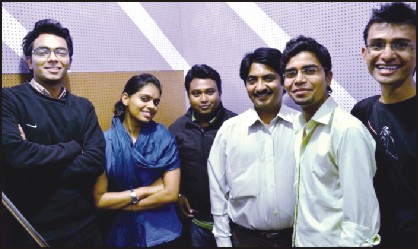
 The Student Team (from left): Himanshu Singh Gurjar, Aastha Vyas, Piyush Kumar, Ravi Shankar, Aman and Omkar Rajyaguru.
The Student Team (from left): Himanshu Singh Gurjar, Aastha Vyas, Piyush Kumar, Ravi Shankar, Aman and Omkar Rajyaguru.

Mysore :

The short film “Who am I” by the students of Shri Dharmasthala Manjunatheshwara Institute for Management Development (SDMites) — Himanshu Singh Gurjar, Omkar Rajyaguru, Piyush Kumar, Aastha Vyas and Ashwin S. Prasad — won the BoroPlus All India Short-Film Making Contest-2014. This year the contest invited entries on the theme ‘Crime against Women.’

The film was expected to speak about the domestic violence, sexual harassment, income inequality, chauvinism, cultural stereotyping. The theme attracted entries across India and 14 entries were shortlisted for the final round. The entries were judged by the jury headed by Ad Guru Alyque Padamsee (Brand Father of Indian advertising, Padamsee has built over 100 brands).

“Who am I” presented the theme and the contest expectation in five minutes which made it to top the contest.

Himanshu Singh Gurjar, who led the “Who am I” team says, ‘“It was then, when there was a storm of Damini’s case (16 December 2012) across the nation that I wondered what is all this happening in the neighborhood in our country, may be in our city next, what if it is our own people? That very thought was awakening for me, I knew it is not possible to change everything but I wanted to raise my voice, against this crime. It was enough of wondering and I knew it is always the action that has stood strong against the injustice.”

Another team member Ashwin S. Prasad says “Who am I is an attempt which is not just a film but also a question from each and every Damini of our society to me, to you and to everyone. We don’t need to answer anyone at all; we just need to answer ourselves. You don’t know her, she may act strong and happy, but she cries to sleep at night. You don’t know the main story behind her story, and you can’t even make assumptions, because her story is far different from yours. But she is present everywhere. We just need to open our realistic eyes.”

This video was not possible without the support of SDM-IMD student community who helped in spreading the message across the nation through social media platform.

The film is available in YouTube in the link:http://www.youtube.com/watch?v=PuYXIbhFHkkorhttp://youtu.be/PuYXIbhFHkk

source: http://www.starofmysore.com / Star of Mysore / Home> General News / March 05th, 2014

City boy’s chopper bike burns rubber

Zakir’s 10-feet long Captain America-style bikesports monster Trepador tyre; actor Upendra asked him if the bike can be used in one of his movies.

The bike sports a converted 500 cc Royal Enfield engine

If you find a monstrous 10-feet long bike zipping around the streets of Bangalore, ridden by a young lad, don’t mistake him for a ghost rider. It is actually 25-year-old interior designer Zakir Hussain Khan, who has passionately created this unique chopper bike which sports a converted 500 cc Royal Enfield engine.
Zakir Hussain, aka Zak as he’s popularly known among motorcycle enthusiasts, was inspired by the intriguing ‘Captain America’ chopper bikes in the West. Choppers are handcrafted or modified bikes. Captain America is the lead character in the counterculture 1960s movie Easy Rider, in which the two protagonists ride a chopper bike.
It took Zak three months to create this mean machine, which he calls the ‘Big Indian’. He now has Sandalwood bigwigs queuing up to feature this monster in their movies.
“Actually, I was test-riding the bike near actor Upendra’s house when his son saw the bike and called his father to check it out. He seemed quite impressed,” said Zak.
Uppi, known to wow his audience with his exuberant and larger-than-life characters, has even asked him if the bike can be used in one of his movies — this of course, after spending a few minutesinspecting the bike and its unusually big hind wheel.
The young designer, who invests most of his earnings from interior designing on modifying bikes, used the imported Maxxis Trepador tyre made by Taiwanese company Cheng Shin Rubber, doing business as Maxxis International, for the hind wheel. The tyre, made to be used on light trucks and SUVs, reportedly cost Zak a whopping Rs 60,000 to import from Germany. He thinks it gives the machine a mean look.
The bike cost him Rs 6.25 lakh to make from scratch. Another of its unique features is its silencer, which emits fire from its exhaust. This lone cost him a cool INR 1,50,000. Some of the characteristic features of this single-seater bike, now grabbing onlooker eyeballs, are its lengthened frame, extended forks, a skull for headlight, and Gatling-style (a forerunner of the modern machine gun) barrels, extending from one side of both the fork tubes.
Zak, always keen on wanting to make something different, started modifying cars and bikes since he was an 18-year-old. “I want to create another chopper bike which is 18-feet long,” said the ambitious Zak. And what is he going to do with this one? “I want to auction it after a few months,” he said.

source: http://www.bangaloremirror.com / Bangalore Mirror / Home> Bangalore> Others / by Nandini Kumar, Bangalore Mirror Bureau / March 08th, 2014

Shrine to immortalize Pope John Paul II’s visit to Bajpe

Mangalore :

The ‘Rome of the East’, which celebrated the beatification of Pope John Paul II three years back on the silver jubilee year of the first ever Papal visit to this coastal city, has another celebration in the offing.

A shrine is being built at the place where Pope addressed a humongous gathering of more than four lakh people on February 6, 1986. Also doubling the joy will be canonization of John Paul II by Pope Francis on April 27 this year.

Canonization is the act by which the Catholic Church declares a deceased person to be a saint, upon which the person is included in the canon, or list, of recognized saints.

Elaborating on the importance of the initiative, Fr William Menezes, public relations officer of the diocese of Mangalore, said: “It is a momentous occasion for us. Not only was John Paul II the first Pope to visit Mangalore, but will also be a Saint declared in our time.”

The shrine is being built at a cost of Rs 1.5 crore. Though work has begun, the shrine will not be complete when John Paul II is elevated to sainthood in April. It will be ready by August-September and the Vatican Ambassador to India – Apostolic Nuncio Salvatore Pennacchio will inaugurate it, Fr William said. A life-size bronze statue of John Paul II, sent by the Apostolic Nuncio, will be unveiled on that day.

Recently, a delegation led by Mangalore Bishop Aloysius Paul D’ Souza met chief minister Siddaramaiah requesting him funds for the shrine.

source: http://www.timesofindia.indiatimes.com / Times of India / Home> City> Mangalore / by Stanley Pinto, TNN / February 28th, 2014

City Doctor to address American Academy of Orthopaedic Surgeons

DrPrashanthBF09mar2014

Mysore :

Dr. B.R. Prashanth, Joint Replacement and Sports injuries expert, Columbia Asia Hospital, Mysore, has been invited to the American Academy of Orthopaedic Surgeons (AAOS) to moderate one of the sessions of the annual meeting in New Orleans, Lousina, from March 11 to 15.

Dr. Prashanth, who has been associated with AAOS, will also be critically evaluating two instructional courses on Joint Replacement and Knee Reconstructive Surgery along with Dr. Frederic Wilson from USA and Prof. Raman from UK for these sessions. The session will also include scientific research papers from Canada, Sweden, USA, UK and Korea.

Founded in 1933, the American Academy of Orthopaedic Surgeons (AAOS) is the pre-eminent provider of musculoskeletal education to orthopaedic surgeons and others in the world.

source: http://www.starofmysore.com / Star of Mysore / Home> General News / March 03rd, 2014

An unfinished episode

Embark on an adventure with Pheroze Kharegat as he takes us to a place steeped in history and conspiracy. Bara Kaman in Bijapur mesmerises and captivates anyone who looks upon it…
BaraKhambaMPos04mar2014

With an overwhelming number of Mughal monuments in India, we tend to forget that, down South, in Bijapur,Karnataka has a great treasure house of Islamic architecture. Peep into the annals of history and you will be intrigued to know how this obscure  little town in northern Karnataka attracted countless dynasties in its brief thousand years of existence.

Dynasty rules

The mighty Chalukyas led the pack, followed by the Khiljis, the Bahamanis and the Adil Shahis. Bijapur’s ancestry rattles off the veritable who’s who of medieval India. They came here to rule and left their imprints in stone – the Gol Gumbaz unparalleled anywhere in the world, the sombre mausoleums and the lavish mahals.

Of all these, the most mystifying in the unfinished edifice is known as the Bara Kaman, or twelve arches. Arches that are silently crumbling, yet graceful. The unfinished tomb of Ali Adil Shah lies a short distance to the north of the citadel and the Gagan Mahal. The great high basement upon which the building stands is 215 feet square.

The most peculiar characteristic of the building are its arches. They are purely Gothic in outline, being struck from two centres with the curves continued up to the crown. On a raised platform, in the inner enclosure is the tomb of Ali Adil Shah. Standing at a dead end of a lane, located a few km from the present day Bijapur town, the Bara Kaman — as this mausoleum was called, stands in ruins.

There are no domes or pillars; just towering stone walls that curve into arches, built to represent death and immortality, as they tried to reach out to each other. The original plan was to build an edifice of 12 arches arranged both horizontally and vertically around the tomb of the king and his queens. However, barely a couple of arches completed the picture, while the rest of them seemed to have been left undone.
This is the incomplete mausoleum of Ali Adil Shah, Sultan of Bijapur, who ruled from 1656 to 1686. This building is also called as Ali Roza. This is located near to the Bijapur main market.

Family politics

Built in 1672 A D, it was the burial place of Ali Adil Shah II and his queens and members of royalty. But the planning of such a grand monument spelt death for the prince.

Ali Adil Shah was murdered by his father Ibrahim Adil Shah to prevent him from completing Bara kaman. Ibrahim Adil Shah feared that Bara kaman would lessen the popularity of Gol Gumbaz that he had gotten constructed. Bara Kaman has the tombs of Ali Adil Shah, his wife Chand Bibi, his mistress and his daughters.

The architect Malik Sandal, initially raised solid walls in the form of concentric arches and once the entire wall was erected, the inner arches were toppled off and only the outermost arch was left intact. Also iron rings were used to hold the stones in place. They weren’t cemented together.

If the mausoleum had been completed, it would have definitely rivalled the Gol Gumbaz in Bijapur.

As a visitor enters the place, he is bound to be impressed by the huge symmetrical arches. The pillars are built of stone and stand tall. The architectural skill of those who designed and constructed this monument is noteworthy.

It is a fine example of Islamic architecture which is synonymous with grace, beauty and opulence. There is no roof over the structure, a clear indication that work had to be stopped due to unknown reasons.

Massive pillars, with large stones nicely held together, support the arches, which soar to the sky. The arches are interlinked giving a picture of continuity.

The tombs are simple with no decoration and a hemispherical smooth top. Two of the arches are located on a tiered high platform, at a distance from each other, and have an austere look.

A wall at the back of the monument has a small arched opening as a lookout. The entire monument is bereft of any embellishment.

The garden in front is well maintained and the Archaeological Survey of India is looking after the upkeep of the monument, though no entry fee is charged.

It was rather late in the evening, and the sun’s rays filtered through the towering  arches, radiating a soft glow. The cenotaph just stood there throwing no clues as to why it was incomplete.

The only motive available in history is   pride that came between the father and the son. They both tried to surpass each other in terms of massive mausoleums.

source: http://www.deccanherald.com / Deccan Herald / Home> Supplements> Spectrum / Maharaja Features / March 04th, 2014
Count, count ’n’ there’s more

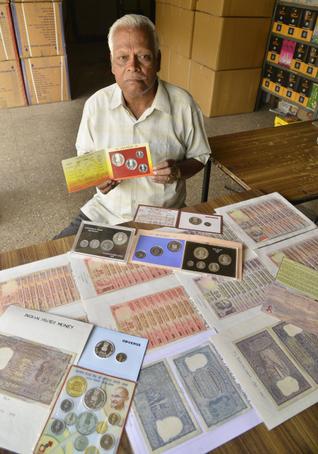
P. Subramanyam Setty has a collection of coins and notes that encapsulate nuggets of history.

TREASURE TROVE My collection is the rarest, says Subramanyam / Photo: Murali Kumar K. / The Hindu

At the 5th National Numismatic Exhibition that concluded in the city recently, Bangalorean P. Subramanyam Setty, the veteran coin and note collector, was honoured for his impressive collection over the years. At his Vijayanagar residence, heaps of albums with the rarest of notes and coins are neatly arranged and placed in a room that attracts anyone to take a closer look. “At the outset I want you to see the Fancy Number series in my note collection, they are thrilling,” says the septuagenarian, a member of the Karnataka Numismatic Society. The fancy is in the Mahatma Gandhi note series where the denominations from Rs. 1,000 to Rs. 10 bear the numbers 111111 to 999999 and from 100000 – 1000000, — 19 notes in all.

Out of the 136 Star Notes issued by the Reserve Bank of India, Setty has 130 out of them in Rs. 10, 20, 50 and 100. “Star Notes are currency notes issued by RBI for replacement of defectively printed bank notes bearing the star in the number panel for indication. Issued between 2006 and 2014, the present RBI Governor Raghuram Rajan too has issued three Star Notes of Rs.10, and I have many of them issued by former governors, Dr. Y.V. Reddy and D. Subba Rao too,” he explains. Going back to pre-Independence British India Series-1, with a profile portrait of King George VI on the first series of RBI notes issued in 1938 is what Setty cherishes, while his post-Independence Republic India Series – II has a Rs.1000 note issued in 1954 with the Brihadeeshwara Temple of Tanjore depicted on the reverse. “Look at the size, it’s a huge 20 x 13 cms!” exclaims Setty.

“My collection is the rarest. Each of the old and exceptional of the notes costs in thousands to get hold of them. On many occasions we have travelled to the nook and corners to meet people who possess them, and we pay a premium,” says Setty. The Republic of India Ashoka Pillar series with the Chakra depicting the wheel motif of the Konarak Sun Temple issued in 1975 and the Mahatma Gandhi Series issued from 1996 are all available with him. “The one rupee Gandhi series of 1969 and the Rs.2. 5 and 10 issued between 1957 and 1970 stands out in my collection as the RBI stopped one and two rupees in 1995,” he says, the nearly 200 staggering variety with different signatures making up his note collection.

Subramanyam Setty also has an astounding 71 varieties of ‘Commemorative Coins’ up-to-date, issued by the government since 1964. “They are referred to as the uncirculated proof-sets,” he says. While most of these coins are in memory of events or renowned personalities of the country which are mostly in quaternary alloy with 50 per cent of silver along with copper, nickel and zinc, the thousand years of the Brihadeeshwara Temple in Thanjavur is commemorated with a 44 mm thousand rupee coin with 80 per cent of silver in its make-up!

The Platinum Jubilee dedicatory coin of the RBI released in 2010 is a Rs.75 denomination with the RBI monogram of the Tiger. “I am still waiting for the Motilal Nehru and Sant Tukaram coins, it takes six months to one year and we book a year in advance,” says Setty. “I also treasure the Mahatma Basaveshwara coin that I possess.” Born in Andhra Pradesh and settled in Bangalore with an agarbathi business, Setty’s son Sharath Babu and daughter Sharmila are captivated to be part of the note and coin fold, while his other son Varaprasad, a central excise employee, has received several awards for his postal stamp collection.

source: http://www.thehindu.com / The Hindu / Home> Features> MetroPlus> Society / by Ranjani Govind / Bangalore – March 03rd, 2014

Two-day workshop on endangered tribal languages in city

CIIL to document these languages; Dictionaries to be brought out and ethnic knowledge system to be recorded.

(from left) L. Ramamoorthy, Head, Linguistic Data Consortium for Indian Languages, CIIL; P.K. Misra, President, Anthropological Association; C.R. Satyanarayana, Deputy Director & Head, Anthropological Survey of India and Lawrence Surendra, Senior Fellow, ICSSR, at the workshop.

Mysore :

Anthropological Survey of India (ASI) in collaboration with Central Institute of Indian Languages (CIIL) has organised a two-day workshop on ‘Endangered tribal languages in South India’ at ASI’s Manav Bhavan in Bogadi II Stage here since yesterday.

CIIL will take up a mega project under which it will document nearly 500 endangered languages in the country, each spoken by less than 10,000 people. The project has got its nod in principle by the Ministry of HRD and CIIL will collaborate with Universities and Institutes in carrying out the project.

Speaking to media persons, L. Rama- moorthy, Head, Linguistic Data Consortium for Indian Languages, CIIL, said that the work would be taken up under a scheme to preserve and protect endangered languages.

“The objective is to bring out dictionaries and also document and preserve the ethnic knowledge system enshrined in the languages, including folklore. It would also extend to frame grammar rules. Also, experts would give suggestions for revitalisation of these languages. The project would be carried out phase-wise. About 70 languages from different parts of the country would be studied in the first phase and 500 words would be taken up in a span of 10 years,” said Ramamoorthy and added that the study and documentation of each language would cost Rs. 6 lakh to Rs. 8 lakh.

Earlier, P.K. Misra, President, Anthropological Association, Mysore, inaugurated the workshop on ‘Endangered tribal languages-Initiatives from CIIL.’ Speaking on the occasion, he said “Language is embedded in society and culture. It is an important tool to identify people belonging to different communities. The region, inhabited by Jenu Kuruba community, is also home to other communities like Betta Kuruba, Soliga, Yerawa and others,” and added, “The status of language should be understood in the context of society and culture which were not static but under constant change. Even the changing external environmental factors have affected the traditional lifestyle of the tribal people.”

Ramamoorthy, during the workshop, quoting a survey, said that there was no consensus on the status of endangered languages. “While the Census of India 2001 fixed the number as 122, Anthropological Survey of India put it at 323, while a UNESCO report said 196 Indian languages were endangered,” he said and added, “Language is a complex phenomenon and its use is also complex due to the onset of globalisation. We get to know one’s culture through the clan’s name of the community to which they belong. In fact, many languages are known through their communities.” He hoped that the workshop could work out parameters and tools to identify an endangered language.

Lawrence Surendra, Senior Fellow, Indian Council of Social Science Research (ICSSR), who delivered a special lecture on ‘Endangered tribal languages and cultures’ said, “There is a link between language and bio-diversity as they reinforce each other. Language represents knowledge. Endangerment of language is far more serious than that of culture because with the extinction of language, the entire encyclopaedia of knowledge enshrined in that language would be lost forever.”

C.R. Satyanarayana, Deputy Director & Head, Anthropological Survey of India, Southern Regional Centre, subject experts from different Universities and Institutes are attending the workshop which concludes today.

source: http://www.starofmysore.com / Star of Mysore / Home> General News / February 25th, 2014

Felicitation marks 28th death anniversary of freedom fighter R.S. Naidu


RSN Memorial awardees (sitting from left) Senior Advocate M.A. Sampath Iyengar, Sri Kumara Nijaguna Swamiji of Kollegal and Star of Mysore Editor-in-Chief K.B. Ganapathy are seen with (standing from left) artist Dr. Jamuna Rani V. Mirle, District Kannada Sahitya Parishat President M. Chandrashekar, sculptor L. Shivalingappa, KSOU VC Prof. M.G. Krishnan and N.K. Ramesh of RSN Trust.

Mysore :

“R.S. Naidu was a multi-faceted person excelling in every field,” opined Prof. M.G. Krishnan, Vice-Chancellor, Karnataka State Open University (KSOU).

He was speaking after inaugurating a programme organised by R.S. Naidu Art and Cultural Welfare Trust at Nadabrahma Sangeetha Sabha on JLB Road here yesterday to mark the 28th death anniversary of Freedom Fighter and Sculptor R.S. Naidu.

Krishnan said that Naidu joined Youth Congress and worked for its unification. He added that Naidu was also an art patron and a good sculptor.

On the occasion, RSN Memorial award was presented to Senior Advocate M.A. Sampath Iyengar, Sri Kumara Nijaguna Swamiji of Kollegal and Star of Mysore Editor-in-Chief K.B. Ganapathy.

Addressing the gathering, Ganapathy said that Naidu after having worked hard for the society turned a loner towards the end probably upset over the value deficit in society.

He said that though many leaders fought for nation’s freedom only a few are being remembered. Sardar Vallabhbhai Patel, for example, is hardly remembered despite his great contribution for country’s unity. He also lauded the services of R.S. Naidu Trust.

Mysore Art Gallery President and sculptor L. Shivalingappa presided. District Kannada Sahitya Parishat President M. Chandrashekar was present.

Later, a cultural programme was presented by Mahathi Orchestra and M-Modal troupe.

source: http://www.starofmysore.com / Star of Mysore / Home> General News / February 25th, 2014

Country’s First Electric Bus Launched in Bangalore

BMTC launched an electric bus at Shantinagar Bus Station on Thursday; Right: A view of the interiors | Sudhakara Jain

The Bangalore Metropolitan Transport Corporation (BMTC) introduced the country’s first electric zero-emission bus in the city on Thursday.

Although the bus has been in Bangalore for over a month now, it was officially launched by Transport Minister Ramalinga Reddy after getting the required permissions from the Transport Department.

The bus will run on a trial basis for the next three months. During this time, it will operate along various routes, beginning with one from Majestic to Kadugodi that is likely to cost `80.

Plans are also afoot to run the bus along the airport routes. The charging point for the bus is at the Volvo depot at Majestic.

“We will study whether the bus is economical and if it can function efficiently in the city. When the battery is fully charged (six hours), the bus can run for about 250 km, which is ideal for BMTC. However, this needs to be tested. We also need to see how it fares on various roads in the city and which routes are best suited to operate the bus,” said BMTC managing director Anjum Parvez.

Transport Minister Ramalinga Reddy said that though the bus is expensive, it is likely to be a good deal as a long-term investment.

“The bus costs about `2.7 crore and this is expensive. But this is one bus in the entire country. Once the demand for the bus goes up and more people express interest in purchasing it, the rates are likely to come down. Moreover, the research and development wings of various bus manufacturers are working on this and it is some only time before the initial cost of the bus is reduced,” he said.

When asked if the state government would be willing to share the cost or offer subsidies, Reddy said, “We will consider various options if the bus is found to be suitable for the city. At present, it is on a three-month trial and following this, a decision will be taken on whether or not to purchase the bus,” he said. He added that what was important was that pollution levels would be brought down by using electric buses, hybrid or CNG-operated buses. The bus, manufactured by Build Your Dreams (BYD), was brought to India by Utopia Pvt Ltd. At least 5,000 such buses are operational in countries such as the United States, Netherlands, Switzerland and some European countries.

GOING GREEN

Zero emission

No oil required

Costs Rs 2.7 crore (Volvo Rs 88 lakh)

Fare from Majestic to Kadugodi – Rs 80

Runs for 250 km with 6 hours of charging

source: http://www.newindianexpress.com / The New Indian Express / Home> Cities> Bangalore / by Express News Service – Bangalore / February 28th, 2014

Bangalore’s 5-year-old kid in Guinness Book of Records for skating

Bangalore :

A five-year-old boy from the city made it to the Guiness Boook of World Records by skating under 39 Toyota Qualis cars in just 28 seconds. The wonder kid, Gagan S, a kindergarten student at Florence School in Basveshwaranagar, achieved this feat last month.

The boy broke the record of Rohan, 9, from Belgaum who skated across 24 cars in 47 seconds.

Gagan’s father Satish works at a washing machine service centre. He said Gagan was always enthusiastic about skating and joined the skating classes just one-and-half year ago.

Gagan’s proud parents hoped Gagan’s achievement would help skating gain popularity in India and more youngsters take up the sport.

It is not the first recognisation of Gagan’s skating abilities though. In November last year, he had won the ‘youngest skate award’ in Belgaum. His parents now dream about sending him to the Olympics.

OneIndia News

source: http://www.news.oneindia.in / Home> OneIndia> News> Bangalore / by Shubham Ghosh / Thursday – February 13th, 2014