Category Archives: Records, All

Kannada Sangha lines up star-studded show

Bahrain :

Kannada Sangha will organise its annual mega cultural event Kannada Vaibhava on Tuesday at the Al Raja School, from 5pm.

Well-known flautist and world famous fusion artist Pravin Godkhindi and his troupe are being specially flown in from Bangalore to perform at the eagerly awaited show in the Kannada Sangha calendar.

“We are once again coming together to put up another mega show to highlight our music, art and culture,” said Sangha president Mr B Rajkumar.

“Pravin Godkhindi is a household name in India and the world over for his contribution to Indian classical music and experimentation with various instruments. I’m sure music lovers in Bahrain can look forward to a memorable evening of classical music.”

Mr Godkhindi became the first Indian flautist to perform the eight-feet contrabass flute and the first Indian to represent ‘Bansuri’ at the World Flute Festival held in Mendoza, Argentina.

He has toured the US, Canada, Spain, Belgium, Germany, Muscat, Qatar, Holland, Bangkok, Singapore, Dubai, Argentina and Portugal for his solo and fusion performances. He has also performed with eminent musicians like Ustad Zakir Hussain, Dr Balamurali Krishna, Pandit Vishwa Mohan Bhatt and Dr Kadri Gopinath.

Three prominent politicians from Karnataka will also attend the event. They are Forest Minister B Ramanath Rai, Health and Family Welfare Minister U T Khader and Kannada and Culture Minister Umashree.

Title sponsors are United Land Bank, Platinum sponsors Metalco, and main sponsors are Al Namal Group, State Bank of India, Prudential Manpower, Auma Bahrain and Malabar Gold and Diamonds.

Entry is free and all are welcome. For more details, contact Mr Rajkumar on 39688395.

source: http://www.gulf-daily-news.com / Gulf Daily News / Home> Local News / Saturday – December 14th, 2013

First five-star hotel in India earns Green Globe certification

Achieving another milestone in the hospitality industry, Movenpick Hotel&Spa Bangalore in India, has recently been awarded Green Globe certification. This makes it the first five-star hotel in the country to be Green Globe certified. In line with the corporate philosophy, Movenpick Hotel&Spa Bangalore has been dedicated to the preservation of a safe and healthy environment for years.

MovenpickBF24dec2013

“In the tough times of today, being eco-friendly and maintaining it, is the core of all business, said Biswajit Chakraborty, General Manager at Movenpick Hotel&Spa Bangalore. “We have implemented eco-friendly practices at all levels of our operation, from people to procurement, to product and services. The core values at our property include a firm commitment to conserving resources, preventing pollution, and to act with integrity. Sustainability to us means meeting the needs of the present without compromising the ability of future generations to meet their own needs. We are proud of our achievements, and will challenge ourselves to improve the standards, since sustainability is an ongoing process.”

The values of quality, reliability, and care are fundamental in guiding this upscale property towards best sustainable business practices. A special Green Team formed of eleven individuals from different departments, monitors the progress of eco-friendly measures, shaping and realizing the environmental goals of the hotel. The hotel uses green energy, provided by wind, and LED lighting is installed throughout all areas of the property. Waste volume, weight and reduction goals are specified, garbage is being segregated per the waste management policy of Movenpick. A reuse and recycle policy is in place and packaging is reduced to a minimum. Suppliers adhering to environmentally friendly practices, organic and certified products are favored.

As part of their CSR initiatives, Movenpick Hotel&Spa Bangalore works closely with a number of social and fund raising organizations, contributing to a positive community and environment. “Joy of Giving” is a campaign conducted every three months, and employees donate their clothes, books, and toys that are still in good condition, to fund local charities, such as the regional Snehasadan. In collaboration with the Ministry of Tourism, the hotel strongly supports Hunar Se Rozgar, a training program creating employable skills in eligible young people. Blood donation drives, relief funds, and charitable events are organized by on a regular basis.

source: http://www.forimmediaterelease.net / ForImmediateRelease.net / Home> In Accomodation / December 13th, 2013

Nomads who archive family details

A Helava community member with documents in his possession. / by Special Arrangement / The Hindu

Helavas have documents containing the genealogy of almost all families in 10 districts

They may look like members of yet another nomadic tribe moving from one place to the other. The big difference is that people in certain parts of the State look upon their arrival eagerly, as the bundles that they carry contain documented information dating back centuries.

Helavas, traditional archivists, have documents containing the genealogy of almost all families in every village and town in Belgaum, Dharwad, Bijapur, Bagalkot, Haveri, Gadag, Bellary, Uttara Kannada, Davangere and Chitradurga districts.

Their traditional occupation is to visit every household in different groups, read out the genealogy, and add on details of new members of the family.

Perhaps, it is the only community in India that has made archiving a source of livelihood. Families offer them money, gold and silver articles, and foodgrains in return. Their inherited skills of archiving can leave modern archivists awestruck.

K.S. Korishettar, a lawyer in the Karnataka High Court, said he got details of nearly 10 generations of his family from them. “The oldest details are in copper plates which appear to be reliable. The names of ancestors of three to four generations in the Helava records are accurate. They have legal sanctity and courts have termed them valid documents in some partition-related suits,” he said.

“Earlier, people would give donations in kind. But today, most of the families pay in cash. We earn enough for our subsistence,” Fakirappa of Hadagali village said. He said they have some ancient records written on copper plates and palm leaves.

Their lifestyle too has not changed over the years. During their tour, they stay in tents and use bullock carts to commute. Women are mainly engaged in household work.

The legend has it that the Helavas existed from the days of Basaveshwara. An extensive research of their documents may unearth several interesting facts.

source: http://www.thehindu.com / The Hindu / Home> News> National> Karnataka / by N. Dinesh Nayak / Dharwad – December 13th, 2013

Prafulla Chandra, noted agriculturist and technologist, dies

Shimoga :

Well-known agriculturist and technologist Devangi Prafulla Chandra passed away at a private hospital here on Wednesday due to heart attack, family sources said.

80-year-old Prafulla Chandra was popularly known as “Krishi Rushi” for his work in the areas of agriculture, energy conservation and rural development.

Prafulla Chandra, who is recipient of honorary doctorates from the University of Agricultural Sciences, Dharwar and Kuvempu University, Shimoga for his work towards technology transfer to rural development, is the brother-in-law of renowned Kannada poet and literary personality, the late Kuvempu.

He had bagged several coveted prizes and honours from number of institutions in the country and abroad like Krushi Samrat, state awards, world food day medal from the United Nations, American farmer’s award and 8 gold medals from government of India for excellence in crop production.

source: http://www.articles.timesofindia.indiatime.com / The Times of India / Home> India> Energy Conservation / PTI / December 11th, 2013

“What is a Pinhole ? Such is the ignorance of today’s Photographers ”

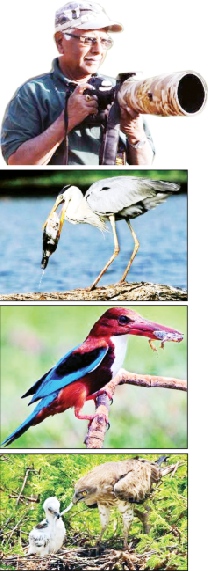
ThippeswamyBF24dec2013City’s eminent cinematographer & photographer, S. Thippeswamy, in a candid conversation…

One photograph published in one daily newspaper, the photographer immediately poses and puffs smoke rings and claims that he is a professional photojournalist, wildlife photographer and more,” commented city’s eminent cinematographer and wildlife photographer S. Thippeswamy, with a wry smile on his face.

This and other candid comments are made at an impromptu addaa sessions deep in the basement of ‘Ramsons House’ in city.

The prickly subject of professional photographers and their art came up when someone present commented on the great annual Pinhole Camera Photography contest conducted by a top professional photography magazine in USA and top photographers from across the globe test their skills using a handmade cardboard pinhole camera!

“To use an ordinary box camera or pinhole camera to photograph people or places, that is the mark of a true professional,” says Thippeswamy. “A thorough knowledge of light, composition and most important of all, the ability to see the photograph in the mind’s eye, the third eye. If I were to ask today’s professionals, then they will ask, ‘What is a pinhole? Who is pinhole …?’ such is their ignorance…” says Thippeswamy.

R.G. Singh of Ramsons Kala Pratishtana in a brief tete-a-tete with Thippeswamy. Excerpts…

R.G. Singh (RGS): “One swallow does not a summer or (is it spring?) make…” Similarly one or even several photographs published here and there does not make one a true professional…” Like Jiddu Krishnamurthy would often say in his talks, can we go a little deeper into this issue?

S. Thippeswamy: It took me more than 30 years of continuous learning process and I am still learning even to this day. Photography is much more than just a sophisticated camera that does all the work for you. The true photographer is one who has been drawn to this field because he has a passion and the commitment to make it a lifelong mistress!

RGS: As you have done so… made photography your lifelong mistress !

Thippeswamy: (Laughs) Yes, a very jealous mistress! passion and commitment, Sir, passion and commitment! There is romance in photography. You learn the art of composition, the play of light and shade… a vision forms in your mind and that is where the first photograph is created in your mind …even before you click the shutter.

RGS: You have to be a technician too, right ?

Thippeswamy: The old box cameras required human expertise. I still have my old Voigtländer camera and several others too like the Brownie wherein you had to check the focal length, aperture speed and so on and then the actual taking of the picture. It needs a keen eye, the ability to see the picture in the mind’s eye. Photography is a lifelong love affair. If it isn’t there, then what you will get is just a picture. (Laughs)

RGS: Then the films had to be sent for processing …?

Thippeswamy: After all that work, the films would be sent to be processed and then till the finished prints arrived you would never know how the photographs would turn out… Of course, later I began making the prints myself in my dark room.

RGS: From being a professional photographer for magazines and brochures to wildlife, how did this transition occur?

Thippeswamy: I have previously done corporate photography and industrial photography too. They needed a different perspective, the advertising angle. The photographs had to sell the product. The image had to be eye-catching, only then would the customer read the text. The photographs of people and places to illustrate magazine and newspaper articles also needed a different perspective. Wildlife and nature photographs need solid discipline — to blend with nature and the animal’s habitat. It takes years to mature as a nature and wildlife photographer. I have done more than 200 documentaries and have got four national awards.

RGS: One documentary which impressed you most?

Thippeswamy: In 1972, I made a documentary on tribes like Kaadu Kurubas, Jenu Kurubas and Soligas for the Information Department which was well received. This was a documentation of the lives of these tribes for their rehabilitation from core forest areas. Interviews with them, documenting their lifestyle and their closeness to nature and wildlife… it was a lot of effort, but worth it. I have also made documentaries for the Central Institute of Indian Languages and the Abdul Nazir Sab Institute for Rural Development (ANSIRD). I also made nine short films for ANSIRD. All of them were greatly appreciated.

RGS: When did you take to jungle trails?

Thippeswamy: You see, I did not become a wildlife photographer overnight. I was a member of the camera unit of several film studios including Kanteerava Studios for years before I moved on to a career as a photographer for the Mysore Medical College. Around this time, it was in 1979 that I began photographing the monuments and heritage buildings of the city and some of them were published in a few dailies. They were spotted by journalist M.B. Singh who was then the Editor of Sudha and Prajavani. M. B. Singh, who I consider my Godfather, gave me several assignments.

A fellow professional who had seen my work one day challenged me to photograph wildlife which he said was more difficult. Thus in 1981, I took up wildlife photography as a challenge as this particular field requires several attributes, like patience, using whatever light is available and not frightening the subject. Animals are wary of humans and to click them without arousing any nervousness in them is an art that has to be learnt and no textbook can teach you that… I have covered all wildlife reserves and national parks in the State and most across the country.

RGS: One last question… your advice to the budding photographers?

Thippeswamy: First, it is an expensive profession. Do you have the financial ability to live off your work? The equipments like cameras, lenses, etc., are expensive, can you afford them? Can you afford to spend days in difficult conditions without basic necessities? Can you spend time away from your job, family for days? If the answer is positive to all these questions, only then should you should become a photographer. Let your photographs do the talking. Do not become mere posers !

— R.G. Singh

Awards & Fellowships

‘Lifetime Achievement in Photojournalism’ by Karnataka Media Academy; Bharatiya Vidya Bhavan’s ‘E. Hanumantha Rao Lifetime Award’ for achievements in wildlife photography; ‘Raghavendra Chitravani’ Award for film and TV work , Public Relations Council of India (PRCI), Bangalore Chapter’s ‘Samvahana Award,’ for contribution to wildlife photography. Fellowship of the Photographic Society of America (2005); Proficiency Distinction for the Nature category (2005); Award for Best Thematic Nature photography by UNESCO supported Federation of International De L’Art Photography (1995) and Fellowship of The British Royal Photographic Society (1992).

source: http://www.starofmysore.com / Star of Mysore / Home> Feature Articles / by R. G. Singh / December 18th, 2013

Art runs in her blood …You think of it , she creates it

Truly amazing...Sea shell replicas of Taj Mahal and a Shiva Temple at Radha‘s Kalashree Bhandar.
Truly amazing…Sea shell replicas of Taj Mahal and a Shiva Temple at Radha‘s Kalashree Bhandar.

Mysore :

Being an artist is one thing and being a versatile one is something else altogether. And showing versatility to such an extent that you end up seeing art in almost every single thing that you come across is something all the more exceptional. Now, who wouldn’t want to meet an artist so nifty? Come, we’ll introduce you to one.

Meet Radha Mallappa, a city based artist who sees art and artistry in almost any medium that she comes across. Having gotten into the world of creating thing artistic almost 30 years ago, she is one person who we can quite valiantly say has downrightly dedicated her life to fine arts. Give her anything from coconut shell to sand; stones and thread to sea shells; cotton, clay or glass; she can create an art piece out of it! Surprising isn’t it?

But for 51-year-old Radha, art is a thing as easy as a pie. She has created so many artworks that she has a museum of her own at her home at Bannimantap in city which is a storehouse of all her beautiful artworks. Called ‘Kalashree Bhandar,’ the museum is a place worth a visit for all the art lovers, as it houses art works created out of over 150 different mediums by Radha.

But how does she manage to create artworks of such diverse forms? “I spend about 8-10 hrs a day on this hobby of mine,” she replies. Ask her if she doesn’t find it difficult to juggle between housework and hobby and pat comes the reply, “I somehow manage. I cannot give upon my hobby at any cost. And I am glad I am equally encouraged by my husband and mother at home, who thoroughly cooperate.”

Some of the latest additions to her museum include a 10 ft tall model of the famous Taj Mahal and a 12 ft tall model of a Shiva Temple, both made out of sea shells. They are created out of over 20 different varieties of sea shells brought in from various places across the country as well as a few imported from places abroad.

What’s more, apart from being so artistic, the artist has also tried her hands in singing, Kannada poetry writing and is also an Ayurveda practitioner who has been successful in healing several people suffering from various ailments since many years now. And for all her efforts, Radha Mallappa has received several awards continuously ever since the year 2001. Some of them include the ‘Bharat Jyoti Award’ from the National Integration and Economic Council, ‘Kittur Rani Chennamma award,’ ‘Hoysala award,’ ‘Kala Sarawathi award,’ ‘Aryabhata,’ ‘Amoghavarsha,’ and ‘Sir M.Visvevaraya’ awards.

Radha is married to businessman Mallappa and resides at No 25, KSRTC Colony in Hanumantha Nagar, Mysore. — AN

source: http://www.starofmysore.com / Star of Mysore / Home> Feature Articles / December 18th, 2013

Wipro receives 15th NCPEDP-Shell Helen Keller Awards

Bangalore:

Wipro Ltd. (NYSE:WIT), a leading global Information Technology, Consulting and Outsourcing company today announced that it has been recognized as a  role model organization by the Helen Keller awards. The National Centre for Promotion of Employment for Disabled People (NCPEDP) also conferred the 15th Hellen Keller Award to Wipro employee, Ankit Rajiv Jindal.

Instituted in 1999, every year the NCPEDP-Shell Helen Keller awards honors individuals or organizations who are working towards helping people with disabilities find positions of equality and dignity in the workplace.

Wipro has been hiring persons with disabilities and providing them with necessary support on an individual basis to help them realize their potential, for many years now. The company has also supported employees who may have sustained disability during the course of their employment and provided them with necessary support to enable them to continue their work adequately. Inspired by the UN/DPI theme “Nothing about us without us”, Wipro is now consciously involving persons with disabilities in reviewing, re-designing and sustaining the company’s “Persons with Disabilities” charter.

Ankit Rajiv Jindal is the first marketing manager with visual impairment at Wipro and was hired from Faculty of management Studies, Delhi University in 2011. Technology has been a great enabler and equalizer for Ankit who leverages it extensively to perform his work and personal tasks.

Isaac George, Vice-President and Human Resources Head, Wipro Infotech said, “It is a matter of immense pride that Wipro has won the NCPEDP-Shell Helen Keller Award under the Category: Role Model Companies/Organizations. Wipro currently employs over 450 persons with disabilities. Many functions have collaborated to create the opportunity for them to pursue mainstream careers through a supporting framework of accessible software applications, physical infrastructure, policies, training and culture building initiatives. This reflects the importance that Wipro accords inclusion, and this award recognizes the spirit of all Wiproites who joined hands to create a more inclusive workplace.”

source: http://www.indiaeducationdiary.in / India Education Diary.com / Home / Report by India Education Bureau, Bangalore / Saturday – December 14th, 2013

City’s aroma bakery creates a 548-Kg replica of Lalitha Mahal Palace !

A cake replica of Lalitha Mahal Palace displayed at Loyal World, V.V. Mohalla. Picture right shows the actual architectural marvel — Lalitha Mahal Palace.

Mysore :

Chefs and bakers of Loyal World Aroma Bakery at Vontikoppal in city, inspired by the architectural beauty of Lalitha Mahal Palace have prepared a replica of the structure in the form of a cake.

Toiling for about 28 days, the team of chefs and bakers completed the cake at the cost of Rs. 1.35 lakh, weighing about 548 kgs and measuring six and a half feet tall and five and a half feet wide.

Imran Khan, Bakery Manager, said that the bakery prepares and displays such structures in the form of cakes especially during Christmas and New Year seasons.

This year, the Lalitha Mahal Palace was chosen for its architectural marvel.

The replica, created by chefs Lal, Shaneesh, Ramesh, Irshad, Ashok,Jasmir, Rangaswamy, Rashid and Mahender will be on display at Loyal World, V.V. Mohalla, till Dec. 31.

source: http://www.starofmysore.com / Star of Mysore / Home> General News / December 16th, 2013

High on learning

From hating wine to becoming India’s first female wine maker, it’s been an educational ride 

Karishma Grover (29) Associate Wine Maker, Grover Vineyards

She cringed at her first taste of wine as a child. But an encounter with Michel Rolland, the Bordeaux-based oenologist at the age of 16, effected a change. “Michel has had a phenomenal influence on my career. I began following him around in vineyards, taking in everything he was saying, fascinated,” she says.

Grover decided to study viticulture and oenology, with a minor in managerial economics from the University of California, Davis. She also did an internship at Cakebread Cellars in Napa Valley.

“Wine is an integral part of my upbringing, but I wanted to take my legacy to new heights,” she says. Unlike her contemporaries, Grover decided to focus on quality control in winemaking, and started at the bottom of the rung as an assistant wine maker.

Her day begins at 7 am during the peak season (between February and May) in the Nandi Hills estate. She inspects grapes, checks the fermentation process and decides how to sort the wine into different categories. “Much of the day goes in walking and it gets pretty tiring.” As a new winery has opened in Nasik, Grover’s time is divided between the two cities.

The hardest part of her job is people management. “In the States, smaller tasks are often automated with someone to supervise the machines. I only have to deal with people at higher levels. Here, I have to interact with everyone, from the grape-picker to the highest executive. It gets overwhelming,” she observes. That said, her India experience has boosted her confidence. “The eagerness here is refreshing. Every day is a different challenge.”

A 12-hour day ends with Grover thoroughly exhausted but satisfied. “I usually take a walk near my house to clear my head. It helps me relax.” She lives in Yelahanka so she doesn’t drive into the city often, and draws solace from her never-ending vineyards.

source: http://www.bangaloremirror.com / Bangalore Mirror / Home> Columns> Work / by Sindhuja Balaji, Bangalore Mirror Bureau / December 07th, 2013

B’lore lab helping develop first TB vaccine in 100 years

Scientists at Max Planck Institute of Infection Biology, Germany, are trying to develop a tuberculosis vaccine for adu-lts which will be the first in nearly hundred years since the Bacille Calmette-Guérin (BCG) vaccine for children was developed. Lending a helping hand in this is a clinical lab at St John’s Research Institute (SJRI) in Bangalore.

The SJRI has been commissioned to come up with biomarkers to test the efficacy of the new vaccine, which is set to go into phase three trials.

The vaccine being developed by Max director Stefan H E Kaufmann is considered the most promising among a clutch of other candidates that have appeared following a renewed interest on account of the emergence of drug-resistant varieties of the disease.

Kaufmann, who was in Bangalore last week, has tied up with John Kenneth, head of the infectious disease unit and molecular diagnostics at SJRI, to locate biomarkers that will establish the efficacy of any tuberculosis vaccine administered to patients.

“All current vaccine candidates are relatively low on ambition. They all attempt to contain mycobacterium tuberculosis. We do not have a candidate that claims to prevent infection or eradicates the pathogens,” Kaufmann said.

Max has created a vaccine against adult TB of the lungs by working with a recombinant version of the BCG vaccine that prevents TB in children.

The vaccine had been sub-licensed to Serum Research Institute of India that wants to test it, Kaufmann said.

“When you put the vaccine candidate into the trial cycle you need an end point measure of the efficacy of the vaccine to indicate that antibodies have been produced to provide immunity. We don’t have that marker at present,” Kenneth of SJRI said. The presence of a biological databank and a TB patients to carry out tests for biomarkers is key to the tie-up between Max and SJRI.

“Biomarkers are critical factors for the future research on TB. They are critical factors for better vaccines, better drug design and better diagnosis,” Kaufmann said. One of the questions that the researchers are trying to answer in the quest for biomarkers for TB is, what distinguishes patients with active TB and those who remain healthy.

source: http://www.indianexpress.com / The Indian Express / Home / Bangalore, Saturday – December 14th, 2013