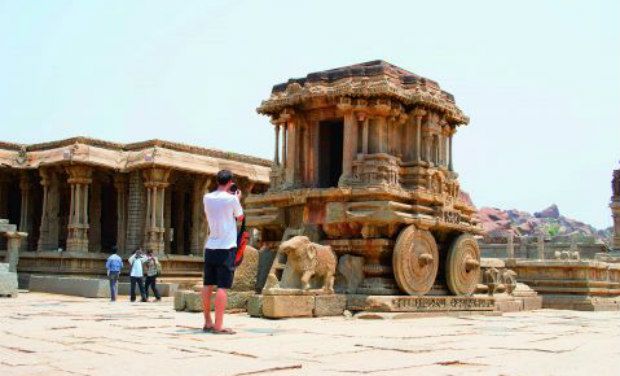
The state government has decided to conduct the three day Hampi Utsav-2014 from January 10. Speaking to reporters here on Friday, minister of state for labour P.T. Parameshwar Naik, who is also in-charge minister for Bellary district said Chief Minister Siddaramaiah will inaugurate Hampi Utsav.
Tourism minister R.V. Despande and Mandya Lok Sabha member Ramya will be the chief guests at the programme. Since former deputy chief minister M.P. Prakash had started Hampi Utsav, the government has decided to honor his wife Rudramma on the occasion.
Naik also announced that the government is committed to pay minimum wages to garment factory workers. At present, the government has fixed the minimum wage at Rs 4700, but due to the increase in the price index, it has been decided to raise the minimum wage for garment factory workers, Naik said.
source: http://www.deccanchronicle.com / Deccan Chronicle / Home> News> Current Affairs / DC / November 09th, 2013
The Infosys Science Foundation on Tuesday announced the winners of the Infosys Prize 2013 across six categories: Engineering & Computer Science, Humanities, Life Sciences, Mathematical Sciences, Physical Sciences and Social Sciences.
The winners were recognised for their outstanding achievements and contributions to scientific research. The Infosys Science Foundation also announced an increase in the prize purse by Rs 5 lakh to Rs 55 lakh for each category for 2013. The prize for the humanities category will be split equally between the two winners.
Prize winners include, Ramgopal Rao from Indian Institute of Technology, Mumbai in Engineering and Computer Science; Nayanjot Lahiri, Professor – Department of History, University of Delhi in Archaeology; Ayesha Kidwai, Professor – Centre for Linguistics, School of Language, Literature and Culture Studies, Jawaharlal Nehru University in Linguistics.
Rajesh Gokhale, Director, Council of Scientific and Industrial Research – Institute of Genomics and Integrative Biology, New Delhi in Life Sciences; Rahul Pandharipande, Professor – Department of Mathematics, Eidgenössische Technische Hochschule, Zürich (ETH Zurich) in Mathematical Sciences; Shiraz Naval Minwalla, Professor – Department of Theoretical Physics, Tata Institute of Fundamental Research in Physical Sciences; and Aninhalli R Vasavi, Senior Fellow, Nehru Memorial Museum and Library in Social Sciences.
Member of Infosys Board Srinath Batni said, “Continuing its efforts to encourage and attract young minds towards science and research in the country, the Foundation has decided to increase the prize money from Rs 50 lakh to Rs 55 lakh with an aim to build a strong future in science, mathematics and humanities.”
The seven winners were chosen based on significant progress showcased in their chosen spheres, as well as for the impact their research will have on the specific field.
In addition to the prize purse, each category award includes a gold medallion and a citation certificate. The winners of the Infosys Prize 2013 were evaluated by a panel of jurors comprising eminent scientists and professors from around the world.
source: http://www.deccanherald.com / Deccan Herald / Home> Business / DHNS / Bangalore – November 12th, 2013
There’s the Adam’s Family, the Jetsons, the Simpsons and The Flintstones and then there is Bangalore’s very own biker family —the Acharya family. This family of five — mother Jayashree, 56; father GV Acharya, 64; brother Srikanth, 31 and sister-in-law Namitha, 30 — led by daughter Shubra Acharya, holds the Limca Book Record of being the only family to have crossed the world’s highest motorable pass the Khardung La pass in Leh in 2011.
Riding through the 18,379 ft pass, Shubra, anardent biker, says, “We felt like we had conquered the world! My father owned a Bullet. Since then, we are familiar with the thump of the bike.”
It was during her MBA in 2010 that Shubra’s brother got her a Bullet Classic 500cc on her birthday. The brother-sister duo would set out on road trips around Bangalore with their dad; who would borrow a bike from friends and set out on a road trip. “I would write about the trips on my blog. Once my mother read the stories and wanted to be with us on a trip.”
It was during the Tonnur Kere ride on Mysore Road in December 2010 that they decided on a bike trip to Ladakh. “We just wanted to do it with mum. So we coaxed her to ride pillion with dad.”
It was a surreal experience for the Acharya family. “We stopped after the two and- a-half hour ride from Leh to the top of the pass and were drinking a lot of lemon tea because it was freezing,” says Shubra. They met other bikers who told them to send applications to the Limca Book of Records. They garnered two records: GV Acharya at 64 became the oldest man to have crossed the pass and the Acharya family became the “largest family” to have conquered Khardung La pass. For this family, no mountain is too high!
source: http://www.bangaloremirror.com / Bangalore Mirror / Home> Columns> Work / by Ayesha Tabussum, Bangalore Mirror Bureau / November 11th, 2013
(1-Top Left )Sabu, the elephant boy. (2-Top Right) Sabu with his father, a mahout (3- Middle) This is the rear of the building from where Kennedy was shot and killed. (4-Bottom) The memorial like a wall with vertical lines at the spot where Kennedy delivered his last speech. Dr. Sunder Raj is seen standing by the side of the information plaque.
A couple of days back, an old friend of mine from Bangalore had come to meet me and casually asked if Dr. J.K. Sunder Raj, a well-known family doctor of our city, had hung his stethoscope. Since I am in regular contact with him either in the Sports Club or Mysore Race Club or in connection with the Zoo (where he treats the gorillas), I answered in the negative.
“What makes you think Dr. Sunder Raj has called it a day and closed shop?” I asked.
It seems my friend had gone to see him at his clinic on Old Mysore Bank Road in city and found there was no clinic. That was news for me too. I called him on telephone to check. Yes, indeed he had closed his city clinic, but continues his service to the sick families from his house on Vivekananda Road in Yadavagiri. It was then that the good doctor said he was wanting to see me personally to hand over a unique newspaper that he had purchased in Dallas, Texas, where he had been recently to be with his daughter.
As promised, he came to my office with his special newspaper and more. The cover page of the newspaper is produced here… and the headline is self-speaking.
The daily newspaper ‘The Dallas Times Herald’, in its Friday evening Nov. 22, 1963 Final Edition, had carried world’s most shocking and tragic news of the day that happened in the city from where the paper was published. The assassination of US President John F. Kennedy. Looking at the paper that appeared as pulled out from the well-preserved archive, I wondered how our doctor managed to get the paper which will have huge antique value ! He asked me to take it easy. There is nothing like grabbing an old copy of that day of tragedy of Nov. 22, 1963. The credit for making available this copy of the newspaper to tourists should go to the Curator of Kennedy Museum at Dallas where Dr. Sunder Raj purchased it by paying $ 4.60. The cover price of the newspaper in 1963 was five cents.
The Museum authorities periodically print this historic newspaper as it was printed on that tragic day and sell them. What better souvenir one would want for visiting the Kennedy Museum ?
I took a copy of it before returning the original to the doctor and wondered if anything like this is being done at Gandhi Museum or Nehru Museum in our country. Readers with information on this may please write or e-mail to me.
Dr. Sunder Raj also gave me two photographs he had taken — one of the building from where Lee Oswald, the assassin, shot the President from the sixth floor which has now been converted into a Museum and another, the spot where President Kennedy delivered his last speech.
Dr. Sunder Raj also had two more surprise photographs with him which were of personal nature. One was a photograph he had clicked in the year 1951-52 at the elephant stables of the Maharaja, known famously as ‘Anekaroti.’ Now the new generation as also of the old generation may not know that the Anekaroti ever existed in Mysore, attracting huge number of tourists those days.
The stable was located where the JSS Hospital Complex is now. There used to be 20 to 25 elephants, well fed and healthy, says the doctor. The area of the Anekaroti used to be green and cool with plenty of trees, adds Dr. Sunder Raj.
The doctor recalls: Once a team of Hollywood film-makers visited Mysore in around 1950. They also visited the then famous Anekaroti. As they went around Anekaroti, they saw a young, bright and handsome boy playing with a huge elephant. His name was Sabu Dastagir who later became a famous Hollywood actor under the name Mysore Sabu (27.1.1924 – 2.12.1963). He was born in Karapore in H.D. Kote, the famous hunting forest of the Maharaja of Mysore. His father was a mahout (elephant attendant) and trainer of elephants. Sabu, his son, too was following his father’s profession where he was spotted by the Hollywood film-maker Robert J. Flaherty.
Dr. Sunder Raj says that Robert Flaherty persuaded Sabu’s father to let him take Sabu to Hollywood. Once in the US, Sabu was taught English and given training in acting.
Sabu acted in several English movies, specially connected to the jungles. His first movie was ‘Elephant Boy’ which was a great hit. Other movies were ‘Song of India,’ ‘The Jungle Book,’ ‘The Thief of Baghdad’ etc. It is sad that such a talented Mysore boy died young at the age of 39.
To those working to develop Mysore as a tourist destination, I may suggest that they revive the ‘Anekaroti’ which is sure to become a tourist attraction. Some lessons from the ‘elephant show’ of Bangkok’s ‘Rose Garden’ may be learnt and incorporated to this Anekaroti. Howzzat?
source: http://www.starofmysore.com / Star of Mysore / Home> Abracadabra….Abracadabra / by K.B. Ganapathy, Editor e-mail kbg@starofmysore.com / November 18th, 2013
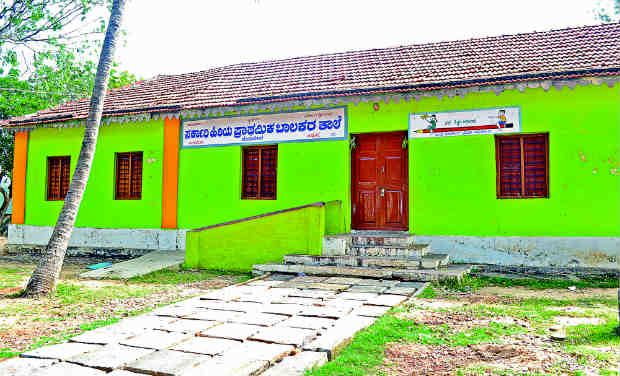
Kannada poet Purohita Thirunarayana Narasimhachar, or PuTiNa as he is more popularly known, did his schooling here as did many other prominent figures. But the 138 year old government Kannada primary school in Melkote, Mandya district lacks even basic infrastructure, and its students continue to sit on the floor as the classrooms are bereft of chairs or desks.
Located on the main street of Melkote, the school has produced prominent journalists like Khadri Shamanna, and judges such as Justice Shivappa, but in 2012 it nearly lost its identity.
Concerned by its poor student strength and lack of basic facilities, the government seriously considered merging it, despite its history, with other, more ordinary institutions. The school, which boasted of 300 students, was left with only 32 at the time.
But fortunately for the institution, education officers and teachers came to its rescue and worked collectively to give it a face-lift.
Thanks to their efforts it now has 85 students and its walls have received a fresh coat of paint after decades. The school compound has been rebuilt and the teachers have sunk a borewell in its grounds to solve its drinking water problem.
But the school clearly has a long way to go as it still has no chairs, desks, a computer learning centre, study or sports material.
Having done everything they could, the teachers say they can do no more and it is upto the government and philanthropic organisations to provide all the equipment the school needs. It is time they acted considering the illustrious alumini it has produced, they emphasise.
source: http://www.deccanchronicle.com / Deccan Chronicle / Home> News> Current Affairs / DC / by S V Krishna Chaitanya / November 12th, 2013
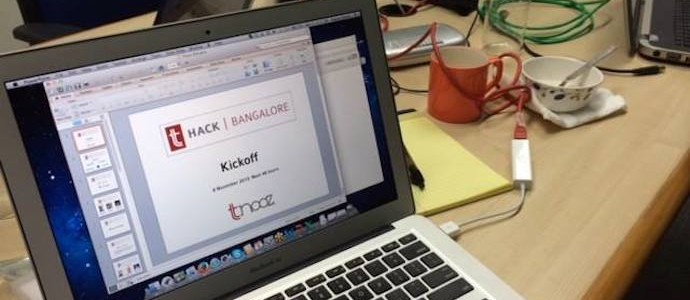
For the first time in India, a travel vertical focused hackathon (THack) took place in the country’s own Silicon Valley – Bangalore.
THack Bangalore was planned to be slightly different from the other THacks we have been doing for a few years.
In our regular hackathons (recent ones in SFO, Boston, Sydney ), we make travel APIs available to developers in advance. Participants are given eight (sometimes more) days to build hacks/products on top of the APIs and, finally, present at a showcase on the final day.
However, THack Bangalore (hosted at Cleartrip‘s Bangalore office) turned the idea around, with no travel branded APIs made available – rather, a 48-hour, open hackathon concluding on midday Sunday 12 pm on November 10.
The event attracted 60 developers forming 22 teams. One team among the 22 included students, the remaining 21 teams were developers and engineers working at various companies.
Participants came from a string of organisations including Amadeus, Nibodha Technologies, RedBus, C-soft Technologies , TripThirsty, OLA Cabs, Cleartrip , Yahoo, Armor Technologies, FindMyCarrots , and PayPal.
Tnooz CEO Gene Quinn briefing developers.
Highlights
Amadeus had two teams involved in the event – one developed a service which alerts a traveller about local events during his/her travel. The other team developed a trip recommendation engine based on user’s social media data.
The team from Armor built NFC-based use cases for the airline industry. For example: A traveller browsing and buying inflight products and food using NFC technology.
Yahoo hackers built a marketplace for finding information regarding destination related souvenirs – browse, read, customize and buy souvenirs.
Teams from RedBus built crowd-sourced location tracking engine for buses and cars. A number of travel planning hacks were also built in the event.
The judging team – Mahesh Murthy, founder of SeedFund; Ram Badrinathan, CEO of GlobalTHEN ; Mukund Mohan, head of Microsoft Ventures – focused on four areas: creativity, originality, technical proficiency, and business purpose/revenue scope.
Every team was given four minutes to present their final product to the judges and fellow participants, followed by two minutes of Q&A (these turned out on a number of occasions to live consulting sessions).
Third place
The third place was shared by two teams.
Hack 1: This team of three from Nibodha Technologies built a trend-based travel opportunity creation engine. Depending on a local trend, the engine creates automatic posts with travel content in it that can be posted to a company’s social media pages.
Example: Sachin Tendulkar’s last test match (before he retires) that is scheduled to happen in Mumbai is a local trend. The hack engine picks this trend, validates a travel opportunity, and creates a post something like this – “Travel to Mumbai to watch Sachin’s last test match, hotels in Mumbai starting at $50, book here: <a link>”.
Hack 2: This team of two from OLA Cabs built a personalized destination recommendation platform by retrieving data from Facebook friends. The team says:
“We were developing Facebook app for the first time. We spent nearly half the event time in figuring out auth-token and FQL. Best thing we did was we kept going, kept the spirits up. We didn’t know then, but others were struggling as well.”
Second place
This team of two from RedBus built a real-time group trip planning service – bringing people who wish to travel together into a closed group where they can discuss their travel ideas, share details, and create a travel plan.
All searches and destination suggestions by people (in a group) gets pinned to the group’s wall. Each pin can be upvoted or downvoted by group users. All of these activities happen realtime so that group users get an update.
The team used technologies like Node.js and Redis to enable real time communication between users. Also, Wikipedia pages were scraped and Google APIs like search, images, maps, places were used to aggregate a lot of information into pins.
The team also wrote an algorithm to find the best possible order of locations in cities to help users who do not have much knowledge about the location.
The team says:
“This was our first experience in a hackathon and it was a memorable one. From sleepless nights to Redbulls to long hours of coding and designing, it was fun and a good learning experience. We interacted with other teams and were able to understand and learn a lot. Also we got to know about a lot of interesting ideas that we never thought could help solve problems in travel.”
The winner
All three judges unanimously picked Salil Panikkaveettil. Working on his own, Panikkaveettil built a prediction service which will work out if an Indian railway’s wait-list ticket will be confirmed or not.
The Indian Railway is the fourth biggest train network in the world. Considering this fact and the technically challenged railway reservation service, there exists a good chance for a user to end up in wait-list status.
Panikkaveettil built PNR.me, a service which tells in advance whether a waiting list ticket will be confirmed or not with 75% accuracy, (a kind of Big Data hack). Panikkaveettil works as an online marketing analyst at BankBazaar.
Panikkaveettil was awarded Rs 50,000 for winning the THack, the second team was awarded Rs 30,000, and the third place teams were awarded Rs 10,000 each.
Judges pointed out that a number of the products had very good solution developed as hacks, but they lacked a real business problem which needed solving
They also pointed out that a hack always need not result in a big product/company, and only 2% of the hacks developed make it to become a big company.
source: http://www.tnooz.com/ TNOOZ / Home> Articles / by Karthick Prabu / November 13th, 2013
A film conceived, written, directed, edited and produced – all by women. In all likelihood, we have all watched women-centric films and those with a dominant female cast. And then there is the all-women crew. In a first for Sandalwood, an all-women crew is set to roll out their film ‘Ring Road Shuba’ in January next year. The Kannada film is directed by Priya Belliappa, a graduate of Film and Television Institute of India (FTII), Pune.
Belliappa’s ladies brigade includes Ranjini Ravindra Das who is the producer, script writer Rekha Rani, cinematographer Reshmi Sarkar, editor Maryann D’Souza, music director Vani Harikrishna While newcomer Khushi will play the title role of Shubha, the film also stars actors Nikita Thukral and Duniya Vijay.
‘Ring Road Shuba’ is the reel version of the infamous 2003 murder in Bangalore involving Shubha, an advocate who was convicted for killing her fiance.
However, the makers maintain that the crime story is only an inspiration point for the film. “The rest of the story is my imagination. The film is a creative adaptation of many incidents that I came across,” Priya Belliappa tells CNN-IBN.
But getting the crew together was not an easy task and it was their biggest challenge, admits the team. Most members were scattered across the country and were practically strangers before they met. However, director Priya, cinematographer Reshmi Sarkar and editor Maryann D’Souza knew each other from their days at FTII.
The rest of the team was formed soon after through friends and acquaintances. Women coming from diverse backgrounds and from different cities have probably worked in the team’s favour. Each of them has brought in their unique sensibility to the film.
And what about cynics who tried to dissuade an all-women’s team from going ahead with the project? Pat comes the response. “These are all pre-conceived notions that women can’t work in a team. Our aim was to make a film. We are like-minded individuals with same thoughts,” says Priya. And where there any cat fights, as the stereotype goes?
“We had great fun on the sets while shooting ‘Ring Road Shubha’ and became good closer friends on the sets,” says Belliappa.
The team, excited about their one-of-a-kind project’s release, is now busy completing the last leg of the film with eighty percent of the shoot already over.
source: http://www.ibnlive.in.com / IBN Live / Home> Bangalore / by Shylaja Varma, CNN-IBN / November 13th, 2013
As young Zaman was wheeled into the operation theatre, her head shaved, her mother Ninaya Khalil bent down to scoop up long locks of hair spread on the floor. Zaman had gone in for a complex surgery, and Ninaya wanted the hair for keepsake. Just in case. For Zaman had a ‘time bomb’ ticking inside her little head.
“I wanted to keep her hair, I didn’t know if she would come out alive,” says Ninaya, happy and relieved a week after her daughter’s surgery on November 1.
Zaman Adlaab, 9, from Iraq, was flown down to Bangalore, the left side of her body paralyzed. Zaman needed a surgery to remove a knot of arteries which was rupturing, leading to bleeding in her brain.
It began when Zaman was just six. She began complaining of severe bodyache that was followed by repeated convulsions. A few days later, she fell unconscious, white liquid oozing out of her mouth. Terrified, Ninaya took her daughter to a hospital in Iraq for an MRI, for a clear image of the brain.
“Doctors detected bleeding in Zaman’s brain. A surgery was performed and Zaman spent 15 days in the ICU. After the surgery, Zaman appeared healthy, apart from partial paralysis in the left side of her body,” recalls Ninaya.
The nightmare returned after two-and-a-half years. The bodyache and convulsions recurred, and she fell lifeless again. “A surgery was needed to get rid of the root cause. Although there was some risk involved, we had no other option. The doctors said a third fit could prove fatal,” says Adlaab Mehsin, Zaman’s father.
They came down for the surgery at Fortis Hospitals. “Bleeding in Zaman’s brain was due to Arteriovenous Malformation (AVM), a knot or ball-like structure formed by arteries which are “not fully developed”. Unless this knot was removed, chances of AVM rupturing the third time were high. Moreover, the AVM was sitting on the right side of the basal ganglia, a part of the brain that controls motor movement of the opposite side of the body. This made the surgery even more complex,” said Dr S Satish, consultant neurosurgeon, Fortis Hospitals.
The surgery, that went on for over nine hours, has given the girl a new life. “I feel no pain. I want to go home and start cycling with my brothers,” says a lively Zaman, waiting for the metal plates holding her scalp together, to be removed.
What is AVM?
* Arteriovenous Malformation is a condition that arises when immature blood vessels (arteries) in the brain form a ball-like structure. Often defined as a ‘time bomb’ by experts, AVM can rupture anytime without any symptoms, due to blood flow pressure and causes bleeding inside the brain.
* Brain AVMs occur in less than 1% of the population
* Cause unknown, are usually congenital but not hereditary
source: http://www.articles.timesofindia.indiatimes.com / The Times of India / Home> City> Bangalore> Time Bomb / by Garima Prasher, TNN / November 11th, 2013
Abhigya with his father Anand Ramasubramanian, mother Annu Anand and sister Abhidheya.
by Anagha Mahesh
This Children’s Day, we bring you a special feature on an 8-year-old boy, who can recite all the 700 shlokas of Bhagavad Gita with perfect pronunciation and spell out over 125 botanical names of various medicinal plants by just looking at their pictures.
Meet the wonder kid Abhigya Anand, a resident of city. Born to Anand Ramasubramanian and Annu Anand couple, residing at Emerald Enclave, behind Infosys, Mysore, Abhigya is just eight years. When he was just two-and-a-half years old, he could identify 40 flags of different countries and also about 50 car models. The virtue continued, with him learning to speak German in just a month when he was five years old and was residing at Stuttgart, Germany.
Abhigya’s father, an MBA graduate, has travelled extensively throughout the world along with family. Hence, Abhigya found it exciting to learn new languages. When he was seven years old, the family was based in Melbourne, Australia.
It is here that Abhigya drew inspiration to memorise and understand the Bhagavad Gita. He succeeded in learning 12 chapters out of 18. He chanted a few chapters at various temples in Melbourne, Mysore and Bangalore. Whatever he learnt was through You Tube videos as he didn’t have access to a teacher at Melbourne.
He was too keen on learning all the 18 chapters.
Once, Abhigya’s parents came to know that Sringeri Mutt would felicitate and honour anybody who can chant all the 18 chapters of Bhagavad Gita.
When they tried contacting them, the boy’s parents were told that all the 18 chapters should be recited at once. The parents were a little disheartened since Abhigya was confident of reciting only 12 chapters. This motivated the boy so much that he learnt the remaining six chapters and was thorough with all the 18 chapters within nine months with perfect intonation.
Abhigya will recite Bhagavad Gita at Sringeri during the end of this month.
His love for languages helped him learn how to speak and write Kannada within a month’s time. He is also fluent in Tamil and Sanskrit and has learnt and understood the meanings of over 200 Sanskrit shlokas.
The 8-year-old genius has also read over 500 Amar Chitra Kathas and can recollect most of the stories he has read. Apart from this, his other hobbies include playing cricket and football with his father and friends. He also plays mridanga.
Unlike most of the children, since there was a lot of globe-trotting involved, Abhigya has never been into a formal school. He is home-schooled by his mother Annu, a home-maker. He does attend a few classes here and there at MCS Govt. School, Belagola, for the sole purpose of socialisation with other children.
He has a four-year-old sister Abhidheya, whom he cured of dengue by suggesting a few ayurvedic medicines which he had learnt about by reading a book on Ayurveda.
Those who want to see it to believe it can watch Abhigya’s video on YouTube titled ‘7 year old Abhigya chanting Bhagavad Gita.’
Mother’s Message
Children should be encouraged to develop inclination towards spirituality as such an inclination at a tender age will help them maintain the same throughout their life. Thus, making them worthy citizens for the Nation, which claims to be a nation where spirituality occupies a vital place.
And it is also advised that children be given home food always and kept away from junk food with their future health in view.
source: http://www.starofmysore.com / Star of Mysore / Home> Feature Articles / November 14th, 2013
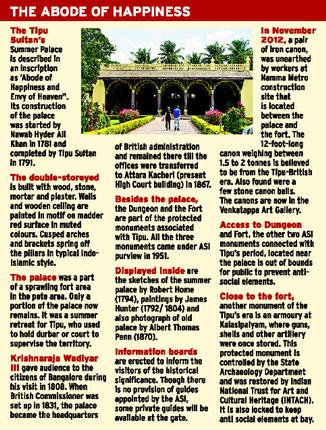
Paintings will be cleaned using chemicals, and scribbles on the walls will be covered by patch plastering work
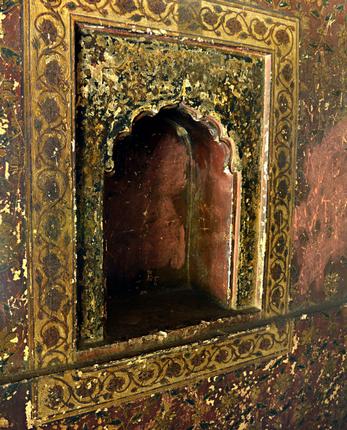
Years of dust and smoke that have masked the paintings on the walls and ceiling of Tipu Sultan’s summer palace in Bangalore may finally be cleaned up, while portions of the wall vandalised with graffiti could also receive much-needed attention.
The Archaeological Survey of India (ASI), which protects the 18th Century monument, will take up chemical cleaning of the paintings. The scribbles on the walls will be covered by patch plastering work.
Protected monument
Located in the busy Kalasipalya area, the wooden edifice built in Indo-Islamic style, is a protected monument along with the nearby fort and dungeon.
The chemical wash is expected to brighten the paintings at the palace, most of which are vivid floral designs in water and vegetable colour.
Conservation wing
The process will be done by the ASI’s Mysore-based chemical conservation wing.
“Chemical wash was conducted on a small test area about five years ago. The painting has not changed much since then,” a senior ASI official said. He explained that it was a slow process that was dependent on humidity and dust, among other factors.
Besides, structural conservation work has to be completed before chemical wash is taken up.
An eyesore
However, this will do little to address the damage to paintings from scribbles and scratches.
“If the graffiti has to be removed, restoration of paintings has to be taken up. This is nearly impossible. It is difficult to maintain the same quality of painting and sourcing raw materials is highly impossible,” the ASI source said.
Instead, patch plastering work could be taken up to remove the eyesore in some spots.
“We will attempt to fill the scribbled portions with the patch work.”
Public office
The official claimed: “The palace was a public office before it was handed over to us in the 1950s. Much of the graffiti is from that period.” It was this sort of vandalism that had led the ASI to hire private security guards at the palace.
“We do not encourage visitors to stay on the palace premises for long,” another official said.
Colour washing of pillars with a protective coating and replacing some wooded portions that have been damaged by the elements too are on the agenda.
source: http://www.thehindu.com / The Hindu / Home> News> National> Karnataka / by Sharath S. Srivatsa / Bangalore – Novembr 19th, 2013