Category Archives: Records, All

A chamber of secrets

This museum chronicles the evolution of product packaging from the 1900s. Weave through the mesmerising stories of humble soft drink bottles and wooden radios.

A soft-spoken man of average height and an engaging baritone, Vimal Kedia looks like a regular Marwari businessman. Until you meet him at the imposing Manjushree Heritage Packaging Museum, nestled off Bommasandra in Electronic City. In his element, surrounded by over 200 beloved products in various packages, from Cadbury Fryhocolates to Agfa and Kodak cameras, he turns into a repository of information.

Did you know, for instance, that in the 1950s, Coke bottles were narrow-necked glass items, with a marble in a glass casing within? “When you would tilt the glass bottle to drink, the marble moved up, blocking the gas, thereby retaining the fizz,” he rattles off. “Ceramic bottles were considered a premium and expensive material in the ’50s and ’60s. Ceramic Coca- Cola bottles had a metallic cap, but were heavy and bulky. Later, in 1993, the company began using high-grade plastics that had made an entry into the market. They were lightweight, retained the gas easily and were reusable.”

Nuggets of fascinating information like this emerge from the 1,200 sq ft Museum (launched in 2009), the country’s first and only packaging museum, devoted to the study and showcase of products and their packaging from the 1900s. Kedia, managing director of Manjushree Technopack Ltd, hopes to help FMCG analysts, marketing honchos and brand designers understand how product packaging has evolved over time. To that end, he also published a coffee table book Reflections in January this year, a comprehensive analysis of 50 brands that have evolved over time, and is planning another book in March or April. Dig deeper, though, and you realise that it is a 30-year-old labour of love.

Story of change 
It began after Kedia’s tryst with business at the age of 22, that he was forced to pursue due to financial constraints on his family. He discovered the entrepreneur in him and started his career by selling umbrellas. The Northeast, where he lived, was prone to long and hard spells of rain. The 57-year-old’s sharp instincts and ability to find something profitable in what may otherwise seem ordinary, was born out of dire circumstances.

Today, that has translated into a fascinating repository of items from across country — Nestle tin cans, Ponds talcum powder and Khodays’s rum bottles. An impressive showcase at the entrance displays an array of glass products, in which the Coca Cola bottles take pride of place. Kedia says, “I have a huge network. I search for shops that sell packaged items at throwaway prices — they are considered scrap. Who preserves a Ponds talcum powder case or a Nutrine biscuit box?” These items then find their way into the museum shelves.

Admittedly fascinated by soft drink bottles, he rues missing out on procuring a limited edition collection of Coke bottles, preserved by a man who sold the collection to the company before moving abroad. “I wish I had caught hold of him — it would have added value to my collection.” The evolution of the Coca Cola bottle, spread across six decades, highlights how need-based inventions shape a design sensibility, he believes.

Collectibles galore
A variety of other items populate the Museum — Tipu Sultan’s gun case, a hand-painted 1940s Cypress powder box made in clay, miniature glass liquor bottles and Chanel and Estee Lauder perfumes dating back to the ’60s, painstakingly catalogued and labelled by Kedia. There is a definite progression in style, design, packaging and usage of material, as evidenced by a range of vanity cases used by airhostesses of Indian Airlines in the ’60s. While the first few are heavy, made of wood and rexine, and lined with velvet, the later ones are made of lightweight rexine, and then come plastic cases with metal reinforcements.

“Plastic was considered avant-garde — it was not easy to procure and India didn’t possess the technology to make it. Wood was most common as it was cheap and there were a lot of carpenters. Metal was also hard to work with as one needed a blacksmith to bend and mould metal sheets,” explains an enthusiastic Kedia.

As you walk further in, a range of musical instruments catch your eye, mostly made of rexine, silk casing, wood and cardboard. Metal was too heavy. A real gem here is the first radio made by HMV, in wood. “Radio players would come in wood or cardboard cases, never metal as it would vibrate when music played,” we learn.

A rare Ronson cigarette, and cigar boxes made in moisture-proof metal are next. Another favourite case study is liquor bottles, which, says Kedia, have largely retained their design. Even now, premium liquor is sold in glass. “People like the feel of glass. Even now, the VAT 69 bottle looks the same as it did 40 years ago.”

But preserving history is no mean feat. He stores most aluminium and metal chocolate and biscuit boxes, hairdryers and powder cases in well-illuminated almirahs to keep them dust and moisture-free. Items made of wood, metal and glass are kept on open shelves, and cleaned every week. “I will shift the entire museum to a new factory in Bommasandra soon, where I will have air-conditioners,” he says, explaining that air conditioning helps keep dust at bay. He is also planning to rope in a curator.

Kid in a candy store
Kedia cherishes each item in this space. He puts down his knowledge of the subject to his extensive travels over the years and power of observation. His Rs 360-crore business stands strong, and he continues to be the South Asian leader in packaging, %with a dominating presence on the National Stock Exchange and Bombay Stock Exchange.

With a President’s Award for Outstanding Entrepreneur in 1998, Kedia feels instincts have guided him well thus far, and wants his museum to be a harbinger of valuable lessons for young minds. So far, the global head of Unilever R&D, head of purchase of Coca Cola, purchase and procurement team at PepsiCo among others have paid a visit to his museum and have marvelled at his collection, and he is a proud collector in business circles. “It’s been a cumulative process for me, and each item carries a beautiful story. I doubt I’ll ever stop collecting such items.”

source: http://www.bangaloremirror.com / Bangalore Mirror / Home> Columns> Sunday Read / by Sindhuja Balaji, Bangalore Mirror Bureau / November 17th, 2013
Karnataka, gift-wrapped

RajBhavanBookBF17nov2013

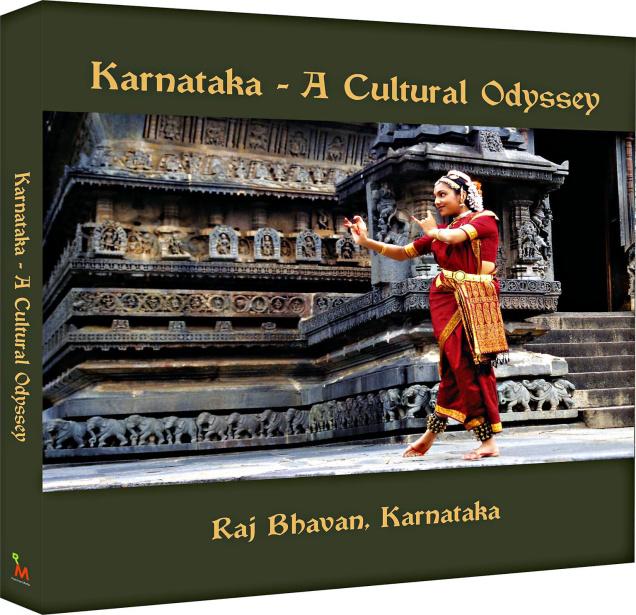
Karnataka – A Cultural Odyssey is a glossy 200-page coffee table book that gives you a quick and easy bird’s eye view of several aspects of the State

It’s a coffee table book specially meant for guests of the Raj Bhavan, the home of the Governor of Karnataka, and it fulfils its purpose of offering a visitor to the state glimpses of a bit of everything.

Karnataka – A Cultural Odyssey has 200-odd pages of glossy pictures, some really interesting profile pictures of the greats of the State, peppered with nuggets of text.

Hans Raj Bhardwaj, Governor of Karnataka, says in the foreword of the book: “This is the book that we have specially commissioned for the Raj Bhavan to bring out the cultural grandeur of the entire State. The purpose of this book is to enable visitors to Karnataka to embark on a cultural odyssey of this vast state, and to carry back memories of its rich heritage and vibrant society.” The book also takes readers on tour of the Raj Bhavan, allowing a peek into the hallowed grandeur of its interiors, its many abundant gardens and their winged occupants.

You can leisurely flip through pages of historic structures, the history of the State’s several ruling dynasties, spiritual sects and movements, centres of worship that are a treasure trove of myths and legends, festivals that bind the various communities, the thriving art scene, the disparate cuisine, traditional crafts and textiles of the state, cinema, music, English and Kannada theatre, historic monuments spread across the state.

To highlight a few chapters, the heritage and architecture section looks at rock-cut caves of the Chalukyas, British and Islamic architecture, the historic monuments of Srirangapatna, a peek into Chitradurga’s Obavvana Kindi, and talks of the splendour of Belur-Halebid and Hampi, delves into the Islamic architecture of Bidar, Gulbarga, skims over the Agastya-Tirtha lake of Badami. The Fount of Faith chapter takes you on a tour of the gurudwaras, dargahs, churches and cathedrals, the temples of the coastal belt, Jain monuments, and Buddhist monastries.

The chapter on The Arts divides itself into music, which travels into sugama sangeetha, janapada songs, Karnataka’s tradition of Hindustani music. The theatre section features the institution of company theatre in the state, the New Wave, and a brief look at English theatre. The section on Kannada cinema takes you in brief through its various periods. The section on dance looks at the history of court dancers, lists dance phenomenons from across the state and time. There are interesting looks at fold dances, the theatre-dance confluence — this section brings together a colourful collage of images. The book wraps up with a chapter called Memorable Moments that captures in pictures the high points of events at the Raj Bhavan between 2010 and 2013.

The limited-edition book contains over 200 stunning photographs from a battery of photographers including Dinesh Shukla, K.G. Somsekhar and Asha Thadani, and is designed by Mishta Roy. The 200-page book also has articles by architect Naresh Narasimhan, film scholar M.K. Raghavendra, theatre persons Prakash Belawadi and Sreenivas G. Kappanna, musician-author Vikram Sampath, danseuse Madhu Natraj, professor M.S. Asha Devi and artist Suresh Jayaram. The book is edited by Sandhya Mendonca, MD and Editor-in-Chief, Raintree Media.

On his first visit to Bangalore since taking office, President of India Pranab Mukherjee was presented the first copy of the book.

source: http://www.thehindu.com / The Hindu / Home> Features> Metro Plus / by B.K. / November 03rd, 2013

Up, up and away

India’s first hot-air balloon flight celebrates 50 years on Children’s Day.

Anil Kumar’s kin watch him board the hot-air balloon on 14 November 1963

“I was called the Yuri Gagarin of India,” says Anil Kumar, recalling his experience of having travelled on India’s first hot-air balloon ride on 14 November 1963. The hydrogen gas balloon, launched by the then Karnataka chief minister S. Nijalingappa from the Race Course grounds in Bangalore, was part of Children’s Day celebration. The plan to build a Pestalozzi Children’s Village (based on the principles of Johann Heinrich Pestalozzi, a Swiss educational reformer) was also announced. “They wanted to have a grand event to make the announcement and so a hot-air balloon was brought in from Germany,” recalls Kumar, who was 14 years old at the time. The village was never built, but the memories of that balloon ride remain.

Two trained and licensed pilots from Germany, Hermann Johannes Scheer , the then director of Pestalozzi Kinderdorf, Germany, and Alfred Schulz were flown in for the event. Since the pilots were both German nationals, it was thought appropriate that at least one Indian should fly along with them to mark Children’s Day. “I was at the press conference two days before the event, along with my father who ran a magazine for the Karnataka Electricity Board. Since I was the only child they saw, they asked me if I would like to come along. Of course, I said yes,” says Anil Kumar.

Two trained and licensed pilots from Germany, Hermann Johannes Scheer and Alfred Schulz were flown in for the event. Anil Kumar (fourth from left), then 14 years old, was the only Indian on board.

The event made front page news in all the leading Indian newspapers. From a height of 18,000ft, Kumar recalls Bangalore as being green and gorgeous. “But the sight I can’t forget was the railway lines and the network,” he says.

“India Post brought out a First Day Cover with a photograph of Kumar and the two pilots in the balloon. “They handed us two mail bags containing the First Day Covers, to be carried as Balloon-Mail,” says Kumar, adding, the balloon landed about 20 miles (around 32km) away in a village called Cholanayakanahalli, on Magadi Road. Kumar was trained by the Bangalore city police to use a wireless communication handset and to keep them informed of the route they were taking. “The direction of a hot-air balloon is guided by the wind, so we couldn’t entirely determine where we would land,” says Kumar.

To celebrate 50 years since the country’s first hot-air balloon flight, Kumar, who runs a placement agency in Bangalore, will travel to Germany and launch another balloon flight in the presence of the Alfred Schulz, the only surviving pilot.

Anil Kumar also plans to start licensed balloon club in Bangalore this year.

India’s first hot-air balloon flight was launched by the then Karnataka chief minister S. Nijalingappa from the Race Course grounds in Bangalore on 14 November 1963.

source: http://www.livemint.com / Live Mint & The Wall Street Journal/ Home> Leisure / by Pavitra Jayaraman / Tuesday – July 05th, 2013

City athlete P.G. Sathyanarayana who ran with Milkha Singh — A flashback

P. G. Sathyanarayana with his medals which he won at various athletic championships during his younger days.

by SOM Sports Correspondent

India’s pride athlete Milkha Singh nicknamed the ‘Flying Sikh,’ has been our country’s flag-bearer by winning international acclaim with his performances in the Olympics, Asian, Commonwealth and International and National meets.

The Flying Sikh held centre stage with his brilliant performances in the International scene. In 1956-57, Milkha had just then started to make an impression in the National scene when he gave some splendid performances in the National meets.

In 1956-57, the Indian National Athletics camp was organised in Bangalore for the preparation of the Asian Championships. At the camp were National champion Makkan Singh, Milkha Singh and six other athletes.

As the camp was held in Bangalore, a trial was held at the Sampangi Stadium (now called Sree Kanteerava Stadium) cinder track. Mysore lad and 16- year-old youngster P.G. Sathyanarayana, a X std. student at Hardwicke High school, Mysore, who was a budding and upcoming athlete in the State, had gone for training to Bangalore under his coach C.M. Muthaiah.

His coach C.M. Muthaiah and then Karnataka State Athletic Association, Secretary, Chikkapapaiah, seeing this boy’s excellent performance asked him also to take the trials along with 7 other athletes.

Sathyanarayana, the 16-year- old lad was surprised with the call, but listened to his coach’s orders and agreed to take part in the trials. He was to run the 400m race as a time trial. The qualifying time for the selection to the Indian team was 49.00s. Sathyanarayana’s career best timing was also 49.00s.

Sathyanarayana’s coach told him that he was pitted against Milkha Singh (who was just making his mark in the National level) and asked him to give his best, to which Sathyanarayana replied, “Even if world champion Otis Davis is running with me, I am not worried, I will go all out and give my best.” Such was his confidence level. When Milkha Singh arrived on to the lane, he asked Sathyanarayana in Hindi ‘Kounsi Lane Chahiye?’ to which the soft spoken Sathyanarayana said “any lane.”

The Race of his life

Milkha was allotted the second lane and Sathyanarayana took the first lane. The race turned out be a historic one in Sathyanarayana’s life which he and the spectators who had assembled at the stadium couldn’t forget.

The race started and both the athletes busted off the blocks and ran at a good pace, matching each other’s strides meter-to-meter. The first curve saw both of them at a very close distance and up to the last 100m both were on equal terms.

Sathyanarayana with his excellent strides matched Milkha Singh stride by stride and kept everyone at awe with his performance, matching the great Sikh and also threatening to beat him. The last 75m, both were running together, with Milkha murmuring “Sala Bhagh Raha Hai.”

The last 25m of the race was nail-biting and it saw the Flying Sikh sprint like a cheetah and he beat the youngster to emerge as the winner, with Sathyanarayana finishing not far behind. Both Milkha Singh and Sathyanarayana qualified with timings of 47:00s and 47:09s respectively.

Sathyanarayana’s coach C. M. Muthaiah, who was the time keeper came and hugged him and informed him about his qualification. After the race was over Milkha Singh kept staring at this youngster who ran a great race and matched him step-by-step.

Sathyanarayana was overjoyed with his performance and was informed by the then Karnataka State Athletic Association Secretary, Chikkapapaiah, that he has been selected for the Indian camp to be held at Patiala, and has to come and confirm his availability by next week.

Sathyanarayana, was encouraged a lot by his school Principal Sanath Kumar. He was to appear for the SSLC exams that year. His mother late. Kamalamma, wanted him to concentrate on studies and asked him to forego the camp. His father late. P Ganapathy supported P.G. Sathyanarayana and told him that it is a rare opportunity and asked him to utilise it.

Ultimately, Sathyanarayana decided to concentrate on studies and did not attend the camp. I A great opportunity lost for this Mysore lad. Who knows? He could also have worn the India colours, but it was not to be, it was destiny. It was a missed opportunity, which Sathyanarayana repents till date.

About P.G.Sathyanarayana P.G. Sathyanarayana, 75, is a resident at Chamaraja Mohalla. Born to P.Ganapathy and Kamalamma, he had three brothers. His inclination towards athletics was encouraged by his elder brother P.G.Govindaraj who was also his first coach.

He represented Hardwicke High school, Mysore in the Subbakrishna Memorial Middle School City-level Athletic meets and emerged champion in the 100m and Long Jump events. In the High School level, he took part in the Silver Jubilee Inter- School Sports meet in 1954-56 and won medals.

He used to visit Bangalore once in a week and take tips and work out schedules from his coach C.M. Muthaiah. In Mysore, he trained under the supervision of Ambareesh. He was also helped by Lakshman Rao Jagtap ( Railway athlete).

Sathyanarayana joined D. Banumiah’s College for his PU. After PU, during his degree course at Yuvaraja’s College, he got a job at P & T, Mysore on Sports Quota in 1961 and discontinued his studies. He represented Mysore State from 1957 to 1963. He married Nirmala in 1968 and has three children.

Sathyanarayana retired as a Post Master from Devaraja Mohalla Post Office in 1996.

He is happy with his achievement in athletics, but still rues the lost opportunity of representing the country.

He took up to officiating in athletics in 1975-76 and has officiated in State, National and International athletic meets. He competed in the Veteran’s Athletic meet in 1990 in the 45-plus group and won medals. He took up to administration and is presently the Hon. Secretary of the Mysore District Masters Athletic Association.

Memories do not die and many people who watched him in action will not forget the great race he ran at the Sampangi Indoor stadium. We salute this feat of his and wish that youngsters take the cue and upstage such feats in the days to come.

source: http://www.starofmysore.com / Star of Mysore / Home> Sports News / November 08th, 2013

MP H. Vishwanath presents Kannada Ratna awards

KannadaRatnaBF14nov2013

Mysore :

The government has sanctioned Rs. 5 lakh for the construction of Kannada Bhavana in city.

This was disclosed by MP H. Vishwanath while speaking after presenting Kannada Ratna awards to 35 Kannada activists at a programme organised as part of Kannada Rajyotsava by the Dasara Exhibition Cultural Sub-Committee at P. Kalinga Rao Gana Mantapa at Exhibition Grounds here recently.

Vishwanath said that the government has envisaged several schemes for the promotion of Kannada in the State. He lauded the services of the Kannada activists who vociferously spear- headed Kannada movements unlike the senior litterateurs with a lot of intellectual finesse.

The Kannada Ratna awardees were felicitated on the occasion. MLA M.K. Somashekar presided. Sub-Committee President Biligiri Ranganath, Vice-President Latha Siddaranga Shetty, District KSP President M. Chandrashekar and others were present.

List of awardees: H. Vishwanath, A.T. Ranganath, S.L. Nagaraj, G. Hanumantha Shetty, Chandrashekaraiah, M.B. Doddegowda, Thayur Vitthal Muthy, Mugur Nanjundaswamy, S.S. Shastri, C. Sampath, M.B. Vishwanath, M.P. Anandakumar, N. Vanaraju, H.K. Ananth Palahalli Ramakrishna, Dr. T. Bharadwajan, K. Raghuram, M.N. Gopalkrishna, R. Ranganath, S. Murali, C. Srinivasa Gowda, M. Jayaprakash, G. Balasubramanya, G.S. Bhoganandish, Gubbigoodu Ramesh, B.A. Shivashankar, M.P. Jnanamurthy, K. Satyappa, H. Rajneesh, Abdul Ghani, K. Madesh, Nataraj, Mohankumar Gowda, Balakrishna and Nalabeedi Ravi.

source: http://www.starofmysore.com / Star of Mysore / Home> General News / November 08th, 2013

Tipu Sultan sadbhavana yatra begins from city

TipuSultanMPos14nov2013

Mysore :

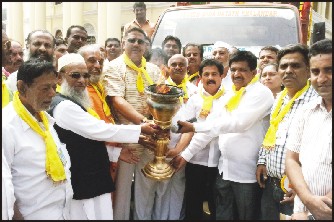
Marking the birth anniversary of Tipu Sultan (Nov. 10), a Sadbhavana Yatra from Mysore to Bangalore began here this morning.

The yatra was launched from the Town Hall premises by MP A.H. Vishwanath in the presence of Sir Khazi of Mysore Moulana Mohammed Usman Shariff, Prof. Bhashyam Swamiji of Sri Yoganarasimha Swamy temple, Tipu Sultan Sadbhavana Yatra Committee President Mohammed Ali and others. The yatra will pass through the thoroughfares of city before proceeding to the tomb of Tipu Sultan at Gumbaz in Srirangapatna, where special prayers would be offered to the tomb.

Later the yatra would proceed through Mandya, Channapatna, Ramanagar to Bangalore and reach Ravindra Kalakshetra on J.C. Road where Chief Minister Siddharamaiah would receive the Yatra Jyothi.

MLAs Tanveer Sait and M.K. Somashekar, former Corporator M.Shivanna, Showkath Ali Khan and others took part in the yatra function.

source: http://www.starofmysore.com /

First he fought the British, then battled for his pension

Bengaluru:
He sacrificed his youth fighting for India’s independence against the British rule and went to jail on several occasions, including the ‘Quit India Movement’; The autumn of his life he had to fight brought a different struggle -— a series of legal battles against government authorities to get his discontinued pension restored.
After being a part of historic freedom struggle, H.B. Kolyappa, who is currently in his mid-nineties and resides in Chitradurga, had to literally fight the ‘system’ to prove that he was a genuine freedom fighter, to avail his ‘discontinued’ pension given to freedom fighters.
Kolyappa emerged winner only after his third round of legal battle against the authorities, who had discontinued his freedom fighters pension. The high court directed the authorities to continue the pension within six weeks.
The freedom fighter had approached the court seeking directions to the authorities to continue the payment of freedom fighters pension. He had claimed before the court of having participated in the ‘Quit India Movement’ in the year 1942 and also in ‘Mysore Chalo Movement’ in 1947. After taking all this into consideration Kolyappa was awarded freedom fighters pension.
However, in the year 2009, the authorities concerned intimated the office of the Accountant General (A & E) Karnataka, to cancel and recover the pension granted to the petitioner.
The authorities had stated that the nature of the claim made by Kolyappa was not admissible. He had produced the ‘co-prisoner’s certificate’ of Bellary Siddamma, ex-MLA on the ground of non-availability of records and certificate. Kolyappa then approached the high court, but his petition was dismissed.
In the second round of legal battle, he filed an appeal and after careful consideration, the division bench allowed his appeal while directing the authorities to continue the pension. However, the state government authorities felt that it is was a proper case for re-verification.  A notice was issued to the petitioner in this regard and since the petitioner did not produce any satisfactory document to support his claim, the authorities declined to restore the pension.
However he did not lose heart and approached the court for the third time. This time the court stated, “When a positive direction had been issued by a division bench of this court to restore the pension, the observation made in the communication dated that despite the said order, the claim of the petitioner does not appear to be genuine, cannot be countenanced by this court inasmuch as the same would amount to an attempt by the state authorities as well as the respondent authorities to overreach the decision of this court.”
“Since the division bench has already issued a direction to restore the honorarium — the freedom fighters pension to the petitioner, the order shall be followed by the respondents as expeditiously as possible, but not later than six weeks from the date of receipt of a copy of this order,” the court ordered.
source: http://www.deccanchronicle.com / Deccan Chronicle / Home> News> Current Affairs / DC / by Shashiprasad S.M / November 10th, 2013

CFTRI’s chapati-maker wins ‘Engineering Marvel’ award

CFTRI Scientist Dr. B. S. Sridhar (right) receiving the Engineering Excellence Award from the guest at a function held in New Delhi recently.

Mysore :

The Continuous Automatic Chapati Machine designed by the Engineers of CSIR-Central Food Technological Research Institute, Mysore was the jury’s choice for the ‘Most Impactful Engineering Marvel’ for the Engineering Excellence Awards (EEA) 2013.

The EEA awards instituted by Engineering Watch Magazine, the prestigious engineering journal, are given in recognition of engineering marvels created by Indian engineers/ scientists/ technologists.

A total of 25 awards were given in different categories at an award function held at New Delh recently.

The machine designed by CFTRI technologists can bake around 800-1,000 chapatis per hour continuously and is in commercial production. The machine has come handy in large scale catering situations and has been used in producing food for calamity relief operations, according to a press release.

source: http://www.starofmysore.com / Star of Mysore / Home> General News / November 07th, 2013

Rajyotsava awardees from Mysore feted


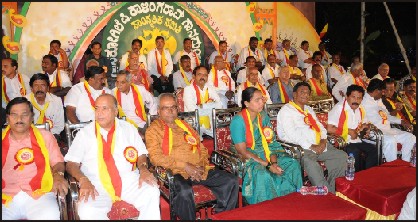
Seen are (from right) Rajyotsava awardees Dr. Vasanthkumar Thimakapura, Bannur Kempamma, Dr. N. Rathna, Dr. V. Lakshminarayan and My.Na. Gopalakrishna with City Congress President C. Dasegowda, MDCC Bank President C. Basavegowda, MP Vishwanath, MLA Tanveer Sait, ZP President Mahadevu, Mysore District Kannada Sahitya Parishat President M. Chandrashekar and others during the felicitation ceremony at the MP’s office at Govt. Guest House in city this morning.

Mysore :

Rajyotsava awardees from the city and district — Dr. V. Lakshminarayan, Dr. N. Ratna, My. Na. Gopalakrishna, Dr. Vasanthkumar Thimakapura and Bannur Kempamma — were felicitated at a function organised at Mysore-Kodagu MP’s office at Government Guest House in Nazarbad here this morning.

MP H. Vishwanath, speaking on the occasion, said it is a matter of delight that the Government has identified and awarded the achievers who have excelled in their own fields.

Pointing out that the State Government had chosen the Rajyotsava awardees purely on merit, without giving way for the interference of political or external forces, Vishwanath said the government’s action had only enhanced the value of Rajyotsava award.

NR constituency MLA Tanveer Sait, who presided, said the Government’s action of selecting the awardees based on merit, was a sign of better prospects for the State.

Tanveer Sait called for more developmental works in the city so as to make it a model one for the entire country.

He also stressed the need for making Mysore a bigger educational hub, with the city already known for providing quality education besides making rapid strides in the educational field .

Mysore District Kannada Sahitya Parishat President M. Chandrasekhar was the chief guest.

source: http://www.starofmysore.com / Star of Mysore / Home> General News / November 07th, 2013

Cruising down memory lane

For these youngsters, owning a vintage bike is a matter of great pride as they travel the length and breadth of the country to scour these beauties

Yezdi lovers’ says a patch of graffiti on a lamppost outside Vikram Kumar’s house at Dairy Circle. “It’s been there almost 10 years,” he says, laughing. Clearly, like his 10-month-old daughter Lakshita, who sleeps soundly through everything except the hum of her father’s Yezdi, Kumar’s neighbourhood is well aware of his love of vintage bikes.

Parked at the entrance of the 33-year-old software engineer’s house are two shiny Jawas — one green and the other red. Next to them stands a Yezdi Roadking. “The red and green Jawas have shin covers, which protect you from snow. These bikes are originally from Czechoslovakia and are designed to protect riders from extreme weather conditions,” he says, with pride.

Dressed in a casual pair of jeans, a T-shirt with a bike print and a Jawa cap, Kumar’s passion took root when he saw his father ride a Jawa at the age of 10. “I fell in love with the sound of the engine,” he recalls. He began collecting bikes in 1999 and today boasts Lambrettas, a Vespa, Enfield Mofa and a couple of mopeds in his 35-strong collection. He even has a 1957 Fiat 1100 —”as old as my father”. They are stored in his garage in Kalasipalayam.

Kumar isn’t the only one. Owning a vintage bike (least over 30 years old) is a matter of pride for young Bangaloreans who are splurging on restoring and maintaining them.

Twenty-four-year-old gym owner Bhuvan Narayan first bought a Yezdi Classic for Rs 4,500 three years ago and decided to restore it. “Ever since, I began collecting bikes. Today, I own a 1979 Classic Yezdi, a 1976 Standard Bullet which is a 350 cc twin engine, a 1964 Bullet, a 1962 Jawa, and 1990 Yezdi Deluxe. I just purchased four Yezdi Roadkings in bulk,” he says. Narayan even owns rare bikes like the France-made Suvega- a moped that he picked up in Tirupati; a Czech imported 1952 Jawa Parack and a Lambretta scooter.

Tracing the classics Sourcing the bikes is a task. Mudasir Ahmed, (33) who works for a construction company, owns three vintage bikes and says, “Networking is the best way. Social media has made it easier to find bike owners, who may want to sell since they fetch a good price.”

A host of Facebook pages such as Royal Knights Motorcycle Club, Bangalore Jawa Yezdi Motorcycle Club and Bangalore Vintage Group provide useful information about where to find these vehicles, cost, availability of spare parts and more. “I have made friends through these clubs, and we network online to service our bikes and find spare parts too, which is otherwise very tough,” says Kumar.

Some good leads are also found when they set off on weekly rides to nearby districts such as Kolar, Mysore, Ramanagaram, Shimoga and Ooty. They track down old mechanics who supply them with information about bikes and the whereabouts. Twenty-eight-year-old Alwin Lawrence found his 1955 AJ Stevens just like that. “My uncle is a vintage motorcycle mechanic in Coimbatore and when I enquired about a British bike, he tracked one down in Kanyakumari for me. I went to Kanyakumari to pick up the bike and brought it back in a bus to Bangalore,” he says.
Maintenance Looking after these beauties is a tall order too. “I used to own around 12 bikes but sold most of them because finding a good mechanic and getting spare parts is a challenge. Since most of them are not of Indian origin, it’s not easy to understand the mechanism,” admits Ahmed.

Trial and error Kumar and his father say they are fairly aware of how these bikes function, as they have spent years tinkering away on these classic beauties; their learning has been largely trial-and-error. “My father can put together a bike with ease, and I’m slowly getting there. I have all the spares in my factory for most of my bikes,” he says. Narayan and Lawrence are learning too. “I get manuals online or from showrooms. Unless they need serious repair, it’s not impossible to fix the bikes. Jawas and Yezdis usually don’t need much maintenance, but the older ones need to be taken care of,” explains Kumar.

Money matters At Rs 50,000 for a Jawa and almost 2 lakh for older bikes like Paracks, it’s an expensive hobby. Lawrence has spent close to Rs 5 lakhs on his bikes, some of which were given to him by parents and the rest were paid for from his savings. Vikram approximated his collection to be priced at about Rs 20 lakh.

Passion play While these biker boys are the object of envy for many collectors, their hobby is perceived differently by their family. Nitu, Kumar’s wife says, “The entrance to our house looks incomplete without these bikes. My son has to take a ride on his father’s bike every weekend or he won’t eat, and my daughter gets excited when she hears the sound of a Yezdi. These bikes are a part of my life now.” Alwin Lawrence’s mother Julie says, “At first, the sight of the bikes would annoy me and I always find my son cleaning the bikes in his spare time. But I also think its these bikes that have given my husband and son a chance to bond. It’s great to see that, and I cannot put a price on it.”

The envious glances, curious questions and approving stares from the onlookers make all the trouble worthwhile. Kumar cannots even dream of selling any of his prized possessions, and says, “The joy of taking a bike out and riding it around town is unparallelled. My grandfather rode a 1941 Triumph which is one of the most special bikes we own. It’s a way of honouring the style and poise of the men of that age,” concludes Kumar.

source: http://www.bangaloremirror.com / Bangalore Mirror / Home> Columns> Sunday Read / by Sindhuja Balaji, Bangalore Mirror Bureau / November 10th, 2013