Category Archives: Records, All

US varsity honours Narayana Murthy

Tampa (Florida) May 16

The University of South Florida has honoured Infosys founder N.R. Narayana Murthy with the Global leadership and Free Enterprise Awards for his leadership and contributions to the international business world.

Presenting Infosys chairman emeritus Murthy with the awards at the Patel Centre for Global Sustainability here Monday, USF President Judy Genshaft praised him for his entrepreneurial spirit, according to a university press release.

Earlier, in an informal conversation with past and present students, Murthy said because of his middle class background, it was not as difficult for his company to maintain its values as it might be for the mass of people eking out a living.

‘You need a spirit of sacrifice and you need to have trust,’ he said.

Murthy explained how the company’s ethos has its roots in the very first meeting held at his house in Mumbai with his six fellow founders. Their discussion was focused on profitability.

Murthy focused their attention on ‘seeking respect’, ‘living in harmony with society’ and making sure ‘you don’t shortchange your customers,’ he said. When you do those things, ‘revenue will come. Profit will come’.

In response to a question from about the chances of Murthy entering politics, he mentioned his preference for ‘rational discussion’ and the difficulty the political world offers for such and expressed some hesitation.

Kaushal Chari, chair of the USF information systems and decision sciences department, said Murthy’s story is inspiring for students.

‘He’s a world-class business leader,’ said Chari, who leads a study abroad trip to India every year for business students.

IANS

source: http://www.india.nydailynews.com / Home> News> Desi News / Wednesday, May 16th, 2012

Bitten by the B’lore bug

LEGENDARY CONNECTION

It was in Bangalore that Ronald Ross first became interested in mosquitoes. Ross would go on to make the crucial discovery of plasmodium, the malarial parasite, in a mosquito, and win the Nobel too. Bangaloreans can truthfully say that the seeds of that great discovery were sown in our City, writes Meera Iyer

In September 1883, a British doctor named Ronald Ross was appointed the Acting Garrison Surgeon in the Bangalore Civil and Military Station. The doctor initially stayed in a bungalow close to today’s MG Road. He records in his memoirs that this was when he first became interested in mosquitoes. “They devoured me,” he writes, “until I discovered that they were breeding in a tub just outside my window.” Ross got rid of the wee beasties by the simple expedient of tipping the tub. So began a series of experiments and observations on mosquitoes that eventually led to a Nobel Prize for Physiology and Medicine in 1902.

Ronald Ross was born in Almora, Uttarakhand, on May 13, 1857, three days after the Indian Mutiny or the First War of Independence began. He grew up in Almora, Nainital and Benares and was sent to England for his education when he was eight.

The future scientist and Nobel Prize winner displayed no interest whatsoever in science but took wholeheartedly to painting, literature and the arts. He wrote poetry while still at school and at 17, decided he wanted to be a writer. But his father wanted him to join the Indian Medical Service, and so Ross resignedly joined St Bartholomew’s Hospital Medical School in London to study medicine. Ross wrote more poetry and even some short plays while at St Bartholomew’s but remained quite indifferent to medicine. He failed a qualifying exam for the Indian Medical Service, cleared it a year later on his second attempt, and then joined the Service. Ross came to India in 1882, stayed in Madras briefly and then had the first of many stints in Bangalore when he was given medical charge of a unit of the Madras Infantry for a few weeks.

Like many others before and after him, Ross loved Bangalore. He describes how he used to go for long walks every day among “rocky crests of mountains, fir woods, dells with beautiful little trickles of streamlets”. The sun and the breeze, he says, “were those not of earth but of heaven.” In a complaint that sounds all too familiar to us today, Ross says that when he looked for these same places ten years later, he found they had all been swallowed by development.

Over the next few years, Ross returned to Bangalore several times and also served in Quetta, Burma and the Andamans. He churned out more plays, novels and dramas, became very interested in mathematics, played a lot of tennis, whist and golf, but remained a completely ordinary doctor. It was only when he was on leave in England in 1888 that something ignited a spark in him: “I determined now to interest myself much more in my profession,” he writes, and he returned to India with renewed vigour.

Back to Bangalore

Ross was posted in Bangalore once again in 1890, as Staff Surgeon of the Civil and Military Station. Now married, he and his family lived in High Grounds, “in a delightful house facing the golf ground, called Uplands”. (Incidentally, this very house was where Sir M Visvesvaraya stayed for a time after his retirement in 1908). According to his Nobel lecture, it was during this 1890-1893 period in Bangalore that Ross made his first studies of malaria.

He also wrote his first research papers on the disease, including some that rejected the ‘bad air’ theory but speculated (wrongly, of course) that malaria might have an intestinal cause.

In the 1890s, scientists had begun to realise that parasites in blood caused malaria, but no one had any idea how these parasites moved from sick people to healthy people. In 1894, while on leave in England, Ross sought out Patrick Manson, a tropical disease expert who had recently discovered that mosquitoes spread the disease filariasis.

Manson told Ross he believed mosquitoes also spread malaria. This was the beginning of a long association between the two scientists.

Ross returned to India, and plunged into research, determined to prove Manson’s ‘Grand Induction’ as he called it.

Within a few months, Ross became an expert on dissecting mosquitoes, identifying parasites and diagnosing malaria. In his memoirs, Ross states that from April 1895 to February 1899, he wrote 110 letters to Manson about his research, “containing almost exactly 1,000 words each, or about one word to every ten people killed by malaria in India alone every year.”

At West End

But another disease also killed hundreds in India in those days. In 1895, Ross was called to Bangalore on special sanitary duty to contain the frequent cholera outbreaks here, especially in Shivajinagar, Ulsoor and parts of the pete.

Ross took up residence in a tent on the grounds of the (now Taj) West End Hotel. Over the next two years, he organised an overhaul of refuse-cleaning systems, suggested improvements in drainage, mapped the locations of wells and had them disinfected, and posted hospital assistants at stations to detect cases. He also frequently accompanied scavengers in their early morning work. “These experiences are not easily forgotten,” he writes.

Of the scavengers, “the poor men themselves, the last pariahs and outcasts of society, toiling while others slept,” says Ross, “None shall know of your labour, no one shall thank you, you shall die forgotten,” and yet, “the civilisation of the thronged cities was based upon their labour.” Though occupied by his sanitary work, Ross still eked out time for malaria. Until then, both he and Manson had thought that when malarial mosquitoes died, they somehow infected the water they bred in, which when ingested, caused malaria in humans. It was in Bangalore that Ross came up with another hypothesis that later proved correct: In May 1896, he wrote to Manson, “…the belief is growing on me that the disease is communicated by the bite of the mosquito. She always injects a small quantity of fluid with her bite — what if the parasites get into the system in this manner.”

Ross set out to test this hypothesis by the decidedly questionable method of getting mosquitoes to bite volunteers, mostly ‘natives’ of course, including the Assistant Surgeon of the Bowring Civil Hospital.

But as Ross had yet to discover that only the Anopheles mosquito carried the malarial parasite, his results remained negative. It wasn’t until 20 August 1897 (now commemorated as World Mosquito Day), when Ross was posted in Secunderabad, that he made the crucial discovery of a Plasmodium, the malarial parasite, in a mosquito. He came back to Bangalore on short leave a month later, staying at the West End once again (in a room this time, and not a tent!), and wrote up his exciting discovery. The paper, “On some Peculiar Pigmented Cells found in two Mosquitoes fed on Malarial Blood,” appeared in the British Medical Journal in December 1897.

In Secunderabad, the building where Ronald Ross made his landmark discovery is now called the Sir Ronald Ross Institute, and bears a plaque in appreciation of Ross’s work. But Bangaloreans can truthfully say that the seeds of that great discovery were sown in our City.

ROSS, THE POET

* Ronald Ross was known to be a poet, novelist and painter.
* His collection of poems include: ‘psychologies’, ‘Poems’, and ‘Fables and Satires’. He composed this verse about his first impressions of malaria that killed millions:

In this, O Nature, yield I pray to me.I pace and pace, and think and think, and takeThe fever’d hands, and note down all I see,That some dim distant light may haply break.The painful faces ask, can we not cure?We answer, No, not yet; we seek the laws.O God, reveal thro’ all this thing obscureThe unseen, small, but million-murdering cause.

(Courtesy: malariasite.com)

source: http://www.DeccanHerald.com / Home> Supplements> Spectrum / by Meera Iyer / May 07th, 2012
Innovation award for Skanray

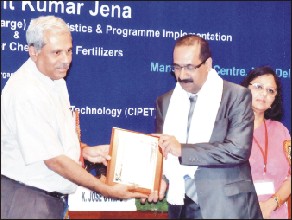
Caption: Balasubramaniam, Director & CTO, Skanray Technologies, receiving the award from K. Jose Cyriac, Secretary, Dept. of Chemicals & Petrochemicals, at New Delhi recently.

Mysore, May 3

Skanray Technologies Pvt. Ltd. won an award for innovation in polymeric products at the 2nd National Awards ceremony for technology innovation in various fields of petrochemical and downstream plastics processing industry held in New Delhi recently. The award is instituted by Ministry of Chemicals & Fertilisers, Govt. of India.

Skanray Technologies won the award for developing ‘Use of Engineering Plastics for Diagnostic X-ray equipment.’

Balasubramanian, Director & CTO, Skanray Technologies, received the award from K. Jose Cyriac, Secretary, Dept. of Chemicals & Petrochemicals.

Skanray was founded in 2007 by a team of reputed engineering and business professionals with decades of experience in industrial and medical devices sectors and having global exposure. Skanray moved into its state-of-the-art manufacturing facility in Hebbal, Mysore and commenced commercial business in 2011.

source: http://www.StarofMysore.com / General News / May 03rd, 2012

‘Khadri Shamanna Award’ for D. Mahadevappa

Mysore, Apr.15

Senior Journalist D.Mahadevappa, who is actively invol-ved in journalism for over three decades, has been selected for this year’s prestigious Khadri Shamanna Award for journalism.

The award is given by Khadri Shamanna Memorial Trust in the memory of late Khadri Shamanna, well-known for his activities in Kannada journalism.

Mahadevappa is presently working as the Editor-in-Chief of Kannadigara Prajanudi in city and his name was unanimously recommended by a selection committee comprising of S.V. Jayasheela Rao, M.K.Bhaskar Rao and H.R.Srisha at a meeting held at Bangalore recently.

The award will be conferred on Mahadevappa at Bangalore on June 6 during the birth anniversary celebrations of Khadri Shamanna, said Trust Secretary Khadri S. Achyuthan.

source: http://www.StarofMysore.com / General News / April 15th, 2012


Two Bangalore kids score perfect at International Maths Olympiad

Bangalore:

It’s double delight for Bangalore as two eight-year-olds from a city school grabbed first rank at the International Olympiad of Mathematics with a perfect score.

Adit Chatterjee and Rutajit Bharadwaj, students of Class III in Vidyashilp Academy, won the competition outperforming thousands of their counterparts from over 3,000 schools in 14 countries. The Olympiad has two rounds, testing students’ competence and proficiency in Mathematics. Their mental ability and reasoning skills are also on test. The competition is conducted for each grade separately. Questions are objective with multiple choices.

“Maths is fun to do… it’s kind of creative. You don’t have time to get distracted. I love decimals and fractions. You’ve to rack your brains for that,” said Adit. But ask him the humdrum question on what he wants to become when he grows up — “I want to become an Olympic swimmer!” is his apt and unexpected answer.

Adit loves swimming, said his father, Amit Chatterjee. “Getting him to practise Maths was very challenging. We used to do Maths drills while driving to the pool,” he said.

So what does the other wizard, Rutajit, want to do when he grows up? “I want to become an astronaut. I want to go to the space. The planets will look beautiful, the Sun will be bright, stars will shine and I want to land on the Moon!” Well, there’s no stopping Rutajit when you ask him about his future plans.

“I like Maths because it makes you smart. You can use the skills in your daily life,” the boy said.

“He was very excited about the competition as he loves Maths. He worked out sample papers and that further developed his interest. We have been telling him that if he’s good in Maths, it’ll be easier to analyze and apply logic even in daily life,” said Sham Prasad KN, his father, a software engineer.

Kalpana Mohan, principal, Vidyashilp Academy said: “Both the kids are intelligent, not because they came first in a competition but because we find them extremely active in extra-curricular activities that the school offers.”

source: http://www.timesofindia.indiatimes.com / Home> City> Bangalore / TNN / April 05th, 2012


XLRI award for Narayana Murthy

Kolkata, MARCH 30:

XLRI School of Business and Human Resources, Jamsedhpur, will confer the Sir Jehangir Ghandy Medal to Infosys Technologies chairman emeritus and chief mentor, Mr N.R. Narayana Murthy, during its annual convocation.

The Sir Jehangir Ghandy Medal for Social and Industrial Peace is awarded to heroic leaders who have contributed towards the growth of their respective organisations.

Mr Jaspal Singh Bindra, group executive director and chief executive officer, Asia, Standard Chartered, will be present as chief guest at the convocation.

source: http://www.TheHinduBusinessLine.com / Industry & Economy / by Hindu Bureau / March 30th, 2012

Kalam moots integrated healthcare

Bangalore:

India’s Missile Man, former president APJ Abdul Kalam has some advice for the healthcare sector. He wants the entire sector to integrate itself so as to evolve a specialized healthcare system. “Medical colleges normally deal with diagnosis and treatment of diseases only when the patient is ill. I feel the university has to specialize in integrated healthcare system. Every doctor, every dentist, nurse, pharmacist, traditional practitioner , paramedical staff has to be equipped with knowledge of the integrated medicare system. RGUHS should consider this and transform the syllabus accordingly,” Kalam said in his speech at the 14th convocation of Rajiv Gandhi University of Health Sciences here.

Regarding medical education, Kalam said in a competitive environment, the focus should be research and teaching. “Institutions should promote research and teaching. Good teaching emanates from research. The teacher’s love for research and experience in research are vital for the growth of an institution. A university is judged by the level of research work it accomplishes. This sets in a regenerative cycle of excellence,” Kalam added.

Dr C N Manjunath, director of Sri Jayadeva Institute of Cardiovascular Sciences and Research Centre, Bangalore, and retired DIG H F Naicker, a yoga expert , were awarded ‘Doctor of Science’ honorary degrees. The function was attended by governor H R Bhardwaj, who is also Chancellor of Universities, and 82 medals were given to students who excelled in medicine, dental science, pharmacy , nursing and Ayush.

Toppertalk

They were all smiles. Their hard work has finally paid dividends, and they had the honour of receiving medals from former President APJ Abdul Kalam. Toppers Dr Vishwanath K Pai and Dr M Joshi Arun Bharat had some commonalities: both studied in Mangalore and both secured eight gold medals each. While Pai studied medicine at AJ Institute of Medical Sciences, Gujaratbased Bharat studied dental science at AB Shetty Memorial Institute of Dental Sciences.

“I want to do MD in medicine,” said Pai, acknowledging the support of his family members and faculty. Bharat wants to do an MDS in periodontics.

Dr Pooja Prakash Prabhu has the distinction of getting four gold medals, the highest in female category. A student of JSS Medical College, Pooja hails from Mangalore. While crediting her success to her parents, both doctors, Pooja wants to study MD (Paediatrics).

source: http://www.articles.timesofindia.indiatimes.com / Home> City> Bangalore / TNN / April 01st, 2012

City Artist’s logo selected for ‘Sakala’

Wins Rs. 50,000 prize


<strong>Mysore</strong>, Mar. 31:

City artist Balaswamy’s logo has been selected for Sakala, the State government’s ambitious initiative aimed at providing timely services to citizens under the Karnataka Guarantee of Services to Citizens Act 2011.
The government had invited entries of logos for the initiative. Over a thousand participants had taken part in the contest, in which Balaswamy’s concept won the government’s approval.
Chief Minister D.V. Sadananda Gowda presented Balaswamy with a cash prize of Rs. 50,000 for creating the logo during the inauguration of Sakala recently.
Speaking to Star of Mysore, Balaswamy said that he had sent three designs of logos and his design based on ‘Time and Law’ (see above) was selected.
Family members of Balaswamy, who came to know about his interest in arts when he was studying PU at St. Philomena’s College in city, brought him an application from Chamarajendra Academy of Visual Arts (CAVA) and enrolled him there after PU.
After completing two years foundation course at CAVA, he took up Bachelor in Fine Arts (BFA) with specialisation in Applied Arts and completed his graduation in 1997 besides working in many advertisement agencies as designer in Bangalore.
He again came back to Mysore and completed his Master in Fine Arts (MFA) in the year 2004 with Sculpture as his specialisation.
He said that he is one among the five artists who created logo for University Grants Commission (UGC) and regretted that he could not go to collect the certificate which was presented by former President Dr. A.P.J.Abdul Kalam in the year 2003 owing to financial constraints despite having been invited. Balaswamy said that the news of his logo being selected was given by Mamatha, Joint Director, Department of Information over phone and added that he was delighted with the news. At present, Balaswamy is working as a freelancer in city.
He may be contacted on Mob:99003-00038.
source: http://www.StarofMysore.com / General News / March 31st, 2012

‘Bhramara Awards’ presented to eminent Scientists

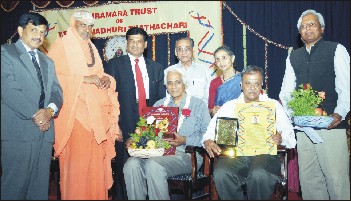
Caption: Scientists Dr. Tej Pal Singh and Dr. Debashis Mitra being presented with the Bhramara Awards at a function held at Sri Shivarathri Rajendra Bhavan in JSS Medical College last evening. Others seen are (from left) JSS Medical College Principal Dr. H. Basavana Gowdappa, Suttur Seer Sri Shivarathri Deshikendra Swamiji, KSOU VC Prof. K.S. Rangappa, Bhramara Trustee Prof. R. Srinivasan, Managing Trustee Madhuri Thathachari and Director of National Centre for Biological Sciences, Bangalore, Prof. K. Vijayaraghavan.

Mysore, Mar. 29

Dr. Tej Pal Singh, Distinguished bio-technology research professor of AIIMS, New Delhi, was conferred with the prestigious Bhramara’s Lifetime Achievement Award instituted by the city-based Bhramara Trust of Y.T. & Madhuri Thathachari at a function held at Dr. Shivarathri Rajendra Auditorium in JSS Medical College on Mysore-Bangalore road here last evening.
Dr. Debashis Mitra, Scientist in National Centre for Cell Science, Pune, was presented with the Prof. Y.T. Thathachari Prestigi-ous Research Award for Science while JSS Medical College Principal Dr. H. Basavana Gowdappa was presented with the endowment prize for the Best Research Paper. This endowment prize is for the faculty or PG student of JSS Medical College who present the best research paper.
Karnataka State Open University (KSOU) Vice-Chancellor Prof. K.S. Rangappa spoke as the chief guest.
Prof. K. Vijayaraghavan, Director of National Centre for Biological Sciences, Bangalore, delivering the presidential address, praised the initiative of Bhramara Trust for creating a link between the society and the achievers in the field of science and fine arts.
“Researchers and artists get to do what they love to do and get paid for it too. But, despite being paid by the people, they seldom get the due recognition. This drawback has been made good by organisations like the Bharama Trust,” he said.
He also praised the JSS institutions for grooming the younger generation into useful citizens of India. “India has the largest population of Under-15 who need proper education and jobs. If groomed properly, they would be a boon for the world; if not, they might be a disaster for the world,” he opined.
Suttur Seer Sri Shivarathri Deshikendra Swamiji, who inaugurated the programme earlier, said in his benediction address that the scientists were noble souls who dedicated their entire lives to the service of mankind. Mentioning about the general notion that researchers cannot be good administrators, the Seer lauded the administrative skills of Prof. Rangappa as the KSOU Vice-Chancellor, despite being a chemistry research scholar.
The Seer also appreciated the presence of some well-known personalities of the city among the audience by naming some like industrialist K.V. Murthy, Bharathiya Vidya Bhavan, Mysore Kendra Chairman Prof. A.V. Narasimha Murthy, danseuse Dr. Vasundhara Doreswamy, art critic S.R. Krishnamurthy, litterateurs, auditors, etc.
Yesterday being the 30th wedding anniversary of Dr. Tej Pal Singh, he and his wife Dr. Meera Singh, Deputy Director General, Indian Council for Medical Research, were felicitated by the Seer.
Managing Trustee Madhuri Thathachari welcomed. Trustee Prof. R. Srinivasan explained about the selection process. Annapurna Srikanth rendered the invocation. Jyothi proposed a vote of thanks.

source: http://www.StarofMysore.com / General News / March 29th, 2012

Tale of two cities

MULTIPLE CITY

Inscribed on the grains of sand, somewhere in the hour-glass of time, is the story of Bangalore, a story that has intrigued many. There are stories within stories of the multiple city that Bangalore is.

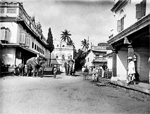
SIGHTS OF BANGALORE in the 1900’s. Clockwise from top left: A typical street with turbaned men and women ( Photo courtesy: Jane Smith, England , Missionary Fred Goodwill’s, grand daughter and Jones Ebinesan,  Western Australia).

A common thread that runs through the City’s centuries-old history is that of the constant pete-Cantonment parallel, and the story of the City’s municipal governance occupies a special place in the existence of two separate geographical entities within the map of Bangalore.

Even 150 years after the first municipal board came into existence on March 27, 1862, one can still tell the difference between the old City area and the Cantonment. Today, the cosmopolitan nature of the City, punctuated by people of many communities, occupations and ethnic origins might have masked the difference between the two areas, but not obliterated it. The dichotomy seems to be a constant through Bangalore’s history.

Although the first municipal board was already established in 1862 for old Bangalore, drawing a line of distinction, another board was formed on August 1 of the same year, to govern the Cantonment area.

State within a state

The Cantonment was a state within the state. Its demography was largely decided by the British. Historians point out that the British had, in order to cater to their various needs, brought ‘rich’ communities like the Mudaliars and Naidoos and some Muslims. They had also brought the ‘Harijan’ community to perform menial jobs.

With higher expendable income, larger budgets, special provisions, the Cantonment was elite. But the old City area could not be left out, not even if it were not the bosom of the City in the eyes of historians. Their charms were different. The Cantonment was English; the City area, notwithstanding some resembling architecture, was local.

But they were both vibrant by virtue of enjoying separate business districts, a provision the City planners post-Independence have given little importance to.

According to H S Doreswamy, the oldest (living) freedom fighter of Bangalore, the City’s business district housed all kinds of businesses, from oil producers to potters and silk weavers to bangle makers.

The Cantonment was different. It had bazaars that sold finished products, grocery and was home to a spectrum of entertainment avenues.

In 1871, a new municipal regulation saw the appointment of J H Orr as the fulltime president for the control and direction of the affairs of both the municipal. This was the first attempt at unified governance.

But the differences were not to be wiped out. The total revenue generation of the Bangalore City Municipality was Rs 43,010 while the revenue of the Bangalore Civil and Military Station Municipality (Cantonment) was Rs 92,617.

After the conclusion of the Commissioner’s administration and the beginning of the Mysore rulers’ administration, the Cantonment area was called British Cantonment.
By 1881, the differences in the administration became very apparent and caused discomfort among the locals in the City area. The administration continued, brushing aside these differences that did not last, for Bangaloreans then, like now, 150 years later, didn’t get ruffled too much by these differences.

Home to the British automatically meant more access to many provisions that the City area did not have. The ever-benevolent (British) government’s hand meant funds for development projects.

One such key priority that came the Cantonment’s way was drinking water supply. As early as 1881, Sampangi and three Millers tanks were the chief sources of water for the Civil and Military Stations. The Millers tank, constructed in 1854, was the first step taken to meet the demand for water. For the City, before the commencement of the scheme of protected (filtered) water supply to the City initiated in 1896 by Dewan K Sheshadri Iyer, unfiltered raw water was supplied from a number of tanks like the Dharmambudhi tank, Sampangi, Ulsoor and the Sankey tank.

The British officers deputed in Bangalore during the 1890s were looking for a new source of water supply. Major Grant worked at four sources––Maligal valley, Hebbal, Rachenahalli and Hessaraghatta––and M C Hutchins, the chief engineer of Mysore preferred Hessaraghatta.

More equal than others?

While people residing in the limits of the Bangalore City Municipality were levied three per cent-four per cent water tax, buildings and land used for military purpose were exempted from tax.

In 1892, for the first time, elections were conducted for these boards.
Voting rights were restricted only to male property owners and even among them, only those who have paid property tax, according to provisions of the Central rule of 1883. Both civil and military areas saw 18 members in all.

The differences between the two though, had to continue. Unlike in the City area, only in the Cantonment, women were allowed to vote. It was not until 1923, when the City board submitted a memorandum that women in the City area were allowed to cast their vote.

The differences continued even after Independence, as historians have described.
On December 8, 1949, post-Independence, both the boards were legally merged as one. But the most immediate challenge for the new administrators was to find the much needed co-operation for common administration. For the lines had to be “undrawn.”
The path taken after that needs little recalling. Bangalore has grown, it has a fresh identity. But the two separate identities that the Cantonment and City areas have given to Bangalore will continue to add to the charm of this City in its own way.

source: http://www.DeccanHerald.com / Home> Supplements> Spectrum / by Chethan Kumar / Tuesday, March 27th, 2012