Category Archives: Records, All

VONTIKOPPAL PANCHANGA: Five Generations of expertise in Almanac

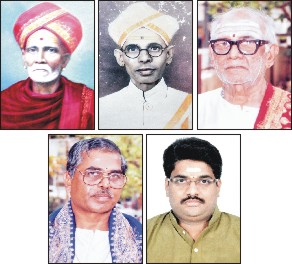
Caption: Siddanthi Tammaiah Shastry, Siddanthi T.V. Krishna Shastry, Siddanthi V. Ramakrishna Shastry, Siddanthi R. Kumar, Siddanthi K. Mohan

By M.S. Apuurva

Most of us will have memories of our childhood with our grandfathers reading from a book full of tables and text in small font, which we could never understand. The ease with which they would decipher the information in the book remained a mystery to us. The book — Panchanga — has been a part of Hindu household since ages and no ritual is held without referring to it.

During Ugadi (tomorrow), which marks the start of a new Hindu year, it is a tradition to read Panchanga (Panchanga Shravanam). The Panchanga reveals the forces that will rule various aspects of life in the coming year. This forecast deals with the transition and effect of constellations on the social life of people. It is a belief that those who read the Panchanga as well as those who listen will be rid of their sins and blessed with a long, prosperous and happy life.

Panchanga’s importance

Dharma plays a very vital role in Indian culture. Sages have allotted a specific time for every work (rituals) and this is defined in Dharma Shastra. Unlike in western traditions wherein for example, Dec. 25 every year is celebrated as Christmas, in Hindu customs, every festival has a fixed start time. Every ritual, be it naming or house-warming ceremony, must compulsorily be carried out within the designated span of time. This calculation of time is done using Panchanga. In simple words, the five attributes of Panchanga (Pancha-Anga) are: Vara – Time from one sunrise to the next sunrise; Tithi – It is the distance between the sun and moon; Nakshatra – It is the movement of the moon; Yoga – It involves the movement of both sun and moon; Karna – It is half of Tithi. The Pancha-nga has two systems — Chandramana and Souramana. The former is calculated based on the moon and the 12 months span from Chaitra to Phalguni, the latter is based on sun with the 12 months where sun travels from Mesha rashi to Kumbha.

Consisting of complex calculations mainly based on spherical trigonometry, Panchanga is propounded with the theories in Surya Siddantha. It is said that demon Maya meditated and Surya appeared before him to grant him a wish. Maya asked Surya to explain all the effects of the movement of Sun. Surya explained them through Sanskrit Shlokas. This was followed by Vakya, Aryabhatiya Siddantha and Dru Ganita (western). Vakya is followed by Tamilians and those who follow Souramana system; Aryabhatiya is used by Vaishnavas; Dru Ganita is mainly followed by people of South Kanara and Surya Siddantha by the remainder of Karnataka.

Vontikoppal Panchanga

One family from city has the pride of writing and printing Pan-changa continuously for the past 126 years. The Vontikoppal Panchanga, as it came to be known, was started by Siddanthi Tammaiah Shastry in 1887-88. Presently, the fifth generation of the family is carrying on the work.

Over the years, Vontikoppal Panchanga has been widely used across Karnataka and even abroad. When asked the reason for this popularity, Siddanthi R. Kumar says, “Ours is the only Panchanga in the world to print information in detail. We print according to all four categories — Surya Siddantha, Aryabhatiya Siddantha, Vakya and Dru Ganita — along with Chandramana and Souramana systems. Presently my son K. Manohar and I are its authors and my father is the verifier. Its printing has not stopped since it was first started by my great great grandfather.”

The Vontikoppal Panchanga has been accepted as the official Panchanga by the Government of Karnataka. The dates for all utsavs under Muzrai Department and govt. holidays are given by the family during June-July and the gazette notification is given during October.

Five generations of expertise

Siddanthi Tammaiah Shastry: This panchanga was started by him. He was born in 1862 at Agara of Yalandur and started learning astrology, literature, philosophy and dharma shastra from the age of eight years. He became the President of Sri Chamarajeshwara Sanskrit Pathashala, Chamarajanagar, in 1914. During 1887-88, he started writing the panchanga and printing it in Madras. In 1925, he was named as the Asthana Vidwan by Nalwadi Krishnaraja Wadiyar. In 1942, Jayachamaraja Wadiyar honoured him with the title Jyotishya Ratna and presented a golden bracelet. For 38 years he published the Panchanga before he passed away in 1944.

Siddanthi T.V. Krishna Shastry: Born in 1892, he learnt medicine, astrology, literature and Veda from his father. In 1932, Nalwadi Krishnaraja Wadiyar appointed him as the Head Master of Vontikoppal Middle School and requested him to compile Vakya Panchanga for the Palace. Since he resided in Vontikoppal, the Panchanga got its name. He passed away in 1946.

Siddanthi V. Ramakrishna Shastry: Born in 1918, he continued the publication for 80 years after the death of his father. He set up a press in city for printing the Panchanga. He was also the Hon. Member of American Astronomical Society. He retired after his son took over the responsibility.

Siddanthi R. Kumar: Born in 1950 at Kanuru, Hassan, he practiced law for a few years. He started learning from his father since the age of 14 years and lent a hand with the Panchanga since 1965. In 1980, he set up Bhagirathi Printers in memory of his mother. He started printing using offset method and recently shifted to web offset.

Siddanthi K. Mohan: Has been learning Sanskrit, astrology and panchanga calculation from his father since childhood and is presently helping his father with the preparation and printing.

When asked why no daughter of the family had continued the tradition, Kumar said, “It is not the question of son or daughter. Learning this knowledge should come in one’s horoscope. I have two brothers and four sisters but only I could continue this.”

American Panchanga

Vontikoppal Panchanga is the first in the world to bring out a Panchanga exclusively for America. “Many Mysoreans living in America would take this Panchanga. But this cannot be used to prepare horoscope there. Hence I started preparing one according to America latitude and longitude in 2001. Since America has 10 zones along with daylight saving, I have prepared this for New York City and have given conversions for other places,” says Kumar.

Publications: Apart from Panchanga, they also print pocket calendars, wall calendars, Ready Reckoner and Muhurtha Manjari. The Ready Reckoner Nitya Kundali Mattu Grahasputa is for professionals who write horoscope, etc. Muhurtha Manjari is an advanced Panchanga. It helps in fixing dates one year in advance. The work usually begins during June-July. Their press is presently located in Hebbal Industrial Area. The printing and sales is completed one month prior to Ugadi. “We need 6 to 7 months to prepare the Panchanga. We don’t use any software or computer and rely only on hand calculation,” says Kumar.

Panchanga can never be repeated

“Some allege that the same Panchanga published some 100 years back is repeated. But this is impossible because the position, speed and distance of stars will keep vary hence changing our calculations. We can never use the same Panchanga and write for another year,” says Kumar.

“If you want to check its accuracy, then the position of the moon or the occurrence of eclipse can be tallied with that mentioned in the Panchanga,” he adds.

Today, Vontikoppal Panchanga has become a household name in Mysore and across the State. Let us hope that the tradition is carried forward by the family for generations to come. [Kumar and Manohar can be contacted on e-mail: manohar13@gmail.com]

SOM was printed here

Remembering the time when Star of Mysore office was in Saraswathipuram, Kumar says, “On two or three occasions, when there was power failure at SOM office just before the paper was printed, it was brought to us for printing. Both had the same Mercedes printing press and it was a time when SOM sister publication Mysooru Mithra was yet to be started.”

source: http://www.StarofMysore.com / Feature Articles / by M. S. Appurva / March 22nd, 2012

Presentation of Science Awards on Mar. 28th

Mysore, Mar. 24

The Prof. Y.T. Thathachari Science Award function will be held on Mar. 28 at 5.30 pm at Dr. Shivarathri Rajendra Auditorium, JSS Medical College, Shivarathrishwara Nagar here.

Suttur Seer Sri Shivarathri Deshikendra Swamiji will light the lamp and deliver the benediction. Prof. K. Vijayaraghavan, Director of National Centre for Biological Sciences, Bangalore, will preside.

Prof. K.S. Rangappa, Vice-Chancellor, Karnataka State Open University, Mysore will be the chief guest. Dr. B. Suresh, Vice-Chancellor, JSS University and Dr. H. Basavana Gowdappa, Principal, JSS Medical College, will be the guests of honour.

Prof. Tej Pal Singh, Distinguished Biotechnology Research Professor, All India Institute of Medical Sciences, Delhi will receive Bhramara’s Lifetime Achievement Award while Dr. Debashis Mitra, National Centre for Cell Science, Pune, will receive the Prof. Y.T. Thathachari Prestigious Research Award.

source: http://www.StarofMysore.com / General News / March 24th, 2012


JK Tyres, Ranga Rao & Sons, Biligiri Granites win State Export Awards

Mysore, Mar. 21-

The State Export Awards have been bagged by city-based JK Tyres, N. Ranga Rao & Sons and Biligiri Granites of Chamarajanagar for having exported the maximum quantity of products in the State.

The awards will be given away by Chief Minister D.V. Sadananda Gowda and Industries Minister Murugesh Nirani today at a programme to be held at Capitol Hotel in Bangalore at 5.30 pm.

During 2009-10 and 2010-11, the awards were bagged by J.K. Tyres and Ranga Rao & sons. They have bagged the awards for the third time in a row.

source: http://www.StarofMysore.com / General News / March 21st, 2012


Eminent Scientists chosen for ‘Thathachari Memorial Awards’

Mysore, Mar. 19

The city-based Bhramara Trust of Y.T. and Madhuri Thathachari has announced the awardees of the Thathachari Memorial Science Awards for the year 2011.

Prof. T.P. Singh, distinguished Biotechnology Research Professor, All India Institute of Medical Sciences, Delhi will be the recipient of Bhramara’s Lifetime Achievement Award for Science — 2011 and Dr. Debashis Mitra, National Centre for Cell Science, Pune will receive the Prof. Y.T. Thathachari Prestigious Research Award for Biological/Medical Sciences, said Trustee Madhuri Thathachari, in a press release.

Dr. Singh has made significant contributions in the field of Rational Structure based drug design, Protein Structure biology and X-ray crystallography. Prof. Singh is carrying out elaborate structural studies of proteins from several systems which are important potential drug targets.

He has submitted more than 400 protein structures in the Protein Data Bank. He has published more than 400 research papers in leading international journals. He is a fellow of national and international academies — The Third World Academy of Sciences, Indian National Science Academy, National Academy of Sciences, Indian Academy of Sciences, Alexander von Hum-boldt Foundation and Biotech Research Society of India.

Dr. Singh is the recipient of many national and international awards.

Dr. Debashis Mitra is an outstanding immunologist who has contributed greatly to the understanding of modulation of host cell factors during HIV-1 infection. His laboratory has been able to identify several novel HIV inhibitors which are being worked upon as anti-HIV lead compo-unds to develop potential micro-bicides for HIV prevention.

In recognition of his work, Dr. Mitra has received several aw-ards such as American Foundation for AIDS Research Award in 1995 and DBT Overseas Associateship Award in 2007. He was elected as a Fellow of the Maharashtra Academy of Science, India, and the National Academy of cience, India.

The Award for Science consists of a memento, citation and a cash prize of Rs. one lakh. The award would be presented at a function to be held in city. The date, venue and other details will be announced soon, stated Madhuri Thathachari.

source: http://www.StarofMysore.com / General News / March 19th, 2012


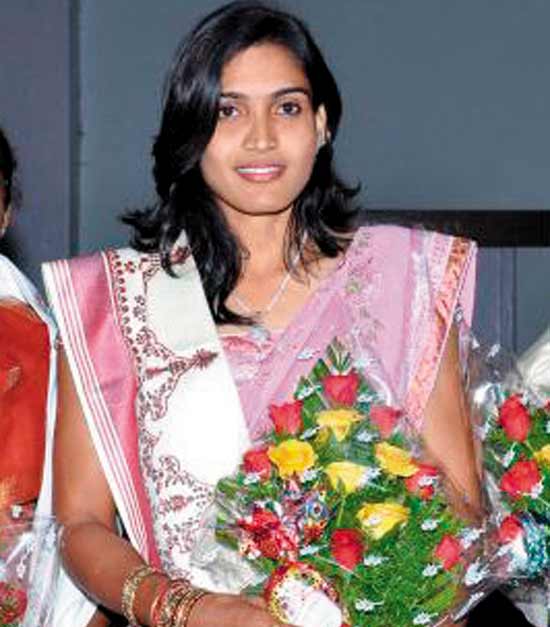
Mamatha Poojary

The Indian kabaddi captain on winning the first Women’s World Cup Kabaddi Championship

10 QUESTIONS

You beat Iran 25-19 in the final. Was it as easy as it seemed?

Our team was the best in Patna (the final’s venue), but in the Asian Games, we beat Iran by just one point. So, we were under pressure.

But you played really well?

We were certain of winning the gold, and the team played well. I could have performed better. But I am happy I won my first big event after becoming captain.

International competition seems to be getting tougher?

Yes, other teams have never beaten us. They are determined to work hard and change that.

Your father is a farmer in a small Udupi village. How did you decide to get into sports?

Life is not easy in the village, and you get physically strong. I had been good at volleyball, javelin throw and short-put from my school days. I took up kabaddi in 2003 when I was 17.

And you got into the Indian team in three years?

Yes. That was the year I joined Railways, too.

How did that change your life?

That was my lucky year. I got a job, got into the Railways team, became secure and got good support and coaching. I then got into the Indian team.

You had to give up studies early?

I graduated with history, political science and economics, but couldn’t pursue education because I was so involved in sports.

In your village (Hermunde), how are you looked at now?

I get a little too much respect, because there was no one into sports from my village.

Are girls following in your footsteps?

Girls used to get into athletics, now they are also taking up kabaddi.

You’ve also participated in beach kabaddi.

Yes, and I was the captain! I also played in events in Colombo, Iran, Indonesia and China.

source: http://www.OutlookIndia.com / Sports> Interview> 10 Questions / Magazine / Interview by Rohit Mahajan / March 19th, 2012


‘I was fine with becoming blind, but not when asked to give up running’

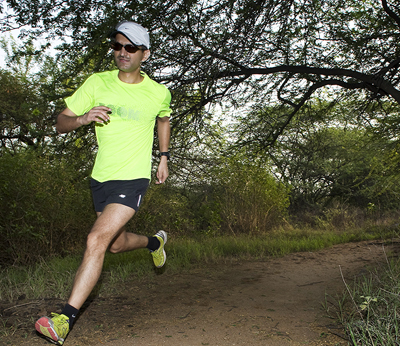
Living out loud with Dr Rajat Chauhan, (37) Marathoner, sports medicine doctor

Dr. Rajat Chauhan (37), Matathoner, Sports Medicine Doctor

The world’s highest ultra marathon, La Ultra, is his brainchild. But there was a time when this sports medicine doctor was asked to forsake his dreams because he was losing his vision


I started running when I was nine. I was studying at Wynberg Allen School, Mussorie. All the boarders had to run every Sunday morning for four kms; it was quite a distance for a nine-year-old and that too in the mountains. The one who finished last would be caned. That’s how it all started. Back then it was more of something I was expected to do. Later, the school started giving mango juice to the first six boys at the finishing line. 

There was no way I was going to miss that! I was pretty useless at other sports, so I thought why not running. I was in 9th standard when I got into the cross country team and that is when I realised how much I was hooked to running. I ran my first half marathon (the Rath half marathon in Delhi) at 16 in 1 hour 29 minutes.

My parents didn’t object to my obsession with running, but when I told them that I wanted to be a runner, they flipped. They wanted me to be a doctor. In the first year of med school I suffered from retinal detachment in my right eye. The doctors forbade me to do physical activities. I was completely fine with the idea of becoming blind; it wasn’t an issue with me, but being told that I can’t run was a huge blow. I got operated in 1994 and after that my power jumped to -6.
For the next four years, I’d run for just 30 minutes once a week. And that’s when I decided to study sports medicine in the University of Nottingham in the UK. Peter Gregory, the chief medicine officer of the English cricket team, was my immediate supervisor. He had a huge impact on me. I went to South Africa in 2004 during the World Cup; it was my first on-field exposure. That’s where I realised that the guys behind the scenes really impact the activities on the field.
I also ran my first ultra marathon from Paris to London covering 200 miles. I worked in the UK as a sports medicine doctor before moving to Bangalore in mid 2006 when my wife was expecting our second son.
I conceived La Ultra, the world’s highest ultra marathon, by chance. In 2010, I asked a friend of mine whether he wanted to go to Manali to run in the Rohtang Pass. He agreed. We couldn’t run beyond 30kms in four hours. Luckily, for our egos, there was a landslide! In Manali, we saw an altitude map from Manali to Leh in an internet café. It reminded me of the Badwater ultra marathon in Death Valley, California. Manali to Leh is 500 odd kms. I thought we could run 222 kms because I wanted to do a run that was longer than Badwater (which covered 217 kms). This route is far more difficult than Badwater! On our way back to Delhi, my friend and I charted a plan for La Ultra on the back of a newspaper. But we were told that at high altitude runs, you need to rest at 13,000 feet. But I wanted to do an uninterrupted one.  So I thought, why not descend from a higher altitude to a low altitude so that the body gets acclimatised to that condition. People thought I’d lost it and said it’s not doable because of the lack of oxygen. But we did it! We started the run from Leh. ‘La’ stands for Tibetan mountain passes. The track required us to cross four mountain passes, including the world’s highest pass, Khardung La and that’s where we got the name from. So it’s the Ultra of passes.
There was five of us, two from the UK and two from the US who got to know of the run from Facebook. A lot of strangers from Mumbai, Hyderabad and Bangalore volunteered to help, and not all of them had running backgrounds. But only one person, Mark Cockbain, finished the run. The biggest thing that this run, which has now become an annual event, taught me was discovering human nature. Out in the open, people become unpredictable.
Both my boys (one is six and the other 10) run. The older one started when he was three years old and the younger one did his first mile nonstop when he was 18 months old. I don’t push them; they love it as they find it pretty cool. But I have not been able to convert my wife into a runner, maybe I haven’t tried hard enough. She just goes to the gym. I have been running for the last 28 years and it’s a way of life. It means the life to me. When I don’t run, I am pretty miserable. In hindsight, I am grateful to the man with the stick for giving me a reason to run. It gave me so much more than just that mango drink. 

— As told to Piali Dasgupta

source: http://wwww.BangaloreMirror.com / Home> Sunday Read> Special > Story / by Piali Dasgupta / Sunday, March 04th, 2012

Indian-Born Kamal Bawa Wins Award for Sustainability Work

Washington, Feb 18 (IANS):

Kamal Bawa, an Indian-born professor of biology at the University of Massachusetts Boston, is the 2012 winner of the Gunnerus Sustainability Award, the world’s first major international award for work on sustainability.

Bawa will receive the Gunnerus Gold Medal and the award of 1 million Norwegian Kronor (about $190,000) at a ceremony in Trondheim, Norway, the university said citing a Royal Norwegian Society of Sciences and Letters (DKNVS) announcement.

Bawa, also a faculty fellow at the Centre for Governance and Sustainability, home of the Global Environmental Governance Project, is known for his research on population biology in rainforest areas. His span of work includes biological discoveries made in Central America, the Western Ghats, and the Himalayas in India.

He is also noted for founding, and serving as president, of the Ashoka Trust for Research in Ecology and the Environment (ATREE), a non-profit conservation and development research think tank in Bangalore.

“I am very pleased over the recognition that our work has received,” Bawa was quoted as saying in an interview with a Norwegian newspaper.

“In January, 2011, a University of Pennsylvania study ranked ATREE #19 among the environmental think tanks in the world, and implicitly #1 in Asia, and now the Gunnerus Award–I am naturallyvery happy.”

Until recently, Bawa held the Ruffolo Giorgio Fellowship in Sustainability Science and Bullard Fellowship at Harvard University.

The Gunnerus award is the first major international prize for outstanding scientific work that promotes sustainable development globally, and will be awarded every two years.

The award is named after DKNVS’ founder, Bishop Johan Ernst Gunnerus (1718-1773), and is the result of collaboration between DKNVS, Sparebank1, SMN, and the society Technoport.

source: http://www.daijiworld.com /  United States / Washington,, IANS / Saturday, February 18th, 2012


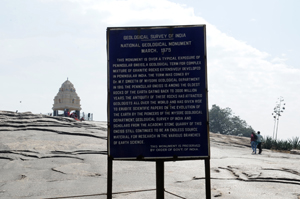
3000 million years old Lalbagh rock facing human threat?

Morning walkers fear that it may be damaged by the use of heavy drilling machinery by personnel hired to rejuvenate the lake in the garden

The rock, termed Peninsular Gneiss, is a mixture of granitic rocks

The use of heavy drilling machinery by construction personnel hired to rejuvenate the lake in the renowned Lalbagh botanical gardens has several morning walkers and joggers worried. They fear that work would endanger the 3,000 million years old Peninsular Gneiss, the rock in the centre of the park. The personnel are cutting huge boulders using earth movers, near the Siddapura Gate. Dr Krishna, a morning visitor to the park, told Bangalore Mirror, “I saw these machines near the rock a few days ago. Vigilance officers informed them that they were drilling the earth to cut rocks. None of us had any clue where those rocks were transported.”

But horticulture officials clarified that the rock won’t be damaged. H M Krishnappa, deputy director of Lalbagh, said, “We are not drilling into the rock. 

Special white stone boulders have been brought from Pavagada to construct a bund along the recently rejuvenated Lalbagh lake. They are not only huge but irregular in shape as well. Hence, they have are being cut to fit our requirements. As there was no vast space available within the park to take up the drilling and chiseling work, we chose the empty space near Siddapur Gate, which was sometimes used as a parking lot.”  But when asked whether the drilling work with high level vibrations would damage the texture of the geologically significant rock, Krishnappa clarified, “They have just cleared the soil to keep the boulders intact while drilling and chiseling using heavy machines. We have been vigilant at every step.”

N Chandranna, a retired senior geologist from the mines and geology department, said, “The drilling would not harm the rock as the vibrations would be of negligible level. But using explosives would have a huge impact on the composition of the rock.”
history of the rock
The term Peninsular Gneiss means mixture of granitic rocks, which are largely spread around the southern plateu of India. The term was coined by Dr W F Smeeth of the Mysore Geological Department. It is considered to be one of the oldest rocks of earth. It was declared a national geological monument in 1916.
The antiquity of this rock has attracted geologists from all over the world and has given rise to erudite scientific papers on the evolution of earth by the pioneers of the Mysore Geological Depart-ment, Geological Survey of India and scholars. Stone quarry of this gneiss continues to be source material for research in the various branches of earth science.
source: http://www.BangaloreMirror.com / Bangalore> City / by Niranjan Kaggere / Friday, December 23rd, 2011

JSS Doctor bags Oration Award

Caption: Dr. Nataraja receiving Dr. R.K. Oza Oration award from the Vice-Chancellor of Hyderabad University.

Mysore, Feb. 16:

Dr. N.P. Nataraja, Director, JSS Institute of Speech and Hearing in city, has been awarded Dr. R.K. Oza Oration National award, at the 44th annual conference of Indian Speech and Hearing Association, held recently at Hyderabad. The award was instituted to honour successful entrepreneur in the field of speech and hearing from India and consists of a citation and trophy.

Dr. Nataraja is a scientist, trainer and a pioneer in voice among the Indian Speech Language Pathologists. He has contributed tremendously in escalating the field of Voice Disorders, Speech Sciences and Forensic Speech Analyses. He was conferred with Bharat and Dr. Ratna Oration awards in 1999 at the 31st Indian Speech & Hearing Assn. Conference, Chandigarh. He was also awarded LVA Oration award at the 1st Annual Conference of Laryngology and Voice Association named as Laryngology Update 2012 in Mumbai on Feb. 4 and 5. The award has been instituted to felicitate leading Phono-surgeons and Speech Language Pathologists who have contributed in the field of Laryngeal Disorders, Voice Restoration.

source: http://www.StarofMysore.com / General News / February 16th, 2012

Rs.1 crore Jindal prize for Dr.Kalam, Santosh Hegde

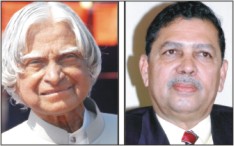
Caption: Dr. Kalam, Justice Hegde

New Delhi, Feb.16:

Former President A.P.J. Abdul Kalam and former Lokayukta of Karnataka Justice N. Santosh Hegde have been selected by the Sitaram Jindal Foundation for S.R. Jindal Prize for their outstanding contributions in their respective fields.

The prize amount carries a cash of Rs. 1 crore. Sitaram Jindal Foundation will felicitate 25 other achievers also at the award ceremony to be held on Feb. 23.

S.R. Jindal Prizes will also be awarded for crusade against corruption, rural development and gallantry.

Patron of the Foundation Sitaram Jindal said, Dr. Abdul Kalam has been selected for the award for his contributions in science and technology while Justice Santosh Hegde will be honoured for his extraordinary service in social development.

source: http://www.StarofMysore.com / General News / February 16th, 2012