Category Archives: Records, All

Mango processing centre inaugurated, finally, in Chintamani taluk

One of the buildings of the Mango Development Centre at Madikere Cross in Chintamani.

It is the first in Karnataka, CFTRI experts to provide technical counselling to farmers

The Mango Development and Processing Centre, established at Madikere Cross in Chintamani taluk of Chickballapur district, has been opened up for the service of mango cultivators after a long wait.

Though the construction work of the centre, set up by the Karnataka State Mango Development and Marketing Corporation (KSMDMC), ended around three years ago it was left unused in the absence of a formal inauguration. Mango cultivators from Kolar and Chickballapur beside other parts of the State will benefit now.

Transport Minister K. Ramalinga Reddy inaugurated the centre on Monday, bringing cheers to mango farmers and traders as it will pave way for processing fruits in a most advanced manner. Constructed at a cost of around Rs. 7 crore, the centre is billed as the first of its kind in Karnataka, third largest mango producing State in the country.

The centre has been established with an aim of imparting training in safety measures to procure quality crop and guiding farmers about post-harvesting maintenance of mango, says Corporation chairperson Kamalakshi Rajanna.

Kolar and Chickballapur districts account for about 40 per cent of mango production in the State. Srinivasapur in Kolar and Chintamani in Chickballapur district contribute heavily for this. In spite of large-scale production, the State lagged behind in international marketing. Lack of awareness about nurturing of saplings, pre-harvesting and post-harvesting measures and absence of scientific methods of processing are blamed for this situation.

The centre was conceived to overcome these shortcomings. Facilities such as sorting and grading, washing, hot water treatment, ripening, packing, and processing technologies would be provided at the centre. This will help the farmers in following suitable methods, from selecting plant variety to post-harvesting and export. Demonstrations would be organised for farmers at the centre.

The centre has appointed experts from the Mysuru-based Centre for Food Technology and Research Institute (CFTRI) as technical advisors.

Main features

• State-of-the-art machineries to process up to 10 tonnes of mango a day.

• Hostel to accommodate about 60 farmers visiting the centre for training.

• Practical training cell.

• Hall to hold meeting with farmers.

• CFTRI experts to provide technical counselling.

source: http://www.thehindu.com / The Hindu / Home> News> Cities> Bengaluru / by Staff Correpondent / Kolar – August 22nd, 2016

Meet Aditi Ashok, India’s future in women’s golf

Aditi Ashok became the youngest and first Indian to win the Lalla Aicha Tour School and get a Ladies European Tour card for the 2016 season. — Photo: Getty Images

The 18-year-old from Bengaluru, the only Indian woman golfer competing int the Rio Olympics, 2016, turned professional earlier this year after a sparkling amateur career.

Eighteen-year-old Aditi was slotted 58th among the women who had qualified for the Rio Games. She’s ranked 439th on the official women’s world rankings list but that didn’t make any difference to her approach coming into the Games and facing off against higher-ranked opponents.

In the 2016 Summer Olympics at Rio de Janeiro, Aditi, the youngest contender and only Indian woman golfer in the fray, was able, for the most part of the first 36 holes, to tail the top spot on the leaderboard. She even shared the lead briefly before falling away in the third round.

A student at Bangalore’s Frank Anthony Public School, Aditi has been a consistent figure on the Indian amateur golfing scene. She turned professional in January 1, 2016, after an illustrious amateur career.

She made history when she became the first player from the country to win the Ladies British amateur stroke-play championship at Leeds, in 2015.

She won the St. Rule Trophy at St. Andrews and finished second in the 2015 European Women’s Amateur Championship, also claimed the overall title called ‘The Nicholls Trophy’ as well as the ‘Dinwiddy Trophy’ given for the lowest score by an under-18 player.

She is the only Indian golfer to have played the Asian Youth Games (2013) Youth Olympic Games (2014) and Asian Games (2014).

She is a three-time National Junior Champion for 2014, 2013, 2012 and a two-time National Amateur Champion for 2014, 2011.

source: http://www.thehindu.com / The Hindu / Home> Sport> Other Sports / Internet Desk / August 20th, 2016

Autorickshaw driver’s son scores big in NEET

Dinesh Rajkumar, who got 31st rank in NEET, with his parents in Sri Channabasaveshwar Gurukul in Karadyal in Bhalki on Thursday

Dinesh studied in Kannada medium till SSLC, before joining Channabasaveshwar Gurukul for PUC.

Dinesh Rajkumar, son of an autorickshaw driver from Enakur in Bhalki taluk, has earned the 31st rank in the National Eligibility-cum-Entrance Test (NEET).

A student of Sri Channabasaveshwar Gurukul in Karadyal in Bhalki, Dinesh has had the smart streak from his childhood. He scored 93 per cent in the SSLC exams and got 94 per cent marks in the pre-university exam. He stood 500th in the State in the CET medical rankings and had recently joined the MBBS course at Bangalore Medical College, said Basavaraj Molkeri, Gurukul principal.

He studied in Kannada medium till SSLC, before joining the Gurukul for PUC.

His father, Rajkumar, who drives an auto in Bhalki and surrounding villages, does not know much about NEET. He thinks that if Dinesh chooses to pick a seat in the national quota, he will have to leave Karnataka. “My son is already in a medical college in Bengaluru. It will be difficult to send him elsewhere, especially to cities like Delhi or Mumbai. Those cities may be costlier than Bengaluru for him to live in,” he said.

Dinesh’s mother is a homemaker. She is just happy that her son is studying to be a doctor. She wants him to come back and heal the sick in her village.

Dinesh, who came to see his teachers at the Gurukul on Thursday, said he wants to continue studying and pursue research. Teachers and staff were present at a felicitation organised for him and his successful batchmates.

source: http://www.thehindu.com / The Hindu / Home> National> Karnataka / by Special Correspondent / Bidar – August 19th, 2016

Narayana Health launches Robotic Surgery Training programme with support from Infosys Foundation

Dr. Devi Shetty and Sudha Murty unveiling the plaque at the launch of ‘Infosys Institute of Robotic Surgery.’

Bengaluru :

Narayana Health (NH), Bengaluru, has launched the Institute of Robotic Surgery supported by Infosys Foundation at its flagship unit at Narayana Health City.

The da Vinci Robotic Surgical System will be used primarily for prostate, kidney, gynaecological, colorectal and select head and neck cancer surgeries.

Symbolically unveiling the plaque, signifying the launch of ‘Infosys Institute of Robotic Surgery,’ Sudha Murty, Chairperson, Infosys Foundation said, “The need to adopt and continually update treatment protocols that reduce errors is crucial for a country like India, which sees high patient volumes and a wide spectrum of complex diseases. Robotic surgery, with its high degree of precision and faster recovery time, has the potential to address this efficiently. Our partnership with Narayana Health, incontestably a pioneer in delivering world-class healthcare, is aimed at encouraging rapid adoption of robotics in healthcare in India. Through this endowment, we also intend to provide impetus for further research in this area, and enable the masses to reap the benefits of affordable and high-quality treatment.”

“Technique of surgical intervention on the human body is undergoing dramatic change. It took over 30 years for laparoscopic surgery to replace open abdominal operation. World is on the threshold of a major transition from laparoscopic surgery to robotic surgery,” said Dr. Devi Shetty, Chairman, Narayana Health.

Robotic surgery has proved that inaccessible areas of the human body like deep in the pelvis where a prostate surgery needs to be done for a patient with cancer of the prostate can easily be accessed. Robotic surgery has proven beyond doubt its supremacy.

“It is a matter of time before most procedures on the human body will be done better with robotics. However, for the large scale technical adoption of robotic surgery major hitch is the surgeon’s skill,” informed Dr. Devi Shetty. Today surgical robots are available in very few centres across the world and the training programme to train an experienced surgeon as a robotic surgeon is expensive and inaccessible.

Explaining further on the need for such training programmes, Dr. Devi Shetty said, “Infosys Foundation always believed in the power of technology to transform the world and address the human sufferings. With that objective, Infosys Foundation donated ‘da Vinci Surgical Robot’ to develop Infosys Institute of Robotic Surgery to train robotic surgeons for the future. The philosophy of creating the institution is to train any surgeon with a passion to learn robotic surgery and certify them to start robotic surgical programme in different parts of the country. NH Foundation along with Infosys Foundation believes that this is the only way robotic surgery services will be available to the common man of this country.

source: http://www.starofmysore.com / Star of Mysore / Home> General News / August 19th, 2016

No stings in this tale of celebrating scorpions

On Nagara Panchami, people offer puja to scorpions and hold them in their hands.

Kandkur village in northern Karnataka worships and plays with venomous stingers.

You may have heard of different kinds of fairs including cattle fair. But this village in Yadgir district of Karnataka on Sunday celebrated a “scorpion fair.”

In this annual fair on Nagara Panchami, people not only offer puja to scorpions, but also take these venomous stingers in their hands and allow them to move freely over their bodies.

This year was no exception with scorpion devotees from the district and across the border in Maharashtra, Telangana and Andhra Pradesh converging on the village to celebrate scorpions.

Devotees young and old, women and men thronged the temple on the village hillock where they first offered pooja to Goddess Konddammai who is said to be a scorpion goddess. Later, they searched for scorpions, which were found in plenty under the rocks and the stones of the semi-arid region.

Having caught the venomous insects, the devotees proceeded to play with them. Some let the creatures crawl over their bodies, some pop them into their mouths, letting the insect rest on their tongues for a few minutes. Children, too enjoyed playing with scorpions, exhibiting no fear.

The devotees’ courage stems from the belief that Goddess Kondammai will save them should the scorpion bite.

If bitten, they apply a paste of herbs, largely consisting of turmeric, on the wound. Shankar, a regular to this fair, however, claims that no serious injury or death has occurred so far at the fair over the years.

Government precaution

The State Health Department, however, is taking no chances. Concerned over such a “dangerous tradition”, officials deployed additional doctors at the primary health centre in Kandkur village.

Dr. Diwakar, District Health Officer, cautioned that scorpion bite could turn out to be very dangerous for children below 10 years. “But people don’t heed to our request to desist from touching the scorpions. Hence, we have kept ready a team of doctors for any emergencies,” he told The Hindu.

source: http://www.thehindu.com / The Hindu / Home> National> Karnataka / Ravikumar Naraboli  / Kandkur – August 08th, 2016

Excel Public School student attends GSA Summit at New York

PrithveBF15aug2016

Mysuru :

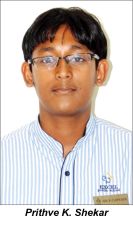
Prithve K. Shekar, a Class X student of Excel Public School (EPS), attended GSA (Global STEM Alliance) Summit, an initiative of The New York Academy of Sciences (NYAS) held at New York recently.

Being the only Indian student selected, Prithve was part of the virtual program by The Junior Academy’s Innovation Challenge for creating novel solutions addressing major planetary challenges.

He was selected to be one among the 123 students from 13 countries to network with international students and STEM (Science, Technology, Engineering and Mathematics) experts. He was invited for an all-expense paid trip to New York recently for the Award Ceremony, where he also got a chance to interact with top-notch scientists and executives. The team was also invited to the R&D unit of the PepsiCo at New York.

Prithve is the son of Roopa Viswanath and Kiran Shekar residing at Gokulam. It is the second time that an Excelite was selected to the prestigious scholarship of Junior Science Academy, New York.

source: http://www.starofmysore.com / Star of Mysore / Home> General News / August 09th, 2016

Endowment Awards presented to promising Journalists

Instituted by senior journalist K.V. Sreenivasan

Sitting from left: K.V. Sampath Kumar, Editor, Sudharma Sanskrit Newspaper; K.H. Chandru, Photojournalist, Vijayavani Kannada Daily; Rajendra Rao, Reporter, Vijayakarnataka (K.R. Nagar); B.S. Prabhurajan, UNI Dist. Correspondent; Gayathri V. Raj, Sub-Editor, Deccan Herald and Mullur Shivaprasad, Senior Reporter, Andolana, who received the awards instituted by senior journalist K.V. Srinivasan at a function organised at MDJA yesterday, are seen with (standing from left) Karnataka Media Academy Member K. Shivakumar, MDJA General Secretary K.J. Lokesh Babu, Karnataka Media Academy Chairman Siddaraju; Mayor B.L. Bhyrappa; Senior Journalist K.V. Srinivasan (Brother); MDJA President K. Deepak and Vice-President S.T. Ravi Kumar.

Mysuru :

Mysuru District Journalists Association (MDJA) had organised a function at its premises here yesterday to present various endowment awards to journalists for their contribution to the sector, instituted by senior Journalist K.V. Sreenivasan (Brother).

The awardees are B.S. Prabhurajan, senior journalist, UNI – Dr. Nadig Krishnamurthy award; K.V. Sampath Kumar, Editor, Sudharma Sanskrit Newspaper – Dr. APJ Abdul Kalam award; Mullur Shivaprasad, reporter, Andolana – Mahatma Gandhi award; Gayathri V. Raj, Sub-Editor, Deccan Herald – Janakamma Venkatappagowda award; K.P. Chandru, Photographer, Vijayavani – K.V. Srinivasan award and Rajendra Rao, Correspondent, Vijaya Karnataka, K.R. Nagar – J.P. Youth award.

Presenting the awards, Karnataka Media Academy Chairman Siddaraju sought good encouragement for new enterprising journalists that would enthuse the tribe. He lauded the performance of the awardees and expressed gratitude to K.V. Sreenivasan for instituting the six awards. He said that the Academy had come out with a programme to provide 10-month internship for young journalists with a poor background and also provide a monthly scholarship of Rs. 10,000.

Mayor B.L. Bhyrappa, MDJA President K. Deepak, General Secretary K.T. Lokesh Babu, Vice-President S.T. Ravikumar and senior journalist K.V. Sreenivasan were present on the occasion.

source: http://www.starofmysore.com / Star of Mysore / Home> General News / August 09th, 2016

IISc bags maximum number of INSA Medals for Young Scientists

The Indian Institute of Science (IISc), Bangalore had the lion’s share of medals with five of its faculty members being awarded the Indian National Science Academy (INSA) Medal for Young Scientists 2016, making it the institute with more awardees than any other, a release said.

The winners from IISc this year are: Prabeer Barpanda, Sai Siva Gorthi, Praveen Kumar, Anshu Pandey and Chandan Saha.

The INSA annually presents the Young Scientist Award to distinguish young scientists who have made notable research contributions in science and technology. Started in 1974, about 760 scientists have been recognised so far. A maximum of 30 awards are given each year.

Terming it a matter of pride for its faculty, Anurag Kumar, Director, IISc said: “These awards have recognised work that cuts across boundaries of basic research and applied research, and of science and engineering. Their conferral on our faculty is testament to the success of the rich and varied, interdisciplinary intellectual atmosphere of the institute.”

The winners

Praveen Kumar, Assistant Professor at the Department of Materials Engineering: Awarded for his discovery of electric-field induced changes in the mechanical behaviour of Carbon Nanotube (CNT).

Prabeer Barpanda, Assistant Professor at the Materials Research Centre: Awarded for his work on the development of new classes of Lithium and Sodium cathode materials for next generation battery and storage application.

Sai Siva Gorthi, Assistant Professor at the Department of Instrumentation and Applied Physics: Awarded for his contribution to the field of Innovative Optofluidic technologies, an area that combines the advantages of microfluidics and optics. His recent work includes research and development of in-vitro diagnostic tools, biomedical instrumentation and microfluidic nanotechnology.

Chandan Saha, Assistant Professor at the Department of Computer Science and Automation: His work on arithmetic circuit lower bounds, polynomial identity testing and reconstruction of arithmetic circuits has led to the discovery of new mathematical techniques and substantial progress on these problems.

Anshu Pandey, Assistant Professor at the Solid State and Structural Chemistry Unit: Made it to the list with his contributions in the area of low threshold quantum dot lasers.

Praveen Kumar, Assistant Professor at the Department of Materials Engineering:

“In our work, we discovered that the strength and the energy absorption capacities of CNT cellular structures could be dramatically enhanced by applying an electric field. In addition, we also studied how we can manipulate the stress relaxation and creep behaviours, which are important for knowing the long-term applications of these samples.”

Chandan Saha, Assistant Professor at the Department of Computer Science and Automation:

“Understanding computational efficiency is a great challenge in theoretical computer science. Our work in the last eight years has revealed new insights into the behaviour of low-depth circuits that capture highly parallel computations. Low-depth circuits also form a gateway to understanding the intricate nature of general arithmetic computations. So, there is hope that some of the ideas and proof techniques introduced in our work will continue to generate exciting new research in the area.”

source: http://www.thehindu.com / The Hindu / Home> National> Staff Reporter / Bengaluru – August 12th, 2016

Star this week : Tennis Official : Sagar Kashyap

SagarKashyapBF13aug2016

Any tennis official’s dream is to officiate in the Olympics tennis events and also be part of the Olympic Games. Our city’s Sagar S. Kashyap is in Rio De Jeneiro as a Tennis official and is officiating in the ongoing Tennis events in the Olympic Games-2016. Twenty eight-year-old Sagar achieved a milestone in 2015, when he officiated as a line umpire in the men’s singles final between Novak Djokovic and Roger Federer at the Wimbledon Grand Slam Tennis Championships at the all England Club’s Courts on July 12, 2015. Sagar became the youngest Indian to officiate in the Wimbledon Championships final. Today, he is officiating in the Rio Olympics as part of the ITF Tennis Officials’ team. He is our ‘Star This Week.’

He is the only Mysurean official other than Mysuru-born US-based athlete Vikas Gowda who are doing our city and nation proud at the Olympic Games in Rio.

In Wimbledon Championships-2015, Sagar served as a line umpire along with another Indian referee Abhishek Mukherjee from Kolkata. This was the first time that two Indian officials were selected to officiate in a Wimbledon Championships men’s final. He is the first official from Karnataka to officiate in the Wimbledon final and the third Indian to be selected to officiate in the final of the Wimbledon Championships.

Sagar, a former national ranked tennis player and an Engineering graduate from Mysuru, fascinated by the game, took up officiating in smaller tourneys in Mysuru and Bengaluru in 2007. Sagar passed the International Tennis Federation’s Level-1 Exams in 2008. Later, he passed the ITF Level-2 exams and became the youngest White Badge official in the country, making him eligible to officiate at the highest level.

Sagar started officiating in ITF Tournaments and gradually was chosen for bigger tournaments. He got an opportunity to officiate in the ATP Chennai Open, WTA Sunfeast Open and ATP Kingfisher Open Tennis Championships.

In 2009, he got an opportunity to officiate as a line umpire in the Wimbledon championships qualifying rounds. In 2010, the British Lawn Tennis Association invited him to officiate in the main draw of the Championships. Since then he has been a regular in the Wimbledon Championships.

He was awarded as the Best performing Tennis Official by the ITF in 2015-16.

Sagar, after being in the circuit for seven years travelling to officiate from one championship to another, intends to climb greater heights in officiating various tournaments across the globe.

source: http://www.starofmysore.com / Star of Mysore / Home> Sports News / August 07th, 2016

A home that housed 4 generations of Genius

Many years ago in Madras, reclining on an easy chair and chewing on a piece of clove, R.K. Narayan (RKN) quite uncharacteristically said: “Although I have built the Mysore house brick by brick, I carry no emotions, no nostalgia about it… In life one has to move on, you can’t simply dwell in the past,” recalls RKN’s grand-nephew, the journalist-turned-corporate manager Chetan Krishnaswamy, who recaptures life as it used to be at 15, Vivekananda Road, Yadavagiri, Mysore – 570020, in this writeup…

by Chetan Krishnaswamy

I don’t quite remember the details now, but oddly, that muggy afternoon, I thought I detected a streak of nostalgia beneath the veneer of cold pragmatism and bravado.

RKNarayanHouseBF12aug2016

The true magnificence of RKN’s sprawling bungalow on 15, Vivekananda Road in Yadavagiri, Mysore, lies in the lively people who inhabited, or were associated, with it throughout its 60-plus years of existence.

In 1948, the scrubby land measuring 180 x 120 was bought from a local Shetty at the rate of around Rs. 2 per square yard. Narayan’s older brother R.K. Pattabhi had a share in it, too.

By this time, Narayan had already established himself as a writer and was attracting global acclaim.

Mysore’s famous Chief Engineer Shama Rao (who had built the famous Krishna Raja Sagar [KRS] Hotel and after whom a string of buildings are named in Mysore’s Vontikoppal, including the shopping complex on 3rd Main Road called Shama Rao building), who was retired by then, was given the contract to construct RKN’s house in 1949.

Narayan designed a large, roomy home that would accommodate his brothers, their wives and their children. By this time, the cartoonist R.K. Laxman, the other famous sibling, had already flown the coop and was building his reputation in distant Bombay.

The extended family which resided at Door Number 963, Lakshmipuram, comprised brothers R.K. Srinivasan and Pattabhi and their families apart from Narayan’s daughter Hemavathi (RKN’s wife Rajam had passed away suddenly in 1939).

Reigning over the household was Narayan’s mercurial mother Gynanambal — expert cook, chess champ and tennis player, all rolled into one.

The house was completed in 1952, with the griha pravesha being a grand affair. Among the guests was Soma, a blind mystic who lived atop Chamundi Hill and who had taken a liking for the family. On one occasion, the gifted Soma through his clairvoyant powers had accurately traced Laxman’s wife Kamala’s missing diamond ring, that had been swept away with the garbage.

And then came the unforeseen crisis: None of Narayan’s brothers were keen to relocate to Yadavagiri from the centrally located Lakshmipuram. This, despite the comforts of a large house.

In light of this new dilemma, Narayan settled into a peculiar routine: Every day after lunch he was driven in his Morris Minor to Yadavagiri by driver Rangappa.

In the unbroken silence of his house, Narayan wrote profusely. This was the phase in which he wrote two of his novels: The Financial Expert and Waiting for the Mahatma.

By about 5.30 pm, after lighting the lamp in the ‘puja room,’ Narayan would be back home in Lakshmipuram for his routine evening walk with brother Srinivasan. Eventually, for about a year, 15, Vivekananda Road was rented out to Henry C. Hart, a Visiting Professor of Political Science from the University of Wisconsin, on a monthly rent of Rs. 200. Hart was in India on a Fulbright Fellowship, with his wife in tow.

Their legacy was an elegant piece of furniture custom made for the house: wooden seating that skirted the entire semi-circular perimeter of the large living room. After many years of service, and in the wake of sustained onslaught from a riotous bunch of kids, that primarily included my cousins, the furniture slowly disintegrated.

One morning, 15, Vivekananda Road, had a surprise visitor.

The flamboyant actor Dev Anand accompanied by Yash Johar (Karan Johar’s father) had dashed to Mysore, after giving a day’s notice to Narayan. The actor was there to negotiate for the filming rights of The Guide.

Narayan’s starstruck nephews were directed to fetch a breakfast of idli-vada and dosas from Seshagiri’s hotel (Hotel Ramya now). After thoroughly enjoying the meal, Dev is said to have whipped out his cheque book and asked “How much?”

RKN feebly said,“I don’t know.”

Dev left after presenting the author with an advance of Rs. 5,000.

Finally, with the daughters of the house married and gone and brother Srinivasan moving out of Mysore in pursuit of government service, a hesitant Pattabhi gave in. Much to Narayan’s relief, Pattabhi moved to Yadavagiri with his wife and mother. Also in tow were Narayan’s young nephews R.S. Krishnaswamy and R.S. Jayaram, both studying at the Mysore’s National Institute of Engineering (NIE).

In 1973, Narayan’s mother Gynanambal passed away.

The large, two-storied house of around 5000 sq.ft. had five bedrooms with attached bathrooms. There was a spacious semi-circular living room with an array of windows that brought in the sunlight.

The dining hall, kitchen, an unusually huge store-room adjoining a ‘puja room’ formed another portion of the expansive house.

A winding, narrow flight of stairs led to Narayan’s airy room on the top floor.

The room was minimalistic, almost spartan in décor. Apart from a single cot, there was this heavy easy chair and a solid walnut table from Kashmir on which rested an assortment of books and papers.

In another corner Narayan displayed his interesting collection of miniature owls, which he had picked up during his travels. On a wooden bracket fixed to the wall rested the Filmfare award (which the writer had won for The Guide) and other memorabilia. That he never thought too highly of this award was another thing.

The room had a modest ante chamber where Narayan tucked away his veena. He played it well.

On the wall of his room was a framed picture of his late wife Rajam. He would regularly place a string of jasmine flowers on the frame every day. The room opened up to a cosy balcony, which was Narayan’s favourite spot. He sat there, hours on end, writing, watching the flitting birds and squirrels on the frangipani tree that majestically arched into the compound, scattering its canopy of green.

Sometimes he would meditate and recite a version of the Gayatri Mantra sitting here. Narayan had revealed to my aunt Rajani, Jayaram’s wife, that this particular Mantra was a revelation that was relayed to him from another spiritual plane.

The other room, which usually accommodated guests and other relatives who were on an extended stay, had an unusual revolving wooden shelf, which originally belonged to Narayan’s academic father R.V. Krishnaswamy Iyer. The shelf creaked and groaned under the weight of the thick hardbound classics, some of which were rare out of print editions.

The house had a garage which at one time held Narayan’s Mercedes Benz, a gift from a publisher which he subsequently disposed off. There were also two make shift ‘sheds’ that in the later years were used to park the other automobiles in the house.

In 1987, after Pattabhi’s death, Narayan travelled into Madras and the US, periodically coming into Mysore. From 1991 onwards, he started living in Chennai owing to his ill health. For many years, the empty house was taken care of by Narayan’s driver Krishnamurthy.

Sometime in early 2000, the house was leased out to the cousin of a very powerful Congress party politician. The influential tenant used it as an office-cum-residence, altering certain facets and progressively destroying the old world charm of the house.

At one point, he stopped paying the rent and refused to move out. The family seemed helpless…

One fine morning, suitably galvanised by Narayan’s son-in-law Chandrasekaran, who lives in Chennai, I strode into the house determined to take on the truant tenant.

After making us wait for a long time, the kurta-clad man came down and spoke to us in the most unfriendly manner, clearly indicating that he would leave the house when he felt the need to do so.

I left the house quite disappointed and reported the conversation back to Chandrasekaran. In a few months’ time, good sense prevailed and the man left the house but in complete disarray.

Today 15, Vivekananda Road, which stood forlorn, almost ghostly for years waiting patiently, uncomplainingly, for that fresh gust of wind to breathe again, has finally seen the light of the day with the Karnataka Government converting it into a museum. Now, once again one can hear the echoing laughter, the quibbles and the genius of four generations of an uncommon family that it has nurtured.

source: http://www.starofmysore.com / Star of  Mysore / Home> Feature Articles / August 06th, 2016