The alumnus of B.K. Model High School will organise a two-day exhibition of ancient and rare coins, and currency notes to mark the golden jubilee of the 1966 batch of Kannada medium students from March 5. It will be open from 11 a.m. to 5 p.m.
According to Raja Katti, president of the school’s board of management, I.G. Paramshetty, an alumnus of the school, will showcase his rich collection of ancient coins and currency notes from India and other countries. Sulabha Wadeyar, who also belonged to the same batch, and retired as a teacher from the school, would exhibit his collection of paintings. Mr. Katti, a senior photographer, would display antique and vintage camera and a few of his photographs.
source: http://www.thehindu.com / The Hindu / Home> National> Karnataka / by Special Correspondent / Belagavi – March 02nd, 2016
A joint initiative of HKRDB and Calcutta University to document an Ashoka Circuit for Karnataka from Sannati to Siddhapura has been launched.
Head of Ancient History Department of Calcutta University Prof Susmita Basu Majumdar is the Principal Investigator. As part of this expedition, a documentary will be filmed and a pictorial Pali-English-Kannada dictionary will be compiled.
Karnataka has perhaps the largest number of Ashoka sites and those dating back to the 3rd century BC are the earliest legible records found from Afghanistan in the northwest, Andhra Pradesh in the south, Odisha in the east to Girnar in the west. The project will first document all the Ashokan sites in Karnataka and then establish the full circuit from Afghanistan.
A team of three, Prof Susmita Basu Majumdar, artist Rajib Chakraborty and film maker Ranjay Ray Choudhury visited the Chandralaparameshvari temple at Sannati on Sunday, to document the spot where the Ashoka edict was found. They found the original idol of deity Mahakali broken into four pieces lying on the western side of the temple on the banks of river Bhima.
Prof Basu Majundar took the initiative to re-join the idol and narrated the interesting story behind the discovery of the Ashoka inscriptions. In 1986, a portion of the roof of the temple collapsed and caused damage to the 12th century seated four handed figure of goddess Mahakali wearing mundamala and holding damaru, trishula, kapala and sword.
Presently, this beautiful piece of sculpture only shows the trishula and kapala and the other two hands are broken but the temple authorities informed that the present image of Chandraparameshwari which is worshiped in the temple is a replica of the previous Goddess.
The khandita pratima of the deity lying on the banks of Bhima was almost awaiting the visit of this team and when the sculpture was joined it looked as if the beautiful Goddess had reappeared.
The idol base had a protruding pillar like hinge which was fitted into a stone socket. The stone on which the Ashoka inscription was engraved was used to form the base of this deity. When the idol was damaged, the inscription was discovered.
This inscription carried the separate edicts one and two and rock edits 12 and 14 of Ashoka (274-232 BC). Karnakata was the southernmost boundary of the Ashoka’s Mauryan Empire.
This inscription was discovered in 1989. Now the original idol which is about 600 years old is also restored to the temple. The matter is being reported to the ASI for further action.
source: http://www.newindianexpress.com / The New Indian Express / Home> States> Karnataka / by Express News Service / March 02nd, 2016
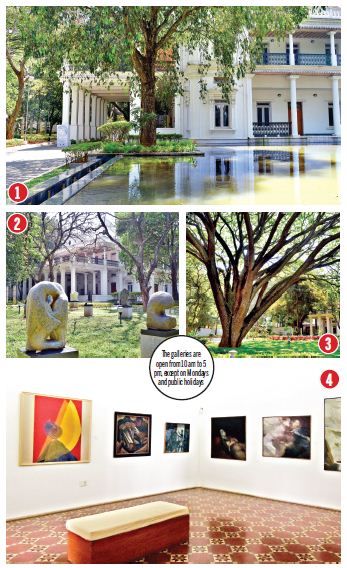
The old bungalow is marked by a British colonial architectural style, with a touch of Indian influence Jithendra M
Bengaluru :
Plaques detail the contributions of the three Tagores — Abanindranath, Gaganendranath, Rabindranath — and various art movements in the country at National Gallery of Modern Art on Palace Road. But no boards speak of the significance of the heritage structure that houses the collections of rare paintings — Manikyavelu Mansion.
A document in NGMA’s official files, titled Excerpts from Karnataka Government Gazetteer and signed by its former owner Vilum Manickavelu Mudaliar’s granddaughter Vitto Bai, tells you that this once belonged to the Yuvaraja of Mysore.
Mudaliar, it reads, was the third son of a poor family. He married into an aristocratic family and became a successful ‘business magnate’ after taking manganese and chrome mines on lease. He acquired this building, the document says, ‘during his early years’, and called it Manickavelu House. While reliable history books say it was sold to him, the record of the sale perhaps remains unknown, says historian and researcher Arun Prasad.
Officials in the NGMA say Mudaliar and his family lived in the mansion for some years. “But due to a domestic problem, they defaulted payments either to a bank or the government, and the house was put on auction,” says an official. It was acquired by the City Improvement Trust Board, the erstwhile BDA, and then transferred to the Housing Board in the 1960s. The Ministry of Kannada and Culture, which has taken it on lease, sub-leased it to the Ministry of Culture in 2000, when it became the chosen location for NGMA’s southern centre.
As for when the mansion was built, again records are elusive. “It’s neighboured by several century-old colonial bungalows, including the Balabrooie Guest House,” says Prasad. Hence, it’s probably safe to assume ManiIf you wander in its 3.5-acre campus, and look beyond the official records, you might catch snatches of a fascinating oral history account: Mudaliar, on a visit to Bengaluru, stumbled upon the colonial-style house when it belonged to the Yuvaraja of Mysore. Impressed, he sought entry and was refused until he greased some palms. After a tour around the mansion, he vowed he would one day come to own it.kyavelu Mansion dates back to that time, he adds.
If you wander in its 3.5-acre campus, and look beyond the official records, you might catch snatches of a fascinating oral history account: Mudaliar, on a visit to Bengaluru, stumbled upon the colonial-style house when it belonged to the Yuvaraja of Mysore. Impressed, he sought entry and was refused until he greased some palms. After a tour around the mansion, he vowed he would one day come to own it.
Indra Rajaa, daughter of Mudaliar’s granddaughter Vitto Bai, says her generation, brought up in Madhya Pradesh, is rather removed from their Bengaluru connection. “My maternal mother, Manickavelu’s only daughter, moved to Kotagiri after marriage,” she says. “She died a month after giving birth to my mother, who was brought up by her paternal uncle and his wife. My mother thought they were her parents till she got married.”
In 2003, the year she passed away, 67-year-old Vitto Bai visited the mansion with her husband. “She said she got a royal reception by the officials there, and was very happy,” her daughter says. Rajaa tried locating the house when she was last in the city. “I asked for Manickavelu’s mansion, but no one seemed to know where it was,” she says.
The Chennai-based chartered accountant recalls that an ‘uncle’, one of her clients who had met Mudaliar, had told her that great grandfather was a ‘generous man’. She quotes him: “He would willingly feed any number of people, but would refuse loans.”
But Mudaliar’s descendants are scattered across the city, says architect Naresh Narasimhan of Venkatramanan Associates, involved with the restoration and design of the new wings. “It is said he lived atop a hill in Rajajinagar, next to the one Iscon is on. He owned a lot of land in Mahalaxmi Layout, named after his daughter,” he says.
He says although the house is prominently British colonial in architecture, it features some Indian decorative elements on the outside.
When Narasimhan began visiting the site, what he calls the biggest bungalow in Bengaluru had a kitchen in the back. “It was in ruins, so we took it out and built the new galleries there,” he says.
In 2003, when restoration and construction began, the heritage building needed plugging of leaks, to say the least. “Water used to seep in,” says Rehana Shah, currently Bengaluru NGMA’s curator, who was posted here from the headquarters in Delhi to oversee the work. “The entire building was built with brick, with mud plastering,” says Narasimhan, adding that most structures back then were not constructed to last.
The auditorium too, built – according to Narasimhan – when the property was with a UN body before it was acquired by the government, also required work. “We replaced the roof,” Shah says. “And extended the stage, originally designed for talks,” he adds. The first couple of rows of seats were taken off to make room for this, and the hall now accommodates 168 people.
So the heritage building is like a central diamond, with the new additions – two galleries a museum shop and the cafeteria – like the ring around it, Narasimhan says. “That’s why there’s a pool next to the old mansion. Together with its reflection, the mansion forms a spectacular image in the evenings. The pool’s pump keeps its water moving, cleaning out fallen leaves.”
Tree Treasure
During the restoration and construction, the team of architects and Central Public Works Department officials took care to retain all the tress. “Next to the cafeteria stands the biggest, and probably the oldest rubber tree I’ve seen,” says Narasimhan.
The trees probably have their own stories to tell, says Prasad, for many of them have been around since the bungalow was built. Tree walks are conducted here regularly, and a part of the city’s tree festival, Neralu, was also held here.
“The trees here are truly grand,” says Janani Eswar, who conducted one of the festival’s sessions. “They have been allowed to grow undisturbed as they would be in a rain forest. Finding a spot like this in the city is very rare.” Visitors must not miss the nearly 150-ft tall banayan the back corner and a huge raintree in front, she says.
The Gallery and Museum
“As early as 1989, the state government proposed that the bungalow should be converted into a museum,” says historian Arun Prasad. “And the Centre agreed.”
In 2000, the Ministry of Culture took over the building for the National Gallery of Modern Art (NGMA) and the foundation stone for the new structure was laid in 2001, during S M Krishna’s government. Work began in 2003 and continued right up to 2008. A 1, 260 sq metre gallery block, where exhibitions are organised, was added to the 1,551 sq metre art museum in the heritage building on the walls of which hang works of unknown artists alongside greats like Raja Ravi Varma, Jaimini Roy and Amrita Sher Gil. “This is perhaps the only colonial structure, located in such an aesthetic setting, that has been aptly converted into a museum – a museum with a collection no other in South India has,” says Prasad. “The extension has been made without damaging the original structure. Even the wooden panel flooring and the ornamental windows have been retained.”
source: http://www.newindianexpress.com / The New Indian Express / Home> Cities> Bengaluru / by Chetana Divya Vasudev / February 25th, 2016
Nothing seems to go well for the much loved and regarded Wadiyar dynasty of erstwhile Kingdom of Mysore these days. Rather since independence of our country in 1947. The problem for the then last Maharaja Sri Jayachamarajendra Wadiyar [1940-1950] began when, under wrong advice by his much-hailed Dewan Sir Arcot Ramaswamy Mudaliyar [1946-1947], His Highness refused to sign the all-important Accession Treaty with the Union Government and lost its goodwill for ever. The dilly-dallying did not last long though.
Since then, the events in the Mysore Palace (Amba Vilas Palace), the Bengaluru Palace and the Palace in Ooty (Udhagamandalam) Fern Hill Palace and other minor Palaces in city and may be, elsewhere are under the shadow of ill-omen. Nothing seemed to go well for the Royalty — from domestic affairs to the ownership and management of its multi-crore rupees worth of properties spread all over the State and who knows abroad.
The Wadiyar dynasty, which never drew the battle-sword from its sheath or fired a shot from the gun or cannon eversince Hyder Ali usurped the throne in 1761 till this day, lived a leisurely, languid life under the suzerainty and protective wings of the British Raj. However, after the death of Krishnaraja Wadiyar IV, whom Mahatma Gandhi rightly called the Raja Rishi, the philosopher King of the kind described by the Greek philosophers, the dynasty seemed to lose its hallow of earlier glory.
The political events in the country moved so fast, the Wadiyars were unable to anticipate the consequences. The worse happened after the death of Sri Jayachamarajendra Wadiyar, the father of the scion of the royal family Sri Srikanta Datta Narasimharaja Wadiyar leaving behind the burden of many unsettled property issues among his children and the Government. His son Sri Srikanta Datta Narasimharaja Wadiyar himself died without issues on Dec. 10, 2013 and the Maharani Pramoda Devi Wadiyar had to resort to the Hindu tradition of adopting Yaduveer Gopal Raj Urs, a grand nephew of her husband and rechristen him as ‘Yaduveer Krishnadatta Chamaraja Wadiyar.’ But, the Maharani and her adopted son Yaduveer are now to carry on a different kind of battle — in the law courts. And to think that so many valuable properties are lying around like imaginary assets without generating any income or income commensurate with its value is indeed sad.
What could be the cause for this ashanthi, for these problems haunting the Royal family? Is it similar to the legendary curse of Alamelamma to the Wadiyars that is thought to be the cause for the dynasty not having a son to inherit the throne by a direct descendent of the ruling King? We do not know. But here is a probable cause for the present troubles of the dynasty after the death of Sri Krishnaraja Wadiyar IV as told to me by a reader of this paper.
The root cause is traced to the Palace atop Chamundi Hill, known as Rajendra Vilas Palace, now lying in a state of total neglect — euphemistically called under repair and renovation.
But before I come to that, a brief history of the Palace atop the hill itself. It all started when one englishman by name Sir Arthur Cole constructed his bungalow here in 1822. The kingdom was under the suzerainty of British East India Company following the fall of Tipu Sultan in 1799 and Sir Arthur Cole must have been in the service of the company. Lord William Bentinck, the Governor-General of India [1833-1835], had stayed here in 1834 for a few days, according to history.
Later when the British left, under the royal ownership, it was used as a Summer Palace, a hill station residence at an altitude of 1000 feet above mean sea level. It is said, Mahraja Krishnaraja Wadiyar IV was taught English and Philosophy here in this ‘Summer Palace.’
It was re-built as a Palace in the Indo-Saracenic architectural style found in Rajasthan by Krishnaraja Wadiyar IV and completed in 1938-39. The Palace was further developed with a high dome during the period of Sri Jayachamarajendra Wadiyar. However, the Maharaja was cautioned by the Chief Priest of the Palace and the Chamundeshwari temple not to raise the dome to a height which will be higher than that of the vimana gopura atop the tower of the Chamundeshwari temple closeby, hardly 1000 meters away. The warning was ignored.
The Palace was leased to a hotel for some years where ‘sinful’ activities were taking place. And later it was closed. Sri Srikanta Datta Narasimharaja Wadiyar ran it as a hotel for a while but failed and then the Palace fell into disuse and royal neglect. The Palace, located on 15 acres of land, was valued at Rs. 6 crore during the year 2000.
Srikanta Datta Narasimharaja Wadiyar wanted to remodel the Palace with special interiors and re-start the hotel after his vision: “The Rajendra Vilas Hotel will have the stamp of a five-star luxury and heritage Palace hotel. Ancient scenes of Khedda operation, Dasara processions and Jumboo Savari will be depicted on murals by artists,” Wadiyar used to say to journalists who talked to him on seeing the construction work being carried out. Sadly he did not live to see his dream-hotel operational. But, what about the prognosis of the Palace Priest?
Would the property problem of the Wadiyars find a final resolution if the dome of the Palace is reduced in size or removed to comply with the Chief Priest’s warning? Or would it help the Wadiyars if the Palace itself is given up as belonging to the presiding deity Chamundeshwari on the lines how properties of some temples are considered belong to the deity as owner?
God only knows. But I would be happy if Wadiyars are allowed to live in peace by the government and the law of the land under a democratic governance. After all, the Wadiyar Kings were good Kings, benevolent Kings, encouraged art, literature, sculpture and worked to make Mysore a great cultural capital of Karnataka.
e-mail: kbg@starofmysore.com
source: http://www.starofmysore.com / Star of Mysore / Home> Abracadabra….Abracadabra / by K.B. Ganapathy / February 11th, 2016
Seen in the picture are (standing from left): Lt. Col. P.C. Guru (Retd.), 19 MARATHA LI; Lt. Col. K.N. Srikantaiah (Retd.), 17 MARATHA LI; Maj. K.P. Madappa (Retd.), 22 MARATHA LI; Col. T.M. Muthappa (Retd.), 20 MARATHA LI (10 Mech Inf); Col. P.B. Chengappa (Retd.), 6 MARATHA LI; Maj. Gen. C.K. Karumbaya, SM (Retd.), 5 MARATHA LI; Capt. P.M. Ganapathy (Retd.), 17 MARATHA LI; Col. C.P. Muthanna (Retd.), 18 MARATHA LI; Lt. Col. M.M. Aiyanna (Retd.), 17 MARATHA LI; Brig. P.T. Monappa, VSM (Retd.), 17/15 MARATHA LI; Lt. Col. Thamappa (Retd.), 20 MARATHA LI (10 Mech Inf); Col. N.A. Chinnappa (Retd.), 20 MARATHA LI (10 Mech Inf) and Chaitra, wife of Maj. N. Naveen, 22 MARATHA LI. Sitting from left: Arathi Muthanna, Varija Chinnappa, Mrs. P.B. Chengappa, Lalitha Ganapathy, Sudha Srikantaiah, Lilly Ganesh, Dechu Karumbaya and Taj Madappa.
Mysuru :
With an aim to foster the regimental spirit, the first ever Maratha Regimental Day was celebrated at a function held at The Roost in city on Feb.4 to commemorate the capture of Singhgarh Fort by Tanaji Malusare, the Maratha military leader in the army of Shivaji, the founder of the Maratha Empire, way back in 1670. The famous battle witnessed the tenants of ‘Duty, Honour, Courage.’
The event was attended by the veterans along with the families stationed in Mysuru and Kodagu. A similar kind of event was held at 40 places spread across India as a mark of respect to the Maratha warrior and to celebrate the spirit of ‘Duty, Honour, Courage,’ the motto of the Regiment.
Maratha Regiment has been in service of the nation for the last 247 years, actively involved in both the World Wars and all the wars fought by the Indian Army post-independence.
The Regiment was honoured with three battIe honours and two theatre honours for their exemplary performance during the testing times of 1965 conflict in Punjab and Rajasthan and in 1971 in both Western and Eastern sectors where the Marathas made their presence felt.
The first ever Maratha Regimental Day was very well organised by the veterans who showcased the Espirit-de-corps of the Marathas and will go long way in fostering the regimental spirit bringing everyone on a common platform to celebrate their everlasting association with the great Regiment.
Lt. Col. K.N. Srikantaiah welcomed. On the occasion, Maj. Gen. C.K. Karumbaya, SM, spoke about the brief history of the Maratha Empire and also about the prestigious Maratha Regiment. He fondly remembered the Maratha Reunion of 2015.
The Profile of Maj. Gen. PJS Pannu, AVSM, VSM, was stated formally to the gathering by Chaitra Naveen.
Maj.K.P.Madappa conveyed the Congratulatory Message of the Colonel of the Regiment to all the veterans and their families attending the event.
source: http://www.starofmysore.com / Star of Mysore / Home> General News / February 09th, 2016
The Devannahalli fort, which stands 35 kms away from Bengaluru, is older than the city itself by 37 years.
The fort has been occupied by different dynasties over time. It was built in 1501 by Kempegowda’s ancestor, Malla Baire Gowda. But in 1747, in a battle led by Nanjarajaiah, the dalwai of Mysore, the clan lost it to the Wadiyar dynasty. Marathas later claimed it and lost it back to the Mysore state, in a siege led by Hyder Ali in 1746.
Arun Prasad, from Discover Bangalore Project, says that though Hyder captured the fort, it was his son Tipu Sultan who was responsible for modelling and building the Pulkad fort.
The town surrounding the fort was meant to be a a centre of learning and arts. “The Devannahalli town was supposed to be a place for learned artisans and intellectuals to inhabit,” says Prasad.
Devannahalli was a town typical of the time, with protected farmlands and fields. A lake, behind the fort and seen from the bastions, was meant to serve the needs of the inhabitants.
Today, the lake is dried up and is a sad sight to notice. Prasad blames it on poor urban planning. Earlier, a highway used to pass through the western part of the town. Now, a road has been built, which passes over the lake. A good portion of the lake was used up for it.
“The lake has always been rain-fed. But the new road cut the lake away from the adjoining canals and channels,” says Prasad. “The rain water could not flow in and the lake dried up. The vast area of 400-500 kms metres has only weeds and little water due to rains. You can also spot some tattered measurement devices, which was a failed attempt to study the level of water in the lake.”
Pics: Pushkar V
Bastions
Built on a higher ground, the bastions were used to keep a watch out for the enemy. The fort is 30 to 35 feet high and bastions, along the fort, are placed at equal distance from each other. “The bastions have well protected chambers, used by soldiers. The gun points are holes in the wall which can still be seen today. They are built from lime and brick. The holes were used to keep guns during the war,” adds Prasad.
Tipu’s Birthplace
South-west of the fort, there is memorial with a board, which proclaims that Tipu was born here. A six-foot-tall enclosure marks the spot.
When Tipu was born in 1750, his father Hyder Ali was engrossed in a battle. His mother, Fatima Fakhr-Un-Nisa, was secretly ushered into a carriage to give birth at the fort, as it was considered a safe place. However, she ended up giving birth inside the vehicle, right outside the fort. The monument is built over this birth spot.
A pond was built under the administration of Purnaiah, the then Dewan of Mysore. It is a beautiful pond with the stones and excavations intact. “The water is used for rituals and festivals,” says Prasad. “People take baths here as well.”
Pics: Pushkar V
Temples
Inside the Devannahalli fort, there is the Venugopalswamy temple. The temple, which was built in the Vijaynagara style, has several depictions from the Ramayana on the walls. “At the entrance, the two horsemen are believed to belong to the Western Ganga dynasty (which ruled 350 and 1000 AD),” said Prasad.
Pics: Pushkar V
There are sculptures of seamstresses, as you enter, from the same era. The north and south walls have sculptures showing Rishyasringa being brought from a forest to Ayodhya accompanied by dancing girls. There is also a scene of Vishwamitra caught in a an archery battle with Rama. The south wall has ten incarnations of Lord Krishna and Rama’s father performing a sacrifice.
The fort gate and the fort walls are crumbling and there are scribblings on the walls. There is no security at the entrance and anyone can walk in. The commercial establishments all around have failed to preserve the authenticity of the past. “An ASI (Archeological Survey of India) office is located at the entrance, which is always closed and does not provide much information,” says Prasad. “The fort area needs to be protected by ASI and does not come under the corporation. The northern gate is crumbling as well.”
How it Began
Refugees on the run from Kancheepuram settled down near the Nandi Hills. Legend has it that Rana Baire Gowda, their leader, was told in a dream that he had to build a settlement in this region. This family goes by the name of Morasu Wokkalu. His son Malla Baire Gowda founded Devanahalli. Kempegowda also belongs to this family.
source: http://www.newindianexpress.com / The New Indian Express / Home> Cities> Bengaluru / by Seema Prasad / January 28th, 2016
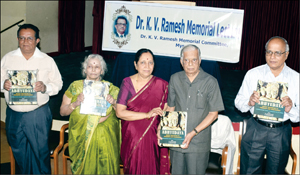
Prof. A.V. Narasimha Murthy (second from right), Chairman, Bharatiya Vidya Bhavan (BVB), Mysuru, released the Commemoration Volume “Abhyudaya” brought out in honour of late Dr.K.V.Ramesh, an erudite scholar and an epigraphist of international-fame, edited by Dr.T.S. Ravishankar (extreme left) and Dr. S. Swaminathan (extreme right), at function in BVB premises in Vijayanagar here recently under the auspices of K.V.Ramesh Memorial Committee, Mysuru.
Prema Ramesh (second from left), wife of late Dr. K.V. Ramesh and Kamalamba Narasimha Murthy are also seen.
The volume contains a detailed bibliography of Dr. Ramesh’s research work and his bio-data.
It has been embedded with 72 pearls (research articles penned by scholars from all over India and abroad).
Published by Bharatiya Kala Prakashana, Delhi, the book is priced at Rs.4,000
source: http://www.starofmysore.com / Star of Mysore / Home> General News / Monday – January 25th, 2016
St Joseph’s Convent High School for Girls will observe its quasquicentennial (125 years) jubilee in a grand manner here on Friday. Superior General of the Canossian Daughters of Charity from Italy M. Annamaria Babbini will be present to witness the celebrations.
Addressing a press conference, school principal Thankam Michael said here on Tuesday that the school had been functioning under the management of the Canossian Sisters Congregation since 1891.
It was founded 125 years ago when the British civilian and military officers petitioned the then Archbishop of Goa to establish an English-medium school here.
In response to the request from the Archbishop, Mother Stella of the Canossians in Hong Kong sent five nuns who reached Cochin by ship and then Belgaum (now Belagavi) covering the distance by bullock cart and on foot. Since then the school has shaped the lives of a large number of girl students of Belagavi, Goa and north Karnataka region.
To commemorate the occasion, the school has given a facelift to basic infrastructure and also launched a project, Light a Lamp, to help the poor and deserving girl students. Donors and philanthropists could sponsor a girl child for education.
About 15 former students, including social activist Olive D’silva, Anita Rodrigues, Ruhi Sait, Padmashree award winner Sucheta Dalal, psychiatrist Belinda Viegas Muller, Sadhan Pote, renowned artist and sculptor Veena Chandavarkar and the former Deputy Mayor of Belagavi Asma Tahsildar, who have excelled in various fields, would be honoured.
source: http://www.thehindu.com / The Hindu / Home> National> Karnataka / by Special Correspondent / Belagavi – January 21st, 2016
Anjanappa performing at an event.— photo: by Special Arrangement
70-year-old Anjanappa from Gudibande taluk learnt to play Mukhaveni, an instrument that resembles a flute, from his father and grandfather
If you happen to see this 70-year-old musician at a public place seeking alms while playing an instrument that resembles a shehanai or a flute, do not dismiss him as just a beggar. Anjanappa is not only a gifted musician, but also one of the last links to Mukhaveni, a wind instrument.
The art of playing Mukhaveni is in his genes as Anjanappa, who hails from Gauguntehalli of Gudibande taluk in Chickballapur district, learnt it from his father and grandfather, who were professional musicians. He has mastered the art of playing Karanji, a piped instrument that involves taking in water from one nostril and leaving it through another, besides Panchavaadhya. Sometimes, he also enthrals the crows by playing all three instruments at once.
Besides Karnataka, Anjanappa has performed in Tamil Nadu, Andhra Pradesh and Kerala. “I play the songs from the films of matinee idols of the respective States at concerts,” he says. Despite mastery over this instrument and huge popularity, Anjanappa lives in poverty.
“My music is not for sale. I will never fix a price for my music,” says Anjanappa, when asked why he should not quote a price for the music shows, which he performs at the request of various organisations.
“But, I accept whatever these organisations give me. While some pay a few hundreds, some have even paid Rs. 25,000. However, what they give is not my concern at all, because my main aim is to entertain the crowd with my music,” he says. He does not feel bad about getting alms from people after playing music. “It is a reward they give if they are satisfied. And this is how I lead my life,” says the humble musician.
The Kannada and Culture Department has sanctioned a monthly pension of Rs. 1,000 for him. But, that is not enough for this musician, who has a family of 10 members, who are farm labourers.
“I got a cash reward of Rs. 3 lakh. I used it to build a house for my family. I have built the walls. But I do not have money to put the roof over them,” says Anjanappa, whose dream is to complete his humble house.
However, more than completing the construction of the house, what bothers him is that nobody is willing to learn his music. “I taught these skills to one of my sons. But once when he was playing it outside a house in Mysuru, the owner got annoyed and scolded him by saying that he was wasting his life like his father. My son took it seriously and broke the instruments. Since then, he has not touched them,” says Anjanappa, who is eager to pass on the music tradition so that there will be somebody to carry forward his legacy.
Anjanappa (70) from Gudibande taluk learnt to play Mukhaveni, an instrument that resembles a flute, from his father and grandfather
source: http://www.thehindu.com / The Hindu / Home> News> Cities / by B.S. Satish Kumar / Bengaluru – January 11th, 2016
The St Joseph’s Indian Educational Institutions located on Vittal Mallya Road is all set to celebrate 110 years of its existence. The institutions have relentlessly transformed thousands of lives over the years.
It was started in 1904 by priests of the Paris Mission Society. They first began working out of the basement of St Joseph’s European School building on Residency Road before the management of the school was taken over in 1937 by the Society of Jesus. In 1968, the school moved to its current location on Vital Mallya Road. In the last 110 years, the institutions have had more than 50,000 students pass out.
Currently, St Joseph’s Indian Educational Institutions encompass a complete range of educational institutions such as St Joseph’s Indian Primary School, St Joseph’s Indian Middle School, St Joseph’s Indian High School, St Joseph’s Indian Composite PU College and St Joseph’s Community College.
Talking about the philosophy of the school, Fr Sunith Prabhu SJ, director St Joseph’s Indian Composite PU College and director of St Joseph’s Indian Middle School, says “We have always mentored and trained our students to be able to face the competition in the outside world. We not only prepare them academically but also to face life. There are 23 clubs in the school and every club has its unique activities that do well to mould the personality of the students,” he explains.
The education is predominantly value-oriented with a special emphasis on providing educational opportunities to the poor and the disadvantaged sections of society. Fr Gerald Furtado, principal of St Joseph’s Indian Composite PU College, says one of the biggest strengths of the institution is the importance given to sports.
“We not only give importance to academics but also to sporting activities so as to keep the students physically, emotionally and mentally active,” he shares. He also says, in addition to sports the management also stresses on every student enrolling in extra-curricular activities.
One other significant wing of the institution is Community College which was started 10 years ago. Fr Melwyn Lobo, director of Community College, states that the courses have been thoughtfully designed in keeping with the current business trends in the market.
“Our emphasis is on the character formation of students through our many programmes, giving equal importance to students, from all classes of society and the importance on sports has given us that extra edge,” explains Fr Melwyn.
The school has produced some of the best minds across the country which includes several social activists, sports personalities and politicians. The list is rather exhaustive but a few notable names among them are TV Mohandas Pai, Kumar and Madhu Bangarappa, Ashok Kheny, actor Prakash Rai, singer Rajesh Krishnan and theatre artiste Sunder Raj just to mention a few.
St Joseph’s Indian Educational Institutions will celebrate the completion of 110 years with a two-day programme on January 10 and 12.
source: http://www.deccanherald.com / Deccan Herald /Home> Supplements> Metrolife / by Nina C. George, DHNS / January 08th, 2015