Category Archives: Amazing Feats

D. L. Narasimhachar: The Epitome Of Scholarship

Narasimchar01BF06mar2019

He was an ace linguist, grammarian, lexicographer, editor of numerous volumes, epigraphist and literary critic. He roughly churned out 80 research articles in 40 years in both Kannada and English. Always seen in a close collared coat and dhoti, he was humility personified. The Government of Mysore conferred on him the Kannada Rajyotsava Award. And in recognition of his Lifetime contribution to the world of Kannada Studies, the University of Mysore bestowed on him an Honorary D. Litt in 1969. He is D. L. Narasimhachar, the epitome of scholarship.

By Dr. S. N. Bhagirath

Doddabele Lakshmi Narasimhachar was born on 27th October 1906 in Chikkanayakanahalli, Tumkur district. His father Shamayya Iyengar was a clerk in the Sub-Registrar’s Office. His mother Lakshmamma was daughter of Annaswamy Iyengar, known for his rendition of Mahabharata (Bharathavachana). D.L. Narasimhachar (DLN) spent most of his childhood at Annaswamy Iyengar’s house and he had mastered “Jaimini Bharatha” by the age of 12 ! His family had migrated from Salem during the Vijayanagar Empire’s reign.

Narasimhachar had his schooling at Pavagada, then at Madhugiri and Sira. He learnt Sanskrit through private tuition. While in school, he was an avid contributor to the school magazine “School Folk” which was started by Principal Krishnaswamy Iyer. His earliest articles were an English article titled “The Story of a Cotton Seed” and a Kannada article titled “Dodda Manushyaru Yaaru?” In his school years, he had read works of Raghuvamsa and Champunarayana. During these school years, B.M. Srikantaiah once paid a visit to DLN’s school and took a class on “Stories from Aeneid.” This class captured DLN’s attention and fostered an ardent devotion to B.M. Srikantaiah under whose aegis he would later complete his Master’s qualification.

Narasimhachar joined Central College, Bangalore, in 1927 for his Bachelor’s Degree. His chosen subjects here were Chemistry and Physics. As he scored high marks in Kannada, he joined MA Course (in Kannada) at Maharaja’s College, Mysore. Here, his classmates included K.V. Puttappa, K.V. Raghavachar, Anantarangachar and K. Venkataramappa. While at Maharaja’s College, he came under the tutelage of B.M. Srikantaiah, Rallapalli Anatha Krishna Sharma, C.R. Narasimha Sastry, T. S. Venkanayya and A.R. Krishna Shastry. During his free time, he would frequent Oriental Research Library to peruse old Kannada manuscripts. Narasimhachar completed his MA in 1929 and was awarded the H. V. Nanjundaiah Gold Medal.

DLN was among the first to secure a research grant set aside for the Kannada Department. The Research topic was on the period during which Veerashaiva Literature developed in Karnataka. His first job was as a resident lecturer at Oriental Research Library. Concurrently, he was taken in as a part-time lecturer at Maharaja’s College Kannada Department.

DLN married Muthamma, last daughter of Tiruvallur Sreenivasa Raghavachar, who was himself a great Kannada Scholar. Raghavachar’s residence was a treasure house of rare Kannada books. Narasimhachar utilised this veritable library and penned “Pampa Ramayana Sangraha.” The couple’s first issue was a daughter by name Rajalakshmi. Their second child, a boy, died early in his childhood and this was a great loss to the parents. They would have four more children — Prabha, Padmini, Jayashree and Madhavi.

DLN is famously believed to have dissuaded his first daughter from pursuing Kannada Studies for BA degree. He felt that if she happened to secure a first rank in BA degree, then the gossiping tongues would blame him for favouritism and nepotism !

DLN had a penchant for ‘snuff’, something he picked up from his close friend Kuvempu. Interestingly, Kuvempu is believed to have later given up the habit, whereas his friend continued it till his later years.

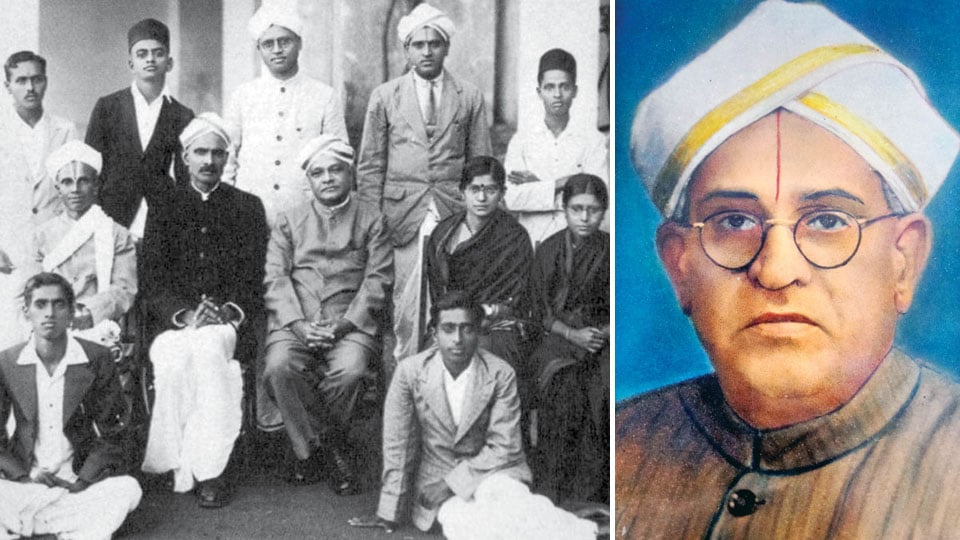
D.L. Narasimhachar (standing second from right); T.S. Venkanayya (sitting second from left), B.M. Srikantaiah (sitting third from left) and G. Venkatasubbaiah (squatting on floor – extreme right). Others’ name not known. (File photo)

Narasimhachar was appointed full-time lecturer in Kannada in 1932 at Maharaja’s College. He remained here for the next seven years and was deputed to the Intermediate College in Mysore (present day Yuvaraja College) from 1939 to 1941. His promotion to the post of Assistant Professor saw him being transferred to Bangalore Central College in 1945. By 1948, he was promoted and consequently transferred back to Maharaja’s College, Mysore.

In 1954, he was appointed Chief Editor of the ‘Kannada-Kannada’ Dictionary Project — a role which required him to again relocate back to Bangalore! Two years hence, by 1956, he was promoted to the post of Professor and came back to Maharaja’s College where he would teach for the next six years before retiring in 1962. His teaching tenure spanning thirty years from 1932 – 1962 was divided almost equally between Mysore and Bangalore.

Following his retirement in 1962, he was appointed UGC Research Fellow for the next six years at the University of Mysore — Department of Kannada Studies. On the demise of T.N. Srikantaiah, he took over the position of Chair of ‘Kannada-Kannada’ Dictionary Project. He eventually presided over the official release of the first edition of the Dictionary. During these years, he published his magnum opus on the art of ‘editorship’ titled “Kannada Grantha Sampadane.” This hectic schedule sadly resulted in him suffering his first heart attack in 1965. Between 1959 and 1963, he edited the prestigious academic journal “Prabuddha Karnataka” on behalf of Prasaranga of Mysore University.

Narasimhachar delivered many lectures on Mysore Akashvani (later AIR). His radio address in 1943 on contemporary Kannada poetry dealt with many elements, which critics later considered to be an early foretelling of ‘Navodaya Literature.’ He penned a memorable preface to K.S. Narasimha Swamy’s famous work “Shilalathe.” His love for ‘Halegannada’ saw him evince keen interest in Epigraphical studies — resulting in a close involvement in the publication of successive volumes of ‘Epigraphia Carnatica.’

His closest acquaintances included T.N. Srikantaiah, N. Shivarama Shastry, K.V. Raghavachar, T.P. Krishnachar, K. Venkataramappa. S. Srikanta Sastri and Kuvempu. Among his list of friends were the likes of V. Raghavan, N. Anantarangachar, Pu.Ti. Narasimhachar, Gorur Ramaswamy Iyengar, D. K. Bhimasena Rao, Manjappa Bhatta, M. R. Sreenivasa Murthy and A. N. Murthy Rao.  Among his illustrious students were Parameshwara Bhatta, D. Javare Gowda, H.M. Shankar Narayan Rao, M. Chidanandamurthy and T.V. Venkatachala Sastry.

DLN authored four major works in Kannada, edited about nine comprehensive volumes, penned about eleven prefaces, close to eighty-odd articles across three decades, seven monographs in English and four masterly introductions to various books. His introduction to ‘Vaddaradhane’, ‘Pampa Ramayana Sangraha’ and ‘Sukumara Charitam’ are the best of their kind in Kannada.

Narasimhachar’s scholarship was vast. In fact, it is believed that T.N. Srikantaiah once remarked that “DLN’s name was synonymous with scholarship!”

Maharaja’s College Group Photo (undated) shows (sitting from left) Prof. Chandrashekhar Pattankar Bhat, M.R. Varadachar, Lakshminarasimaiah, M.H. Krishna, A.R. Krishna Sastri, Name unknown, Name unknown, Dr. S. Srikanta Sastri and Ralapalli Anantha Krishna Sharma; (standing bottom row from left) Name unknown, Name unknown, Name unknown, V. Sitaramaiah, K. Venkataramappa, Prof. Nam Sivarama Sastri, Dr. D.L. Narasimhachar and Chengalvarayan. Others’ name not known.

He was an ace linguist, grammarian, lexicographer, editor of numerous volumes, epigraphist and literary critic. He roughly churned out eighty research articles in forty years in both Kannada and English. Always seen in a close collared coat and dhoti, he was humility personified.

He was honoured on multiple occasions by the Kannada Sahitya Akademi. He presided over the 41st Kannada Sahitya Sammelana at Bidar in 1960. He received two Felicitation Volumes — “Jnanopasaka” (1960) and “Upayana” (1967) with rare articles penned by subject experts and close friends. The Government of Mysore awarded the Kannada Rajyotsava Award. In recognition of his Lifetime contribution to the world of Kannada Studies, the University of Mysore bestowed on him an Honorary D. Litt in 1969.

The relentless pace of work sadly resulted in a second fatal heart attack on the night of 7th May 1971. He was 65-years- old at the time of his death. He is cherished by generations of Kannada scholars (many of them his students) who remember his affable, affectionate bearing which often concealed a mountain of intellect.

The Mysuru City Corporation (MCC) has named the Fifth Cross Road in Saraswathipuram after this great soul.

(bugs2beatles@gmail.com)

source: http://www.starofmysore.com / Star of Mysore / Home> Feature Articles / by Dr. S.N. Bhagirath


TEDx event at Ramaiah Institute of Technology today

Anuradha Vikranth believes that dance enhances the personality and helps to connect with oneself and will be attending the TEDxMSRIT event as a speaker.

Ramaiah Institute of Technology (Photo | RIT Website)

The talks at the conference, called TED Talks, are then made available on TED.com. Ramaiah Institute of Technology, Bengaluru is organising an independent TEDx event on March 2, 9am to 5pm. Renowned speakers will be joining the event. Anuradha Vikranth is a danseuse who has incorporated dance into every aspect of her life. She believes that dance enhances the personality and helps to connect with oneself and will be attending the TEDxMSRIT event as a speaker.

Other speakers include Archana Timmaraju, who has a hearing impairment, and Daniel Sundaram.
Through sheer grit and hardwork, Timmaraju embarked on a journey called ‘Silent Expedition’  with her partner Sundaram to empower the community across India. Dr Prabha Chandra will also be present at the talk.  He is the Head of Psychiatry at NIMHANS and has spent the larger part of her career exploring and unravelling the intricacies of the mind and will enlighten the audience with a talk on the complexities of the mind.  Cohan Sujay Carlos is a researcher and the CEO of Aiaioo labs. The speaker’s brainchild, Mechanical Chef, is a robot that can cook more than 100 Indian dishes.

Kim Sain Jidung will also be joining the panel and is actively involved in the drive against prevention of sex trafficking and empowering survivors to lead a transformed life. Girish Badragond is the son of a farmer and is currently a partner at Santepp Systems, a fast-growing technocrat proprietary firm in the field of agricultural technology manufacture. N M Prathap will also speak at the event and is well-known for being the epitome of a small-town boy from Mandya making it big in the world. He won a gold and silver medal and $1,0000 in International Robotics Exhibition held in Tokyo in 2017.

The event will be held at Ramaiah Institute of Technology, Bangalore, on March 2, 9 am – 5pm. Tickets are priced at `800 and available on http://bit.ly/TEDx_Tickets.

source: http://www.newindianexpress.com / The New Indian Express / Home> Cities> Bengaluru / by Express News Service / March 02nd, 2019

Inspiring village near Karwar shows the way forward

If you want to know what a model Green Village looks like, then you have to visit Satageri near Karwar.

Solar light and battery at a house in Satageri

Karwar  :

If you want to know what a model Green Village looks like, then you have to visit Satageri near Karwar. Until three years ago, women had to blow and invariably inhale the smoke while cooking on firewood. Not any more. Now they boast of an LPG connection. This is not the only clean and green change in this village.

Satageri, located about 25 km from Karwar and surrounded by forests of the Western Ghats, proudly displays solar power, LPG connection and toilet in every house. Solar lamps light up the houses. People do not throw any waste on the streets, and even make vermicompost for use in their garden and fields. The village, with 70 houses and a population of about 270, sets an example of how people can live with forest and nature without harming it.

“We are happy to live here and nobody is interested in leaving the village any more,” says Gajer Vaikuntha Marathe, a farmer from Satageri.The villagers cannot thank the forest department enough for the change that it ushered into their hamlet over three years ago. The forest department took Satageri under its wing in 2016, as part of the Green Village and Smokeless Village schemes of the state government.

LPG cylinder and gas stove;

It distributed free LPG connections and two solar light systems to each house. A total of 12 solar street lights were also set up.According to a senior forest officer, since 34 houses already had LPG connections, they distributed free connections to the remaining 36 houses. All the people were also given fruit and flower saplings, and encouraged to grow trees near their houses. The place has now been converted into a Green Village.

The situation was far different here earlier. The village was like many others in the country. People collected firewood from the forest, electricity was a nightmare during the monsoon months and the surroundings, though enveloped by a verdant green cover, were not clean.Women had to go to the forest every day to collect firewood, otherwise they faced shortage to meet the daily household needs, says Malita Mohan Marathe, talking about how the practice has been stopped over the last three years since food in every house is now cooked using LPG.

Gajer Vaikuntha too points out that all the villagers have happily adopted the new way of life. Each house got a toilet constructed under the Gram Panchayat scheme.Vinod Marathe, who runs an autorickshaw, says he earlier used to pay `100 towards the electricity bill every month, but the charges have come down by half after solar light system was installed at his house. His family uses electricity only to watch TV, and to run the refrigerator and mixer-grinder while the house is lit using solar power.

Satageri has a primary school, and after completing Class 5, children travel 3 km to Ulga village for pursuing higher education, including graduation and some professional courses. People here are engaged in various occupations, including farming, daily wage labour, and small businesses. Some of them work in Karwar and other nearby towns while four persons hold government jobs. Women mostly look after the house and work in their fields.

They are also involved in making vermicompost, and are part of the Village Forest Committee (VFC), that strives to conserve the forest and wildlife, and protect it from poachers. They plant saplings and take up other work with the forest department, for which the latter shares its profit with the VFC.Satageri, which comes under Gopishitta range forest, was selected to be developed as a model village in 2015-16, says K Ganapathi, Deputy Conservator of Forests, Karwar Division. He lauds the women of the village for their commitment towards protecting the forest. “We wish such VFCs come up in other villages too,” Ganapathi says.

What is a Green Village?
State forest department’s Green Village scheme aims to make the whole village smokeless by making people stop using firewood and opting for LPG stoves. Satageri village of Karwar taluk was selected under the scheme on a pilot basis.

Tackling Poverty
More than 65 families of the village have Below Poverty Line (BPL) cards, and all of them have enrolled in Mahatma Gandhi National Rural Employment Guarantee Act (MGNREGA). They have been earning money by taking up activities such as developing  the school ground, desilting the pond, and other  works.

Natural Treasures
The village is surrounded by the thick and evergreen forest of Western Ghats. Along with precious wood, it is home to wildlife such as leopard and black panther. The Kali river flows just a few kilometres away from the village.

source: http://www.newindianexpress.com / The New Indian Express / Home> States> Karnataka / by Arunkumar Huralimath / Express News Service / February 24th, 2019

New imaging technology to the aid of manuscripts

Professor P.R. Mukund and MegaVision president Ken Boydston with the multispectral imaging.

It is currently being used on rare texts in Udupi’s Ashta Mutts

Thousands of manuscripts scattered across India — many lying in neglect or threatened by the exposure to vagaries of nature — are facing threats of destruction. To preserve them, a Bengaluru-based not-for-profit organisation has procured a highly advanced multispectral imaging technology to capture their images. The technology is currently being used on rare texts in the Ashta Mutts of Udupi.

What is special about multispectral imaging is that it can capture texts in manuscripts that are affected by pests, fungus, over written, scribbled, blackened or scraped and cannot be seen with bare eyes. It uses infrared rays and ultraviolet rays to retrieve texts.

Its importance

“Mapping of knowledge is important in the current context. People are not bothered about these manuscripts because they do not see a direct relation with them and understand the importance of the stuff in it,” says P.R. Mukund, professor, Electrical Engineering, at Rochester Institute of Technology and founder of Bengaluru-based Tara Prakashana. “We have brought the technology for the first time in the country and the services would be offered for free. Our aim is to preserve the important written scripts in the country for posterity,” he said.

Tara Prakashana has acquired the imaging system from the U.S.-based MegaVision, a leading digital imaging company, that has worked in similar projects across the world and MegaVision president Ken Boydston has been training people in handling the multispectral imager over the last week.

Prof. Mukund’s interest in developing technology that would help conserve the knowledge for posterity started more than a decade ago when his guru Bannanje Govindacharya sought his help in conserving the 800-year-old Sarvamoola Grantha, authored by Saint Madhvacharya. The text is in the possession of Palimar Mutt and was found to be in bad shape in 2006.

“At that time, I did not have any idea about processing of manuscripts. Help came from a fellow professor from the imaging department at Rochester,” said Prof. Mukund. Since then, more than 3,000 rare manuscript bundles have been digitised, a small part of which has now been published into 500 archival books and nearly 1,000 more archival books will be ready shortly. Currently, ancient texts belonging the lineage of Saint Madhvacharya that are in the possession of the Ashta Mutts in Udupi are being digitised using the technology.

For Mr. Boydston, his association with the project comes from his love to protect ancient works, though he says cultural imaging is still not profitable. “I get to meet people who really know stuff. Even if no money is being paid, there is a lot of stuff to do. Objects [antiquities] have great value. Experts know historical contents and to be in the project is a great honour,” he said.

“We want to make the imaging complete and accurate following which several bundles of copies can be generated to preserve the knowledge for future generation,” said Mr. Boydston.

The next stage

The conservation efforts does not stop at capturing the images of manuscripts. While creation of e-library of manuscripts for the scholars to retrieve and research is currently under way, Tara Prakashana has published about 500 books of manuscripts.

“We have used the acid-free cotton archival paper for publishing these manuscripts. These special papers can last another couple of hundreds of years,” said Prof. Mukund.

To enhance the time span of the texts captured in images, a patented technology developed by Prof. Mukund called the wafer fiche, is being used. Using photo lithography technology, the images are imprinted on silicon wafers. “These copies can last for thousands of years,” he said.

source: http://www.thehindu.com / The Hindu / Home> News> Cities> Bengaluru / by Sharath S. Srivatsa / Bengaluru – February 17th, 2019

This device can convert text to Braille in real time

Two students from MVJ College of Engineering have developed a device called  ‘bBook’ that converts text into braille in real time.

The students took five months to create the device

Bengaluru :

Two students from MVJ College of Engineering have developed a device called  ‘bBook’ that converts text into braille in real time. Once a person with a visual impairment places the device over the text, it uses the six pins on its surface to convert the text.

A small camera in the bBook is used to scan text, which is then processed and the data generated is used to drive a braille unit. This unit gives the input character equivalent to braille. “A person can also download the latest news articles. A specially designed audio interface will be available, which will enable the user to use voice-control,” said Rohit Natesh, a student at the college.

The device can also be connected to mobile phones in order to receive notifications from the bBook application. It works in three speeds – slow, medium and fast – that is 4 seconds, 2.5 seconds and 1.5 seconds. They have been working on the device for five months now. “It has been a pleasure to work with my students. We hope to receive more feedback from blind schools,” said Desikan Srinivasan, assistant professor at MVJ College of Engineering.

source: http://www.newindianexpress.com / The New Indian Express / Home> Cities> Bengaluru / by Aarthi M / Express News Service / February 06th, 2019

Bengaluru couple opens up home and heart for young girl

The massive engine whirrs beneath your body, wind strikes your face and your hair whips around you.

Meeta and Amit Walavalkar applied for adoption in 2016

The massive engine whirrs beneath your body, wind strikes your face and your hair whips around you. Every action has an immediate consequence when riding, according to Meeta Walavalkar, whose life motto is to live in the moment. However, the 40-year-old mother of three has not gone riding in the last 45 days.

On December 17, 2018, Meeta, her husband Amit, and their two sons welcomed their three-year-old daughter, Shambhavi, into their home. “My husband and I were so busy with all the paperwork at the time that we did not actually take in the fact that one of the ten children inside was going to be our daughter. We were more concerned about how she would react to coming home or if she would have any language barriers,” said the owner of Soul Bakery, which supplies organic food to Chennai and Bengaluru.

However, she said her two sons, Ved and Darsh, were inside, spending time with their new sister. Shambhavi, who came to Bengaluru from Chattisgarh. Now, she’s seen her 13-year-old and 10-year-old sons become protective of their sister.

In March 2016, after attending an inner engineering workshop with Sadhguru, the Bengaluru-based NGO consultant and her husband came away feeling lighter – spiritually and mentally. Meeta told her husband that she wanted to adopt a girl child, and Amit was onboard. After some discussion with her family, they applied for a girl child through the Central Adoption Resource Authority system, and two-and-a-half years later, they brought their daughter home.

Her name, Shambhavi, is the energy form consecrated in Sadhguru’s ashram in Coimbatore, said Meeta, who is a follower who can perform pujas. The day before Shambhavi came home, Meeta reminded her sons to express any concerns without fear of judgment.

The three-year-old loves school, and wakes up every day excited to learn. “She comes home before they boys do, and asks when her bhaiyas will come home. Before, the boys would come home, eat something, and go out to play. Now, they spend some time with their little sister before going,” said Meeta.

Coming from a family with many male children – Meeta’s father had two brothers, as did Amit’s father, and she has two sons – Meeta has found little changes in her parenting. “With the boys, if they fall and hurt themselves, I just have to put a little dettol and send them off. I’m not used to mollycoddling my children, but Shambhavi wants to be held and cuddled if she falls,” said Meeta.

There was some hesitancy from her and Amit’s parents initially. Meeta had a bustling daily schedule, and caring for a child would take up a lot of time. When the topic was broached to her parents, Meeta’s father was averse to the concept. “Now, he videocalls every other day to see her. You know the Queen song Bohemian Rhapsody? She calls out to him the same way they sing ‘Mama…’ in the song. So she’ll go, ‘Ajuba…’ and call out for him,” said Meeta.

Shabhavi has a high emotional intellect for a child her age, said Meeta. “The other day, my father called, and he had hurt his hand. He showed it to her, and she was very affected by it. She came into our room crying, saying that her Ajuba was hurt,” said Meeta. Another trigger for Shambhavi was when her plate was taken away from her, as in the funds-strapped orphanage she grew up in, that was a sign of having no food.

Meeta and her husband know that eventually, Shambhavi will want to meet her parents. “All I hope is that the process goes as smoothly as possible, for her. We will be there with her, of course,” said Meeta.
It’s too soon to plan for the future, she said. Meeta is not one to live in anything but the present, but for one instance – “When we ride, I take the youngest and Amit takes the older one. Now with Shambhavi, we need to figure out a way to take all of them when we go riding next.”

source: http://www.newindianexpress.com / The New Indian Express / Home> Cities> Bengaluru / by Rochana Mohan / Express News Service / February 04th, 2019

BMTC driver, conductor get Good Samaritan award for saving constable’s life

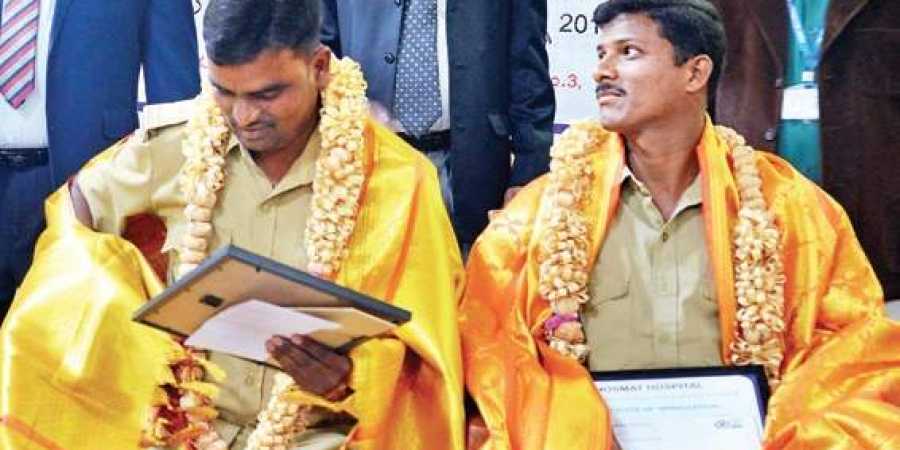
The duo were felicitated with the ‘Good Samaritan Award’ by HOSMAT Hospital on Saturday. This is the second such appreciation the duo has received and they are very happy.

PolicemenBF03feb2019

Bengaluru :

Little did Gangadhar (29), a BMTC driver, and Srinivas, a conductor, think that their Good Samaritan act of saving a constable’s life will bring them so much appreciation and calls from people across the state.

The duo were felicitated with the ‘Good Samaritan Award’ by HOSMAT Hospital on Saturday. This is the second such appreciation the duo has received and they are very happy.

“From an auto driver who wanted to write our names on the back of his auto to our MD of BMTC, we have been appreciated,” said Gangadhar, who has been a driver with BMTC since the past six years, and a native of Hassan.

Recalling the day, Gangadhar said, “On December 29, around 8pm, after finishing our duty, we (he and the conductor) were heading towards Nelamangala from Yelahanka when we saw a crowd of people. I stopped the vehicle thinking people were waiting for a bus but then I noticed a severely injured man in a pool of blood. There were severe injuries on his head and over 50 onlookers were standing there taking videos.”

He continued, “We immediately shifted the victim into the bus and went to the hospital.”

HOSMAT Hospital’s chairman and chief of Orthapaedics, Dr Thomas Chandy who presented the awards to the duo, appreciated them for their courage and kindness.

“It is rare that we find such people. HOSMAT sees at least 25 to 30 accident cases every day and we come across at least 20 per cent of people who would have died due to people not risking to bring them to the hospital on time. Such compassion is needed,” he said.

source: http://www.newindianexpress.com / The New Indian Express / Home> Cities> Bengaluru / by Express News Service / February 03rd, 2019

ISRO sets up Human Space Flight Centre in Bengaluru for manned mission programme

Gaganyaan is the “highest priority” for ISRO in 2019, according to the space agency, and the plan is to have the first unmanned mission in December 2020 and second for July 2021.

ISRO Chairman K Sivan addressing press conference at ISRO Head office, in Bengaluru on January 11, 2019. (File |EPS)

Bengaluru :

Gearing up for its maiden manned space mission ‘Gaganyaan’, ISRO unveiled its Human Space Flight Centre here Wednesday.

The space agency is gearing up for the human spaceflight programme by 2021-end that is likely to include a woman astronaut.

Gaganyaan is the “highest priority” for ISRO in 2019, according to the space agency, and the plan is to have the first unmanned mission in December 2020 and second for July 2021.

Once this is completed, the manned mission will happen in December 2021. K Kasturirangan, former ISRO Chairman, in the presence of K Sivan, ISRO Chairman and Secretary, Department of Space, inaugurated the Human Space Flight Centre (HSFC) Wednesday at ISRO Headquarter campus in Bengaluru, the space agency said on its website.

Directors of other ISRO Centres, former Chairman and other dignitaries were also present, it said, adding that a full scale model of Gaganyaans crew module was also unveiled during the event.

HSFC shall be responsible for implementation of Gaganyaan project which involves end-to-end mission planning, development of engineering systems for crew survival in space, crew selection and training and also pursue activities for sustained human space flight missions, ISRO said.

It will take the support of existing ISRO centres to implement the first development flight of Gaganyaan under the human spaceflight programme.

S Unnikrishnan Nair is the founder director of HSFC, while R Hutton is the project director of Gaganyaan.

The Union Cabinet gave its nod for the Rs 9,023 crore programme recently.

source: http://www.newindianexpress.com / The New Indian Express / Home> Nation / by PTI / January 30th, 2019

George Fernandes, the first politician from Karnataka to make it big on national stage

Leaving a mark: George Fernandes THE HINDU ARCHIVES

George Fernandes, who hailed from Mangaluru, was perhaps the first politician from the State to make it big on the national political landscape.

Though many leaders from the State held the charge of key Union Ministries before him, what set him apart from them was the mass appeal he enjoyed even outside the State. From the then Bombay to Bihar, he grew as a tall leader with mass appeal who could deliver electoral victories for his party in those turfs — a career that doesn’t seem to have any parallels in the State. “He was perhaps the only leader from the State to emerge as a national political icon for the railway strike and his underground resistance to the Emergency of the 1970s,” said his brother and politician Michael Fernandes.

Mr. George Fernandes also nursed ambitions to become the Prime Minister, says social activist Nandana Reddy, daughter of Snehalata Reddy who was closely associated with the late leader from 1954.

“He was an incredible trade union leader. Look at the way he led a three-week-long railway workers’ strike, which brought the country to a grinding halt. He had a flair for dramatics and was aware of its role to build and sustain a social movement,” she said. Recounting an anecdote, she said: “He used to say ‘1, Safdarjung Road’, where the Prime Minister then stayed was just a few steps away.”

However, it never came to be. She said that though he was a key follower of socialist Ram Manohar Lohia, he did not have a firm ideological stand needed to achieve his ambitions and him joining the NDA led by BJP betrayed this.

Though Mr. George Fernandes was mostly active on the national stage — first in Mumbai and later in north India — he remained a key figure during the Janata Party years in the State through the 1980s and ’90s.

Former Chief Minister Siddaramaiah, paying homage on Tuesday, said Mr. George had helped him in the beginning years of his political career. He was the key man who influenced JD(U) in the State, then led by Ramakrishna Hegde and J.H. Patel, to form a pre-poll alliance with BJP that eventually helped BJP make inroads in the State. However, in the only electoral foray he made in the State, by contesting from Bangalore North Lok Sabha constituency in the 1984 general elections, he lost to C.K. Jaffer Sharief of Congress.

source: http://www.thehindu.com / The Hindu / Home> News> States> Karnataka / by Muralidhara Khajane & K.V. Aditya Bharadwaj / Bengaluru – January 30th, 2019

Hampi ranks second in New York Times list of must-visit places this year

An aerial view of Vijaya Vittala temple complex on banks of the Tungabhadra River in Hampi; the famous stone chariot | Express

Ballari  :

Hampi has emerged at the second spot in the list of ‘52 places to go in 2019’ published by The New York Times. The UNESCO World Heritage Site figures behind Puerto Rico, which has grabbed the top place for its amazing recovery from Hurricane Maria to rebound as a tourist destination.

Hampi02BF11jan2019

The report recommends Hampi as a favoured place, and talks about its archeological monuments, scenic vistas against the Tungabhadra river, and geological rock formations. “At the heights of the Vijayanagara Empire in the 16th century, Hampi thrived as one of the largest and richest cities in the world. Its architectural legacy lives on in the Southwestern State of Karnataka with over 1,000 well-preserved monuments, including Hindu temples, forts and palaces,” the report says. The description also mentions the difficulty in reaching there, while pointing out the recent air connectivity provided to Ballari from Hyderabad and Bengaluru. Tourists can take up rock climbing and river jaunts in basket boats (coracle), the feature says, while suggesting a few places to stay.

Hampi is the only destination not just from India, but entire South Asia, in the list.While the report brought happiness to experts, they also said that more needs to be done. “Let monuments be protected and showcased in a better manner. It is important for tourism,” Professor C S Vasudevan from Department of Ancient History and Archeology, Kannada University, Hampi, said.

Mallika Ghanti, Vice Chancellor, Kannada University, said that history of the Vijayanagara Empire is popular, and still has many hidden things. “If a proper excavation is done, it will bring out many more surprises pertaining to the lost history, best architectures and sculptures,” she said, adding that development of only Hampi is not enough, since villages around it should also see progress. “There should not be any eviction in the name of development of the world heritage site; it should be a package development,” she said.

source: http://www.newindianexpress.com / The New Indian Express / Home> States> Karnataka / by Subhash Chandra N S / Express News Service / January 11th, 2019