Category Archives: Amazing Feats

12-year-old Bengaluru girl to perform at Carnegie Hall

NilanjanaaBF27apr2016

Bengaluru :

Performing at the prestigious Carnegie Hall, New York, is a dream for any musician. And a 12-year-old Bengaluru girl is all set to live this dream.

Nilanjanaa Jayant will join a handful of musicians like Pandit Shivkumar Sharma and Ustad Zakir Hussain when she performs at the hall in October. The honour follows her victory at the Golden Voices of America competition.

In March, Nilanjanaa’s mother asked her to send an entry for the event. The girl sent a clipping of her performing Frank Sinatra’s popular jazz number Fly me to the Moon.

Declared a winner in the Musical Theater/Disney/Broadway/Jazz category a month later, Nilanjanaa will perform live the same song at Carnegie Hall this October. Winners in other categories will also perform with her.

Music and Nilanjanaa go a long way, recalls her mother, Sangeeta Ananth. “Even as a young girl, she’d hum the tunes of songs really well. When she turned six, we made her join Carnatic music classes. Though she was left-handed, she was expected to put the tala only with the right hand. This she couldn’t digest and refused to attend the classes.”

“I didn’t understand why I had to use my right hand,” says Nilanjanaa, who was later introduced to Bengaluru-based music school Taaqademy, founded by musicians Rajeev Rajagopal and Bruce Lee Mani.

“It was so much more fun learning music at Taaqademy. They encourage you to do what you want to rather than what you are expected to do,” said the 12-year-old.

The only child of JP Nagar residents Jayant Ananthkrishnan and Sangeeta Ananth, Nilanjanaa studies in class VIII at The Samhita Academy, Bannerghatta Road.

Not just Nilanjanaa, even her teacher Ragini Ramanathan will get a certificate of recognition from the Golden Voices of America for having trained her. “When she came to Taaqademy, she showed a lot of potential. Her voice was loud and clear and her pitch would hit the right notes. She is so determined to learn and so hard working that she wouldn’t give up even if she didn’t get it right after trying 3-4 times,” said Ragini, 25, faculty at Taaqademy.

For IT professional Jayant Ananthakrishnan, Taaqademy was the best thing that happened to his daughter.

“The experience with the music school has been very fulfilling. This success is the result of the training she has been getting there. Coming from a south Indian background, people kept advising us against western music, telling us that she will get used to using the right hand to put her talas. But we know we weren’t wrong in choosing Taaqademy,” he said.

“I have a bit of stage-fright. I’m just going to try and calm myself down before I get on the stage there,” said Nilanjanaa, gearing up for an experience of a lifetime.

Golden Voices of America

Golden Voices of America is an international competition, open to all countries for vocalists of different age groups. It began in 2009 under the American Fine Arts Festival.
Vocalists compete on this global platform and the winners get to perform at the Weill Recital Hall in Carnegie Hall and at Bruno Walter Auditorium in Lincoln Center.

source: http://www.timesofindia.indiatimes.com / The Times of India / News Home> City> Bangalore / Deepika Burli, TNN / April 27th, 2016

Shivamogga boy does a Manjhi for his mother, digs well on his own

The PU student dug a 55-ft-deep well to reduce hardship of his mother, at Settisara village in Sagar taluk of Shivamogga district. Photo: Special Arrangement

PU student digs a 55-ft-deep well in his backyard to provide water for his family.

While Dashrath Manjhi in Bihar carved out a 360 foot road along a hillock in memory of his wife, Phalguni Devi, this 17-year-old boy from Settisara village in Sagar taluk has dug a 55-ft-deep open well on his own to reduce the hardship of his mother, who had to make repeated trips to the public well to get water for the family every night after returning home from work.

In the Malnad region, every household with a decent income will have an open well in its backyard.

However, due to poverty, Pavan Kumar’s family could not have such an open well.

His father, Vinayak Hegde, works as a cook and his mother, Nethravathi, works at a printing unit in Sagar.

Pavan’s mother, after returning from work late in the evening, used to make several trips to the local well, about half a kilometre away, to fetch water for the family.

Pavan Kumar, a PU student, said: “I decided to find a permanent solution for the problem by digging a well at the backyard of my house.”

Following advice from Kannappa, a local hydrology expert, Pavan identified the right location for the well and began digging on February 26. As his family could not afford to hire labourers, he worked single-handedly. He took a break of 10 days in March for writing the first PU exam.

After completing the exam, he resumed work and finished digging the well on April 20, working nearly 45 days on the project. “It was really hard to dig the rocky ground under the scorching sun. Finally, at the depth of 53 ft, when water oozed out, I was filled with a sense of fulfilment. After digging two more feet, I completed the work. I am happy that my mother now has respite from having to rush to the public well after coming home from work,” said Pavan.

source: http://www.thehindu.com / The Hindu / Home> National> Karnataka / by Veerendra P M / Shivamogga – April 25th, 2016

Six ladies from city enter into Guinness Book for Creating ‘Largest Crochet Blanket ’

From left: Vasanthi Bhaskar, Sujatha Badri, Navaneetha Jayaram Shetty, Devaki Ranganathan and Lalitha Suresh displaying the Guinness Certificates.

Mysuru :

Six women from Mysuru were among the 2,500 women from across India, who recently made it to the prestigious Guinness Book of World Records for having created the ‘Largest Crochet Blanket’ measuring a staggering 11,148 square metres in size.

This was a pan-India initiative by the Mother India’s Crochet Queens Group, with women from many cities contributing towards this record.

Those from Mysuru who contributed to this world record are: Vasanthi Bhaskar, Lalitha Suresh, Kamalamma Sathyanarayana (not in pic), Navaneetha Jayaram Shetty, Devaki Ranganathan and Sujatha Badri.

The blanket, created by members of the Facebook group Mother India’s Crochet Queens, is made up of 8,000 individual pieces and is the size of one-and-a-half football fields, making it more than three times as big as the previous Guinness World Record, created by a group in South Africa.

This massive blanket was later segregated into 5000 individual blankets and donated to NGOs across the nation, according to Vasanthi Bhaskar.

The Facebook group was started by Chennai resident Subhashri Natarajan in August 2015 to connect with fellow knitting enthusiasts.

The project was a beautiful combination of social media and the old world charm of crochet, says Subhashri.

source: http://www.starofmysore.com / Star of Mysore / Home> General News / Friday – April 15th, 2016

Bengaluru Musician in John Lennon Contest Finals

Bengaluru :

Sandeep Boniface, a city-based musician, has been shortlisted for the coveted John Lennon Songwriting Contest.

His composition Moments of Bliss has been selected as one of the three entering the final round for the award. He is a music composer, singer, keyboardist and music teacher at Canadian International School, Bengaluru.

The contest, named after the former Beatles singer, was started by Lennon’s wife Yoko Ono in 1997. It is a platform for amateur and professional musicians across the globe.

Over the years, Sandeep got many offers to sing for Bollywood films, thanks to his association with musicians from around the country. However, he did not go down that road. “I did not want to cater to a particular market. I wanted freedom to make my own music,” he says.

Being nominated for an international prize has been a dream come true, says Sandeep.

“It is also a privilege to rub shoulders with fellow finalist and Grammy Award winner Ricky Kej,” he says.

Sandeep started learning piano at a very young age and performed for the first time at the local church when he was 10. “One of my earliest influences was the band Bee Gees. I was fascinated by their compositions and the harmony in their music,” he says.

Subsequently, works of French composer Eric Serra created an impact on him.

As a singer, Sandeep learnt a lot from Rab Halford, lead vocalist of the heavy metal band Judas Priest, and Pakistani singer Nusrat Fateh Ali Khan.

He has sung and composed music for numerous radio jingles, TV commercials, documentaries, films and plays. He has also worked with organisations like Nimhans as a music consultant. A couple of months ago, he set up his own recording studio named DJ Nitro Production.

“Winning the award will help me reach out to a global audience,” he says.

source: http://www.newindianexpress.com / The New Indian Express / Home> Cities> Bengaluru / Express News Service/ April 07th, 2016

City architect only Indian at Swiss clock-making competition

Bengaluru:

Dilip Sivaraman, a Benglauru-based architect, believes everything has a soul and requires a human touch. For the same reason, he found love in watches that run mechanically.

“I have always loved the fact that a watch can be powered by you. Till today, I wear the HMT winding watch and it works beautifully,” he said. Little did he know that this passion for watches would make him the only Indian finalist on a global platform for watch-making apprentices.

For Dilip, 38, buying a 1980s clock over a year ago meant revisiting the heritage of clock-making. “I am a purist. So, whatever I buy or have currently in my house is a throwback in time,” said Sivaraman.

However, finding it tough to set the timepiece right, Dilip took to exploring the world of clocks himself. He searched the internet and scoured through online books on clock-making.

Recalling the experience of reading digitized versions of over 200-year-old books, Dilip said, “Most of these were written when technology didn’t exist. While questioning the need for complete traditional clock-making, I decided to integrate the use of technology into it as well.”

Although it took him 18 months, Dilip successfully designed and recreated from the scratch a mechanical regulator clock, which he named Gato.

Last September, while doing a regular follow up on the Academie Horlogere des Createurs Independants (AHCI) website, Dilip chanced upon the AHCI young talent competition for young clock/watch making apprentices. “I showed them the design of my clock while informing them that I’m not a formal student or apprentice. For something that I did out my love for it, they let me complete the project and send in my entry by January,” said Dilip.

Being the only Indian to enter the global competition and emerging among the top ten finalists, Dilip not only received huge support from the watch-making community at Switzerland but also got to meet his icon and renowned high-end watchmaker, FP Journe at the Baselworld watch exhibition in Switzerland this March.

A resident of Murugeshpalya, Dilip has plans to take his passion forward, “I wanted to make a clock that’d last for the next few hundred years and not just perish. At AHCI, I was encouraged to join their community of watchmakers. They have offered to review my work. But, for now, I’m hoping to wind up with Gato and, hopefully, start my next project soon,” he said.

Encouraging Experience

When I started the project I had no idea that it would enter the competition. The clock wasn’t complete and I had to seek an extension of deadline from the event organizers. But when I presented my work at the AHCI competition, watch-makers came up to me asking if I was willing to sell it. That was very encouraging. I hope to see my clock being sold someday and contribute to independent watch making.

source: http://www.timesofindia.indiatimes.com / The Times of India / News Home> City> Bangalore / by Deepika Burli, TNN / April 06th, 2016

Giving Voice to the Voiceless

Dr. Vishal Rao | Pushkar V

Losing one’s voice after an operation is very traumatic, and for patients with throat cancer, it becomes an added burden. India witnesses about 25,000-30,000 throat cancer cases each year, out of which at least 5,000 patients stand to lose their voice box due to the advanced stages of the disease.

Thanks to Dr. Vishal Rao, head and neck surgeon at Bengaluru-based HCG Hospital who has come up with a simple and affordable voice box prosthesis, patients can ‘speak’ again and swallow food.

According to Rao, one of the major disadvantages for throat cancer patients is the loss of their voice box when they undergo laryngectomy, the surgical removal of larynx. This is a hollow muscular organ forming an air passage to the lungs and holds the vocal cords.

Rao, a visiting scholar to the Pittsburgh School of Medicine in the US, says, “The larynx houses the vocal cords through which sound is produced. It also lets air travel from the lungs to the mouth. During laryngectomy, when the trachea (windpipe) and esophagus (food pipe) are separated from each other, an opening is created between them which is called the tracheo-esophageal puncture. The device is placed in this opening. Though the patients can eat through their mouths but they cannot speak due to the absence of the voice box.” Once he saw a villager who couldn’t speak for 16 years because he could not afford the imported device. Rao thought, speech and communication are not only the basic tenet to life force but a right to freedom, peace, dignity and justice. “These poor patients were bereft of this essential means of communication owing to costs only,” he says.

Rao realised there was a need for an improved device with a one-way valve enabling laryngectomy patients to speak. In 2013, he started researching on this problem. He and his industrialist friend Shashank Mahesh came up with a technical plan to develop such a device. After working for two years with engineers, physicists, biomedical and material experts, the voice box was built.

Explaining his innovation, the 37-year-old doctor adds, “Regaining one’s voice is much like a rebirth. We have named the artificial voice box as Aum device, because that sound first resonated across the universe. If air passes through the food pipe into the lungs, it will vibrate and create noise, which can be converted into intelligent speech, with coordination from the brain. As food or water should not fall into the lungs, it is a one-way valve device. It weighs about 25 grams and is 2.5 cm long.”

An imported prosthesis is available for Rs 20,000-45,000 and needs to be changed once in six months. “As 80 per cent of patients belong to the poor socio-economic strata, a majority of them are unable to afford the western prosthesis. Our innovation comes as a boon to them. We have priced it at Rs 50, which is less than a dollar at the moment. Presently, there is a clinical study going on at HCG, after which we will take it to other cities, especially to the regional cancer centres where there is a need for such device,” says Rao.

He has used the device on a few patients. Ramakrishna, a 55-year-old watchman from Bengaluru needed to change his imported prosthesis but could not afford it. “When my voice box was removed,  I was given an imported machine, which  I used for two years. I had trouble eating as the food leaked through the device. I am doing better after using the Indian device,” says Ramakrishna.

With more than 20 national and international publications to his credit, Rao has also received many global awards.

source: http://www.newindianexpress.com / The New Indian Express / Home> LifeStyle> Health / by Meera Bharadwaj / March 26th, 2016

Bengaluru gears up for a new vintage car museum

Car collector Dr Ravi Prakash promises to pull the wraps off over 900 classic beauties

Classic car lovers may soon be spotted wheeling down the state highway more frequently than ever before. Giving the finishing touch to his glossies, doctor-turned-vintage-car-collector Ravi Prakash is almost ready to steer open the doors of a nine lakh square feet property on the fringes of Bengaluru that will house a covetable collection of more than 900 classic cars, together with a range of time-honoured motorbikes and carriages.

Describing it as an ‘auto-history museum’, Dr Ravi says, “More than a treasure trove of vintage automotives, I hope to create an aural-visual and educative experience that every vehicle enthusiast and historian would want to have. The museum will illustrate the evolution of motor vehicles through its exhibits. But more importantly, it will replicate the bygone era, complete with the classic favourites, road networks as well as the people and attire of old times.”

From the Bentleys, Aston Martins and Rolls-Royces to the Mini Coopers, the museum will showcase a diverse collection of glistening steel beauties that could make even the most hard-nosed cynic quiver with excitement. Located on a farmland near Rajarajeshwari Nagar along the Mysore Road, the museum will not just line up the cars in an array. “Expected to be one of the 10 largest vintage car museums in the world, this state-of-the-art venue will promote awareness about old-style vehicles. The property will also comprise an automotive mall, serving as a platform for buyers and sellers,” adds the collector, who himself was a national rallying and racing champion between 1981 and 1984, and is a die-hard fan of the Mercedes Benz classics.

It’s not just this cardiothoracic surgeon who likes to travel back in time. His daughter Rupali also takes interest in old cars. “She is into vintage car merchandising and is quite passionate about it,” sums up Dr Ravi, who dreams to make this museum a major tourist hub in the coming years.

Zooming facts

The museum will be equipped with advanced technology, wherein each car will be displayed under individual sheds.

Among the lot will be a car driven by Motilal Nehru.

Visitors will have access to an enviable collection of 18,000 books and journals on automobiles, apart from other antiques.

Typically, the restoration and modification process for every car takes around six to nine months, while it may also vary between three to four years, depending on the amount of work required on the vehicle.

The restoration of the vehicles is a done by a team of 15 motor experts at a special workshop.

A restaurant featuring car-themed design and decor will be the star attraction of the auto-mall.

A charitable foundation will run the museum, the proceeds of which will be primarily spent for the treatment of road accident victims, while the rest of the money will be used for the acquisition and restoration of cars.

source: http://www.timesofindia.indiatimes.com / The Times of India / News Home> City> Bangalore / by  Reema Gowalla / TNN / March 28th, 2016

2 billion meals for schoolkids, this IITian shows the way

Bengaluru :

Its 12 noon at the government school in DJ Halli, northeast Bengaluru. Hundreds of little faces are fixed on the van that has carried their lunch. For 15 years, every afternoon, the Bengaluru headquartered Akshaya Patra Foundation (APF) has been bringing smiles on faces of 1.4 million children.

And in a few weeks, it will serve its two billionth meal.

APF,founded by IITian Madhu Pandit Dasa, who was conferred the Padma Shri last month, is the world's largest school lunch programme
APF,founded by IITian Madhu Pandit Dasa, who was conferred the Padma Shri last month, is the world’s largest school lunch programme

APF, founded by IITian Madhu Pandit Dasa who was conferred the Padma Shri last month, is the world’s largest school lunch programme.

“I still remember the day when I took the first meal to a government school. The children loved it. I did not believe that we would go with the food the next day. But for 15 years now, we have been able to sustain,” Dasa said. From ensuring that no child in India shall be deprived of education because of hunger, the scheme has won many accolades for its transparency, hygiene and tech savvy delivery of cooked meals.

Says APF CEO Shridhar Venkat: “Growth has not been a challenge but sustainably growing is a challenge. Every time we start a kitchen, children come with a hope that they will get a good meal every day. Ensuring food safety especially at the school level which is the last mile and on a daily basis is a challenge. The road ahead is to implement innovative ideas in operations, fundraising and sourcing. We also would like to freely share our learnings with any organigation or an individual who wants to work on alleviating hunger amongst children.”

APF trustee T V Mohandas Pai told TOI: “I think the reason for our success has been how different competencies which are mutually inclusive and collectively exclusive have come together to fight hunger among children.”

PM Narendra Modi has congratulated the foundation for the milestone. “I am happy to learn that the foundation will complete 15 years of serving midday meal to schoolchildren and will serve its second billionth meal soon. These milestones and efforts inspire many to serve children,” he said.

source: http://www.timesofindia.indiatimes.com / The Times of India / News Home> India / by Seetha Lakshmi, TNN / February 10th, 2016

Bengaluru scientists find drug which could cure malaria with one dose

The Bengaluru solution – Triaminopyrimidine (TAP) comes with many advantages over existing drugs

Bengaluru :

Three scientists from Bengaluru, who led a team of global reserchers looking for an antimalarial drug, have found a fast-killing solution.  After completing some tests, it’ll go in for clinical trials on humans. That this drug has the potential to cure the dreaded disease in one dose makes it more attractive to healthcare providers.

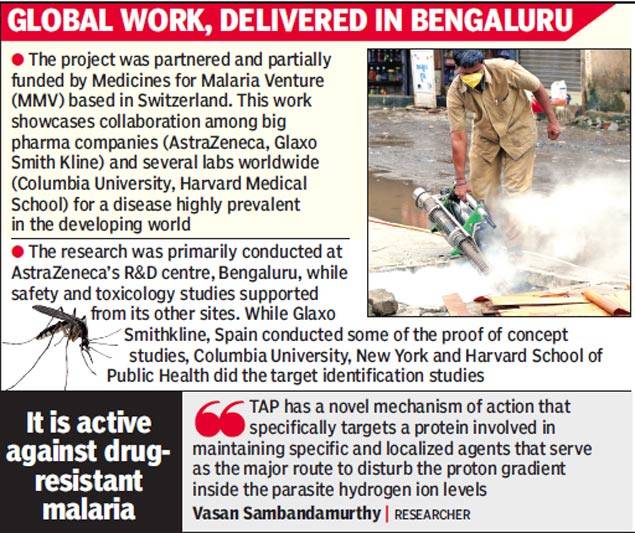
The Bengaluru solution — Triaminopyrimidine (TAP) — comes with many advantages over existing drugs. Vasan Sambandamurthy, one of the senior authors of the research paper, said: “It’s a fast-killing and long-acting antimalarial clinical candidate. TAP acts exclusively on the blood stage of Plasmodium falciparum (the stage responsible for clinical symptoms) in a relevant mouse model. This candidate is equally active against causative agent Plasmodium vivax.”

He added, “The compound has shown good safety margins in guinea pigs and rats. With a predicted half-life of 36 hours in humans, TAP offers potential for a single dose combination.”

The rapid spread of Plasmodium falciparum, the parasite which causes malaria in humans, has left nations battling it with a weakened arsenal and coping with thousands of deaths every year. This parasite has gradually become resistant to available medication.

The World Health Organisation (WHO) estimates that 3.2 billion people in 97 countries, including India, are at risk of being infected with malaria. In 2013, WHO reported an estimated 198 million cases and the disease was responsible for an estimated 5.84 lakh deaths, including 4.53 lakh children less than five years old.

Every person infected with malaria has to deal with millions of parasites and existing drugs have a limited effect in humans. “The half-life, which isn’t more than 2 hours, means it allows parasites to bounce back. Existing drugs are not fast-killing, which means that not only does a human need more doses but each dose is capable of only killing a few parasites,” he said.

GlobalWorkMPOs26dec2015

Besides, a potential side-effect of existing drugs is liver damage. “This doesn’t happen all the time, but the possibility does exist. Also, the parasites have become resistant to these drugs. With TAP, there are now known side-effects and the parasites are unable to develop resistance at the same pace as they do for existing drugs,” he said.
TAP was discovered by a team at pharmaceutical company AstraZeneca. “The main research happened in its R&D centre in Bengaluru between 2011 and 2014, which has since been shut down. It took us three years of rigorous work by teams across the globe. Today, we confidently nominate TAPs as a clinical candidate to treat drug-resistant malaria,” Vasan said. Shahul Hameed and Suresh Solapure were the two other team leaders.

Times View
The discovery of a malaria drug, yet again, highlights Bengaluru’s leadership in scientific research. The promise that the new medicine can kill the virus in a single stroke and act for a long time is good news for malaria patients. While the scientists deserve compliments on working towards a remedy free of side-effects, the companies that will eventually massproduce the drug should look at making it affordable to the aam aadmi. For their part, public health administrators must renew their battle to prevent vector-borne diseases, which cause untold suffering.

source: http://www.timesofindia.indiatimes.com / The Times of India / Home> City> Bangalore / by Chetan Kumar, TNN / April 01st, 2015

Science fiction comes alive as Indian startup grows human liver in lab

Liver team at Pandorum Technologies: Dr. Abdullah Chand, senior scientist (left); Arun Chandru, co-founder and managing director (centre); and Dr. Sivarajan T., senior scientist / @ABHINAV_MAURYA

Pandorum Technologies, a Bengaluru-based biotech startup, has developed an artificial tissue that performs the functions of the human liver.

Pandorum said these 3D printed living tissues made of human cells would enable affordable medical research with reduced dependence on animal and human trials. It will also eventually lead to full scale transplantable organs.

Arun Chandru, 30-year-old co-founder of Pandorum, said liver toxicity and drug metabolism are the key hurdles, and contributors to failed human trials.

Pandorum’s 3D bio-printed mini-livers that mimic the human liver will serve as test platforms for discovery and development of drugs and vaccines. The firm said these drugs would have better efficacy, less side-effects and be developed at lower costs.

“We developed everything here in India,” said Mr. Chandru. “We can grow thousands of these tissues in the laboratory and test the efficacy of drugs on them for diseases including cancer.”

He said large pharma companies on an average spend about $10 billion (Rs. 66,290 crore) and 10 years on research and development to get a single new drug to the market.

Tuhin Bhowmick (34), another co-founder of Pandorum, said development of artificial organs has numerous clinical uses. The cell-based miniature organs can be used to develop bio-artificial liver support systems for preserving life in patients who have developed liver failure.

“In the near future, such bio-printed organs will address the acute shortage of human organs available for surgical transplantation,” said Dr. Bhowmick, who holds a Ph.D. from the Indian Institute of Science.

Pandorum was founded by a group of friends in 2011 who were pursuing their higher studies at IISc. They came together to work on the development of artificial human organs after winning a business competition.

Surviving initially on money from friends and family, the team approached the Department of Biotechnology with their vision. The company was awarded funding support by the Biotechnology Industry Research Assistance Council in 2012. The same year, the company got incubated by the Centre for Cellular and Molecular Platforms in Bengaluru.

Mr. Chandru said they created the innovation with a funding of about Rs. 1 crore, more than half of which came from the government.

Scientists and startups across the globe are growing artificial organs made of human cells to better study diseases and help test drugs. A team of researchers led by Hebrew University professor Eduardo Mitrani is growing pancreas in a petri dish to better regulate blood sugar in diabetic patients.

The global artificial organ and bionics market is expected to reach $38.75 billion (Rs 2.5 lakh crore) by 2020 at an estimated CAGR of 9.3% from 2014 to 2020, according to a study by Grand View Research.

Pandorum’s ultimate aim is to make personalised human organs such as lungs, liver, kidney and pancreas on demand, according to Mr. Chandru.

Pandorum’s innovation takes the area of making artificial organs to the next level. Bengaluru-based bioinformatics firm Strand Life Sciences founded by IISc. professors had earlier developed a virtual liver that mimics the functions of liver through software simulation. It is a predictive method that integrates data and insights for deeper understanding of the impact of a drug on the liver. The platform can predict the toxicity of several known drugs and toxins and explain the mechanism.

source: http://www.thehindu.com / The Hindu / Home> Sci-Tech / by Peerzada Abrar / Bengaluru – December 23rd, 2015