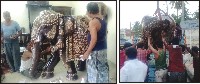
Photographs depicting the Madras Sappers, who designed the Bangalore Torpedo were part of an exhibition exploring India’s role in the First World War
Over a million Indian soldiers fought in World War I of which 60,000 were killed in the fighting.
First encounter, Bangalore Digging deep, Crossing far
Elke Falat and Julia Tieke put together Digging deep, Crossing far, a series of workshops and exhibitions to throw light on hitherto unexplored aspects of the war.
“The objective is to start a discussion on topics in the first World World that are often neglected in the writing of history, such as the German perspective on the prisoner of war camps or how the non-European world was involved,” says Julia. “This is the first part of a long-term project we will continue in other countries. Through questions and archives, we will get into conversation with artists and through them, the audience on topics like war, nation building, propaganda and recognition.”
First encounter, Bangalore Digging deep, Crossing far
Their stopover in Bengaluru, titled ‘First encounter, Bangalore’, was on display at the Max Mueller Bhavan and the Bangalore Literature Festival.
They will also be taking their work to Pakistan, Morocco Tunisia, Algeria, the village of Wunsdorf and Berlin.
“It is not as though we are revealing something new. Everybody knows what we are talking about, but it is not in their collective consciousness,” says Elke.
One of the focal points of the exhibition is the German Prisoner of War camps near Berlin, on which Julia was conducting research for a radio programme.
“I stumbled upon the image of a postcard showing the first mosque built in Germany which was in the camp. Then I found articles by academic institutions which were involved in research on the type and history of sound archives in the prisoner of war camps,” she recalls.
“I thought it was a contemporary topic, it can relate to so many things like the German call for jihad or the relationship between the so-called Western world and Islam. The idea was to involve artists so they would work with the material in different ways and try to get into conversation about what it means.”
These camps, explains Elke, hosted a constellation of Colonial soldiers from North Africa and British India, even Bangalore. And so the exhibition in Bangalore featured four artists who each explored different perspectives of the war in the context of India.
Surekha, a Bangalore-based artist, explored the city’s connection with the war through ‘Black Pepper & Red Pepper’, a series of photographs depicting the role of the Madras Sappers, who designed the Bangalore Torpedo war weapon and the Mysore Imperial Army. The artist captured the bravery and skill of the Indian soldiers; the socio-political context of the war, through the code words ‘Red pepper’ for British soldiers and ‘Black pepper’ for the Indian soldiers; and depictions of the Indian soldiers in the war.
“The photographs printed on aluminium are quite uncanny. They are clear yet capture the passage of time. The people in the photographs appear like ghosts. Viewers will be able to understand what happened just by looking at the photographs, it is almost like a history lesson,” says Elke.
The exhibition featured yet another Bengaluru-based artist, Ayisha Abraham, whose grandfather fought in the war. Through a deconstructed photograph, Ayisha explored the consequences of a self-transformation of identity on his heritage.
Artist-author Sarnath Banerjee offered a national perspective through his notice boards titled The reduced history of the First World War, 2015. Through his series of black and white drawings, he captured scenes from the war featuring the Indian independence as well as the racial contexts.
While Gilles Aubry, a Berlin-based Swiss artist, known for his research on the history of sound, explored the Indian prisoners’ recordings in the German prisoner of war camps. He presented two tuning forks, of the note ‘A’ and the sound ‘Om’ which play in between the recording of a Hindi song sung by an Indian prisoner. He also presented the recording of a voice reciting a translated list of words recorded in the camps.
“His work is a reflection on what these techniques of recording tell us about science, the grammar of power and the knowledge of Colonial practices. He presents a link between Berlin and India,” explains Elke.
source: http://www.thehindu.com / The Hindu / Home> Features> MetroPlus / by Harshini Vakkalanka / Bengaluru – December 07th, 2015
Dayananda Sirigere, a hobbyist inventor who fashions camera lenses and telescopes made from PVC pipes and discarded electronic equipment, has been getting inquiries from unlikely corners. “In September, a businessman called from California,” says the 53-year-old. “He said he will be coming to Bengaluru to meet me as he was fascinated by what I do.”
While most of his equipment costs Rs 5,000 to Rs 10,000 to make, his talents have remained largely undiscovered by shutterbugs. “Until a neighbour came and admired his work, I kept telling him to throw all this rubbish out,” says his wife Ratna Rao.
Dayananda Sirigere and the telescopes/JITHENDRA M
The “rubbish” is about 35 cartons of telescope lenses stacked up in their house in Bengaluru’s Chandra Layout. Sirigere seems completely uninterested in the possibilities of using his skills to pursue a commercial end. He is fired by passion for the “practical” aspect of science.
“In school, I used to wonder what the planets we drew looked like,” he says. “Much later, when I was going through some bad times in the 90s, people attributed it to an unfavourable influence of Saturn.”
This rekindled his curiosity in astral bodies, and he got to work on trying to make a telescope. Years of trial and error followed till 2003 when his efforts came to fruition and his first telescope was ready. “I assembled an optical lens, a mirror lens and a PVC pipe using calculations based on the focal length of the lenses,” Sirigere explains.
When he looked through it, he was overjoyed. He then began working on how to attach a powerful lens to a camera to photograph planets. For this, he used a teleconvertor to enlarge the image.
He finished his first telephoto lens in 2005. “I made a wide-angle lens that covers 180 degrees and another that covers 230 degrees,” he says. The macro lens in his collection has enabled him to photograph the pores in the eye of an ant and air bubbles and droplets of water in a leaf against light. “If you attach it to a video camera, you can see the water movement in leaves,” he says.
His lenses and telescopes have kept him up nights in the open, gazing at the galaxy. “Some parts of the moon reflect more light due to its undulated surface,” he says. “The craters are best visible on the fourth day after the new moon because that side is facing Earth.”
As novel as his hobby is, he is also aware of its amateur nature. “The lenses are too bulky for some people, unlike the professional ones. There’s no way I can build in auto-focus,” he says. Procuring a camera and xerox lenses collecting dust in homes or shops takes time. “Whenever I’m visiting someone or passing by someplace and I notice parts I could use, I ask the owners if I could buy them,” he says.
Once when Sirigere wanted to photograph cricketers in Chinnaswamy Stadium, the security stopped him and asked what he was carrying in his bag. They refused to believe they were lenses. They said, “These look more like AK-47s,” he says with a hearty laugh.
Before he moved to Bengaluru eight years ago, he often let children look at the stars through his telescopes in his native Sirigere, a village in Chitradurga district. “In rural areas, children don’t have any exposure to the practical aspect of science,” he says. With them, he has observed eclipses, the rings of Saturn and four of Jupiter’s moons.
The people and the clear skies of the pastoral countryside beckon, but it might take him a couple of years to shift base. “Ideally, I would like a village not yet penetrated by electricity,” he says.
source: http://www.newindianexpress.com / The New Indian Express / Home> Magazine / by Chetana Divya Vasudev / October 31st, 2015
20 craftsmen took three years to create the 900-kg sculpture
by S. Kenneth Shishir
City artisans, who are also recipients of State Awards, have sculpted a five feet tall elephant from a single block of rosewood.
Artisans Khalil ur Rahman Khan alias Parveez Khan, Fazlur Rahman Khan alias Touseef Khan, Hafeez ur Rahman Khan alias Tanveer Khan and Habeeb ur Rahman alias Asif Khan, sons of late A. Majeed Khan, a recipient of Karnataka State Award in 1985 and National Award in 1991, have sculpted this wooden elephant at their workplace Majeed Fine Arts on Anegundi Road in Mandi Mohalla in city.
Khalil ur Rahman, the eldest among the four brothers, speaking to SOM, said that Mysuru is the birth place for inlay work and is famous for rosewood inlay craft all over the world.
He said that to promote rosewood inlay work and to keep the tradition alive, his father late A. Majeed Khan, established Majeed Fine Arts in city in the year 1972 and since then many artisans have been trained in the inlay work by his father, who have made big names now.
Khalil further said that the Karnataka Government recognising the outstanding and excellent inlay works made by his late father awarded him with a State Award in 1985 and a National Award in 1991.
He said that his brother Fazlur Rahman Khan is a recipient of Karnataka State Award in 1995 and a National Award in 1997 while another brother Hafeez ur Rahman is a recipient of Karnataka State Award in 2003.
Khalil said that his younger brother Habeeb ur Rahman is also a recipient of the State Award in the year 2003 with himself being a recipient of the State Award for the year 2004-05.
When asked why did he and his brothers choose to sculpt an elephant when they could have sculpted anything, Khalil said that getting a single piece of rosewood was very rare and added that he procured the rosewood at an auction in Kushalnagar about three years ago. He further said that he and his brothers decided to sculpt a big elephant from the single piece of rosewood as Mysuru is famous for the world famous Dasara in which elephants play an important role especially during the Jumboo Savari.
When asked whether it was he and his brothers alone sculpted the elephant? Khalil said that they took the help of 20 craftsmen to complete their dream project and sculpted the elephant from a single solid block of rosewood.
He said that to decorate the sculpture they used inlay work. While 60% of the inlay work has been done using ‘Mother of Pearls,’ the remaining 40% work was done using natural wood colours for further decoration of the wooden elephant.
He said that to represent Karnataka, we have used the logo of the State along with our National Emblem on the side and a Gandaberunda on the forehead of the elephant besides birds, animals, flowers, etc.
When asked about the procedure of sculpting the elephant, Khalil said that as the first step, we made a design and drew an outline image and patterns on the solid rosewood block. Then the rosewood was carved into proper shape and cut into three parts (Head, body and tail) to give proper shape. The motifs that had to be inlaid were hand-cut and the area where the motifs had to be inlaid were carefully scooped out and the motifs were inlaid and fixed, he said and added that the sculpture was then smoothened using sandpaper and polished to give a bright look and joined together.
Khalil said that after the elephant was sculpted, it was 5 ft. tall, 3 ft. wide, 6.6 ft. in length and weighed about 900 kgs. The wooden sculpture has been shifted to Cauvery Emporium on Sayyaji Rao Road where it is kept on display now.
source: http://www.starofmysore.com / Star of Mysore /Home> Feature Articles / Wednesday – September 09th, 2015
At the ripe age of 110, Muniyappa is brimming with life. Unlike his peers, he’s not dependent on others. However, a couple of months ago, he began to complain of impaired vision.
Muniyappa and his 90-year old wife Nanjamma underwent cataract surgeries on the same day.
Reason: Cataract, a common eye ailment among the elderly . But thanks to a surgery he underwent recently , the supercentenarian has regained his eyesight.
Old age may mean befriending a walking stick and getting used to blurred vision. However, many have got their sight back in their 90s, because of advancement in medical science.
Muniyappa, who underwent the cataract surgery at St John’s Hospital, is not alone. At Sankara Eye Hospital, over 24 patients aged above 90 have been operated upon since 2013. Most recently, a 91-year-old male patient underwent a surgery to correct a retinal disorder on August 13. Doctors say complications are more when it comes to geriatric patients.
About a year ago, Muniyappa underwent an angioplasty . All was well till cataract clouded his lens and led to blurred vision. Doctors suggested an operation.”With age, the risk increases. He was on blood thinners, so performing the surgery was even tougher, said Dr Mary Varghese, head, vitreo-retinal surgery and associate professor, St John’s Medical College.
An experienced surgeon, she recalled the tense moments she had in the operation theatre. “Since he’d suffered from cardiac ailments in the past, we couldn’t stop him from taking blood thinners. They prevent blood from clotting, which can lead to bleeding during surgery . I was very careful while operating on him. After it was over, I heaved a sigh of relief,” she said.
Muniyappa’s son Krishnamma M told TOI he is able to see clearly . “He has been asked to wear protective glasses,” he said. Muniyappa’s wife Nanjamma, 90, too underwent the same surgery on the same day .
Of the patients operated upon at Sankara Eye Hospital, most suffered from age-related disorders; cataract being the majority (50%), said Dr Kaushik Murali, president, medical administration, qual ity and education. “Other conditions included age-related macular degeneration (ARMD), lid anomalies and tearing and glaucoma,” he said.
Dr Rohit Shetty, vice-chairman, Narayana Nethralaya, recalled operating on a 100-year-old woman in 2005. The team has to factor in aspects like age. “There are chances of dryness and a delayed healing.Complications like bleeding and haemorrhage may also happen,” he said.
source: http://www.timesofindia.indiatimes.com / The Times of India / News Home> City> Bengaluru / by Sunitha Rao, TNN / September 01st, 2015
Here we publish the full text of the convocation address delivered by Dr. A.P.J. Abdul Kalam, the then Scientific Adviser to Raksha Mantri and Secretary, Department of Defence, Research & Development, at the 75th Convocation of University of Mysore on Feb. 25, 1995. — Ed.
Dr. A.P.J Abdul Kalam (second from right) seen with the then Governor-Chancellor Khurshed Alam Khan, the then Higher Education Minister and Pro-Chancellor D. Manjunath and the then Vice-Chancellor Prof. M. Madaiah during the 75th Convocation of University of Mysore on Feb.25, 1995.
by Dr. A.P.J Abdul Kalam
Dare to Dream: I am indeed delighted and honoured to participate in this 75th Convocation of University of Mysore. I have been thinking about what to share with you on this important occasion when you are entering the most eventful phase of your life after years of learning. I know that for the past twenty-years or so you have been continuously taught various aspects by teachers. I am, therefore, not going to extend this process. Instead, I would like to share with you a few of my experiences, one at a place very close to you and others at Trivandrum and Hyderabad.
These are the experiences where people have dared to dream and met with success. Of course, we have to recognise that success is always the result of sweat of individuals and also coupled with many failures. The place close to you is the site of pilgrimage not only for me but for every one who practices rocketry in our country. Let me first tell you something about this.
First War Rocket: When I was studying in school and college, Srirangapatna interested me for two reasons — the place was the scene of battle against foreign rule and also there was a reference to a new weapon introduced. In 1960, when I visited Srirangapatna with my friends, we were thrilled to walk around this historical town. We searched for the Turukhan-hally Fort built during Hyder Ali – Tipu Sultan times and used for making rockets, way back in 1794. I had a tremendous disappointment when I did not see any permanent evidence or historical recordings in Srirangapatna regarding creation or development of first war rocket in the world.
Later, in 1963, I was at Wallop’s Island, the rocket launch facility of NASA in USA, in connection with a collaborative programme of launching of sounding meteorological rockets for research of upper atmosphere. In the lobby of their command-control centre, I saw a prominently displayed picture. The war dress and the colour of the soldiers’ skin attracted my attention. Some dark complexioned soldiers were firing rockets on their white skinned opponents. The label on the painting read, “The world’s first war rocket.” It was indeed a great pleasure to see an Indian feat acknowledged on the other side of the planet. I felt excited with happiness.
I started reading the history of rockets. I had a dream I must see Tipu’s rockets. Time continued to pass. Rocket technology engulfed me and India’s first Satellite Launch Vehicle SLV-3 was launched. In 1980, we had an opportunity to visit London. There, I saw two of the war rockets captured by British at Srirangapatna, displayed at Museum of Artillery at Woolwich in London with the heading “India’s War Rocket.” Probably, Europe learnt rocketry from our Srirangapatna rocket in the eighteenth century! It was a great thrill to see an Indian innovation on a foreign soil, well-preserved and with facts not distorted.
I got the performance of these 2 kg rockets, 50 mm in dia. and about 250 mm in length analysed by our designers. What a simple and elegant design, effectively used in war ! Surely, Hyder – Tipu Sultan would have had talented men who could look at propulsion, material, ignition and build rockets and fly them for war operations. In fact, when we look back to eighteenth century ambience, it is a technology marvel.
I would like to declare today that this land is the birth place of war rockets in the world and offer it my reverence and respect. The tradition continues.
Prof. Vikram Sarabhai – Man of Vision: Nations advance along the course charted by great dreamers. Let me narrate to you an incidence which occurred in 1968. We were working on the configuration of India’s satellite launch vehicle in Thumba. One day, Prof. Vikram Sarabhai, the then Chairman, Indian Space Research Organisation (ISRO), brought Prof. Curien, President, CNES, France, to our laboratory. France was developing Diamont satellite launch vehicles at that time. After focussing on our planned efforts, as an almost spontaneous reaction, Prof. Sarabhai proposed that we should fly India’s fourth stage of SLV-3 as the Diamont’s fourth stage. We had not flown even a meteorological rocket by that time, but Prof. Sarabhai was aware of the possibilities and trusted the capabilities of his team. His dream of SLV-3 fourth stage getting into a French launch vehicle finally came true in the form of apogee boost motor for APPLE satellite, flown by ARI
ANE, the European launch vehicle. This is the vision ! He gave us a 15-year jump in our efforts. With three experimental Indian Remote Sensing (IRS) Satellites in orbit and their images being received in the USA, Satellite Ground Stations with Indian Satellite Launch Vehicle PSLV launching our own satellite from our own land, his dream visualised in 1965 has taken form through the people born at different times. Nations are thus built by men of vision who dream and prepare ground for the coming generations.
Super Computer and Parallel Processing: In 1986, Dr. V.S. Arunachalam and myself went to US to buy a Super Computer with 400 mega flop speed. The Deputy Secretary in the Department of Defence at Pentagon first put us into long series of technical discussions and then regretted the sale on the pretext that we will use it to develop long range missiles detrimental to the security interests of the world. Travelling back disappointed, Dr. Arunachalam said, “Let us make our own Super Computer.” Today, India has a 32 node 1000 M Flops PACE SPARC 10 machine available for other countries to buy. Once we decide, we work and realise even tough dreams. That is what India expects from you.
A team of young scientists and engineers under the leadership of Dr.G.Venkataraman formed ANURAG, that is, Advanced Numerical Research and Analysis Group, to develop a parallel processing computer specially for aircraft design. At that time, AGNI also was taking shape. The payload of AGNI would re-enter the atmosphere at 15 times the speed of sound. Even at this speed, we had to keep the vehicle under control and while the payload outer temperature goes to 3000 degrees centigrade, inside of payload the ambient has to be less than 30 degrees centigrade. We have in India supersonic wind tunnel. We needed hypersonic wind tunnel for designing the AGNI payload. Various wind tunnel data could provide the loads experienced during the re-entry phase of the system. There were tunnels abroad but once they knew the application, they were refused.
This time our high-tech academic institutions rose to the occasion. Prof. S.M. Deshpande of Indian Institute of Science (IISc.) with five young bright fresh scientists from DRDL with background of mathematics and fluid dynamics, developed Computational Fluid Dynamics Software for Hypersonic Regimes in just six months. This software is the original contribution with minimum computational facility available in the world. No country would have given us this type of software. But it was done through optimum partitioning, sequencing and paralleling the task. This software solution has established that brain-power excels man-made machines, even super-computers.
I have seen that India can build her own super-computer; India can fly its own rocket system within and outside the country. Both the dreams have come out of visions. This convocation ambience, where hundreds of young graduates are entering their professional lives, is ideal for thinking about the need of visions for the next two decades. What could they be?
Vision for the Nation: With the growing population, increasing unemployment, unaffordable medical care and changing value system, our society is going through certain turbulent situation. The society looks forward to prosperity. In a decade or two, prosperity and good life is possible if the nation has the vision. Vision generates progress. As an example, we can study the period between 1857 and 1947; it was the vision of freedom which not only got us independence but during the same period in India, vision of independence generated many leaders of excellence in politics, philosophy, history, science and technology and industry. Again, can we dream for a vision to make this nation great — a nation with prosperity and peace?
Enlightened Citizens: The vision of “Enlightened Citizens” calls for a mission of integrating education, occupation and health care as one single entity. For development of self, society and nation, it is essential that hundreds of clusters of villages are divided into multiple blocks of 20,000 families. And each block can be considered as a progress group with certain number of hospitals, schools and agriculture farms which could be growing cash crops, aromatic plants or fish farms.
The experience in Kerala and Tamil Nadu indicates that integration of education and occupation resulted in small families, in addition to promoting self- sustained good life. This enlightened citizen package can be extended to the whole country.
Networking of Major Rivers: We recently conducted a workshop on the subject based on Dr. K.L. Rao’s report “National Water Grid” and Capt. Dastur’s proposal of “Garland Canal.” This has all the dimensions of becoming an important vision for the nation. Nation can aim at linking multiple rivers resulting in water distribution, flood and drought control, navigation and power generation.
Above all, this will bring together the country as it happened during the independence movement, with potential revolution in agricultural output and employment generation. Experts have indicated that this is the right time to take this as a major programme as technology exists today and the country has the capability to finance such a programme.
Today we have: satellite mapping of water resources and river flow aspects; capability to use nuclear energy for large tunnelling in mountains to direct the river flows and technological strength in mechanical, civil and communication engineering. It may be a 20-year programme for the nation.
Energy Everywhere: Similarly, the third area is “Energy Everywhere.” We believe by year 2000-plus, we will have to generate almost 50% more power. Probably, we will have to look for environment clean power. In addition to hydro and thermal energy, the non-conventional energy and nuclear energy has to contribute to power generation for which technological innovation is essential. Even hydro and thermal energy would need newer technologies so that they can provide affordable electrical energy.
Conclusion: Friends! Vision for the nation is in front of you. These dreams are bigger than the individual or group of people. Great things do not just occur; you have to dream about them and work to realise them. You can be a partner to the visions for the country and begin to experience dreams coming true. What you are is God’s gift to you. What you make out of yourself will be your gift to God. I wish you a challenging profession in your respective fields and recall the famous lines:
“The chances have just begun
The best jobs haven’t been started,
the best work hasn’t been done.”
source: http://www.starofmysore.com / Star of Mysore / Home> Feature Articles / Saturday – August 01st, 2015
Tipu Sultan’s notebook. Photo: Shiv Sahay Singh / The Hindu
The lovers of history and connoisseurs of artefacts are up for a treat as the Victoria Memorial Hall is going to display for the first time a notebook belonging to Tipu Sultan, the legendary ruler of Mysore.
The notebook written in Persian (Shikasta) touches on a variety of subjects but is mainly a treatise on the art of artillery. It is divided into eight chapters with introduction dealing with certain tenets of Islam and chapters dedicated to rules for horsemen and piyada (foot soldiers) of his army.
Each page of the notebook consists of nine lines of script. Some pages bear the stamp of the three royal seals while ten sketches explain the use of muskets with details on how to load and hold them.
Sahebzada Ghulam Mohammad, one of Tipu Sultan descendants, had donated the notebook to the trustees of Victoria Memorial in 1904.
“The notebook reflects his keen interest and the first hand information on the use of arms and artillery along with the fact that he was introducing modern equipment in his armoury. In fact Tipu Sultan was one of the few great kings who died fighting,” Gholam Nabi, head of VMH documentation and photography unit told The Hindu.
Mr. Nabi said the King of Mysore who wrote in Kannada, had dictated the contents of the note book to his calligrapher who wrote it in Persian. Historians believe that Tipu Sultan was one of the first kings to have made use of rockets in war as early as 1790s.
“The artefact is going to be part of an exhibition on ‘Life and Times of Tipu Sultan’ which we have been planning for quite some time. The exhibition is likely to be held at the end of this year,” Jayanta Sengupta, the secretary and curator of VMH told The Hindu.
source: http://www.thehindu.com / The Hindu / Home> National> Other States / by Shiv Sahay Singh / Kolkata – July 05th, 2015
Bengaluru girl Rebecca Taylor has sealed her place in the Guinness Book of World Records.
Rebecca has made the largest tealight candle, which is 5’5″ in diameter.
The previous record-holding candle measured 3’3″ in diameter.
“I had applied for the record on June 1, 2014, but got the confirmation only on June 27 this year,” said the 27-year-old cartoonist.
Rebecca took five hours to make the candle through a unique process called hand moulding, in which semi-hot wax is sculpted into different shapes.Each petal of the pink rose-shaped candle is unique in shape and size, and measures one-and-half to two feet.
“This is an amalgamation of my love for nature and passion for the arts. However, it turned out to be a Herculean task to work on a candle of this magnitude.
It took me a lot of time to understand the behaviour of the wax and work in various temperatures,” she added.
source: http://www.timesofindia.indiatimes.com / The Times of India / Home> Life & Style> People / by Stuti Agarwal, TNN / July 02nd, 2015
B Jayant Baliga, a US-based Indian-origin scientist, is being awarded Russia’s top technology award in recognition of his work as a major development in energy management which brought about huge increase in efficiency and major savings.
B Jayant Baliga, a US-based Indian-origin scientist, is being awarded Russia’s top technology award. (Representative image)
The award will presented to Professor Baliga and Shuji Nakamura on Friday by Russian President Vladimir Putin at a ceremony here.
Nakamura, a Nobel Laureate, is being recognised for his work on blue light emitting diodes (LEDs). In Russia, the Global Energy Prize is known as the electronics equivalent of the Nobel Prize.
Professor Baliga invented the digital switch or the insulated gate bipolar transistor (IGBT) while working at General Electrical research & development centre in New York state in the US in 1983. The IGBT switches energy hundreds of thousands of times a second, raising the efficiency of any equipment manifold.
“Every equipment from your refrigerator to lights to motor vehicles has the need to use energy efficiently. If you take away the IGBT today, almost everything will come to a standstill,” Baliga told a visiting IANS correspondent on the eve of receiving the award.
Scientific American magazine called him among the ‘eight heroes of the semiconductor revolution’, and President Barack Obama awarded him the highest American technology prize last year and he is the 2014 recipient of the IEEE Medal of Honour, a rare distinction.
Professor Baliga, who now teaches to the North Carolina university as ‘distinguished university professor’, said that the IGBT that his invention combines two streams of electronics and electrical engineering and has possibly saved the world around $24 trillion dollars by raising efficiency, according to one detailed calculation.
“I got zero out of it. But then I did it all for humanity.”
Of course, says Prof Baliga, that he did make some money when he started three companies, but these were financed by venture capitalists who exited with enormous profits at the right time.
He says every motor today is at least 40 percent more efficient, the light bulb like the CFL better by almost 75 percent and a motor vehicle saves over 10 percent fuel because of his invention. He has written 19 books and over 500 papers in peer-reviewed journals.
Baliga passed out of IIT Madras before going to the US for his MS and PhD after electrical engineering after which he joined GE where he spent over 15 years.
After his ‘switch’ was invented, several of his colleagues told him that it would not work, and many scientists said he would fall “flat on his face”. But he said it stood the test of time.
The chairman of GE at that time, Jack Welch flew down especially to meet him when he heard what it could do. GE used the switch in the several of the equipments it sold, including medical devices.
A US citizen since 2000, he now has very little connection with India and does not travel to his home country much, especially after his parents and parents of his wife passed away. But, says Prof Baliga, an invention like his is unlikely in India, because it needs huge research infrastructure to be in place from universities to industries.
He feels, that India has a potential which has not been fully used, although in software “it has made great strides”.
Could a Nobel be on its way in the future? “I used to say no way,” but with so many recognitions and this “global prize where I am being feted with a Nobel Laureate, who knows”, he says. His regret though is that India does not know much about him.
“Top scientists that I meet always ask me, why has India not recognised your achievement?” And with characteristic modesty, Baliga told IANS, “I tell them that perhaps my country does not know about what I did.”
source: http://www.timesofindia.indiatimes.com / The Times of India / Home> NRI / IANS / June 18th, 2015
Dinaker Kenjur and Sabita Gundmi got married in Udupi on Tuesday.
Both – Dinaker Kenjur (32) and Sabita Gundmi (29) – have firsts to their credit in the most backward Koraga community, a Scheduled Tribe, and both entered the wedlock in a simple ceremony on the Ambedkar Jayanti here on Tuesday.
The main occupation of the community is basket weaving and collection of minor forest produce. The population of this community in Udupi and Dakshina Kannada, and Kasaragod district of Kerala taken together is about 17,000.
While Ms. Gundmi is Assistant Professor at the Department of Sociology in Mangalore University for last one-and-a-half years, Mr. Kenjur is guest lecturer in the Department of Commerce in the same university since 2009.
Both Ms. Gundmi and Mr. Kenjur overcame heavy odds to make a mark in their community. While Ms. Gundmi is the first person from the community to pass National Entrance Test (NET) for lectureship conducted by the University Grants Commission in 2010, Mr. Kenjur is the first in the community to have done M.Com.
Ms. Gundmi lost her father, when she was five while her mother died in an accident when she was studying SSLC. She had to discontinue her studies for two years after SSLC due to financial problems.
But she persevered and completed M.A. in Sociology standing second in Mangalore University in 2010. She cleared the NET in the first attempt.
She also cleared the State-level Eligibility Test (SLET) for lectureship conducted by the University of Mysore. She is pursuing Ph.D. for the last two years.
Mr. Kenjur too was born in a poor family. He suffered a polio attack when he was young and it affected his leg. He too had to struggle to complete his education. He has also completed third semester in MBA course from Karnataka State Open University. He is trying to clear the NET.
Both are childhood friends. They had both decided to marry nine years ago. Both have no superstition and decided to marry on Ambedkar Jayanti here.
“I told my well-wishers that I was born on a Tuesday. I joined work on a Tuesday. It would make no difference to me to marry on a Tuesday [which is considered inauspicious]. I have been deeply influenced by Dr. Ambedkar’s philosophy. Hence I and Dinaker decided to get married on Ambedkar Jayanti,” he said.
source: http://www.thehindu.com / The Hindu / Home> News> National> Karnataka / by Ganesh Prabhu / Udupi – April 15th, 2015
A 19-year-old Bengaluru boy is all set to take part in the G200 youth forum 2015 in Germany. Shailesh Singhal, studying in St Joseph’s College of Arts and Science, has been chosen as the India head in the summit. Shailesh, a first-year BSc (Economics) student, will represent India as its Head of State at the G20 Youth Summit beginning on April 29. He will lead the Indian delegation and share his and his country’s views on global issues during the summit. Shailesh will join the Global Market Challenges Committee of the forum.
After a detailed application was sent, he was shortlisted for an interview through Skype and chosen. He received a confirmation letter in February from G8 and G20 alumni association headquartered in Geneva.
G200 Youth Forum will be the largest international event organized for young leaders in 2015, and about 500 young leaders, parliamentarians, students and academicians, representatives of the business world, governments and international organizations will be participating in it. The forum will take place in Garmisch-Partenkirchen, Bavaria, Germany from April 29-May 3. The youth forum serves as a unique opportunity for participants to gather together in an exchange of ideas and best practices and encourage stronger persona and professional relationships.
Speaking to TOI, Dr Fr Praveen Martis, principal of St Joseph’s College, said that the initiative was completely Shailesh’s and the college was supportive. “It is a matter of pride to have our student take part in an international summit. I wish him all the best. He is a bright student,” he said.
However, Shailesh is all excited that he will be able to spend his summer holidays differently. “All I wanted was to make good use of my two months’ vacation. I searched about taking part in international summits and got to know about G200 youth forum. I applied and got through. Currently I am reading more about global market and international relationships,” says Shailesh who wants to pursue higher studies in Economics. Though he’s from a business family, Shailesh is certain he won’t join it.
source: http://www.timesofindia.indiatimes.com / The Times of India / Home> City> Bengaluru / TNN / April 15th, 2015