Category Archives: Amazing Feats

PM invited to unveil Basaveshwara statue in London

Former Mayor of London Borough of Lambeth Dr. Neeraj Patil, who called on Prime Minister Narendra Modi at New Delhi on Mar.24, is seen presenting a bust of Basaveshwara to the latter.

Mysuru :

Extending an invitation on behalf of the British Indian community to unveil the Statue of the 12th century Indian Philosopher Basaveshwara in London, United Kingdom (UK), the former Mayor of London Borough of Lambeth, Dr. Neeraj Patil met Prime Minister Narendra Modi at New Delhi on Mar.24 and requested him to unveil the statue during his next visit to London.

Modi has expressed his willingness to unveil the statue during his visit to London, slated to be in the month of June/July this year after the British General Elections in May.

Modi has thanked the British Indian community for their efforts to get the approval for Basaveshwara Statue in the backdrop of Big Ben bell and the British Parliament.

As per the Statue’s Act of 1854 of United Kingdom, a petition to erect the statue of the 12th century Indian Philosopher, social reformer and Statesman, was approved by the Planning Department of the London Borough of Lambeth on Apr. 4, 2012 and subsequently by the British Cabinet Minister for Culture, Jon Penrose on July 3, 2012.

Paying tribute to Basaveshwara, Speaker of British Parliament, John Bercow said, “It is amazing and extraordinary that Basaveshwara professed, campaigned and advocated genuine democracy, human rights, gender equality way back in 12th century, even before anyone in UK had even thought about it.”

The statue of Basaveshwara which will be installed on the bank of River Thames will be the second statue of an Indian only after Gautham Buddha.

The other Indian leaders’ who’s statues have been approved and installed in London are that of Mahatma Gandhi, Jawaharlal Nehru and Rabindranath Tagore.

source: http://www.starofmysore.com / Star of Mysore / Home> General News / Friday – March 27th, 2015

Oracle picks Bengaluru boy Thomas Kurian for top job

Boy from Bengaluru, Thomas Kurian, 48, has been elevated as president of Oracle responsible for software development.

Bengaluru :

Boy from Bengaluru, Thomas Kurian, 48, has been elevated as president of Oracle responsible for software development, making him perhaps the single most senior executive in the company after co-CEOs Safra Catz and Mark Hurd. Kurian, who joined the $38-billion US company in 1996, was executive VP (product development).

Indians are now at top levels in many IT firms – the notable being Satya Nadella, CEO of Microsoft, and Sundar Pichai, head of most major Google products. A recent entrant is Bhaskar Ghosh, management committee member and group chief executive of technology delivery at Accenture.

Kurian is an alumnus of Bengaluru’s St Joseph’s Boys High School. He holds a BA in electrical engineering from Princeton University, where he graduated summa cum laude (highest distinction). He has an MBA from Stanford University where he was an Arjay Miller scholar. He has served as an advisory member on the boards of several international venture funds and software companies. In Oracle, he has held various product management and development positions.

An Oracle India spokesperson confirmed Kurian’s elevation, but did not respond to a question whether any other executive had been similarly promoted. On Oracle’s website, the highest designation among executives below the CEOs is executive vice-president. If no other executive has been promoted, then Kurian becomes the only president in the company.

Oracle chairman Larry Ellison wrote an email to employees to announce Kurian’s elevation. “I’m pleased to announce that Thomas Kurian has been promoted to president of Oracle, responsible for software development. He has a long track record of developing suites of software products that go to achieve pre-eminent success in the marketplace. His first major engineering effort was developing the Oracle suite of Fusion Middleware,” he wrote. Oracle Fusion Middleware is a business innovation platform for the enterprise and the cloud that enables enterprise to create and run applications maximizing IT efficiency.

Ellison, in his email to employees on Thursday, said Kurian was focusing on engineering products required to transition software technology to the Oracle Cloud. “The transition is going well with the Oracle cloud sales starting to take off…The world can get a glimpse of how well Thomas and his team are doing their job,” he said.

source: http://www.timesofindia.indiatimes.com / The Times of India / Home> Tech> Tech News / TNN / January 09th, 2015

Arun Pudur: From Bengaluru to billions

ArunPudurBF17mar2015

Recently, Wealth-X listed Indian businessman Arun Pudur as the world’s 10th richest individual under 40; top on the list was Mark Zuckerberg of Facebook.
Arun Pudur, whose net worth is estimated at over four billion dollars, is the CEO of Celframe, which makes world’s second most popular word processor after Microsoft, among other things. Based in Kuala Lumpur, Arun Pudur has diversified into several sectors including mining and real estate.

In an exclusive interaction with Tarannum Khan of Deccan Herald, the reclusive billionaire, who says he does not give interviews as they intrude into his personal space, opens up.

He talks about his humble beginnings in Bengaluru, the milestones in his sensational success, the city which made him, his parents and the qualities that propelled him to the top.

A shorter version the interview appeared in the Panorama section of the Deccan Herald.

You were born in Chennai, when did you shift to Bengaluru?

When I was in my sixth standard, my family decided to move to Bengaluru as my father spent nearly seven to eight months in a year there. When we came to Bangalore, we stayed in Rajajinagar and then moved to Basaveshwarnagar before buying a place in HBR Layout. I stayed there till 2003, when I shifted overseas.

When I lived there, there was nothing in HBR Layout. Now I am told it’s a central part of the city.

When you were born, your family felt, you had a great destiny to fulfil…

My father always used to talk about us being Tirupathi Iyengars, one of the three families, who were the high priests at Tirumala. Though we never managed the temple, we always knew greatness was within us.

My mother always used to say that I was the lucky one in the family. After I was born, my father’s career skyrocketed. He passed away just three months ago. My mother always instilled in me that I was born for greatness.

Your parents wielded a considerable influence on your growth…

My father Sri Ranga, was a cinematographer, who was known for his work in the 16 mm movies, which typically tend to be artsy and low-budget movies. He had built quite a reputation in Kannada and Tulu industries and thanks to him I knew everyone in the industry – be it Vishnu uncle, Ambareesh uncle, even Dr Rajkumar and his sons.
I remember when Shivrajkumar stopped his car on a road and touched the feet of my father. I was shocked that my father, who was just a normal guy at home, commanded that kind of respect in the industry.

He did produce a few movies and television serials. But I asked him to retire early as the movie industry is a really tough business and every Friday fortunes are made and lost. I didn’t want him to be stressed out.

My mom was a housewife, who was my teacher as well. She was a disciplinarian, who made sure that we did our chores ourselves, including washing clothes and utensils.
But she was there 24×7 for me and now, I understand, the value she brought to my life. She taught me the way I should grow.
Now I have chefs, cleaners and a dozen people helping me run the house. But my mom used to do everything on her own.

I have a brother as well, who runs his own consulting business.

While stuyding in Bengaluru, you seemed to have stayed away from well-known schools…

When we moved to Bengalurufor my sixth standard, it was already August. So my father had to scramble to find a school.

Though I was supposed to go to National School in Rajajinagar, the cut off date to transfer had passed. So I joined St Anns Matriculation School. I had never been in a co-ed before, so it was a shock when I saw girls sitting in the classroom.

I had to learn Kannada as well. I think in my entire life it was the only time I failed in a subject.  I am very proud to say that in a matter of six to seven months, before the end of annual exams, I had mastered Kannada, and scored my usual, between 80 to 95 per cent.

The choice of college was also unconventional…
In SSLC, my results were fantastic, so I could have picked any course or college. Typically for Bangalore, everybody was pushing me to take science. But the entrepreneur bug had already bitten me and I wanted to do commerce instead of science.

While I was looking at St Joseph’s and other colleges, my mother wanted me to come home for lunch everyday as we were not allowed to eat outside.

So, I joined the Nijalingappa College in Rajajinagar, which was nearby. Though everyone said it was notorious, the year I joined, a new principal took over and he turned my college years into the strictest time of my life.

Literally, we were not allowed to do anything at all; only in the last year, that is when I was in the third year of B com, we could have a college day.

I was pretty studious and attendance was very important for me. I would sit right on the front bench everyday. College days are the best memories one has in a life and my longest-lasting friends are from this college.
You have been away from Bengaluru for a long time; what are your memories of the city…

It brings joy whenever I think of my days in Bangalore. The City was extremely cold until early 2000. Coming from Madras in the ’80s, where it was scorching hot, I took to wearing sweaters in Bangalore.

Whenever I travel overseas, and whenever I wear a sweater, the first thing that comes into my mind is Bangalore. If anyone asks me where I am from, my immediate answer is not Malaysia, not Chennai, but it’s Bangalore, India.

I remember the time with my friends when we used to ride in our kinetic Honda and drive down to Bannerghatta or the Tumkur road.

And of course, the one-by-two coffee or tea… Though I was not allowed to have tea or coffee at home, when I was out with my friends, we used to have by-two tea, and I think that’s a very Bengaluruthing to have.

There were some bad experiences as well; when we were staying at Rajajinagar, the Cauvery riots happened. We saw how the National School was looted.

I have not visited Bengalurufor a very long time. My parents went back to Chennai as that was where they were born and brought up. But I am in touch with few of my closest friends through Whats App and Viber.

What turned you into an entrepreneur?

I think curiosity, the zeal to solve problems and take on challenges. If you ask any of my school or college mates, they will tell you that I used to look forward to examinations, which may sound very funny, but that’s true.

I never wanted to work for anybody. In my entire life I have spent just one year working for a company in Jayanager. It was a training company. When I had joined the company they had a turnover of five to six lakhs a year. When I left after nine months, I had brought up the turnover to one crore a year.

I was working to open franchises for this training centre. That guy had promised to pay me for every few centres set up, but he did not keep his word.

I have seen top CEOs of multinational companies, who retired with very little to their name. They were running 120 and 130 billion dollar companies and now may have a personal fortune of 30 to 40 million dollars. And that was what I didn’t want to be.

You began your career at the age of 13 in a garage, fixing kinetic Hondas…

We opened the garage for a guy who was working for a shop near our house; he became a friend of us. He was from Tamil Nadu and could not speak Kannada. As we could speak Tamil, though we are Telugus, he became close to us.

He told me there was good money in garage. So we coaxed our mother and borrowed a few thousands to fund the garage at Rajajinagar, just a stone’s throw away from National school. But he disappeared after five or six months and we were stuck with the garage.

When I began my career in the garage, we had no training.  There was no Google at that time or any no manual. I had just had observed how this guy used to fix bikes and picked up from there.

But whenever a bike or a scooter used to come with a problem, I was on my own.

We used to solve problems on the fly and became good at that. I really loved it. I could open and fix back the engine, almost the entire vehicle, in about one hour and fifteen minutes, without any specialised tools.
Sai scooter garage became famous and even scientists from ISRO started coming to us. That is where I think I got the taste of business. That is where I learnt sales, marketing, customer handling, problem solving, managing human resources and financial management.

Running the garage was not a financial necessity to our upper middle class family. But I still ran it till my first year or second year PUC.

I would come back from school, finish homework and then open the garage. On Saturday and Sunday we were open full. It helped me not to get into wrong company, wasting my time, or you can say, chasing girls.

My priority was to show much business I could generate, how much money I could give my mother. My mother, who managed the finances of the house, would keep all the money. We would consider ourselves lucky to even get 10 rupees from her. But I loved the business. That’s why I went into it.
But we decided to close the garage because of my studies; my father wanted me to perform very well in college.

But you started breeding dogs after that…

From my aunt in Chennai, I found out about breeding dogs, and she gave me a Boxer to kick start my business. I started breeding boxers and Rottweilers. I have delivered hundreds of puppies, cut their umbilical cord and taken care of them. Though there was no formal training, I learnt how to manage them. Any dog lover would tell you that a dog will not allow anyone near the puppies unless she trusts you with her life.

Then I used my marketing skills to sell the puppies for up to Rs   20,000, which was good money in the mid ’90s. I was in this business till the end of my final degree.

You started Celframe after graduating; how difficult were the early days…

We opened the first office of Celframe at Lalbagh road. Prior to it, I had done one venture with my brother, which had failed.

Funding is a problem when you are not a big brand or don’t have a big family name behind you. Because of my age, I worked with wrong people, who took advantage of my naivety. I lost quite a bit of money – my own money and also the money of some of my initial backers. But I bounced back and it made me understand people better.
What were the major turning points in your career?

Everything was a turning point – opening the garage, breeding dogs, starting a technology company. But the biggest jump or spike in my revenue happened – if you consider money to be metric of success – when we released our first product called Celframe office.

It is now considered to be the Number 2 office suite in the world by way of sales. Not many people know that Microsoft office makes more than 60 billion dollars annually. When I launched my office suite, companies like Sun had failed in this product category. Even IBM’s Lotus notes had not made a big impact. Coral is still there but its sales are very small.

It is said you were one of the few people the Redmond giant could not smother…

It was more of a David and Goliath kind of situation. Being a monopoly Microsoft used every tool in its arsenal to bring us down. They made sure that no Original Equipment Manufacturer like Dell, HP or IBM would ever buy our products and pre-load them on their PCs.

I will not use the word bully but that is the word everybody uses when it comes to dealing with American tech firms. They use patent, money and media to bring down any small company that may look like a threat.

How did you survive that?

In this industry, partners and distributors get one or two per cent on every deal they make. I decided to give away 40 percent of my revenue and make them partners in success. We treat customers with respect and customise the way they want.

I focused my business more on the public sector as private companies cannot bully the government.  We managed to implement our product in several governments in Asian and African regions.

We made it a policy to promise a 50 per cent reduction in the tech cost of customers using our products. That is, if they are paying 100 million dollars to a competitor, we would deploy our software for just 50 million. We would increase the price over three to four years and by this time they would have realised that we were a fantastic company to work with. We also supported them very well.

That was the biggest hurdle I crossed in business. But now with the mobile ending the old monopolies, things are moving forward amazingly.
You have also made you mark as an investor…
I have diversified into gold mining, coal business, oil and gas, real estate, venturing with top companies. I am looking to build a casino and start an airlines in South Africa.

It’s said that my fortune is four billion dollars but with my diversification it has grown nearly five to six times in the last two to three years.

I am a very cautious investor. You want me in, you need to show me why should I invest money. I would like to know the entire story and the people before I do business. I turn away from a deal if the pressure is too much for me to invest money into it.

I invest only if I can get a majority control on that company. I don’t like to be a minority partner as I am very passionate about what I do. I get involved in minute details from the start to the end. The running of the company is done by CEOs whom I trust. But I get involved in major decisions. If a problem needs solving, I am there in the front. I don’t like to sit back and let my people take the hit.

You say your upbringing taught you the value of money

There was a time when I used to buy jets like buying candies. I had eight private jets of my own. I once tried to sell one of my jets and found that I had lost about 40 percent of what I had actually paid. Then I realised that these toys, homes or yachts, do not add much value to you.

I took the hit, got rid of jets and houses, and reinvested them back into my businesses. I also turned whatever jets and yachts I was left with, into a rental business.

This lesson, appreciating the value of money, was taught by my parents. The strongest reason for my success was the foundation I had when I was young.

What are your future plans?

I am excited about several ventures we are pursuing. We started a technology company called Browsify corporation a few months ago. We are setting up one of the largest mines in South Africa.
I am looking for partners to bring Celframe products to India. It’s ironical that most of the governments use my product, but the Indian government does not. India is still reliant on the investments coming from the US. China did a phenomenal job supporting local companies such as Alibaba.
Though I am known globally for my technology company, very few people know that I have a group company called Pudur group. We are going to make the information public sometime later this year.
You left Bengalurufor Kuala Lumpur, when the whole tech world was coming here…   
I was brought here in 2002 or 2003 by someone I knew in Bangalore. Though the business with him didn’t work out, and I lost quite a bit of money, I loved the way the government was moving over here.

The quality of people, though more expensive than India at the time, was very good. The access to banking was much better; if I needed money, I could always rely on my bank without having my father to co-sign as age was not a barrier.

As I grew, I was given tax exemptions. I have not paid tax in the past eight to nine years. I do pay income tax, though a small amount.
Government is straightforward; if you need an approval, it gets done on time. Malaysia compared to Singapore is a bit slow, corruption does exist here as well.

The support from the government is phenomenal. As it is a small country, they act pretty fast. They can change rules very fast in the interest of the nation.

source: http://www.deccanherald.com / Deccan Herald / Home> Panorama / by Tarannum Khan, Bengaluru / DHNS / March 07th, 2015

This IISc researcher makes books accessible to visually challenged

Bengaluru :

Sridhar S (22), a visually challenged degree student from Shivamogga, was good at academics. But he couldn’t study for his final-year BA or take the exam simply because no textbooks were available in Braille.
As books were part of old literature, they were not available in digital version either. His father Srinath would read out from the printed textbooks whenever he had time. But that didn’t help Sridhar much as he found it tough to memorize and recall the portions.

Now, an innovation by Shiva Kumar HR, a student at the Indian Institute of Science (IISc), has made life easier for the likes of Sridhar. Shiva’s innovation helps scan printed books and instantly makes them text compliant for the visually challenged.

Shiva has deservedly bagged the Gandhian Young Technological Innovation Award for 2015.

The young scientist, who is pursuing his PhD under the guidance of Prof AG Ramakrishnan at the Medical Intelligence and Language Engineering (MILE) Laboratory, department of electrical engineering, IISc, has developed high-accuracy optical character recognizers (OCR) for Kannada and Tamil languages. This converts scanned pages of a printed documentbook into e-text.

By using the OCR along with the Printto-Braille tool, it is easy to scan any printed bookdocument and convert it into Unicode text in a short span of time.The visually challenged person can listen to that e-text through any text to speech (TTS) synthesis software. The etext can also be converted into Braille codes and printed using a Braille embosser. Shiva said the study substance for English and European languages were available in digital and Braille versions for visually challenged. “But not so with Indic languages (classical literature, novels and even school and college books). Here, much of the printed material e-text is not available and hence inaccessible to visually challenged. Converting books into Unicode text by manual typing takes time and is costly,” he added.

It reduces time, cost

Shiva said the high-accuracy OCR cuts down on time and cost. “We have demonstrated it already and found it is possible to convert more books in a short span of time and make them accessible to the visually challenged. The Worth Trust in Chennai has opened a facility using our product.Family members or friends of visually challenged students come and get digitalized or Braille versions of printed textbooks in minutes. The number of the visually challenged in India is over 18 million and the product goes a long way in helping them,” he added.

Applications aplenty

Shiva and team have also developed an intuitive graphical user interface (GUI) called Print-to-Braille tool that enables even non technical people to quickly use their OCR and make corrections to the mistakes, if any, in the text output by the OCR. Hundreds of Tamil books, including textbooks, story and general books, have been converted into Braille format, and distributed to the needy.A Kannada version of the software has been given to some voluntary organizations and individuals in Karnataka associated with visually challenged students. Apart from pursuing PhD, Shiva is a software engineer at IBM Software Labs.

Awarded for its social relevance

The award to Shiva has been given by the Society for Research and Initiatives for Sustainable Technologies and Institutions (SRISTI) and aims to recognize student projects that have social relevance. Shiva’s work, Gift of New Abilities, was chosen for the award in the Computer Science, Information Technology and Related Fields category. The award was given at a function at Rashtrapati Bhavan in New Delhi on March 8.

source: http://www.timesofindia.indiatimes.com / The Times of India / Home> City> Bengaluru / TNN / March 12th, 2015

Daughter of devadasi achieves doctorate degree fighting all odds

Belagavi :

Examples of children of devadasis qualified with higher education are seen very rare following poor social and financial background of these families. In such conditions, Suvarna Shanta Madar, 36 year old devadasi daughter from Kokatnur village in Athani taluk has achieved doctorate degree fighting all odds came in her way.

After completing B.Com from Karnataka University Dharwad with fifth rank in 2002, Suvarna completed her MA. She did not stop there by deciding to pursue PhD on devadasi system with which she suffered from. Karnataka State Women’s University, Vijayapur awarded her doctorate degree last year for doing PhD in the subject ‘An Economic Study of Rehabilitation Programme of Devadasis in Athani Taluk’.

She did research on five government schemes for the eradication of devadasi system and the welfare of devadasis including the schemes for providing housing, pension, rehabilitation and make them self reliant. Professor S S Peerzade in Economics department in women’s university guided her to pursue PhD.

“Pursuing the education was not a smooth task for me. I used to sell coconut, turmeric, oil, flowers and other things sitting in-front of goddess Renuka Yallamma temple in the village till the school time and after returning from school. It was the business providing us bread and butter. There are lot of hilarious experiences I have experienced in my childhood and adolescence being a daughter of devadasi. Poverty was our biggest enemy. As I had experienced the worries of devadasi system and being a daughter of devadasi I chose this subject”, Suvarna said speaking to the TOI.

In 1993-94 state government conducted the survey of devadasis and after that mother of Suvarna began getting Rs 500 monthly pension. The pension amount gave lot of solace to their day today financial problems for survival. Suvarna has two sisters and one brother. One sister is a police constable while another is a staff nurse on contract bases. Brother is daily wage worker. Suvarna works as a guest lecturer at the local 1 stgrade college.

Shanta Madar, mother of Suvarna is very happy with daughter’s achievement. Speaking to the TOI she said she wanted to look her daughter doing a permanent government job. Suvarna said “I have not married so far to achieve something. My first priority is getting a permanent job which is my mother’s dream too”, she said.

Considering the achievement of Suvarna Madar, district officer on devadasi rehabilitation programme M K Kulkarni has wrote letter to the Women’s Development Corporation fortnight ago to bring a book of Suvarna Madar’s thesis submitted for PhD and print at least 1,000 its copies. He has also appealed to honour both mother and daughter on state level platform on Women’s Day. “It’s not a small achievement for any devadasi daughter and it is encouragement for others too”, Kulkarni said.

source: http://www.timesofindia.indiatimes.com / The Times of India / Home> City> Hubballi / by Ravindra Uppar, TNN / February 13th, 2015

Once a TOI vendor in Bengaluru, IIM student rockets to MNC job


Shiva has been placed as the deputy country manager of Rocket Internet, a German company working in the space of e-commerce

Bengaluru  :

Two years ago, it was a fairy-tale beginning when a newspaper boy from the city made it to the Indian Institute of Management-Calcutta.

Today, N Shiva Kumar stands tall with an international job offer in hand, having received it on Day Zero (the day placements begin).

Shiva has been placed as the deputy country manager of Rocket Internet, a German company working in the space of e-commerce.

He will be posted to the Indian subcontinent, though the exact location is yet not finalized.

“I could not have asked for more. The company is relatively new. The entrepreneur in me would love to work in a company like that. The e-commerce space is like hot cake now. And, the role I have received provides great scope for learning and growth. There is a lot of responsibility involved,” he told TOI.

Shiva, a computer science engineering student from the Bangalore Institute of Technology, was a TOI vendor.

Son of a truck driver, he had don many hats to support his family. He sold flowers while in primary school, turned into a newspaper boy before becoming a vendor in Class 10. A well wisher helped him with his school fees after realizing he was a good student.

He cracked CAT 2012 and grabbed a seat in the premier B-school. IIM-C waived off his tuition fees as part of its policy to support students who require financial assistance.

“My interview with the company went on for 45 minutes. The first 15 minutes was introduction. The panel found my case rare and interesting. They were curious to know more about me and my background,” Shiva said.

Shiva had become popular by the time he joined IIM-C with the national media highlighting his success story. “People knew me when I joined IIM-C. They were friendly and had respect for my background. I have also grown as a person during my stay in IIM-C. I have got a macro and micro view of the world,” said the 25-year-old.

Shiva’s father has taken over newspaper distribution after he left for Kolkota. “My parents wanted me to be with them in Bengaluru. Now, they are worried that I will have to travel outside the country,” he said.

Shiva has set his priorities straight. “I have to get my sister married off. I have an educational loan to repay. I need to get my parents secured. After that, I will let the entrepreneurial streak in me unwind. It will be 10-15 years before I chase that dream,” he said.

It has been a long struggle for Shiva so far. Now, the long journey of chasing the dream begins.

Krishna Vedavyasa, who helped pay Shiva Kumar’s school fees, said he was completely thrilled. “Shiva Kumar is different. He has the grit and determination to go on,” said Vedavyasa.

“This is a milestone for him and his family, and just the first step in his career. My input in Shiva’s life is very marginal. If not me, it would have been somebody else. When he came to me for the first time asking help to pay fees, I knew I would not have said a ‘no’.”

source: http://www.timesofindia.indiatimes.com / The Times of India / Home> City> Bengaluru / by Sruthy Susan Ullas, TNN / February 21st, 2015

Chota packet , Bada power …

ShreekarBF22feb2015

Meet city’s young singing talent Shreekar

He has made significant achievements in singing. He has participated in hundreds of State and District-level cultural competitions and won many prizes in Karnatak music (vocal), sugama sangeetha, Daasara padagalu, film hits (solo), classical music (vocal), devaranama, jathiswara, bhavageethe (solo), vachana gaayana, folk songs, patriotic songs, janapadageethe, keerthanas, bhajans, vachanas and Bhagavadgita chanting…and what have you?

He also has the talent in him to repeat any song heard by him once just like the original one. Meet B.R. Shreekar, a 5th standard student of DAV Public School in Vishweshwara Nagar, who has performed in ETV Kannada Channel’s ‘Canara Bank Yede Thumbi Haduvenu’ programme hosted by noted playback singer S.P. Balasubramanyam (SPB) in 2011. This child participated in three episodes and went up-to semi finals receiving appreciation from SPB for his talent.

The ten-year-old was conferred ‘Balashree Award-2013’ by Mysuru Sahitya Matthu Samskruthika Pratishtana, Kuvempunagar, for excellence in classical and light music.

He was conferred State-level Children’s Pratibha Puraskara by the Department of Women and Child Development, Bengaluru on Nov. 14, 2013 (Children’s Day) for exceptional achievements in academics.

He was presented Children’s Exceptional Achievements Award for the year 2013-14 along with a cash prize of Rs.10,000 by the Department of Women and Child Development, Mysuru, for excellence in cultural field.

He was conferred with ‘Adarsha Baala Prathibha Rathna’ award by Adarsha Seva Sangha, Mysuru on Jan. 26, 2014 for excellence in singing.

Shreekar, who took part in the ‘Mysuru Kogile-2014’ singing competition, organised by Bharathiya Samskruthika Vikasa Vedike, Mysuru in association with Yashaswini Groups, Mysuru at Jaganmohan Palace, won the second place where he was honoured with a cash prize of Rs.10,000.

Apart from excelling in the cultural field, Shreekar has made achievements in academics too.

He won prizes in Wordsworth International Spelling Bee Contest at the School, District and State-levels in 2011; He passed the National Scholarship Examination conducted by Divine Publishers, Cochin thrice with distinction in the years 2010, 2011 and 2012 while he was studying in 1st, 2nd and 3rd standard respectively; He secured top ranks in National Science Olympiad and International Mathematics Olympiad conducted by Science Olympiad Foundation, Gurgaon.

Shreekar passed the Karnatak Music Junior Grade Vocal Examination, conducted by Karnataka Secondary Education Examination Board, in October, 2014 with 94%.

He is being trained in music under Karnatak Vocalist Vidwan P.C. Vijesh of Guru Subbanna Keshava Music School.

Considering, Shreekar’s outstanding achievements in academics, DAV School awarded a proficiency certificate to him.

Shreekar is the proud son of B.S. Ramamurthy, Senior Manager, Finance & Accounts, Ripple Fragrances Pvt. Ltd., VV Mohalla and H.S. Vageeshwari, a home-maker, who reside in Krishnamurthypuram in city. His elder brother B.R. Shankar is pursuing 1st year Engineering at Vidya Vikas Institute of Engineering & Technology.

source: http://www.starofmysore.com / Star of Mysore / Home> General News / Monday – February 16th, 2015


Visually impaired strike a chord, win hearts

Chennai :

These aspiring singers required no accomplices, not a single musical instrument. Their sole voices would do the job for them once they were handheld and aided to climb the stage. For, they were all visually impaired.

More than 100 students from- Tamil Nadu, Kerala, Karnataka and Andhra Pradesh endeavoured to hit all the high and low notes at the South Indian Singing Festival 2015 organised by the NGO, Nethrodaya. And it was 20- year- old Bhagyamma a student from Bangalore who was adjudged the best among them for her rendition of a Carnatic based Kannada cinema song and won Rs 50,000 in cash. The second and third winners were both from Chennai. “I don’t know what raaga I sang in, I’m not trained in music, but I have the gift of singing which I don’t want to waste,” says Bhagyamma, a BA History student from Bharat Education Society, Bangalore who has been visually impaired since she was born.

But the man who was placed after her in the third position is Gokula Krishna who has been training in Carnatic music since he was 6. This final year B Com student from Loyola College sang a medley of the popular Rajinikanth song raagangal pathinaru and the recent aanandha yaazhai. Krishna, 20 is also part of Loyola’s light music team. “Parents forced me into learning classical music but I began liking it,” laughs Krishna who now says he wants to make it as a professional singer. Krishna has a condition of low vision but like Bhagyamma he says they are not stumbled by difficulties. “No one deliberately isolates you, if you can mingle with a normal crows, it’s just fine. Fortunately my peers who have vision are friendly and cooperative,” Krishna says.

Six playback singers from Tamil cinema were the panellists who marked them on par with any other singing competition. Social Welfare minister B Valarmathi gave away the prizes. “The purpose was to provide entertainment and competitions for the visually impaired and to make an impact that they are on par with sighted singers,” says Nethrodaya founder C Govindakrishnan known as Gopi to Chennaiites. “The fighting spirit among is prevalent but they have no platform to showcase their talents. This is why we increased the price money to encourage the student community. It is a hope that now other clubs and organisations too will host competitions and fests for them.”

source: http://www.timesofindia.indiatimes.com / The Times of India / Home> City> Chennai / by Divya Chandrababu, TNN / February 22nd, 2015

An illiterate Farmer designs a Water Mill to generate Electricity

SidappaBF09feb2014

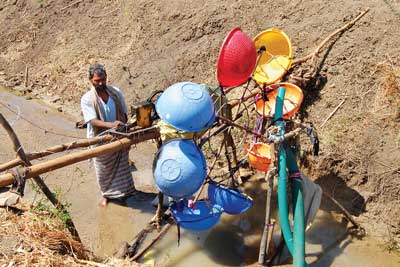
Siddappa, an illiterate farmer from Somapur village in Gadag district of Karnataka, has designed a water mill to generate electricity. Right from conceptualizing to materialisation, the farmer has done everything on his own. He operates the water mill in the canal near his house.

Using timbers, Siddappa prepared a giant wheel that joined at a central hub. There are eight arms, five feet each, extending from the central hub. A plastic bucket is dangled at the tip of each arm. When the water from two pipes gushes into one of the buckets, it generates the pressure that turns the 10-feet wheel in an anti-clockwise motion. The bucket could also be spun in the horizontal plane using a central steering wheel, similar to a teacup ride. As one after another bucket is driven by the flowing water, the first arm declines back to the ground while the other rises in the air. This process spins the black wheel attached to this giant wheel. The spinning black wheel rotates another wheel connected to a dynamo.

A converter converts the Direct Current from the dynamo into Alternating Current. Siddappa claims to have spent a mere Rs 5000 on building the entire apparatus. This is his second attempt to show the villagers that anybody can produce electricity for self-consumption using the resources at hand. “Many people who have canals flowing near their villages don’t know how to use that natural gift. I want to show them all practically that electricity problems can be solved by being creative. There is no need to beg to the government for everything,” he says.

He gets 150 watts of power from this water mill when water flows in the canal. Siddappa claims he can create electricity for the entire village through his machine. But the problem is that the canal in his village flows only for three months a year!

source: http://www.thebetterindia.com / The Better India / Home> Innovation / by N K Suprabha / April 08th, 2011

________________________________________________________________

This article originally appeared in The Sunday Indian (TSI) magazine and has been reproduced here as part of an arrangement between The Better India and TSI. The author, Suprabha Naik is a correspondent with the Kannada Bureau of TSI. Read previous article of this author here.

For the first time, a priest from coastal region is canonized

Mangaluru :

Most Rev Bernard Moras, Archbishop of Bengaluru diocese, said let the shrine of Blessed Joseph Vaz satiate the spiritual hunger of those who approach in need of strength.

The Archbishop on Friday unveiled the statue of St Joseph Vaz to mark the end of the three-day celebration of the canonization of the saint at the Miracle Hill shrine. The Archbishop also launched a free meal programme for devotees by pouring rice into a pot. The shrine will provide free meals once a week to devotees on Friday.

The celebrations were a bit dampened after chief minister Siddaramaiah and his cabinet colleagues missed the event due to state mourning announced in the wake of the death of former governor Rameshwar Thakur on Thursday.

This is the first time a priest from the coastal region has been elevated to sainthood.

The statue of Blessed Joseph Vaz was brought to the shrine in a procession from Panir to Mudipu in a decorated vehicle on January 9, in the run-up to the event. Pope Francis on January 14 raised Blessed Joseph Vaz, who performed miracles on the hill of Mudipu, to the altar of sainthood in Sri Lanka.

Earlier during the mass, Mangaluru Bishop Aloysius Paul D’Souza, Msgr Denis Moras Prabhu, PRO Fr William Menezes, and others took part. In his homily, Moras said Blessed Vaz brought more people near God with his work and dedication. Bishop Aloysius Paul D’Souza said apart from his missionary work, his service to society in helping the needy was exemplary.

Who’s the saint:

Joseph Vaz was born on April 21, 1651, in Benaulim, Goa. He was the third son of Christopher Vaz and Miranda. He became a priest in 1676 and served in different parishes of Goa till 1681. Later, he was sent to Canara. Fr Joseph Vaz travelled from Goa barefoot. He served in Honnavar, Basrur, Kundapur, Gangolli, Mulki, Mangaluru and Panir. He was miraculously saved from an attempt on his life in 1684 while serving as the parish priest of Panir Church.

source: http://www.timesofindia.indiatimes.com / The Times of India / Home> City> Mangaluru / TNN / January 17th, 2015