Category Archives: Amazing Feats

Artificial waterfall to bring magic to Jog round the year

Bengaluru :

The world famous Jog, the second highest plunge waterfall in the country, will soon enthrall visitors round the year.

All the four cascades of the 252 metre-high falls — the majestic Raja, the graceful Rani, the swift Rocket and boisterous Roarer — will be in full splendor through the year as the Jog Management Authority (JMA) plans to re-circulate its water during non-rainy seasons.

Two companies have come forward to take up the project following a global tender and work is expected to start before this rainy season. Once installed, it will be world’s tallest feature of its kind, JMA officials claim.

“The full view of Jog is available to tourists only for four months (July to October) during rainy season. With Jog lacking other features required for a popular tourist destination, the number of foreign and local tourists is considerably less in the year. This is why we approached experts for a solution,” a senior JMA official told TOI.

HR Viswanath, consultant for JMA and the brain behind the project, said the magic of artificial waterfall will be realized through re-circulation method. “Using a reversible pump, the water will be pumped up through a 1,200 mm diameter pipe from the storage pond constructed at the bottom of the falls. A 3-mtr high anicut (dam) constructed upstream the Sitakatte Bridge will receive the pumped water. Then 200 cusecs of water will be let out the four sluice gates of the anicut in off seasons,” he explained.

Asked about the electricity requirement and cost of pumping water upstream, Vishwanath said the water cascading down will generate electricity with the help of a mini power station installed at the bottom of the falls. The pump will get power from the station, and the system won’t need extra power supply unless it is emergency.

Viswanath, who is former principal of BMS College of Engineering, said the technology is of double advantage as the project will be able to generate excess electricity during rainy season from the same pump by letting the waste water down. There will be no pumping up of water from the bottom during rainy season.

“The electricity produced will be surplus after meeting the required quantity for pumping purposes which can be used by the Sharavathi power grid. The project manager can also make profits by selling the excess power,” he added.

Another JMA official said two companies — National Buildings Construction Corporation, New Delhi; and an Abu Dhabi-based company owned by BR Shetty, an NRI businessman and Padma awardee — have come forward to take up the project under the build-operate-transfer model. “Once the detailed project report is ready, we will finalize the company for project implementation. The estimated cost of the project is Rs 350 crore and we are expecting the ground work to begin before July this year,” he added.

How it works

A sump to hold 23,000 cubic ft water will be built at the bottom of 252 mtr (820 ft) fall.

Using a reversible pump, water will be lifted via 1200 mm diameter pipe to a 3 metre tall anicut (dam) constructed upstream. A power pump of 20 kilowatt per hour is necessary for the purpose.

200 cusecs water let out from the four sluice gates of the anicut to create the normal beautiful jog falls.

The water cascading down will also generate electricity with the help of a mini power station installed at the bottom of the falls. The power is sufficient to pump back the water and mechanism will keep the system round the clock. Water lost in evaporation is negligible say experts.

During rainy season, power generated is an advantage as there will be no need to pump the water upstream.

source: http://www.timesofindia.indiatimes.com / The Times of India / Home> City> Bengaluru / by Rohith B R, TNN / January 26th, 2015

‘Purathathvaratna Award’ for Prof.A.V. Narasimha Murthy

NarasimhaBF15jan2015

Mysuru :

Prof. A.V. Narasimha Murthy (AVN), former Head, Department of Ancient History and Archaeology, University of Mysore, will be conferred ‘Purathathvarathna Award’ by the Department of Archaeology, Karnataka Government, in recognition of his rich contributions to the development of Archaeology in Karnataka in general and Numismatics in particular.

Prof. AVN has been serving the cause of Archaeology for the past five decades. Even at the age of 80, he has been continuing the study and research of coinage.

The award will be presented to Prof. AVN and four others (two posthumous) at a function tomorrow (Jan. 10) at Dasara Exhibition grounds here at 12.45 pm by Chief Minister Siddharamaiah. The award carries a citation and a cash reward of Rs.1 lakh.

Presently, Prof. AVN is the Chairman of Bharatiya Vidya Bhavan, Mysore Kendra and writes a column in Star of Mysore.

source: http://www.starofmysore.com / Star of Mysore / Home> General News /  Friday , January 09th, 2015

One boiled egg can lift 200 Kg Royal Enfield Bullet !

Thousands of people thronged Sawday Road, Mandi Mohalla in city during the recent Eid Meelad celebrations to witness a Royal Enfield Bullet bike weighing 200 kg being hung from a boiled egg. The owner of the bike and the man behind this creativity is Inayath Ulla Shariff, a two-wheeler mechanic by profession. Curious people were seen clicking pictures of the bike in their cellphones. Inayath Ulla has been repairing and tuning two- wheelers such as Lambretta, Java, Royal Enfield Bullet, Yamaha RX 100, Yezdi, Road King, Vespa and Bajaj Chetak for the last 25 years. He started his career as a mechanic when he was just 15-years-old. Now he is 40. Inayath Ulla, who owns a two-wheeler garage by name ‘Track Point’ on Sawday Road in Mandi Mohalla, is the son of Late Mahmood Shariff, a Milkman and Late Chhoti Jaan. Star of Mysore caught up with Inayath Ulla Shariff for a tete-a-tete. Excerpts…

Inayath Ulla Shariff poses alongside his 200 kg Royal Enfield bike, hung from a boiled egg, at his garage 'Track Point' on Sawday Road in city. [Pic. by Golden Babu]
Inayath Ulla Shariff poses alongside his 200 kg Royal Enfield bike, hung from a boiled egg, at his garage ‘Track Point’ on Sawday Road in city. [Pic. by Golden Babu]
 by Arafat Ahmed Aizaz

SOM: How did you get an idea of hanging such a heavy bike from a single boiled egg?

Inayath Ulla: I have been a mechanic for the last 25 years. During the past Eid Meelad processions, I had seen people hanging bikes from a bottle-gourd, ridge-gourd, brinjal and other vegetables. So, I too thought of hanging a heavy bike (Royal Enfield bullet) from an egg as nobody had tried it.

SOM: How can a single boiled egg hold such a heavy bike? Have you done any gimmick?

Inayath Ulla: No gimmick at all. It is all about balancing. Myself, along with six others, lifted the bike and hung it from the egg with the help of ropes and two 7mm rods. It took an hour to hang and balance the bike. One should have the skill to balance through ropes and know how to do the centring properly.

Even if a single person does not balance properly or shakes the bike while hanging, then the bike will fall down.

SOM: You have inserted two 7mm rods into the egg to lift the bike with the help of ropes. How did you insert the rods? Didn’t the egg break while inserting the rods?

Inayath Ulla: First I boiled the egg. After boiling it, I did not remove its shell. I slowly made two small holes in the egg with the help of a drilling machine. Then gradually I increased the sizes of the two holes by inserting pencil into the holes and rotating the pencil clockwise. Later, I inserted the two rods. So the egg did not break.

SOM: Doesn’t the bike fall when the egg gets shaken by the wind?

Inayath Ulla: The bike does not fall due to wind. Even the egg does not break into two parts during the wind. But the bike will fall only if someone shakes or pushes the bike manually. You should ensure that nobody touches the bike when it is hanging.

SOM: You have been an expert in repairing bikes and earned a name for yourself. Do you want your children also to become famous mechanics like you?

Inayath Ulla: I have two children. One is studying in 8th standard and the other in 2nd PUC. I don’t want them to be mechanics. I want them to study well and become Officers. I am working very hard to provide them good education. I do not want them to suffer as I did.

[Inayath Ulla is married to Reshma Banu and resides in Hanumanthanagar in city. To meet Inayath Ulla, one can visit his shop on Sawday Road in Mandi Mohalla in city or call:97430-28265].

source: http://www.starofmysore.com / Star of Mysore / Home> Feature Articles /  Wednesday , January 07th, 2015

A precious bond


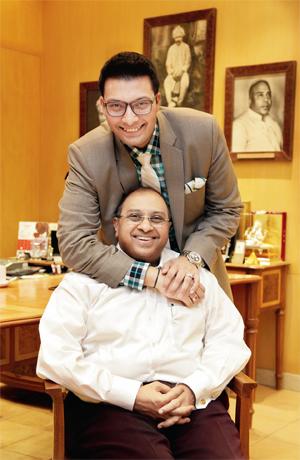
Vinod Hayagriv (54) & Chaitanya V Cotha (28)
Friends, critics and business partners — this father-son duo who run a 145-year old jewellery house get candid about their relationship in and out of office 
As a class four student when Chaitanya V Cotha was diagnosed with dyslexia, his father, C Vinod Hayagriv, the Managing Director of C Krishniah Chetty & Sons (CKC), felt like there was a wall in front of him. “What was the future going to be like, where would this lead to, what would he be, will he be himself, would it be a difficult life?” Hayagriv recalls asking himself. Referring to his elder son as a Taare Zameen Par kid, he adds, “Initially, we felt terrible as parents. It just wasn’t easy.”
But, today, when he looks back, Hayagriv is a proud father. Full of praise about how Cotha not only overcame his disability but also went on to manage the 1869 founded family-run business as its Executive Director, the 54-year-old also points out how Cotha has spearheaded three ventures of his own. When we meet the father-son duo at The Touchstone, off Cubbon Road on Friday morning, Hayagriv says, “He’s got a fighting determination. Most people would have given up midway.”
Which is the reason Hayagriv would be present at every parent-teacher meeting to make note of his son’s progress. “That’s something I didn’t do for my younger son,” he says, even as father and son unanimously agree that Shreyas is the “smartest” in the family. Talking about how Cotha has trained himself well in the last 10 years — from not being able to read long passages to pursuing a course in gemology and an MBA course, we are told that he is called back to school (Mallya Aditi International School) to talk to students facing similar issues.
When Hayagriv entered the family-run business in the ’80s, it was considered a natural progression for him to join his father CV Hayagriv (known as Hayagriv senior). But it was a different story when Cotha, who completed his Masters in Business Management from Regis University in 2009, was to enter the business in 2010.
Although the idea of joining the family business was always at the “back of his mind”, Cotha had begun applying for jobs back in the US.
He even got an offer from a leading jewellery brand in the world, which incidentally was also a family business. Wanting his father to aid in the decision-making process, Cotha asked his dad to come over and take a look at the place he might be working at. Never mind the speeding ticket that they got while driving down from San Diego to Arizona (which Cotha admits was his fault), Hayagriv laughs as he tells us that he was impressed with the line-up of Rolls-Royce and Porches in front of the store. “It’s a fine life that he gave up. If I were him, I might still take that option,” Hayagriv says. To which Cotha immediately reminds him that he was recently offered a position to head the store in California.
“It was completely his decision. We had a couple of brainstorming sessions with my sisters, one in Mysore, and the other in the US, to give their suggestions,” Hayagriv says. To which Cotha says, “But, right at the beginning my father had set things straight; I remember him saying, ‘The business is not built for you.’ That way he’s very open in how he thinks, he never forced us to come back.”
Starting from scratch
When Cotha finally took the decision of coming back to India, he didn’t join his father as one would have expected. Instead, he started a new business of his own —1869 Guild, a manufacturing and wholesale jewellery business. Having taken no financial assistance from his father, Cotha, who was working out of an office space on Avenue Road, found himself going to small jewellers in Karnataka, Tamil Nadu and Andhra Pradesh, Punjab to get dealers for his venture. And within a span of 18 months, he had tied up with 250 stores.
Going from jeweller to jeweller, “without being the shadow of his father” was tough, he admits. But, looking back, he is thankful for the experience of spreading the word about the set-up and learning the ropes of the business. “When you go out there, people don’t know who you are. I was out travelling to smaller places in the state, at least 20 days a month. I must admit, it was hard, but I enjoyed it. People looked at me as me — not part of CKC,” he says.
It was a similar story when Cotha’s younger brother, Shreyas was contemplating his plan of action after graduation. But, following his elder brother’s example, Shreyas too ditched the offer to work for the “second largest jewellery company” in the world to join the CKC in 2012.
Work and play 
When it comes to working with his sons, Hayagriv makes no bones when he admits that it’s “very tough”. A generation gap, different mindsets and conflicting viewpoints are some of the reasons for this. “When I was working with my father, it was different. I used to do as he said. But with my sons it’s different. They are opinionated, there are numerous debates, and all this requires a lot of tolerance. But, in a way, it is positive,” says Hayagriv, who consults his father even today when it comes to taking decisions. “But whatever happens, we never walk out of arguments,” Cotha adds.
For instance, at present, they are working on a wealth and asset management structure that would work for each of the four families (Hayagriv senior, junior, the two sons and their families). Hayagriv and his father are planning a safety net (in terms of old age, health) for each of the family members. “My father has done a lot of family settlements and partitions in his life. These are the areas that his experience comes in handy,” he says.
When it comes to their working styles too, they’re like chalk and cheese. Though Hayagriv thinks about work 24/7, with dinner table conversations revolving around the business, Cotha switches off once he’s out of office. “No screen time post work hours. I must credit that to my wife Yagnika,” says Cotha, who spends his free time with his toddler son.
When Hayagriv does unwind, he often heads outdoors — golfing or trekking. In fact, earlier this year, Hayagriv used a Trikke to commute to work. “Actually, Dad is a fun guy off work,” Cotha reveals. As a principle though, the family, we’re told, never goes on vacations together. It’s planned in such a way that one of them is there to ensure the business runs smoothly.
The women in their lives 
Behind these successful men, are their wives, who they credit for keeping them going through ups and downs. Hayagriv turns to his wife Triveni for financial advice, although he doesn’t heed it all the time. “Especially in stock market matters, there are times that she has told me that I should just sell them but I didn’t,” he says, regretting the I-told-you-so moments this gives rise to.
Although Cotha turns to his father for advice on business, he’s also influenced by his mother, who is involved in charity work. “She cares a lot for people in general. Those are some qualities I hope to inherit,” he adds. Looks like this is one family with ties as solid as gold.
source: http://www.bangaloremirror.com / BangaloreMirror.com / Home> Columns> Sunday Read / by Vidya Iyengar, Bangalore Mirror Bureau / December 21st, 2014

He will grow with a remote-controlled leg

Bengaluru  :

This 10-year-old cancer patient from Sri Lanka has his limb remote-controlled. To ensure that he doesn’t undergo surgical procedures often, doctors have increased the length of the magnetic metallic implant on his left leg through remote-control. The implant was placed after a cancerous tumour was removed from his knee.

Binura Lakvindu from Colombo, who was diagnosed with bone cancer, underwent surgery at BGS Global Hospital, Bengaluru, recently.

“For Binura, we have implanted the expandable prosthesis that has an in-built magnetic disc, gear box and a telescoping rod. The growth anticipated from that bone was calculated and the prosthesis was designed accordingly. He has to visit the hospital once in three months and place his leg in a magnetic coil, and the limb will be lengthened by 1 mm in 4 minutes. The required length will be achieved without additional surgeries. Binura will have limb growth up to 14 to 15 years,” said explains Dr Srinivas C H, consultant, orthopaedic onco-surgeon, who operated on Binura.

He developed pain in the knee in July, 2014. “We noticed him limping and avoiding cricket, his favourtite sport. We consulted a local physician who prescribed him medicines for pain. But the pain didn’t subside and a month later, we noticed swelling above his knee. An orthopaedic surgeon in Colombo suggested that this could be a tumour in his thigh bone and advised treatment in Bengaluru,” says Mallikarachchige L R, Binura’s father.

HOW DOES IT WORK

When the prosthesis is placed in the magnetic field, it leads to rotation of the magnetic disc at 16,000 rpm (revolutions per minute). The telescoping rod moves, resulting in expansion of the prosthesis. The tailor-made implant was imported from the UK to suit the unique specifications of Binura. This technique is tried only on paediatric cases with bone cancer.

source: http://www.timesofindia.indiatimes.com / The Times of India / Home> City> Bengaluru / by Sunitha Rao, TNN / December 19th, 2014

Bangladesh war : Victory Day Today

A War Record — All for a bottle of Scotch !

December 16 is celebrated as ‘Victory Day’ because on this day in 1971 a spectacular victory was achieved by India under the able political leadership of the then Prime Minister Indira Gandhi with brilliant military leadership provided by the Chief of Army Staff, Field Marshal SHFJ Manekshaw. This victory not only liberated erstwhile East Pakistan (present Bangladesh) but handed over the most humiliating defeat to Pakistan. Pak Army in the East surrendered unconditionally and India took 93,000 Prisoners of War who were released only after Shimla Agreement.

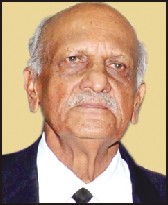
Maj. Gen. C. K. Karumbaya, SM (Retd.), now a resident of Mysuru, had the honour of taking part in this war, as part of 2 Corps, 4 Mountain Division, in the Western segment of Bangladesh which was defended by 9 Pak Division. Here is an account of the pursuit operation of 5 Maratha L I (Royals), under Maj. Karumbaya’s command which is considered as a post-Independence war record as the longest and fastest. Now read on. —Ed
MajGenBF21dec2014

by Maj. (later Maj. Gen.) C. K. Karumbaya, SM

It was a proud moment for our Bn, 5 Maratha L I (Fifth Royal) when our GOC Maj. Gen. M. S. Brar, PVSM, presented us a bottle of Scotch whisky, which he had promised during the height of the Bangladesh Liberation War. The occasion was the gala victory dinner for the officers of 4 Mtn. Div. (Red Eagle Division) at Jessore Cantonment. A proud moment indeed.

Mission with a Bait: I took over the command of Fifth Royal after our CO, Lt. Col. J. P. Torpy, VSM, was wounded in the battle of Elangi and evacuated on Dec. 6, 1971. On Dec. 8, we were ordered to move North to Jhenida and link up with 41 Mtn. Bde. I reached Jhenida at about 1100 hrs on Dec. 8 with B Coy commanded by Maj. P. K. Chatterjee, VrC, D Coy commanded by Maj. Shri Ram Singh and A Sqn 45 Cav (PT76) less two tps commanded by Maj. Batra. The rest of the Bn with a Coy of 7 Punjab (SCOTS APCs) who were placed under command were trailing behind as the APCs had problems traversing swampy areas.

Jhenida was still being mopped up by the troops of 41 Mtn Bde. On arrival, I was briefed by 41 Mtn. Bde. Commander, Brig. A. H. E. Michigan, MVC in the presence of GOC, Maj. Gen. M. S. Brar and my own 62 Mtn. Bde. Commander, Brig. Rajender Nath. I learnt that Pak 57 Bde. after its defeat at Jhenida was carrying out an orderly withdrawal towards Magura where HQ of Pak 9 Div. was located. Magura was a strategically located medium sized town. It was 30 km away from Jhenida and connected by a good concrete road. It was a communication centre with excellent roads connecting Khustia in the North, Kamarkhali-Faridpur in the East and Jessore and Khulna in the South.

My Bde. Commander then ordered me to lead the advance of the Bde. and instructed me to be cautious and take all precautions. Thereafter, the Div. Commander stressed the importance of the mission and said half in jest, “Karumbaya, 50 (I) Para Bde is also advancing towards Magura from Jessore and if your Bn succeeds in capturing it earlier than them, I shall present you with a bottle of Scotch!”

I was willing to take the above bait because the morale of Pak Army was in their boots due to a series of setbacks they had suffered earlier on. In contrast our own morale was sky high with our outstanding success, especially at Suadih. This psychological advantage had to be fully exploited.

Calculated Risk and Unorthodox Formation: I took a calculated risk. I used the tanks at my disposal aggressively and unconventionally. Instead of making the tanks move cross country on either side of the road axis (which could have slowed down our speed of advance and made the tanks vulnerable to any nuisance mines which enemy may have placed), I put them all in a road formation with about a 100 yd interval between each tank. I made my D Coy, R Gp and part of B Coy to ride piggy-back on the tanks and drive with full speed towards Magura. I ordered other coys to follow with whatever vehicles they could muster and the balance to march on foot to catch up.

The vanguard Coy Commander, Maj. Shri Ram Singh was in the second tank with Sqn 2IC, Capt. Metha. I followed in the fourth tank with the Sqn. Commander, Maj. Batra and FCO from the Medium Regt. I instructed Maj. Shri Ram Singh to keep watching the area in front and engage suspected delaying positions with prophylactic fire while on the move to scare the enemy. He was not to get bogged down dealing with small batches of enemy stragglers who would be taken care of by follow up troops. I kept a careful watch of the area in front with binoculars glued to my eyes so that we did not fall into a trap as cautioned by the Bde. Commander. As a commander, I realised that I should mix audacity with caution. The occasion certainly called for more audacity and willingness to take calculated risks.

Advance turns into pursuit: The advance (or pursuit) commenced at 1300 hrs and progress was very rapid as though we were in a road race! I was inspired by Field Marshal Rommel, who led his famous Afrika Korps in the deserts during the Second World War! Ironically, our Red Eagle Division had played a prominent part in his eventual defeat. On the way we saw some Pak stragglers running away from the main axis, but we pressed forward relentlessly and reached the outskirts of Magura at 1515 hrs. Infantry and tanks quickly got into assault formations for attack.

The enemy was taken completely by surprise. We were heavily shelled in which one of our artillery OP officer’s jeep was directly hit by a shell and all occupants were killed including the officer.

Capture of Magura: To our great relief, A and C Coys and SKOTS APCs (with their deadly machine guns) started trickling in. The enemy was in total disarray. They fled, leaving behind their 9 Pak Div. Operation Room complete with maps, Quarter Guard with their national and 29 Baluch Regimental flags, kotes full of weapons, ammunition dump (estimated to be about 300 truck loads) and ordnance stores, intact. They had started to make preparations to blow up their ammunition dump with a 6 hr delay fuse which would have been devastating had they had time to activate it.

Pursuit continues: We continued the pursuit beyond Magura towards Kamarkhali, leaving behind C Company and Pioneer Platoon to guard the captured stocks and the prisoners that we had taken in the process. At last light we observed enemy troops crossing a canal after demolishing a culvert on the road about 6 kms ahead of Magura. They were subjected to heavy machine gun fire from our newly arrived APCs and the enemy replied with 105 Howitzers. We firmed in there at night and waited for the tail to catch up.

Pursuit up to Kamarkhali next day: We the Fifth Royal continued to lead the Divisional advance next day, that is on Dec. 9, at first light. The PT 76 tanks and APCs had to be unfortunately left behind due to demolished culvert over sharp banks but the Bn in true Patton style continued the advance on foot at light infantry speed. We reached Kamarkhali Ferry area on the banks of Madhumati river which was about 24 km away by 1130 hrs and firmed in.

Pak defences at Madhumati and their concept of Operations: Pak troops had taken up hasty defences on the East bank of the Madhumati river. Their morale was naturally low due to pressures put on them by us. The Pak Army was mainly road bound whereas we were able to move cross country on man pack basis. Their strategy was to fall back from their forward defences by taking successive delaying positions to their strong points in the rear. The Pak plans that might have looked impressive on paper had gone awry on the first day itself. We had learnt with experience that the enemy was highly sensitive to any outflanking moves as they were afraid of their withdrawal routes being cut off by us.

The Madhumati river was about 300 ft wide and 30 ft deep; but we did not consider it as an insurmountable obstacle. The PT 76 tanks had the ability to swim, ferry troops and stores. In addition, my Bn. had gained expertise in crossing rivers with our own expedients. All ranks knew swimming. To top it, the locals were too willing to carry us across in their own country boats — after all, we were a liberating Army fighting for their freedom.

Disappointment: To our great disappointment, the tanks and APCs which we had left behind near the demolished culvert were withdrawn from us and allotted to 22 Rajput (7 Mtn. Bde.) who were operating in Khustia Sector and we were ordered to stop further advance and firm in at Majai near Kamarkhali. We were ordered not to attempt crossing the Madhumati river.

Thus, our long pursuit ended on the banks of Madhumati abruptly. I felt that instead of pulling out troops from us, if the higher ups had only reinforced us to exploit our success, the 2 Corps Operations would have been a lot speedier and even more spectacular.

Our achievements: I have turned the pages of post-Independence military history books in vain to find out if any other unit of the Indian Army had carried out as long and as rapid a pursuit operation during war as my Battalion. According to Col. Afridi, the Col. Staff of 9 Pak Div. who was taken as PW at Faridpur and remained in our custody, our lightning advance resulted in GOC 9 Pak Div. (Gen. Ansari), who had moved from Jessore to Magura on the first day of the war, losing all control over his brigades. His 107 Bde. (Brig Makhmad Hayat) was forced to withdraw southwards towards Khulna and his 57 Bde. (Brig Manzoor) was hemmed in at Khustia instead of falling back to Madhumati-Faridpur through Magura as visualised earlier.

Perhaps the circumstances were highly favourable to us or the offer of Scotch Bottle promised by the GOC was too tempting to resist; but the fact remains that we in the Fifth Royal are proud of the extremely fast pursuit operation we carried out not only to capture Magura, the HQ of 9 Pak Div; but after capturing it, pursue the enemy much beyond it up to the banks of Madhumati, till ordered to halt.

I am happy to note that the Scotch Bottle, its contents having been emptied on the day of the presentation itself, is now beautifully decorated, mounted and displayed in our Officers’ Mess along with the Pak flags which we captured at Magura.

source: http://www.starofmysore.com / Star of Mysore / Home> Feature Articles /  Tuesday , December 16th, 2014

Counting sheep, literally

A farmer tending to the ‘Nari-Suvarna’ breed of sheep at Veerapura in Tumakuru district of Karnataka.

Sheep farmers in Tumakuru have agri-scientists in Maharashtra to thank for a breed that has, quite literally, doubled their profits.

The new breed, developed by scientists at Nimbkar Agricultural Research Institute, Phaltan, called ‘Nari-Suvarna’ has turned out to be a boon for farmers. While the local breed of sheep gives birth to one lamb at a time, the new breed gives birth to two or three.

Cost of the sheep

The State government is trying to promote the Nari-Suvarna breed. It plans to offer subsidy to purchase the sheep, which costs Rs. 8,000 each, in the future. The local breed in Tumakuru —both Hassan and Bellary breeds — cost Rs. 6,000 per sheep.

With the guidance of the Karnataka Sheep and Wool Development Corporation (KSWDC), a farmer in Sira taluk in Tumakuru district has bought 10 sheep and they have given birth to 23 lambs. Farmers at Sidlaghatta in Chickballapur district and Chitradurga district are now eager to follow suit.

The new breed, according to the Agriculture Department, is a combination of three Indian breeds – Deccani and Madgyal breeds of Karnataka and Garole of West Bengal.

Doddaraju of Veerapura in Sira taluk, who bought the 10 sheep, told The Hindu that people in his village were making advance payments for Nari-Suvarna sheep. He said the sheep had adjusted to the climate and environment of his village and could be reared along with the local breed.

Mirza Basheer, Assistant Director, KSWDC, Tumakuru, said the new breed would help meet the demand for meat and would be beneficial to farmers. Nagaraja G.M., Assistant Director, Special Livestock Breeding Programme, Tumakuru, said the government would identify farmers in Belagavi, Vijayapura and Kolar districts and would introduce them to the new breed.

Scientists have developed a new breed of sheep, Nari-Suvarna, that gives birth to two or three lambs at a time

source: http://www.thehindu.com / The Hindu / Home> National> Andhra Pradesh / by S. Bhuvaneshwari / Tumakuru – December 14th, 2014

Karnataka citizens can now access over 4,000 services on their smartphones

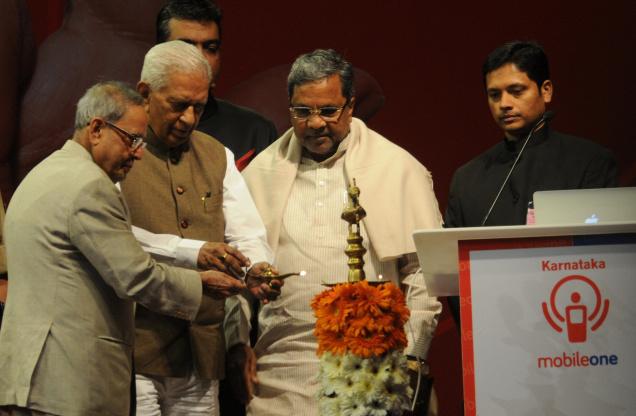
President Pranab Mukharjee, Chief Minister of Karnataka Siddaramaiah and Governor of Karnataka Vajbhai R. Vala at the launch of the Unified Mobile Governance Platform for citizens "Karnataka MobileOne" in Bengaluru on Monday. Photo: G.R.N. Somashekar.
President Pranab Mukharjee, Chief Minister of Karnataka Siddaramaiah and Governor of Karnataka Vajbhai R. Vala at the launch of the Unified Mobile Governance Platform for citizens “Karnataka MobileOne” in Bengaluru on Monday. Photo: G.R.N. Somashekar.

The country’s and the world’s largest multi-mode mobile governance platform – Mobile One – will offer 4,000 services. A unified mobile platform will enable services to citizens from both the government and private sector.

President Pranab Mukherjee will launch the initiative at BIEC in the presence of Chief Minister Siddaramaiah and Governor Vajubhai Vala.

These anytime, anywhere, anyhow services will be available round the clock throughout the year at any location in the state on any mobile device.

Through this initiative citizens can now pay utility bills, property tax, book bus and railway tickets, file income tax returns, m-passport, driving licenses and many other activities with their smartphones. Over 4000 services including G2C, B2C and G2B services can be availed through this mobile governance initiative.

Citizens can even take a simple picture of road potholes or street lights and send it automatically to the concerned officials for redressal.

This initiative named as “ICARE”, is one of a kind government-citizen engagement model.

The app is available for download on android and iOS platforms and all major mobile service providers such as Airtel, BSNL, Vodafone, Aircel, Idea, Reliance among others. Citizens can access services through this platform by dialling unique 3-digit number 161.

The Karnataka ‘Mobile One’ will integrate digital media and advertising going forward to enable it to be a self-sustaining model for some select services via advertising revenue, user fees and subscription models. Payments through a variety of modes including debit, credit cards, online wallet, PayGov are enabled.

source: http://www.thehindu.com / The Hindu / Home> News> Cities> Bengaluru / by Nagesh Prabhu / Bengaluru – December 08th, 2014

The trailblazers who made a case for women in law

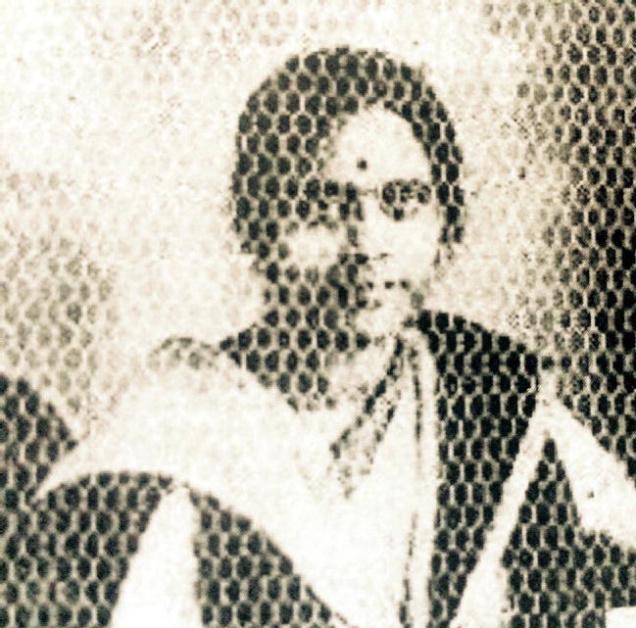
In 1928, B. Ananda Bai was the first woman law graduate in then Madras Presidency. Photo: The Hindu Archives

B. Ananda Bai was the lone female law graduate in then Madras Presidency, which included parts of Kerala, Karnataka and Andhra Pradesh.

Cornelia Sorabji, the first woman to practice law in India, was born on November 15, 148 years ago. She was only one among the many pioneers who worked long and hard to breach the glass ceiling for women in courtrooms across the country.

For the women of Madras, the foundations of this struggle were laid by B. Ananda Bai in August 1928. After graduating with a degree in law from Madras University, she became the lone female law graduate in then Madras Presidency, which included parts of Kerala, Karnataka and Andhra Pradesh.

Bai’s original career path, however, did not involve becoming a lawyer. According to the Palaniappa Brothers’ book Madras: the Land, the People and their Governance, it was only after being rejected in the government services that Bai considered entering the chambers of law. Finally, after a rigorous apprenticeship under V.V. Srinivasa Iyengar, she enrolled in the Madras High Court on April 22, 1929, to become the first woman advocate trained and specialised in the city of Madras.

Hailing from the South Kanara region (present day districts of Dakshina Kannada and Udupi), Bai’s father, Dr. Krishna Rao, was particular that all female family members receive a ‘liberal and academic education’.

While admitting that Bai represented a privileged minority, historian V. Geeta points out the 1920s and 30s were a time of churning for women. “With the social reform movement gaining ground, law became central to a lot of the debates regarding women, which were governing civil discourse. Both Hindu and Muslim women with The All India Women’s Conferences, for instance, were very vocal about their aspirations for empowerment through social legislation,” she says.

However, as Rukmani Lakshmipathi, president of the League of Youth, said at a meeting to honour Bai in 1929, “Education and medicine are becoming more and more popular with girls. That is not the case with law. We are glad that a beginning has been made in this direction, and an impetus has been given.”

K. Shantakumari, president, Tamil Nadu Federation of Women Lawyers, points out that storming the male bastion of law was far from easy. She says, “In those days, people were apprehensive and would not give cases to women. Societal taboos also forbid women from taking criminal cases. Because of this, many had to work under male lawyers and did not receive fair remuneration.”

By setting a precedent, in spite of these daunting obstacles, the likes of Bai and Sorabji made a career in law a distinct possibility for women. Today, as we celebrate the latter’s birthday, it only seems fitting to raise a toast to these pioneers for the new ground they broke.

source: http://www.thehindu.com / The Hindu / Home> News> Cities> Society / by Nitya Menon / Chennai – November 15th, 2014

Mandya girl aims to conquer all major peaks

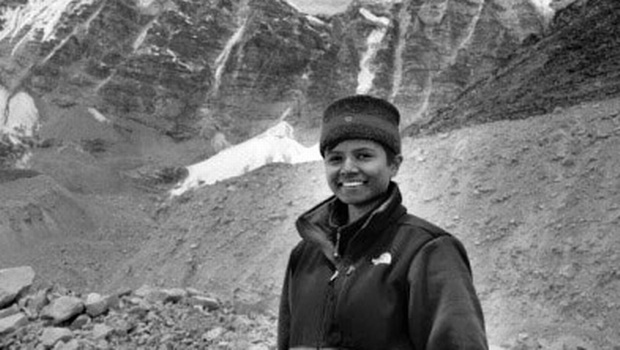
Smitha Lakshmana
Smitha Lakshmana

Gender discrimination can’t suppress the spirit of achievement. The best example is Smitha Lakshmana, the first woman from Karnataka to climb Mount Everest, situated at a height of 29,035 feet (8,848 metres) above sea level. She now aspires to climb all the major peaks in the world.

Climbing Mount Everest in freezing conditions is extremely dangerous and is a dream for many. Twenty-year-old Smitha took up mountaineering a year ago, when the Indian Army Women’s Everest Expedition-2012 invited applications. She was one among 22 people selected to take part in the adventure and successfully reached the summit.

After selection, she underwent special fitness training in Siachen. She now plans to climb 13 peaks of the world which are about 8,000 metres high. “From childhood, I dreamt of doing something adventurous. When I was selected, my joy knew no bounds. Though I fell sick because of bad weather conditions while climbing Mount Everest, I overcame the difficulties,” says Smitha.

“Among a group of 22, 17 of us climbed Everest. We started trekking on May 15 from Kathmandu and reached the top on May 25. It was delayed for seven days due to bad weather. The 20 minutes spent atop Everest is a dream come true. The scenic beauty was marvelous,” she said. Hailing from a middle class family, Smitha is from Bangalore and is a Captain in the Indian Army. Her parents are from Devalapura hobli, Nagamangala Taluk, Mandya district and her younger brother Sagar is an agriculturist.

source: http://www.newindianexpress.com / The New Indian Express / Home> States> Karnataka / by K. Rathna, Mysore / October 29th, 2012